Top 10 AI PoC Development Companies in 2026
Key Takeaways
- The best AI PoC development companies help organizations test the main uncertainty behind an AI idea, whether it involves enterprise AI, generative AI, predictive models, computer vision, or workflow automation.
- A PoC should test an idea under realistic conditions. This becomes especially important when the project forms part of a broader digital transformation that depends on legacy applications, business systems, and multiple data sources.
- Representative data has a direct effect on validation quality. A model that performs well on carefully selected examples may respond differently when it receives incomplete, noisy, outdated, or ambiguous information.
- Technical performance alone does not make a PoC successful. Teams should define business goals, measurable outcomes, and acceptance criteria before development begins.
- Security, privacy, governance, and human oversight requirements differ across industries. A healthcare PoC, for example, may require different controls from an internal retail forecasting experiment.
- A useful PoC ends with a practical decision. The evidence should help stakeholders decide whether to move forward, change the approach, run another experiment, or stop further investment.
- Reliable providers use structured AI model testing to measure model quality, latency, cost, edge-case behavior, and failure patterns instead of relying on a successful demo alone.
AI ideas often look promising on paper, but businesses still need evidence that they can work with real data, existing systems, user workflows, and operational limits. An experienced AI PoC development services partner helps test these assumptions in a controlled environment before an organization commits budget and resources to a larger AI implementation.
A well-planned AI PoC development process tests technical feasibility, data readiness, model performance, business value, and integration needs against clear success criteria. This article compares leading providers and highlights what organizations should evaluate when choosing a partner for practical AI PoC use cases for enterprises.
De-Risk Your AI Idea Before Full Development
Prismetric helps validate technical feasibility, data readiness, model performance, integrations, and business value before you commit to a larger AI investment.
Start Your AI PoC
Our Criteria for Ranking the Top AI PoC Development Companies
We assessed each provider using factors that matter during proof-of-concept development. Company size and brand recognition can be useful signals, but they do not show whether a team can test an AI idea in a clear, measurable, and technically sound way.
Data readiness and engineering. AI systems depend on usable data. We considered whether each provider can assess data quality, accessibility, labeling needs, and pipeline requirements, including the ability to prepare the data foundation required for AI validation.
Relevant PoC experience. A strong provider can turn a broad business idea into a focused hypothesis that can be tested. Organizations may also work with AI specialists during early feasibility planning to define what needs to be proven before further investment makes sense.
Evaluation rigor. A credible PoC needs more than a working prototype. We looked for clear baselines, representative test data, edge cases, measurable technical metrics, and predefined acceptance thresholds. An AI automation ROI framework can also help connect technical findings with potential business value.
Business-case alignment. A model can perform well and still fail to solve the intended business problem. An AI workflow discovery checklist helps teams identify the process, users, systems, and outcomes that the PoC should validate.
AI strategy and architecture. PoC results should support wider technology decisions. We considered whether providers can connect validation findings with applications, data platforms, governance requirements, and a successful AI strategy.
Model selection and explainability. The right model depends on the task, required accuracy, response time, risk level, and need for human review. Some decision-support systems may also require explainable AI so teams can better understand why a model produces a particular result.
Production and technology fit. A PoC should stay focused, but it should not ignore what happens after validation. Organizations may need to compare custom AI vs off-the-shelf AI, plan for integrating LLMs with enterprise databases, or assess private and public LLM deployment before choosing a production path.
The Ultimate List of the Top AI PoC Development Companies
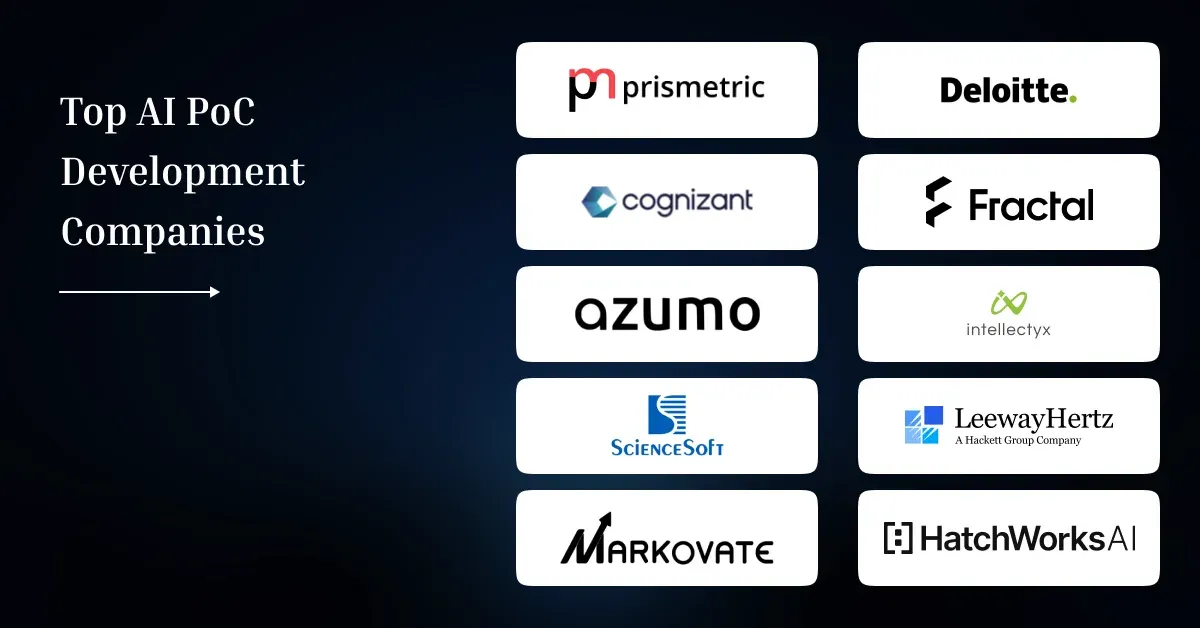
The table below provides a quick view of the 10 companies covered in this guide. It compares their typical PoC focus, core AI capabilities, enterprise suitability, and ability to support the next stage after validation.
| Company |
Best For |
PoC Specialization |
Core AI Capabilities |
Enterprise Fit |
PoC-to-Production Support |
| Prismetric |
Custom AI validation with an MVP path |
Feasibility, workflow, data, integration |
GenAI, RAG, agents, ML, NLP, vision |
Startups to enterprises |
Strong |
| Deloitte |
Governance-heavy PoCs |
Risk, compliance, enterprise validation |
GenAI, analytics, ML |
Large regulated enterprises |
Strong |
| Cognizant |
Legacy modernization |
Experimentation and integration |
GenAI, ML, automation |
Large enterprises |
Strong |
| Fractal |
Data-heavy PoCs |
Analytics and model validation |
ML, analytics, GenAI |
Data-intensive enterprises |
Strong |
| Azumo |
LLM and automation PoCs |
Rapid AI experimentation |
LLMs, GenAI, automation |
Mid-market and enterprise |
Moderate to strong |
| Intellectyx |
Workflow and agentic AI |
Agents and data readiness |
GenAI, agents, data engineering |
Enterprises |
Strong |
| ScienceSoft |
Feasibility-first AI/ML |
Technical validation |
ML, vision, NLP |
Mid-market and enterprise |
Strong |
| LeewayHertz |
GenAI and AI agents |
LLM and agent validation |
GenAI, RAG, agents |
Enterprises |
Strong |
| Markovate |
Narrow workflow validation |
Automation and agents |
GenAI, agents, automation |
Startups and growth teams |
Moderate |
| HatchWorks AI |
AI product PoCs |
Product validation |
GenAI, ML, data engineering |
Product-led organizations |
Strong |
1. Prismetric
Prismetric helps businesses test AI ideas before investing in full product development. Its PoC approach focuses on whether an idea can work with the available data, business workflow, technical environment, and expected outcome. Projects can cover generative AI, RAG, AI agents, predictive models, NLP, computer vision, and workflow automation.
A working model alone does not prove that an AI use case is ready to move forward. The PoC also needs to show how the system behaves when connected to actual applications and business data. Prismetric provides AI integration services for connecting models with APIs, databases, CRMs, ERPs, and other enterprise software.
For businesses that depend on older applications, the validation stage can also uncover integration limits before they become expensive development problems. Reviewing an AI integration architecture for legacy systems can help teams understand what needs to change before an approved PoC moves toward MVP or production.
Expertise:
- Generative AI and LLM PoCs
- RAG-based applications
- AI agents and workflow automation
- Predictive machine learning
- NLP and computer vision
Advantages:
- Covers business, model, data, and integration feasibility
- Provides a development path from PoC to MVP and larger AI applications
Industries served: Healthcare, fintech, retail, logistics, real estate, travel, and other digital business sectors.
Test the Riskiest Assumption Behind Your AI Use Case
Run a focused PoC with real data, clear success criteria, edge-case testing, and measurable outcomes to determine whether the idea is worth scaling.
Validate Your AI Idea
2. Deloitte
Deloitte is a suitable choice for large organizations where AI validation involves governance, compliance, security, and business risk as much as model performance. Its broader AI work covers strategy, experimentation, model selection, operating models, governance, application modernization, and implementation. This makes the company particularly relevant when a PoC must fit established enterprise controls instead of operating as an isolated technical experiment.
For example, a financial or healthcare organization may need to validate access controls, human approval points, data handling, and audit requirements alongside accuracy. Companies facing these conditions may need to develop AI within enterprise governance requirements while considering how US AI regulation and compliance requirements affect future deployment.
Expertise:
- Generative AI strategy and experimentation
- AI governance and risk management
- Enterprise AI architecture
- Model selection and deployment planning
Advantages:
- Strong fit for regulated and governance-heavy environments
- Connects technical testing with business and risk requirements
- Supports larger enterprise AI programs after validation
Industries served: Financial services, healthcare, government, consumer businesses, manufacturing, technology, and other large enterprise sectors.
3. Cognizant
Cognizant fits organizations that need to test AI inside existing business systems. This can be useful when the main question is not simply whether a model works, but whether it can work with legacy applications, enterprise data, security controls, and established workflows.
Its AI capabilities cover generative AI, agentic AI, machine learning, governance, data modernization, and enterprise automation. This breadth allows a PoC to test both model behavior and the practical requirements of introducing AI into a larger technology environment.
If the experiment succeeds, businesses can plan for enterprise AI implementation rather than treating the PoC as a disconnected prototype. Teams can also consider how testing, monitoring, governance, and maintenance fit into the wider software development lifecycle, which helps identify production requirements earlier.
Expertise:
- Generative AI
- Agentic AI
- Machine learning
- Data modernization
- Enterprise automation
- AI governance
Advantages:
- Strong experience with complex enterprise environments
- Combines AI validation with modernization and integration planning
- Supports scaling after successful experimentation
Industries served: Banking, healthcare, insurance, manufacturing, retail, communications, and other enterprise sectors.
4. Fractal
Fractal is a strong option for AI PoCs where data quality, analytics, and model behavior are central to the business question. Its AI portfolio includes machine learning, advanced analytics, generative AI, enterprise knowledge systems, and agentic AI. These capabilities are relevant for projects such as forecasting, decision support, recommendation systems, customer analytics, and knowledge retrieval, where the value of the PoC depends heavily on the underlying data. Organizations can use this type of engagement to develop and validate machine learning models before committing to larger implementation work.
Its data-oriented background also makes it relevant when the PoC supports business intelligence workflows, where AI needs to analyze enterprise information and produce outputs that teams can use in operational or strategic decisions.
Expertise:
- Machine learning and advanced analytics
- Generative AI and LLM applications
- Agentic AI systems
Advantages:
- Strong focus on enterprise data
- Suitable for analytics-heavy validation
- Supports structured and unstructured information
- Useful for model evaluation and decision-support use cases
Industries served: Consumer businesses, financial services, healthcare, insurance, technology, and other data-intensive enterprise environments.
5. Azumo
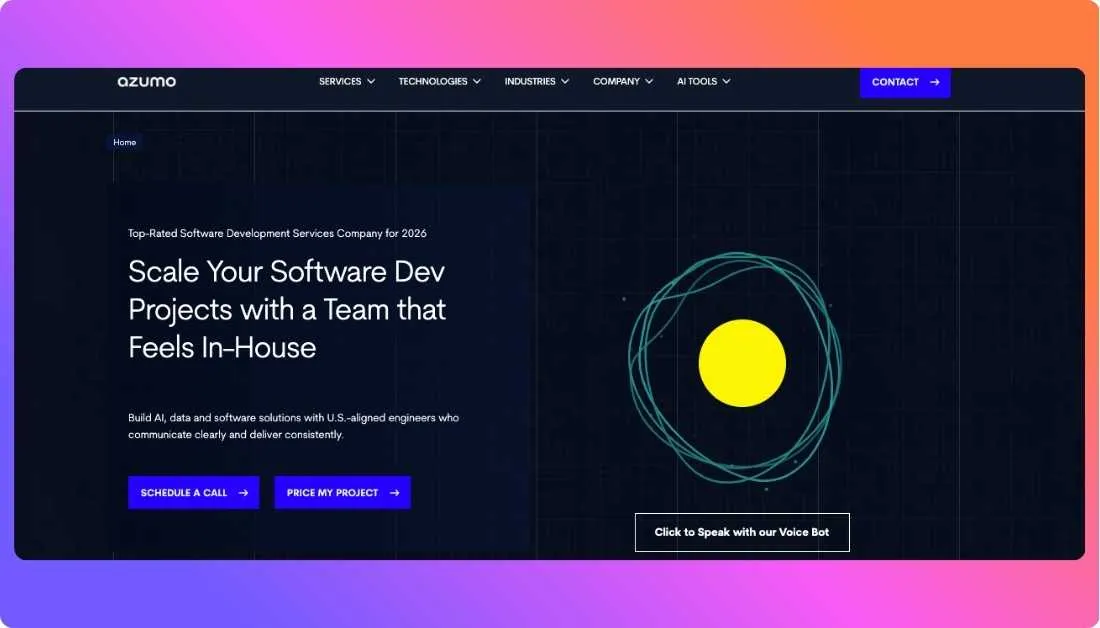
Azumo is a good fit for companies that want to test generative AI, LLM, or automation ideas without starting with a large enterprise program. Its AI work covers model selection, prompt engineering, RAG, fine-tuning, evaluation, agents, and integration with existing business systems. Azumo also offers PoC and MVP engagements specifically for testing models, integrations, and expected value before full development.
For LLM-based projects, teams can use custom generative AI applications to test tasks such as document processing, internal knowledge search, conversational interfaces, and content automation. The PoC can compare models against the same data and acceptance criteria instead of choosing a platform based only on general benchmark results.
Architecture is another part of validation. Depending on the use case, teams may need to compare fine-tuning vs prompt engineering vs RAG to find the simplest approach that meets accuracy, cost, latency, and data requirements. Azumo supports these approaches along with deployment on major cloud AI platforms.
Expertise:
- Generative AI and LLM applications
- RAG and knowledge-grounded systems
- Model evaluation and fine-tuning
- AI agents and workflow automation
Advantages:
- Offers focused PoC and MVP development
- Supports model comparison before architecture decisions
- Covers integration and production deployment after validation
Industries served: Fintech, healthcare, media, gaming, technology, and other businesses building custom AI applications.
6. Intellectyx
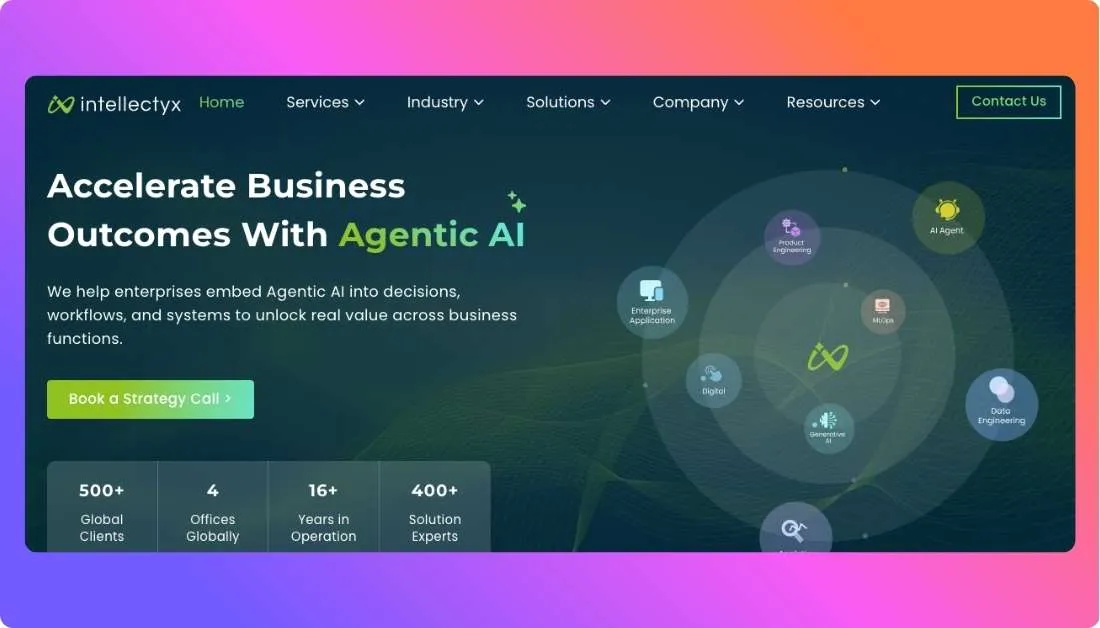
Intellectyx focuses on enterprise AI PoCs where organizations need to validate workflows, data readiness, agent behavior, and expected business impact. Its PoC offering emphasizes production scalability, measurable operational outcomes, agentic AI validation, security, governance, and a defined transition from proof of concept to deployment. This makes it relevant for businesses testing AI within established enterprise processes rather than building a standalone demonstration.
Agent-based projects may involve planning, tool use, enterprise data, multiple systems, and human approval points. Organizations can build task-oriented AI agents around these requirements and then evaluate AI agent performance before giving the system greater responsibility. Intellectyx’s development process covers data readiness, architecture, integration, testing, explainability, deployment, and ongoing AgentOps monitoring.
Expertise:
- Agentic AI strategy
- Custom AI agents
- Multi-agent orchestration
- Generative AI applications
- Enterprise data and workflow integration
Advantages:
- Strong focus on enterprise workflow validation
- Connects PoC testing with governance and production planning
Industries served: SaaS, fintech, healthcare, retail, manufacturing, and other enterprise environments.
7. ScienceSoft
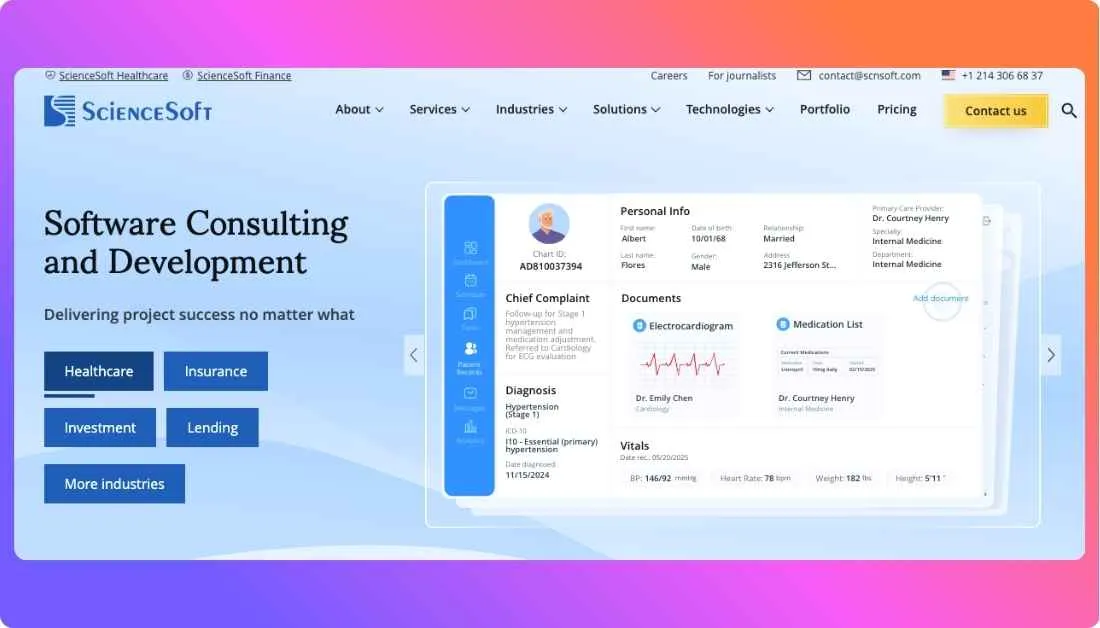
ScienceSoft suits organizations that want to validate AI feasibility before making a larger investment. Its AI consulting practice includes PoC delivery for both generative AI and traditional machine learning. For GenAI projects, the company tests areas such as output quality, grounding, guardrails, and the safe use of business data. For custom ML, it evaluates data suitability, model performance, and technical feasibility.
This approach is useful when success depends on measurable model behavior. A computer vision PoC, for example, may need to test image quality, detection accuracy, processing speed, and difficult visual conditions before a business can decide whether to develop a vision-based AI application.
ScienceSoft also works with generative AI, machine learning, deep learning, NLP, RAG, agents, and predictive systems. When an experiment involves sensitive information or specific infrastructure requirements, teams may need to compare cloud and on-premise LLM deployment as part of the architecture decision rather than waiting until production planning.
Expertise:
- Generative AI and RAG
- Predictive machine learning
- Computer vision
- NLP and AI agents
Advantages:
- Provides dedicated PoC delivery
- Tests against defined success criteria
- Covers data suitability and model feasibility
- Supports the path from PoC to MVP and full AI software
Industries served: Healthcare, insurance, investment, financial services, manufacturing, retail, e-commerce, professional services, and other sectors with data-intensive workflows.
8. LeewayHertz
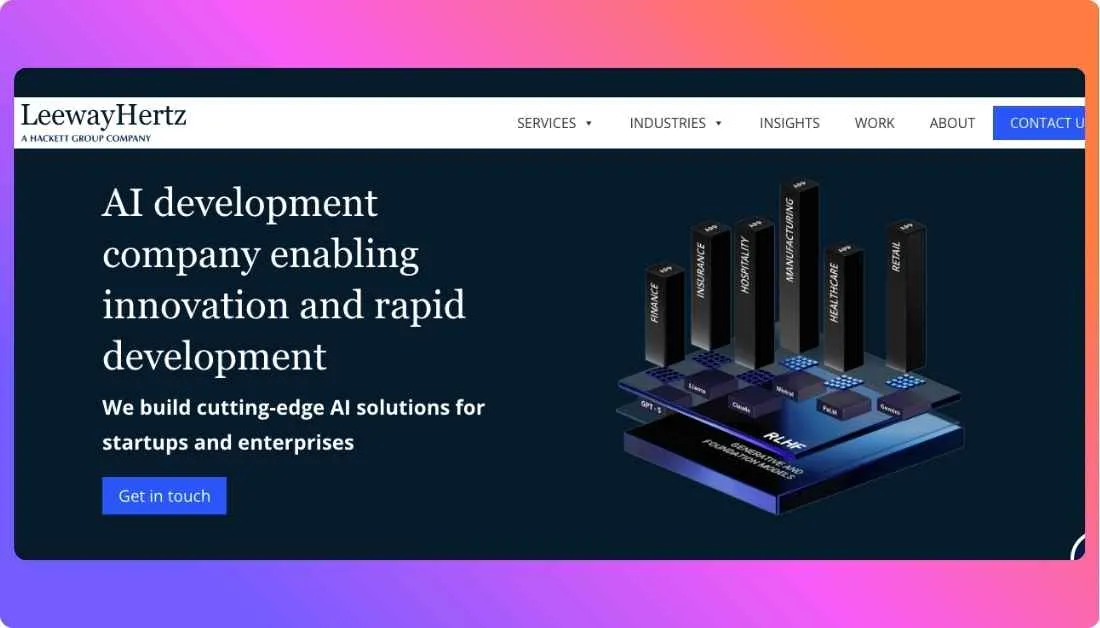
LeewayHertz works across generative AI, AI agents, multi-agent systems, enterprise knowledge applications, and workflow automation. Its generative AI services include consulting, technical design, custom development, enterprise integration, testing, deployment, governance, and ongoing monitoring. This breadth can support PoCs where a business needs to test not only an LLM’s response quality but also how the system retrieves information, uses tools, interacts with business software, and handles approvals.
For knowledge-intensive projects, organizations may first ground AI outputs in approved enterprise knowledge so responses rely on relevant internal information. More complex agent architectures may require teams to compare MCP and RAG architectures when deciding how models should access knowledge, tools, and external systems. LeewayHertz also supports multi-agent orchestration, human approvals, exception handling, and observability for workflows that require more than a single conversational model.
Expertise:
- Generative AI solutions
- RAG and enterprise knowledge systems
- AI agents
- Multi-agent orchestration
- Machine learning
- Enterprise AI integration
Advantages:
- Covers both generative and agentic AI use cases
- Supports integration with databases and enterprise applications
- Provides development support beyond the initial validation stage
Industries served: Banking and finance, healthcare, retail, manufacturing, supply chain and logistics, insurance, automotive, and technology.
9. Markovate
Markovate fits companies that want to validate AI around a focused operational workflow. Its AI services cover generative AI, machine learning, conversational AI, computer vision, workflow automation, and agentic systems that can reason, plan, use tools, and carry out multi-step tasks.
For a PoC, the main value is testing whether automation works within the actual process rather than judging an AI model in isolation. Businesses can validate AI-driven workflow automation against task completion, accuracy, human intervention, and integration requirements.
Markovate also works with agent-based systems for activities such as task automation, data analysis, order management, and operational workflows. These projects can start with narrow agentic AI use cases before teams give agents access to more systems or higher-impact actions.
Expertise:
- Agentic AI and multi-step workflows
- Generative AI
- Machine learning
- AI automation
Advantages:
- Suitable for focused workflow experiments
- Covers AI from discovery through deployment
- Supports integrations with existing processes
10. HatchWorks AI
HatchWorks AI is a good fit for organizations that want a PoC to become the foundation of an AI-enabled product. Its services cover AI strategy, AI-native products, agentic automation, data modernization, model optimization, and machine learning. The company also uses its Generative-Driven Development approach to connect AI-assisted engineering with production software development.
This product focus can help when a validated experiment needs to progress into AI MVP development services. Instead of treating the PoC as the final deliverable, teams can use its evidence to decide which features, data flows, integrations, and controls belong in the next version. Understanding how to build an AI MVP also helps separate experimental functionality from what real users need.
Expertise:
- AI-native product development
- Agentic automation
- Data modernization
Advantages:
- Connects AI validation with product engineering
- Supports data and AI development in the same engagement
How to Choose the Right AI PoC Development Company
Choosing an AI PoC development company starts with the uncertainty the business needs to resolve. A provider with a long service list is not automatically the right fit if its process does not produce evidence that supports a clear investment decision.
Define the Business Hypothesis
Start with one business problem and the assumption that needs testing. For example, a support PoC might ask whether an LLM can answer policy questions accurately enough to reduce manual handling. Clarifying AI PoC vs AI MVP also prevents teams from adding product features before feasibility is proven.
Examine Relevant PoC Experience
Case studies are more useful when they show a similar technical or business problem, not simply a well-known client name. Teams should look for evidence that the provider has worked with comparable data, integrations, users, or model risks.
If the next stage involves real users, it also helps to understand when a validated idea is ready to move from PoC toward an MVP.
Review the Evaluation Plan Before Development
A provider should explain how success and failure will be measured before building begins. The plan can include baseline performance, representative test cases, model quality, latency, cost, edge cases, and human review.
For LLM projects, businesses may assess generative AI feasibility before implementation so model choice follows the use case rather than the other way around.
Assess Data, Integration, and Security Requirements
AI depends on the systems around it. Teams should identify required datasets, APIs, access controls, sensitive information, and human approval points early.
These decisions become especially important when the PoC may later become an AI application for business, where reliability and integration matter beyond the demonstration.
Confirm Technical and Industry Fit
The provider should understand the AI method as well as the workflow being tested. A healthcare document assistant, manufacturing vision system, and retail forecasting model create different data, risk, and evaluation requirements.
The PoC should also fit the organization’s broader approach to AI in digital product development.
Evaluate the PoC-to-Production Path
A successful experiment still requires engineering before production. Organizations should ask what changes are needed for security, monitoring, scalability, infrastructure, governance, and ongoing model evaluation.
Comparing top AI implementation companies can help teams understand the next-stage requirements, while a partner able to build the production AI solution may reduce handoff problems after validation.
Compare Ownership, Cost, and Next-Stage Support
Before signing, companies should clarify ownership of source code, prompts, evaluation datasets, documentation, infrastructure, and other project assets. Commercial terms should also explain what happens when the PoC succeeds or fails.
Teams expecting to continue development can compare AI MVP development companies and assess whether the proposed solution can produce measurable efficiency gains before committing to a larger build.
Turn a Successful AI PoC Into a Clear Production Roadmap
Prismetric can help move validated concepts toward an MVP or production system with the right architecture, security, integrations, monitoring, and scalability.
Plan Your Next AI Stage
Benefits of Working with Leading AI PoC Development Companies
A capable PoC partner helps organizations test whether an AI idea is technically workable, useful to the business, and realistic to scale. This reduces uncertainty before larger development budgets, infrastructure changes, or process redesigns are approved.
Validate Feasibility Before Full Development
A PoC helps teams test the riskiest assumption first. For example, a business exploring AI in the workplace can validate whether a model can handle real employee questions, documents, and workflows before building a complete application.
This approach can expose weak data, poor model fit, or unrealistic expectations while changes are still relatively easy to make.
Reduce Technical and Financial Uncertainty
Early testing shows how model choice, data quality, API usage, latency, and infrastructure affect the solution. For LLM projects, teams can also explore ways to reduce LLM inference costs before usage grows.
The result is a clearer view of both technical feasibility and likely operating costs.
Make Better Architecture and Scope Decisions
A PoC gives teams evidence for deciding what the production system actually needs. This is especially useful for agent-based applications, where AI agent development cost by complexity can change based on tool access, integrations, memory, approval steps, and multi-agent coordination.
Create a Clearer Route Toward Automation at Scale
A validated workflow gives teams a starting point for wider automation. Organizations can compare AI workflow automation tools and decide which parts of the process should remain rule-based, use AI, or require human review.
Frequently Asked Questions
An AI PoC development company helps businesses test whether an AI idea is technically feasible and commercially useful before investing in full development. The work usually covers data readiness, model selection, prototyping, testing, integrations, and recommendations for the next stage.
There is no single best provider for every project. The right company depends on what the PoC needs to prove and the environment in which the AI system will operate.
For example, businesses may prioritize:
- Prismetric for custom AI PoCs with a path toward MVP development.
- Deloitte for governance-heavy enterprise programs.
- Cognizant for AI connected with legacy modernization.
- Fractal for analytics and data-intensive use cases.
- Azumo for focused LLM and automation experiments.
Start with the business assumption that needs validation rather than comparing companies only by team size or technology lists.
A suitable partner should be able to explain how it will test:
- Data readiness and quality
- Model performance
- Business success criteria
- Integration feasibility
- Security and governance
- Production requirements
The evaluation plan should be clear before major development begins.
Large enterprises often need a provider that can work with existing applications, complex data environments, security controls, governance policies, and regulatory requirements.
Deloitte and Cognizant are relevant for large enterprise environments, while Fractal can fit data-intensive projects. Prismetric and other custom development firms may suit organizations that need a more focused PoC with a defined path toward application development.
Startups usually benefit from a partner that can keep the experiment narrow and avoid building unnecessary production features too early.
The first goal should be to validate the riskiest assumption. If the results are positive, the startup can then decide whether to develop an MVP, change the approach, or continue testing.
Factors worth comparing include:
- PoC scope and timeline
- Access to the development team
- Experience with the required AI approach
- Ability to continue into MVP development
- Ownership of code and project assets
There is no fixed AI PoC price because cost depends on data preparation, model type, integrations, testing requirements, infrastructure, security, and project complexity.
Generative AI projects can also vary based on RAG, fine-tuning, model usage, and evaluation requirements. These factors also influence broader generative AI development cost.
A focused PoC should test the main uncertainty without adding features that belong in an MVP or production system.
The timeline depends on the number of assumptions being tested, data readiness, integrations, model complexity, and evaluation requirements.
A narrowly defined experiment can move faster than a PoC involving several enterprise systems, sensitive data, multiple models, or complex approval workflows.
A useful PoC should provide more than a demo.
Typical deliverables can include:
- A working prototype
- Test datasets and evaluation results
- Defined success criteria
- Model-performance findings
- Known limitations and failure cases
- Architecture recommendations
- Integration findings
- A go, revise, or stop recommendation
These outputs help decision-makers understand not only whether the AI works, but whether further investment makes sense.
An AI PoC provider focuses first on reducing uncertainty. Its job is to test whether the proposed use case is feasible before a company commits to full development.
A broader AI development company may also design, build, integrate, deploy, monitor, and maintain production systems.
Some providers support both stages, which can reduce handoff work when a successful PoC moves into MVP or production development.
Not usually. A successful PoC shows that the main idea is feasible, but production software has stricter requirements.
Teams may still need stronger security, monitoring, scalability, error handling, integrations, documentation, governance, and human-review processes.
The PoC should therefore show both what worked and what must change before production.
An AI PoC makes sense when there is significant uncertainty about data, model performance, technical feasibility, or integration. It answers, “Can this idea work?”
An MVP makes more sense once the main technical assumptions have been validated and the next question is, “Will real users get enough value from this product?”
Companies should ask questions that reveal how the provider thinks about validation, not just development.
Useful questions include:
- What assumption will the PoC test?
- How will success and failure be measured?
- What data is required?
- Which difficult or edge cases will be tested?
- How will security and privacy be handled?
- Who owns the source code, prompts, and evaluation assets?
- What additional work will be required if the PoC succeeds?
A provider that can answer these questions clearly is more likely to produce evidence that supports a real business decision rather than only an impressive prototype.