How to Build a Successful AI Strategy: From Business Goals to Scalable AI
Key Takeaways
- A successful AI strategy starts with measurable business problems and outcomes, not AI tools, models, or technology trends.
- Organizations should assess data, technology, people, and governance readiness before moving AI initiatives into development.
- AI use cases should be prioritized based on business value, feasibility, data readiness, adoption potential, and risk rather than pursued as disconnected experiments.
- Enterprise AI requires governance, security, human oversight, and a structured roadmap from discovery and PoC through production and scale.
- AI success should be measured beyond model accuracy by tracking adoption, operational improvement, system performance, cost, and measurable business ROI.
AI investments create value when they solve a clearly defined business problem, fit existing workflows, use reliable data, and produce outcomes the organization can measure. Without that discipline, companies can end up with disconnected pilots, overlapping tools, and proofs of concept that never reach production.
A successful AI strategy provides a structured way to decide where artificial intelligence should be used, which initiatives deserve investment, what capabilities need to be built, and how results will be measured. This becomes particularly important as organizations explore enterprise AI across different industries and move beyond isolated experiments toward systems that affect daily operations.
The goal is not to use AI everywhere. It is to identify the business processes where AI can realistically improve productivity, reduce operational effort, support better decisions, or create new capabilities. Organizations exploring how AI can help reduce business costs still need to determine whether those opportunities are technically feasible and economically worthwhile.
What Is an AI Strategy?
An AI strategy is a business-led framework that connects organizational objectives with suitable AI use cases, data, technology, governance, people, implementation priorities, and measurable outcomes. It defines not only what an organization wants to build, but also why the initiative matters and how the business will determine whether it deserves to scale.
It is different from purchasing an AI platform or launching a chatbot. A complete AI strategy framework creates a path from business need to production:
Business objectives → AI readiness → use-case prioritization → technology → governance → implementation → adoption → measurement
This distinction matters because implementing AI often affects existing applications, employees, data access, security controls, and operating processes. Companies that need structured support at this stage may use AI consulting services to assess opportunities before committing resources to development.
Build an AI Strategy Around Real Business Outcomes
Prismetric helps assess AI readiness, identify high-value use cases, and create a practical strategy aligned with your data, systems, people, and business goals.
Plan Your AI Strategy
How to Build a Successful AI Strategy: 8-Step Framework
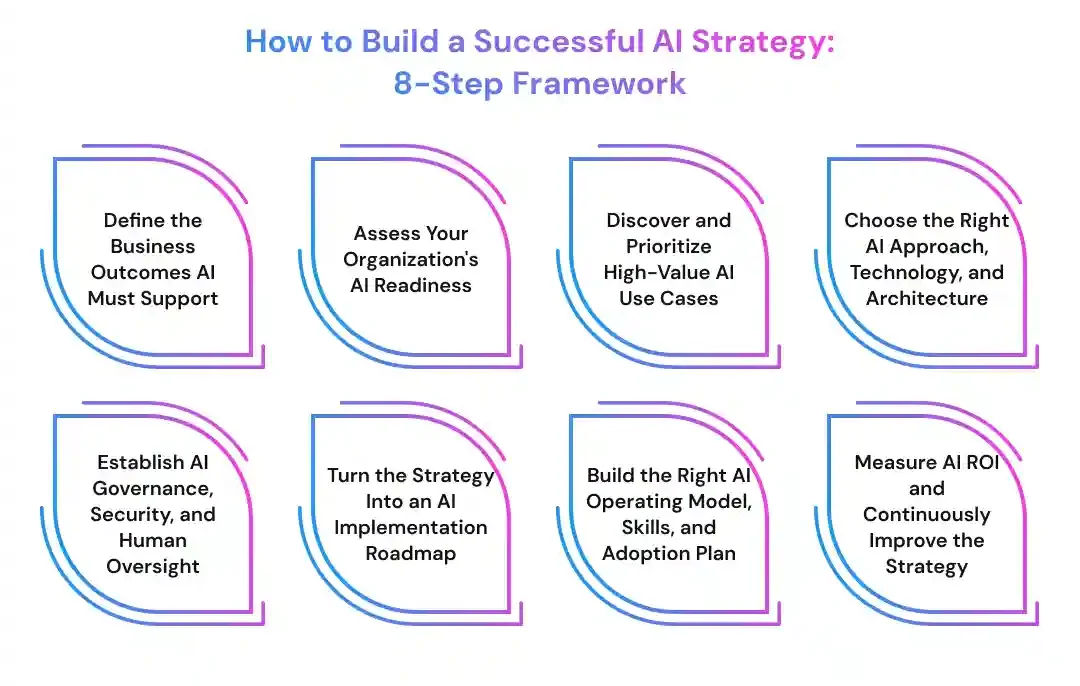
1. Define the Business Outcomes AI Must Support
Start with the business problem, not the model or AI tool.
A team might want to reduce invoice-processing time, improve demand forecasts, analyze thousands of support requests, detect unusual transactions, or give employees faster access to enterprise knowledge. Each objective describes a problem that can be measured.
Before approving an initiative, establish four things:
- Current baseline: What is happening today?
- Target outcome: What should improve?
- Success metric: How will the change be measured?
- Business owner: Who is accountable for the result?
For example, instead of setting a vague objective such as “use generative AI to improve customer service,” define the operational issue: support teams spend too much time searching several systems for approved information. That problem can then be evaluated against response time, resolution quality, employee workload, and customer experience.
A structured AI workflow discovery process can help teams identify these operational bottlenecks before deciding how AI should be applied. Some workflows may benefit from AI in business process automation, while others may only require better software integration, analytics, or conventional automation.
That leads to an important question in any AI strategy for business: Does this problem actually require AI?
AI should not be selected simply because the technology is available. Rules-based automation may be more predictable for deterministic workflows, while traditional analytics may be sufficient when the requirement is reporting rather than prediction or generation.
2. Assess Your Organization’s AI Readiness
Once the business objective is clear, assess whether the organization can support it.
An AI readiness assessment should examine four areas:
Data readiness: Is the required data accurate, accessible, sufficiently complete, and governed?
Technology readiness: Can existing applications, APIs, infrastructure, and cloud environments support the proposed system?
People readiness: Does the organization have the domain knowledge, engineering capability, AI expertise, and executive ownership required to implement it?
Governance readiness: Are security, privacy, compliance, access-control, and accountability requirements understood?
Data deserves particular attention. An enterprise AI application may need information stored across CRM platforms, ERP systems, documents, databases, or legacy software. Connecting LLMs with enterprise databases or designing an AI integration architecture for legacy systems can become a significant part of implementation.
Organizations do not need perfect enterprise-wide data before starting. They need data that is sufficiently trustworthy for the specific outcome the system is expected to support. Where data pipelines, transformation, storage, or governance remain weak, data engineering services may be necessary before advanced AI development begins.
Classify each readiness area as Ready, Needs Improvement, or Blocking Issue. This makes it easier to identify which projects can move forward and which require foundational work first.
3. Discover and Prioritize High-Value AI Use Cases
After assessing readiness, identify where AI can create meaningful value.
Instead of collecting generic ideas such as “build an AI agent,” examine actual workflows. Look for activities involving high manual effort, repeated decisions, large volumes of documents, forecasting, customer interactions, knowledge retrieval, anomaly detection, or frequent handoffs between systems.
Resources covering enterprise AI PoC use cases and practical agentic AI use cases can help teams understand what is technically possible, but every candidate should still be evaluated against the organization’s own processes.
Use an AI use case prioritization scorecard:
| Criterion |
What to evaluate |
| Business value |
Impact on cost, revenue, productivity, risk, or customer experience |
| Feasibility |
Whether available technology can perform the task reliably |
| Data readiness |
Availability and quality of the required data |
| Adoption |
Ability to fit the solution into an existing workflow |
| Risk |
Consequences if the AI produces an incorrect or inappropriate result |
Projects with high business value, sufficient data, realistic feasibility, strong adoption potential, and manageable risk should move to the top of the portfolio.
From there, divide initiatives into quick wins, strategic bets, experiments, and projects to defer. Teams considering workflow-focused opportunities can also evaluate AI workflow automation before deciding whether they need custom development or AI workflow automation services.
This prioritization step prevents an enterprise AI strategy from becoming a long list of disconnected ideas. It establishes which initiatives deserve validation first and creates the foundation for technology selection, governance, and an actionable AI strategy roadmap.
4. Choose the Right AI Approach, Technology, and Architecture
Once you know which use cases deserve investment, choose the technology based on the problem not the other way around.
Traditional machine learning can work well for prediction, classification, forecasting, and anomaly detection. Generative AI is better suited to tasks such as content generation, document analysis, summarization, and knowledge assistance, while AI agents can support multi-step workflows that involve tools, data sources, and predefined actions.
The AI implementation strategy should also address whether to build, buy, or partner. Evaluate each option against accuracy requirements, integration complexity, data privacy, scalability, latency, customization, operating cost, and vendor dependency. For LLM-based systems, choices such as private versus public LLMs can directly affect security and infrastructure decisions.
When technical feasibility remains uncertain, validate the approach before committing to full development. An AI PoC development service can help test whether the proposed model, data, and architecture can meet the required performance criteria.
5. Establish AI Governance, Security, and Human Oversight
An AI governance framework defines how AI systems can be used, monitored, and controlled across the organization. Governance should begin during strategy development rather than after a solution reaches production.
At minimum, define policies for data access, privacy, model approval, security, output evaluation, auditability, intellectual property, bias, and regulatory compliance. Generative AI systems may also require controls for hallucinations, prompt injection, sensitive-data exposure, and unauthorized actions.
Accountability needs to be equally clear. Determine who owns the business outcome, who monitors model performance, who approves high-risk outputs, and who responds when the system operates outside acceptable limits.
The level of control should reflect the consequences of failure. An internal writing assistant does not require the same oversight as an AI system supporting financial, healthcare, legal, or safety-related decisions. Organizations operating in regulated environments should also account for applicable AI regulation and compliance requirements.
6. Turn the Strategy Into an AI Implementation Roadmap
An AI strategy roadmap converts priorities into defined stages, responsibilities, investments, and decision points.
For many initiatives, a practical progression is:
Discovery → PoC → MVP or pilot → production → scale
A proof of concept tests technical feasibility. An MVP or pilot determines whether the system creates value within a real workflow. Production deployment adds the integration, security, reliability, monitoring, and operational controls required for sustained use. The difference between an AI PoC and AI MVP is therefore important when deciding what should be validated at each stage.
The roadmap should identify owners, data requirements, dependencies, integration work, budget, risk controls, timelines, KPIs, and go/no-go criteria. Organizations ready to operationalize these plans may require AI implementation services or specialized AI integration services when solutions must connect with existing enterprise systems.
Most importantly, do not scale an initiative simply because the demo works. Move forward only when technical performance, user adoption, operational value, risk, and economics justify further investment.
7. Build the Right AI Operating Model, Skills, and Adoption Plan
Technology alone does not make an AI adoption strategy successful. Organizations also need clear ownership, the right skills, and employees who understand how AI fits into their work.
Create a cross-functional team that brings together business owners, AI or data specialists, software engineers, security teams, compliance stakeholders, and end users. The business owner should remain accountable for the outcome, while technical teams manage development, integration, evaluation, and monitoring.
When skills are missing, decide whether to upskill existing employees, hire specialists, or work with an external partner. Organizations may need to hire data scientists for model and data work or AI developers when internal engineering capacity is limited.
Adoption should also be planned early. Explain how the system changes existing workflows, where human judgment is still required, and how employees can report poor or unsafe outputs. An AI solution that performs well technically but is ignored by its intended users creates little business value.
8. Measure AI ROI and Continuously Improve the Strategy
A successful AI strategy needs measurable evidence that an initiative is worth continuing.
Establish a baseline before deployment, then monitor performance across five levels:
- Model: accuracy, factuality, safety, and reliability.
- System: latency, uptime, scalability, and operating cost.
- Adoption: active users, usage frequency, completion, and feedback.
- Operations: processing time, throughput, errors, and manual workload.
- Business: cost savings, revenue impact, risk reduction, or customer and employee outcomes.
Regular AI model testing helps identify whether technical performance remains acceptable, but model metrics should never be viewed in isolation. A highly accurate system can still fail if employees do not use it or if operating costs outweigh the value it creates.
Use these results to decide whether to scale, improve, redesign, or stop an initiative. The broader AI strategy roadmap should also be reviewed when business priorities, regulations, available models, security risks, or technology costs change.
Know Which AI Opportunities Deserve Your Investment
Evaluate business value, feasibility, data readiness, adoption potential, and risk before committing time and budget to AI development.
Prioritize Your AI Use Cases
Common AI Strategy Mistakes to Avoid
Many AI programs lose momentum because organizations:
- start with a tool instead of a business problem;
- launch too many disconnected pilots;
- overlook data readiness;
- build before defining measurable success;
- treat governance as a late-stage task;
- ignore workflow integration and employee adoption;
- continue technically impressive projects that do not create enough business value.
A working prototype is not the same as a successful business initiative. Production AI must be useful, adoptable, governable, supportable, and economically justified.
How Prismetric Helps Enterprises Build Successful AI Strategies at Scale
As an AI consulting and development company, Prismetric helps businesses turn AI opportunities into practical strategies, validated use cases, and AI solutions aligned with business goals.
A successful AI strategy needs clear priorities, data readiness, governance, implementation planning, and a path from experimentation to enterprise adoption.
Prismetric supports AI initiatives from discovery through deployment and optimization.
Prismetric helps businesses with:
- AI strategy and roadmap planning
- Use-case discovery and prioritization
- Data and architecture assessment
- AI PoC and MVP development
- Enterprise AI integration
- Deployment, monitoring, and optimization
Our teams work across:
- Generative AI
- AI agents and copilots
- RAG systems
- Machine learning
- Natural language processing
- Computer vision
| Prismetric Capability |
Delivery Footprint |
| Happy Clients |
1000+ |
| Solutions Developed |
1500+ |
| Countries Served |
50+ |
| Developers |
100+ |
| AI Lifecycle Support |
Strategy to post-launch optimization |
| Enterprise AI Focus |
Agents, RAG, LLMs, ML, NLP, and computer vision |
We help enterprises build:
- Business-aligned AI roadmaps
- Prioritized AI use-case portfolios
- Scalable AI architectures
- Production-ready AI applications
- Integrated AI workflows
Our teams focus on implementation realities such as:
- Data readiness
- Security and access controls
- Model evaluation
- System integration
- User adoption
- Production monitoring and continuous improvement
Work with Prismetric’s AI consulting team to turn your AI strategy into a focused implementation roadmap before disconnected pilots consume time and budget without creating measurable value.
Building an AI Strategy That Can Scale
The purpose of an AI strategy is to help an organization decide where AI deserves investment, what must be ready before implementation, and whether deployed systems are producing measurable business value.
Start with the problem, validate readiness, prioritize carefully, govern according to risk, and scale only after the evidence supports it. Organizations that need additional expertise can use structured AI implementation services to move from strategy and validation into secure, production-ready deployment.
Turn Your AI Strategy Into a Production-Ready Roadmap
Prismetric can help move your initiative from discovery and PoC to integration, governance, deployment, monitoring, and enterprise-scale adoption.
Talk to Our AI Consultants