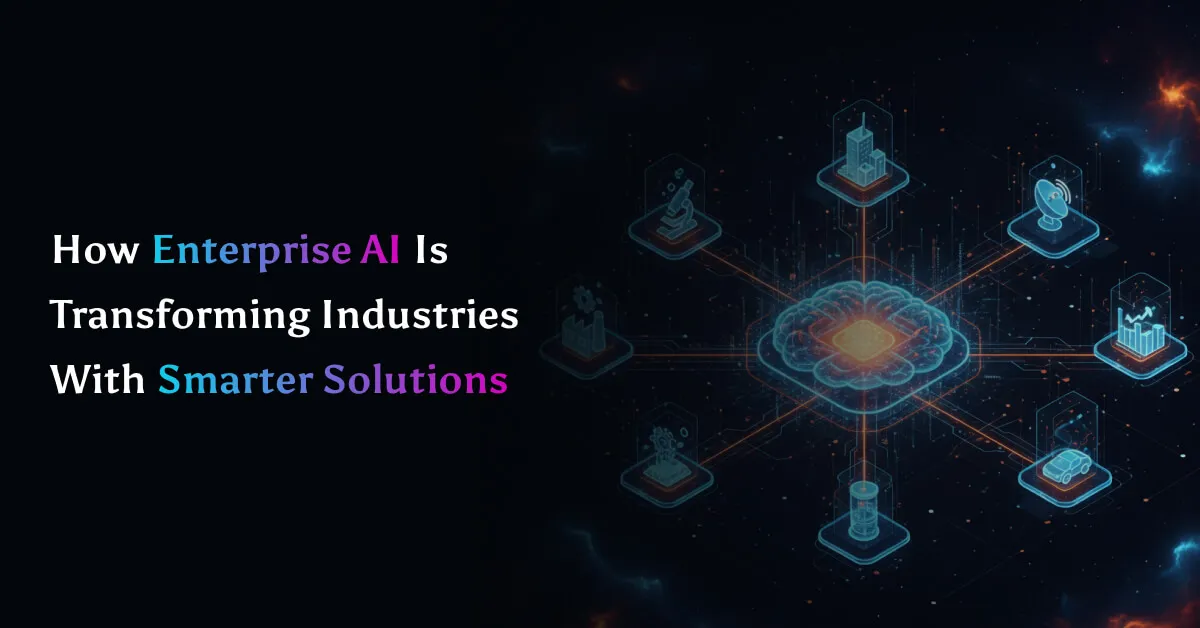
How Enterprise AI Is Transforming Industries with Smarter Solutions
Key Takeaways
- Enterprise AI enables faster, data-backed decisions by automating tasks, analyzing real-time data, and reducing human error.
- From predictive maintenance in manufacturing to fraud detection in banking, AI improves efficiency, safety, and customer satisfaction at scale.
- The enterprise AI market is expected to reach $254.50 billion by 2026 as businesses accelerate digital transformation.
- Organizations like JPMorgan, Siemens, and Shell use AI to save thousands of work hours and cut operational costs by 20 percent or more.
If you’re still running your business on legacy systems, you’re already a step behind. Today’s markets move fast. Customers expect instant service. Data pours in from every direction. And decisions need to happen in real time.
Banks are battling a flood of fraudulent transactions. Hospitals are overwhelmed with patient records. Retailers struggle to predict what their customers will want next. Across industries, traditional systems are no longer enough.
Without smarter AI tools, companies risk more than inefficiency. They risk unhappy customers, lost revenue, and missed opportunities. The solution is enterprise AI.
By integrating enterprise AI into core operations, organizations unlock new levels of speed, precision, and personalization. They make better decisions. They serve customers faster. And they create space for innovation.
Statista projects that the AI market will reach USD 254.50bn billion in 2026, growing at a CAGR of 27.67% to hit USD $1.68tn by 2031.
In this blog, we’ll explore what enterprise AI really is, the value it brings, and how it’s driving growth across industries. You’ll learn about real-world use cases, the challenges to watch for, and how to start your AI journey.
Let’s get started. 
What is Enterprise AI?
Enterprise AI is the use of artificial intelligence to solve real business problems at scale.
It goes beyond chatbots or smart assistants. Enterprise AI integrates AI technologies like machine learning, natural language processing, and computer vision into a company’s core operations. The goal is simple, help businesses with AI work smarter, faster, and more efficiently.
Think of it as a digital brain that learns from your business data. It studies customer behavior, spots patterns in supply chains, detects fraud in transactions, and even predicts equipment failures before they happen. And it does all of this automatically, without constant human input.
Unlike consumer AI, which is built for individuals, enterprise AI is designed for organizations. It handles large volumes of data. It scales across departments. And it supports critical business decisions.
Here’s what makes enterprise AI powerful:
- It automates routine tasks and reduces human error.
- It analyzes massive data sets in seconds, not hours.
- It improves accuracy in forecasting and planning.
- It personalizes customer experiences in real time.
Companies that use enterprise AI can uncover insights they never knew existed. They can respond to market changes faster. And they can make decisions based on data, not guesswork.
In short, enterprise AI helps businesses do more with less.
Core Factors Behind the Enterprise AI Revolution
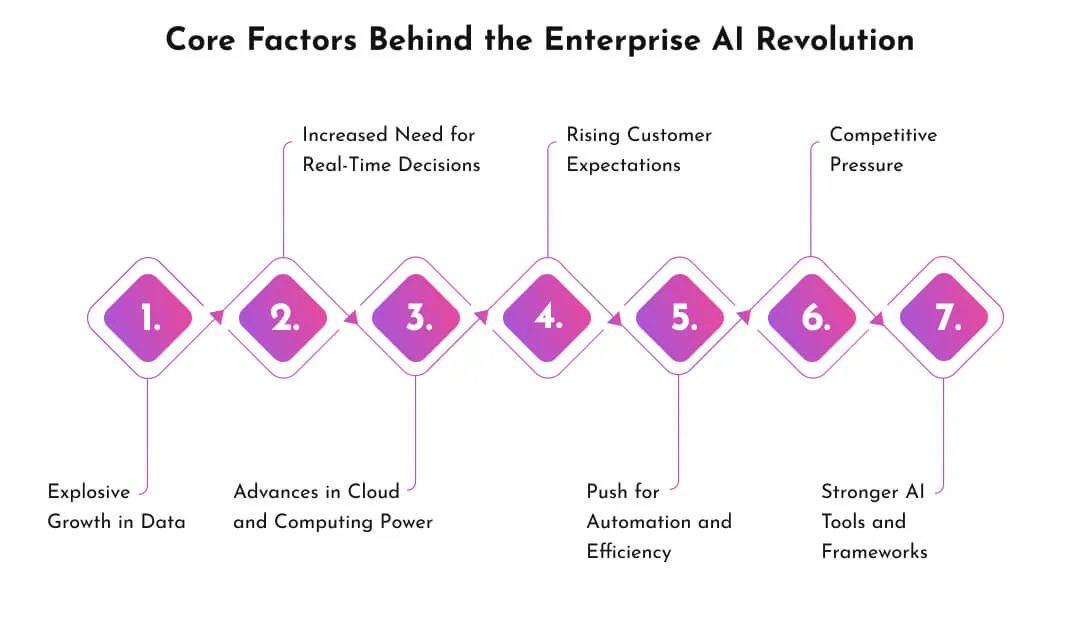
Enterprise AI isn’t just a trend. It’s a response to real business pressures and massive shifts in how companies operate. Several core factors are driving this rapid adoption, and together, they’re reshaping industries.
1. Explosive Growth in Data
Businesses are generating more data than ever before from customer interactions and transactions to supply chain logs and social media. Traditional systems can’t keep up. AI turns this data into insights, helping companies make faster, smarter decisions.
2. Increased Need for Real-Time Decisions
Markets move quickly. Delayed decisions can cost money, customers, and competitive edge. Enterprise AI supports real-time analytics and decision-making, allowing businesses to act on insights as they happen.
3. Advances in Cloud and Computing Power
AI used to require massive infrastructure investments. Now, with cloud computing and AI-as-a-Service platforms, even mid-sized companies can deploy enterprise-grade AI solutions. It’s faster, more affordable, and easier to scale.
4. Rising Customer Expectations
Customers expect personalized experiences, instant support, and seamless interactions. Enterprise AI helps companies meet these expectations by powering recommendation engines, smart chatbots, and customer journey analytics.
5. Push for Automation and Efficiency
Every business wants to reduce manual work, cut costs, and streamline operations. AI can automate repetitive tasks, optimize workflows, and reduce human error. It’s a key tool in building leaner, more efficient organizations.
6. Competitive Pressure
Companies adopting AI are gaining a serious edge. Those that delay risk falling behind. As AI proves its value in one industry, others follow quickly to avoid being left out.
7. Stronger AI Tools and Frameworks
AI has matured. Tools are more reliable. Models are easier to train. Open-source frameworks and pre-trained models make development faster and more accessible than ever before.
Benefits of Enterprise AI for Multiple Industry Organizations
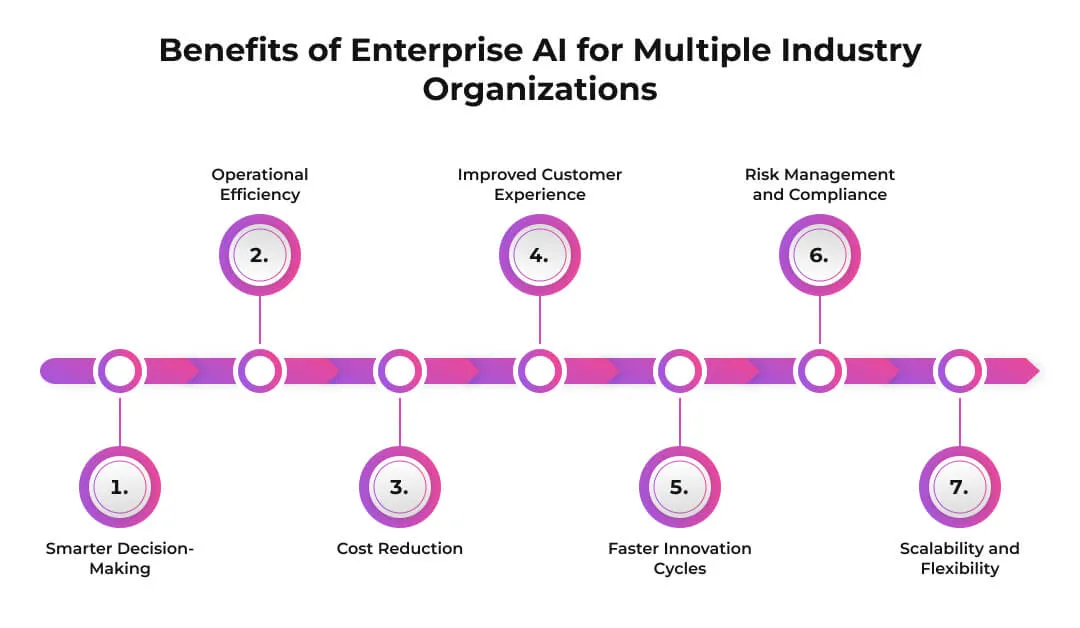
Enterprise AI is not just a technological upgrade. It’s a business accelerator. From healthcare and finance to retail and logistics, AI delivers practical benefits that solve real challenges. When applied correctly, it drives performance, improves decision-making, and creates space for innovation.
Here are the core benefits that organizations across industries are experiencing today:
1. Smarter Decision-Making
Enterprise AI analyzes large volumes of data in real time. It finds patterns, predicts outcomes, and helps leaders make faster, data-backed decisions. Whether it’s setting prices, managing inventory, or detecting risks, AI improves accuracy and speed.
2. Operational Efficiency
AI automates repetitive and time-consuming tasks. From processing claims in insurance to managing patient records in healthcare, AI reduces manual work, lowers error rates, and frees teams to focus on strategic priorities.
3. Cost Reduction
By optimizing resource use and streamlining workflows, AI helps organizations cut unnecessary costs. Predictive maintenance, for example, reduces equipment downtime and extends asset life in manufacturing and logistics.
4. Improved Customer Experience
AI helps companies understand customer behavior at a deeper level. It powers personalized recommendations, real-time support, and proactive service. This leads to higher satisfaction, better retention, and stronger brand loyalty.
5. Faster Innovation Cycles
With AI handling routine operations, companies can shift focus to innovation. AI also supports rapid testing, simulation, and development making it easier to bring new products and services to market.
6. Risk Management and Compliance
AI strengthens fraud detection, monitors transactions, and ensures regulatory compliance. In sectors like banking and healthcare, this reduces legal exposure and enhances trust.
7. Scalability and Flexibility
AI systems grow with your business. Whether you’re expanding into new markets or adding more services, AI helps maintain performance without overwhelming your team or resources.
Use Cases of Enterprise AI for Different Industries
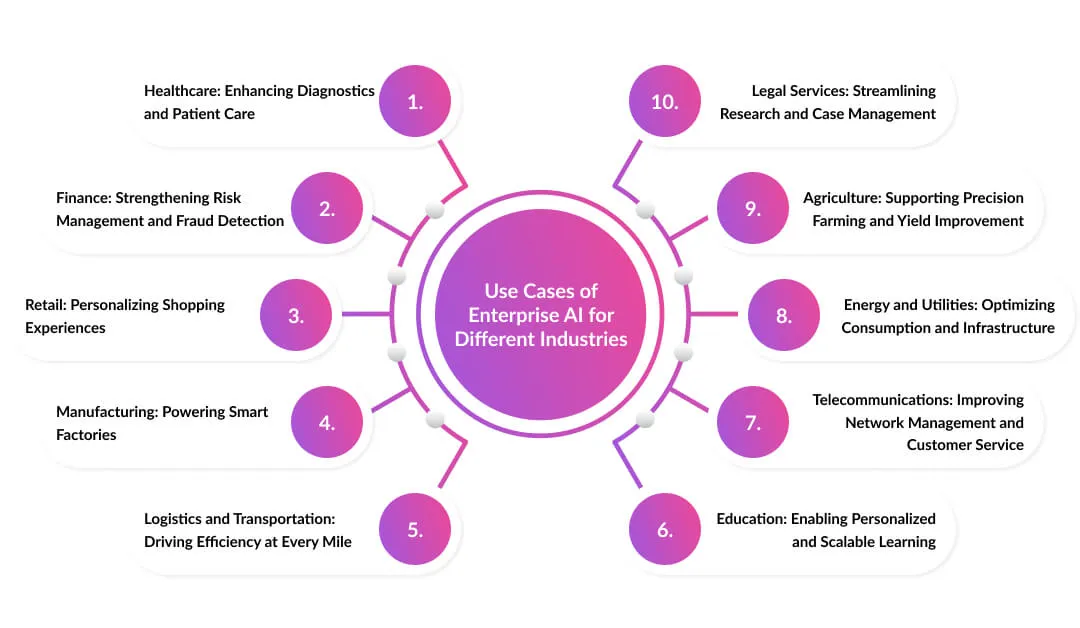
Enterprise AI is not a one-size-fits-all solution. Its real power lies in how it adapts to the needs of each industry. Below are real-world examples of how AI is transforming five key sectors. Each use case shows how AI delivers speed, intelligence, and efficiency at scale.
1. Healthcare: Enhancing Diagnostics and Patient Care
Healthcare is overwhelmed with data. From patient records and imaging scans to lab results and clinical trials, AI helps make sense of it all.
Use Cases:
- Medical imaging analysis to detect tumors, fractures, or abnormalities with high accuracy
- Predictive analytics to flag patients at risk of chronic conditions
- Virtual health assistants that automate scheduling and post-care follow-ups
- Clinical decision support tools that recommend personalized treatment plans
Real-World Example:
Mayo Clinic uses AI to predict cardiac arrest by analyzing ECG data. This helps doctors intervene earlier and save lives.
2. Finance: Strengthening Risk Management and Fraud Detection
Finance depends on speed, security, and data-driven decisions. AI gives financial institutions the tools to keep up with market demands and protect customer assets.
Use Cases:
- Real-time fraud detection across thousands of daily transactions
- Smarter credit scoring using alternative data like mobile usage and purchase behaviour
- Algorithmic trading that analyzes market signals and executes trades in seconds
- AI-powered chatbots for customer support and financial queries
Real-World Example:
JPMorgan Chase uses its COiN platform to review legal documents in seconds. This replaces 360,000 hours of manual review each year.
3. Retail: Personalizing Shopping Experiences
Retail success depends on knowing your customers. AI helps retailers anticipate needs, personalize offers, and optimize inventory for smoother operations.
Use Cases:
- Personalized product recommendations based on browsing and purchase history
- Demand forecasting to optimize stock and reduce overstock
- Visual search tools that let customers shop using images
- Dynamic pricing that adjusts based on market trends and customer behavior
Real-World Example:
Sephora uses AI-driven enterprise AI chatbots and recommendation engines to deliver personalized beauty guidance online.
4. Manufacturing: Powering Smart Factories
Manufacturing thrives on precision and uptime. AI supports this by driving efficiency and reducing costly downtime.
Use Cases:
- Predictive maintenance that identifies equipment issues before they cause failures
- Computer vision for real-time quality control on production lines
- Supply chain forecasting to prevent delays and material shortages
- Production automation with AI-powered robotics for greater speed and consistency
Real-World Example:
Siemens uses enterprise AI to optimize factory workflows and has reduced unplanned downtime by up to 20 percent.
Also Read: AI in Visual Quality Control for Manufacturing
5. Logistics and Transportation: Driving Efficiency at Every Mile
Logistics and transportation rely on precise timing and coordination. AI simplifies complex networks and boosts reliability.
Use Cases:
- Route optimization for faster, fuel-efficient deliveries
- Predictive fleet maintenance to reduce vehicle breakdowns
- Warehouse automation for faster sorting, packing, and tracking
- Delivery forecasting with real-time customer updates
Real-World Example:
FedEx uses AI to predict package delivery times with 97 percent accuracy. This helps improve planning and customer satisfaction.
6. Education: Enabling Personalized and Scalable Learning
Education is shifting toward personalized, data-driven models. AI is helping institutions deliver better outcomes for students and educators alike.
Use Cases:
- Adaptive learning platforms that adjust content based on student performance and pace
- Automated grading systems that free up teacher time for more meaningful interaction
- AI-powered tutoring bots that provide real-time assistance to students
- Predictive analytics to identify at-risk students early and support intervention strategies
Real-World Example:
Carnegie Learning uses AI to deliver customized math instruction, improving student engagement and retention.
7. Telecommunications: Improving Network Management and Customer Service
Telecom companies handle vast networks and millions of customer interactions daily. AI helps manage complexity while improving service quality.
Use Cases:
- AI-driven network monitoring to detect and fix outages before they affect users
- Chatbots and virtual agents for round-the-clock customer support
- Predictive maintenance for telecom infrastructure and hardware
- Churn prediction models that help retain at-risk customers
Real-World Example:
AT&T leverages AI to predict network congestion and automatically reroute traffic for smoother connectivity.
8. Energy and Utilities: Optimizing Consumption and Infrastructure
Energy providers are under pressure to reduce costs, improve reliability, and support sustainability goals. AI helps balance all three.
Use Cases:
- Smart grid optimization using AI to forecast energy demand and adjust supply
- Predictive maintenance for pipelines, turbines, and critical infrastructure
- Energy consumption analytics to identify waste and improve efficiency
- AI-assisted forecasting for renewable energy production from solar and wind sources
Real-World Example:
Shell uses AI for predictive maintenance and well performance analysis, reducing downtime in oil and gas operations.
9. Agriculture: Supporting Precision Farming and Yield Improvement
Agriculture is adopting AI to increase crop yields, optimize resource use, and respond to climate challenges.
Use Cases:
- Crop health monitoring using AI and drone imagery
- Predictive models for weather, pest outbreaks, and soil conditions
- Automated harvesting systems powered by computer vision and robotics
- AI-based planting schedules optimized for location, season, and crop type
Real-World Example:
John Deere integrates AI in its machinery to analyze soil data and optimize seeding with high precision.
10. Legal Services: Streamlining Research and Case Management
The legal industry is known for document-heavy processes and time-consuming research. AI is helping law firms become more efficient and accurate.
Use Cases:
- Document review and contract analysis using natural language processing
- Legal research tools that surface relevant case law faster
- Case outcome prediction models to support litigation strategy
- AI-powered chatbots to assist clients with basic legal questions
Real-World Example:
Luminance uses AI to analyze thousands of legal documents in minutes, cutting review time significantly for major law firms.
Conclusion
Enterprise AI is no longer a futuristic concept. It’s a practical, high-impact tool that’s driving real growth across industries. From improving customer experiences to streamlining operations and enabling smarter decisions, AI is helping businesses unlock new levels of efficiency and innovation.
As the technology becomes more accessible and powerful, early adopters are already seeing measurable gains. Whether you’re in healthcare, finance, manufacturing, or any other sector, now is the time to explore how enterprise AI can give your organization a competitive edge.
Frequently Asked Questions (FAQs)
Enterprise AI refers to artificial intelligence systems designed for large-scale, business-wide use. Unlike consumer AI (like virtual assistants or personal recommendation tools), enterprise AI integrates deeply into core business operations to automate processes, analyze big data, and support critical decision-making.
Enterprise AI drives growth by improving decision speed, increasing operational efficiency, reducing costs, and enhancing customer experiences. It enables businesses to scale faster while staying competitive in rapidly changing markets.
Enterprise AI is creating measurable impact across a wide range of industries. It helps organizations solve industry-specific challenges, streamline operations, and make smarter decisions with data. From patient care to predictive logistics, the benefits are both broad and deep.
Industries seeing the biggest impact include:
- Healthcare – AI enhances diagnostics, patient monitoring, and treatment personalization
- Finance – Real-time fraud detection, credit scoring, and risk analysis
- Retail – Personalized shopping experiences, demand forecasting, and dynamic pricing
- Manufacturing – Predictive maintenance, quality control, and smart automation
- Logistics – Route optimization, fleet management, and delivery forecasting
- Telecommunications – Network optimization and customer churn prediction
- Energy and Utilities – Smart grid management and predictive infrastructure maintenance
- Education – Adaptive learning systems and early student performance prediction
- Agriculture – Precision farming, crop monitoring, and automated harvesting
- Legal Services – Document analysis, legal research, and case outcome prediction
Costs vary based on the scale and complexity of the solution. However, cloud platforms and AI-as-a-Service models have made enterprise AI more accessible, even for mid-sized businesses. Many companies see a strong return on investment within months.
Enterprise AI is being applied across departments to automate routine tasks, uncover insights from data, and improve decision-making. These use cases help businesses boost efficiency, reduce costs, and deliver better customer experiences.
Common enterprise AI use cases include:
- Fraud Detection – Identifying suspicious activities in real time to prevent financial losses
- Predictive Maintenance – Anticipating equipment failures before they occur to minimize downtime
- Demand Forecasting – Accurately predicting sales trends to optimize inventory and supply chains
- Personalized Marketing – Delivering tailored content and offers based on customer behavior
- Automated Customer Support – Using AI chatbots and virtual assistants to handle inquiries 24/7
- Real-Time Analytics – Analyzing live data streams to support fast, data-driven decisions
- Document Processing – Automating data extraction and analysis from contracts, forms, and reports
- Workflow Optimization – Streamlining internal operations through intelligent task automation
Common challenges include data quality issues, lack of skilled talent, integration with legacy systems, and change management. Choosing the right tools and starting with small, high-impact use cases can ease the transition.
Start by identifying a business problem that AI can solve. Choose a pilot project with measurable outcomes. Partner with a trusted AI vendor or consultant, and ensure your data infrastructure is ready for AI integration.
AI is more likely to augment human roles than replace them. It takes over repetitive tasks and allows employees to focus on higher-value work like strategy, creativity, and decision-making. Companies that adopt AI often see increased productivity and job satisfaction.