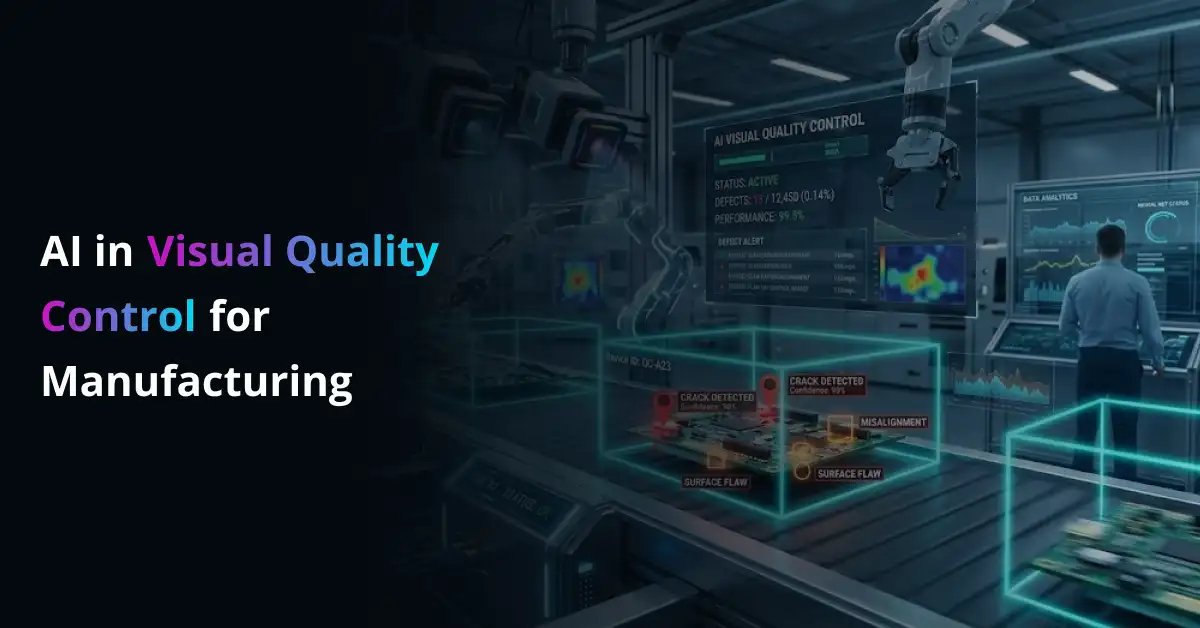
AI in Visual Quality Control for Manufacturing: Benefits, Use Cases, and Implementation Guide
Key Takeaways
- AI removes human fatigue and inconsistency, delivering steady inspection accuracy across all shifts.
- Deep learning models detect subtle defects traditional rule based systems often fail to identify.
- AI enables real time inspection at production speed, reducing bottlenecks on fast manufacturing lines.
- Poor quality costs manufacturers 15–20 percent of revenue, making AI essential for defect reduction.
- Edge AI and AR enhance frontline inspections with instant feedback and guided defect visualization.
Lets see how AI is impacting visual quality control in factories and your business. When you start using it for visual quality control, you shift from asking “Did we catch the obvious defects?” to confidently know you’re catching almost every defect with steady precision.
Quality problems are expensive. According to the American Society for Quality, poor quality costs manufacturers roughly 15 to 20 percent of their sales revenue, and in some cases those hidden costs climb even higher. When you look at visual inspection through that lens, the missed defects, rework, and warranty claims suddenly become impossible to ignore.
That’s where AI makes a practical difference. It doesn’t get tired halfway through a shift, it doesn’t lose focus, and it doesn’t change its judgment from one batch to the next. It keeps analyzing every image, every product, every cycle with the same level of consistency, helping teams reduce scrap, protect margins, and sleep better at night. 
What is The Problem with Traditional Visual Quality Control?
Traditional visual inspection sounds simple on paper. In reality, it’s one of the most inconsistent and expensive parts of the production process.
- Human inspectors get fatigued, especially during long shifts, and fatigue leads to missed defects.
- Two experienced inspectors can evaluate the same part differently, creating inconsistency in quality standards.
- Manual inspection struggles with micro defects like hairline cracks, subtle discoloration, or tiny surface deformities.
- Rule based machine vision systems fail when lighting changes or when a new product variation is introduced.
- Scaling inspection means hiring and training more people, which increases cost and slows growth.
What is AI-Powered Visual Quality Control?
AI powered visual quality control uses machine vision cameras and deep learning models to automatically inspect products for defects in real time. Instead of relying on fixed rules or human judgment, the system learns from thousands of labeled images, recognizes patterns on its own, and improves over time as it sees more data.
Role of AI in Visual Quality Control
AI sits at the core of modern visual inspection systems, working alongside industrial cameras and edge devices to analyze products in real time. Industries increasingly turn to AI and computer vision to augment or replace traditional visual inspection processes because these systems can process large volumes of visual data without slowing production.
Here is how AI is transforming visual quality control process:
- Image Capture and Preprocessing: High resolution cameras capture product images, and computer vision algorithms clean and normalize the data by adjusting lighting, contrast, and noise before analysis begins.
- Defect Detection Using Deep Learning: Convolutional neural networks and anomaly detection models evaluate each image, identifying scratches, dents, contamination, missing components, or incorrect assembly based on learned patterns rather than fixed rules.
- Real Time Decision Integration: AI models connect with PLCs, robotics, and manufacturing execution systems to automatically reject defective parts or trigger alerts within milliseconds.
- Continuous Learning Through Data Feedback: Machine learning systems retrain on new inspection data, helping reduce false positives and improve defect classification accuracy over time.
- Inspection Analytics and Process Optimization: Cloud based AI platforms aggregate inspection results, allowing manufacturers to track defect trends, identify root causes, and improve overall production quality.
Core Technology Components of AI Powered Visual Quality Control
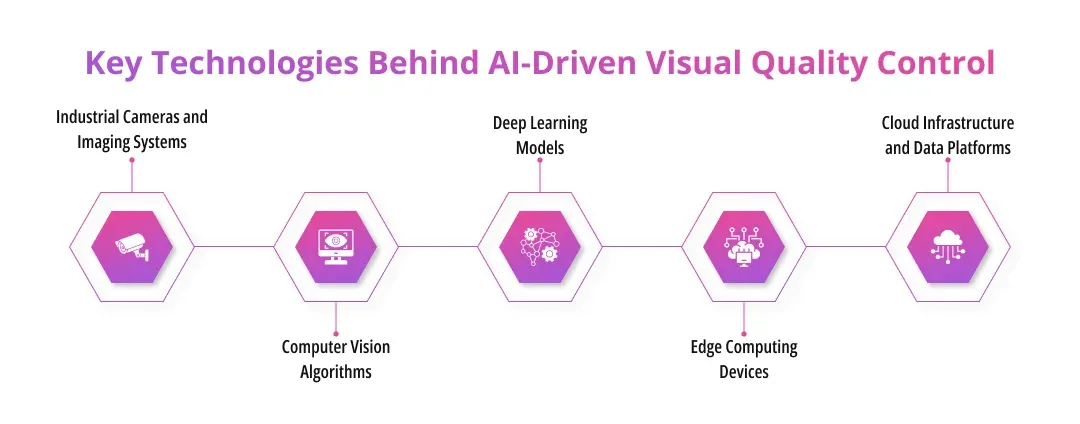
Behind every reliable AI inspection system, there’s a stack of technologies working together. Each layer plays a specific role in turning raw images into accurate quality decisions.
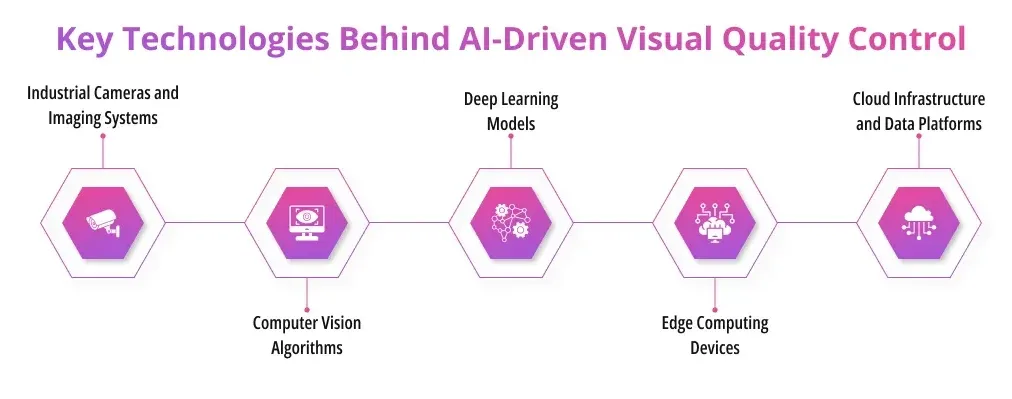
Industrial Cameras and Imaging Systems
High resolution industrial cameras capture detailed images of products as they move across the production line. Proper lighting setups and precision lenses ensure that even small surface defects are clearly visible and consistently recorded.
Computer Vision Algorithms
Computer vision software processes raw images by detecting edges, textures, shapes, and irregularities. It transforms visual input into structured data that AI models can evaluate more effectively.
Deep Learning Models
Convolutional neural networks train on thousands of labeled defect and non defect images. Over time, they learn to distinguish subtle variations that traditional rule based systems struggle to define.
Edge Computing Devices
Edge AI hardware performs image analysis directly on the production floor. This enables real time inspection decisions without delays caused by sending data to remote servers.
Cloud Infrastructure and Data Platforms
Cloud platforms store inspection data, support large scale model training, and provide centralized dashboards for quality analytics. They also allow manufacturers to monitor inspection performance across multiple facilities.
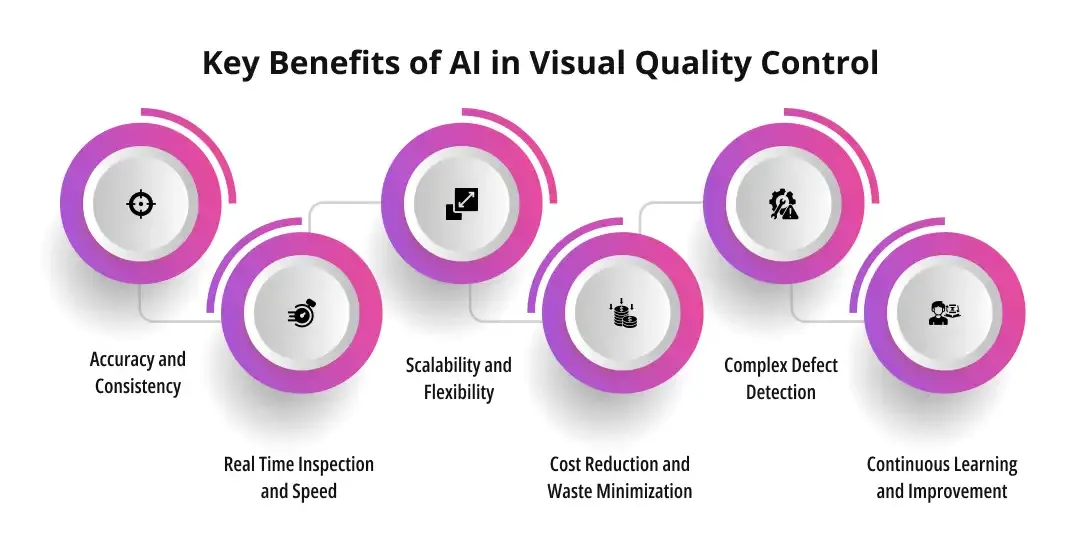
Key Benefits of AI in Visual Quality Control
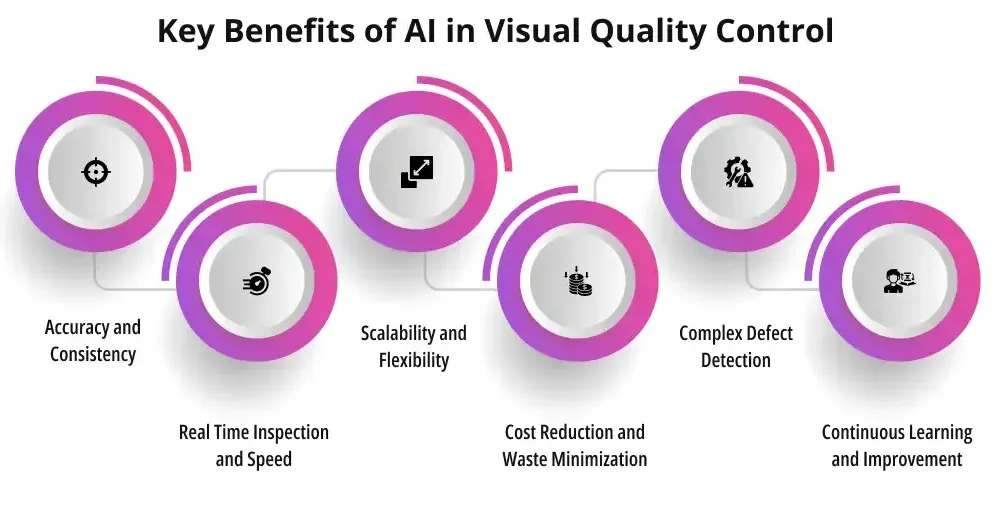
1. Accuracy and Consistency
Human inspectors try their best, but consistency is hard to maintain across long shifts and multiple teams. AI does not struggle with fatigue or shifting judgment. It applies the same inspection standards to every single unit, whether it is the first product of the day or the ten thousandth.
Over time, that consistency reduces variation in quality decisions and builds real trust in your inspection process.
2. Real Time Inspection and Speed
Production lines move fast. If inspection slows things down, it becomes a bottleneck. AI powered visual inspection systems analyze images in milliseconds, keeping up with high speed manufacturing without sacrificing accuracy.
Instead of sampling a few units per batch, you can inspect every single product in real time. That shift alone changes how confident you feel about what leaves your facility.
3. Scalability and Flexibility
Traditional rule based vision systems struggle when you introduce a new product variant or tweak a design. Someone has to rewrite rules, recalibrate thresholds, and test everything again.
AI handles variation better because it learns patterns instead of following rigid instructions. When your product line expands, you train the model with new images instead of rebuilding the entire inspection logic from scratch.
4. Cost Reduction and Waste Minimization
Poor quality is expensive. Scrap, rework, warranty claims, and returns quietly eat into margins month after month. When AI catches defects earlier in the process, you reduce downstream losses.
Instead of discovering issues at final inspection or worse, after shipment, you stop them at the source. That means less material waste, fewer production delays, and more predictable operating costs.
5. Complex Defect Detection
Some defects are obvious. Others are subtle and hard to define. A faint scratch, slight discoloration, minor misalignment, or contamination that does not follow a fixed pattern can easily slip past rule based systems.
Deep learning models shine here because they recognize visual patterns the way humans do, only at scale. They learn what “normal” looks like and flag deviations, even when those deviations are difficult to describe in code.
6. Continuous Learning and Improvement
One of the biggest advantages of AI in visual quality control is that it improves with data. As the system processes more images and receives feedback from operators, it refines its decision boundaries.
False positives decrease. False negatives become rarer. The inspection process becomes sharper over time instead of staying static. That ongoing improvement turns quality control from a fixed checkpoint into a dynamic, evolving capability.
AI vs Traditional Inspection: Side by Side
Here’s a straightforward side by side view that shows how manual inspection, rule based vision systems, and AI powered visual inspection stack up in real production environments.
| Feature |
Manual Visual Inspection |
Rule Based Machine Vision |
AI Powered Visual Inspection |
| Decision Making |
Based on human judgment and experience |
Based on predefined rules and thresholds |
Based on learned visual patterns from training data |
| Consistency |
Varies by shift, fatigue, and operator |
Consistent within programmed limits |
Highly consistent across all shifts and environments |
| Speed |
Limited by human capability |
Fast, but may require recalibration |
High speed, real time inspection at scale |
| Complex Defect Detection |
Difficult to detect subtle or micro defects |
Struggles with undefined or variable defects |
Excels at identifying subtle, irregular, and evolving defects |
| Adaptability to New Products |
Requires retraining staff |
Requires reprogramming rules |
Requires additional training data, no rule rewriting |
| Scalability |
Hiring and training required |
Hardware dependent scaling |
Easily scalable with additional cameras and models |
| False Positives and Negatives |
Higher variability |
Moderate depending on rule precision |
Reduces over time through continuous learning |
| Operational Cost Over Time |
High labor cost |
Moderate maintenance cost |
Lower long term cost due to automation and reduced waste |
AI in Action: Industry Use Cases
Talking about technology is one thing. Seeing where it actually delivers results is another. These AI quality control use cases show how manufacturers apply AI powered visual inspection in real production environments.
Automotive and Electronics
In automotive manufacturing, AI inspects paint finishes for surface imperfections like orange peel texture, micro scratches, and uneven coating. It also analyzes weld seams to detect gaps, porosity, or alignment issues that could compromise structural integrity.
In electronics production, especially PCB inspection, AI defect detection examples include identifying missing components, solder bridge defects, and incorrect placements. These systems catch errors at high speed, long before faulty units reach final assembly.
Pharmaceuticals and Consumer Goods
Pharmaceutical companies rely on AI to verify tablet shape, size, and color consistency. Even slight variations in coating, cracks, or contamination can be flagged instantly to prevent compromised batches from moving forward.
In consumer goods and food and beverage packaging, AI checks label alignment, expiration date printing, seal integrity, and packaging damage. That means fewer recalls and stronger brand protection.
High Precision Manufacturing
Semiconductor fabrication demands extremely tight tolerances. AI systems inspect wafers for micro cracks, pattern defects, and surface contamination that are nearly invisible to the human eye.
Medical device manufacturers use AI to verify precision components, ensuring implants, surgical tools, and micro parts meet strict regulatory and safety standards. In these environments, even a tiny defect can have serious consequences.
Emerging Use Cases
Electric vehicle battery production is one of the fastest growing AI defect detection examples today. Manufacturers use AI to inspect cell alignment, surface damage, and assembly accuracy in real time to prevent costly battery failures.
Robotics manufacturing is also adopting AI based inspection to validate component fit, wiring accuracy, and final assembly quality. As automation expands, AI driven visual quality control becomes a natural extension of the production system itself.
The Role of Edge AI and AR in Visual Quality Control
As inspection systems mature, the real shift is happening at the edge of the production line. AI edge quality control and augmented reality inspection are bringing machine learning and computer vision directly into daily operations, not just dashboards.
Edge AI
Edge AI runs trained machine learning and computer vision models directly on local hardware installed on the factory floor. Instead of sending every captured image to the cloud for analysis, deep learning inference happens instantly on edge devices equipped with industrial GPUs or embedded AI processors.
This real time processing removes network latency and keeps inspection decisions fast and reliable. When the system detects a defect, it can trigger rejection mechanisms or line adjustments within milliseconds. That level of responsiveness is critical in automotive, electronics, and semiconductor manufacturing, where even minor delays can disrupt tightly synchronized production cycles.
AI and Augmented Reality for Inspection
Augmented reality inspection takes the output of AI models and places it directly into a worker’s field of view. Computer vision systems identify defects, misalignments, or missing components, and AR overlays that information on the physical product using smart glasses, tablets, or head mounted displays.
Instead of interpreting raw data on a distant screen, operators see highlighted defect zones, guided inspection steps, and real time validation prompts exactly where they are working. Machine learning handles pattern recognition in the background, while AR enhances human judgment at the front line, creating a collaborative inspection workflow that improves speed and accuracy without removing human oversight.
Implementation Best Practices
Deploying AI in visual quality control is not just about buying cameras and installing software. Success depends on how well you design your machine learning pipeline, prepare your computer vision data, integrate the system into real workflows, and maintain model performance over time.
Start with Data Collection and Labeling
AI inspection models learn visual patterns from data. If your training images are inconsistent, poorly labeled, or biased toward limited defect types, your deep learning model will inherit those weaknesses.
Build a Diverse and Representative Dataset
Capture images across different lighting conditions, camera angles, product variants, and defect categories. A strong computer vision dataset should reflect real production variability, not just ideal lab conditions.
Label Data with Precision
Accurate annotation is critical for supervised machine learning. When defect classes are mislabeled or loosely defined, the model learns incorrect boundaries and repeats those errors during inference on the production line.
Start Small, Then Expand
Begin by training and validating your model on one product line or a specific defect type. Once performance metrics such as precision and recall meet your target thresholds, scale the system to additional lines or facilities.
Integrate with Existing Processes
AI powered visual inspection should fit naturally into your operational workflow. A well deployed system connects machine learning inference directly with production control systems.
Connect with Production Systems
Integrate inspection outputs with PLCs, robotics, and manufacturing execution systems so that computer vision decisions trigger automatic actions like part rejection, line adjustments, or operator alerts.
Keep Humans in the Loop
Human validation remains essential, especially for borderline cases. Operator feedback can be fed back into the training dataset, strengthening the model through continuous learning.
Align with Quality Standards
Your AI model should reflect documented quality benchmarks and compliance requirements. Clear defect definitions ensure that machine learning outputs align with regulatory and operational standards.
Monitor and Update Models Regularly
Machine learning models degrade if left unattended. Production environments evolve, and your inspection system must evolve with them.
Watch for Model Drift
Changes in raw materials, suppliers, lighting conditions, or product design can shift data distributions. Model drift occurs when the deep learning model encounters visual patterns it was not originally trained on, leading to reduced accuracy.
Schedule Periodic Retraining
Use newly collected inspection data to retrain and fine tune your model. Regular retraining improves generalization and reduces false positives and false negatives in real world conditions.
Track Performance Metrics
Monitor key indicators such as defect detection rate, precision, recall, and false rejection rate. Measuring these metrics ensures your AI inspection system continues to deliver reliable performance as production scales.
Future Trends in AI for Visual Quality Control
AI driven inspection is moving fast, and the next wave is focused on making systems smarter, faster, and more collaborative with humans. What we are seeing now is only the beginning of how intelligent quality control will evolve inside modern factories.
- Explainable AI for Transparent Decisions: Manufacturers want to understand why a product was rejected. Explainable AI models are improving visibility into decision logic, helping quality teams trust and validate inspection outcomes.
- 3D Vision and Multimodal Inspection: Advanced systems are combining 2D images, 3D scans, and sensor data to detect structural defects that flat images alone cannot capture.
- Self Learning Inspection Systems: Future AI models will require less manual labeling by using semi supervised and unsupervised learning to detect anomalies automatically.
- AI Powered Predictive Quality: Instead of only detecting defects, systems will analyze inspection trends to predict when a process is drifting out of tolerance before defects spike.
- Deeper Integration with Robotics: AI inspection will work more closely with robotic systems, enabling automatic adjustments in real time when quality deviations are detected.
- Federated Learning Across Facilities: Manufacturers with multiple applicants will train shared models across locations without centralizing sensitive production data, improving accuracy at scale while maintaining data privacy.
Prismetric’s AI Development Services for Visual Quality Control
At Prismetric, we help manufacturers move from manual inspection and rigid rule based systems to intelligent, data driven visual quality control. Our focus is simple: build practical AI solutions that improve defect detection accuracy, reduce production delays, and protect product quality at scale.
AI and ML Consulting for Visual Inspection
We start by understanding your current inspection workflow, defect patterns, and operational constraints. Our AI and machine learning consultants design a clear roadmap that shows where computer vision and deep learning can create measurable impact, not just technical upgrades.
Instead of pushing generic solutions, we align models with your product types, quality benchmarks, and compliance requirements.
PoC and MVP Development
Before full deployment, we build proof of concepts and minimum viable products to validate performance in real production conditions. This allows you to test AI based defect detection on actual line data and measure improvements in precision, recall, and inspection speed.
It reduces risk and gives your team confidence that the system delivers value before scaling across facilities.
AI Powered Reporting and Generative Intelligence
Inspection does not end at pass or fail decisions. We develop AI systems that analyze inspection data and automatically generate structured quality reports, highlighting recurring defect trends and process deviations.
By fine tuning large language models to your quality control terminology, we ensure reports are clear, relevant, and aligned with your internal standards. This saves time and helps quality teams focus on root cause analysis instead of manual documentation.
Seamless Integration with Production Systems
Our solutions integrate with existing cameras, PLCs, robotics, and manufacturing execution systems. This ensures AI inspection outputs can trigger automatic rejection, alerts, or process adjustments without disrupting your production flow.
The goal is smooth adoption, not operational friction.
End to End AI Solutions for Visual Quality Control
We build complete AI powered inspection systems that combine advanced imaging, computer vision algorithms, and predictive analytics. These systems support defect detection, quality grading, compliance monitoring, and real time production insights.
Machine learning models adapt inspection criteria to different product profiles, ensuring each product line meets its specific quality standards.
Custom AI Agents and Inspection Copilots
Prismetric also develops AI agents and inspection copilots that assist quality teams directly.
- Detect micro level defects that are difficult for the human eye to notice
- Maintain consistent inspection decisions across shifts and locations
- Deliver real time feedback to production lines for faster correction
- Automate repetitive checks while allowing experts to focus on complex evaluations
- Scale easily as production volume or product variation increases
With the right AI architecture in place, visual quality control becomes more accurate, faster, and easier to manage, without increasing manual workload.
Final Thoughts
AI in visual quality control is no longer an experimental upgrade. It is becoming a practical necessity for manufacturers who want consistent quality, lower defect rates, and tighter control over production costs. When machine learning and computer vision are implemented thoughtfully, inspection shifts from reactive defect detection to proactive quality assurance.
The real advantage is not just automation. It is clarity. You gain better visibility into defect patterns, faster decision making on the line, and a system that improves as it sees more data. For manufacturers ready to compete on precision and reliability, AI driven visual inspection is not a luxury. It is the next logical step forward.