Voice AI Agents for Conversion and Sales: Use Cases, Benefits and Implementation
Key Takeaways
- Voice AI agents boost conversions by responding instantly, reducing drop-offs, and qualifying leads 24/7 across time zones.
- Businesses using voice AI for proactive outreach report up to 22 percent more revenue by reactivating cold or lost leads.
- AI agents personalize conversations, adapt in real time, and suggest relevant upsells to increase average order value.
- Voice AI supports multiple languages, helping reach global markets where 44 percent of buyers prefer local-language service.
- Call analytics reveals sentiment, objections, and conversion triggers to help sales teams improve messaging and strategy.
- Modern platforms enable fast implementation, with many teams going live in weeks and syncing with CRMs, calendars, and sales tools.
Have you ever noticed how some businesses seem to turn curious prospects into paying customers almost instantly? The difference often comes down to how they hold a conversation and, more importantly, who’s holding it.
Today, AI-powered voice agents are changing how sales teams connect with customers. These aren’t your typical automated responders. They listen, understand, and respond like skilled sales professionals. They qualify leads, answer questions, and guide potential buyers toward confident, faster decisions.
In fact, 60% of customers hang up if left on hold for more than 30 seconds. That’s not just a missed call; it’s a missed opportunity to convert interest into revenue.
The good news is that forward-thinking businesses are already making the shift. With voice AI, they engage leads in real time, respond instantly, and capture sales that would otherwise slip through the cracks. These digital agents work around the clock, delivering consistent, personalized conversations that drive measurable results.
From e-commerce to insurance and real estate, companies are using voice agents to boost conversions, reduce drop-offs, and build lasting customer trust. With AI evolving rapidly, the businesses that act now will shape the future of sales communication.
In this article, you’ll get a complete roadmap for using voice agents to improve conversion and sales. We’ll explore how voice AI works, use cases, why it matters, and how it improves conversion and sales.

What Is a Voice Agent?
A voice agent is an AI-powered assistant designed to communicate with people through natural, human-like speech. It uses advanced technologies like speech recognition, natural language processing (NLP), and machine learning to understand questions, respond intelligently, and carry out tasks in real time. Unlike basic phone bots or IVR systems, voice agents can engage in dynamic conversations, making them ideal for sales, support, and lead qualification.
For example, imagine a potential customer calls a real estate company at 9 PM. Instead of reaching voicemail, they’re greeted by a voice agent that answers questions about available properties, books a viewing, and sends a confirmation email all without human intervention. It feels like talking to a knowledgeable rep, but it’s AI doing the heavy lifting.
Why Voice Agents Are Important for Conversion and Sales
Today’s buyers expect more than fast service. They want intelligent, personalized conversations. They expect answers in seconds, not minutes. They want 24/7 access, consistency, and zero repetition. This is why voice agents have become essential tools for modern sales teams. Let’s explore some of its benefits to understand this better.
1. Faster Responses and Lower Drop-Offs
Speed matters in every interaction. Voice agents respond instantly, reducing hold times and preventing abandoned calls. Cutting wait time by even one minute can increase conversion rates by 10 to 15 percent. When customers get immediate answers, they stay connected and are more likely to make a purchase.
2. 24/7 Availability and Continuous Lead Capture
Voice AI operates around the clock. It answers calls after business hours, responds on weekends, and serves customers across time zones. This constant availability helps businesses capture 20 to 30 percent more leads that would otherwise be lost.
3. Intelligent Qualification and Smart Routing
Not every lead is ready to buy. Voice agents identify intent, ask relevant questions, and route serious prospects to the right sales representative. This ensures that teams spend time where it matters most and focus on high-quality opportunities.
4. Personalization and Mid-Call Adaptation
Advanced voice AI systems personalize every conversation. They adjust tone, language, and recommendations based on customer responses. This natural interaction builds trust, improves satisfaction, and drives higher conversion rates.
5. Higher Order Value Through Upselling and Cross-Selling
Voice agents act as proactive sales assistants. By recognizing buying patterns and preferences, they suggest upgrades or complementary products during the same call. This simple interaction increases average order value and strengthens customer relationships.
6. Better Data and Conversation Analytics
Every conversation holds valuable insights. Voice agents capture and analyze customer sentiment, objections, and engagement patterns. These insights help sales teams refine messaging, improve scripts, and identify opportunities for higher conversions.
You’ll Want to Read This:
What is Agentic Process Automation? Complete Guide
How Voice AI Agents Work in Conversion and Sales
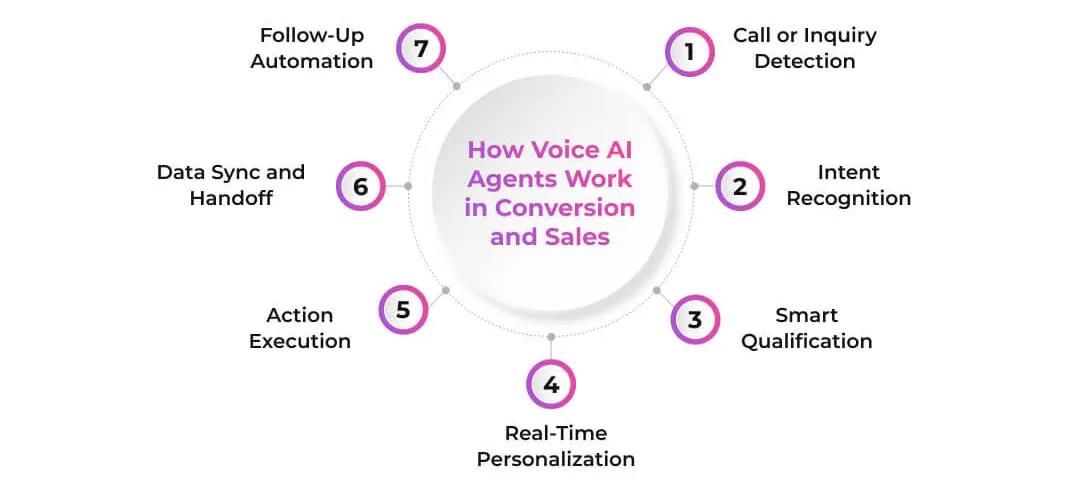
Voice AI agents don’t just talk. They move leads through your sales funnel with precision and purpose. Here’s how the process works, step by step:
Step 1: Call or Inquiry Detection
When a customer calls your business or submits a callback request, the voice agent responds instantly. There’s no music or long wait. The system listens and prepares to handle the conversation in real time.
Step 2: Intent Recognition
Using natural language processing, the agent identifies the customer’s intent. Whether they’re asking about a product, looking for pricing, or requesting support, the AI understands the goal behind the message.
Step 3: Smart Qualification
The agent asks simple, relevant questions to gauge the lead’s intent and interest level. It collects key details like timeline, budget, and decision-making power, helping your team focus on high-value prospects.
Step 4: Real-Time Personalization
Instead of reading a script, the voice agent adapts its responses based on customer tone, past interactions, and context. This creates a natural conversation that builds trust and keeps the caller engaged.
Step 5: Action Execution
Once the lead is qualified, the AI can take action. It can schedule a meeting, share a link, confirm an order, or hand the call off to a live rep when needed. Everything happens smoothly and without delay.
Step 6: Data Sync and Handoff
After the call, the agent logs all interaction data into your CRM or sales tools. This includes notes, lead status, and even customer sentiment, so your team has everything they need for next steps.
Step 7: Follow-Up Automation
If the lead isn’t ready to convert, the voice agent sets a follow-up. It might schedule another call, send a reminder, or re-engage through another channel to keep the conversation moving forward.
10 Ways Voice AI Agents Increase Conversions and Sales
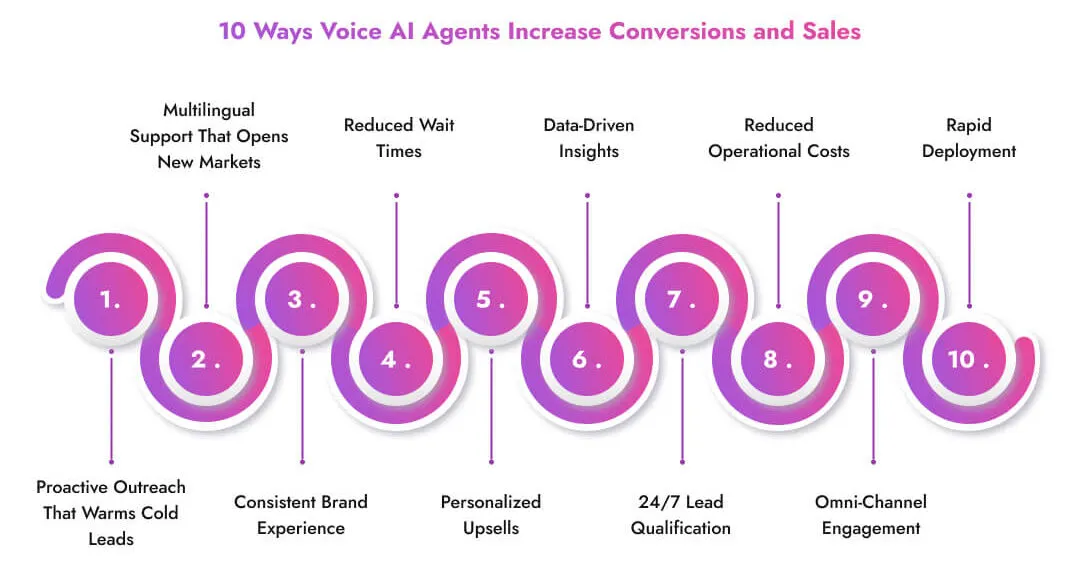
Voice AI agents are changing how businesses sell. They’re not just support tools; they’re sales engines. With every call, they qualify leads, guide buyers, and create seamless paths to purchase. Companies across industries are using them to close more deals, save costs, and deliver consistent experiences at scale.
If you’re still relying on manual processes and human-only teams to manage every interaction, you’re leaving revenue on the table. Here’s how smart businesses are using voice agents to drive measurable growth faster, smarter, and more efficiently.
1. Proactive Outreach That Warms Cold Leads
Most sales teams focus on inbound calls. But what about the leads that never call back? Voice AI agents take the first step.
They reconnect with dormant prospects using real-time data and past behavior. Whether it’s a follow-up on a product demo or a check-in after a free trial, AI reaches out when humans forget. This keeps your brand top of mind and shortens the sales cycle.
Businesses using proactive AI outreach have reported up to 22% more revenue just from re-engaging lost leads. It’s like having a tireless SDR working 24/7 without burnout.
2. Multilingual Support That Opens New Markets
Selling globally used to mean building regional teams, hiring local reps, and training across time zones. Voice AI changes that.
With multilingual capabilities, a single voice agent can engage customers in their native language instantly and naturally. From Spanish to Mandarin, the agent speaks fluently, understands context, and responds in a way that feels local, not automated.
Nearly 44% of buyers prefer service in their own language. This alone can boost conversion rates and improve customer trust, especially in regions where human staffing is limited or costly.
3. Consistent Brand Experience
Voice AI agents deliver the same professional tone and message in every conversation. Whether a customer calls in the morning or late at night, they get a consistent, brand-aligned experience. This builds trust, reduces confusion, and helps your business feel more reliable across every touchpoint.
4. Reduced Wait Times
Long hold times lead to lost interest and missed sales. Voice AI agents manage multiple conversations at once, reducing wait times from several minutes to just seconds. Faster responses keep customers engaged and help you convert more calls into real opportunities.
5. Personalized Upsells
Voice AI agents use real-time insights to suggest products or services that match each customer’s needs. By analyzing previous interactions and purchase history, they make recommendations that feel natural and helpful. This kind of personalization can boost average order value and make customers feel understood rather than sold to.
6. Data-Driven Insights
Every call handled by a voice AI agent creates valuable data. These insights reveal buying patterns, common objections, and conversion triggers that help you fine-tune your sales strategy. Businesses that use AI-driven analytics see stronger results because every future call becomes smarter than the last.
Here’s how voice AI turns raw conversations into strategic sales insights:
- Identify which questions lead to the highest conversion rates
- Spot objections that stall or kill deals, and refine messaging
- Track customer sentiment in real time
- Use transcripts to train teams and improve call flows
- Build predictive models for upselling and churn prevention
7. 24/7 Lead Qualification
Voice AI agents never clock out. They’re available around the clock to answer calls, qualify leads, and route high-intent prospects to the right place. This means your sales pipeline keeps moving even when your human team is offline, helping you capture more opportunities without lifting a finger.
8. Reduced Operational Costs
Hiring and training large sales or support teams takes time and money. Voice AI agents handle repetitive tasks at scale, allowing your human reps to focus on complex deals and relationships. This shift cuts overhead while increasing overall productivity and efficiency.
These are the key ways voice AI helps reduce costs while scaling effectively:
- Automate first-level queries and lead screening
- Eliminate the need to scale headcount during peak seasons
- Reduce training costs for entry-level roles
- Reallocate skilled reps to high-impact tasks
- Improve team efficiency without increasing budget
9. Omni-Channel Engagement
Voice AI agents can connect across voice, chat, SMS, and email without missing a beat. Customers can switch between channels and still feel like they’re having one smooth conversation. This unified experience reduces friction and keeps leads moving forward, no matter how they reach out.
10. Rapid Deployment
Getting started with voice AI doesn’t take months. With the right AI voice agent development services, your system can be live in just a few weeks. Quick deployment means you start seeing results sooner, giving you a competitive edge while others are still stuck in planning mode.
Here’s why setup is faster and easier than most businesses expect:
- Most platforms integrate with CRMs and phone systems in weeks
- No need for heavy infrastructure or large IT teams
- Pre-built voice flows speed up configuration
- Faster setup means faster ROI
- Early movers gain an edge in competitive markets
Step-by-Step Process to Implement Voice AI Agent in Sales
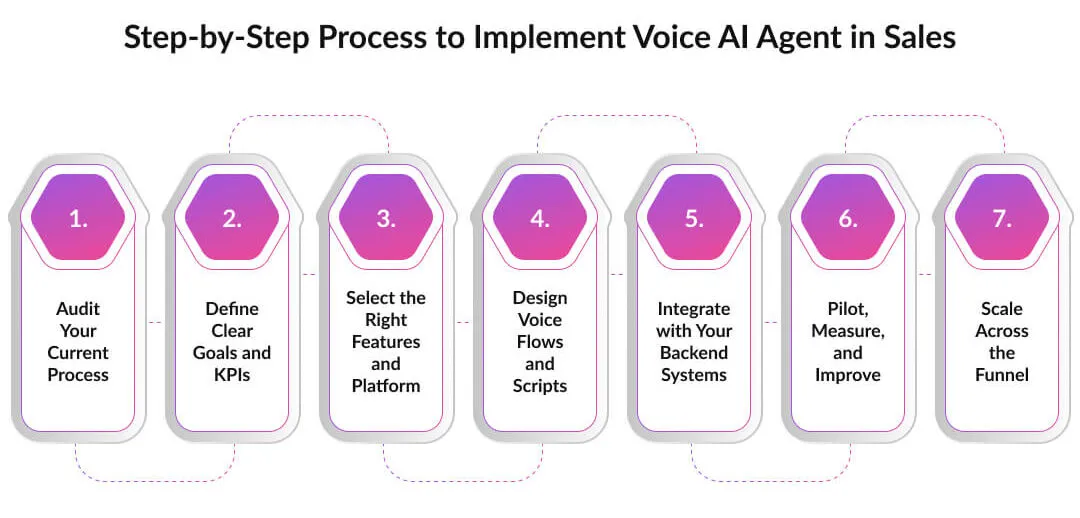
Rolling out a voice AI agent is not a plug-and-play task. To see real results like better lead engagement, higher conversions, and smarter automation, you need a clear and focused setup process. Whether you’re starting fresh or upgrading your current system, every step plays a critical role.
Here’s a straightforward process to help you bring voice AI into your sales workflow with confidence and clarity.
1. Audit Your Current Process
Start by identifying where your current call or sales process is falling short. Are leads being lost after the first contact? Are reps missing calls outside office hours? A detailed funnel audit will help you find the gaps where a voice agent can make the biggest impact.
- Review call volume, missed calls, and customer wait times
- List tasks your team handles manually but could automate
- Look for funnel stages where leads commonly drop off
2. Define Clear Goals and KPIs
Before selecting any tools or writing conversation scripts, get clear on what you want to achieve. Measurable goals will keep your team aligned and help you track performance.
- Set specific outcomes like more qualified leads or shorter response times
- Define KPIs such as contact rate, qualification rate, deal velocity, and ROI
- Make sure every goal connects directly to your sales or customer success strategy
3. Select the Right Features and Platform
Your voice AI platform should match both your business goals and technical needs. Choosing the right one is a critical step in setting your team up for long-term success.
- Look for low-latency speech recognition and smooth user interaction
- Choose a platform that offers multilingual support if you serve global markets
- Prioritize features like live transfer to human agents, CRM integration, and compliance readiness
4. Design Voice Flows and Scripts
Once your goals are clear and the platform is selected, it’s time to map out how your voice agent will talk to customers. This includes the main conversation paths and what happens when the unexpected comes up.
- Create separate flows for different use cases like lead qualification, booking demos, or handling objections
- Keep language simple, friendly, and human
- Add fallback logic for situations when the agent doesn’t understand or needs to escalate
5. Integrate with Your Backend Systems
To make the voice agent useful beyond just talking, it needs to connect with your core tools. This ensures smooth workflows and no lost data between systems.
- Sync with your CRM to store lead details and conversation history
- Connect scheduling tools to enable real-time bookings
- Link marketing automation or ticketing platforms for follow-up actions
6. Pilot, Measure, and Improve
Before a full rollout, test the voice agent with a small group or in a limited scenario. This allows you to catch issues early and optimize based on real user feedback.
- Run A/B tests on scripts to see what converts better
- Track metrics like completion rate, drop-off points, and customer sentiment
- Use feedback from sales reps and callers to refine flows and improve accuracy
7. Scale Across the Funnel
Once the pilot proves successful, expand the use of voice AI across more stages of the funnel. You can start with lead qualification, then move into post-sale check-ins or re-engagement campaigns.
- Identify other touchpoints where voice AI can save time or boost conversions
- Maintain regular reviews to ensure flows stay relevant as your strategy evolves
- Train your team to collaborate with the AI instead of working around it
Future of Conversion and Sales With Voice AI
The way people buy is changing fast. In the coming years, voice will become a core part of how customers discover, engage, and convert. It won’t just be a support feature. It will be integrated into the entire sales journey, from the first question to the final decision.
More customers are choosing to speak instead of type. More businesses are investing in voice-first strategies. And sales teams are beginning to realize that voice AI can do far more than just handle calls.
Here’s what the future of conversion and sales looks like with voice AI at the center:
Personalized, Real-Time Conversations
Voice agents will deliver fast, intelligent responses that adapt to each customer’s needs. These conversations will feel more natural, more helpful, and more human. Buyers will get relevant answers and product suggestions on the spot, increasing both satisfaction and conversion rates.
Voice Search Will Redefine How Buyers Discover You
As voice search becomes more common, customers will find solutions by asking their phone or smart speaker instead of typing. Businesses that optimize for voice queries will show up more often in results and connect with motivated buyers earlier in the funnel.
Unified Experiences Across Channels
Voice AI will not be limited to phone calls. It will connect across mobile apps, smart speakers, and customer support systems to create one consistent experience. Customers will be able to move between platforms without repeating themselves or losing context.
Smarter and More Automated Sales Workflows
Voice agents will be capable of handling complex actions like booking demos, sending follow-ups, and qualifying leads without human help. This will allow sales teams to focus on closing deals while AI takes care of the busy work.
Voice technology is no longer optional. It’s becoming a competitive advantage. Businesses that act now will convert faster, serve better, and lead the market while others are still figuring it out.

Conclusion
Voice AI is no longer just a futuristic concept. It’s a practical, proven tool for boosting conversions, qualifying leads faster, and creating consistent customer experiences. From real-time conversations to data-driven decisions, voice agents are changing the way businesses sell.
If you’re serious about staying ahead, now is the time to take action. Partnering with the right AI development services can help you design, deploy, and scale voice AI solutions effectively. Start small, test what works, and expand across your sales funnel. The sooner you integrate voice AI into your strategy, the faster you’ll see real results and the harder it will be for your competitors to catch up.
Frequently Asked Questions (FAQs)
A voice AI agent is a virtual assistant powered by artificial intelligence that communicates with users through natural speech. It can understand, respond, and take action in real time to support sales, customer service, and lead engagement.
Voice AI agents help increase conversions by responding instantly, even during off-hours, which keeps potential buyers from losing interest. They qualify leads by asking the right questions and gathering key information early in the conversation. By offering personalized responses and guiding users based on their intent, voice agents create a smooth and engaging experience. This speeds up the sales process, reduces drop-offs, and helps sales teams focus only on the most qualified prospects.
Voice AI doesn’t replace human reps. It supports them by handling repetitive tasks, qualifying leads, and managing follow-ups. This allows your sales team to focus on closing deals and building relationships.
Most modern voice AI platforms integrate easily with CRMs, scheduling tools, and marketing automation systems. With the right voice AI agent development partner and setup the deployment can take just a few weeks.
Advanced voice AI uses natural language processing and machine learning to understand tone, context, and intent. Accuracy improves over time as the system learns from each interaction.
Yes, many voice AI platforms offer multilingual support. This allows businesses to serve international customers without hiring region-specific teams.
For example, an e-commerce brand in the U.S. can use a voice AI agent to handle calls in English, Spanish, and French, It will automatically switch language based on the caller’s language preference. This helps expand into new markets while keeping operations lean.
You can track metrics like lead qualification rate, call resolution time, conversion rate, and customer satisfaction. Comparing these metrics before and after implementation shows clear ROI.