AI Agent Development Cost by Complexity: What You’ll Pay in 2026
Key takeaways
- AI agent development in 2026 typically costs $8,000 to $500,000+, depending on complexity, autonomy, integrations, data requirements, security, and deployment scale.
- Costs rise sharply by complexity: basic agents cost 8,000–25,000, while advanced autonomous agents can reach 80,000–200,000 and enterprise multi-agent systems 200,000–500,000+.
- Autonomy, integration depth, data readiness, RAG and memory, model requirements, and security/compliance are the main factors that drive AI agent development costs.
- Development cost is only part of the investment. LLM usage, vector storage, cloud hosting, APIs, monitoring, testing, security, and maintenance create ongoing expenses after launch.
- Businesses can control costs by starting with a focused workflow, limiting early autonomy and integrations, improving data quality, using smaller models where appropriate, and adding advanced capabilities in phases.
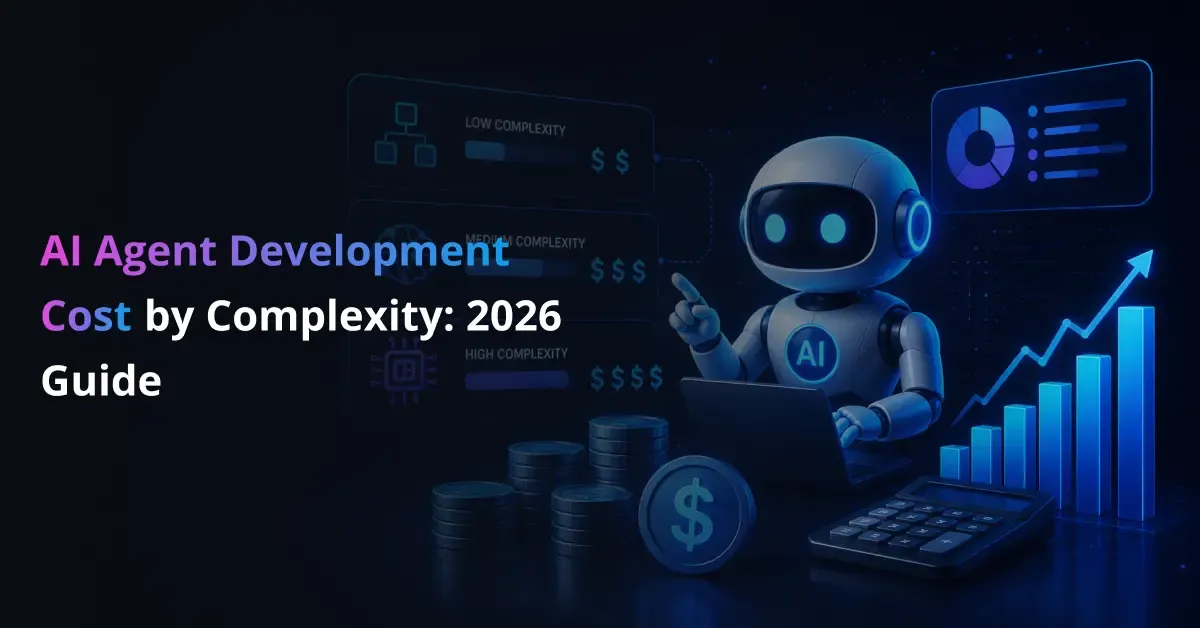
AI agent development cost usually starts near $8,000 for basic agents and can exceed $500,000 for enterprise multi-agent systems. The gap comes from autonomy, integration depth, data requirements, security controls, and production scale.
Basic agents follow narrow workflows. Advanced agents plan actions, use memory, call external tools, and operate across several enterprise systems. Each added capability increases engineering effort, testing scope, and ongoing infrastructure needs.
Most organizations should estimate cost by complexity before comparing vendors. This gives a clearer view of what the agent must do, how much control it needs, and what level of production reliability the business expects.
AI Agent Development Cost at a Glance
AI agent pricing changes quickly once workflows move beyond simple task execution. A single-purpose assistant may use an existing model API and one data source. An enterprise agent may coordinate several models, tools, databases, and approval layers.
| Complexity |
Typical capabilities |
Estimated development cost |
Typical timeline |
| Basic / Reactive |
Single-purpose tasks, predefined logic, limited integrations |
$8,000–$25,000 |
4–8 weeks |
| Intermediate / Workflow |
RAG, short-term memory, multi-step workflows, standard APIs |
$25,000–$80,000 |
8–16 weeks |
| Advanced / Autonomous |
Planning, tool orchestration, persistent memory, guardrails |
$80,000–$200,000 |
3–6 months |
| Enterprise Multi-Agent |
Multiple agents, legacy integrations, compliance, centralized controls |
$200,000–$500,000+ |
6–12+ months |
These figures work best as planning ranges. The final cost to build an AI agent depends on decision complexity, system access, data quality, runtime volume, and deployment requirements.
Development cost is only the first layer. Model usage, vector storage, cloud hosting, monitoring, and maintenance continue after launch and can materially change total ownership cost.
Know What Your AI Agent Will Cost Before You Build
Prismetric helps define the right scope, autonomy, integrations, data requirements, and architecture to create a realistic AI agent development budget.
Estimate Your AI Agent Cost
AI Agent Development Cost by Complexity
Complexity determines how much logic, infrastructure, and control an agent needs. It also determines how many failure paths the engineering team must test before production deployment.
Basic or Reactive AI Agents: $8,000–$25,000
Basic AI agents handle tightly scoped tasks. They usually rely on existing large language model (LLM) APIs, fixed instructions, and limited tool access.
Common use cases include:
- FAQ assistance
- Internal information retrieval
- Lead qualification
- Document classification
- Basic data-entry automation
These agents cost less because the workflow stays predictable. Development teams manage fewer integrations, fewer decision branches, and a smaller testing surface.
Many companies start here when they want AI workflow automation for repetitive internal processes. The agent can retrieve information, trigger a predefined action, or pass an exception to a human without managing complex long-running execution.
Workflow selection still matters. An AI workflow discovery checklist can help teams identify whether the process actually needs an agent or whether simpler automation is enough.
Intermediate or Workflow AI Agents: $25,000–$80,000
Intermediate agents manage connected tasks across several steps. They can preserve short-term context, retrieve enterprise information, call tools, and move work between systems.
Retrieval-augmented generation (RAG) often appears at this level. RAG allows the agent to retrieve approved business information before generating a response or taking an action.
These systems commonly require:
- Short-term memory
- Multi-step workflow logic
- Retrieval pipelines
- CRM or messaging integrations
- Tool calling
- Permission controls
- Production monitoring
The additional cost comes from orchestration and data access. Teams must build ingestion pipelines, manage permissions, evaluate retrieval quality, and handle API failures across the workflow.
RAG implementation can become a core architectural requirement rather than an optional feature. The same applies to integrating LLMs with enterprise databases when agents must retrieve current operational information during execution.
Advanced or Autonomous AI Agents: $80,000–$200,000
Advanced AI agents operate with greater independence across complex workflows. They can plan actions, select tools, maintain context, evaluate results, and continue execution without requiring approval at every step.
This level of autonomy increases development effort. Teams must build more orchestration logic, manage additional failure scenarios, and define clear boundaries around what the agent can execute.
Advanced agents commonly include:
- Persistent memory
- Planning and reasoning logic
- Dynamic tool selection
- Error recovery
- Human-in-the-loop approvals
- Workflow checkpoints
- Guardrails
- Detailed observability
Some projects also require LLM fine-tuning when general-purpose models cannot meet domain-specific requirements. This adds work across data preparation, training, evaluation, and deployment.
Testing becomes more demanding as autonomy increases. Teams must verify not only what the agent produces, but also which tools it selects and what actions it performs.
An AI model testing framework can help evaluate task completion, tool selection, failure recovery, and output consistency. Organizations should also compare RAG and fine-tuning before adding model customization that may not be necessary.
Enterprise Multi-Agent Platforms: $200,000–$500,000+
Enterprise multi-agent systems coordinate several agents across business processes. Each agent may handle a specialized task while sharing context, data, or execution responsibility with other agents.
These systems are more expensive because complexity moves beyond the AI model. Identity, permissions, governance, observability, reliability, and integration architecture become major engineering requirements.
Enterprise deployments often require:
- Multiple specialized agents
- Agent-to-agent coordination
- ERP and CRM integrations
- Role-based access controls
- Centralized monitoring
- Audit logs
- Human escalation workflows
- Compliance controls
- High availability
Organizations using enterprise AI development also need to define which agents can access data and which actions require approval. These controls become critical when agents interact with financial, customer, or operational systems.
Legacy integration can increase the budget further. Older systems may not provide modern APIs or consistent data structures.
An AI integration architecture for legacy systems may require middleware, authentication layers, data transformation, and additional validation. In some projects, this integration work costs more than the agent logic itself.
Planning to connect an agent with ERP infrastructure? Review the guide to integrating AI with SAP ERP systems before estimating the enterprise integration scope.
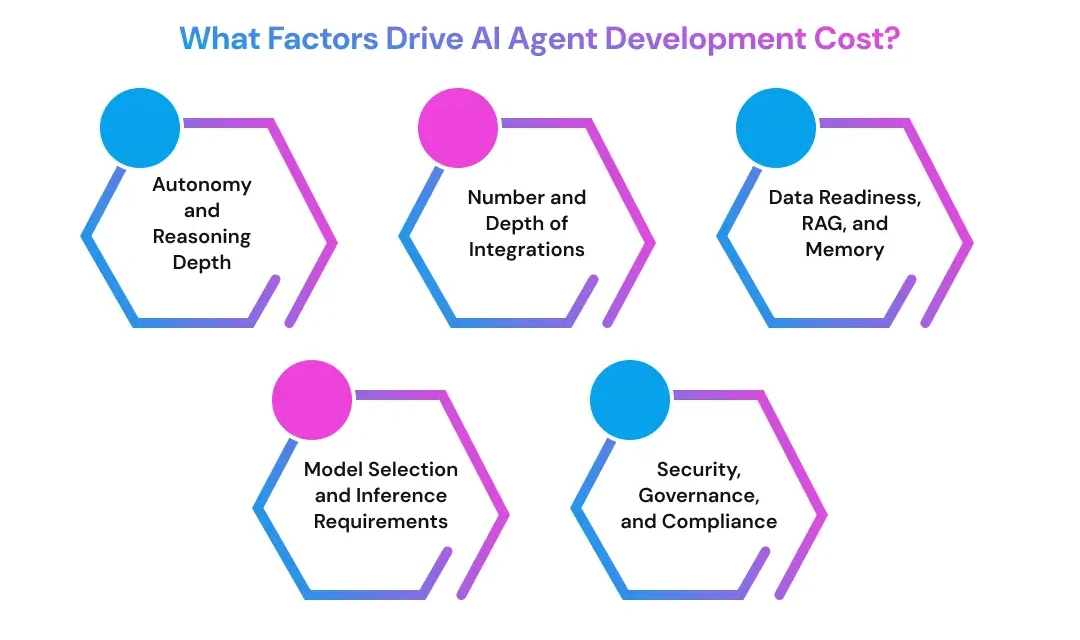
What Factors Drive AI Agent Development Cost?
AI agent development cost rises when the system requires more autonomy, more data, or deeper access to business infrastructure. Each added requirement creates additional development and testing work.
Autonomy and Reasoning Depth
Simple agents follow predefined execution paths. Autonomous agents decide what to do next based on context, tool results, and workflow conditions.
More decision paths require stronger orchestration, exception handling, and guardrails. Teams must also test a wider range of possible actions before deployment.
Number and Depth of Integrations
Integrations determine what an agent can access and what it can execute. Connecting one documented API is different from coordinating actions across CRM platforms, ERP systems, databases, and internal tools.
Projects involving broader AI integration require additional work for authentication, data mapping, middleware, retries, and failure handling.
Data Readiness, RAG, and Memory
AI agents depend on reliable data to retrieve context and complete tasks. Poorly structured or fragmented data increases preparation work before the agent reaches production.
Common data requirements include:
- Data cleaning
- Document ingestion
- Embedding generation
- Vector indexing
- Access permissions
- Retrieval evaluation
- Memory storage
Strong data engineering can reduce these problems early. It helps teams create stable pipelines before retrieval and memory layers are added.
Model Selection and Inference Requirements
Model choice affects both development cost and operating cost. Larger models can support stronger reasoning, but they may also increase inference spending and latency.
Some architectures use multiple models. Smaller models handle routine tasks while more capable models are reserved for complex reasoning.
Organizations may use large language model development services when model routing, fine-tuning, or custom deployment becomes part of the architecture.
Security, Governance, and Compliance
Agents that access sensitive business data require additional controls. These may include encryption, access policies, audit trails, approval workflows, and data-retention rules.
Regulated organizations must also account for AI regulation and compliance requirements during architecture design. Adding these controls after development can create expensive rework.
Initial Development Cost vs. Ongoing AI Agent Costs
The initial budget covers architecture, development, integrations, data preparation, testing, and deployment. Production costs continue after the agent goes live.
Ongoing AI agent costs can include:
- LLM token usage
- Vector database storage
- Embeddings
- Cloud hosting
- Third-party APIs
- Monitoring
- Security controls
- Regression testing
- Maintenance
These costs depend on request volume, model selection, workflow length, and infrastructure design. Long-running agents that call several tools or models may consume more resources than simpler request-response systems.
The lowest development price does not always create the lowest total cost. Inefficient model calls, repeated agent loops, or unnecessary infrastructure can increase spending over time.
Organizations comparing broader AI budgets can also review generative AI development cost to understand how model, infrastructure, and implementation choices affect total investment.
Validate Your AI Agent Before Making a Bigger Investment
Start with a focused AI PoC to test workflows, data, integrations, model performance, and technical feasibility before scaling into a production system.
Start Your AI Agent PoC
How to Reduce AI Agent Development Cost Without Reducing Reliability
Organizations can reduce AI agent development cost by controlling scope before development begins. The goal is to remove unnecessary complexity without weakening security, testing, or workflow reliability.
A structured AI PoC development process can test the highest-risk assumptions first. Teams can then move toward anAI MVP once the workflow, data, and model behavior are validated.
Teams can control development costs by:
- Limiting autonomy during the first release
- Connecting only essential business systems
- Using smaller models for routine tasks
- Improving data quality before integration
- Testing critical workflows early
- Adding advanced capabilities in phases
Model routing can also reduce operating costs. Simple requests can use smaller models, while stronger models handle tasks that require deeper reasoning.
Organizations moving from validation to production may also use AI implementation services to structure deployment, integration, and monitoring requirements before the architecture becomes difficult to change.
Deciding how far to invest before full development?
Compare AI PoC vs. AI MVP to select the right validation stage.
How Prismetric Helps Businesses Build Production-Ready AI Agents
As an AI development company, Prismetric helps businesses plan, build, integrate, and deploy AI agents around real operational workflows.
AI agent development becomes more demanding as projects add enterprise data, autonomous execution, multiple integrations, and stricter security requirements. These requirements affect both the initial development budget and the cost of maintaining the system after deployment.
Prismetric works across the AI development lifecycle, from early validation to production implementation. Our teams build agent architectures that connect with business systems, retrieve enterprise data, automate multi-step workflows, and support controlled execution at scale.
Prismetric builds AI agent systems using capabilities such as:
- Large language model integration
- Retrieval-Augmented Generation (RAG)
- Multi-agent orchestration
- Context and memory management
- API and enterprise system integration
- Human-in-the-loop workflows
- Role-based access controls
- Monitoring and observability
- Enterprise security and compliance
Our AI development experience includes:
- Healthcare
- Fintech and banking
- Logistics
- Automotive
- Retail and eCommerce
- Travel and hospitality
- Education
- Media and entertainment
- Enterprise operations
Prismetric reports more than 1,000 clients, 1,500 developed solutions, delivery across 50+ countries, and a team of 100+ developers.
| Prismetric Delivery Capability |
Scale |
| Happy Clients |
1,000+ |
| Solutions Developed |
1,500+ |
| Countries Served |
50+ |
| Developers |
100+ |
We help businesses build:
- Single-purpose AI agents
- RAG-powered enterprise assistants
- Autonomous workflow agents
- Multi-agent systems
- Enterprise copilots
- AI-powered workflow automation
- AI agents connected with CRM and ERP systems
- Secure agent architectures for sensitive business data
Our engineering teams focus on production requirements such as:
- Workflow reliability
- Integration stability
- Data access and permissions
- Human approval checkpoints
- Runtime monitoring
- Failure handling and recovery
- Auditability
- Security and governance
- Scalable deployment
The right architecture can help prevent businesses from paying for autonomy, infrastructure, or model capacity that the workflow does not require. Prismetric helps organizations align AI agent scope with business requirements so development decisions account for both immediate implementation costs and long-term operating needs.
How to Estimate an AI Agent Development Budget
A reliable estimate starts with the workflow rather than the model. Teams need to understand what the agent must do, what it can access, and how much independence it requires.
Budget planning should answer five questions:
- What tasks will the agent perform?
- How much autonomy does it need?
- Which systems must it access?
- What data requires preparation?
- What security and compliance controls are required?
These answers help place the project into the basic, intermediate, advanced, or enterprise complexity tier. AI consulting services can help define these requirements before engineering estimates are finalized.
For projects ready to move into production, an AI agent development company can estimate the effort across architecture, integrations, data pipelines, testing, and deployment.
Build a Production-Ready AI Agent Around Your Business Workflow
Prismetric develops secure AI agents with RAG, memory, enterprise integrations, human approvals, monitoring, and scalable orchestration.
Talk to Our AI Agent Experts
Frequently Asked Questions About AI Agent Development Cost
AI agent development can cost $8,000 to $500,000+ in 2026, depending on the agent’s complexity, autonomy, integrations, data requirements, security, and deployment scale.
Basic agents sit at the lower end, while autonomous and enterprise multi-agent systems require significantly larger development budgets.
A basic or reactive AI agent typically costs $8,000–$25,000. These agents usually handle a narrow task using predefined instructions, an existing LLM API, and limited integrations.
They are commonly used for FAQ support, information retrieval, lead qualification, document classification, and simple workflow automation.
AI agents become expensive when they need to make decisions, access multiple systems, maintain memory, retrieve business data, or execute actions autonomously.
Major cost drivers include:
- Agent autonomy and reasoning depth
- Number of integrations
- RAG and data preparation
- Memory requirements
- Model selection
- Testing and monitoring
- Security and compliance controls
An advanced autonomous AI agent generally costs around $80,000–$200,000 to develop.
The higher cost comes from planning logic, persistent memory, dynamic tool selection, error recovery, guardrails, workflow checkpoints, and human approval mechanisms.
Unlike basic assistants, autonomous agents also require testing of both their responses and the actions they choose to perform.
Enterprise multi-agent systems typically cost $200,000–$500,000+ because several specialized agents must coordinate across shared workflows and enterprise infrastructure.
Costs can increase further when the system requires:
- ERP or CRM integrations
- Agent-to-agent communication
- Role-based access
- Audit logs
- Compliance controls
- Centralized monitoring
- High availability
- Legacy system integration
A narrowly scoped AI agent may be possible near the $8,000–$10,000 range when it performs one predictable task and relies primarily on existing APIs and infrastructure.
Complex workflows, custom integrations, enterprise data, persistent memory, or autonomous decision-making will usually push the project beyond that budget.
There is no fixed integration price because the effort depends on API availability, authentication, data structure, workflow complexity, permissions, and the number of systems involved.
Modern documented APIs generally require less engineering than legacy ERP or internal systems.
Integration work may include:
- API development
- Authentication
- Data mapping
- Middleware
- Permission management
- Retry and failure handling
- Data validation
For complex enterprise projects, integration work can become one of the largest parts of the overall AI agent budget.
Yes. Adding Retrieval-Augmented Generation (RAG) increases development work because teams must prepare data, build ingestion pipelines, generate embeddings, configure retrieval, manage permissions, and evaluate retrieval quality.
However, RAG can be valuable when an agent must answer questions or make decisions using approved, current enterprise information.
Using an existing LLM API is usually cheaper and faster for most AI agent projects because the team does not need to train and maintain a foundation model.
Custom model development or fine-tuning becomes more relevant when general-purpose models cannot meet specific domain, accuracy, privacy, or deployment requirements.
Development is only part of the total cost. Production AI agents continue generating infrastructure and operational expenses after deployment.
Typical ongoing costs include:
- LLM token usage
- Embeddings
- Vector database storage
- Cloud hosting
- Third-party APIs
- Monitoring
- Security infrastructure
- Regression testing
- Maintenance
The actual monthly cost depends heavily on user volume, workflow length, model choice, and how frequently the agent calls tools or other models.
There is no universal monthly maintenance figure because operating costs vary significantly by architecture and usage.
A low-volume agent using one model and a few simple workflows may have relatively modest operating expenses.
An enterprise agent handling large request volumes, multiple models, extensive retrieval, monitoring, integrations, and long-running workflows can require a much larger recurring budget.
An AI agent generally costs more than a simple AI chatbot because an agent can do more than generate responses.
A typical chatbot may primarily answer questions, while an AI agent may:
- Plan multiple steps
- Retrieve business data
- Call external tools
- Update enterprise systems
- Maintain memory
- Make workflow decisions
- Trigger actions
- Escalate tasks to humans
The additional orchestration, integrations, controls, and testing increase development cost.
Start with the smallest workflow that produces measurable business value rather than building maximum autonomy into the first release.
Companies can reduce unnecessary development spending by limiting initial integrations, improving data quality early, using smaller models for simple requests, and validating critical workflows before expanding the system.
A phased approach also allows advanced memory, autonomy, integrations, and multi-agent capabilities to be added only when the business case justifies them.
Development time generally increases with complexity. A basic agent may take 4–8 weeks, while enterprise multi-agent systems can require 6–12 months or longer.
Intermediate workflow agents often take 8–16 weeks, while advanced autonomous agents commonly require around 3–6 months.
Integration complexity, data readiness, testing requirements, compliance, and approval processes can extend these timelines.
A reliable estimate starts with the business workflow instead of simply choosing an AI model.
Before requesting a development estimate, define:
- What tasks the agent will perform
- How much autonomy it needs
- Which applications and databases it must access
- What enterprise data needs preparation
- Whether RAG or memory is required
- Expected user and request volume
- Security and compliance requirements
- Human approval requirements
- Production reliability expectations
These details help determine whether the project belongs in the basic, intermediate, advanced, or enterprise AI agent complexity tier.
It can be when the agent automates a high-value, repetitive, or time-consuming workflow and the expected operational benefit exceeds its development and ongoing costs.
The business case becomes weaker when a workflow is simple enough for traditional automation or when unnecessary autonomy and infrastructure are added without a clear operational need.
Use simple automation when rules are predictable and every execution path can be predefined.
An AI workflow becomes more useful when language understanding, retrieval, or model-based decisions are required.
An AI agent is better suited to workflows where the system must dynamically decide what to do next, choose tools, maintain context, recover from errors, or coordinate several steps with limited human intervention.