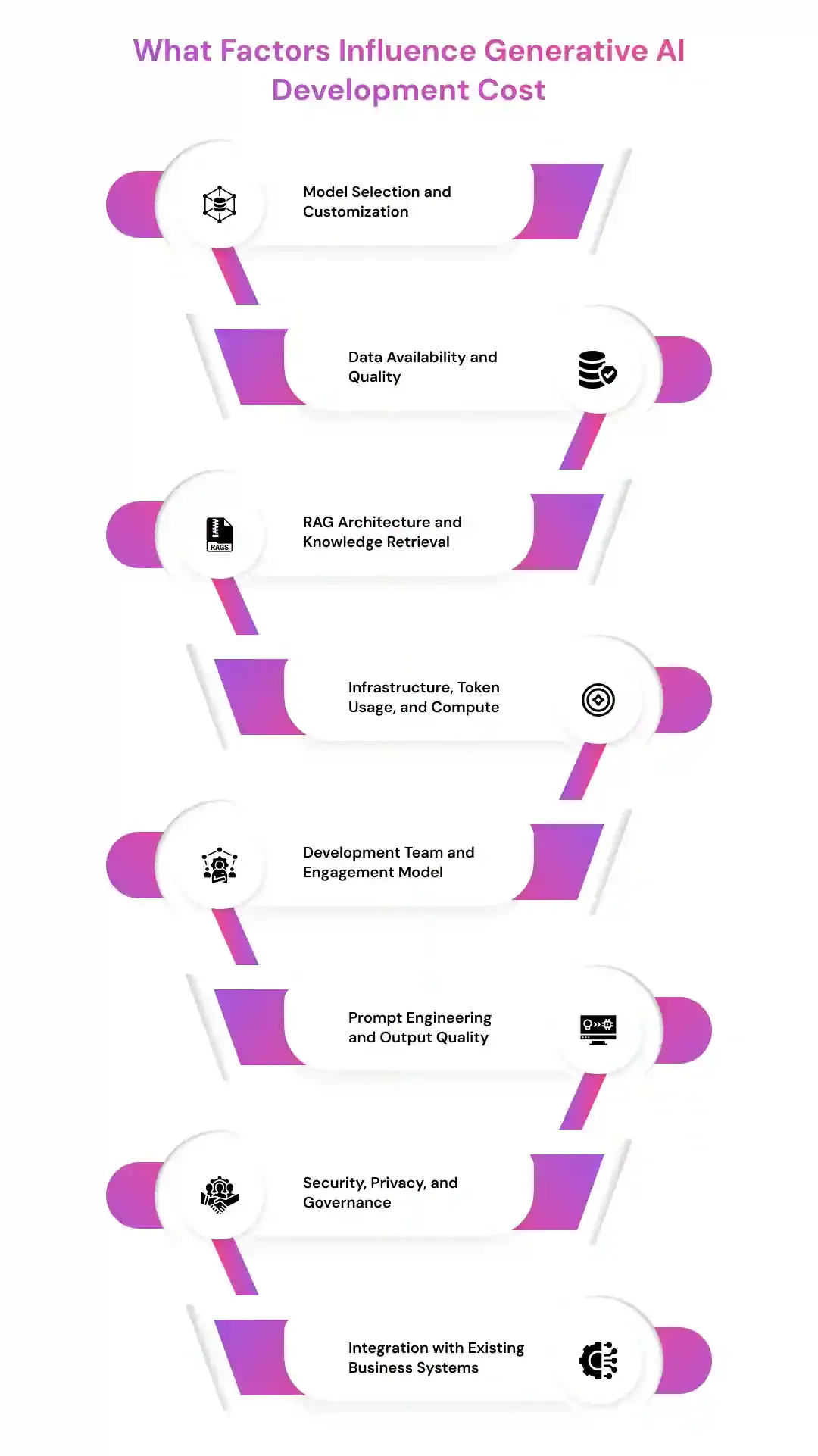
Generative AI Development Cost in 2026: A Complete Pricing Guide

Key Takeaways
- The generative AI development cost in 2026 usually ranges from $20,000 to $500,000+, depending on the use case, model approach, data quality, integrations, infrastructure, and scale.
- A simple GenAI chatbot or content assistant costs much less than a production-ready AI copilot, RAG-based knowledge system, or enterprise generative AI platform.
- Model selection plays a major role in the final budget. Using APIs or pre-trained models keeps the initial cost lower, while fine-tuning, private deployment, and custom model development increase the overall investment.
- Hidden costs such as token usage, cloud infrastructure, vector databases, data preparation, monitoring, security, compliance, and ongoing optimization can increase the long-term cost of generative AI implementation.
- Working with an experienced generative AI development company like Prismetric helps businesses control development cost, avoid unnecessary complexity, and build scalable GenAI solutions around real business goals.
Quick Answer: How Much Does Generative AI Development Cost?
Generative AI development cost usually ranges from $20,000 to $50,000 for a basic prototype, $50,000 to $250,000 for a mid-scale AI application, and $250,000 to $500,000+ for an enterprise-grade generative AI platform. However, the final cost can go beyond $1 million for complex AI agents, heavily customized workflows, regulated industry solutions, or platforms that require advanced security, large-scale infrastructure, proprietary data pipelines, and multiple system integrations.
In simple terms, the more your generative AI solution depends on custom data, real-time performance, third-party integrations, fine-tuning, compliance, and high user volume, the higher the development cost will be.
| Project type |
Estimated cost |
Timeline |
Best for |
| GenAI prototype / PoC |
$20k–$50k |
3–8 weeks |
Validating an idea |
| Basic AI chatbot / text generator |
$30k–$100k |
6–12 weeks |
Customer support, internal Q&A |
| RAG-based knowledge assistant |
$60k–$180k |
8–16 weeks |
Company docs, search, support |
| AI copilot / workflow automation |
$100k–$300k |
3–6 months |
Sales, HR, legal, operations |
| Fine-tuned GenAI application |
$150k–$400k |
4–8 months |
Domain-specific performance |
| Enterprise GenAI platform |
$250k–$500k+ |
6–12 months |
Multi-team, secure, scalable AI |
| Agentic AI / multi-agent system |
$150k–$1M+ |
4–18 months |
Tool use, automation, autonomous workflows |
If you are looking for the generative AI development cost, you have probably seen very different numbers.
One source may tell you that a GenAI chatbot is affordable. Another may show six-figure pricing for an enterprise AI system. Both can be right.
The real cost depends on what you want generative AI to do.
A simple AI writing assistant and a full-scale enterprise AI copilot are not built the same way. A basic chatbot that connects with a website is different from a RAG-based system that reads company documents, understands user intent, connects with internal tools, and gives controlled responses.
That is why the cost of generative AI development varies so much.
Instead of asking only how much generative AI costs, it is better to ask what actually drives the cost.
In this guide, you will get a clear breakdown of the GenAI development cost, the factors that affect it, and how businesses can estimate the right budget before starting development.
Don’t Let GenAI Costs Slow Down Your Product Roadmap
Generative AI can reduce manual work, speed up decisions, and create better digital experiences. But without the right cost planning, the budget can grow faster than expected.
Get a custom GenAI cost estimate from Prismetric’s AI experts.
What Drives Generative AI Development Cost in 2026?
The generative AI development cost in 2026 typically ranges from $40,000 to $500,000+ for most business use cases.
That range covers everything from AI chatbots and content generation tools to AI copilots, RAG-based assistants, document automation platforms, and enterprise-grade GenAI systems.
But the number only makes sense when you look at what sits behind it.
The cost to build generative AI is not a fixed package price. A clear software development cost estimation process helps businesses connect scope, team, timeline, architecture, and long-term support before finalizing the budget. It is a mix of model selection, data preparation, prompt engineering, backend development, cloud infrastructure, API usage, integration depth, security, testing, and ongoing optimization.
Here is a simple way to understand the cost range.
| GenAI Project Category |
Estimated Cost Range |
Typical Use Cases |
Key Characteristics |
| Entry-Level GenAI Solutions |
$20,000 – $90,000 |
AI chatbots, content generators, summarization tools, simple AI assistants |
Uses existing LLM APIs or pre-trained models. Limited workflows. Basic integration. Faster launch. |
| Mid-Level GenAI Applications |
$90,000 – $250,000 |
AI copilots, document AI tools, RAG-based knowledge assistants, personalized content systems |
Connects with business data. Uses custom prompts, retrieval workflows, APIs, and user-specific logic. Moderate integration. |
| Advanced / Enterprise GenAI Systems |
$250,000 – $500,000+ |
Enterprise AI copilots, multimodal GenAI platforms, private LLM deployments, AI agent workflows |
Built for scale, security, governance, high usage, complex workflows, advanced integrations, and continuous optimization. |
You must know that these ranges are not final quotes. Even when you see ranges on others blogs, those are also not the final cost.
They are just practical starting points.
This is how you should think about GenAI cost
Instead of starting with a broad question like “How much does generative AI cost?”, start with scope.
Ask these questions first:
- Are you building a small AI feature or a complete GenAI product?
- Will the solution use a third-party LLM API or an open-source model?
- Do you need RAG, fine-tuning, or custom model development?
- Will the system connect with your CRM, ERP, database, website, app, or internal tools?
- How many users will access the solution every day?
- How sensitive is the data going into the model?
- Do you need human review, audit logs, access control, or compliance support?
See it like this, the more control, customization, and scale you need, the higher the custom generative AI development cost becomes.
For example, adding GPT or Gemini to a basic chatbot is one level of effort. Building an AI copilot that understands your internal documents, retrieves accurate answers, respects user permissions, integrates with your business systems, and improves over time is a different level altogether.
That is where the generative AI app development cost starts moving from a simple implementation budget to a full product engineering budget.
At Prismetric, we help businesses map their GenAI idea to the right technical approach before development begins. That helps avoid overbuilding, reduce unnecessary cost, and create a realistic roadmap for launch.
What Factors Influence Generative AI Development Cost in 2026?
When businesses plan a GenAI project, the budget rarely increases because of one single decision.
It usually increases because of many smaller choices.
- The model you choose.
- The quality of your data.
- The number of integrations.
- The amount of usage.
- The level of security.
- The accuracy you expect.
- The experience you want users to have.
That is how the cost of building a generative AI application works.
Two projects can look similar from the outside. But once you go deeper, their cost can move in completely different directions.
Here are the main factors that affect the generative AI solution cost.
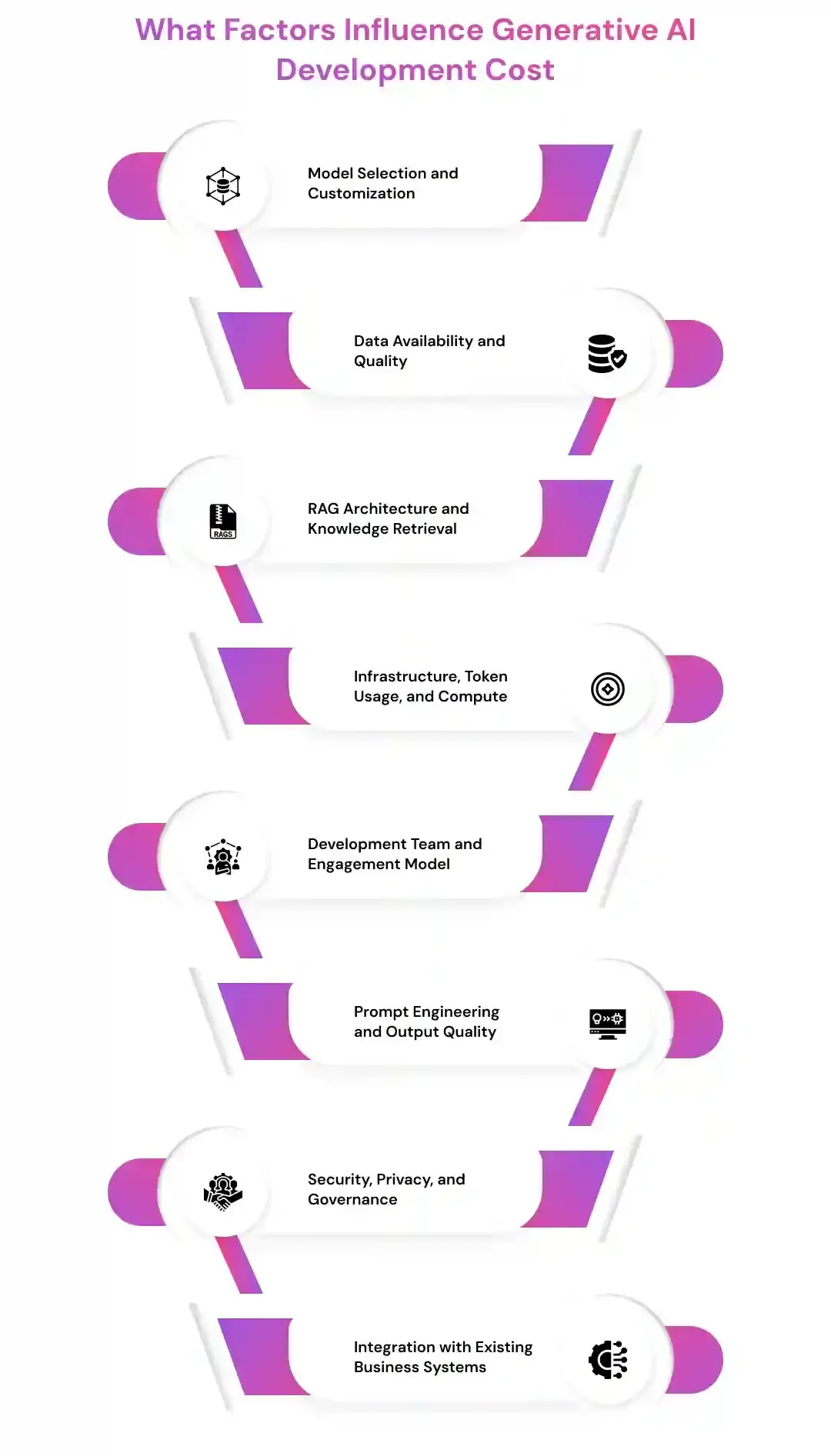
1. Model Selection and Customization
The next major factor is the model approach.
Not every GenAI project needs a custom model. In many cases, businesses can start with existing models such as GPT, Claude, Gemini, Llama, Mistral, or Stable Diffusion and build the product layer around them.
This keeps the initial LLM development cost lower.
But the cost changes when you need more control.
Common model approaches include:
- Using a commercial LLM API
- Using an open-source model as it is
- Fine-tuning a model with business-specific data
- Deploying a private model on cloud or on-premise infrastructure
- Building a custom model for specialized requirements
API-based development is usually faster and more affordable at the beginning. It works well for chatbots, content tools, summarizers, internal assistants, and MVPs.
LLM Fine-tuning adds more cost because the model must be trained or adapted with your specific data.
Private deployment increases cost further because you need infrastructure, model hosting, monitoring, DevOps, and security setup.
Building a custom model from scratch is the most expensive path and is not required for most business use cases.
The right approach depends on your goals.
If speed matters most, API integration may be enough.
If privacy and control matter more, open-source or private deployment may be better.
If accuracy in a specific domain is the priority, fine-tuning or RAG may be required.
Choosing the wrong model approach can increase the AI model development cost without improving business value.
That is why model selection should happen during the discovery and architecture planning stage.
2. Data Availability and Quality
Data is one of the biggest cost drivers in any GenAI project.
A model can only give useful responses when it has access to the right information. For business use cases, that information may come from documents, product catalogs, support tickets, contracts, emails, policies, knowledge bases, reports, CRM records, or internal databases.
Before development starts, this data often needs to be prepared.
That may include:
- Collecting data from different systems
- Cleaning outdated or duplicate records
- Structuring unorganized documents
- Removing irrelevant or sensitive information
- Tagging or labeling data where needed
- Creating embeddings for RAG workflows
- Setting access rules for different user roles
If your data is already clean and well organized, the generative AI implementation cost becomes easier to control.
If your data is scattered across tools, formats, and departments, the project needs more time for data engineering before the AI layer can work properly.
This is especially important for RAG-based GenAI systems.
A RAG solution may look simple to users, but behind the scenes it needs document processing, chunking, vector storage, retrieval logic, prompt design, response testing, and permission handling.
That effort directly affects the RAG development cost.
3. RAG Architecture and Knowledge Retrieval
Many business GenAI solutions need to answer questions using company-specific information.
That is where RAG, or retrieval-augmented generation, becomes important.
RAG allows a GenAI system to retrieve relevant information from documents, knowledge bases, databases, or internal systems before generating an answer.
This is useful for:
- Internal knowledge assistants
- Customer support bots
- Policy search tools
- Product documentation assistants
- Contract review systems
- Employee onboarding copilots
- Enterprise search platforms
But RAG adds its own development cost.
A proper RAG setup may require:
- Document ingestion pipelines
- Text extraction from PDFs, docs, emails, or web pages
- Chunking and metadata tagging
- Vector database setup
- Embedding generation
- Retrieval logic
- Access permission handling
- Source citation support
- Response quality testing
- Continuous document updates
A basic RAG chatbot may be affordable.
A secure enterprise RAG system with role-based access, multiple document sources, audit trails, and regular updates will cost more.
That is why the RAG development cost depends heavily on the number of data sources, document complexity, retrieval accuracy, and security requirements.
4. Infrastructure, Token Usage, and Compute
Generative AI cost does not end after development.
Once the system is live, every model call, prompt, response, file upload, image generation, or workflow execution can add to the operating cost.
This is especially true for LLM-powered applications.
Ongoing infrastructure cost may include:
- API usage
- Token consumption
- Cloud hosting
- Vector database storage
- GPU compute
- Model inference
- Monitoring tools
- Logging and analytics
- Backup and scaling infrastructure
A small internal tool with limited users may have manageable usage costs.
A customer-facing GenAI app with thousands of daily users can become expensive if prompts are long, responses are large, or workflows call the model multiple times for every task.
This is where cost optimization becomes important.
Prismetric helps businesses reduce unnecessary model calls, optimize prompts, use the right model for each task, cache repeated responses where useful, and design efficient AI workflows.
This helps control the long-term cost of generative AI development after launch.
5. Development Team and Engagement Model
The people building the GenAI solution also affect the final budget.
A production-ready GenAI application usually needs more than one developer.
Depending on the project, the team may include:
- AI engineers
- LLM developers
- Data engineers
- Backend developers
- Frontend developers
- Cloud engineers
- QA testers
- UI/UX designers
- DevOps specialists
- Project managers
- Business analysts
Hiring all of these roles in-house can increase cost quickly.
Working with an experienced offshore or outsourced AI development partner can help businesses reduce hiring overhead, access specialized skills faster, and keep the project moving without building a large internal AI team from scratch.
This is where Prismetric’s positioning matters.
Prismetric offers generative AI development, AI consulting, LLM integration, RAG systems, AI agents, chatbot development, ML solutions, and workflow automation under one development partner.
That means businesses can move from idea to PoC, from PoC to production, and from launch to optimization without managing multiple vendors.
6. Prompt Engineering and Output Quality
Generative AI does not become business-ready just because it is connected to a model.
The output needs to be useful, accurate, consistent, and aligned with the user’s task.
That is where prompt engineering matters.
Prompt engineering includes:
- Designing system prompts
- Creating user prompt flows
- Setting response formats
- Adding business rules
- Reducing hallucinations
- Testing edge cases
- Improving tone and relevance
- Creating fallback responses
- Adding guardrails for unsafe or incorrect outputs
For simple GenAI tools, prompt engineering may be limited.
For enterprise GenAI systems, it becomes a larger part of development because the system must behave reliably across many scenarios.
For example, an AI assistant for a public website may only need basic guardrails. But an AI copilot for finance, healthcare, legal, or enterprise operations needs stronger controls, better testing, and more careful output validation.
This directly affects the custom generative AI development cost.
The more accuracy and reliability you expect, the more effort goes into prompt design, response testing, and continuous refinement.
7. Security, Privacy, and Governance
Security is a major cost factor for businesses using generative AI.
When a GenAI system handles customer data, employee records, business documents, contracts, financial information, or healthcare data, it needs stronger safeguards.
Security work may include:
- User authentication
- Role-based access control
- Data encryption
- Prompt and output logging
- Sensitive data masking
- Human review workflows
- Audit trails
- Model usage policies
- Secure API communication
- Private deployment options
- Compliance-ready architecture
A public-facing content tool may not need the same governance layer as an enterprise AI assistant.
But for regulated industries or internal business systems, security cannot be treated as an afterthought.
Adding these controls increases the generative AI software development cost, but it also reduces risk.
Prismetric focuses on privacy-aware architecture, secure integrations, and responsible GenAI workflows so businesses can use AI with more confidence.
8. Integration with Existing Business Systems
Most GenAI solutions do not work alone.
They need to connect with tools your business already uses.
That could include:
- CRM systems
- ERP platforms
- SaaS products
- Databases
- Mobile apps
- Web applications
- Payment systems
- Cloud storage
- Internal dashboards
- Customer support tools
- Document management systems
The deeper these integrations go, the more development effort is required.
A chatbot that answers general questions is easier to build. A GenAI assistant that pulls customer details from a CRM, reads order history, checks support tickets, creates summaries, and updates records is more complex.
That complexity affects the LLM integration cost.
Integration also becomes more expensive when legacy systems are involved, APIs are limited, documentation is poor, or data is stored in multiple formats.
For production-ready GenAI applications, integration planning should happen early.
AI integration services help connect GenAI systems with CRMs, ERPs, databases, apps, internal APIs, and third-party SaaS platforms.
Otherwise, the system may work in demo mode but fail when connected to real business workflows.
Generative AI Development Cost by Use Cases
The generative AI development cost also depends on the type of solution you want to build.
A GenAI chatbot does not need the same architecture as an enterprise AI copilot. A content generation platform is different from a multimodal AI system. A RAG-based assistant for internal teams is different from a customer-facing AI product used by thousands of users every day.
That is why use case matters.
The more business logic, data access, model control, and user workflows you add, the higher the cost of generative AI development becomes.
Here is a practical breakdown of the estimated generative AI app development cost by use case.
| Generative AI Use Case |
Estimated Cost Range |
Common Applications |
What Drives the Cost |
| GenAI Chatbot Development |
$30,000 – $120,000 |
Website chatbot, customer support bot, sales assistant, FAQ assistant |
LLM API integration, conversation flow, prompt design, CRM/support integration, multilingual support |
| AI Content Generation Tool |
$50,000 – $150,000 |
Blog generator, product description generator, ad copy tool, email writer |
Prompt workflows, user templates, content quality checks, brand tone control, plagiarism checks |
| RAG-Based Knowledge Assistant |
$80,000 – $250,000 |
Internal knowledge bot, policy assistant, document search, employee helpdesk |
Document ingestion, vector database, embeddings, retrieval logic, access control, source citations |
| AI Copilot Development |
$120,000 – $350,000 |
Sales copilot, HR copilot, developer copilot, finance copilot, operations assistant |
Workflow automation, business system integration, task execution, user permissions, advanced testing |
| Generative AI Agent System |
$150,000 – $400,000+ |
AI agents for support, research, lead qualification, workflow automation |
Planning logic, multi-step actions, tool use, memory, API orchestration, human approval flows |
| Multimodal GenAI Application |
$180,000 – $450,000+ |
Text-to-image, image analysis, voice assistant, video generation, document + image processing |
Multiple model types, media processing, cloud storage, GPU usage, advanced UX, latency optimization |
| Enterprise GenAI Platform |
$250,000 – $500,000+ |
Company-wide AI platform, private GenAI system, multi-department assistant |
Governance, scale, integrations, monitoring, security, compliance, private deployment |
These estimates give a starting point.
The final cost may be lower or higher depending on features, users, integrations, model choice, data complexity, infrastructure, and long-term maintenance needs.
For example, a basic chatbot built using a commercial LLM API can be launched with a controlled budget. But if the same chatbot needs to understand internal documents, access CRM records, follow role-based permissions, support multiple languages, generate reports, and maintain audit logs, the cost changes quickly.
That is why a use-case-based estimate is more useful than a flat number.
At Prismetric, we first understand the business problem, then map the right GenAI architecture around it. This helps businesses avoid unnecessary model complexity and build only what they actually need for launch.
1. Cost to Build a GenAI Chatbot
A GenAI chatbot is usually one of the most common entry points for businesses adopting generative AI.
It can answer customer questions, qualify leads, assist support teams, recommend products, collect user information, and reduce repetitive queries.
The generative AI chatbot development cost usually ranges from $40,000 to $120,000, depending on the depth of the chatbot.
A simple chatbot may only need:
- Website integration
- Basic conversation flow
- LLM API setup
- Prompt engineering
- Admin dashboard
- Basic analytics
- Fallback responses
A more advanced chatbot may need:
- CRM integration
- Support ticket integration
- Product database access
- RAG-based document search
- Voice support
- Multilingual capability
- Human handoff
- User authentication
- Conversation history
- Compliance controls
The cost increases when the chatbot moves from answering general questions to performing real business actions.
For example, a retail chatbot that answers product FAQs is simpler. A healthcare assistant that collects patient information, follows privacy rules, connects with internal systems, and gives controlled responses needs a stronger architecture.
That is where the custom generative AI development cost becomes higher.
2. Cost to Build an AI Content Generation Platform
AI content generation tools are another popular GenAI use case.
These platforms can create product descriptions, emails, social media posts, ad copies, reports, marketing content, training material, and personalized messages.
The cost to build a generative AI content tool usually ranges from $50,000 to $150,000.
The basic version may include:
- User login
- Prompt templates
- Text generation
- Content editing
- Output history
- Export options
- Basic subscription logic
A more advanced platform may include:
- Brand voice training
- Team collaboration
- Approval workflows
- SEO suggestions
- Plagiarism checks
- Tone adjustment
- CMS integration
- Multi-format output
- Custom templates
- Usage analytics
The cost depends on how much control the user needs over the output.
A simple tool that generates short text is easier to develop. A business-ready platform that creates high-quality content aligned with brand guidelines needs more prompt engineering, testing, and workflow design.
For enterprises, quality control becomes important.
The system should not only generate content. It should generate useful content that follows the brand tone, avoids risky claims, and fits the user’s objective.
That is where development effort increases.
3. Cost to Build a RAG-Based Knowledge Assistant
A RAG-based knowledge assistant is useful when businesses want GenAI to answer questions using internal information.
It can read company policies, PDFs, knowledge bases, product documentation, training material, legal documents, or support records and generate answers from that information.
The RAG development cost usually ranges from $80,000 to $250,000.
The cost depends on how much data the system needs to process and how accurate the answers need to be.
A basic RAG system may include:
- Document upload
- Text extraction
- Embedding generation
- Vector database setup
- Search and retrieval logic
- LLM response generation
- Simple admin panel
A more advanced RAG assistant may include:
- Multiple data sources
- Real-time document sync
- Role-based access control
- Source citations
- Audit logs
- User feedback loop
- Sensitive data masking
- Advanced retrieval ranking
- Department-wise knowledge access
- Continuous quality monitoring
RAG looks simple on the surface.
A user asks a question.
The system gives an answer.
But behind that answer, the system has to search the right content, understand context, avoid irrelevant data, follow access rules, and generate a reliable response.
That is why the generative AI implementation cost for RAG systems depends heavily on document quality, retrieval accuracy, and security requirements.
Prismetric can help businesses design RAG-based GenAI assistants that connect with internal data while keeping responses structured, controlled, and useful.
4. Cost to Build an AI Copilot
An AI copilot is more advanced than a chatbot.
A chatbot usually answers questions.
A copilot helps users complete tasks.
That task may be drafting a sales email, summarizing a meeting, preparing a report, reviewing a contract, creating code, analyzing customer data, or recommending the next best action.
The AI copilot development cost usually ranges from $120,000 to $350,000.
The cost increases because copilots often need deeper business integration.
They may need to connect with:
- CRM
- ERP
- HRMS
- Accounting tools
- Project management systems
- Internal databases
- Communication tools
- Document repositories
- Analytics dashboards
A copilot also needs to understand the user’s role.
A sales manager may see pipeline insights.
A support agent may see ticket summaries.
An HR executive may see employee documents.
A finance team may see expense reports.
This means the system needs permission handling, workflow logic, action controls, and better testing.
The more tasks the copilot performs, the higher the GenAI development cost becomes.
A good copilot is not just a chat interface. It is a productivity layer connected to business workflows.
That is why the architecture must be planned carefully from the beginning.
5. Cost to Build Generative AI Agents
AI agents are becoming one of the most in-demand GenAI use cases.
An AI agent can plan steps, call tools, use APIs, process information, and complete tasks with limited human input.
For example, an AI sales agent can research a lead, qualify it, prepare a personalized message, update the CRM, and schedule a follow-up.
An AI support agent can read a ticket, search the knowledge base, suggest a reply, escalate complex cases, and log the outcome.
The generative AI agent development cost usually ranges from $150,000 to $400,000+.
The cost depends on:
- Number of tasks the agent performs
- Number of tools it connects with
- Level of autonomy
- Approval workflows
- Memory requirements
- Error handling
- Security controls
- Monitoring requirements
- User feedback loops
- Business rules
AI agents need more careful design than basic GenAI applications.
The reason is simple.
If an AI tool only gives a wrong answer, the user can ignore it. But if an AI agent takes the wrong action, it can create business risk.
That is why agentic AI systems need guardrails, permissions, human-in-the-loop controls, and activity logs.
Businesses planning advanced AI agent development should budget for workflow reliability, tool access, memory, approval controls, and post-launch monitoring.
For production use, these features are not optional.
They are part of the real cost of building generative AI applications that act on behalf of users.
6. Cost to Build a Multimodal GenAI Application
Multimodal GenAI applications work with more than text.
They may process images, audio, video, documents, diagrams, voice commands, or visual inputs.
Examples include:
- AI image generation tools
- AI voice assistants
- AI document processing platforms
- AI video generation tools
- AI design assistants
- AI visual search systems
- AI learning assistants
- AI medical image support tools
- AI product catalog generation tools
The multimodal generative AI development cost usually ranges from $180,000 to $450,000+.
This cost is higher because multimodal systems need more than one type of model and more infrastructure.
A text-only system may only need an LLM. A multimodal system may need OCR, speech-to-text, text-to-speech, image recognition, video processing, storage, compression, and model orchestration.
It may also need more advanced user experience design.
For example, users may upload an image, ask questions about it, edit the result, generate new variations, download files, or share outputs with a team.
Each workflow adds development time.
Compute cost can also increase because image, video, and audio processing usually require heavier infrastructure than text generation.
That is why businesses should validate the use case before building a full multimodal GenAI product.
A focused MVP can help test the value before scaling the platform.
7. Cost to Build an Enterprise GenAI Platform
An enterprise GenAI platform is usually the most expensive category.
It is not built for one feature or one department. It is built for wider business adoption.
The enterprise generative AI development cost usually ranges from $250,000 to $500,000+.
An enterprise GenAI platform may include:
- Multiple user roles
- Department-wise AI assistants
- Private data access
- Centralized admin control
- Model selection layer
- RAG pipelines
- AI agent workflows
- API integrations
- Usage dashboards
- Prompt management
- Security monitoring
- Compliance controls
- Governance workflows
- Scalable cloud architecture
- Ongoing optimization
Enterprise systems cost more because they need to be reliable, secure, scalable, and maintainable.
They also need governance.
Businesses must know who is using the system, what data is being accessed, how responses are generated, what actions are taken, and how risks are controlled.
This is where a simple GenAI prototype becomes a serious business platform.
Prismetric helps businesses move from GenAI experiments to production-ready systems with the right architecture, integrations, and long-term support.
Generative AI vs Traditional AI: Cost Comparison
Traditional AI and generative AI both help businesses automate tasks and make better decisions.
But their cost structure is different.
Traditional AI usually works with structured data and defined predictions. It is used for tasks like forecasting, classification, fraud detection, recommendation, scoring, and anomaly detection.
Generative AI creates new outputs. It can generate text, images, code, summaries, conversations, reports, audio, and responses based on user input.
That difference changes the development cost.
A traditional AI model may need more labeled data and model training. A generative AI system may need LLM integration, prompt engineering, vector databases, guardrails, token optimization, and output monitoring.
Here is a simple comparison.
| Cost Factor |
Traditional AI Development |
Generative AI Development |
| Main Purpose |
Predicts, classifies, detects, recommends |
Generates text, images, code, summaries, responses, and workflows |
| Data Type |
Mostly structured or labeled datasets |
Text, documents, images, audio, video, knowledge bases, mixed data |
| Model Approach |
Custom ML models, classification models, prediction engines |
LLM APIs, open-source models, RAG, fine-tuning, AI agents |
| Development Cost |
Moderate to high depending on data and model complexity |
Moderate to high depending on model, usage, integrations, and scale |
| Infrastructure Cost |
Training, deployment, storage, monitoring |
API usage, token cost, vector database, inference, GPU compute, monitoring |
| Customization |
Data-driven model tuning |
Prompt engineering, RAG, fine-tuning, custom workflows, model orchestration |
| Maintenance |
Model retraining, accuracy monitoring, data updates |
Prompt optimization, model updates, token usage control, hallucination reduction |
| Best For |
Forecasting, risk scoring, detection, personalization, analytics |
Chatbots, copilots, content tools, document AI, knowledge assistants, AI agents |
| Long-Term Cost Driver |
Model retraining and data pipeline maintenance |
Usage volume, token consumption, infrastructure, monitoring, governance |
In simple terms, traditional AI is usually built around prediction.
Generative AI is built around interaction, creation, and workflow assistance.
That is why the generative AI software development cost often includes more user experience design, prompt testing, API planning, and safety controls.
For example, a traditional AI system may predict customer churn. A generative AI copilot may explain why a customer is likely to churn, summarize previous interactions, suggest a retention email, and update the CRM after approval.
The second solution creates more business value, but it also requires more moving parts.
That is where the cost difference comes from.
Why Generative AI Can Cost More Than Traditional AI
Generative AI can become more expensive when it needs to work in real business environments.
Here is why.
1. It Needs Continuous Model Calls
A traditional AI model may run predictions at scheduled intervals.
A GenAI application may call a model every time a user asks a question, uploads a file, generates content, or performs a task.
More usage means more API or inference cost.
2. It Needs Better Output Control
Generative AI output can vary.
That means the system needs guardrails, prompt testing, fallback responses, content filters, and human review workflows.
This increases development and testing effort.
3. It Often Needs RAG or Fine-Tuning
Business users do not want generic answers.
They want answers based on their own documents, customers, products, policies, or workflows.
This usually requires RAG, fine-tuning, or custom context management.
That adds to the custom generative AI development cost.
4. It Needs Stronger UX
A GenAI system is often conversational or interactive.
Users expect it to feel natural, helpful, fast, and accurate.
That means more work goes into UI/UX design, chat interface design, response formatting, feedback flows, and error handling.
5. It Needs Governance
For business use, GenAI must be monitored.
Companies need visibility into usage, response quality, data access, risks, and cost.
This adds dashboards, logs, analytics, audit trails, and admin controls to the overall development scope.
Where Generative AI Can Reduce Cost
Generative AI may cost more to build than a basic automation tool.
But it can reduce business cost when applied to the right workflows.
It can help reduce:
- Manual content creation
- Customer support workload
- Document search time
- Repetitive employee queries
- Report generation effort
- Research and summarization time
- Training and onboarding effort
- Sales follow-up delays
- Internal knowledge dependency
- Operational bottlenecks
The goal is not to build GenAI because it is trending.
The goal is to build GenAI where it saves time, improves output quality, reduces manual effort, or creates a better user experience.
That is how the generative AI development cost becomes a business investment rather than a technology expense.
Hidden Costs of Generative AI Development You Shouldn’t Ignore
The initial development estimate is only one part of the total cost.
Many businesses plan for design, development, and launch. But they miss the hidden costs that appear before and after deployment.
These costs may not look big at the beginning.
But over time, they can affect your GenAI budget.
Here are the hidden costs businesses should consider before starting a project.
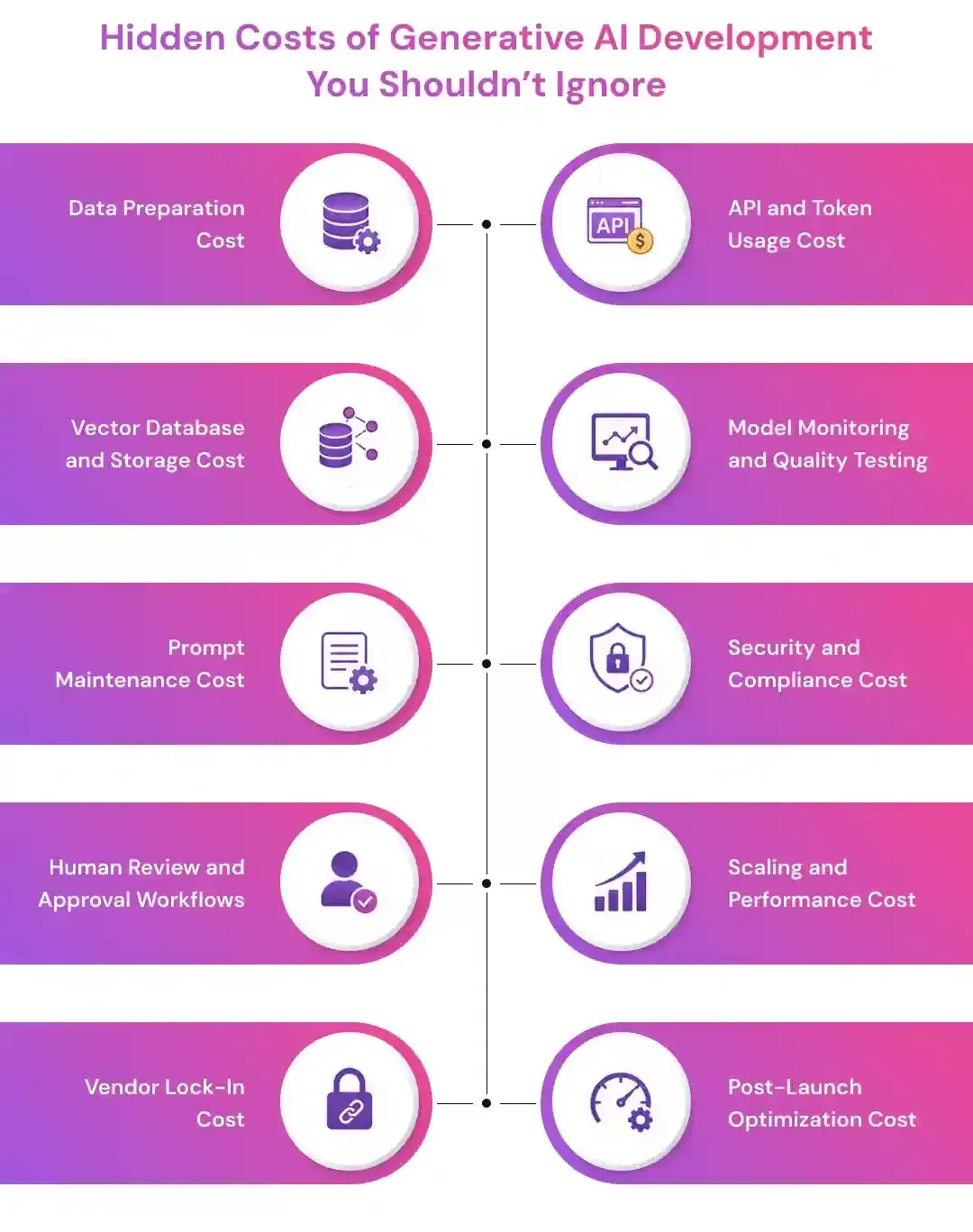
1. Data Preparation Cost
Most business data is not ready for GenAI.
It may be incomplete, outdated, duplicated, unstructured, or stored across multiple systems.
Before a GenAI system can use this data, it must be cleaned and prepared.
This may include:
- Removing duplicate files
- Fixing inconsistent formats
- Converting PDFs into usable text
- Structuring knowledge base content
- Tagging documents with metadata
- Removing sensitive information
- Creating embeddings
- Testing retrieval quality
Poor data preparation leads to poor AI output.
That is why data work is not optional.
If the system is built on messy data, users will not trust it.
2. API and Token Usage Cost
Many GenAI applications use commercial LLM APIs.
These APIs are usually priced based on usage.
That means cost increases as more users interact with the system.
Token cost depends on:
- Prompt length
- Response length
- Number of requests
- Model selected
- File processing
- Context window size
- Number of model calls per workflow
A simple chatbot may call the model once for every message.
An AI agent may call the model multiple times for one task.
That difference can increase monthly operating cost.
To control this, Prismetric designs GenAI workflows with prompt optimization, model routing, caching, and usage monitoring wherever possible.
3. Vector Database and Storage Cost
RAG-based GenAI systems need a place to store embeddings.
That usually means a vector database.
The cost depends on:
- Number of documents
- Size of embeddings
- Update frequency
- Search volume
- Storage provider
- Backup needs
- Performance requirements
If the knowledge base is small, this cost may be manageable.
If the system processes thousands or millions of documents, storage and retrieval cost can become a serious part of the budget.
This is why RAG architecture should be planned with future scale in mind.
4. Model Monitoring and Quality Testing
A GenAI system needs to be monitored after launch.
The model may produce inaccurate, incomplete, outdated, or inconsistent responses.
User behavior may also change over time.
Monitoring helps track:
- Response accuracy
- Hallucination patterns
- Failed queries
- User feedback
- Prompt performance
- Token usage
- Retrieval quality
- Latency
- Cost per user
- Model errors
For LLM-based products, LLMOps tools can help teams manage evaluation, monitoring, prompt tracking, model behavior, and production reliability.
Without monitoring, it is difficult to know whether the system is helping users or frustrating them.
This becomes more important when the GenAI solution is customer-facing or used for business-critical workflows.
5. Prompt Maintenance Cost
Prompts are not one-time assets.
They need to be improved as users interact with the system.
A prompt that works well in testing may not handle real-world edge cases.
Users may ask unexpected questions.
Documents may change.
Business rules may evolve.
A model update may change response behavior.
Prompt maintenance may include:
- Rewriting system prompts
- Adding new response rules
- Improving fallback logic
- Reducing hallucinations
- Adjusting tone
- Updating templates
- Testing new model versions
- Adding guardrails
This ongoing work affects the long-term cost of generative AI development.
6. Security and Compliance Cost
Security is often underestimated in GenAI projects.
This is risky.
A GenAI system may process sensitive customer data, internal documents, financial records, employee information, contracts, or healthcare information.
That means the system needs controls such as:
- Authentication
- Authorization
- Data encryption
- Role-based access
- Sensitive data masking
- Audit logs
- Secure APIs
- Private deployment
- Data retention policies
- Compliance documentation
For regulated industries, this cost can be higher.
But it is necessary.
A low-cost GenAI solution without security can create expensive problems later.
7. Human Review and Approval Workflows
Not every GenAI output should go directly to the end user.
Some workflows need human review.
For example:
- Legal document summaries
- Healthcare recommendations
- Financial reports
- Customer-facing emails
- HR communication
- Compliance documents
- Public marketing content
Adding human-in-the-loop review increases development work.
The system must support approval, rejection, editing, version history, user roles, and accountability.
But for sensitive use cases, this is one of the most important safety layers.
8. Scaling and Performance Cost
A GenAI prototype may work well with 10 users.
That does not mean it will work well with 10,000 users.
Scaling adds cost because the system needs:
- Faster response time
- Load balancing
- Better caching
- Queue management
- Usage limits
- Database optimization
- Cloud scaling
- Error handling
- Observability
- Disaster recovery
If scaling is ignored in the beginning, businesses may need to rebuild parts of the system later.
That can increase the final generative AI implementation cost.
9. Vendor Lock-In Cost
Using a commercial LLM API can speed up development.
But it can also create dependency.
If the provider changes pricing, limits, model behavior, or availability, your product may be affected.
Vendor lock-in risk may appear when:
- All prompts are designed for one model
- Data is stored in one provider’s ecosystem
- The product depends on provider-specific features
- Migration planning is ignored
- There is no fallback model strategy
This does not mean businesses should avoid commercial models.
It means the architecture should be flexible.
Prismetric helps businesses design GenAI systems with practical model selection, API flexibility, and long-term scalability in mind.
10. Post-Launch Optimization Cost
The launch is not the end of a GenAI project.
It is the beginning of real usage.
After launch, businesses may need to improve:
- Response quality
- Prompt flows
- Retrieval accuracy
- User experience
- Cost per request
- System speed
- Model selection
- Workflow automation
- Admin controls
- Analytics dashboards
This ongoing improvement helps the system deliver better value over time.
A GenAI solution should not stay static.
It should learn from usage patterns, business needs, and user feedback.
That is why ongoing optimization should be included in the budget from the beginning.
Avoid Hidden GenAI Costs Before They Affect Your Budget
A GenAI project may look simple at the idea stage.
But once data, integrations, security, usage, monitoring, and scaling enter the picture, the cost can change.
Prismetric helps you plan the right GenAI architecture before development begins, so your budget stays practical and your solution stays scalable.
How to Estimate Generative AI Development Cost for Your Project
A realistic generative AI development cost estimate starts with clarity.
You do not need to define every technical detail on day one. But you do need to understand the business goal, users, data, integrations, and expected output quality.
A good estimate should answer one question clearly:
What will this GenAI solution do, and what will it take to make it work reliably?
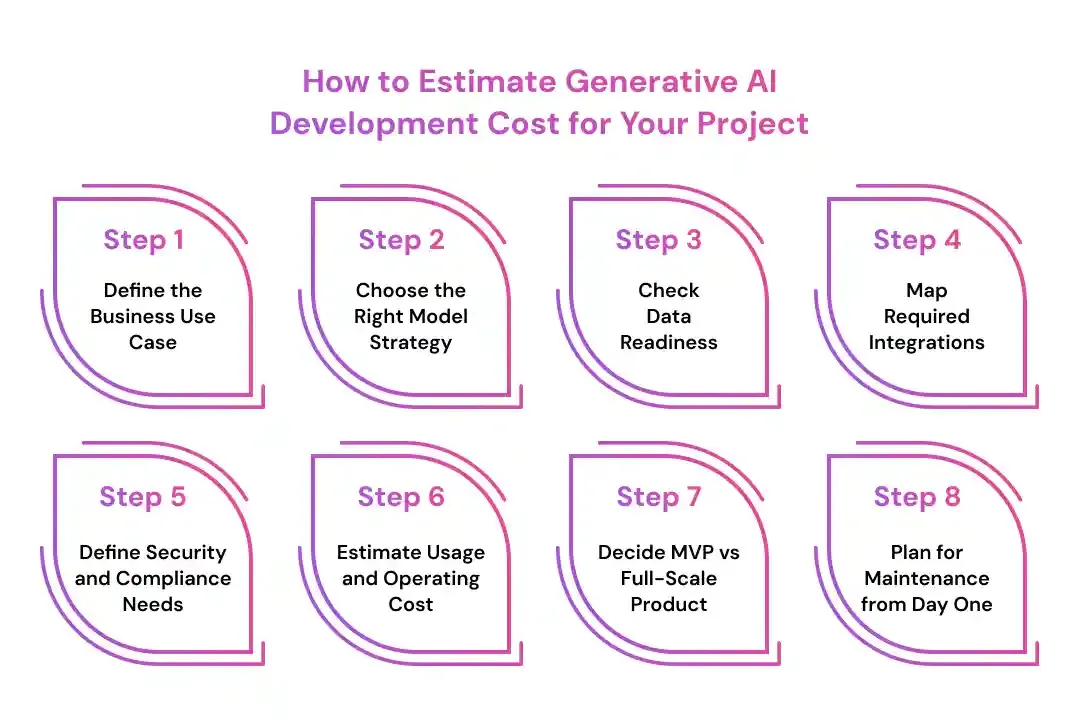
Here is a simple framework businesses can use.
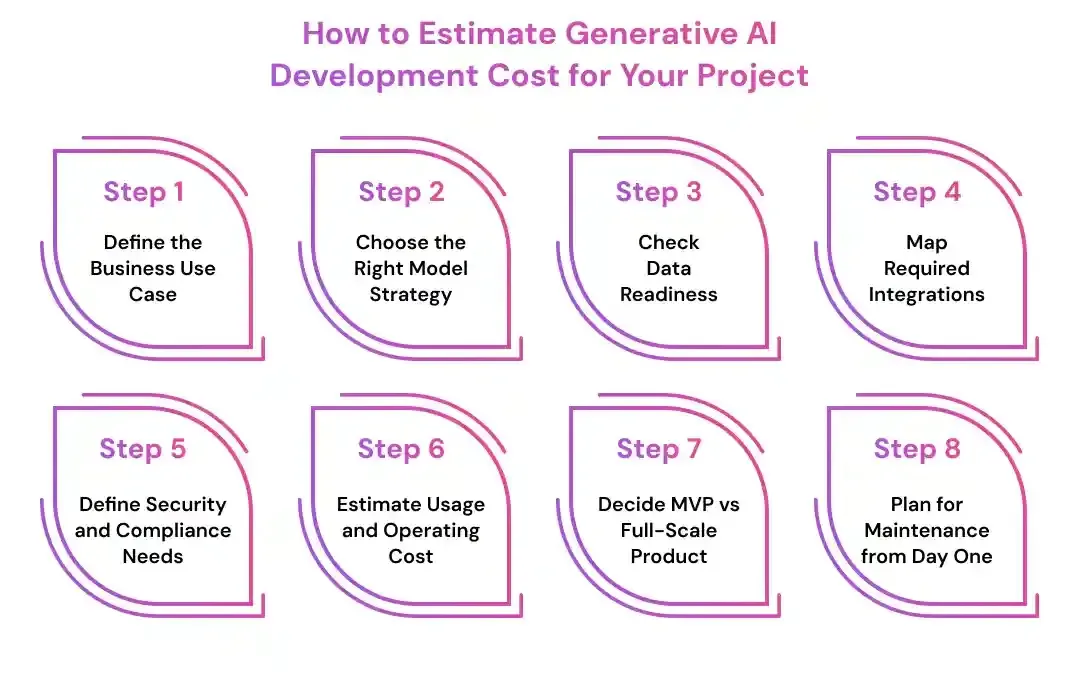
Step 1: Define the Business Use Case
Start with the problem.
Not the model.
Not the technology.
Not the trend.
The problem.
Ask:
- What workflow are we improving?
- Who will use the GenAI solution?
- What task will it complete?
- What output should it generate?
- How will success be measured?
- What business cost or delay will it reduce?
This helps separate useful GenAI ideas from experimental ones.
For example, “we want to use generative AI” is not a clear use case.
But “we want an AI assistant that helps support agents summarize tickets and draft replies using our knowledge base” is much clearer.
Clear use cases lead to clearer budgets.
Step 2: Choose the Right Model Strategy
The next step is model planning.
You need to decide whether the project should use:
- A commercial LLM API
- An open-source model
- A fine-tuned model
- A RAG-based approach
- A private LLM deployment
- A custom model strategy
This decision affects both upfront and ongoing costs. A practical LLM application tech stack guide can help teams understand the model, backend, data, orchestration, monitoring, and deployment layers before development starts.
For many businesses, a commercial LLM API is the fastest way to launch an MVP.
For businesses with sensitive data or heavy usage, open-source or private deployment may be more practical in the long run.
For domain-specific accuracy, RAG or fine-tuning may be needed.
The wrong model strategy can increase cost without improving results.
That is why Prismetric evaluates model fit during the planning stage instead of treating model selection as an afterthought.
Step 3: Check Data Readiness
Data readiness has a direct impact on the GenAI development cost.
Before estimating, check:
- Where is the data stored?
- Is it structured or unstructured?
- Is it clean and updated?
- Are there duplicate records?
- Does it contain sensitive information?
- Who should access what?
- How often does the data change?
- Does it need labeling or metadata?
- Does it need document processing?
If your data is ready, development becomes faster.
If your data needs cleaning, migration, transformation, or governance work, the estimate should include that effort.
This is especially important for RAG systems, copilots, and enterprise GenAI platforms.
Step 4: Map Required Integrations
Integrations are one of the most common reasons GenAI project costs increase.
Your system may need to connect with:
- CRM
- ERP
- CMS
- HRMS
- LMS
- Payment gateways
- Databases
- Cloud storage
- Email systems
- Support platforms
- Internal APIs
- Third-party SaaS tools
The estimate should include integration complexity from the beginning.
A GenAI tool that works independently is easier to build.
A GenAI system that performs actions across multiple tools needs stronger engineering, better security, and more testing.
Step 5: Define Security and Compliance Needs
Security requirements affect both architecture and cost.
Before estimating, identify:
- Will the system handle sensitive data?
- Does it need role-based access?
- Are audit logs required?
- Should data stay within a private environment?
- Are there industry-specific compliance needs?
- Is human review required for certain outputs?
- Should prompts and responses be stored?
- Should user activity be monitored?
These decisions influence backend design, deployment model, database structure, admin features, and monitoring tools.
Skipping security planning may reduce the initial estimate.
But it usually increases risk and rework later.
Step 6: Estimate Usage and Operating Cost
A GenAI system has ongoing cost.
That cost depends on usage.
You should estimate:
- Number of users
- Number of daily requests
- Average prompt size
- Average response size
- Number of model calls per workflow
- File upload frequency
- Data storage needs
- Peak usage hours
- Expected monthly growth
This helps estimate API cost, infrastructure cost, and scaling needs.
A small internal tool may have low monthly usage. A customer-facing platform with thousands of daily interactions needs stronger cost planning.
Prismetric helps businesses estimate both development cost and operational cost so there are fewer surprises after launch.
Step 7: Decide MVP vs Full-Scale Product
Not every GenAI idea should start as a large platform.
In many cases, an MVP is the smarter first step.
An MVP helps validate:
- User demand
- Model performance
- Data quality
- Workflow value
- Cost per request
- Integration feasibility
- Business ROI
Once the MVP proves value, the product can scale.
This approach helps reduce risk and control the cost of generative AI development.
A full-scale product may still be the right choice for enterprises with clear requirements, strong data readiness, and defined adoption plans.
But for many startups and SMBs, starting lean is more practical.
Step 8: Plan for Maintenance from Day One
Maintenance should be part of the estimate.
A GenAI product needs ongoing support for:
- Model updates
- Prompt changes
- Bug fixes
- Security patches
- API updates
- Usage optimization
- Retrieval improvements
- Performance tuning
- Analytics review
- New feature additions
Ignoring maintenance creates a false budget.
The system may launch successfully but become expensive or unreliable later.
A good GenAI estimate includes both launch cost and long-term support.
Simple GenAI Cost Estimation Checklist
Before you ask any development company for a quote, prepare answers to these questions:
- What business problem should the GenAI solution solve?
- Who will use it?
- What type of output should it generate?
- Will it use text, image, audio, video, or documents?
- Does it need RAG or fine-tuning?
- Which systems should it integrate with?
- How many users will use it every month?
- What data will the system access?
- What security controls are required?
- Do you need an MVP or a complete platform?
- What is your expected launch timeline?
- What ongoing support will you need?
The clearer these answers are, the more accurate your generative AI development cost estimate will be.
Get a Realistic GenAI Development Cost Estimate
Share your GenAI idea with Prismetric and get a practical development roadmap with a realistic cost estimate.
Start Your AI Project
In-House vs Outsourced Generative AI Development Cost
Once businesses understand the project scope, the next big question is usually about the development team.
Should you build the GenAI solution in-house?
Should you hire generative AI engineers?
Should you work with an outsourced generative AI development company?
This decision directly affects the generative AI development cost.
Building an internal AI team gives you more control, but it also requires hiring, onboarding, salaries, infrastructure, tools, management, and long-term retention. Outsourcing helps businesses start faster, access specialized talent, and reduce the cost of building a full AI team from scratch.
For many startups, SMBs, and enterprises, outsourcing becomes a practical way to control the cost of generative AI development without slowing down the project.
Here is a simple comparison.
| Cost Factor |
In-House GenAI Development |
Outsourced GenAI Development |
| Initial Setup Cost |
High, because you need to hire AI engineers, backend developers, data engineers, DevOps, QA, and product experts |
Lower, because the development partner already has the required team and delivery process |
| Hiring Time |
Longer, especially for AI, LLM, data, and cloud roles |
Faster, because the team can be assembled based on project scope |
| Monthly Cost |
Fixed salaries, benefits, tools, infrastructure, and management cost |
Flexible engagement based on project, team size, and timeline |
| Technical Expertise |
Depends on your ability to hire and retain AI talent |
Access to GenAI engineers, LLM developers, data experts, cloud engineers, and QA specialists |
| Scalability |
Scaling requires more hiring |
Team size can be increased or reduced based on project stage |
| Control |
High internal control |
Strong control when communication, milestones, and ownership are clearly defined |
| Best For |
Large enterprises with long-term AI product roadmaps and internal AI maturity |
Startups, SMBs, and enterprises that want faster development, controlled cost, and specialized expertise |
| Cost Efficiency |
Can be expensive in the early stage |
Usually more cost-effective for MVPs, PoCs, and production GenAI solutions |
The right option depends on your business goals.
If you already have an experienced AI team, strong data infrastructure, and long-term internal ownership plans, in-house development may work well.
But if you want to validate an idea, build a GenAI MVP, integrate LLMs into an existing product, create a RAG assistant, or launch an AI copilot without hiring a large team, outsourcing can be more practical.
That is why many businesses choose Prismetric as their generative AI development partner.
Prismetric helps businesses plan, design, develop, integrate, test, deploy, and maintain GenAI solutions without the overhead of building a complete AI team internally.
Why Outsourcing Can Reduce Generative AI Development Cost
Outsourcing does not mean cutting corners.
It means accessing the right talent, tools, and process without carrying the full cost of hiring and managing every role in-house.
A GenAI project may need several specialists.
You may need an AI consultant to define the use case.
You may need an LLM engineer to select the right model.
You may need a data engineer to prepare the knowledge base.
You may need backend developers to build the system.
You may need cloud engineers to set up infrastructure.
You may need QA testers to validate output quality.
You may need UI/UX designers to create the user experience.
You may need DevOps support after launch.
Hiring all these roles internally can become expensive.
With outsourcing, businesses can get these skills as part of a structured delivery team.
This helps reduce the overall custom generative AI development cost and keeps the project focused on business outcomes.
Outsourcing can also reduce cost by:
- Avoiding long hiring cycles
- Reducing internal training effort
- Using proven development processes
- Starting with a lean MVP
- Choosing the right model strategy
- Avoiding unnecessary custom model development
- Optimizing API and token usage
- Planning infrastructure early
- Reducing rework through proper discovery
- Offering post-launch support when needed
The biggest advantage is speed with control.
When the right team is involved from the beginning, businesses can move from idea to architecture, from architecture to MVP, and from MVP to production faster. Before choosing a partner, this guide on questions to ask an AI development company can help evaluate technical depth, pricing clarity, delivery process, security, and post-launch support.
When In-House GenAI Development Makes Sense
In-house development can be a good choice when AI is central to your long-term product strategy.
It may make sense if:
- You are building a proprietary AI platform
- You need continuous internal AI research
- You already have strong data engineering capabilities
- You have a long-term AI roadmap across multiple products
- You need complete control over every technical decision
- You have the budget to hire and retain specialized AI talent
- You operate in a highly regulated environment with strict internal data rules
In-house teams can build deep product knowledge over time.
But the cost is usually higher in the beginning.
You need salaries, infrastructure, tools, compliance processes, cloud setup, management, training, and ongoing retention.
That is why many businesses use a hybrid model.
They keep product ownership in-house and work with a GenAI development company like Prismetric for strategy, architecture, development, integration, and scaling support.
This gives them control without carrying the entire delivery cost internally.
When Outsourced GenAI Development Makes Sense
Outsourced development is a good fit when businesses want to move fast without compromising quality.
It works well for:
- GenAI MVP development
- AI chatbot development
- RAG assistant development
- AI copilot development
- LLM integration
- Generative AI app development
- AI workflow automation
- AI agent development
- Custom AI model integration
- GenAI modernization for existing software
- Post-launch GenAI support
Outsourcing is especially useful when the business problem is clear, but the internal team does not have enough AI engineering bandwidth.
For example, your product team may know exactly what users need. But they may not know which model to use, how to design RAG, how to reduce hallucinations, how to optimize token usage, or how to build secure AI workflows.
That is where Prismetric can help.
The goal is not just to build a GenAI feature.
The goal is to build a GenAI solution that works reliably, scales properly, and stays cost-efficient after launch.
Generative AI Development Cost Trends in 2026
The generative AI development cost in 2026 is being shaped by several important trends.
Some trends are reducing the cost of development.
Others are increasing the cost of production-ready implementation.
Businesses should understand both sides before planning a GenAI budget.
1. LLM APIs Are Making GenAI MVPs Faster
Commercial LLM APIs have made it easier to build GenAI MVPs.
Businesses no longer need to train large models from scratch for every use case.
They can start with existing models and build useful applications around them.
This reduces early development effort for:
- Chatbots
- Content tools
- Summarizers
- Internal assistants
- Document Q&A systems
- Email drafting tools
- Research assistants
- Code assistants
This is good for businesses that want to test a GenAI idea quickly.
But API-based development still needs careful planning.
If prompts are long, workflows call the model repeatedly, or usage grows quickly, operating cost can increase.
So while APIs reduce upfront LLM development cost, they do not remove the need for cost optimization.
2. RAG Is Becoming a Standard Requirement
More businesses are moving from generic GenAI tools to business-specific GenAI systems.
They do not want the AI to answer from general knowledge only.
They want it to answer from company documents, customer data, product information, training material, policies, contracts, and internal knowledge bases.
That is why RAG is becoming a standard part of many GenAI projects.
RAG helps improve relevance and control.
But it also adds cost.
Businesses need document processing, embeddings, vector databases, retrieval logic, access control, and quality testing.
This means the RAG development cost will remain an important part of GenAI budgets in 2026.
The good news is that RAG can reduce the need for full model fine-tuning in many cases.
For several business use cases, a well-designed RAG system is more practical than training a custom model.
3. Open-Source Models Are Reducing Vendor Dependency
Open-source LLMs are giving businesses more flexibility.
They can reduce dependency on one commercial provider, improve data control, and support private deployment options.
This is useful for businesses that need:
- Better privacy
- Lower long-term usage cost
- Custom deployment
- Greater control over model behavior
- Reduced vendor lock-in
- Industry-specific workflows
But open-source does not mean free.
Businesses still need infrastructure, deployment, monitoring, optimization, security, and model maintenance.
The development cost may be higher at the beginning, especially when private hosting or fine-tuning is involved.
But for high-volume or sensitive use cases, open-source models can be a strategic choice.
The right decision depends on usage volume, privacy needs, performance expectations, and long-term cost planning.
4. AI Agents Are Increasing Project Complexity
AI agents are one of the biggest GenAI trends.
Unlike chatbots, agents can take actions.
They can search, plan, call APIs, update systems, generate reports, send messages, and complete multi-step workflows.
This makes them powerful.
It also makes them more complex.
Agentic systems need:
- Tool integration
- Action permissions
- Memory design
- Error handling
- Workflow orchestration
- Human approval
- Monitoring
- Audit logs
- Safety controls
- Fallback logic
That is why AI agent development usually costs more than basic chatbot development.
A chatbot gives answers.
An AI agent performs tasks.
That difference changes the architecture, testing effort, risk controls, and maintenance cost.
Businesses planning AI agents should budget for more than model integration.
They should budget for workflow reliability.
5. Security and Governance Are Becoming Non-Negotiable
Early GenAI experiments were often simple.
A team connected a model, tested a few prompts, and launched a prototype.
That approach is no longer enough for business use.
In 2026, companies need stronger GenAI governance.
They need to know:
- What data the model can access
- Who is using the system
- What responses are being generated
- Which actions are being taken
- How errors are handled
- How sensitive data is protected
- How compliance requirements are met
- How cost is tracked
This adds development cost.
But it also makes GenAI safer and more useful.
For enterprise GenAI systems, governance is not an optional feature.
It is part of production readiness.
6. GenAI Cost Optimization Is Becoming a Core Requirement
Businesses are now paying more attention to operating cost.
They do not only ask, “How much will it cost to build?”
They also ask, “How much will it cost to run every month?”
That is a better question.
A GenAI system may have API cost, cloud cost, storage cost, token cost, inference cost, monitoring cost, and support cost.
Cost optimization may include:
- Shorter prompts
- Better retrieval
- Model routing
- Caching repeated responses
- Using smaller models for simple tasks
- Reserving larger models for complex tasks
- Limiting unnecessary model calls
- Tracking cost per user
- Monitoring high-cost workflows
- Improving prompt efficiency
This is where experienced architecture makes a difference.
A poorly designed GenAI system may work, but it may be expensive to operate.
A well-designed system balances quality, speed, and cost.
How Prismetric Helps Optimize Generative AI Development Cost
The right development partner does more than write code.
It helps you avoid unnecessary cost from the beginning.
Prismetric works with businesses to understand the idea, define the scope, select the right model strategy, prepare the data, build the product, integrate it with existing systems, and support it after launch.
The focus is simple.
Build what your business needs.
Avoid what your business does not need yet.
Keep the architecture ready for future scale.
This approach helps control the generative AI development cost without limiting innovation.
1. Discovery and GenAI Consulting
Every successful GenAI project starts with discovery.
Before development begins, the business problem should be clear.
Prismetric helps define:
- Use case
- Target users
- Required workflows
- Data sources
- Model strategy
- Integration needs
- Security expectations
- MVP scope
- Launch roadmap
- Long-term scalability
This reduces guesswork.
It also helps prevent overengineering.
Many GenAI projects become expensive because businesses start with too many features or choose complex model strategies before validating the core use case.
A discovery-first approach helps avoid that.
2. Right Model Selection
Model selection can make or break the budget.
Using a large model for every task may increase operating cost. Building a custom model when an existing model can solve the problem may increase development cost. Depending on one provider without a fallback strategy may create long-term risk.
Prismetric helps businesses choose between:
- Commercial LLM APIs
- Open-source models
- Fine-tuned models
- RAG-based systems
- Private model deployment
- Hybrid model architecture
The goal is not to use the most advanced model every time.
The goal is to use the right model for the right task.
That is how businesses can reduce unnecessary AI model development cost and still deliver strong user value.
3. MVP-First Development
A full-scale GenAI platform may not always be the right first step.
Sometimes, the smarter approach is to build an MVP.
An MVP helps test whether:
- Users need the solution
- The model performs well
- The data is useful
- The workflow saves time
- The cost per request is practical
- The product can scale
- The business case is strong
Prismetric helps businesses define a focused GenAI MVP that solves one important problem first.
Once the MVP proves value, the solution can be expanded with more users, more integrations, stronger automation, better analytics, and enterprise-grade controls.
This helps reduce risk and keep the generative AI app development cost practical.
4. Data and RAG Architecture Planning
For business GenAI systems, data is often the real foundation.
Prismetric helps businesses plan how data should be collected, cleaned, structured, stored, retrieved, and protected.
For RAG-based systems, this may include:
- Document ingestion
- Text extraction
- Metadata tagging
- Embedding generation
- Vector database setup
- Retrieval logic
- Source citation support
- Access control
- Quality testing
- Document update workflows
A strong RAG architecture helps the system give more useful and relevant answers.
It also helps reduce unnecessary fine-tuning cost in many cases.
That is why RAG planning is important for keeping the cost of building a generative AI application under control.
5. Secure Integration with Existing Systems
GenAI becomes more valuable when it works with your existing business systems.
Prismetric helps integrate GenAI solutions with:
- Websites
- Mobile apps
- Web apps
- CRMs
- ERPs
- Databases
- Cloud storage
- Support tools
- Dashboards
- Internal APIs
- Third-party platforms
The integration approach depends on your workflow.
A support assistant may need ticketing-system integration.
A sales copilot may need CRM access.
A document assistant may need cloud storage and role permissions.
An AI agent may need APIs to perform actions.
The right integration strategy helps the GenAI solution become useful in daily operations instead of remaining a standalone experiment.
6. Token and Infrastructure Optimization
A GenAI product should not become too expensive to run.
Prismetric helps reduce ongoing cost through better architecture and optimization.
This may include:
- Prompt optimization
- Token reduction
- Response-size control
- Model routing
- Caching
- Usage limits
- Cloud optimization
- Vector database tuning
- Monitoring dashboards
- Cost tracking
- Performance testing
These decisions matter after launch.
A solution that is affordable during testing may become expensive when usage grows.
That is why operating cost should be considered during development, not after deployment.
7. Testing, Monitoring, and Post-Launch Support
Testing a GenAI system is different from testing a normal software product.
You are not only testing buttons and screens.
You are testing response quality, hallucination risk, retrieval accuracy, prompt behavior, latency, security, user permissions, and edge cases.
Prismetric supports GenAI projects with:
- Functional testing
- Prompt testing
- Response validation
- Security testing
- Performance testing
- Model behavior review
- User feedback loops
- Post-launch optimization
- Maintenance and support
This helps businesses keep their GenAI solution reliable after launch.
A GenAI product should improve over time.
It should become more useful as users interact with it, data improves, and business needs evolve.
Why Choose Prismetric for Generative AI Development?
Generative AI is not only about model integration.
It is about building a business-ready solution around the model.
That includes product strategy, user experience, data engineering, backend development, cloud infrastructure, security, integrations, testing, deployment, monitoring, and continuous improvement.
Prismetric brings these capabilities together under one development partner.
With experience across AI development, generative AI, AI agents, chatbots, ML solutions, workflow automation, mobile app development, web development, and custom software development, Prismetric helps businesses turn GenAI ideas into practical digital products.
Here is how Prismetric supports your GenAI journey.
1. End-to-End GenAI Development
Prismetric can support the complete development lifecycle.
From idea validation to architecture.
From UI/UX design to model integration.
From backend engineering to testing.
From deployment to maintenance.
This helps businesses avoid the complexity of working with multiple vendors.
A single partner can manage the full process and keep the project aligned with cost, quality, and timeline expectations.
2. Business-First AI Strategy
Not every GenAI idea needs a large model.
Not every product needs fine-tuning.
Not every workflow needs an AI agent.
Prismetric focuses on the business goal first.
The team helps identify where GenAI can actually create value, reduce effort, improve customer experience, or support revenue growth.
This helps businesses invest in the right features instead of chasing technology trends.
3. Scalable Product Engineering
A GenAI MVP should be built in a way that can grow.
If the product works well, you may want to add more users, more departments, more integrations, more workflows, or more automation.
That requires scalable engineering.
Prismetric builds GenAI solutions with future growth in mind, so businesses do not have to rebuild everything after the first successful version.
4. Strong AI and Software Development Capability
A GenAI solution needs both AI expertise and software engineering strength.
The model is only one part of the product.
You still need:
- User interface
- Backend system
- Database
- APIs
- Authentication
- Admin panel
- Analytics
- Cloud deployment
- Testing
- Maintenance
Prismetric’s broader software development experience helps bridge the gap between AI capability and usable digital product.
That is important because users do not interact with a model directly.
They interact with the product you build around the model.
5. Flexible Engagement Models
Every business has a different budget and delivery need.
Some need a complete GenAI product.
Some need a dedicated AI development team.
Some need LLM integration in an existing product.
Some need MVP development.
Some need consulting before they start.
Prismetric can support different engagement needs based on scope, complexity, and business goals.
This flexibility helps businesses control the generative AI software development cost while getting the right level of technical support.
Build Cost-Efficient Generative AI Solutions with Prismetric
Generative AI can help businesses automate operations, improve customer experience, speed up content creation, simplify knowledge access, support decision-making, and create new digital products.
But the cost must be planned carefully.
A low-cost prototype may not be enough for production.
A high-cost custom model may not be necessary for every use case.
A poorly planned GenAI solution may become expensive after launch.
That is why the right strategy matters.
Prismetric helps businesses understand the actual generative AI development cost, choose the right model strategy, plan the right architecture, and build scalable GenAI solutions that fit their goals.
Whether you want to build a GenAI chatbot, RAG assistant, AI copilot, AI agent, content generation tool, document AI platform, or enterprise GenAI system, Prismetric can help you move from idea to execution with clarity.
Ready to Estimate Your Generative AI Development Cost?
Talk to Prismetric’s GenAI experts and get a custom generative AI development cost estimate for your project.
Get Custom Quote
FAQs About Generative AI Development Cost
The generative AI development cost usually ranges from $20,000 to $500,000+ depending on the project type, model approach, data quality, integrations, infrastructure, security, and scale.
A simple GenAI content generation or chatbot tool may cost less. A RAG-based assistant, AI copilot, AI agent, or enterprise GenAI platform will usually cost more because it needs deeper architecture, stronger testing, and more integrations.
The cost of building a generative AI application depends on what the application does.
A basic application using an existing LLM API may start around $40,000 to $90,000. A mid-level GenAI application with RAG, workflows, dashboards, and integrations may cost around $90,000 to $250,000. An enterprise-grade GenAI platform may cost $250,000 to $500,000+.
The cost varies because every GenAI project has a different scope.
The final budget depends on:
- Type of GenAI solution
- Model selection
- Data preparation
- Prompt engineering
- RAG requirements
- Fine-tuning needs
- API usage
- Cloud infrastructure
- System integrations
- Security controls
- Number of users
- Post-launch support
A simple chatbot and an enterprise AI copilot may both use GenAI, but they are very different products.
Yes, using an existing LLM API is usually cheaper and faster for early development.
It works well for MVPs, chatbots, content tools, internal assistants, and basic automation.
But API usage creates ongoing cost. As users increase, token consumption and monthly API bills can increase too.
That is why businesses should optimize prompts, reduce unnecessary model calls, and track usage after launch.
No.
Most businesses do not need to build a custom model from scratch.
Many GenAI solutions can be built using existing LLMs, RAG, prompt engineering, fine-tuning, or open-source models.
Custom model development is usually needed only when the business has highly specialized requirements, proprietary data, strict performance needs, or unique domain-specific use cases.
The RAG development cost usually ranges from $80,000 to $250,000, depending on the number of documents, data sources, retrieval complexity, vector database setup, access control, source citation needs, and answer accuracy requirements.
A simple document Q&A system costs less. A secure enterprise RAG system with role-based access, audit logs, real-time updates, and multiple knowledge sources costs more.
The AI copilot development cost usually ranges from $120,000 to $350,000.
The cost depends on the tasks the copilot performs, the systems it connects with, the number of users, the level of automation, the security layer, and the quality of output expected.
A copilot is usually more expensive than a chatbot because it helps users complete tasks, not just answer questions.
A generative AI chatbot development cost usually ranges from $40,000 to $120,000.
The cost depends on chatbot complexity.
A basic chatbot with LLM API integration and simple conversation flow costs less. A chatbot with CRM integration, RAG, multilingual support, human handoff, analytics, and access control costs more.
Hidden GenAI costs may include:
- Data cleaning
- Token usage
- API cost
- Vector database cost
- Cloud hosting
- Monitoring
- Prompt maintenance
- Security
- Compliance
- Human review workflows
- Model updates
- Scaling
- Post-launch optimization
These costs should be planned before development starts.
In many cases, yes.
Outsourcing can reduce the cost of hiring, onboarding, training, infrastructure, tools, and management.
It also gives businesses faster access to AI engineers, LLM developers, data engineers, cloud experts, QA testers, and product specialists.
In-house development may be better for companies with a long-term AI roadmap and strong internal AI capability. But for MVPs, GenAI applications, RAG systems, copilots, and AI agents, outsourcing is often more cost-efficient.
The timeline depends on scope.
A simple GenAI MVP may take a few months. A mid-level GenAI application may take several months. An enterprise GenAI platform may take longer because it needs deeper integrations, data preparation, security, testing, governance, and scaling.
Prismetric’s own GenAI page notes that timelines can vary from around 3 months to more than a year depending on complexity, functionality, and project type.
Prismetric can help reduce cost by planning the right scope, selecting the right model strategy, avoiding unnecessary custom model development, designing efficient RAG architecture, optimizing token usage, integrating with existing systems, and supporting the solution after launch.
The goal is to build a GenAI solution that is useful, scalable, secure, and cost-efficient.
Start by defining your use case.
You should know:
- What problem you want to solve
- Who will use the solution
- What data the system needs
- Which systems it should integrate with
- Whether you need RAG or fine-tuning
- What security controls are required
- How many users you expect
- Whether you need an MVP or a full product
Once these details are clear, Prismetric can help estimate the development scope, timeline, team requirement, and budget.