How Much Does It Cost to Build a Conversational AI Chatbot in the USA? (2026 Guide)
Key Takeaways
- Conversational AI chatbot cost in the USA ranges from $40K to $400K+ based on complexity and integrations.
- Chatbot type impacts cost. Rule based is cheaper, while NLP and LLM chatbots require higher investment.
- Most of the budget goes into backend systems, integrations, data setup, and security, not just the chatbot interface.
- SaaS chatbots fit quick launches, while custom chatbot development supports scalability and deeper integrations.
- Hidden costs like data cleanup, AI usage, testing, and maintenance can increase the total chatbot investment.
- AI chatbots deliver ROI through lower support cost, faster responses, 24/7 availability, and better efficiency.
- Prismetric helps businesses build cost efficient AI chatbots with the right scope, smart architecture, and scalable approach.
If you plan to build a conversational AI chatbot in the USA, one question comes up right away. How much will it cost?
The answer depends on what you want to build. A simple chatbot that answers FAQs or captures leads will cost much less than a custom AI assistant that understands user intent, connects with your systems, and handles real conversations at scale. The more advanced the chatbot, the higher the cost.
This is where most businesses get confused. One agency may quote a few thousand dollars, while another may quote tens of thousands or more. That gap exists for a reason. Every conversational AI chatbot has a different level of complexity, features, and integration needs.
This guide breaks everything down in a clear and practical way. It explains conversational AI chatbot development cost in the USA, what factors increase or reduce pricing, and where hidden costs usually appear. It also helps you understand what you actually need, so you do not overpay or underbuild.
You do not need the biggest budget to succeed. You need the right approach, the right scope, and a clear understanding of what you are paying for. This guide will help you get there.
Cost to Build a Conversational AI Chatbot in the USA
If you are trying to estimate the cost to build a conversational AI chatbot in the USA, a practical budget usually falls between $40,000 and $400,000 for a custom solution. That range may look wide, but it reflects real differences in AI architecture, integration depth, model setup, security needs, and deployment complexity. In most serious projects, backend logic and system connectivity drive cost far more than the chat interface itself.
A basic conversational chatbot sits at the lower end of that range. It usually handles predefined flows, common user questions, and limited API actions. A more capable mid level chatbot costs more because it needs intent detection, entity recognition, conversation memory, and stronger integrations with platforms like CRM, ERP, or support tools. Once a business moves into an advanced LLM powered chatbot with retrieval, vector search, guardrails, analytics, and multi system orchestration, the budget rises sharply.
Conversational AI Chatbot Cost in the USA at a Glance
If you want a quick estimate, most businesses in the USA spend between $40,000 and $400,000 to build a conversational AI chatbot. The actual cost depends on how advanced the chatbot is, what it needs to do, and how deeply it connects with your systems.
| Chatbot Type |
Estimated Cost in the USA |
Best For |
| Basic Conversational Chatbot |
$40,000 to $75,000 |
FAQs, simple customer support, lead capture, and basic website conversations |
| Mid Level AI Chatbot |
$75,000 to $200,000 |
NLP based conversations, CRM integration, appointment booking, and guided sales or support |
| Advanced Enterprise AI Chatbot |
$200,000 to $400,000+ |
LLM powered conversations, complex workflows, enterprise integrations, multilingual support, analytics, and high security use cases |
Basic Rule Based Chatbot
$40,000 to $75,000
- Includes flow builders with predefined decision trees
- Uses keyword based trigger mapping
- Supports limited REST API integrations
- Relies on a static response library
- Handles simple FAQ automation and basic support queries
- Does not offer dynamic intent detection
- Does not retain context across conversations
- Works best for businesses that need structured and predictable conversations only
NLP Based AI Chatbot
$75,000 to $200,000
- Includes intent classification models
- Uses entity extraction pipelines to understand user inputs better
- Manages conversation state across multiple steps
- Retains context in multi turn conversations
- Connects with backend systems through real time API orchestration
- Can support multilingual chatbot experiences
- Often includes CRM sync, ERP ticket creation, authentication layers, and role based response control
- Works well for customer support, booking, guided sales, and workflow automation
Advanced LLM Plus RAG Enterprise Chatbot
$200,000 to $400,000
- Includes LLM integration through enterprise AI models or hybrid model stacks
- Uses retrieval augmented generation to deliver more relevant answers
- Requires vector database deployment
- Uses embedding models for semantic search
- Includes prompt orchestration layers
- Adds AI guardrails to reduce hallucinations and improve response quality
- Connects with business systems in real time
- Often includes token usage optimization, fine tuning or domain adaptation, analytics dashboards, and scalable microservices architecture
- Fits enterprise use cases that require deep intelligence, strong integrations, and large scale performance
Also Read:
Tech Stack for Building LLM Application – Detailed Guide
What Affects Conversational AI Chatbot Development Cost in the USA?
The cost of conversational AI chatbot development in the USA changes from one project to another because every business needs a different level of intelligence, customization, and integration. A simple chatbot with fixed replies costs much less than a smart AI chatbot that understands context, connects with business tools, and supports real user journeys across multiple channels.
- Chatbot complexity and AI capability
A rule based chatbot costs less because it follows fixed conversation paths. A chatbot with NLP, LLM integration, context retention, and smart response generation needs more planning, testing, and AI engineering, which increases the cost.
- Number of features and custom workflows
Basic features like FAQs and lead capture take less time to build. Costs rise when the chatbot needs booking, live chat handoff, payment support, customer data access, multilingual conversations, or workflow automation.
- Integrations with third party and internal systems
A standalone chatbot costs less than one that connects with CRM, ERP, helpdesk, ecommerce, HRMS, or healthcare systems. Each integration adds development time, API work, testing, and security checks.
- UI, platform, and deployment requirements
A chatbot made only for a website costs less than one built for mobile apps, WhatsApp, Slack, voice, and customer service platforms. Custom dashboards, branded interfaces, and multi platform deployment also push the budget higher.
- USA based development rates and compliance needs
Development costs in the USA are higher because local teams charge more for product strategy, AI engineering, design, QA, and support. Costs also increase when the chatbot must meet stricter standards for data privacy, security, accessibility, or industry compliance.
What Makes Chatbot Development Cost Different in the USA?
The cost to build a conversational AI chatbot in the USA depends on several practical factors. Most of the budget goes into what happens behind the scenes, not just the chat interface.
Here are the key factors that influence the cost:
Development Team Cost in the USA
- Hiring experienced AI engineers and backend developers comes at a premium
- Projects often need multiple roles like solution architects, QA, and AI specialists
- Hourly rates in the USA are significantly higher compared to offshore teams
- Longer development timelines increase total cost
Level of AI and Intelligence
- Rule based chatbots are cheaper because they follow predefined flows
- NLP based chatbots require training and context handling, which adds cost
- LLM powered chatbots need advanced setup like prompt engineering and optimization
- Higher intelligence means more testing and fine tuning
Also Read:
LLM vs LAM: What’s the Real Difference
Number of Features and Use Cases
- A chatbot with a single use case stays within a controlled budget
- Multiple workflows like support, sales, and booking increase complexity
- Advanced features like recommendations or automation add more development effort
Integration with Business Systems
- Connecting with CRM, ERP, or internal systems takes extra development time
- Real time data handling increases backend complexity
- Each additional integration adds testing and maintenance effort
- Legacy systems can make integration more challenging and expensive
Data and Knowledge Base Preparation
- Chatbots depend on structured and clean data to perform well
- Preparing FAQs, documents, and internal data takes effort
- Poor data quality leads to more iterations and fixes
- Larger datasets increase setup and processing time
Security and Compliance Requirements
- Industries like healthcare and finance require strict data protection
- Features like encryption and access control increase development effort
- Compliance checks and audits add extra steps before deployment
Deployment Platforms and Channels
- A single platform chatbot is easier and cheaper to launch
- Multi channel deployment across web, mobile, and messaging apps increases cost
- Each platform needs testing and performance optimization
- Voice based or omnichannel bots require additional setup
User Experience and Custom Design
- Basic chatbot UI keeps costs low
- Custom design and branding require more design work
- Personalized user journeys increase development complexity
Testing and Quality Assurance
- Chatbots must handle different user inputs and edge cases
- AI responses need continuous validation and improvement
- More complex bots require longer testing cycles
- Performance and load testing add to overall cost
Ongoing Maintenance and AI Optimization
- Chatbots need regular updates and monitoring
- AI models require tuning to improve accuracy
- Monthly maintenance and support add to long term budget
- Scaling usage increases infrastructure and AI usage cost
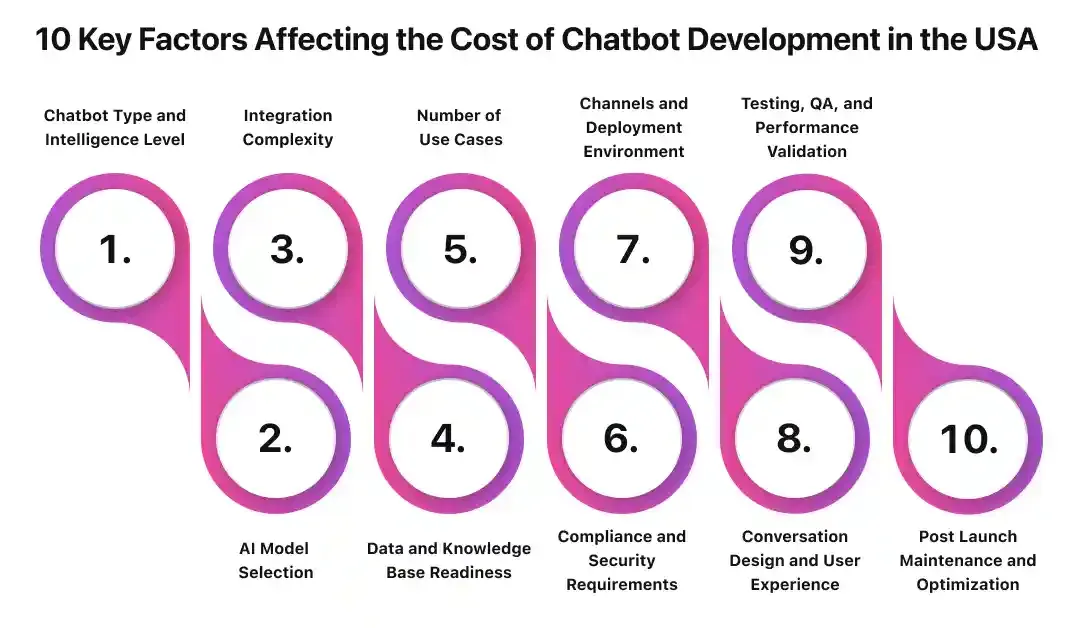
10 Key Factors Affecting the Cost of Chatbot Development in the USA
The cost of chatbot development in the USA depends on far more than the chatbot interface. Two chatbots may look similar to the end user, yet one can cost much more because of deeper integrations, stricter security standards, more advanced AI logic, and heavier infrastructure needs.
That is why chatbot pricing can vary so widely from one project to another. In most cases, backend complexity, model choice, compliance requirements, and long term scalability shape the budget more than the visible chat experience.
Here are the 10 factors that usually create the biggest cost differences in the USA.
1. Chatbot Type and Intelligence Level
The intelligence layer sets the starting point for your budget.
A simple rule based chatbot costs less because it follows predefined flows and fixed replies. An NLP based chatbot costs more because it needs to understand intent, extract meaning from user input, and manage more dynamic conversations. An LLM powered conversational AI chatbot sits at the high end because it requires stronger architecture, testing, and response control.
Cost usually rises when the chatbot needs:
- intent detection and entity extraction
- context retention across multi step conversations
- retrieval based answer generation
- response validation and hallucination control
- scalable AI processing for higher usage
2. AI Model Selection
Your model strategy affects both build cost and long term operating cost.
Some businesses use API based models because they launch faster and reduce infrastructure setup. Others choose open source or privately hosted models for more control, data governance, or cost stability at scale. The right choice depends on usage volume, privacy needs, and performance expectations.
This decision usually affects:
- upfront implementation effort
- monthly inference or token cost
- infrastructure and hosting setup
- fine tuning or prompt engineering effort
3. Integration Complexity
Integration depth often drives the real chatbot budget.
A basic chatbot that answers questions from a content library is much cheaper than one that connects with CRM platforms, ERP systems, payment gateways, EHR tools, booking engines, or internal dashboards. Once the chatbot starts taking actions, pulling live data, or updating records, the architecture becomes much more complex.
Development cost usually increases when the chatbot must:
- connect with multiple APIs and internal systems
- handle authentication and user specific access
- manage secure data exchange in real time
- support fallback logic when systems fail or return errors
4. Data and Knowledge Base Readiness
A chatbot can only perform as well as the data behind it.
If your help center, product data, support documents, or internal policies are already well organized, development moves faster. If the data is scattered, outdated, or inconsistent, the team must spend more time preparing, cleaning, structuring, and validating it before the chatbot can deliver reliable answers.
This usually adds cost through:
- content cleanup and restructuring
- FAQ and document mapping
- metadata tagging and knowledge organization
- testing answer quality against real business content
5. Number of Use Cases
A focused chatbot costs less than a multi purpose AI assistant.
If the chatbot only handles one use case, such as lead capture or support FAQs, the scope stays manageable. The budget rises when the chatbot must support many functions across departments, such as sales, support, onboarding, scheduling, internal help desk, and order tracking.
More use cases usually mean:
- more conversation paths
- more exceptions and edge cases
- more backend logic
- more testing before launch
6. Compliance and Security Requirements
Security requirements can change the budget fast in the USA.
This matters even more in industries like healthcare, finance, insurance, legal services, and enterprise SaaS. In these environments, the chatbot must do more than answer well. It must protect data, control access, log activity, and support governance requirements.
Costs often rise when the project includes:
- encryption for data in transit and at rest
- role based access controls
- audit logs and activity tracking
- HIPAA, SOC 2, CCPA, or internal security review requirements
- secure cloud architecture and restricted environments
7. Channels and Deployment Environment
Where the chatbot lives also affects cost.
A chatbot deployed only on a website is easier and cheaper to launch. The budget rises when the same system must work across mobile apps, WhatsApp, Slack, Microsoft Teams, SMS, contact center tools, or voice channels. Each added channel increases testing, interface handling, and performance tuning.
Deployment complexity grows when you need:
- omnichannel consistency
- cross platform session continuity
- channel specific conversation design
- separate integration and QA work for each environment
8. Conversation Design and User Experience
Good chatbot performance is not just about the model.
The conversation flow needs to feel clear, natural, and useful. That means planning how the bot greets users, guides the interaction, asks follow up questions, handles unclear input, and transfers to a human when needed. Better conversation design improves outcomes, but it also adds more design and iteration work.
This part of the budget often includes:
- user journey mapping
- fallback and escalation logic
- tone and response structure
- branded chat interface design
- usability testing for real conversation flow
9. Testing, QA, and Performance Validation
AI chatbots need much more testing than many businesses expect.
Traditional software testing is only part of the job. Teams also need to test response quality, edge cases, broken flows, system latency, prompt reliability, and behavior under real user load. The smarter the chatbot becomes, the more important structured validation becomes.
QA effort usually increases with:
- multi turn conversation testing
- hallucination and safety checks
- integration stress testing
- load and performance validation
- cross device and cross channel testing
10. Post Launch Maintenance and Optimization
Launch is only the beginning.
Most conversational AI chatbots need regular updates after release. Teams often improve prompts, refresh knowledge sources, adjust workflows, fix unexpected behavior, review analytics, and expand capabilities based on user feedback. Businesses that ignore this phase often end up with a chatbot that becomes less useful over time.
Ongoing cost usually includes:
- model and prompt tuning
- knowledge base updates
- bug fixes and workflow improvements
- analytics monitoring
- infrastructure and usage growth management
AI Chatbot Development Cost Breakdown by Industry in the USA
The cost of building an AI chatbot in the USA does not change just because the business operates in healthcare, banking, retail, or education. The cost changes because each industry asks the chatbot to handle a different level of complexity behind the scenes. That is the real pricing driver. When the chatbot only answers simple questions, the architecture stays lighter. When it needs to connect with regulated systems, process sensitive data, or support transactions, the budget rises fast.
Here is a practical way to look at industry wise chatbot development cost in the USA.
| Industry |
Where the Complexity Comes From |
Estimated Cost in the USA |
| Healthcare |
EHR or EMR integration, patient data protection, audit logs, appointment workflows, secure access |
$180,000 to $450,000 |
| Real Estate |
CRM sync, property database access, lead qualification, WhatsApp or web inquiry automation |
$60,000 to $180,000 |
| Fintech |
Secure APIs, identity checks, transaction flows, fraud monitoring, encrypted workflows |
$150,000 to $400,000 |
| ECommerce |
Order tracking, payment integration, inventory sync, recommendation flows, traffic scaling |
$80,000 to $250,000 |
| Education |
LMS integration, authenticated access, student support workflows, multilingual communication |
$50,000 to $160,000 |
| Banking |
Core system integration, MFA, fraud controls, structured logging, strict security layers |
$200,000 to $500,000 |
| Retail |
POS connectivity, loyalty program sync, customer support automation, high concurrency handling |
$70,000 to $200,000 |
| Hospitality |
Booking engine integration, guest support, upsell flows, multilingual conversations, real time service workflows |
$90,000 to $250,000 |
Build vs Buy: Should You Build a Custom Chatbot or Use SaaS Platforms?
When deciding between building a custom conversational AI chatbot or using a SaaS platform in the USA, the choice depends on your business goals, budget, and long term vision. A quick launch with basic features often fits SaaS. A scalable, deeply integrated solution usually requires custom development.
Here is a clear comparison to help you decide:
| Factor |
Custom Chatbot Development |
SaaS Chatbot Platform |
| Upfront Cost |
Higher initial investment due to full development |
Lower starting cost with subscription based pricing |
| Time to Launch |
Takes longer due to planning, development, and testing |
Faster deployment with ready to use templates |
| Customization |
Fully customizable based on business workflows |
Limited to platform features and constraints |
| AI Capability |
Can include advanced NLP, LLM, and custom logic |
Often limited or standardized AI capabilities |
| Integration |
Deep integration with CRM, ERP, internal tools, APIs |
Limited or prebuilt integrations only |
| Data Control |
Full control over data, hosting, and security |
Data handled by third party platform |
| Scalability |
Built to scale based on business growth |
Depends on pricing tiers and platform limits |
| Compliance |
Easier to meet industry specific compliance needs |
May have restrictions based on platform policies |
| Long Term Cost |
Higher upfront but more cost efficient at scale |
Lower upfront but costs increase with usage and add ons |
| Flexibility |
Can evolve with new features and business needs |
Limited flexibility for complex or changing workflows |
| Best For |
Enterprises or businesses with complex needs and long term plans |
Startups or small businesses needing quick and simple solutions |
When SaaS Chatbot Platforms Make Sense
- When the goal is to launch quickly without long development cycles
- When the budget is limited and a lower upfront cost is preferred
- When the chatbot only needs to handle basic tasks like FAQs, lead capture, or simple support
- When prebuilt templates and workflows are enough for business needs
- When deep customization or complex backend logic is not required
- When integrations are minimal or can be handled through standard connectors
- When the business wants to test chatbot adoption before investing in a custom solution
When Custom Conversational AI Chatbot Development Is Best
- When the chatbot needs to handle complex workflows across multiple business functions
- When deep integration with CRM, ERP, payment systems, or internal tools is required
- When advanced AI capabilities like context understanding, personalization, or LLM based responses are needed
- When the business requires stronger data control, security, and compliance
- When the chatbot is expected to scale with growing user demand and use cases
- When full control over user experience, features, and performance is important
- When the chatbot plays a key role in operations, customer experience, or revenue generation
Hidden Costs Most Businesses Miss
Most businesses focus on the initial development quote, but the real cost of a conversational AI chatbot often goes beyond that. These hidden factors usually show up during development or after launch, and they can quietly increase your total investment if you do not plan for them early.
Data Cleaning and Knowledge Base Preparation
Many businesses underestimate how much effort goes into preparing the chatbot’s knowledge. If your FAQs, documents, or internal data are unstructured or outdated, the team needs extra time to clean, organize, and refine that content before the chatbot can deliver accurate responses.
AI Model Usage and Infrastructure Cost
The chatbot may look simple on the surface, but the AI running behind it adds ongoing cost. API calls, token usage, cloud hosting, and database storage can increase monthly expenses, especially when usage grows or conversations become more complex.
Integration Delays and Backend Adjustments
Integrations often take longer than expected. When the chatbot connects with CRM systems, payment tools, or internal platforms, issues like outdated APIs or missing documentation can slow things down and increase development time.
Testing, Fine Tuning, and Response Improvement
AI chatbots need continuous testing before they perform reliably. Teams spend time improving responses, handling edge cases, and fixing weak conversation flows. This phase often takes more effort than expected, especially for advanced AI systems.
Post Launch Maintenance and Optimization
The work does not stop after launch. Chatbots need regular updates, monitoring, and improvements. As usage grows, businesses may need to expand features, update knowledge, and optimize performance, which adds to long term costs.
What ROI Should USA Businesses Expect From AI Chatbot Investment?
Once the discussion moves past AI chatbot development cost, most USA businesses start asking a better question. Will the investment actually pay off?
In most cases, AI chatbot ROI does not come from one dramatic number. It builds through lower support workload, faster response times, better lead handling, and stronger internal efficiency. McKinsey estimates that applying generative AI to customer care can increase productivity by 30% to 45%, and Harvard Business School research found AI helped support teams respond about 20% faster.
Lower Support Cost
A large share of customer conversations repeat the same questions. Order status, account access, appointment availability, pricing, returns, and policy queries often create avoidable support volume. When a chatbot handles those routine requests, human teams can focus on higher value issues instead of growing headcount just to manage volume. That is one of the clearest sources of ROI for USA businesses with active support operations.
Faster Lead Response and Better Conversions
Speed matters in the USA market, especially in sectors like real estate, healthcare, ecommerce, legal services, and financial services. A prospect who asks a question at night or during peak hours may move on if no one responds quickly.
A conversational AI chatbot can qualify leads, answer early questions, and keep the conversation moving instantly. That faster engagement often improves follow up rates and creates more revenue opportunities from the same traffic.
24 by 7 Availability Without Linear Hiring
Hiring more agents increases salary, scheduling, training, and management cost. A chatbot does not remove every staffing need, but it does let businesses extend coverage without adding people in the same proportion.
That matters for USA businesses serving customers across multiple time zones, after business hours, or during traffic spikes. As usage grows, the financial advantage of round the clock automation becomes easier to see.
Internal Efficiency Gains
Not every return shows up on the customer side. Many businesses use AI chatbots internally for HR questions, IT support, policy lookup, onboarding help, and knowledge access. That reduces ticket volume, shortens wait time for employees, and removes friction from everyday work.
Deloitte notes that many AI benefits come from productivity and workflow improvement, even when the value is harder to isolate in one line item.
How to Choose the Right Conversational AI Chatbot Development Company in the USA
Choosing the right conversational AI chatbot development company in the USA can directly impact your project success. The right partner helps you define the right scope, build a reliable solution, and avoid unnecessary cost. The wrong choice often leads to delays, poor performance, and higher long term expenses. That is why this decision needs careful evaluation beyond just pricing.
Experience in Conversational AI Projects
Look for a company that has real experience building conversational AI chatbots, not just general software. Teams with hands on experience understand conversation design, intent handling, and real business use cases better, which leads to stronger outcomes.
Technical Approach and AI Capability
A good development company should clearly explain how they will build your chatbot. They should guide you on whether you need rule based logic, NLP, or LLM based AI, and how they will manage data, accuracy, and system performance.
Industry Understanding
Choose a company that understands your industry. A chatbot for healthcare, fintech, or ecommerce works very differently behind the scenes. Industry awareness helps avoid mistakes and ensures the chatbot fits real workflows.
Integration Expertise
Your chatbot should not work in isolation. It needs to connect with your CRM, ERP, payment systems, or internal tools. A capable partner should have experience handling APIs, real time data, and secure integrations.
Development Process and Planning
The company should follow a clear process from discovery to deployment. This includes requirement mapping, conversation design, development, testing, and post launch improvements. A structured approach reduces risk and improves quality.
Testing and Quality Assurance
AI chatbots need strong testing before launch. The right partner should focus on response accuracy, edge cases, system performance, and real user behavior to ensure the chatbot works reliably.
Security and Compliance Readiness
If your chatbot handles sensitive data, security becomes critical. The company should understand encryption, access control, and compliance requirements relevant to your business environment.
Pricing Transparency and Value
Do not choose a company based only on the lowest quote. Instead, focus on clarity. A reliable partner explains cost breakdown, scope, and tradeoffs clearly, helping you avoid hidden expenses later.
Post Launch Support
Chatbot development does not end at launch. You need a partner who supports updates, performance improvements, and ongoing optimization as your chatbot evolves.
Long Term Vision and Partnership
The best development companies think beyond just building the chatbot. They focus on solving your business problem and helping the chatbot grow with your operations. This long term approach delivers better value over time.
How Prismetric Helps You Build a Cost Efficient AI Chatbot in the USA
Building an AI chatbot in the USA can get expensive fast if the project starts without the right scope, the right architecture, or the right development partner. That is where Prismetric brings real value. Instead of pushing unnecessary complexity, Prismetric focuses on building conversational AI chatbots that match real business goals, practical budgets, and long term growth plans.
Starts With the Right Use Case
Prismetric helps businesses avoid overbuilding from day one. Instead of adding every possible feature at once, the team first identifies the most valuable use case. That may be customer support, lead qualification, appointment booking, internal help desk, or sales assistance. This keeps the project focused and helps control cost early.
Recommends the Right AI Approach
Not every business needs the same type of chatbot. Prismetric helps choose the right model based on business needs, budget, and expected complexity. For some businesses, a structured chatbot with workflow automation makes sense. For others, a more advanced conversational AI chatbot with NLP or LLM capabilities delivers better value. This practical approach helps avoid unnecessary spending.
Builds Around Business Priorities
A cost efficient chatbot is not always the cheapest chatbot. It is the one that solves the right problem without wasting time or development effort. Prismetric builds chatbots around real business priorities, so businesses invest in features that improve support, save time, increase conversions, or streamline operations.
Reduces Cost Through Smart MVP Planning
Prismetric helps businesses launch with a strong MVP instead of waiting for a large and expensive full scale rollout. This makes it easier to test the chatbot in a real environment, collect user feedback, and improve the system step by step. It also reduces upfront risk and helps businesses manage budget more effectively.
Supports Custom Integration Without Unnecessary Complexity
Many businesses in the USA need chatbot integration with CRM, ERP, internal tools, payment systems, or support platforms. Prismetric focuses on building the integrations that matter most first. This avoids bloated development and keeps the chatbot useful, practical, and cost conscious.
Focuses on Scalable Development
Prismetric does not just build for launch. The team builds with future growth in mind. That means businesses can start with a focused chatbot and expand features later as needs grow. This phased development approach helps control initial cost while creating room for long term scalability.
Improves Efficiency With Strong Technical Expertise
Prismetric combines AI knowledge with software development expertise. That combination helps reduce wasted effort during planning, development, and testing. When the architecture is right from the beginning, businesses avoid expensive rework later.
Helps Businesses Balance Cost and Performance
Some chatbot projects fail because they aim too low and deliver poor results. Others become too expensive because the scope grows without control. Prismetric helps businesses find the balance between performance, usability, and budget. That leads to a chatbot that performs well without becoming unnecessarily expensive.
Delivers Ongoing Support and Optimization
A chatbot needs updates after launch to stay useful. Prismetric supports businesses with maintenance, improvements, and feature expansion, so the investment keeps delivering value over time. This long term support approach helps businesses get better ROI from their chatbot system.
Works as a Strategic Development Partner
Prismetric does not just deliver code. The team works as a development partner that helps businesses plan better, build smarter, and invest more efficiently. That is what makes the chatbot development process more cost effective in the USA market.
Frequently Asked Questions (FAQs)
The cost usually ranges from $40,000 to $400,000 or more. A basic chatbot costs much less, while an advanced conversational AI chatbot with integrations, security, and custom workflows costs significantly more.
The biggest cost factors include chatbot type, AI model selection, number of features, integrations, data preparation, security requirements, and post launch maintenance. The more complex the chatbot becomes, the higher the cost.
Yes, SaaS platforms usually cost less upfront and help businesses launch faster. Custom chatbot development costs more at the start, but it offers better flexibility, deeper integrations, and stronger long term value.
A basic chatbot may take a few weeks, while a more advanced custom chatbot can take several months. The timeline depends on the project scope, features, integrations, and testing requirements.
Healthcare, banking, and fintech usually spend more because they need stronger security, compliance, and system integration. Retail, real estate, education, and hospitality may require lower budgets depending on the chatbot scope.
Businesses should plan for data cleaning, knowledge base setup, AI model usage, cloud hosting, integration changes, testing, and post launch optimization. These costs often increase the total budget if they are not considered early.
A business should choose custom development when it needs advanced AI, deep integrations, stronger data control, better scalability, and a chatbot that supports core business operations.
Businesses can expect ROI through lower support cost, faster lead response, better customer engagement, and improved internal efficiency. The exact return depends on how well the chatbot fits real business workflows.
Look for a company with real conversational AI experience, strong technical expertise, integration capability, industry understanding, and clear post launch support. Pricing matters, but long term value matters more.
Yes. Prismetric helps businesses define the right scope, choose the right AI approach, build only what is needed, and scale the chatbot step by step. This helps control cost while still creating strong business value.