Custom AI vs Off-the-Shelf AI: How to Choose the Right Fit for Your Business
Key Takeaways
- Off-the-shelf AI is usually the better fit for standardized business tasks that need faster deployment, lower initial investment, and less engineering effort.
- Custom AI becomes more valuable when businesses need greater control over proprietary data, specialized workflows, complex integrations, security, governance, or system behavior.
- A hybrid approach can offer the best of both models by combining commercial AI capabilities with custom data pipelines, RAG, integrations, workflows, and business logic.
- The decision should be based on total cost of ownership, not just upfront cost. Subscription fees, usage charges, integration, maintenance, infrastructure, monitoring, and migration can all affect long-term expenses.
- Before committing to custom or off-the-shelf AI, businesses should test the preferred approach in a real workflow and evaluate output quality, integration reliability, operational cost, governance, and user adoption.
Businesses adopting AI usually face one early decision: build around their own requirements or use an existing platform.
Off-the-shelf AI gives organizations ready-made capabilities with faster deployment and lower initial development effort. Custom AI gives teams greater control over data, workflows, integrations, and system behavior.
The right choice depends on what the business expects AI to do.
Standard tasks often work well with commercial AI tools. Complex workflows involving proprietary data, internal systems, specialized logic, or strict governance may require a custom AI solution.
Many enterprises also use a hybrid model. They combine commercial AI models with custom data pipelines, retrieval systems, integrations, and business logic rather than building every component from the beginning.
What Is the Difference Between Custom AI and Off-the-Shelf AI?
Custom AI and off-the-shelf AI can both automate tasks, process information, and support business decisions.
The main difference lies in how much control an organization has over how the AI system works.
Off-the-shelf platforms are designed around requirements shared by many customers. Custom AI is designed around requirements specific to one organization, workflow, or business environment.
What Is Custom AI?
Custom AI is an AI system developed or extensively configured for specific business requirements.
Organizations can use it when existing products cannot adequately support their data, processes, integrations, security requirements, or operating logic.
A custom AI system may use:
- Proprietary business data
- Internal APIs
- Enterprise databases
- Custom workflows
- Role-based access controls
- Domain-specific business rules
- Specialized evaluation criteria
Custom AI does not always mean training an artificial intelligence model from scratch.
Many custom AI development projects use existing foundation models and customize the surrounding architecture. Teams can connect those models with enterprise applications, proprietary information, retrieval-augmented generation (RAG), or orchestration layers.
For example, an enterprise can connect a large language model (LLM) with its enterprise databases and internal knowledge sources. The system can then retrieve business-specific information before generating a response.
Model behavior can also be adapted when general-purpose outputs are not sufficient. Organizations may use LLM fine-tuning services or evaluate RAG versus fine-tuning based on their data, accuracy, maintenance, and deployment requirements.
Custom systems provide more flexibility, but they also create more engineering responsibility.
Teams must plan for data preparation, testing, infrastructure, monitoring, model updates, security controls, and ongoing maintenance. Reliable data engineering services can become important when AI performance depends on information distributed across multiple enterprise systems.
Not Sure Whether to Build, Buy, or Go Hybrid?
Prismetric helps evaluate your workflows, data, integrations, security needs, and long-term costs to identify the right AI approach for your business.
Discuss Your AI Strategy
What Is Off-the-Shelf AI?
Off-the-shelf AI is prebuilt software developed to support common business requirements across multiple organizations.
These products already include the core AI functionality. Businesses mainly configure features, connect supported systems, define users, and establish operating rules.
Common examples include:
- AI writing assistants
- Customer support platforms
- Document summarization tools
- Standard analytics systems
- Productivity assistants
- AI workflow automation tools
This approach reduces the amount of engineering required before deployment.
The vendor usually maintains the underlying infrastructure, software updates, and core AI capabilities. Internal teams continue managing users, integrations, data access, workflows, and governance.
Customization is usually more limited.
Businesses must operate within the platform’s supported features, APIs, integrations, pricing model, and technical architecture. These restrictions may not matter for standard use cases, but they can become important when AI needs to work across specialized enterprise processes.
| Factor |
Off-the-Shelf AI |
Custom AI |
| Deployment |
Usually faster |
Requires development and integration |
| Initial investment |
Usually lower |
Usually higher |
| Customization |
Platform-defined |
Business-specific |
| Data control |
Depends on vendor architecture |
Greater architectural control |
| Integrations |
Standard connectors and APIs |
Custom enterprise integrations |
| Maintenance |
Primarily vendor-managed |
Organization or partner-managed |
| Vendor dependency |
Higher |
Can be reduced through architecture |
7 Factors That Determine Which AI Approach Fits the Business
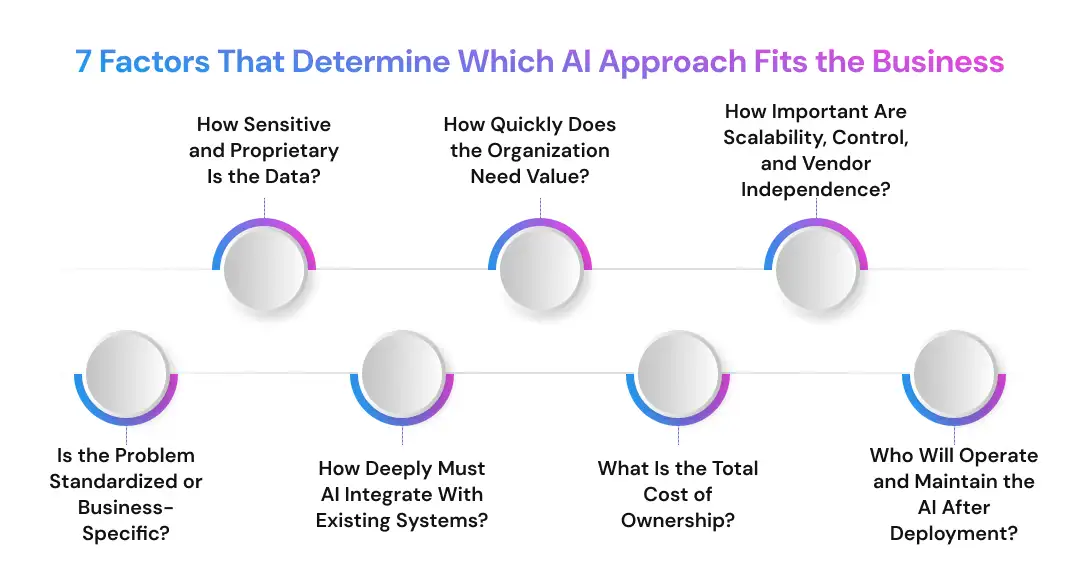
1. Is the Problem Standardized or Business-Specific?
Start with the workflow.
Off-the-shelf AI usually works best when the business requirement is common and several established products already support it.
These use cases can include basic summarization, general content generation, routine customer support, or standard administrative automation.
Custom AI becomes more relevant when the workflow contains proprietary rules, internal terminology, specialized data, or exceptions that generic platforms cannot handle reliably.
Teams should identify these requirements before choosing the technology. An AI workflow discovery checklist can help organizations map workflow stages, inputs, outputs, integrations, and decision points.
Businesses should also determine whether the capability is a utility or a competitive differentiator.
If several vendors can deliver the required result with acceptable control and cost, buying an existing platform may be sufficient. If the workflow directly affects how the organization competes, serves customers, or operates critical processes, custom AI deserves closer evaluation.
2. How Sensitive and Proprietary Is the Data?
Data requirements can quickly change the AI decision.
Organizations working with customer records, intellectual property, financial information, healthcare data, or proprietary datasets need more control over how information moves through AI systems.
Teams should evaluate:
- Where data is processed
- Where information is stored
- How long data is retained
- Who can access it
- Whether inputs are used for model training
- Which security controls are available
- What compliance requirements apply
Off-the-shelf AI is not automatically insecure.
Security and privacy depend on the vendor’s architecture, contractual terms, retention policies, hosting model, and access controls. Businesses comparing deployment options can review private vs public LLMs before deciding how sensitive information should interact with AI models.
Custom AI provides greater architectural control.
Organizations can define where data resides, which systems can access it, and how information moves between applications. This becomes especially important when AI regulation and compliance require stronger governance, auditability, or data-handling controls.
3. How Deeply Must AI Integrate With Existing Systems?
AI creates more operational value when it can work with the systems employees already use.
Many off-the-shelf platforms support common integrations through APIs, plugins, and prebuilt connectors.
These can include:
- CRM platforms
- ERP systems
- Collaboration tools
- Cloud applications
- Document repositories
- Customer support platforms
Standard connectors may be sufficient for straightforward workflows.
Integration becomes more complex when organizations depend on proprietary databases, internal APIs, older applications, or specialized permission structures.
Custom AI can address these requirements through business-specific integration logic. Teams can use AI integration services to connect models with existing applications, data sources, and operational workflows.
Legacy systems create another challenge.
Older applications may not provide modern APIs or standardized data access. An AI integration architecture for legacy systems can help organizations connect these environments without replacing the entire technology stack.
4. How Quickly Does the Organization Need Value?
Deployment speed often favors off-the-shelf AI.
The core platform already exists. Teams mainly configure the product, connect supported systems, establish access controls, and train users.
This makes commercial tools useful for:
- Early experimentation
- Standard business tasks
- Short implementation cycles
- Limited technical resources
- Initial use-case validation
Custom AI requires more preparation.
Teams may need to complete discovery, data preparation, architecture design, development, integration, testing, and deployment before the system reaches production.
The timeline depends on complexity.
A focused AI PoC development process can help organizations test technical feasibility before committing resources to full-scale implementation.
5. What Is the Total Cost of Ownership?
Initial price does not show the complete cost of an AI system.
Businesses should evaluate total cost of ownership (TCO) across development, deployment, operation, maintenance, and future changes.
Off-the-shelf AI costs can include:
- Subscription fees
- Per-user pricing
- API or usage charges
- Premium features
- Integration costs
- Internal administration
- Data migration
- Vendor switching costs
Custom AI has a different cost structure.
Organizations may need to fund data engineering, software development, infrastructure, model usage, testing, monitoring, security, and ongoing maintenance.
This means the cheaper option can change over time.
A low-volume standardized workflow may remain economical with a subscription platform. A specialized, high-volume workflow may justify custom development if recurring platform costs or operational limitations become significant.
Teams can use broader AI development cost estimates when comparing implementation scenarios.
6. How Important Are Scalability, Control, and Vendor Independence?
Off-the-shelf platforms can scale quickly when business requirements remain within the vendor’s architecture.
The provider manages much of the infrastructure. However, organizations also depend on its pricing, feature roadmap, API limits, model availability, and product decisions.
Custom AI provides more control over these choices.
Teams can design infrastructure around specific workloads, data volumes, integrations, and performance requirements. That flexibility also creates additional engineering responsibility.
Vendor independence should be evaluated early.
Businesses should determine whether they can export their data, replace models, migrate integrations, and change infrastructure without rebuilding the entire workflow.
7. Who Will Operate and Maintain the AI After Deployment?
AI systems require ongoing operational ownership.
Models change. APIs change. Business rules evolve. Data quality can also change over time.
Production teams may need to manage:
- Performance monitoring
- Output evaluation
- User permissions
- Security controls
- Human approvals
- Integration updates
- Failure handling
- Model or vendor changes
Off-the-shelf vendors manage much of the underlying platform.
Internal teams still remain responsible for how the technology is used inside the business.
Custom AI requires greater operational involvement. Organizations or their development partners must maintain the architecture, integrations, monitoring processes, and governance controls.
The decision is therefore larger than build versus buy.
Businesses must also determine who can operate the AI system reliably after it goes live.
When Off-the-Shelf AI Is the Better Choice
Off-the-shelf AI works well when the business requirement is common and established tools already solve it effectively.
Organizations can consider this approach when they need:
- Faster deployment
- Lower initial investment
- Standard business functionality
- Vendor-managed infrastructure
- Limited internal AI engineering
- Early use-case validation
For example, a marketing team may use a commercial AI assistant for content drafts, summaries, or routine research. Building a custom system for these tasks may add unnecessary cost and operational responsibility.
Off-the-shelf AI is also useful when AI supports the business but does not create a unique competitive capability.
Build AI Around Your Business, Not Platform Limitations
Combine proven AI models with your proprietary data, RAG, integrations, workflows, and business logic to create a solution tailored to your operations.
Explore Custom AI Development
When Custom AI Is the Better Choice
Custom AI becomes more relevant when business requirements cannot fit comfortably inside a standard platform.
Organizations may require it when AI depends on:
- Proprietary business data
- Specialized workflows
- Domain-specific rules
- Complex integrations
- Custom security controls
- Strict governance requirements
- Unique performance criteria
A financial services company, for example, may need an AI system that analyzes internal data, applies organization-specific rules, and connects with existing approval processes.
Enterprise AI development can support these environments by creating architecture around specific operational requirements.
Teams considering this route should also understand how to build AI software before committing to development.
When a Hybrid AI Approach Makes More Sense
Businesses do not always need to choose between fully custom and completely off-the-shelf AI.
A hybrid AI approach combines existing AI technology with custom business components.
Organizations can combine:
- Commercial foundation models
- Proprietary databases
- Custom APIs
- RAG pipelines
- Business-specific workflows
- Internal security controls
- Custom orchestration layers
For example, a team can integrate an LLM into an application instead of training a new model from scratch.
The commercial model provides the core AI capability. Custom components control how the model accesses information and performs business tasks.
This approach allows businesses to buy standardized capabilities while customizing the areas that create operational or competitive value.
A 5-Step Framework for Choosing Between Custom and Off-the-Shelf AI
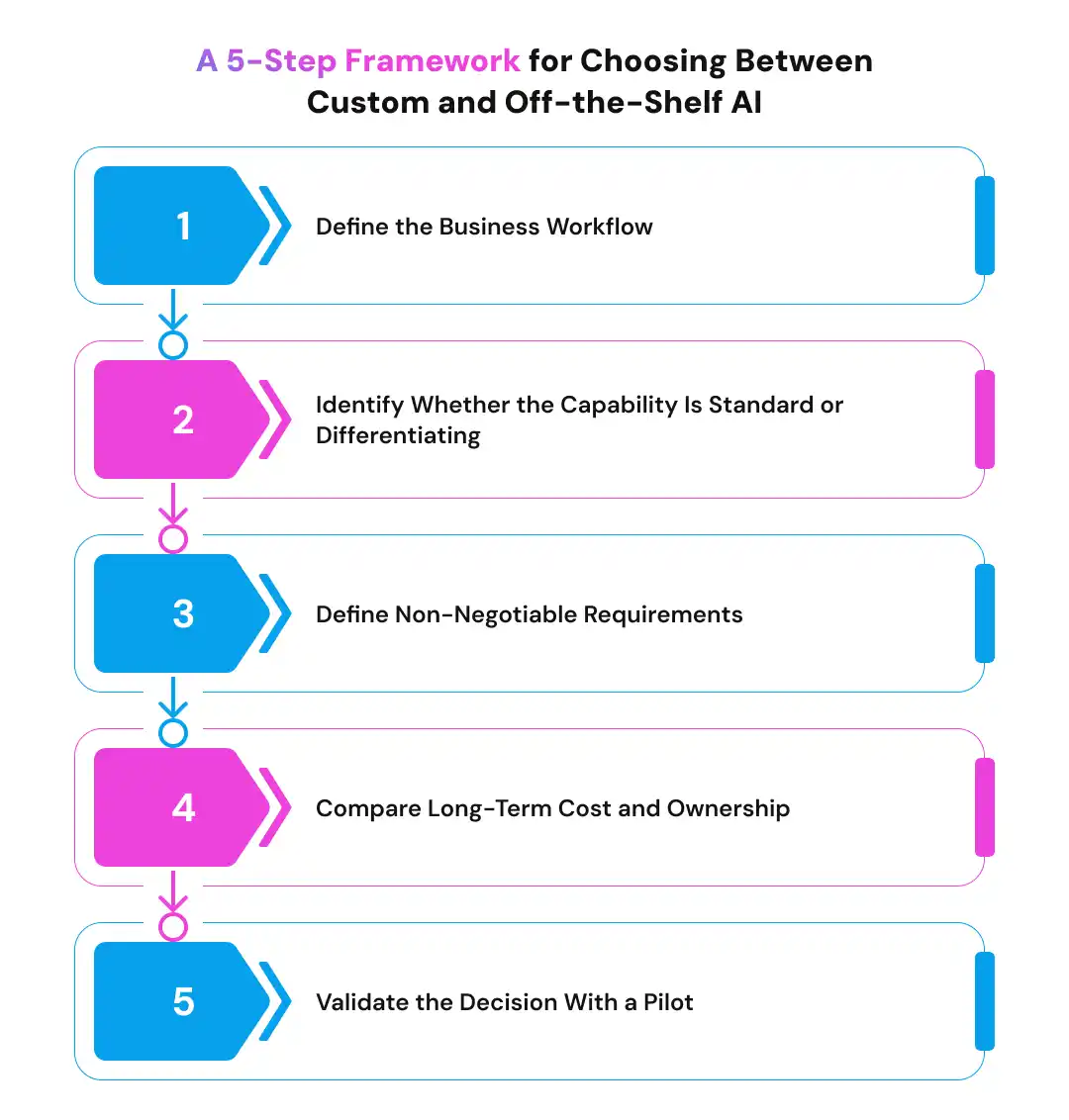
Step 1: Define the Business Workflow
Start with one specific problem.
Teams should document the users, inputs, workflow stages, expected outputs, and business result.
Avoid beginning with a broad goal such as “implement AI.”
Step 2: Identify Whether the Capability Is Standard or Differentiating
Determine whether existing products already solve the requirement.
If several vendors provide acceptable results, off-the-shelf AI may be sufficient.
If proprietary data, workflows, or decision logic create business differentiation, custom AI deserves stronger consideration.
Step 3: Define Non-Negotiable Requirements
Document the requirements that the AI system must meet.
These can include:
- Data privacy
- System integrations
- Compliance
- Reliability
- Permissions
- Auditability
- Human review
- Performance requirements
Organizations needing technical guidance can use AI consulting services to evaluate these constraints before selecting an approach.
Step 4: Compare Long-Term Cost and Ownership
Compare more than development cost or subscription pricing.
Teams should include infrastructure, integrations, usage fees, maintenance, monitoring, staffing, and migration costs.
They should also determine who will maintain the system after deployment.
Businesses working with an external partner can review the questions to ask an AI development company before making that decision.
Step 5: Validate the Decision With a Pilot
Test the preferred approach under actual business conditions.
A pilot should evaluate:
- Output quality
- Integration reliability
- Exception handling
- User adoption
- Operational cost
- Governance requirements
Teams can compare an AI PoC vs AI MVP to determine the right validation scope.
Businesses can also use AI PoC development services before moving toward full AI implementation.
How Prismetric Helps Businesses Build the Right AI Solution
As an AI development company, Prismetric helps businesses evaluate, build, integrate, and deploy AI systems around real operational requirements.
Not every organization needs a fully custom AI platform. Prismetric works with businesses to identify where existing AI models can be used and where proprietary data, workflows, integrations, or business logic require custom development.
Prismetric builds AI solutions using technologies and approaches such as:
| Prismetric Delivery Capability |
Scale |
| Happy Clients |
1,000+ |
| Solutions Developed |
1,500+ |
| Countries Served |
50+ |
| Developers |
100+ |
We help businesses build:
- Custom AI applications
- Enterprise AI agents and copilots
- RAG-based knowledge systems
- AI-powered workflow automation
- Domain-specific machine learning solutions
- AI integrations across existing business systems
Our AI teams focus on production requirements such as:
- Data and system integration
- Workflow reliability
- Security and governance
- Model evaluation and monitoring
- Scalability
- Post-deployment support
Connect with Prismetric to evaluate whether an off-the-shelf, custom, or hybrid AI approach fits your business requirements.
Validate Your AI Approach Before Making a Bigger Investment
Prismetric can build a focused AI PoC to test output quality, integration reliability, governance, user adoption, and operating cost before full implementation.
Start Your AI PoC
Custom AI vs Off-the-Shelf AI: The Final Decision
Off-the-shelf AI fits businesses that need standard capabilities, faster deployment, and lower initial commitment.
Custom AI fits organizations that require greater control over data, workflows, integrations, governance, or system behavior.
A hybrid approach works when existing AI models provide sufficient core capabilities but the surrounding business logic still requires customization.
The right decision is not simply whether to build or buy.
It is deciding which parts of the AI system the business needs to own, control, and differentiate.
FAQs About Custom AI vs Off-the-Shelf AI
No. Custom AI is better when a business needs specialized workflows, proprietary data access, deeper integrations, or greater architectural control.
For standard tasks that existing products already handle effectively, off-the-shelf AI can be faster and more economical.
ChatGPT is generally used as an off-the-shelf AI platform because businesses can access existing AI capabilities without developing the underlying model themselves.
However, businesses can also build custom applications around commercial LLMs by adding:
- Proprietary business data
- RAG systems
- Internal APIs
- Custom workflows
- Access controls and business rules
This creates a hybrid solution rather than a completely off-the-shelf implementation.
Usually, no. Custom AI does not necessarily mean training a new machine learning or language model from scratch.
Many businesses use existing foundation models and customize the data pipelines, integrations, retrieval systems, workflows, permissions, and business logic around them.
Custom AI normally requires a higher initial investment because development, integration, testing, infrastructure, and maintenance must be considered.
Off-the-shelf platforms may cost less initially, but long-term expenses can grow through:
- Per-user subscriptions
- API usage
- Premium features
- Integration fees
- Increasing data or transaction volumes
- Vendor switching costs
The better comparison is therefore total cost of ownership, not only the starting price.
A switch becomes worth evaluating when the limitations of the existing platform begin affecting operations, costs, compliance, or customer experience.
Common warning signs include:
- Important workflows cannot be customized
- Required integrations are unavailable
- Usage costs are becoming difficult to justify
- Proprietary data cannot be used effectively
- Governance requirements exceed platform capabilities
- Vendor limitations are slowing product or operational changes
Some platforms can connect with enterprise data, but the level of control varies by vendor, product, hosting model, and contract.
Businesses should verify where data is processed and stored, how long it is retained, who can access it, and whether submitted information may be used for model improvement.
Not automatically. Security depends on how the system is designed, configured, deployed, monitored, and maintained.
Custom AI can provide greater control over:
- Data location
- Permissions
- Authentication
- Network architecture
- Logging and auditing
- Model access
- Retention policies
That additional control also means the organization carries more responsibility for implementing those protections correctly.
A small business usually does not need custom AI when the requirement involves common tasks such as drafting content, summarizing documents, basic support, or routine productivity.
Custom development becomes more reasonable when a specific workflow creates measurable business value and existing tools cannot support it effectively.
Starting with an off-the-shelf product or a small pilot can help validate the requirement before making a larger investment.
The main disadvantage is the additional responsibility that comes with ownership.
Businesses may need resources for:
- Development and testing
- Data engineering
- Infrastructure
- Security
- Monitoring
- Model evaluation
- Integration maintenance
- Ongoing improvements
The flexibility of custom AI therefore needs to justify the additional operational effort.
Businesses have less control over what the platform supports and how its underlying technology evolves.
They may depend on the vendor for pricing, API limits, available integrations, model choices, feature changes, data policies, and product roadmap decisions.
Off-the-shelf AI can often be deployed faster because the main technology already exists. Implementation may primarily involve configuration, integrations, permissions, and user onboarding.
Custom AI requires additional discovery, architecture, data preparation, development, testing, integration, and production deployment.
The timeline ultimately depends on the number of workflows, data sources, integrations, security requirements, and performance expectations involved.
Yes. This is often a practical way to validate whether AI creates enough value before investing in more specialized development.
A business might first use a commercial AI platform and later add:
- Proprietary knowledge sources
- RAG
- Internal system integrations
- Custom interfaces
- Automated workflows
- Organization-specific business logic
This can gradually turn an off-the-shelf implementation into a hybrid AI architecture.
A hybrid AI solution combines existing AI technology with components developed specifically for the business.
For example, a company may use an existing LLM while building its own retrieval system, integrations, security layer, workflow logic, and application interface around it.
This approach allows businesses to avoid rebuilding standardized AI capabilities while retaining control over the areas that create operational or competitive value.
Start by identifying what an existing platform cannot do rather than asking whether custom AI sounds more powerful.
Custom AI deserves stronger consideration when the business has:
- Proprietary workflows
- Specialized decision logic
- Unique data sources
- Complex system integrations
- Strict security or governance requirements
- High-volume processes where platform limitations affect cost
- AI capabilities that contribute directly to competitive differentiation
If these requirements are limited, an off-the-shelf platform may still be the more practical choice.
The answer depends on what needs to be customized.
RAG is useful when the AI needs access to current or proprietary knowledge. Fine-tuning can help when model behavior, style, or task performance needs adaptation.
Training a model from scratch is a much larger undertaking and is unnecessary for many enterprise AI applications.
Not necessarily. Businesses can use internal engineering teams, external AI development partners, or a combination of both.
What matters is establishing ownership for:
- Data and integrations
- Security and governance
- Output evaluation
- Monitoring
- Infrastructure
- Business rules
- Post-deployment maintenance
Even when development is outsourced, the business should retain clear ownership of requirements, data policies, and success criteria.
Both can scale, but they scale differently.
Off-the-shelf AI can scale quickly while requirements remain within the vendor’s platform. Custom AI provides more freedom to design infrastructure, integrations, and processing around specific workloads.
The better option depends on whether future growth is mainly about more users and usage or about more specialized workflows and system requirements.
Test the AI against the actual workflow rather than relying only on feature comparisons or demonstrations.
A useful pilot should measure:
- Output accuracy and quality
- Integration reliability
- Response time
- Exception handling
- Data and security requirements
- User adoption
- Cost per workflow or transaction
- Human review requirements
- Operational effort
The results provide stronger evidence for the decision than comparing AI platforms only on their advertised capabilities.