Top 10 Conversational AI Development Companies in 2026
Conversational AI has moved beyond simple rule-based chatbots. Businesses now use it to handle customer support, answer questions from enterprise knowledge, qualify leads, automate voice interactions, and complete tasks across connected systems. Modern solutions combine technologies such as large language models, retrieval-augmented generation, natural language processing, and AI agents to create more useful conversations. Businesses exploring conversational AI therefore need to evaluate more than a provider’s ability to build a chatbot.
The best conversational AI development companies can design the conversational experience, connect it with enterprise applications, manage AI reliability, and support production deployment. This guide compares 10 providers and explains the capabilities, selection criteria, benefits, and technical factors businesses should consider before investing in enterprise chatbot development or a broader conversational AI system. Understanding how AI supports customer experience also helps businesses identify where conversational systems can create practical value.
Key Takeaways
- The right conversational AI development company depends on the use case. A customer-support chatbot, internal knowledge assistant, sales bot, and voice agent require different architecture, integrations, and evaluation methods. Businesses should first understand the difference between an AI chatbot, AI agent, and LLM application before choosing a development approach.
- Strong providers combine LLM expertise with NLP, dialogue design, retrieval, evaluation, and application engineering. For projects that depend heavily on language understanding, experienced natural language processing services can help turn unstructured conversations into useful inputs for business workflows.
- Enterprise conversational AI works best when it connects with existing systems. A virtual assistant may need access to CRM records, ERP data, support tickets, internal databases, or knowledge repositories. Businesses should therefore examine a provider’s experience with AI integration architecture for legacy systems.
- Voice AI requires more than converting speech to text. Production systems must manage latency, speech recognition, text-to-speech, interruptions, telephony, routing, and human handoffs. Understanding an AI voice agent architecture and telephony stack helps businesses evaluate whether a provider can support real-time voice interactions.
- Security and governance should be considered before development starts. Access controls, PII protection, audit logs, model permissions, output monitoring, and human review can affect how safely an enterprise conversational AI solution operates.
- Businesses should evaluate working software and production practices rather than relying only on demos. A provider should be able to explain testing, failure handling, model evaluation, monitoring, and improvement after launch. An AI agent evaluation framework can help teams define measurable quality criteria.
- Cost depends on the solution’s complexity, channels, integrations, model usage, data requirements, security controls, and ongoing support. Companies comparing custom development with packaged platforms can use a custom AI vs off-the-shelf AI framework to understand the trade-offs.
Choose a Conversational AI Partner That Fits Your Use Case
Prismetric helps define the right architecture for customer support, knowledge assistants, sales automation, voice agents, and enterprise conversational workflows.
Discuss Your Conversational AI Project
Our Criteria for Ranking the Top Conversational AI Development Companies
To create this list of conversational AI development companies, we focused on technical capability, enterprise readiness, delivery scope, and the factors that affect whether a conversational system can work reliably in production.
Conversational AI experience. We prioritize companies with relevant experience in AI chatbots, virtual assistants, voice agents, LLM applications, or conversational workflow automation. General software experience is useful, but it does not automatically translate into strong conversational AI delivery. Businesses evaluating vendors can also review the broader criteria used when choosing an AI development company.
LLM, NLP, and RAG expertise. A capable provider should understand how language models generate responses, how NLP processes user input, and how retrieval-augmented generation grounds answers in approved business data. Teams may also need to decide between fine-tuning, prompt engineering, and RAG depending on the use case and available data.
Voice and omnichannel capability. We consider whether the company can support text, mobile, messaging, and voice interactions. A strong AI voice agent development company should understand real-time conversation design as well as speech technologies and contact-center integration.
Enterprise integration expertise. Conversational systems often need to retrieve information or trigger actions in connected applications. We therefore favor providers that can integrate AI with enterprise systems instead of building an isolated chatbot that cannot interact with business workflows.
Security and AI governance. The evaluation considers authentication, authorization, privacy controls, data handling, logging, guardrails, and human oversight. These capabilities become more important when conversational AI accesses sensitive enterprise information or performs actions on behalf of users.
Production delivery and optimization. We look for providers that support the full lifecycle from planning and architecture through deployment, monitoring, and improvement. Mature AI implementation services should address how a system moves from prototype testing into a controlled production environment.
Business fit and delivery transparency. Technical skills matter, but businesses also need clear project planning, realistic estimates, suitable engagement models, and measurable objectives. Before shortlisting providers, decision-makers can review the questions to ask an AI development company to compare vendors on more than marketing claims.
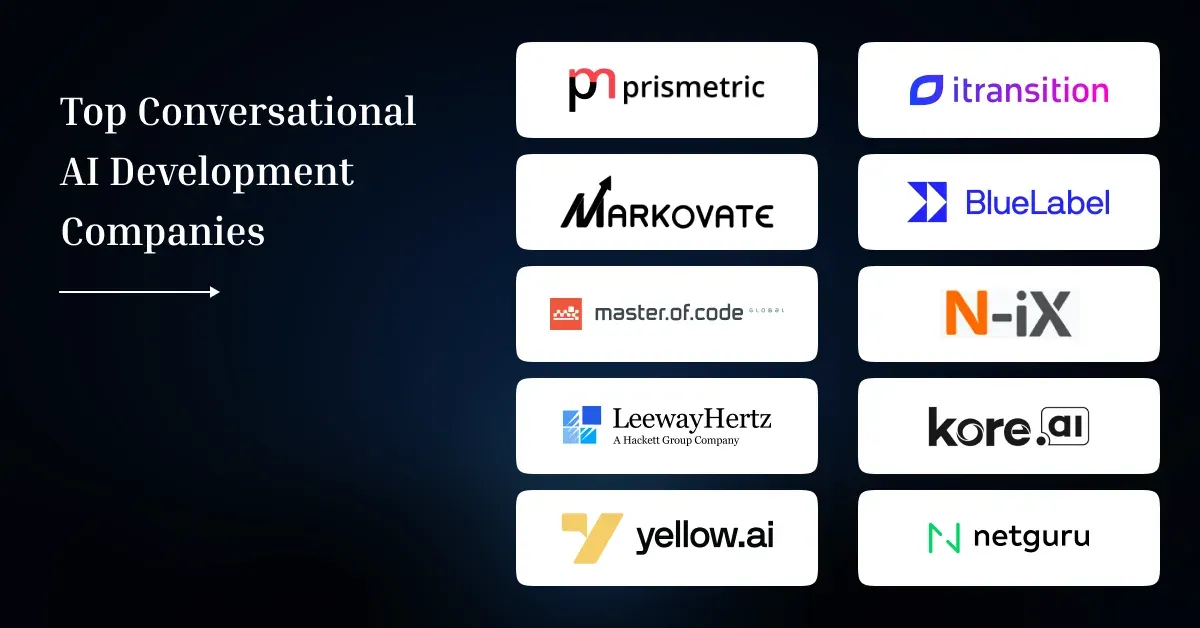
Top 10 Conversational AI Development Companies in 2026
The companies below differ in delivery model, technical focus, and enterprise fit. Some build fully custom conversational AI solutions, while others combine software engineering with AI consulting or provide platform-led approaches. The comparison gives businesses a quick way to identify which providers align with their project requirements.
| Rank |
Company |
Provider Type |
Best For |
Core Capabilities |
| 1 |
Prismetric |
Custom AI development company |
End-to-end conversational AI |
Chatbots, voice AI, LLMs, RAG, AI agents |
| 2 |
Itransition |
AI and software engineering company |
Complex enterprise integration |
Virtual assistants, voice systems, AI agents |
| 3 |
Markovate |
AI development company |
LLM-powered conversational products |
Chatbots, NLP/NLU, voice assistants |
| 4 |
BlueLabel |
AI product development company |
AI-enabled digital products |
Conversational AI, RAG, LLM engineering |
| 5 |
Master of Code Global |
Conversational AI specialist |
Customer-facing AI systems |
Assistants, GenAI, conversational experiences |
| 6 |
N-iX |
Enterprise engineering company |
Large-scale AI implementations |
NLP, assistants, enterprise integration |
| 7 |
LeewayHertz |
AI development company |
RAG and agentic AI |
LLMs, RAG, AI agents |
| 8 |
Kore.ai |
Platform-led provider |
Enterprise conversational automation |
Chat, voice, CX and employee agents |
| 9 |
Yellow.ai |
Platform-led provider |
Multilingual omnichannel CX |
Voice, chat, customer automation |
| 10 |
Netguru |
Product engineering company |
Conversational AI products |
RAG, chatbots, AI integration |
1. Prismetric
Best for: Businesses that need custom conversational AI connected with enterprise data, applications, and operational workflows.
Prismetric develops AI-powered applications that combine conversational interfaces with technologies such as LLMs, RAG, NLP, voice AI, and AI agents. This approach supports use cases ranging from customer-service assistants to internal knowledge systems and workflow automation.
The company also focuses on connecting AI with CRMs, ERPs, databases, APIs, and enterprise applications. Businesses comparing different providers can review other top chatbot development companies to understand how technical scope and delivery models differ across the market.
Expertise:
- Enterprise AI chatbots and virtual assistants
- RAG and LLM-powered applications
- AI agents and workflow orchestration
- Voice-enabled conversational systems
- Enterprise data and API integration
Organizations that need more control over workflows, data access, and user experience may choose custom chatbot engineering instead of relying only on a preconfigured platform.
Advantages:
- Supports development from planning and architecture through deployment
- Builds conversational systems around existing business processes
- Covers text, voice, knowledge retrieval, and agent-based workflows
An AI workflow discovery checklist can also help teams identify which conversations and repetitive tasks are suitable for automation before development starts.
Industries served: Enterprise projects across sectors such as healthcare, fintech, retail, logistics, real estate, travel, and other digital businesses.
Connect Conversations With the Systems That Power Your Business
Build conversational AI that works with CRM, ERP, databases, APIs, support platforms, and enterprise knowledge instead of operating as an isolated chatbot.
Explore Conversational AI Integration
2. Itransition
Best for: Enterprises that need conversational AI integrated with complex software environments.
Itransition develops chatbots, virtual assistants, voice interfaces, and AI agents that can interact with enterprise applications and data. Its broader software engineering background makes the company relevant for organizations where conversational AI must connect with existing systems rather than operate as an independent interface.
Expertise:
- AI chatbots and virtual assistants
- Voice and conversational interfaces
- RAG-based knowledge access
- Multi-step AI agent workflows
The company also supports architecture, implementation, testing, deployment, and ongoing maintenance. These capabilities matter when assistants retrieve private information or trigger actions across several business systems.
Advantages:
- Experience with integration-heavy enterprise projects
- Supports both text and voice conversational systems
- Covers the full software development lifecycle
- Suitable for custom workflow automation
Project budgets can vary considerably as integrations, voice channels, private data, and security requirements increase. Businesses can review the main factors behind conversational AI chatbot development cost before comparing vendor estimates.
Industries served: Enterprise sectors with complex software, data, and operational requirements.
3. Markovate
Best for: Companies developing custom AI chatbots, voice assistants, and LLM-powered conversational applications.
Markovate provides conversational AI development across chat, voice, NLP, and generative AI. Its services cover systems that interpret user requests, generate contextual responses, and connect conversational interfaces with business applications.
The company works with NLP and NLU to help systems identify intent and understand user input. Speech recognition and text-to-speech technologies also support voice-based use cases such as automated customer interactions and conversational IVR.
Businesses assessing the technical work involved can study how to build an AI chatbot to understand conversation design, model selection, integrations, testing, and deployment.
Expertise:
- Custom AI chatbot development
- NLP and NLU
- Voice assistants
Advantages:
- Supports both text and voice interactions
- Covers customer-facing and internal use cases
- Integrates conversational systems with enterprise software
For projects where real-time speech is the main channel, comparing specialized AI voice agent development companies can help businesses assess telephony, latency, speech processing, and deployment expertise.
Industries served: Conversational and AI applications across service businesses, transportation, property-related services, restaurants, and other digital workflows.
4. BlueLabel
Best for: Businesses that want conversational AI embedded into a broader digital product or customer experience.
BlueLabel combines AI strategy with product engineering. Its AI work includes conversational systems, retrieval-augmented generation, AI agents, and LLM engineering. The company builds chatbots that connect with business knowledge, helping applications generate responses based on company information rather than only a model’s general training data.
This approach can fit companies that see conversational AI as part of a larger product rather than a stand-alone bot. Teams planning this type of system can use a generative AI development guide to understand how data, models, architecture, testing, and deployment work together.
Expertise:
- Conversational AI applications
- RAG-powered knowledge systems
- AI agents
- LLM and data engineering
Advantages:
- Combines AI development with digital product engineering
- Supports knowledge-grounded conversational experiences
Businesses that need to ground assistants in private knowledge can also compare RAG and fine-tuning before choosing how the system should adapt to company-specific information.
Industries served: Healthcare, financial services, real estate, consumer products, and other digital-product environments.
5. Master of Code Global
Best for: Customer-facing conversational AI and generative AI assistants across multiple channels.
Master of Code Global has a dedicated conversational AI practice covering conversation design, custom development, generative AI, voice experiences, integrations, testing, and post-launch optimization. Its systems can run across web, mobile, messaging applications, and voice channels.
The company also builds assistants that connect with CRMs, ERPs, Microsoft 365, SharePoint, and other internal tools. This helps conversational systems use business information and workflows instead of operating as isolated interfaces. Organizations defining similar projects can explore generative AI use cases to identify where language-based automation creates practical value.
Expertise:
- Conversation design and conversational AI
- Generative AI assistants
- Voice and omnichannel experiences
Advantages:
- Dedicated conversational AI specialization
- Supports custom and platform-based implementations
- Covers development and post-launch optimization
- Experience integrating assistants with enterprise systems
For companies that need help deciding what to build before development starts, generative AI consulting services can support use-case assessment, architecture planning, and implementation decisions.
Industries served: Finance, healthcare, eCommerce, automotive, telecom, retail, travel, and other customer-facing sectors.
6. N-iX
Best for: Large enterprises that need conversational AI connected with complex data, cloud, and software environments.
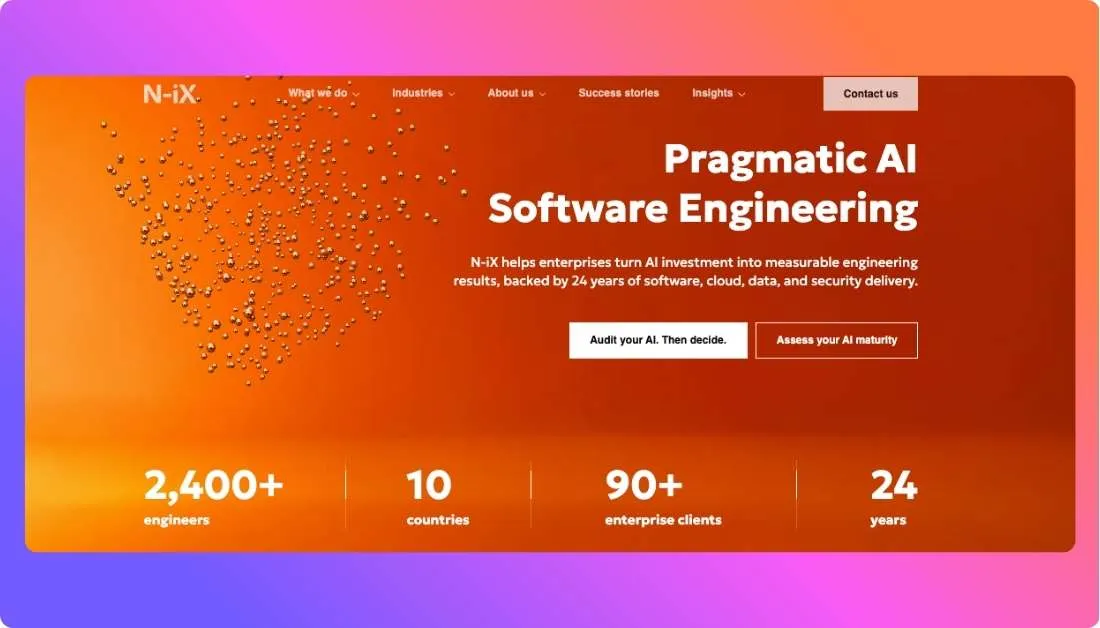
N-iX provides conversational AI consulting from strategy and use-case planning through chatbot design, NLP customization, platform integration, testing, and ongoing optimization. Its services cover customer-facing applications as well as internal workflows such as employee support, knowledge retrieval, and IT assistance.
The company also brings broader NLP, machine learning, data, and cloud engineering capabilities. This can matter when an assistant needs reliable access to enterprise information. For example, businesses can connect LLMs with enterprise databases so conversational responses use current business data rather than relying only on static model knowledge.
Expertise:
- Conversational AI strategy
- Chatbots and virtual assistants
- NLP and ML customization
- Platform and CRM integration
- Testing and production optimization
Advantages:
- Strong enterprise engineering background
- Supports customer and employee use cases
- Covers strategy through ongoing support
N-iX can be particularly relevant when conversational AI forms part of a wider enterprise AI program. Organizations with similar requirements may need enterprise AI development support for architecture, integration, deployment, and scalability.
Industries served: Fintech, healthcare, retail, manufacturing, and other enterprise sectors.
7. LeewayHertz
Best for: Businesses building RAG-based assistants, AI agents, and conversational systems that perform multi-step tasks.
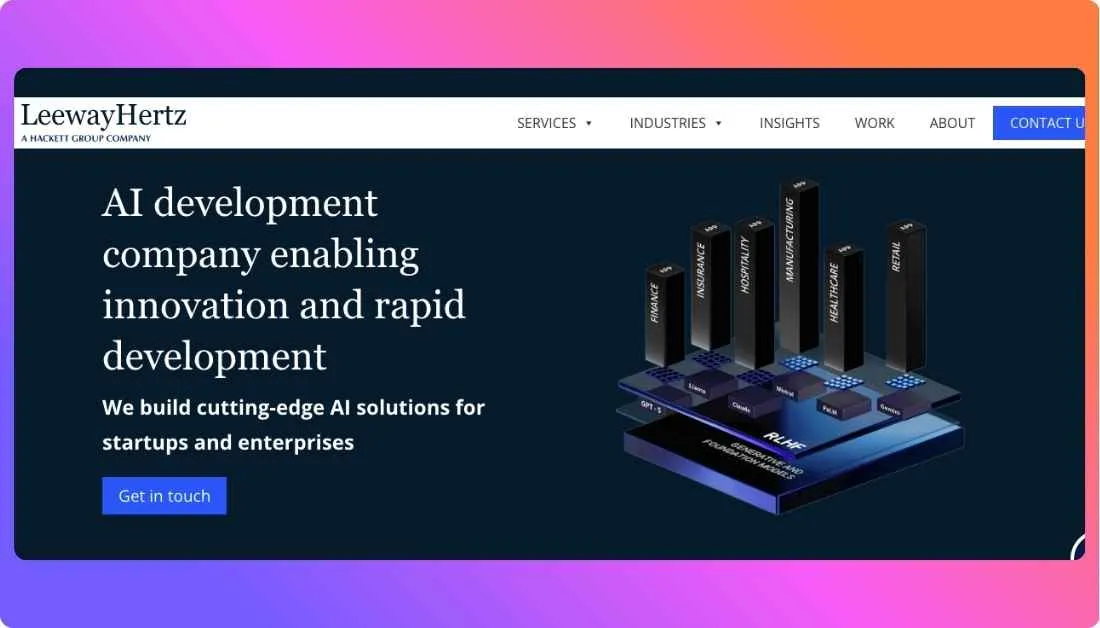
LeewayHertz focuses on custom AI and generative AI development, including AI agents, enterprise assistants, and applications that connect language models with business data and tools. This type of architecture is useful when a conversational interface needs to retrieve information and take controlled actions instead of only returning generated text.
Agent-based systems require clear goals, approved tools, data access, monitoring, and human approval points. Businesses evaluating this approach should first understand what AI agents are and where their capabilities differ from conventional chatbots.
Expertise:
- AI agent development
- RAG-based assistants
- Generative AI applications
- Enterprise workflow integration
Organizations building knowledge-heavy assistants can also use RAG as a service to connect conversational applications with approved documents, databases, and other enterprise information.
Advantages:
- Focus on agentic and generative AI applications
- Supports knowledge-grounded conversational systems
- Suitable for multi-step workflow automation
Industries served: Enterprise applications across finance, healthcare, manufacturing, retail, logistics, and other data-intensive sectors.
8. Kore.ai
Best for: Enterprises that prefer a platform-led approach for customer service, employee support, and large-scale conversational automation.
Kore.ai provides an enterprise AI platform for building, deploying, governing, and improving AI agents. Its customer-experience capabilities include digital and voice agents, agentic RAG search, human handoff, persistent context, and integrations that allow agents to complete tasks across enterprise systems.
Unlike a traditional conversational AI development company, Kore.ai centers its offering around a configurable platform and prebuilt applications. This can suit enterprises that want reusable infrastructure for several conversational use cases. Businesses planning voice interactions can also examine the key features of AI voice agents before selecting an implementation approach.
Expertise:
- Digital AI agents
- Enterprise voice agents
- Agentic RAG and knowledge search
- Employee-facing AI assistants
- Multi-agent workflow orchestration
Kore.ai’s voice capabilities include interruption handling, low-latency conversations, integrations, lifecycle management, and multi-step workflows. Businesses that need deeper customization around these functions may also consider AI voice agent development support.
Advantages:
- Platform-led development with enterprise governance controls
- Supports voice, web, mobile, Slack, Teams, and other channels
- Includes observability, agent evaluation, and lifecycle management
Its broad platform architecture also makes the underlying AI technology stack an important consideration when comparing a packaged platform with a fully custom system.
Industries served: Banking, healthcare, retail, telecommunications, travel, and other enterprise environments.
9. Yellow.ai
Best for: Enterprises that need multilingual conversational automation across voice, chat, messaging, and other customer-service channels.
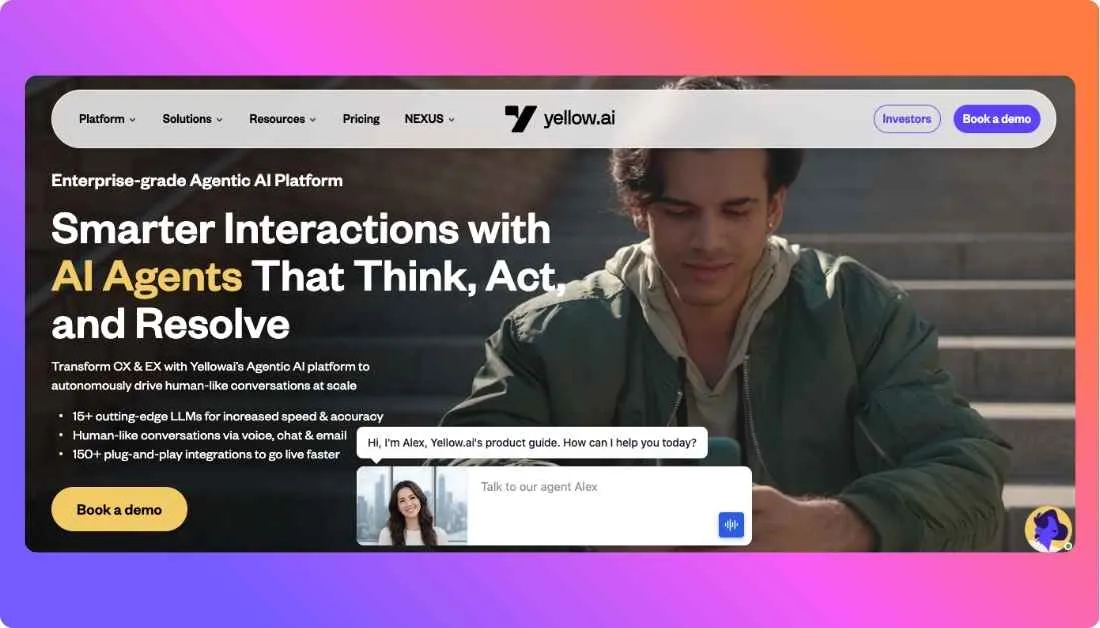
Yellow.ai provides an enterprise platform for AI-driven customer-service automation. It supports conversations across chat, voice, email, and messaging while integrating with business platforms such as Salesforce, Zendesk, SAP, Workday, and Genesys. Its platform also supports multilingual and multi-region deployments.
Voice is a major part of its offering. Yellow.ai’s current Nexus VOX system is designed for enterprise voice interactions across hundreds of languages and dialects while connecting conversations with systems of record. For businesses evaluating similar use cases, understanding voice AI for sales and conversion workflows can help identify where spoken automation fits the customer journey.
Expertise:
- Multilingual voice AI
- Omnichannel customer interactions
- Agentic customer-service automation
Advantages:
- Supports chat, voice, email, and messaging channels
- Integrates with common enterprise applications
- Designed for multilingual deployments
- Combines conversations with workflow execution
Organizations that want conversational agents to perform business actions can also evaluate AI-powered workflow automation rather than treating every interaction as a simple question-and-answer exchange. Comparing available AI workflow automation tools can further clarify build-versus-platform decisions.
Industries served: Enterprise customer-service and employee-experience use cases across multiple sectors.
10. Netguru
Best for: Product teams that need custom conversational AI combined with broader product, data, and software engineering.
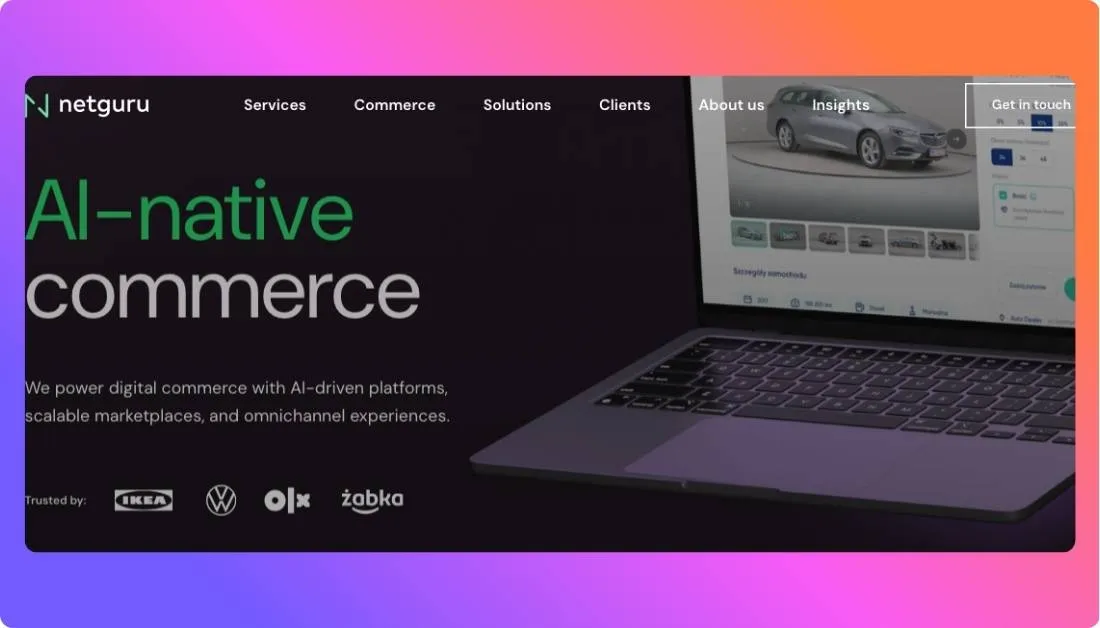
Netguru provides AI development services covering generative AI, RAG systems, AI agents, model development, AI integration, and MLOps. Its dedicated chatbot offering includes conversational design, system integration, analytics, and multi-platform deployment.
The company has also built RAG-based chatbot systems that retrieve responses from controlled knowledge sources. This product-engineering background can suit organizations that want conversational AI embedded into an existing application. Teams considering more autonomous workflows can first review common agentic AI use cases and then assess whether they require custom AI agent engineering.
Expertise:
- Custom AI chatbots
- RAG and knowledge-grounded assistants
- Generative AI development
- AI integration and agentic systems
Advantages:
- Combines AI with end-to-end digital product engineering
- Supports systems from prototype through production and ongoing improvement
Businesses requiring greater architectural control can explore custom AI development capabilities. Deployment requirements also matter, particularly when sensitive enterprise data is involved, making the choice between cloud and on-premise LLM deployment part of the technical evaluation.
Industries served: Finance, retail, commerce, proptech, healthcare, and other digital-product sectors.
How to Choose the Right Conversational AI Development Company
Choosing among conversational AI development companies starts with the business problem, not the model. A clear use case makes it easier to compare technical approaches, delivery models, and long-term costs.
Define the Use Case and Desired Outcome
Decide whether the system should answer questions, qualify leads, support employees, handle voice calls, or complete transactions. An enterprise chatbot guide can help teams separate simple information retrieval from workflows that need integrations, permissions, or human escalation.
Assess LLM, NLP, and RAG Capabilities
A provider should explain how the system understands requests, retrieves trusted information, and controls generated answers. Businesses using private knowledge should understand how RAG works because grounding responses in approved data can improve relevance without retraining the entire model.
Examine Integration Experience
Conversational AI creates more value when it can work with CRMs, ERPs, ticketing platforms, databases, and internal APIs. Integration requirements should be identified early because they affect architecture, security, testing, and delivery effort.
Review Voice and Omnichannel Expertise
Voice projects introduce speech recognition, text-to-speech, latency, interruptions, telephony, and call routing. Teams considering spoken interactions should understand AI voice agents before assuming the same architecture used for a text chatbot will work for real-time conversations.
Evaluate Security and Governance
Ask how the provider handles access control, PII, logging, prompt injection, output restrictions, and human approval. Organizations with sensitive knowledge may also need to consider the security and compliance requirements involved in building an enterprise RAG application.
Check Production Evaluation and Support
A strong provider should test task completion, response quality, retrieval accuracy, latency, escalation behavior, and failure cases. Ongoing monitoring matters because knowledge, prompts, models, and user behavior change after launch.
Compare Pricing and Engagement Models
Configured platform projects may start around $5,000–$10,000, while custom conversational AI can reach $10,000–$50,000 or more depending on scope. These are planning ranges, not fixed prices. Model usage and infrastructure also affect operating expenses, making strategies to reduce LLM inference costs important for high-volume applications.
Move Your Conversational AI From Prototype to Production
Prismetric can help test response quality, RAG accuracy, voice latency, integrations, security, escalation, and monitoring before your solution reaches real users.
Talk to Our Conversational AI Experts
Benefits of Working With an Experienced Conversational AI Development Company
Access Specialized Expertise
Experienced teams bring together LLM engineering, NLP, RAG, conversation design, integrations, and application development. Businesses still defining their AI roadmap may use AI consulting support to assess feasibility and priorities before committing to development.
Move From Prototype to Production Faster
Established development practices can reduce avoidable rework around architecture, testing, deployment, and monitoring. The benefit is not simply faster coding; it is having a clearer path from an initial proof of concept to a system that can support real users.
Connect Conversations With Business Workflows
A capable development partner can connect assistants with systems that hold customer, operational, or knowledge data. This allows the conversational interface to perform useful work instead of functioning only as a question-and-answer layer.
Build for Scale and Changing Demand
Production systems need to handle more users, channels, data, and model requests over time. Good architecture also considers model costs, observability, retrieval performance, and the effect of higher conversation volumes.
Reduce Technical and Governance Risk
Experienced teams can design permissions, guardrails, fallback behavior, evaluation, and human escalation into the system. These controls become especially important when AI agents perform actions or access sensitive business information.
Improve the System After Launch
Conversation analytics and evaluation help teams identify weak answers, failed workflows, and knowledge gaps. For advanced applications, custom generative AI development can support model changes, retrieval improvements, and new conversational capabilities as requirements evolve.
Frequently Asked Questions About Conversational AI Development Companies
Some notable conversational AI development companies include Prismetric, Itransition, Markovate, BlueLabel, Master of Code Global, N-iX, LeewayHertz, Kore.ai, Yellow.ai, and Netguru.
The best choice depends on whether a business needs custom development, enterprise integrations, voice AI, RAG, multilingual support, or a platform-led solution.
A conversational AI development company designs and builds systems that understand user requests, generate relevant responses, retrieve business information, and sometimes perform actions.
Typical services include:
- AI chatbot and virtual assistant development
- Voice AI and speech integration
- LLM and RAG implementation
- NLP and NLU development
- CRM, ERP, and API integration
- AI agent and workflow automation
Traditional chatbots often depend on predefined rules, menus, and scripted responses. Conversational AI uses technologies such as NLP and LLMs to understand more flexible user input.
Modern systems can also maintain context, retrieve enterprise information, and support more complex conversations.
Simple platform-based implementations may start around 5,000–10,000, while custom solutions can cost 10,000–50,000 or more depending on complexity.
Key cost factors include:
- Number of channels
- CRM or ERP integrations
- Voice capabilities
- RAG and private data
- AI agent complexity
- Security and compliance requirements
- Model and infrastructure usage
Businesses building more autonomous systems should also account for AI agent development costs.
A focused chatbot or proof of concept may take several weeks, while an enterprise conversational AI system can require several months.
Timelines increase when projects involve multiple integrations, voice channels, RAG pipelines, custom workflows, security reviews, testing, and production deployment.
A platform can work well when the requirements match standard chatbot, support, or workflow capabilities.
Custom development is more suitable when a business needs:
- Unique workflows
- Deeper enterprise integrations
- Greater control over data and models
- Custom user experiences
- Industry-specific security or governance
Some organizations use a hybrid approach by combining a commercial platform with custom engineering.
Businesses should ask about relevant production experience, architecture, integrations, security, evaluation, and post-launch support.
Useful questions include:
- Which similar conversational AI systems have you built?
- How do you reduce hallucinations?
- How will the AI access our business data?
- How do you test conversation quality?
- What happens when the AI cannot answer?
- How are model and infrastructure costs monitored?
Yes. Many providers build AI voice agents for customer support, lead qualification, appointment scheduling, sales calls, and internal workflows.
Voice development typically requires speech recognition, text-to-speech, telephony integration, interruption handling, latency management, and human-call transfer in addition to the conversational AI layer.
Yes. Enterprise conversational systems commonly connect with CRMs, ERPs, ticketing platforms, databases, knowledge bases, and internal APIs.
For example, an assistant can retrieve a customer’s order status from a CRM and answer the question without forcing an employee to search manually.
A typical conversational AI technology stack can include:
- Large language models
- NLP and NLU
- RAG and embeddings
- Vector databases
- Speech-to-text and text-to-speech
- AI agent frameworks
- APIs and orchestration tools
- Cloud infrastructure and monitoring
The exact stack should follow the use case rather than forcing one model or framework onto every project.
Look beyond service-page claims. Relevant case studies, working demos, technical discussions, architecture examples, and production deployments provide stronger evidence.
A credible provider should also be able to explain limitations, failure handling, testing methods, security controls, and the trade-offs behind its technology choices.
There is no single provider that fits every enterprise project.
Businesses with complex integrations may prioritize engineering depth, while others may value multilingual support, voice capabilities, RAG, or ready-made platform features. The best provider is the one whose technical strengths match the actual workflow, data, security, and deployment requirements.
Many experienced providers offer monitoring, maintenance, model updates, prompt optimization, RAG improvements, analytics, and integration support after deployment.
Post-launch work matters because business data, user behavior, models, and conversation patterns continue to change after the system enters production.