Cloud vs. On-Premise LLM Deployment: 12 Factors to Choose the Right Model
Cloud vs. on-premise LLM deployment is no longer a purely technical choice. It influences how quickly an enterprise launches AI, where its data travels, and who operates the infrastructure.
Cloud platforms provide rapid access to managed models and elastic computing capacity. On-premise environments provide tighter infrastructure control, but they also transfer maintenance, security, and recovery work to internal teams.
For organizations comparing private and public LLMs, the harder question is not simply where a model runs. Model availability, usage patterns, latency, compliance, and engineering capacity can change the answer.
This guide compares both approaches across the factors that matter in production. It will help technology leaders build a deployment-ready AI strategy based on measurable workload requirements rather than assumptions alone.
Cloud vs. On-Premise LLM Deployment: Factors to Consider Before Choosing
First, carefully separate three deployment models that are often grouped together. A managed cloud API places the model and serving infrastructure under provider control. A self-hosted cloud deployment runs an open-weight model on rented GPUs while your team manages serving. An on-premise deployment runs on infrastructure your organization controls.
Teams evaluating large language model development services must compare them separately because each balances model access, responsibility, control, and cost differently.
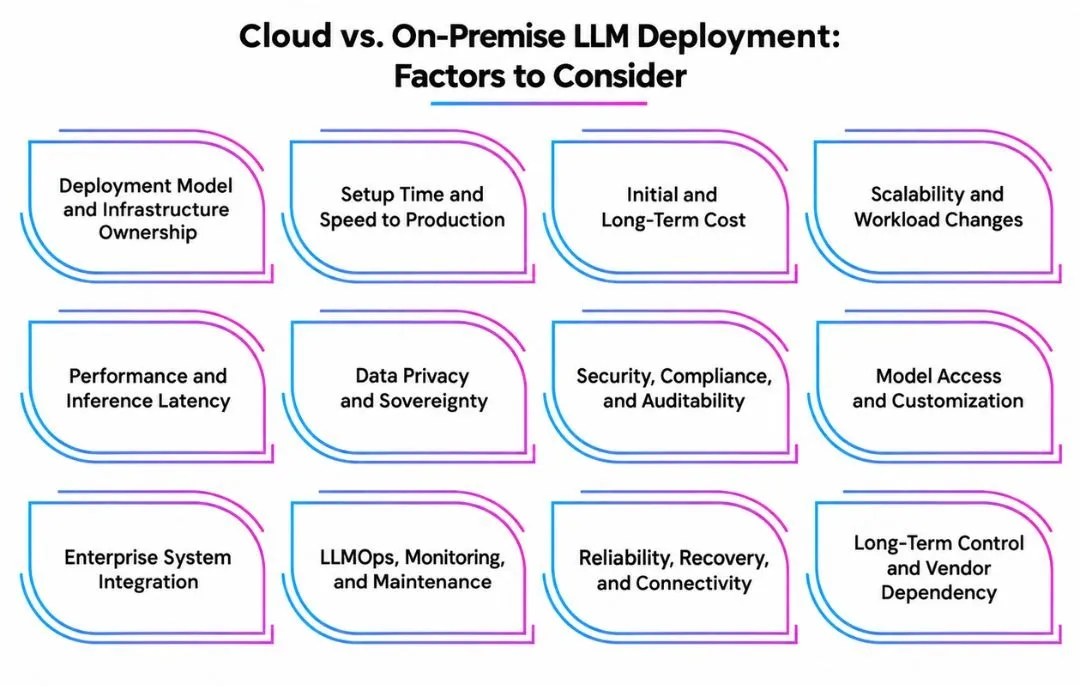
1. Deployment Model and Infrastructure Ownership
Infrastructure ownership determines who manages GPUs, networks, storage, model-serving software, and security. With a managed API, the provider operates the stack. Your team manages application data flows, access policies, prompts, and outputs.
Self-hosting in the cloud shifts more work to your engineers, although the provider owns the hardware. On-premise deployment transfers nearly all operational responsibility to your organization. Understanding AI in cloud computing helps distinguish rented infrastructure from managed AI services.
More control means more work. Ownership helps only when the organization can operate what it controls.
Choose the Right LLM Deployment Model for Your Business
Prismetric helps assess workload, data sensitivity, latency, compliance, and cost to determine whether cloud, on-premise, or hybrid deployment fits best.
Assess Your LLM Deployment
2. Setup Time and Speed to Production
A managed API supports fast prototyping because the model endpoint and scaling layer already exist. The team can focus on workflow design, evaluation, safeguards, and integration.
Self-hosted cloud and on-premise systems require model selection, serving configuration, infrastructure testing, security reviews, and monitoring. A structured generative AI development process prevents unstable releases. Specialists may also design a production generative AI system around performance and governance requirements.
Cloud starts faster. Production readiness still depends on testing, integration, and governance.
3. Initial and Long-Term Cost
Cloud APIs convert model usage into operating expenses. Charges rise with tokens, stored data, network traffic, and provisioned capacity. This works well when demand is low or unpredictable because the organization avoids paying for idle hardware.
On-premise deployment requires GPUs, servers, storage, networking, power, cooling, backup capacity, and skilled operators. Owned infrastructure may become economical when inference demand is sustained and utilization remains consistently strong. A realistic LLM development cost assessment must include more than the model.
Before buying hardware, examine caching, batching, prompt length, model routing, and retrieval quality. These methods can reduce LLM inference costs without changing platforms. Specialists can evaluate the deployment business case across demand and utilization scenarios.
Neither option is universally cheaper. The workload decides where the cost advantage sits.
4. Scalability and Workload Changes
Cloud services can add capacity as traffic rises and release it when demand falls. That flexibility suits seasonal workloads and products with uncertain adoption. Provider quotas, GPU shortages, and rate limits can still restrict growth.
On-premise capacity depends on installed hardware. Expansion requires procurement, installation, and testing. LLMOps tools improve visibility, while specialists can establish deployment automation and observability across either environment.
Cloud fits variable demand. On-premise suits stable, measurable capacity needs.
5. Performance and Inference Latency
Deployment location affects performance, but response time also depends on model size, quantization, context length, GPUs, batching, concurrency, and serving efficiency.
On-premise systems remove public internet latency and can support disconnected operations. A cloud endpoint may still respond faster with stronger hardware or more efficient serving. AI model testing should measure time to first token, throughput, output quality, and errors under load. Teams may also optimize and serve task-specific models within defined limits.
Test the complete application path. Location alone does not determine speed.
6. Data Privacy and Sovereignty
An LLM workflow processes more than prompts. It may handle retrieved documents, embeddings, conversation history, evaluation samples, logs, and outputs. Enterprises must know where each data type is processed, stored, transmitted, and deleted.
On-premise deployment gives the organization direct control over the infrastructure boundary. Cloud deployment depends on the provider’s architecture, contracts, retention settings, and regional availability. The correct choice may be shaped by industry-specific IT compliance obligations and internal data-classification policies.
Strong privacy also requires well-designed ingestion and retrieval systems. Teams may need to prepare governed data pipelines so sensitive information reaches only approved models, users, and applications.
7. Security, Compliance, and Auditability
Keeping a model inside the building does not make it secure. On-premise teams must configure identity controls, encryption, segmentation, audit logs, patching, vulnerability management, and incident response. Weak operations can create exposure even when data never reaches an external provider.
Cloud vendors may provide security controls and compliance documentation, but customers retain responsibilities. Teams must review retention, administrator access, subprocessors, logging, and contracts. They should also protect connected applications from prompt injection.
For regulated deployments, review applicable AI regulation and compliance in the US and every other jurisdiction where the system operates. Compliance depends on evidence and controls, not a hosting label.
8. Model Access and Customization
Managed APIs provide access to proprietary models that organizations generally cannot download and operate on their own servers. Self-hosted cloud and on-premise deployments normally rely on open-weight models whose licenses permit the intended commercial use.
Customization can involve prompt design, retrieval-augmented generation, fine-tuning, quantization, or changes to the surrounding application. The right method depends on the problem. Teams should first compare fine-tuning, prompt engineering, and RAG and then decide whether retrieval or fine-tuning fits the required behavior.
When domain adaptation is justified, specialists can adapt an open-weight model with business data. The resulting model must still pass quality, safety, latency, and cost tests before deployment.
9. Enterprise System Integration
An enterprise LLM rarely works alone. It may need controlled access to databases, document repositories, CRM platforms, ERP systems, identity providers, workflow tools, and internal APIs.
The architecture must protect these connections while preserving reliable access. Guidance on integrating LLMs with enterprise databases can help define permissions and retrieval paths. Teams must also connect the selected LLM with an application without exposing unnecessary systems.
For complex environments, AI integration services can connect the model, data layer, and business workflow under consistent security controls.
10. LLMOps, Monitoring, and Maintenance
Cloud API providers maintain their model-serving infrastructure, but customers still need to monitor application quality, token usage, latency, failed requests, and unsafe outputs. Provider updates can also change behavior, which makes regression testing necessary.
Self-hosted systems add responsibility for model servers, drivers, orchestration, scaling, patches, capacity, and rollback. A disciplined DevOps implementation helps teams automate repeatable releases and reduce configuration errors. The underlying delivery and operations architecture should define monitoring, ownership, escalation, and recovery paths.
The operational question is simple: who will detect a problem, and who is accountable for fixing it?
11. Reliability, Recovery, and Connectivity
Cloud APIs depend on provider availability and network connectivity. Enterprises should plan for timeouts, regional failures, quota exhaustion, and degraded model performance. Multi-region designs or alternative endpoints can improve resilience, but they add cost and testing work.
On-premise deployment removes reliance on an external inference endpoint, yet it introduces local risks. Hardware can fail. Storage can become unavailable. Certificates can expire, and one overloaded inference server can interrupt the entire service.
A team moving the selected architecture into production through AI implementation services should test backup capacity, failover, restoration, and the loss of dependencies. Local operation is useful only when the recovery plan is equally local and proven.
12. Long-Term Control and Vendor Dependency
Managed platforms can create dependency through proprietary APIs, model-specific prompts, pricing structures, security features, and evaluation methods. Moving later may require application changes and model retesting.
On-premise deployment offers greater control over update timing and infrastructure, but it creates a different dependency. The organization becomes responsible for hardware lifecycle, model support, engineering knowledge, and replacement capacity. Open weights do not remove operational lock-in.
Teams should keep the application layer portable, maintain reusable evaluation datasets, document configuration, and define how data and logs will be exported or deleted. Contracts should also explain provider exit, access revocation, and deletion evidence.
Cloud offers easier entry. On-premise offers deeper control. Long-term flexibility depends on architecture and documentation in both cases.
When to Choose On-Premise LLM Deployment
On-premise LLM deployment is a strong choice when control, predictable performance, or local processing matters more than rapid setup. Consider it when:
- Sensitive information must remain inside your environment. Healthcare records, financial documents, source code, and regulated data may require strict processing and storage boundaries.
- The application must operate without dependable internet access. Factories, defense environments, remote facilities, and isolated research networks may need local inference.
- Inference demand is high and consistent. Owned infrastructure can become cost-effective when GPUs remain well utilized, but the calculation must include power, cooling, maintenance, and replacement capacity.
- You need deep model and infrastructure control. Teams can choose open-weight models, set update schedules, configure serving, and apply domain-specific changes. A custom AI versus off-the-shelf AI assessment can clarify whether that flexibility is justified.
- Your organization already has capable platform teams. On-premise systems require security, networking, MLOps, disaster recovery, and hardware expertise.
- Your retrieval system uses tightly governed internal knowledge. Review enterprise RAG implementation requirements before committing infrastructure.
Choose on-premise only when operational readiness matches the need for control and a clearly measurable long-term business case.
When to Choose Cloud LLM Deployment
Cloud LLM deployment usually fits organizations that value speed, elasticity, and access to managed capabilities. It is practical when:
- You need to validate an idea quickly. Managed APIs let teams test workflows and model quality before committing to dedicated infrastructure. A defined AI proof-of-concept development process keeps the experiment tied to measurable business criteria.
- Demand is uncertain or changes sharply. Elastic capacity supports pilots, seasonal workloads, product launches, and sudden traffic increases without permanent hardware purchases.
- Your internal infrastructure team is small. The provider manages physical servers and, with managed APIs, model serving. Your organization still owns application security, access controls, evaluations, and data handling.
- You need access to proprietary models. Many advanced commercial models are available only through provider endpoints and cannot be installed locally.
- Users operate across several regions. Regional resources can reduce network distance, subject to provider availability and residency rules.
- You prefer operating expenses over capital investment. Pay-as-you-go access reduces upfront spending, although sustained token volume can raise long-term costs.
Teams can also build generative AI software on rented GPUs for more control without purchasing hardware.
Is a Hybrid LLM Setup the Better Choice?
A hybrid LLM setup can be more practical than placing every workload in one environment. It can combine managed cloud models, self-hosted cloud infrastructure, and on-premise systems according to data sensitivity, latency, access, and cost.
For example, a business might use a cloud API to summarize public research while processing contracts, customer records, or proprietary engineering documents through an internal model. An AI workflow discovery assessment can identify which tasks belong in each environment before infrastructure decisions are made.
It also supports gradual adoption. Teams can test low-risk workflows in the cloud, collect evaluation data, and move selected workloads on-premise when volume, compliance, or control justifies the change. A governed enterprise retrieval layer can provide approved information to models across both environments.
Hybrid deployment adds operational work. Identity rules, model routing, logging, evaluations, and incident response must remain consistent across platforms. A defined integration architecture for legacy systems helps prevent disconnected controls and duplicated data pipelines.
Hybrid is not a compromise by default. It is a workload-by-workload design choice that succeeds only when routing policies and operational ownership are explicit.
Design a Hybrid LLM Architecture Without Creating More Complexity
Prismetric can help route workloads across cloud and on-premise environments while keeping data access, security, monitoring, and governance consistent.
Plan Your Hybrid LLM Setup
How to Choose the Right LLM Deployment Model for Your Business
Choosing an LLM environment should begin with business requirements, not model popularity. Use the following five steps to turn privacy, performance, cost, and operational concerns into a defensible deployment decision.
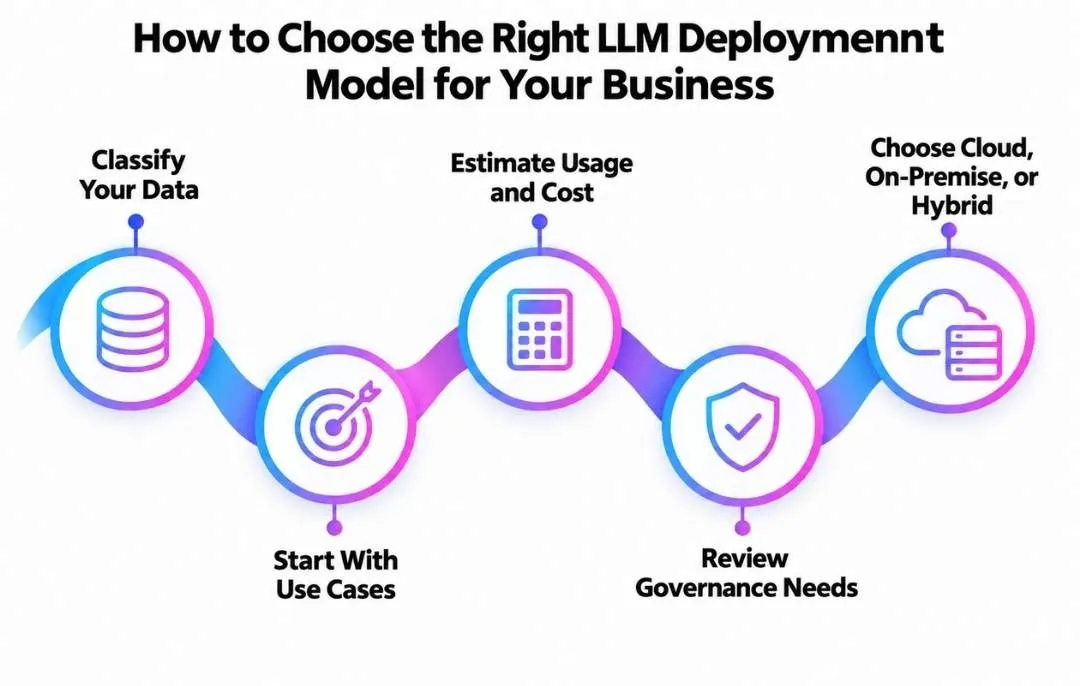
1. Classify Your Data
List every data type the application will process, including prompts, retrieved documents, embeddings, logs, feedback, and generated outputs. Mark information as public, internal, confidential, regulated, or prohibited from external processing.
Then map storage locations, retention limits, residency obligations, and approved users. This classification determines whether a managed cloud API is acceptable, whether private cloud controls are sufficient, or whether processing must remain on-premise.
2. Start With Use Cases
Evaluate specific workflows rather than selecting one platform for every AI initiative. A public website assistant, internal knowledge copilot, claims-review tool, and offline factory assistant have different data, latency, reliability, and oversight requirements.
Rank each use case by business value and implementation risk. Guidance on AI POCs and AI MVPs can help teams choose an appropriate validation stage before production investment.
3. Estimate Usage and Cost
Forecast request volume, input and output tokens, context length, concurrency, peak demand, storage, data transfer, and expected growth. Compare cloud charges with the full cost of owned infrastructure over the same period.
Include engineering, monitoring, power, cooling, redundancy, and hardware replacement. A generative AI cost assessment should also test how caching, batching, smaller models, and request routing affect both options.
4. Review Governance Needs
Identify who approves models, data sources, access permissions, updates, and production releases. Define the evidence auditors will require and how teams will investigate unsafe or inaccurate outputs.
An enterprise AI governance plan should cover ownership, evaluation thresholds, logging, human review, incident response, and model retirement. Cloud contracts and on-premise operating procedures must support the same policies.
5. Choose Cloud, On-Premise, or Hybrid
Choose cloud for fast deployment, variable demand, and managed model access. Select on-premise when strict local control, offline operation, or steady utilization justifies ownership. Use hybrid when workloads have materially different requirements.
An experienced team can design an enterprise AI environment and validate it with real workloads before wider rollout. Document the decision, assumptions, benchmarks, and review date because pricing, models, regulations, and demand can change. Reassess deployment during AI transformation when workload volume, data classification, or operating requirements change.
How Prismetric Supports Cloud and On-Premise LLM Deployment
Choosing an environment is only the beginning. Enterprises also need an architecture that connects models with approved data, business applications, security controls, and measurable operating goals. Prismetric supports this process from workload assessment through production monitoring.
1. Assessing Deployment Readiness
Our team starts by examining the intended workflows, data classifications, user groups, latency targets, expected demand, and compliance obligations. We also review existing cloud accounts, data centers, integration patterns, and engineering capacity.
This assessment identifies which workloads suit managed APIs, self-hosted cloud models, on-premise infrastructure, or a hybrid design. It also prevents organizations from purchasing GPUs or signing long-term platform commitments before validating demand.
Move Your LLM From Deployment Planning to Production
Prismetric helps with architecture, enterprise data integration, security, LLMOps, evaluation, monitoring, and continuous optimization across cloud and on-premise environments.
Talk to Our LLM Experts
2. Designing the LLM Architecture
Prismetric evaluates model access, context requirements, retrieval design, inference capacity, availability, and cost. Our engineers can create an architecture that separates sensitive workloads, routes requests to suitable models, and maintains consistent access policies.
Businesses can also assemble a generative AI engineering team with experience in model integration, retrieval systems, APIs, evaluation pipelines, and production deployment.
3. Integrating Security and Enterprise Data
An LLM becomes useful when it can work with accurate, permitted business information. We connect models with databases, document repositories, enterprise applications, and identity systems while limiting each user and service to authorized data.
The implementation can include encryption, secrets management, audit logging, prompt filtering, output validation, retention controls, and human approval points for sensitive actions.
4. Supporting LLMOps and Continuous Improvement
After deployment, teams must track response quality, latency, throughput, failures, token consumption, infrastructure utilization, and security events. Prismetric can establish evaluation datasets, monitoring dashboards, release controls, rollback procedures, and responsibility for incidents.
We also help businesses measure AI returns after deployment and reassess the architecture as usage changes. The goal is a maintainable LLM environment that fits the workload today without limiting future deployment choices.
We can begin with a controlled pilot, document benchmarks, and expand only after the design meets agreed quality, security, reliability, and production cost thresholds.
Frequently Asked Questions About Cloud vs. On-Premise LLM Deployment
Neither option is automatically more secure. On-premise deployment provides direct infrastructure control, while reputable cloud platforms offer mature security capabilities. The result depends on identity management, encryption, configuration, monitoring, patching, contracts, and the team responsible for operating each environment. Security must be verified continuously.
It can be cheaper for sustained, predictable inference when owned GPUs remain highly utilized. Cloud deployment often costs less for experiments, small workloads, and uneven demand. Compare token charges against hardware, staffing, power, cooling, redundancy, maintenance, and replacement costs. Model efficiency can shift the result.
Yes. A hybrid architecture can route general or low-risk tasks to cloud models and keep restricted workloads on internal infrastructure. The organization still needs consistent identity controls, data classification, monitoring, evaluation, and routing policies across both environments. Test cross-environment failures before production.
Requirements depend on model size, quantization, context length, concurrency, and latency targets. A production setup may need suitable GPUs, sufficient memory, storage, networking, model-serving software, monitoring, cooling, backup capacity, access controls, and engineers who can maintain the complete stack.