How to Build Gen AI Software for Your Business: A Complete Guide for 2026
Over the past few years, generative AI has moved from being an experimental technology to becoming a practical business accelerator. From intelligent chatbots and AI copilots to document automation, code generation, content creation, and personalized recommendations, Gen AI is helping businesses rethink how software products are planned, built, and scaled.
This rapid shift has made business leaders ask one important question: how to build Gen AI software that is not just innovative but also useful, secure, scalable, and aligned with real business goals. The answer lies in combining the right use case, quality data, reliable LLMs, smart architecture, and continuous optimization. Many businesses start by working with experienced AI development services teams to validate requirements, reduce risk, and accelerate implementation.
Let’s talk about the transformation brought by cloud platforms, foundation models, vector databases, retrieval augmented generation, and LLM orchestration. Just like mobile apps changed customer engagement and SaaS changed software delivery, Gen AI software is now changing how businesses automate work, serve customers, analyze information, and create digital experiences.
Building Gen AI software is not limited to adding a chatbot to a website. It involves creating intelligent systems that can understand prompts, retrieve business context, generate accurate responses, complete tasks, connect with existing tools, and keep improving with user feedback.
For startups, SMBs, and enterprises, investing in Gen AI software development can help unlock faster workflows, smarter decision-making, reduced manual effort, and new product opportunities. But to achieve these outcomes, businesses need more than a model API. They need a strong GenAI development strategy, the right development team, and a production-ready approach.
Before diving into the complete process, let us first understand why building Gen AI software is becoming a strategic move for modern businesses.
How Gen AI Software Can Help Businesses in Streamlining Their Operations: Understanding the Worth
Gen AI software can streamline business operations, improve internal productivity, enhance customer experiences, and help teams make faster decisions. Unlike traditional software that follows fixed instructions, generative AI-powered software can understand user intent, generate content, summarize information, answer complex questions, automate repetitive tasks, and support employees across different workflows.
Modern GenAI applications can be built using pretrained models, LLM APIs, RAG pipelines, vector databases, prompt workflows, and enterprise data integrations. This makes it possible for businesses to build powerful AI-powered products without training large language models from scratch.
From AI-powered customer support assistants to internal knowledge copilots and document intelligence systems, Gen AI software development is helping businesses move from manual processes to intelligent automation.
Build Smarter Software with GenAI
Prismetric creates generative AI software for customer support, workflow automation, business intelligence, and scalable digital products.
Build GenAI Solution
Gen AI in Customer Service: Revolutionizing Engagement
Generative AI has completely changed the way businesses interact with customers. AI-powered chatbots and virtual assistants can now understand customer queries, provide personalized responses, recommend products, summarize support history, and route complex issues to human agents when needed.
By using custom GenAI software, businesses can offer faster support without increasing the workload of customer service teams. These solutions can work across websites, mobile apps, SaaS platforms, CRMs, and helpdesk systems.
How Gen AI helps customer service:
- Gen AI chatbots provide instant and personalized customer support
- AI assistants answer product, service, billing, and troubleshooting queries
- RAG-powered systems fetch accurate answers from business documents
- Support teams save time by automating repetitive customer interactions
Gen AI in Process Automation: Enhancing Operational Efficiency
Gen AI software is also becoming a strong driver of business process automation. It can help teams draft emails, summarize meetings, generate reports, extract insights from documents, classify requests, automate internal workflows, and assist employees in completing routine tasks faster.
In process automation, GenAI solutions are especially useful when businesses deal with large volumes of unstructured data such as PDFs, contracts, support tickets, emails, manuals, call transcripts, and knowledge base articles. Instead of making teams search manually, Gen AI software can read, interpret, summarize, and generate useful outputs from that information.
How Gen AI helps in process automation:
- Automates content-heavy tasks such as drafting, summarization, and reporting
- Reduces manual effort in document handling and knowledge search
- Improves team productivity by acting as an AI copilot
- Helps businesses scale workflows without adding unnecessary operational load
Considering these advantages, building Gen AI software has become a practical decision for businesses that want to stay competitive in a digital-first environment.
Let us now look at the advantages of Gen AI software development for businesses in detail below.
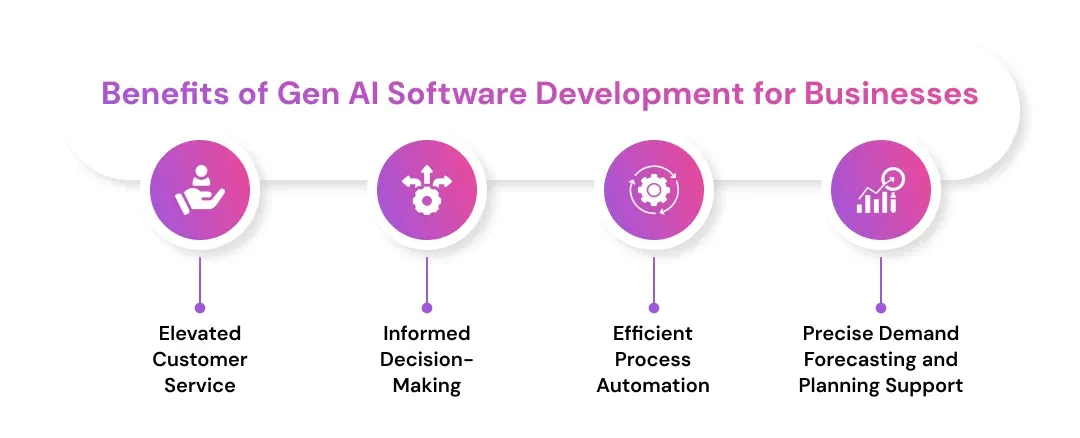
Benefits of Gen AI Software Development for Businesses
Adopting generative AI software brings multiple benefits for businesses across industries. Understanding how to build Gen AI software allows organizations to create custom solutions that solve specific problems instead of relying only on generic AI tools.
When developed with the right strategy, Gen AI software can improve customer engagement, automate internal tasks, support faster decision-making, personalize user experiences, and open new revenue opportunities.
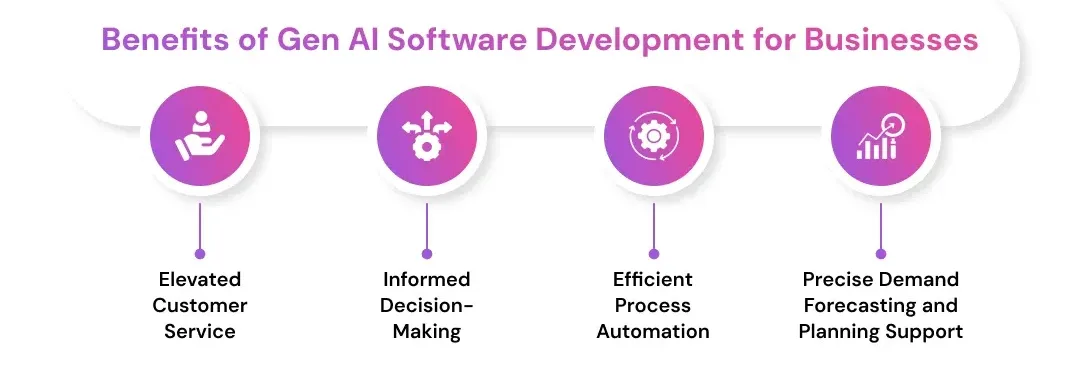
Elevated Customer Service
AI-powered customer service solutions are one of the most practical applications of Gen AI software development. These intelligent systems can answer questions, guide users, recommend products, explain policies, and help customers complete actions without waiting for human support.
Example: An eCommerce business can use a GenAI chatbot to help shoppers find products, compare options, check return policies, and receive personalized recommendations. This improves customer engagement while reducing repetitive support requests.
How Gen AI in customer service increases engagement:
- AI chatbots handle customer queries around the clock
- Personalized responses improve customer satisfaction
- Support teams can focus on complex and high-value issues
- Businesses reduce response delays and repetitive manual work
Informed Decision-Making
Gen AI platforms can help businesses turn scattered information into actionable insights. By connecting with documents, databases, reports, dashboards, and knowledge repositories, GenAI software can summarize information, highlight patterns, generate recommendations, and support faster business decisions.
Example: A finance team can use a GenAI-powered reporting assistant to summarize monthly performance, explain changes in revenue, identify unusual expenses, and prepare decision-ready insights for leadership.
How Gen AI enhances decision-making:
- Gen AI analyzes large volumes of structured and unstructured data
- Teams receive summaries, insights, and recommendations faster
- Business leaders can ask natural language questions to explore data
- AI copilots reduce the time spent searching through reports and documents
Efficient Process Automation
One of the biggest advantages of custom GenAI software is its ability to automate repetitive and time-consuming tasks. Businesses can use Gen AI tools for email drafting, proposal generation, document review, report creation, customer response automation, workflow assistance, and internal knowledge retrieval.
Example: A legal or consulting firm can use Gen AI software to review lengthy documents, summarize key points, identify missing clauses, and create first-draft responses for internal review.
How Gen AI drives process automation:
- Gen AI handles repetitive content and document-based workflows
- Teams save time by automating drafting, summarization, and classification
- Employees can focus on strategic work instead of manual processing
- Businesses improve workflow speed without compromising output quality
Precise Demand Forecasting and Planning Support
Gen AI can also support planning by combining historical data, business context, market information, and internal documents. While predictive AI identifies trends through data models, Gen AI helps explain those trends, generate planning summaries, and assist teams in making better decisions.
Example: A retail business can use GenAI software to summarize product demand reports, explain regional buying patterns, generate inventory planning notes, and help teams decide which products need more attention.
How Gen AI helps with forecasting and planning:
- Gen AI summarizes complex reports into decision-ready insights
- Teams can understand demand trends through natural language explanations
- Businesses can generate planning documents and action points faster
- Internal teams get better visibility into operations, sales, and customer behavior
How Every Industry is Utilizing Gen AI in Their Business – A Glimpse
Generative AI is no longer limited to technology companies or experimental innovation labs. Businesses across healthcare, manufacturing, finance, logistics, education, retail, tourism, real estate, and cybersecurity are already exploring how to build Gen AI software that can solve real operational challenges.
The biggest reason behind this adoption is flexibility. Many of these implementations follow proven generative AI use cases that have already demonstrated business value across industries. A GenAI solution can be developed as a chatbot, AI copilot, recommendation engine, document intelligence platform, code assistant, content generator, enterprise search tool, or workflow automation system depending on the business objective.
Let us look at how different industries are using Gen AI software to improve productivity, customer engagement, and decision-making.
Healthcare
The healthcare industry is using Gen AI software to simplify patient communication, medical documentation, clinical workflow support, and healthcare data analysis. AI-powered assistants can help patients book appointments, understand basic health information, receive reminders, and navigate healthcare services more easily.
For healthcare professionals, GenAI software can summarize patient records, generate clinical notes, assist with medical document review, and support administr≈ative teams by reducing manual paperwork. However, healthcare GenAI solutions must be developed with strong privacy, compliance, and accuracy controls.
Also Read: 10 Use Cases of Computer Vision in Healthcare
Manufacturing
Manufacturing businesses are using Gen AI to improve production planning, maintenance support, quality control, and internal knowledge management. A GenAI-powered assistant can help factory teams access equipment manuals, troubleshoot machinery issues, generate inspection summaries, and create maintenance reports.
Manufacturers can also use GenAI software to analyze operational documents, vendor communication, supply chain data, and production reports. This helps teams make faster decisions and reduce delays caused by scattered information.
Cybersecurity
In cybersecurity, Gen AI software is helping teams detect threats, summarize alerts, generate incident reports, and support faster response workflows. Security teams often deal with large volumes of logs, alerts, policies, and compliance documents. Gen AI can simplify this by turning complex technical information into easy-to-understand summaries.
A custom GenAI solution can also help cybersecurity professionals draft response plans, classify vulnerabilities, review risk reports, and provide quick answers from internal security documentation.
Logistics
Logistics and supply chain companies are using Gen AI to improve route planning support, shipment tracking communication, customer updates, inventory documentation, and operational reporting. AI assistants can help teams summarize shipment delays, explain delivery exceptions, and generate customer-facing messages.
Gen AI software can also be integrated with transportation management systems, warehouse tools, and customer portals to provide real-time assistance and improve operational visibility.
Finance
Finance businesses are using GenAI software for report summarization, customer query handling, document processing, risk analysis support, compliance assistance, and financial advisory workflows. A GenAI-powered assistant can help users understand account details, loan information, policy documents, and transaction summaries.
For internal teams, GenAI software can review financial reports, summarize market documents, generate compliance notes, and assist analysts in preparing business insights. Since finance involves sensitive information, security, data governance, and responsible AI practices are extremely important.
Education
The education industry is using Gen AI to personalize learning, support students, generate study material, automate administrative tasks, and assist teachers in content creation. AI-powered learning assistants can answer student questions, explain difficult topics, generate quizzes, and provide personalized learning paths.
Educational institutions can also build GenAI platforms for admission support, student engagement, research assistance, and automated feedback. This helps improve learning outcomes while reducing repetitive workload for educators and staff.
Tourism and Hospitality
Tourism and hospitality businesses are using Gen AI software to create personalized travel recommendations, automate customer service, generate itineraries, and improve booking experiences. AI travel assistants can help users explore destinations, compare packages, understand policies, and receive customized travel plans.
Hotels, travel agencies, and booking platforms can also use GenAI solutions to manage guest communication, summarize reviews, automate FAQs, and create multilingual support experiences.
Retail and eCommerce
Retail and eCommerce businesses are using GenAI software to personalize shopping journeys, generate product descriptions, automate customer support, and recommend products based on user intent. AI shopping assistants can help customers compare products, find suitable options, and complete purchases faster.
GenAI solutions can also support internal teams by creating marketing content, summarizing customer feedback, improving catalog management, and analyzing buying behavior.
All these industry applications clearly show that Gen AI software development is not a one-size-fits-all approach. Every business needs a custom strategy based on its users, workflows, data sources, compliance needs, and long-term growth plans.
Now that we have understood how different industries are using generative AI, let us move to the actual process of building Gen AI software.
Also Read: 9 Ways Computer Vision Is Shaping the Future of Retail
A Step-by-Step Guide to Build Gen AI Software
Building Gen AI software requires a structured approach. Businesses cannot simply integrate an AI model and expect reliable outcomes. The development process involves understanding the business use case, preparing data, selecting the right model, designing the architecture, integrating AI workflows, testing outputs, deploying securely, and continuously improving the solution.
Here is a complete step-by-step process to build Gen AI software for your business.
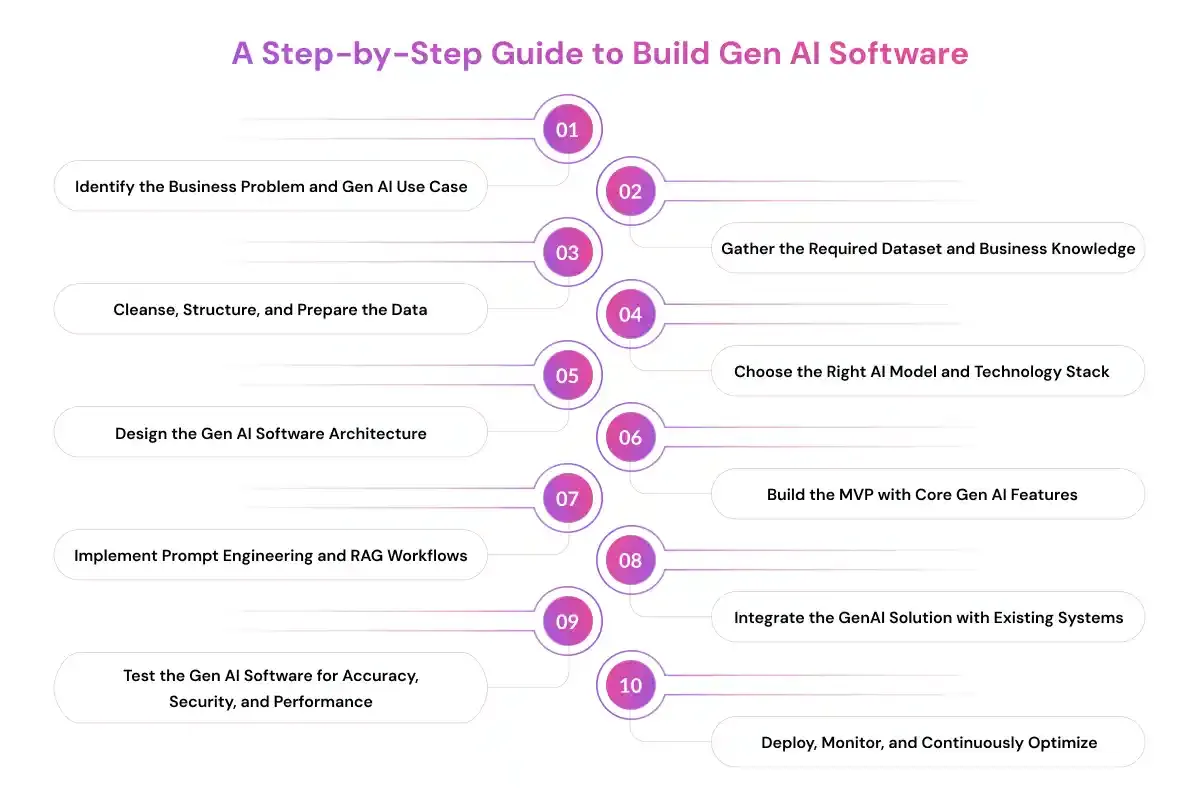
1. Identify the Business Problem and Gen AI Use Case
The first step in Gen AI software development is to identify the problem you want the solution to solve. This could be customer support automation, internal knowledge search, document summarization, sales assistance, report generation, code assistance, content creation, or workflow automation.
At this stage, businesses should define the target users, expected outcomes, core features, and the value the GenAI solution will deliver. A clear use case helps development teams choose the right model, architecture, data strategy, and integration approach.
For example, a business that wants to automate customer support may need a chatbot with RAG capabilities, CRM integration, multilingual support, and escalation workflows. On the other hand, a company building an internal AI copilot may need secure access to documents, role-based permissions, and enterprise search functionality.
2. Gather the Required Dataset and Business Knowledge
Once the use case is defined, the next step is to gather the required data and business knowledge. Gen AI software becomes more useful when it can work with company-specific information such as product documents, user manuals, support tickets, policies, reports, FAQs, CRM data, knowledge bases, and internal process documents.
For many GenAI applications, businesses do not need to train a large language model from scratch. Instead, they can connect the AI system with their private data using techniques like retrieval augmented generation. This allows the software to generate responses based on relevant business context.
The quality of this data directly affects the quality of the GenAI output. Therefore, businesses should collect accurate, updated, and well-organized information before moving to the next stage.
3. Cleanse, Structure, and Prepare the Data
After collecting the dataset, the information needs to be cleaned, organized, labeled, and prepared for AI usage. Raw business data often contains duplicate files, outdated documents, inconsistent formatting, incomplete information, and irrelevant content.
Data preparation may include removing duplicates, converting documents into machine-readable formats, dividing large files into smaller chunks, adding metadata, organizing content by category, and preparing vector embeddings for semantic search.
This step is especially important for GenAI software that uses RAG pipelines. Well-structured data helps the AI system retrieve relevant information and generate more accurate responses.
4. Choose the Right AI Model and Technology Stack
The next step is selecting the right AI model and technology stack. Businesses can choose from various foundation models, LLM APIs, open-source models, cloud AI services, vector databases, orchestration frameworks, and backend technologies depending on their needs.
The choice of model depends on factors such as accuracy, speed, cost, security, customization needs, multilingual support, context length, deployment flexibility, and compliance requirements. Some businesses may use commercial LLM APIs, while others may prefer open-source models for better control over data and infrastructure.
A typical Gen AI software development stack may include:
- Large language models for text generation and reasoning
- Vector databases for semantic search and retrieval
- Backend systems for API development and workflow logic
- Frontend interfaces for web or mobile user experiences
- Cloud infrastructure for deployment, scaling, and monitoring
- Security layers for access control, encryption, and data protection
Selecting the right stack at this stage helps avoid performance, scalability, and cost-related issues later.
5. Design the Gen AI Software Architecture
Once the model and technology stack are selected, the next step is designing the software architecture. A strong architecture ensures that the GenAI application is secure, scalable, reliable, and easy to maintain.
The architecture may include user interfaces, APIs, LLM integration, prompt management, retrieval systems, vector databases, authentication, user role management, analytics, monitoring tools, and third-party integrations.
For example, a GenAI enterprise knowledge assistant may include a document ingestion pipeline, embedding generation, vector storage, query processing, LLM response generation, source citation, admin dashboard, and feedback system.
A well-planned architecture makes it easier to expand the solution in the future with new features, additional data sources, advanced analytics, and multi-user support.
6. Build the MVP with Core Gen AI Features
Instead of developing a full-scale product from the beginning, businesses should start with a minimum viable product. A GenAI MVP helps validate the idea, test user behavior, measure output quality, and identify improvements before investing in a complete solution.
The MVP should include the most important features required to solve the core problem. For example, a GenAI chatbot MVP may include prompt input, knowledge base integration, response generation, basic admin controls, and feedback collection.
Starting with an MVP helps businesses reduce risk, control development costs, and launch faster.
7. Implement Prompt Engineering and RAG Workflows
Prompt engineering plays a key role in how Gen AI software behaves. Well-designed prompts guide the model to generate accurate, relevant, and business-aligned responses. Prompt workflows may define the response tone, output format, user instructions, safety rules, and task-specific behavior.
For business-specific GenAI software, RAG is often used to improve accuracy. In a RAG workflow, the system retrieves relevant information from a knowledge source before generating the answer. This helps reduce hallucinations and makes the output more grounded in company data.
Prompt engineering and RAG workflows should be tested across different user scenarios to ensure the software responds consistently.
8. Integrate the GenAI Solution with Existing Systems
A GenAI product becomes more powerful when it connects with existing business systems. Depending on the use case, the software may need integration with CRMs, ERPs, helpdesk tools, payment systems, analytics platforms, cloud storage, communication tools, document repositories, or internal databases.
For example, a GenAI customer support assistant can be integrated with a CRM to understand customer history and with a ticketing system to create or update support tickets. Similarly, an AI copilot for internal teams can connect with project management tools and company documents.
These integrations help businesses move from simple AI responses to action-driven GenAI workflows.
9. Test the Gen AI Software for Accuracy, Security, and Performance
Testing is one of the most important stages in Gen AI software development. Unlike traditional software, GenAI applications must be tested not only for functionality but also for response accuracy, relevance, safety, bias, privacy, latency, and consistency.
The testing process should include real user scenarios, edge cases, incorrect prompts, sensitive data handling, performance under load, and security checks. Businesses should also test whether the AI system provides incorrect information, overconfident answers, or unsupported claims.
This stage helps improve the reliability of the GenAI software before it is launched for real users.
10. Deploy, Monitor, and Continuously Optimize
After successful testing, the GenAI software can be deployed on the selected cloud or enterprise infrastructure. Deployment should include monitoring systems, usage analytics, security checks, error tracking, cost monitoring, and performance optimization.
Once the software is live, user feedback becomes extremely valuable. Businesses should track how users interact with the system, where it fails, which responses need improvement, and which features generate the most value.
Continuous optimization helps improve prompt quality, retrieval accuracy, model performance, user experience, and overall business impact.
Understanding the Gen AI Software Development Costs
The cost to build Gen AI software depends on multiple factors such as use case complexity, number of features, AI model selection, data volume, integrations, security requirements, UI/UX complexity, deployment infrastructure, and development team location.
A simple GenAI chatbot with limited knowledge base integration will cost less than a complex enterprise AI copilot with RAG pipelines, role-based access, multi-source data connectors, analytics, advanced admin controls, and compliance-ready security.
Here is a broad estimation of Gen AI software development cost based on complexity.
| Type of Gen AI Software |
Development Cost Estimation |
Timeframe |
| Simple Gen AI Software |
$30,000 – $60,000 |
2 – 4 months |
| Medium Complex Gen AI Software |
$60,000 – $120,000 |
4 – 7 months |
| Highly Complex Gen AI Software |
$120,000 – $250,000+ |
7 – 12+ months |
Simple Gen AI Software
Simple Gen AI software usually includes basic AI chatbot functionality, limited prompt workflows, predefined knowledge base integration, simple UI, and basic admin controls. These solutions are suitable for startups or businesses that want to validate an AI use case quickly.
Examples include FAQ chatbots, basic content generators, internal document summarizers, and simple AI assistants for limited workflows.
Medium Complex Gen AI Software
Medium complexity GenAI software includes advanced features such as RAG pipelines, vector database integration, user authentication, third-party integrations, analytics dashboards, feedback systems, and custom workflows.
Examples include customer support copilots, sales assistants, enterprise knowledge search tools, AI-powered document automation platforms, and personalized recommendation assistants.
Highly Complex Gen AI Software
Highly complex GenAI software includes enterprise-grade architecture, multiple AI models, advanced security, compliance controls, multi-agent workflows, complex integrations, large-scale data processing, role-based permissions, continuous learning systems, and custom dashboards.
Examples include AI copilots for enterprises, GenAI-powered SaaS platforms, domain-specific AI assistants, AI-driven automation systems, and industry-specific GenAI products.
The final Gen AI software development cost depends on how deeply the AI solution needs to integrate with your business workflows. Businesses should start with a focused MVP and then scale the software based on usage, feedback, and measurable business outcomes.
Overcoming Challenges in Gen AI Software Development
Building Gen AI software can bring significant business advantages, but the development process also comes with certain challenges. These challenges are different from traditional software development because GenAI applications depend on data quality, model behavior, prompt accuracy, security, compliance, infrastructure, and continuous monitoring.
To build generative AI software that delivers reliable business value, companies need to identify these challenges early and solve them with the right development approach.
1. Data Quality and Availability
Challenge:
Gen AI software depends heavily on the quality of data it can access. If the data is incomplete, outdated, duplicated, biased, or poorly structured, the AI system may generate inaccurate or irrelevant responses.
Solution:
Businesses should start with proper data preparation. This includes cleaning documents, removing outdated files, organizing knowledge sources, adding metadata, and creating a structured data pipeline. For RAG-based GenAI applications, businesses should also ensure that the retrieval system can find the most relevant information before generating a response.
2. AI Hallucinations and Inaccurate Outputs
Challenge:
One of the biggest challenges in Gen AI software development is hallucination. This happens when the AI model generates confident but incorrect information. For customer-facing or enterprise applications, this can affect trust, decision-making, and user experience.
Solution:
Businesses can reduce hallucinations by using retrieval augmented generation, source citations, prompt guardrails, validation layers, human review workflows, and strict response boundaries. The AI system should be trained to answer only from approved knowledge sources when accuracy is critical.
3. Integration with Existing Business Systems
Challenge:
Gen AI software often needs to connect with CRMs, ERPs, helpdesk tools, document repositories, databases, analytics platforms, and internal workflows. Poor integration can limit the usefulness of the solution.
Solution:
A strong API-first architecture should be planned from the beginning. The development team should identify all systems the GenAI solution needs to access and create secure integrations for data retrieval, task automation, and workflow execution.
4. Data Security and Privacy
Challenge:
Generative AI software may process sensitive information such as customer data, financial records, business documents, contracts, healthcare details, or internal knowledge. Without proper security, this can create privacy and compliance risks.
Solution:
Businesses should implement role-based access control, encryption, secure APIs, audit logs, data masking, private deployment options, and compliance-ready data handling practices. The AI system should not expose restricted information to unauthorized users.
5. Model Selection and Cost Management
Challenge:
Choosing the wrong AI model can increase development costs, reduce performance, or create scalability issues. Some models may be expensive for high-volume usage, while others may not deliver the required accuracy.
Solution:
Businesses should compare models based on use case, response quality, speed, pricing, context length, customization needs, and deployment requirements. A hybrid approach can also be used, where different models handle different tasks to balance cost and performance.
6. Scalability and Performance
Challenge:
A GenAI solution that works well during testing may face latency, performance, and cost issues when used by thousands of users. Slow responses can affect customer experience and employee adoption.
Solution:
The architecture should be designed for scalability from the beginning. This may include cloud-native deployment, caching, optimized retrieval pipelines, load balancing, token usage control, queue management, and continuous performance monitoring.
7. Responsible AI and Compliance
Challenge:
GenAI software must be developed responsibly to avoid biased responses, unsafe outputs, data misuse, and compliance issues. This becomes even more important in industries such as healthcare, finance, insurance, education, and legal services.
Solution:
Businesses should define responsible AI policies, test the system for bias, create safety filters, maintain human oversight, document AI behavior, and ensure compliance with industry-specific regulations. Transparency and accountability should remain part of the development process.
By solving these challenges with a structured approach, businesses can build Gen AI software that is secure, accurate, scalable, and ready for long-term success.
The Future of Gen AI Software Development
The future of Gen AI software development is moving toward more personalized, autonomous, multimodal, and enterprise-ready systems. Businesses are no longer looking at generative AI as a standalone chatbot. They are exploring GenAI as a core layer of digital products, business workflows, customer experiences, and decision-making systems.
As AI models become more capable, GenAI applications will become more context-aware, task-oriented, and deeply integrated with business systems. This will help organizations move from simple content generation to intelligent execution.
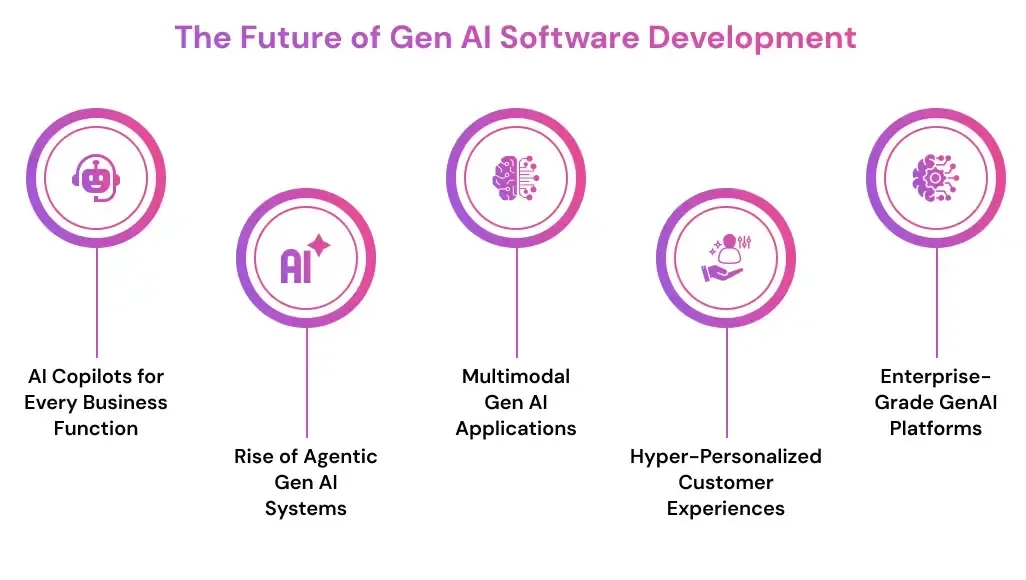
AI Copilots for Every Business Function
In the coming years, AI copilots will become common across sales, marketing, HR, finance, customer support, operations, development, and leadership teams. These copilots will help employees write, search, analyze, summarize, plan, and complete tasks faster.
For example, a sales copilot can prepare meeting notes, summarize CRM updates, draft follow-up emails, and recommend next steps. Similarly, an HR copilot can answer policy questions, support onboarding, and generate employee communication drafts.
Rise of Agentic Gen AI Systems
GenAI software is also moving toward agentic workflows, where AI systems do not just answer questions but also take action. These systems can plan tasks, use tools, connect with APIs, complete workflows, and coordinate multi-step business processes.
For example, an AI agent can receive a customer request, check order details, update a ticket, generate a response, and notify the support team. This shift will make GenAI software more useful for business automation.
Multimodal Gen AI Applications
The next phase of generative AI software will involve multimodal capabilities. This means AI systems will be able to work with text, images, audio, video, documents, and structured data together.
Businesses can use multimodal GenAI solutions for product search, training, customer support, document analysis, creative workflows, quality inspection, and visual intelligence applications.
Hyper-Personalized Customer Experiences
Gen AI will help businesses create more personalized experiences across websites, apps, SaaS platforms, and customer portals. Instead of offering the same journey to every user, GenAI systems can adapt responses, recommendations, content, and workflows based on user intent and behavior.
This will be especially useful for eCommerce, finance, travel, education, healthcare, and media businesses where personalization directly impacts engagement and conversions.
Enterprise-Grade GenAI Platforms
Enterprises will increasingly demand GenAI platforms that are secure, compliant, scalable, and integrated with internal systems. The focus will shift from experimenting with AI tools to building production-ready GenAI software that supports measurable business outcomes.
Businesses that start investing in Gen AI software development today will be better positioned to adopt these future innovations and create intelligent digital ecosystems.
How Can Prismetric Help You Build Gen AI Software?
Building Gen AI software requires the right mix of business understanding, AI expertise, product engineering, cloud architecture, UI/UX design, and post-launch optimization. This is where Prismetric can help businesses turn GenAI ideas into scalable and market-ready software solutions.
As a technology partner, Prismetric helps startups, SMBs, and enterprises build custom GenAI software that aligns with their business goals, user needs, and operational workflows. Whether you want to build an AI chatbot, AI copilot, document intelligence platform, GenAI-powered SaaS product, or enterprise automation solution, Prismetric can help you plan, develop, deploy, and scale the product.
Move from AI Idea to GenAI Product
Prismetric helps startups and businesses plan, build, test, deploy, and scale custom generative AI software.
Start Building Today
Gen AI Consulting and Strategy
Prismetric helps businesses identify the right GenAI use cases based on their goals, industry, users, data availability, and expected ROI. The team can help define product scope, feature priorities, AI architecture, technology stack, development roadmap, and MVP strategy.
This ensures that your GenAI software development journey starts with clarity instead of assumptions.
Custom GenAI Software Development
Prismetric develops custom GenAI software solutions tailored to business-specific workflows. The solutions can include AI chatbots, virtual assistants, enterprise knowledge search tools, AI copilots, AI-powered document processing systems, content generation platforms, and workflow automation tools.
Every solution is designed to match your business logic, brand experience, data structure, and growth needs.
LLM Integration and RAG Implementation
Prismetric can help businesses integrate large language models and build RAG-based systems that generate responses using trusted business data. This includes document ingestion, data chunking, embedding generation, vector database setup, prompt workflows, retrieval logic, and response generation.
With RAG implementation, your GenAI software can provide more accurate, context-aware, and business-specific responses.
AI Chatbot and Virtual Assistant Development
Prismetric builds AI-powered chatbots and virtual assistants for customer support, sales, internal operations, healthcare, finance, education, retail, travel, and other industries. These assistants can be integrated with websites, mobile apps, CRMs, helpdesk tools, and enterprise systems.
The goal is to help businesses automate conversations, reduce repetitive queries, and improve user engagement.
AI Copilot Development
Prismetric can help businesses build AI copilots that assist employees in daily tasks such as searching documents, generating reports, writing emails, summarizing meetings, analyzing information, and managing workflows.
These copilots can be customized for different departments including sales, HR, finance, operations, customer service, and management teams.
GenAI Product Engineering
From MVP development to full-scale product launch, Prismetric supports the complete GenAI product engineering lifecycle. This includes UI/UX design, frontend development, backend development, AI integration, API development, cloud deployment, testing, and ongoing maintenance.
The team focuses on building GenAI products that are not only intelligent but also user-friendly, secure, scalable, and performance-driven.
Security, Testing, and Optimization
Prismetric follows a structured testing and optimization approach to ensure that the GenAI software performs reliably. The solution can be tested for accuracy, usability, security, scalability, latency, response quality, and workflow performance.
After launch, Prismetric can also help monitor the solution, improve prompts, optimize model usage, enhance retrieval accuracy, and add new features based on user feedback.
If you are planning to build Gen AI software for your business, Prismetric can help you move from idea validation to full-scale implementation with a tailored development approach.
To build Gen AI software, you need to start by identifying the business problem and defining the use case. After that, you need to collect and prepare the required data, choose the right AI model, design the software architecture, build an MVP, implement prompt engineering and RAG workflows, integrate the solution with existing systems, test the software, and deploy it securely.
A reliable GenAI development partner like Prismetric can help you handle the complete process from strategy to deployment.
The cost to build Gen AI software usually depends on the complexity of the solution, features, AI model usage, data requirements, integrations, security needs, UI/UX design, and development timeline.
A simple GenAI solution may cost around $30,000 to $60,000, while a medium-complexity solution may cost between $60,000 and $120,000. A highly complex enterprise-grade GenAI platform can cost $120,000 to $250,000 or more.
The development timeline for Gen AI software depends on the scope and complexity of the project. A simple GenAI chatbot or assistant may take 2 to 4 months. A medium-complexity GenAI solution may take 4 to 7 months. A complex enterprise-grade GenAI platform can take 7 to 12 months or more.
Starting with an MVP can help businesses launch faster and improve the solution based on real user feedback.
The key features of Gen AI software may include:
- Natural language understanding
- AI-powered content generation
- Chatbot or virtual assistant interface
- RAG-based knowledge retrieval
- Document summarization
- User authentication and role-based access
- Third-party system integrations
- Analytics and feedback dashboard
- Prompt management
- Security and compliance controls
The final feature list depends on your business use case and target users.
Almost every industry can benefit from Gen AI software development. Healthcare, finance, eCommerce, education, logistics, manufacturing, real estate, travel, insurance, legal, and cybersecurity businesses can use GenAI solutions to improve customer support, automate workflows, generate insights, personalize experiences, and reduce manual effort.
Not always. Many businesses can build powerful GenAI software using existing large language models and connect them with company-specific data using RAG, fine-tuning, prompt engineering, and secure integrations.
Training a model from scratch is usually expensive and is only required for highly specialized use cases. For most business applications, using an existing LLM with custom workflows is more practical and cost-effective.
RAG, or retrieval augmented generation, helps GenAI software generate answers using relevant business data. Instead of relying only on the model’s general knowledge, the system retrieves information from approved documents, databases, or knowledge sources before generating a response.
This improves accuracy, reduces hallucinations, and makes the GenAI solution more useful for business-specific applications.
Prismetric can help businesses build custom GenAI software by offering strategy, consulting, product planning, UI/UX design, AI model integration, RAG implementation, backend development, frontend development, testing, deployment, and post-launch support.
Whether you want to build an AI chatbot, AI copilot, GenAI SaaS product, document intelligence platform, or enterprise automation solution, Prismetric can help develop a secure and scalable solution aligned with your business goals.