What Is Enterprise AI? How It Works, Benefits, Use Cases & Implementation
Key takeaways:
- Enterprise AI goes beyond standalone AI tools by connecting models with business data, applications, workflows, security controls, and governance at organizational scale.
- Successful enterprise AI depends on strong integration with ERP, CRM, databases, APIs, and existing workflows so AI outputs can support real business operations.
- Enterprises can combine machine learning, generative AI, RAG, predictive analytics, computer vision, and AI agents depending on the business problem being solved.
- Effective implementation starts with a measurable business problem, followed by data-readiness assessment, architecture selection, proof-of-concept validation, integration, and gradual scaling.
- Security, governance, human oversight, and continuous monitoring are essential as enterprise AI becomes more autonomous and increasingly connected to operational systems.
Artificial intelligence is increasingly moving beyond standalone tools and isolated experiments into systems that operate across business functions. Organizations are connecting AI models with enterprise data, applications and workflows so that the technology can support activities such as customer service, forecasting, document processing, software development and operational decision-making.
This broader approach is known as enterprise AI. It combines artificial intelligence technologies with the data, infrastructure, security controls and business systems required to operate at organizational scale. Unlike a consumer AI application used for an individual task, enterprise AI must work reliably across departments, integrate with existing technology and meet organizational requirements for privacy, governance and performance.
What Is Enterprise AI?
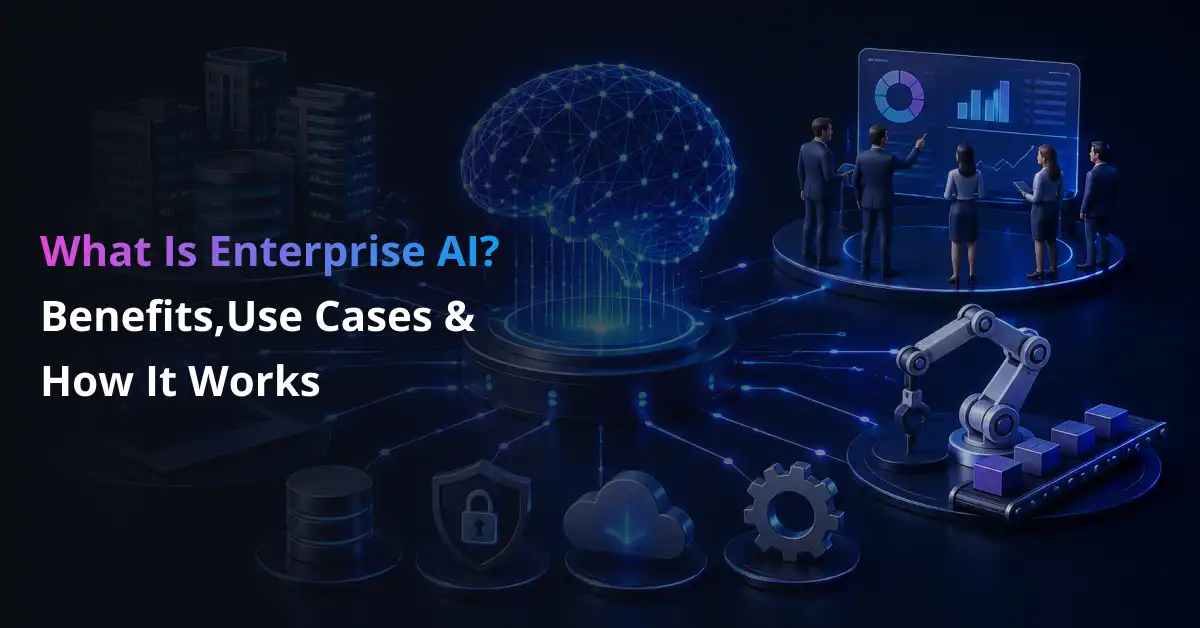
Enterprise AI is the organization-wide application of artificial intelligence to business data, applications, workflows and decision-making processes. It is designed to operate at scale, integrate with systems such as customer relationship management (CRM) and enterprise resource planning (ERP) platforms, and meet enterprise requirements for security, reliability, governance and regulatory compliance.
Enterprise AI is not a single model, application or technology. An enterprise environment might combine machine learning (ML), predictive analytics, generative AI, large language models (LLMs), computer vision and AI agents depending on the business problem being addressed.
The difference lies in how these technologies are deployed. A generative AI model, for example, might summarize a document when used as a standalone tool. In an enterprise AI system, the same type of model could retrieve information from authorized company databases, analyze customer records, generate a response and send the output into an existing approval workflow.
Organizations therefore need more than an accurate AI model. They also need data pipelines, access controls, integrations, monitoring, infrastructure and governance processes that allow AI applications to operate safely and consistently. Building these components into a coordinated enterprise AI technology stack is what turns an isolated AI capability into an enterprise system.
Turn Enterprise AI Ideas Into a Clear Implementation Roadmap
Prismetric helps identify high-value use cases, assess data readiness, select the right AI architecture, and define a practical path from pilot to production.
Plan Your Enterprise AI Strategy
What makes AI enterprise-grade?
Enterprise-grade AI is designed around organizational rather than individual requirements. It must support large numbers of users, process significant volumes of data and continue operating as workloads increase.
Integration is another important characteristic. Enterprise AI often connects with ERP platforms, CRM systems, internal databases, cloud applications, data warehouses and legacy software. These connections allow AI systems to use relevant business information instead of working only with the information contained in a model’s original training data.
Security and governance also distinguish enterprise deployments. Organizations need to control who can access particular models and datasets, determine how information is processed and maintain oversight of AI-generated outputs. These controls become especially important when systems process customer information, financial records, intellectual property or regulated data.
For organizations moving from experiments to production systems, enterprise AI development consequently involves application architecture, data engineering, model integration, security and operational monitoring in addition to model selection.
How Does Enterprise AI Work?
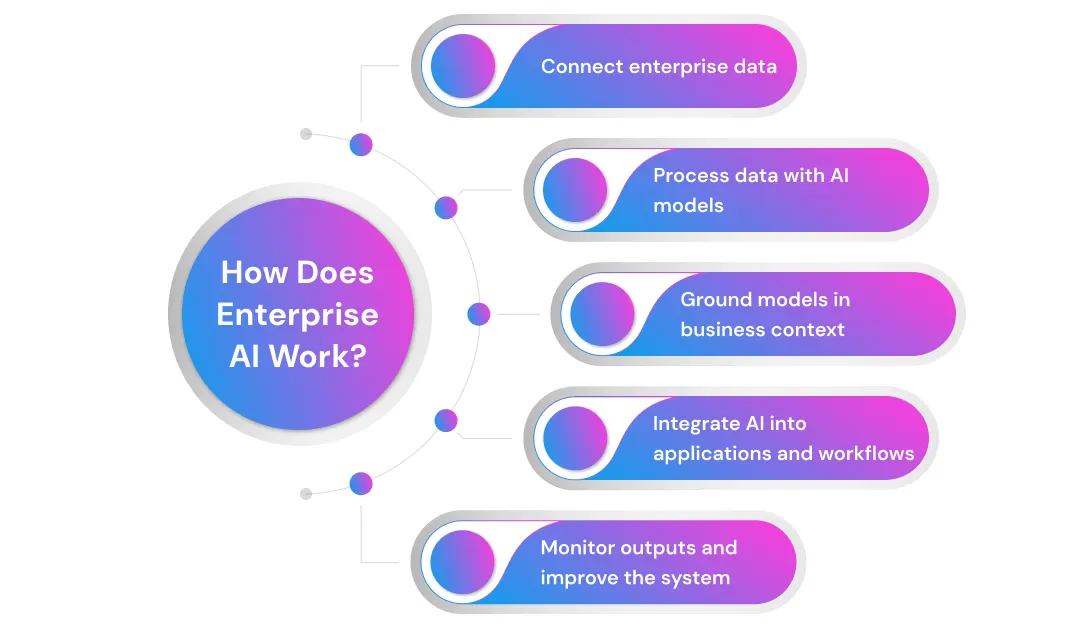
Enterprise AI works by connecting business data with AI models and embedding the resulting capabilities into existing applications and operational processes. Although architectures vary by use case, most systems involve a sequence of data integration, model processing, contextual grounding, application integration and continuous monitoring.
1. Connect enterprise data
Enterprise AI begins with data. Useful information may be distributed across relational databases, CRM applications, ERP platforms, documents, emails, data warehouses, APIs and other internal systems.
Organizations first need to identify which data sources are relevant to a particular use case and determine how that information can be accessed securely. Data engineering processes can then prepare, organize and move the required information so that AI applications can use it consistently.
For example, an AI system assisting a customer service team might need account details from a CRM platform, order information from an ERP system and product documentation from an internal knowledge base. Without these connections, the model would have limited business context.
2. Process data with AI models
Once information is available, different AI models can process it according to the task.
Machine learning models can identify patterns, classify records and generate predictions from historical data. LLMs can analyze and generate text, summarize documents or support conversational interfaces. Computer vision models process images and video, while predictive models can estimate future demand, operational risk or equipment failures.
The model should be selected according to the business problem rather than because a particular type of AI is currently popular. A demand-forecasting system, for example, has different technical requirements from an enterprise document assistant.
3. Ground models in business context
General-purpose AI models do not automatically have access to an organization’s current internal information. Enterprise systems therefore need mechanisms that supply relevant business context when a model processes a request.
Retrieval-augmented generation (RAG) is one common approach. A RAG system retrieves relevant information from approved enterprise sources and provides that information to an LLM before the model generates an answer.
Organizations can also integrate LLMs with enterprise databases when applications need controlled access to operational records. These architectures can help keep responses connected to current business information instead of relying entirely on general model knowledge.
4. Integrate AI into applications and workflows
An AI capability becomes operationally useful when employees and business systems can use it within existing processes. Integration layers, APIs and orchestration components connect models with enterprise applications and determine what happens after an AI system produces an output.
For example, an AI system might classify an incoming invoice, extract required information and send the result into an ERP approval process. Another system might analyze a customer request and provide relevant information directly inside a service agent’s existing interface.
This stage can become more difficult when organizations depend on older software. A carefully designed AI integration architecture for legacy systems can provide controlled connections between newer models and applications that were not originally designed for AI. Organizations that need to connect these components across multiple platforms may also use AI integration services to implement the required interfaces and data flows.
ERP environments illustrate the same requirement. Enterprises using SAP, for example, need to connect AI capabilities with existing business data and process rules rather than operate the AI system separately. Integrating AI with SAP ERP systems requires attention to data access, application architecture and workflow controls.
5. Monitor outputs and improve the system
Enterprise AI requires ongoing monitoring after deployment. Teams need to evaluate model outputs, system performance, data quality, security events and business outcomes.
Monitoring is particularly important for generative AI because LLMs can produce incorrect or unsupported information. Organizations can use testing, evaluation frameworks, access policies and human review to reduce these risks.
Feedback from employees and operational systems can also help teams identify where models, prompts, retrieval processes or workflows need adjustment. Enterprise AI is therefore an ongoing operational capability rather than a system that is deployed once and left unchanged.
Enterprise AI vs. Consumer AI vs. Generative AI
Enterprise AI, consumer AI and generative AI can use some of the same underlying models, but they describe different concepts.
| Factor |
Enterprise AI |
Consumer AI |
Generative AI |
| Primary purpose |
Support organizational workflows and business operations |
Help individual users complete personal tasks |
Generate new text, images, code, audio or other content |
| Typical users |
Employees, departments, business applications and customers |
Individual consumers |
Consumers or enterprise users |
| Data |
Often uses proprietary and operational business data |
Primarily user-provided or public information |
Depends on the application and model |
| Integration |
Connects with ERP, CRM, databases, APIs and business workflows |
Usually limited integration with enterprise systems |
Can operate independently or as part of enterprise applications |
| Scale |
Designed for organizational workloads and many users |
Generally focused on individual use |
Depends on deployment architecture |
| Governance |
Requires access controls, monitoring, security and compliance policies |
Usually managed primarily by the service provider |
Governance depends on how the model is deployed |
| Examples |
Fraud detection, enterprise assistants, demand forecasting, workflow automation |
Personal assistants, image tools and writing applications |
Text generation, summarization, code generation and image creation |
The primary difference is that enterprise AI describes how AI is applied across an organization, while generative AI describes a category of technology.
A company can therefore use generative AI as one component of its enterprise AI architecture. It might deploy an LLM to summarize internal documents, combine the model with RAG to retrieve company information and integrate the application with employee workflows. The organization might also use conventional machine learning for fraud detection and predictive analytics for forecasting within the same enterprise AI environment.
Consumer AI typically has a narrower operating context. A personal AI assistant can perform an isolated task without connecting to a company’s ERP platform, enforcing department-specific access policies or supporting thousands of employees. Enterprise systems must account for those requirements because their outputs can affect business processes, sensitive information and operational decisions.
The deployment model also affects how organizations choose between private and public LLMs. Public models can provide convenient access to advanced capabilities, while private or more tightly controlled deployments can be appropriate when data residency, customization or security requirements demand greater control. The appropriate architecture depends on the organization’s use case, data and regulatory obligations.
Core Technologies and Components of Enterprise AI
Enterprise AI systems combine multiple technologies rather than relying on a single model or application. The appropriate combination depends on the business problem, the type of data involved and the level of automation required.
A typical enterprise AI architecture can include machine learning models, large language models, retrieval systems, data pipelines, APIs, business applications and governance controls. These components work together to turn enterprise data into predictions, generated content, recommendations or automated actions.
Machine learning
Machine learning (ML) allows software systems to identify patterns in historical data and use those patterns to make classifications or predictions. Enterprises commonly use ML for demand forecasting, fraud detection, recommendation systems, risk analysis and predictive maintenance.
For example, a retailer can train a model on historical sales, seasonal trends and inventory data to forecast product demand. The forecast can then support purchasing and inventory planning decisions.
Machine learning is particularly useful when an organization has large amounts of historical data and needs to identify patterns that would be difficult to detect consistently through manual analysis. Organizations developing these capabilities may use machine learning development services when models need to be integrated with operational systems and business workflows.
Generative AI and large language models
Generative AI creates new content based on patterns learned from training data. Large language models (LLMs), a common form of generative AI, can generate and analyze text, summarize documents, answer questions, create code and support conversational applications.
Within an enterprise environment, LLMs can help employees retrieve information, prepare reports, summarize contracts or analyze large collections of documents. They can also support customer-facing assistants and internal knowledge applications.
Enterprise deployments usually require more control than public generative AI tools provide by default. Organizations might connect an LLM to private data sources, establish permissions, monitor model outputs or adapt a model for a particular domain. In some cases, large language model development services can support the design and deployment of these applications.
AI agents and agentic AI
AI agents extend AI beyond generating responses by allowing systems to perform tasks through tools, APIs and connected applications. An agent can receive a goal, identify the actions required and interact with enterprise systems to complete part or all of a workflow.
For example, an IT support agent might classify a service request, retrieve relevant documentation, check system information and create or update a ticket. More advanced agentic systems can coordinate several steps rather than completing only one predefined action.
This capability can reduce manual handoffs in processes that involve information retrieval, decision rules and repetitive system interactions. However, organizations need safeguards around permissions, tool access and human approval before allowing agents to perform high-impact actions. Businesses building these systems may require specialized AI agent development to control how agents interact with enterprise applications.
Natural language processing
Natural language processing (NLP) enables software to process and analyze human language. Enterprises use NLP for document classification, sentiment analysis, information extraction, search, conversational interfaces and text analytics.
A financial organization, for example, can use NLP to extract names, dates, transaction details and contractual terms from large volumes of documents. This reduces the amount of manual review required before structured information can enter downstream systems.
Although modern LLMs perform many NLP tasks, traditional NLP techniques remain useful when organizations need narrowly defined classification, extraction or language-processing capabilities.
Computer vision
Computer vision allows AI systems to analyze images and video. Enterprise applications include visual quality inspection, document scanning, shelf monitoring, equipment inspection and medical imaging support.
Manufacturers can use computer vision systems to examine products for visible defects as they move through a production line. Retailers can apply similar technology to monitor shelf conditions and detect stock availability. A broader explanation of these applications appears in computer vision for retail and other industry-specific implementations.
Because visual AI often influences operational decisions, organizations must also account for image quality, camera placement, model accuracy and environmental conditions when deploying these systems.
Predictive analytics
Predictive analytics uses historical and current data to estimate likely future outcomes. Enterprises apply it to areas such as demand forecasting, equipment maintenance, customer behavior and financial risk.
The usefulness of predictive models depends heavily on the quality and relevance of the underlying data. If historical records are incomplete or no longer reflect current conditions, predictions can become less reliable. For this reason, predictive analytics usually needs ongoing data quality management and model monitoring rather than one-time development.
Retrieval-augmented generation
Retrieval-augmented generation allows an LLM to retrieve information from external knowledge sources before generating a response. This makes RAG particularly useful for enterprise AI applications that need access to current internal information.
A company can build an internal assistant that retrieves policies, product documents or technical procedures from an approved knowledge base and uses those documents as context for its response. This approach can reduce reliance on the model’s general training data and provide more relevant business-specific answers.
Organizations building production RAG systems also need to consider document ingestion, access permissions, retrieval quality, evaluation and compliance. These factors are explored in more detail in this guide to building an enterprise RAG application and can also be addressed through RAG implementation services when the application requires integration with enterprise infrastructure.
Enterprise data and integration layer
AI models depend on the systems that provide them with business information. The enterprise data and integration layer connects models with databases, data warehouses, ERP platforms, CRM applications, APIs and other operational systems.
This layer controls how data moves between systems and which information an AI application is permitted to access. It can also include identity management, data transformation, API gateways and orchestration tools.
Without reliable integration, an AI application may produce useful output but remain disconnected from the workflow where that output is needed. For this reason, enterprise AI architecture must treat data integration as a core component rather than a secondary implementation task.
Connect AI With the Systems Your Business Already Uses
Prismetric integrates AI with ERP, CRM, databases, APIs, legacy applications, and enterprise workflows so AI outputs can support real operations.
Explore AI Integration
Key Characteristics of Enterprise AI
Enterprise AI differs from small-scale AI applications because it must operate under organizational requirements for performance, security and control. Several characteristics determine whether an AI system can function effectively at enterprise scale.
Scalability
Enterprise AI systems must support growing numbers of users, datasets and workloads without significant reductions in performance. A system that works for a small pilot may require different infrastructure, model-serving capabilities and monitoring when deployed across multiple departments.
Scalability also includes the ability to add new use cases without rebuilding the entire architecture. Shared data pipelines, APIs and model-management practices can make it easier to expand AI adoption over time.
Enterprise integration
Enterprise AI needs to work with existing business systems. These can include CRM software, ERP applications, databases, cloud platforms and legacy applications.
Integration enables the AI system to retrieve relevant data and place its output where employees or business processes can use it. In many organizations, this requirement is one of the most complex parts of AI implementation because different systems can have separate data models, security controls and interfaces.
Security and privacy
Enterprise AI frequently processes confidential business information, customer records, intellectual property and regulated data. Organizations therefore need access controls, authentication, encryption and data-handling policies appropriate to the sensitivity of the information being used.
Security also extends to the AI application itself. Risks such as unauthorized tool use, data leakage and prompt injection need to be considered when LLM-based systems interact with enterprise data and applications.
Governance and control
Enterprise AI governance defines how AI systems are approved, monitored and used within an organization. Governance can include model documentation, access policies, risk classifications, testing requirements, audit records and human review.
These controls help organizations determine who is accountable for an AI system and what should happen when its outputs are inaccurate or inappropriate. Governance becomes more important as AI begins to influence decisions, automate workflows or interact directly with customers.
Reliability
Enterprise applications need predictable availability and performance. AI systems therefore require monitoring for model failures, unavailable data sources, degraded retrieval quality and other issues that can affect output.
Regular AI model testing can help teams evaluate whether a model continues to perform as expected after deployment. Testing can also identify changes in model behavior when business data or user patterns change.
Business alignment
Enterprise AI should address a defined business problem rather than exist as a technology experiment. Organizations need to connect each use case with operational goals such as reducing manual processing, improving forecast accuracy or decreasing response times.
This business alignment influences model choice, data requirements, integration priorities and evaluation criteria. It also makes it easier to determine whether an AI deployment is delivering useful results.
Benefits of Enterprise AI
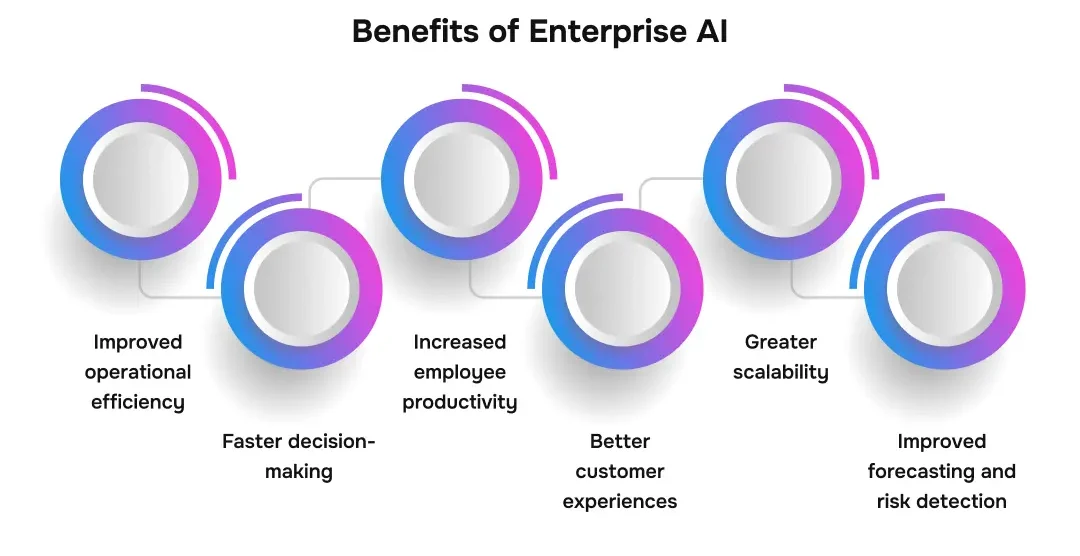
The benefits of enterprise AI come from applying automation and data analysis to processes that operate across departments and systems. The value depends on how well the technology is integrated with existing workflows and whether it addresses a meaningful business need.
Improved operational efficiency
Enterprise AI can automate repetitive activities such as document classification, data extraction, information retrieval and routine decision support. By reducing the amount of manual processing required, organizations can streamline workflows and allow employees to focus on tasks that require judgment or specialized expertise.
For example, an accounts payable system can extract invoice information, compare it with purchase records and route exceptions for review. The automation does not remove the need for oversight, but it can reduce the number of routine steps employees perform manually.
Faster decision-making
AI systems can analyze larger volumes of information than teams can typically review manually. Predictive models, natural language interfaces and automated analytics can surface patterns or anomalies that support faster operational decisions.
Business teams can also combine AI with business intelligence systems to make analytical information easier to retrieve and interpret. The result is not automatic decision quality; rather, AI can provide relevant information more quickly so that employees can make informed decisions with appropriate context.
Increased employee productivity
Enterprise AI assistants can help employees search internal information, summarize documents, prepare drafts and perform routine administrative work. This reduces the time spent locating information across disconnected systems.
For example, an employee might ask an internal assistant about a company policy instead of manually searching several document repositories. If the assistant retrieves information from an authorized knowledge base, it can provide a relevant response while preserving existing access permissions.
Better customer experiences
AI can help customer service teams respond to routine requests more quickly and consistently. Chatbots and AI agents can retrieve account information, answer common questions and route complex issues to human representatives.
An enterprise chatbot can also connect with CRM and knowledge systems so that responses reflect customer context rather than only generic information. Organizations that need deeper workflow and system integration can use enterprise AI chatbot development services to build these capabilities into existing support operations.
Greater scalability
Automation allows organizations to process increasing volumes of requests, transactions or data without increasing manual effort at the same rate. This can be useful in customer support, document processing, fraud monitoring and other high-volume operations.
Scalability depends on infrastructure and architecture as well as model capability. Systems need sufficient computing resources, resilient integrations and appropriate monitoring to maintain performance as usage grows.
Improved forecasting and risk detection
Machine learning models can identify patterns in historical and real-time data that indicate future demand, financial risk or potential operational problems. Organizations can use these predictions to plan inventory, allocate resources or investigate anomalies.
The benefit comes from earlier visibility rather than certainty. Predictions remain probabilistic, so organizations should evaluate model performance and combine AI-generated forecasts with business judgment where decisions have significant consequences.
Enterprise AI Use Cases
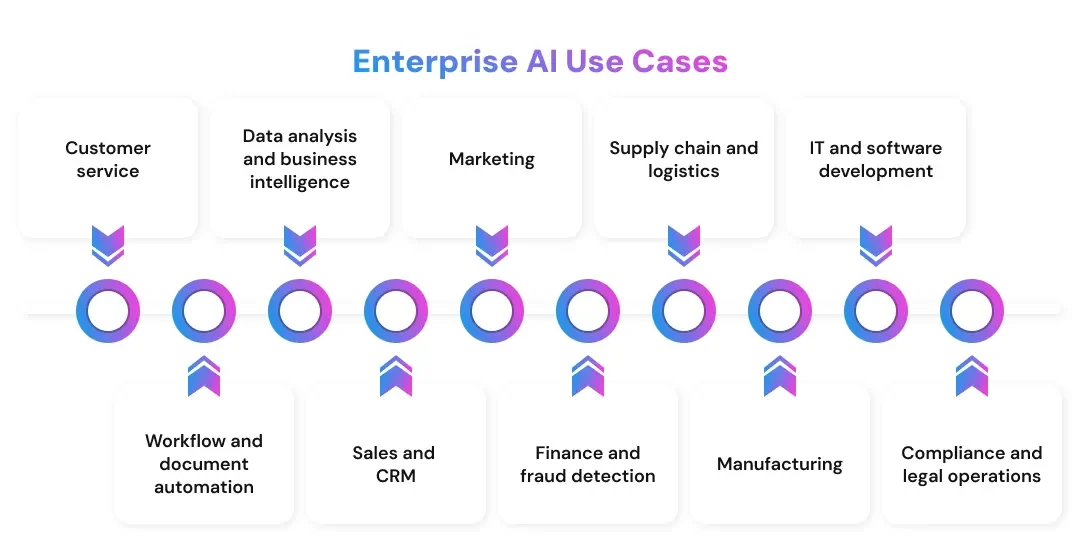
Enterprise AI use cases span customer-facing processes, internal operations and analytical workflows. The strongest opportunities usually involve high volumes of data, repetitive processes or decisions that benefit from faster access to relevant information.
Customer service
Customer service teams can use AI assistants, chatbots and agents to answer routine questions, retrieve account information and summarize previous interactions. This can reduce response times while allowing human representatives to focus on complex requests.
A service organization might also use AI to classify incoming cases and route them to the appropriate team. This combines language processing with workflow automation rather than treating the chatbot as a standalone interface.
Workflow and document automation
Many enterprise processes depend on documents such as invoices, contracts, claims, forms and reports. AI can extract information, classify documents and trigger appropriate workflow steps.
Organizations can combine these capabilities with AI workflow automation to reduce repetitive data entry and move information between systems. Where a process spans multiple departments or applications, AI workflow automation services can help connect models with existing business rules and approval steps.
Data analysis and business intelligence
Enterprise AI can help employees analyze structured and unstructured data through predictive models and natural language interfaces. Instead of manually creating every query, a business user might ask a question in natural language and receive information based on approved data sources.
This capability can make analytics accessible to a wider group of employees, although organizations still need data governance and validation to ensure users interpret the results correctly.
Sales and CRM
Sales teams can use AI to summarize customer interactions, prioritize leads, identify account signals and support forecasting. Generative AI can also draft follow-up messages or meeting summaries using CRM information.
Because these systems work with customer data, they need appropriate access controls and monitoring. The goal is to reduce administrative work and provide sales teams with relevant information rather than automate relationship-based decisions without oversight.
Marketing
Marketing teams can use enterprise AI for segmentation, content support, campaign analysis and personalization. Machine learning models can identify behavioral patterns, while generative AI can help produce variations of campaign content for different audiences.
AI agents can also coordinate routine marketing workflows such as retrieving campaign data or preparing reports. More advanced applications of agentic AI in marketing can involve multi-step processes across analytics, content and campaign-management systems.
Finance and fraud detection
Financial teams use AI for anomaly detection, forecasting, document processing and transaction monitoring. Models can identify patterns that differ from expected behavior and flag transactions for further investigation.
Generative AI can also assist with financial reporting and document analysis, but outputs that influence financial decisions typically require validation and human review.
Supply chain and logistics
AI can analyze inventory, demand, transportation and supplier data to support planning. Predictive models can forecast demand, identify potential delays and help organizations allocate inventory more effectively.
In logistics environments, AI can also support route planning and operational monitoring. These applications are discussed further in AI for logistics.
Manufacturing
Manufacturers use enterprise AI for predictive maintenance, production planning and visual quality inspection. Machine learning models can analyze equipment data to identify patterns associated with potential failures, while computer vision can examine products for visible defects.
These systems can help maintenance and production teams identify problems earlier, but their effectiveness depends on reliable sensor data, model accuracy and integration with plant systems. Broader applications are covered in AI in manufacturing.
IT and software development
IT teams can use AI for incident analysis, knowledge retrieval, code generation and software testing. Generative AI can assist developers with routine coding tasks, while AI agents can automate parts of IT support and application management.
Organizations can also apply generative AI for IT to summarize technical documentation, analyze operational information and support internal service workflows.
Compliance and legal operations
Enterprise AI can help compliance and legal teams classify documents, identify relevant clauses and review large volumes of regulatory information. These capabilities can reduce manual document processing, but they do not remove the need for professional judgment.
Organizations operating in regulated environments also need to consider applicable AI regulation and compliance requirements when deploying models that process sensitive information or influence regulated decisions.
How to Implement Enterprise AI
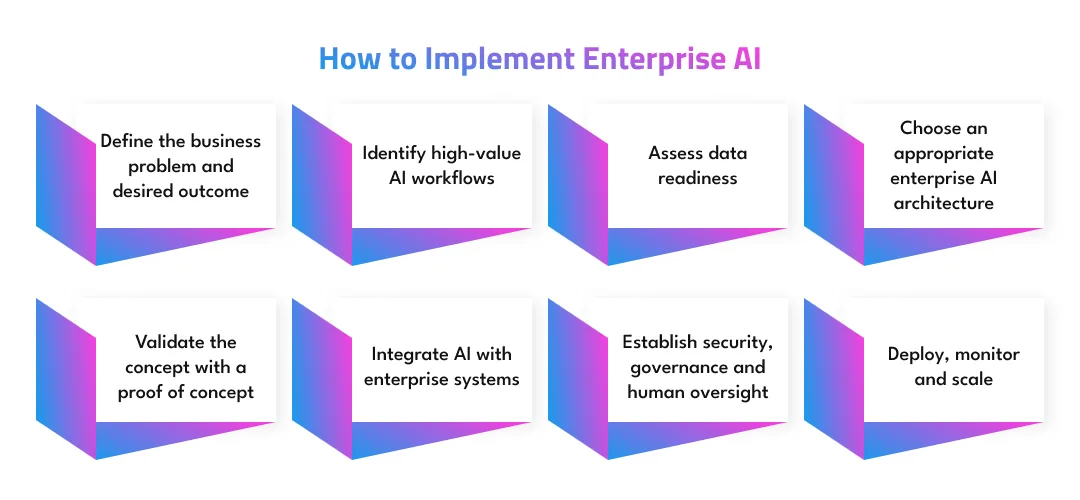
Enterprise AI implementation is a business and technology program rather than a single software deployment. Organizations need to identify where AI can create measurable value, determine whether the required data and systems are available, select an appropriate architecture and establish controls for operating the system after launch.
A phased approach can reduce the risk of investing heavily in an AI system before its technical feasibility and business value have been demonstrated.
1. Define the business problem and desired outcome
Enterprise AI projects should begin with a specific operational problem. Starting with a model or technology and then searching for a use case can result in systems that demonstrate technical capability without improving an important business process.
An organization might want to reduce the time required to review invoices, improve demand forecasts or help customer service employees retrieve information more quickly. The objective should identify the workflow being changed and the result the organization expects to measure.
Organizations that need help translating broad AI goals into implementation priorities can use AI consulting services to evaluate business requirements, technical constraints and suitable adoption approaches.
2. Identify high-value AI workflows
Not every process requires AI. Organizations should identify workflows where automation, prediction, information retrieval or content generation can address a recurring operational problem.
Useful candidates often involve large volumes of data, repetitive manual work, frequent information searches or decisions that depend on recognizing patterns. An AI workflow discovery checklist can help teams assess whether a process has sufficient data, business value and technical feasibility for automation.
Organizations can then rank potential projects according to expected value, implementation difficulty, risk and data readiness rather than attempting to deploy enterprise AI across every department simultaneously.
3. Assess data readiness
Enterprise AI depends on accessible and reliable data. Before implementation, teams need to determine where the required information is stored, who owns it, whether it is accurate and what restrictions apply to its use.
Data preparation may involve removing duplicate records, resolving inconsistent formats, establishing access permissions and connecting previously isolated sources. Organizations should also determine whether sensitive data can be processed by the selected model and infrastructure.
Poor data quality can undermine even technically capable AI models. Data readiness should therefore be evaluated before substantial model development begins.
4. Choose an appropriate enterprise AI architecture
The architecture depends on the use case, security requirements, existing systems and degree of customization required. Organizations might use commercial AI APIs, open-source models, private models or a combination of several approaches.
A knowledge assistant may use an LLM with RAG, while a forecasting application may depend primarily on machine learning. A highly specialized generative AI application might require prompt engineering, retrieval or LLM fine-tuning services when adapting a model is justified by the use case and available training data.
Enterprises should also decide where models will run and how they will access organizational information. Cloud, on-premises and hybrid architectures provide different tradeoffs involving cost, scalability, control and data residency.
When generative capabilities form a central part of the application, generative AI development services can support model integration, application development and deployment within existing enterprise environments.
5. Validate the concept with a proof of concept
A proof of concept (POC) tests whether an AI approach can solve the selected problem before the organization commits to a full production deployment.
The POC should evaluate technical feasibility, data availability, model performance and integration requirements. It should also define success criteria so that teams can determine whether further investment is justified.
A structured AI POC development process helps organizations test assumptions in a limited environment. Reviewing enterprise AI POC use cases can also help teams understand which types of business processes are appropriate for early validation.
6. Integrate AI with enterprise systems
Once feasibility has been established, the AI system needs to connect with the applications and workflows where employees perform their work. These integrations can include ERP platforms, CRM software, databases, document repositories, APIs and identity-management systems.
Integration determines how information enters the AI system and what happens after the system produces an output. For example, a model that extracts information from an invoice creates limited operational value if employees still need to copy the result manually into another application.
Organizations should therefore design integration around the complete business workflow rather than the model alone.
7. Establish security, governance and human oversight
Security and governance should be part of the architecture before production deployment. Organizations need policies governing data access, model permissions, acceptable use, output validation and accountability.
Human oversight should reflect the consequence of the task. An AI system drafting an internal summary may require less review than a system influencing lending, healthcare or employment decisions.
Organizations operating generative AI systems may also use generative AI consulting services to evaluate governance requirements, architecture choices and operational controls before broader deployment.
8. Deploy, monitor and scale
Production deployment is not the final stage of enterprise AI implementation. Models and applications need ongoing monitoring to identify degraded performance, changing data patterns, security problems and unexpected outputs.
Teams should track technical metrics alongside business outcomes. A customer service system, for example, might be evaluated using response accuracy, escalation patterns, system availability and the amount of manual work required.
Organizations should expand successful implementations gradually. A proven workflow can provide reusable data pipelines, governance policies and integration patterns for subsequent AI projects. A broader guide to implementing AI in business can help connect these technical stages with organizational adoption.
Enterprise AI Challenges, Security and Governance
Enterprise AI can improve business processes, but deploying models across organizational systems introduces technical, operational and governance challenges. These issues become more significant when AI applications use sensitive data or perform actions within production environments.
Data quality and fragmented information
Enterprise information is often distributed across applications, databases and departments. Records may be incomplete, duplicated or stored in incompatible formats.
AI systems that rely on this information can inherit those problems. A forecasting model trained on inaccurate historical data can generate unreliable predictions, while a RAG system connected to outdated documents can return obsolete information.
Organizations therefore need processes for data quality, ownership and access before AI systems are allowed to depend on enterprise information at scale.
Legacy system integration
Older enterprise applications were not necessarily designed to provide real-time data to AI models or expose modern APIs. Integrating these systems can require middleware, custom interfaces and additional security controls.
The challenge is not simply making a technical connection. Teams need to preserve existing business rules and determine what data an AI system can read or modify without disrupting established processes.
Privacy and security
Enterprise AI can process customer information, employee records, intellectual property and other sensitive data. Organizations need controls that prevent unauthorized users or applications from accessing this information.
Security requirements can include identity management, encryption, role-based permissions and logging. LLM applications require additional attention because prompts, retrieved documents and generated responses can create new paths through which sensitive information is exposed.
Enterprise AI governance and regulatory compliance
Enterprise AI governance establishes the policies and responsibilities used to control AI systems throughout their lifecycle. Governance can define who approves an application, what data it can use, how models are tested and who is responsible when the system produces an inappropriate result.
Regulatory requirements differ by industry and jurisdiction. Organizations should identify applicable rules before deploying AI into regulated processes rather than attempting to address compliance after the system is already operational.
Incorrect outputs and hallucinations
Generative AI systems can produce statements that sound plausible but are inaccurate or unsupported. This behavior becomes more consequential when users depend on generated output for operational or customer-facing decisions.
RAG, model evaluation and better prompting can reduce some errors, but they do not guarantee accuracy. High-impact applications should include appropriate review, source verification and escalation mechanisms.
Bias and explainability
AI models can reflect patterns or biases present in training and operational data. These issues can affect recommendations or classifications if the system is used in areas such as recruitment, lending or customer risk assessment.
Organizations should test models across relevant user groups and operating conditions. In situations where stakeholders need to understand why a model produced a result, explainable AI approaches can help teams examine the factors influencing predictions and decisions.
Infrastructure and operating costs
Enterprise AI can require significant computing, storage, integration and monitoring resources. Generative AI applications can also create recurring inference costs that increase as the number of users and requests grows.
Organizations should evaluate the total operating model rather than model-access costs alone. Development, integration, data preparation, evaluation, security and ongoing maintenance can all contribute to the cost of AI development.
Cost requirements also depend on whether an organization builds custom models, adapts existing models or uses managed services. Architecture decisions should therefore consider expected usage and operational requirements from the beginning.
Skills and organizational adoption
Successful enterprise AI requires participation from more than data science teams. Business specialists, developers, security teams, compliance stakeholders and employees who use the system all influence whether a deployment works effectively.
Employees may need training on where AI is appropriate, how to verify outputs and when human intervention is required. Organizations also need clear ownership for maintaining models and resolving operational problems after deployment.
The Future of Enterprise AI
Enterprise AI is moving toward systems that are more deeply connected with business applications and capable of performing larger parts of operational workflows. The change does not eliminate the need for governance or human oversight; it increases the importance of controlling how AI accesses information and performs actions.
Agentic AI is one important development. Instead of only generating text or predictions, AI agents can use tools, call APIs and coordinate multiple steps toward a defined objective. As organizations expand agentic AI use cases, permissions and approval controls will become increasingly important because these systems can affect operational environments directly.
Multimodal models are also expanding the types of enterprise information that AI systems can process. A single application might analyze text, images, audio and video, allowing organizations to combine data that previously required separate systems.
Enterprise AI is also likely to become more closely integrated with systems of record such as ERP and CRM platforms. As these connections deepen, organizations will need stronger observability, access controls and model-management practices to understand how AI-generated decisions and actions move across business processes.
Move From AI Proof of Concept to Production-Ready Enterprise AI
Prismetric can help you build, integrate, secure, monitor, and scale enterprise AI solutions with the governance and human oversight required for operational use.
Talk to Our Enterprise AI Experts
Frequently Asked Questions About Enterprise AI
Enterprise AI is the use of artificial intelligence across an organization’s data, applications and business processes. It differs from a standalone AI tool because it is designed to integrate with enterprise systems, support many users and meet requirements for security, governance, scalability and reliability.
An enterprise customer service system is one example. The system can use AI to interpret a customer’s request, retrieve account information from CRM software, search an approved knowledge base and provide a response or route the request to an employee. The AI operates as part of the organization’s existing workflow rather than as an isolated chatbot.
Generative AI is a category of artificial intelligence that generates content such as text, code, images or audio. Enterprise AI describes the broader organizational use of AI technologies. An enterprise AI environment can include generative AI alongside machine learning, predictive analytics, computer vision and AI agents.
An enterprise AI platform provides infrastructure and tools for building, deploying, integrating and monitoring AI applications across an organization. Depending on the platform, it may include data integration, model management, APIs, security controls, deployment infrastructure and governance capabilities.
Common enterprise AI use cases include customer service automation, document processing, demand forecasting, fraud detection, business intelligence, sales support, software development, predictive maintenance and supply chain optimization. The appropriate use case depends on the organization’s data, workflows and business priorities.
ChatGPT is a generative AI application, but enterprise AI is a broader concept. An organization might incorporate an LLM-based assistant into an enterprise AI environment by connecting it with internal data, access controls, applications and business workflows. The enterprise system includes the architecture, integrations, governance and operational processes surrounding the model.