How Does AI Improve Efficiency? 7 Ways AI Makes Businesses More Productive
Key takeaways:
- AI improves business efficiency by automating repetitive work, accelerating data analysis, optimizing workflows, and helping employees make faster, better-informed decisions.
- The biggest efficiency gains come from improving entire workflows—not just individual tasks—by reducing manual handoffs, bottlenecks, errors, and unnecessary processing.
- AI can boost employee productivity by handling routine research, document processing, reporting, knowledge retrieval, and customer-support tasks while people focus on judgment and higher-value work.
- Predictive analytics, AI agents, and computer vision can help businesses anticipate operational problems, coordinate multi-step processes, improve quality control, and reduce downtime or rework.
- Measurable AI efficiency depends on choosing the right use case, integrating AI with existing systems, maintaining human oversight, and tracking outcomes such as processing time, cost, throughput, error rates, and response time.
AI improves efficiency by automating repetitive work, analyzing large volumes of data faster, identifying patterns that are difficult to spot manually, and helping employees make better-informed decisions. In practical terms, this can mean shorter processing times, fewer manual handoffs, faster customer responses, better resource allocation, and more consistent workflows.
The real value of artificial intelligence is not simply that it performs tasks quickly. AI becomes useful when it removes unnecessary work from a process while giving people more time for decisions that require judgment, experience, or creativity.
For businesses, these efficiency gains can appear across finance, customer service, manufacturing, logistics, sales, marketing, and back-office operations. Organizations exploring the wider benefits of AI for business should therefore look beyond isolated tools and examine where AI can improve an end-to-end workflow.
How Does AI Improve Efficiency in Business?
AI improves business efficiency mainly by reducing manual effort, accelerating analysis, and coordinating workflows more intelligently. The impact is strongest when organizations apply AI to a clearly defined operational problem rather than adopting the technology without a specific use case.
Here are some of the most practical ways AI improves efficiency.
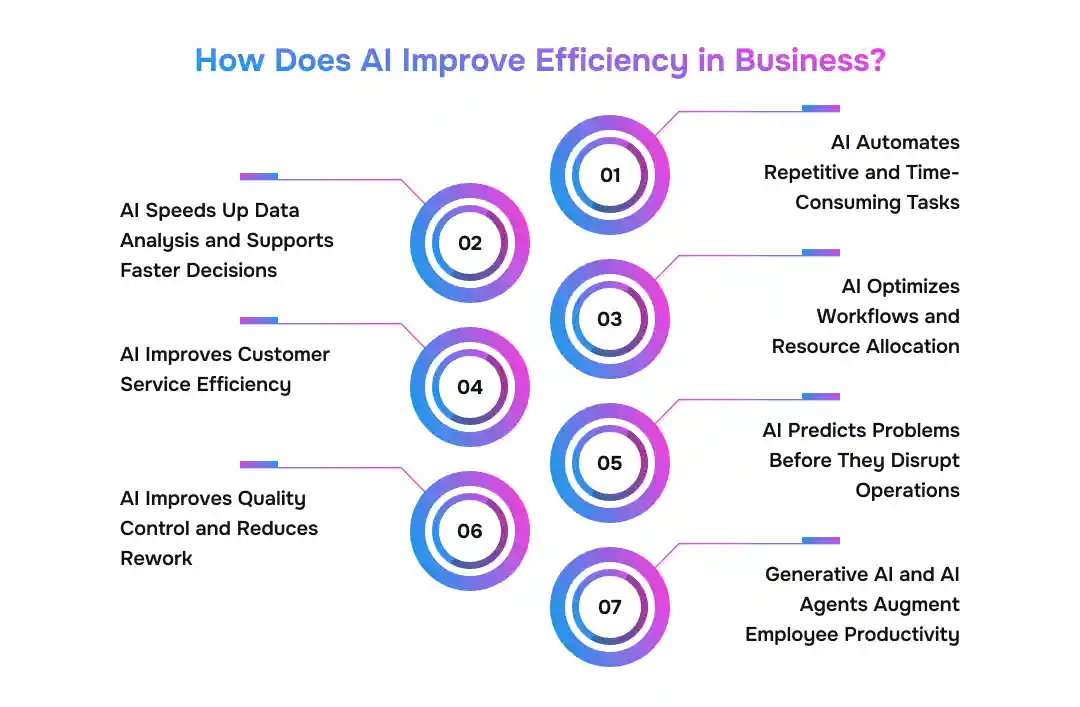
1. AI Automates Repetitive and Time-Consuming Tasks
One of the clearest efficiency gains comes from automating work that employees repeatedly perform using predictable rules or structured information.
AI systems can support tasks such as:
- extracting information from invoices and forms;
- entering or validating data;
- classifying documents;
- generating routine reports;
- routing requests to the right team;
- scheduling recurring activities;
- summarizing lengthy documents;
- preparing standard customer responses.
Traditional business automation and robotic process automation already help companies automate rule-based processes. AI extends this capability by handling less structured inputs such as emails, documents, conversations, and images.
For example, an accounts-payable team may receive hundreds of invoices in different formats. Instead of manually opening every document and copying fields into an ERP system, an AI-enabled workflow can extract vendor names, invoice numbers, amounts, and payment dates before sending exceptions to an employee for review.
This type of AI in business process automation can reduce dependence on repetitive manual processing without removing human oversight where validation is still required.
The same principle applies across larger operations. AI workflow automation can connect several steps, systems, and approval points so employees spend less time moving information between applications. Businesses with more complex requirements may also use AI workflow automation services to design automation around existing systems rather than forcing teams to change established processes unnecessarily.
Find Where AI Can Create the Biggest Efficiency Gains
Prismetric helps identify workflow bottlenecks, repetitive tasks, data gaps, and automation opportunities that can deliver measurable operational improvements.
Assess Your AI Opportunities
2. AI Speeds Up Data Analysis and Supports Faster Decisions
Businesses generate more operational data than most teams can review manually. Sales transactions, customer interactions, machine logs, financial records, website activity, support tickets, and supply-chain events can collectively contain useful signals, but finding them can take significant time.
This is where machine learning and AI-based analytics can improve efficiency.
Instead of asking analysts to manually review thousands of records, AI models can identify patterns, correlations, anomalies, and trends across large datasets. Teams can then focus their attention on the findings that require interpretation or action.
Practical applications include:
- identifying unusual transactions for further review;
- analyzing customer behavior;
- forecasting sales or demand;
- detecting operational anomalies;
- prioritizing leads;
- comparing performance across locations;
- monitoring changes in key business metrics.
Modern AI tools for data analysis can also help employees query data using natural language, summarize reports, or surface relevant insights without requiring every business user to work directly with complex analytical tools.
This does not mean AI should make every business decision automatically. In many enterprise environments, the more useful role is decision support: AI performs the computationally intensive analysis, while employees evaluate the result using business context, risk considerations, and professional judgment.
For organizations building more advanced predictive systems, machine learning development services can help connect models with the operational data and applications where those predictions will actually be used.
3. AI Optimizes Workflows and Resource Allocation
Automating one task can save time. Optimizing an entire workflow can create a larger operational impact.
AI can analyze how work moves through a process and identify where delays, repeated handoffs, capacity constraints, or inefficient routing occur. It can then help prioritize tasks, assign work based on availability or expertise, recommend next actions, and coordinate information across connected systems.
Consider a customer service workflow. A request may need to be classified, prioritized, matched with customer history, routed to an appropriate employee, and escalated when certain conditions are met. Performing each step manually adds time. An AI-enabled process can handle several of those activities automatically while leaving complex cases to people.
This distinction matters:
Task automation improves one activity. Workflow optimization improves how several activities work together.
Organizations considering broader automation should therefore begin by identifying the actual bottleneck. An AI workflow discovery exercise can help determine which steps consume the most time, create the most errors, or depend too heavily on manual coordination.
Once the opportunity is clear, AI implementation services can support the practical work of integrating AI with existing applications, data sources, approval rules, and operational processes. The goal should not be to automate everything. It should be to remove avoidable friction while keeping human involvement where it adds real value.
4. AI Improves Customer Service Efficiency
AI improves customer service efficiency by handling routine requests, retrieving relevant information, and helping support teams respond faster without requiring every interaction to start from scratch.
For example, AI can classify incoming queries, answer common questions, summarize previous conversations, recommend relevant knowledge-base content, and route complex cases to the right employee. Natural language processing makes many of these capabilities possible by helping systems process and analyze human language across chats, emails, tickets, and documents.
This approach can reduce the time employees spend searching for information or repeating standard responses. In more advanced AI customer experience workflows, AI can support human agents during live conversations by surfacing account details, previous interactions, or suggested next actions.
Research from Stanford Graduate School of Business found that generative AI assistance increased customer-support productivity by about 14% on average, with larger gains among less experienced workers. The finding is important because it shows that AI productivity gains can come from helping employees apply knowledge more effectively, not simply replacing human work.
Businesses implementing conversational systems at scale may use enterprise AI chatbots for repetitive interactions while keeping people involved in sensitive, unusual, or high-impact cases.
5. AI Predicts Problems Before They Disrupt Operations
Another way AI improves operational efficiency is by identifying patterns that indicate what may happen next.
Predictive models can analyze historical and real-time data to estimate equipment failures, changes in demand, inventory requirements, delivery delays, or other operational risks. This gives teams an opportunity to respond before the problem becomes more expensive.
Manufacturing provides a clear example. In AI-powered manufacturing, machine-learning models can monitor equipment data such as vibration, temperature, or operating behavior. When patterns begin to resemble conditions associated with previous failures, maintenance teams can investigate the equipment before an unexpected shutdown occurs.
The same principle applies to logistics. AI can analyze order volumes, shipment data, traffic patterns, inventory levels, and historical demand to support better planning. These capabilities are already being applied across AI in logistics to improve route planning, inventory visibility, shipment coordination, and exception handling.
Predictive analytics does not remove uncertainty. Its value is that it gives teams earlier signals and more data to work with when deciding how to allocate resources.
6. AI Improves Quality Control and Reduces Rework
Quality problems create more than defective products. They can also lead to wasted materials, repeated inspections, production delays, warranty costs, and additional manual work.
AI can help identify these issues earlier.
For example, computer vision systems can analyze images or video from production lines to identify visible defects, missing components, incorrect assembly, or other predefined quality conditions. Items that require attention can then be flagged for human inspection.
Organizations with specialized inspection requirements may develop AI visual inspection systems around their own products, production environments, and defect criteria.
The efficiency gain comes from earlier detection. Finding a problem before the next production stage can reduce unnecessary processing, scrap, and rework. Human review may still be necessary where defects are ambiguous or where quality decisions carry significant operational or safety consequences.
7. Generative AI and AI Agents Augment Employee Productivity
Generative AI extends efficiency improvements into knowledge-intensive work.
Employees can use it to summarize long documents, draft reports, retrieve enterprise knowledge, analyze text, prepare meeting notes, assist with research, and generate first versions of routine content. These generative AI applications in business can reduce time spent on low-value preparation while leaving employees responsible for verification and final decisions.
AI agents can take this further by coordinating several steps in a workflow. An agent might retrieve information from approved systems, prepare a report, update a record, route a request, and escalate an exception based on predefined rules.
However, more automation does not automatically mean more efficiency. AI agents require appropriate tool permissions, data access, monitoring, guardrails, and human approval points. For business-critical workflows, these controls help prevent an automated mistake from moving quickly through several connected systems.
The practical objective is not to remove people from every process. It is to use AI for repeatable analysis and execution while employees focus on work that requires context, judgment, accountability, and domain expertise.
What Does Research Say About AI and Productivity?
Research suggests that AI can produce meaningful productivity gains when it is applied to tasks that fit its capabilities.
Stanford researchers found an average productivity increase of about 14% among customer-support workers using generative AI assistance. MIT Sloan also reported that workers using generative AI on tasks within the technology’s capability boundary performed substantially better, while performance declined when people relied on AI for tasks it handled poorly.
The takeaway is straightforward: AI efficiency depends on task fit.
Organizations need the right use case, relevant data, suitable systems, employee training, and appropriate human oversight. Giving employees access to an AI tool without redesigning the surrounding workflow may create more output, but it does not necessarily create more valuable or accurate work.
Where Can AI Improve Operational Efficiency?
AI can improve operational efficiency across industries when it addresses a specific workflow, decision, or resource constraint. The technology itself matters less than how well it fits the process.
Common applications of AI in business include:
- Manufacturing: Predictive maintenance, production planning, and generative AI in manufacturing can help teams reduce unplanned work and process operational information faster.
- Retail: AI in retail can support demand forecasting, inventory planning, customer analysis, and product recommendations.
- Logistics: Companies are using AI for route planning, shipment monitoring, demand forecasting, and exception handling. These are some of the practical ways AI is transforming logistics.
- Finance: AI can assist with document processing, anomaly detection, forecasting, and large-scale data analysis.
- Customer operations: AI can classify requests, retrieve knowledge, summarize interactions, and automate suitable parts of support workflows.
The strongest results usually come from industry-specific systems rather than generic automation. For example, organizations may require dedicated AI solutions for logistics or computer vision development when workflows depend on specialized data, integrations, or operating conditions.
When Does AI Not Improve Efficiency?
AI does not automatically make every process faster or better. Poor task selection can create additional work instead of removing it.
Efficiency gains may be limited when:
- business data is incomplete, outdated, or inaccessible;
- employees must repeatedly correct unreliable outputs;
- AI is added to an inefficient process without redesigning the workflow;
- systems cannot exchange the data AI requires;
- automation removes necessary review points;
- teams lack clear performance measures.
Legacy infrastructure is a common example. An AI model may perform well in isolation but deliver little operational value if it cannot access the ERP, CRM, database, or other systems where work happens. A suitable AI integration architecture for legacy systems is therefore part of the efficiency equation.
Generative AI also requires careful task selection. Organizations evaluating complex use cases may use generative AI consulting to assess data requirements, model choices, security controls, and where human review should remain in the workflow.
Turn Repetitive Work Into Smarter, Faster Workflows
Prismetric builds AI-powered workflows that automate routine tasks, connect business systems, reduce manual handoffs, and keep human oversight where it matters.
Explore AI Workflow Automation
How Can Businesses Implement AI for Better Efficiency?
Businesses can improve the likelihood of measurable AI efficiency gains by starting with a workflow problem rather than an AI tool.
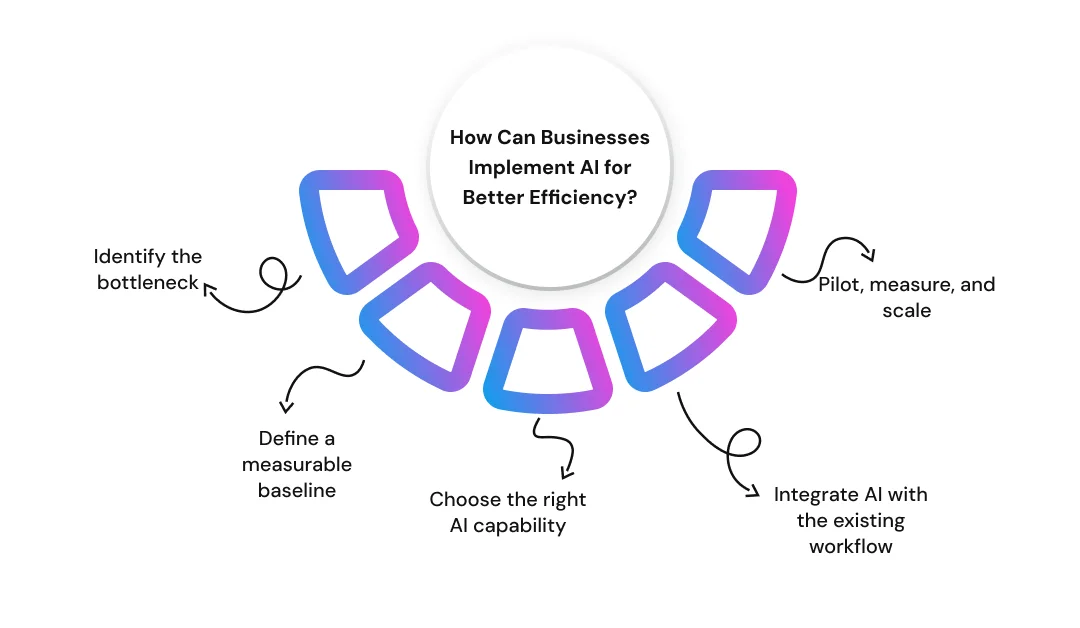
1. Identify the bottleneck
Find processes with high processing time, repeated manual work, frequent handoffs, avoidable errors, or capacity constraints. A practical guide to implementing AI in business can help structure this assessment.
2. Define a measurable baseline
Record metrics such as cycle time, cost per transaction, throughput, error rate, downtime, or response time before introducing AI. Business intelligence services can be relevant when efficiency measurement depends on bringing operational data together across multiple systems.
3. Choose the right AI capability
Different problems require different technologies. Text-heavy workflows may benefit from natural language processing services, while document generation and knowledge assistance may require generative AI development.
Multi-step processes may be better suited to agentic process automation or purpose-built AI agent development when software needs to coordinate approved tools, data sources, and actions.
4. Integrate AI with the existing workflow
An isolated AI application creates limited value if employees must manually transfer information between systems. AI integration services can connect models with business applications, APIs, databases, and operational systems.
Businesses comparing automation approaches can also evaluate available AI workflow automation tools before deciding whether an off-the-shelf platform or custom implementation is more appropriate.
5. Pilot, measure, and scale
Start with a controlled workflow, define human approval points, monitor output quality, and compare performance against the original baseline. Organizations implementing AI across several business functions may require broader enterprise AI development or support from an AI automation agency to coordinate architecture, integrations, governance, and deployment.
How Should Businesses Measure AI Efficiency?
AI efficiency should be measured through business outcomes, not the amount of content or activity an AI system generates.
Useful metrics include processing time, cost per transaction, employee hours required, error and rework rates, equipment downtime, customer response time, forecast accuracy, and the percentage of cases requiring manual escalation.
Cost matters, but it should be evaluated alongside quality and throughput. Looking at how AI helps businesses reduce costs without measuring whether work remains accurate and useful can give an incomplete picture of productivity.
Efficiency Should Create Capacity for Growth
Efficiency is most valuable when businesses know how they will use the capacity AI creates.
Time saved through automation can allow employees to handle more customers, investigate complex problems, improve products, analyze new opportunities, or focus on work that requires human judgment. The objective should therefore extend beyond completing the same work with fewer resources. AI can also create room for organizations to do higher-value work.
How Prismetric Helps Enterprises Improve Efficiency With AI
Prismetric helps enterprises improve efficiency by applying AI to real workflows, data, and business systems not isolated experiments.
Efficiency gains require more than an AI model. Organizations need clear core process goals, reliable data, system integration, governance, monitoring, and human review.
Prismetric supports enterprise AI initiatives with capabilities such as:
- AI workflow automation
- Generative AI and AI agents
- Predictive analytics and machine learning
- Computer vision and visual inspection
- NLP-powered document processing
- Enterprise AI integration
Our teams support use cases across:
- Manufacturing
- Logistics
- Retail
- Healthcare
- Financial services
- Enterprise operations
| Enterprise AI Need |
Prismetric Delivery Focus |
| Workflow automation |
Multi-step process automation |
| Decision support |
Predictive models and analytics |
| Customer operations |
AI chatbots and NLP workflows |
| Quality control |
Computer vision inspection |
| Knowledge work |
Generative AI and RAG |
| System connectivity |
API and legacy integration |
| Governance |
Human approvals and monitoring |
We help enterprises build:
- Human-in-the-loop AI workflows
• Data-connected automation systems
• Governed AI agent architectures
• Monitoring and observability pipelines
• Scalable integrations across business systems
Our implementation approach focuses on:
- Workflow and KPI definition
• Data readiness and integration
• Security and access controls
• Output validation and monitoring
• Integration across legacy and modern applications
Work with Prismetric to identify high-value AI opportunities and implement workflows designed to reduce manual effort and improve operational efficiency.
Move From AI Ideas to Measurable Efficiency Gains
Prismetric can help you define the right use case, integrate AI with existing systems, launch a controlled pilot, and measure improvements in cost, speed, quality, and throughput.
Talk to Our AI Experts
Frequently Asked Questions About How AI Improves Efficiency
AI improves efficiency by automating repetitive tasks, analyzing data faster, predicting operational issues, and helping employees complete knowledge-intensive work with less manual effort. This can shorten processing times and improve how resources are used.
AI reduces the time employees spend on routine activities such as searching for information, summarizing documents, preparing reports, and processing standard requests.
Employees can then spend more time on problem-solving, customer relationships, planning, and decisions that require human judgment.
AI can improve efficiency across several parts of a business, including:
- Automating repetitive workflows
- Accelerating data analysis
- Improving demand forecasting
- Supporting faster customer service
- Predicting equipment failures
- Optimizing inventory and resources
- Assisting employees with knowledge retrieval
AI can reduce errors in repetitive, data-heavy tasks by applying the same predefined rules or models consistently across large volumes of information.
However, AI can also produce incorrect outputs. Businesses still need validation, monitoring, good-quality data, and human review for important decisions.
Yes. Many AI systems are designed to augment employees rather than replace them by taking over repetitive processing or assisting with research, analysis, drafting, and information retrieval.
The strongest workflows often combine:
- AI for speed and scale
- Employees for judgment and context
- Human approvals for exceptions or high-risk actions
AI improves operational efficiency by identifying bottlenecks, automating process steps, predicting disruptions, and coordinating work across connected systems.
For example, an AI system may prioritize service requests, forecast inventory demand, identify equipment anomalies, or route documents automatically.
AI saves time by completing activities that would otherwise require employees to manually review, classify, summarize, calculate, or transfer information.
The amount of time saved depends on the workflow, data quality, integration with existing systems, and how much manual review remains necessary.
AI can help manufacturers improve production efficiency through predictive maintenance, visual quality inspection, demand forecasting, production planning, and equipment monitoring.
Common applications include:
- Detecting early signs of machine failure
- Identifying product defects with computer vision
- Forecasting material requirements
- Reducing unnecessary downtime and rework
AI can classify requests, answer routine questions, retrieve customer information, summarize conversations, and recommend responses to support agents.
Human employees can then focus on complex, sensitive, or unusual cases where context and judgment matter more.
AI can process large datasets and surface patterns, anomalies, forecasts, or relevant information faster than manual analysis.
It works best as decision support. Business leaders still need to evaluate AI-generated insights against operational context, risk, regulations, and strategic priorities.
No. AI can reduce efficiency when it is applied to the wrong task, trained or prompted with poor data, poorly integrated with business systems, or requires extensive correction.
Businesses should evaluate:
- Task suitability
- Data readiness
- Integration requirements
- Output accuracy
- Human oversight
- Measurable business impact
A company should compare operational performance before and after AI implementation using metrics tied to the workflow.
Useful measures include processing time, cost per transaction, employee hours required, throughput, error rates, downtime, response time, forecast accuracy, and the percentage of cases requiring human intervention.
AI tends to provide the most value in processes that involve high volumes of repetitive work, large amounts of data, recurring decisions, or predictable workflow steps.
Examples include document processing, customer support, invoice handling, inventory planning, reporting, quality inspection, forecasting, and knowledge retrieval.
Start with a measurable operational problem rather than selecting an AI tool first.
Identify the bottleneck, establish current performance metrics, assess available data, test AI on a controlled workflow, keep appropriate human approval points, and scale only after the results show measurable value.