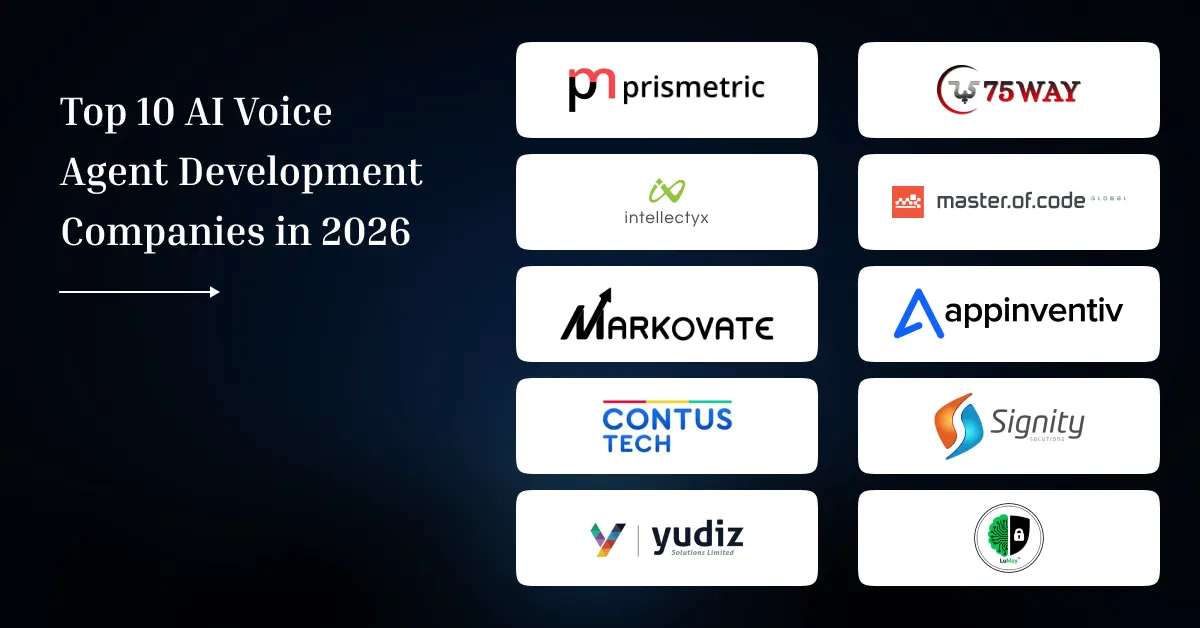
Top 10 AI Voice Agent Development Companies in 2026
AI voice agents now handle far more than basic call routing. Businesses use them for inbound and outbound conversations, lead qualification, customer support, appointment scheduling, CRM updates, and other voice-driven workflows that previously depended on human agents or rigid IVR menus.
Choosing among AI voice agent development companies matters because production systems depend on more than a natural-sounding voice. The partner must connect speech models, LLMs, telephony, enterprise data, business rules, security controls, and human escalation into one reliable workflow.
How We Evaluated the Top AI Voice Agent Development Companies
In 2026, evaluating AI voice agent development companies requires more than reviewing their AI expertise, supported models, or speech technology stack. Many providers can work with similar LLMs, speech-to-text engines, and text-to-speech tools. The real difference is how effectively they can turn those technologies into reliable voice systems that operate under real business conditions.
Our evaluation focused on whether each company can move an AI voice agent from an early prototype to a production-ready solution where conversational quality, integration, security, and operational reliability all matter.
We assessed each company across five practical dimensions:
- Voice AI maturity: Demonstrated experience building AI voice agents that understand natural speech, maintain context, manage interruptions, handle multiple intents, and complete meaningful tasks. Broader experience with agentic AI use cases can also indicate whether a provider understands how agents reason, use tools, and execute multi-step workflows.
- Enterprise readiness: Ability to deploy voice agents across complex operating environments, including high call volumes, multiple user journeys, multilingual requirements, and evolving business rules. This becomes especially important as enterprise AI adoption across industries introduces different data, workflow, and governance requirements.
- Integration capability: Experience connecting voice agents with CRM, ERP, helpdesk, telephony, databases, APIs, and operational systems so conversations can trigger actions inside existing workflows. Providers familiar with generative AI in CRM are better positioned to support use cases where agents need to retrieve, update, or act on customer information during a call.
- Security and governance: Strong practices around access control, data privacy, call recordings, PII handling, monitoring, escalation rules, compliance, and human oversight when voice agents interact with sensitive business information.
- Production reliability and support: Ability to test latency, interruptions, fallback behavior, transfers, edge cases, and conversation quality while providing monitoring, optimization, maintenance, and post-launch support.
These criteria apply to both growing businesses and enterprises evaluating AI voice agent development services for customer support, sales, appointment scheduling, lead qualification, and other voice-driven workflows. They also help determine whether voice automation can contribute to broader goals such as reducing business operating costs with AI without sacrificing service quality or control.
The companies featured in this list demonstrate strengths across these areas, making them relevant partners for organizations planning to build, integrate, and scale production-grade AI voice agents in 2026.
Build AI Voice Agents That Do More Than Talk
Prismetric develops custom voice agents that understand intent, access business data, trigger actions, and handle real customer workflows.
Build Your AI Voice Agent
Top AI voice agent development companies
The AI voice agent development companies below take different approaches to voice automation. Some specialize in custom enterprise engineering, while others combine development expertise with reusable AI platforms. We compared them based on voice AI capabilities, enterprise integrations, customization, production readiness, and their ability to support systems after deployment.
1. Prismetric
Founded in 2008, Prismetric develops custom AI voice agents around a company’s workflows, data, telephony, and existing business systems. Its offering covers AI voice strategy, Voice User Interface design, custom agent development, NLP training and tuning, integrations, modernization, and post-deployment optimization. Prismetric reports 100+ developers and delivery experience across more than 50 countries.
Its development approach combines speech recognition, NLP, LLM-based conversational intelligence, text-to-speech, and real-time processing. Voice agents can connect with CRMs, ERPs, helpdesks, APIs, databases, and telephony infrastructure. Businesses can also extend voice interactions through AI agent development when calls need to trigger multi-step workflows or actions in connected systems.
Prismetric is relevant for customer support, appointment scheduling, lead qualification, sales outreach, order updates, and voice AI agents for conversions and sales.
- Company size: 100+ developers
- Year founded: 2008
- Headquarters: Gandhinagar, Gujarat, India
- Specialties: Custom AI voice agents, VUI design, NLP, multilingual voice AI, enterprise integration, voice workflow automation
- Clutch rating:4.8/5.0
- Website: prismetric.com
2. 75Way Technologies
75Way Technologies provides custom AI and software engineering services for organizations that want voice automation built around specific workflows instead of relying entirely on an off-the-shelf product. Its broader capabilities cover AI agents, generative AI, software development, IoT, data analytics, and enterprise automation. The company reports a team of more than 150 professionals and was founded in 2015.
Its engineering capabilities can support voice agents that need to use LLMs and agent frameworks to perform actions beyond conversation. This becomes useful when businesses want custom AI agents connected with internal tools, APIs, CRM data, or automated workflows.
- Company size: 150+ professionals
- Year founded: 2015
- Headquarters: San Jacinto, California, USA
- Specialties: AI voice agents, custom AI development, conversational AI, AI integrations, workflow automation
- Clutch rating:5.0/5.0
- Website: 75way.com
3. Intellectyx
Intellectyx is a Data, AI, and digital solutions company founded in 2010. Its AI work includes custom agents, generative AI, data engineering, analytics, MLOps, and enterprise applications. The company positions its voice AI offering for environments where conversational systems must interact with existing business platforms and data rather than operate as standalone call bots.
Its integration experience is relevant for contact centers and enterprise workflows where agents need CRM information, internal knowledge, analytics, or access to enterprise databases before responding or transferring an interaction.
- Company size: 200+ employees
- Year founded: 2010
- Headquarters: Denver, Colorado, USA
- Specialties: Enterprise voice AI, AI agents, CRM integration, multilingual AI, data engineering, generative AI
- Clutch rating:4.9/5.0
- Website: intellectyx.com
4. Master of Code Global
Master of Code Global was founded in 2004 and has grown to more than 200 professionals. Its AI practice covers conversational AI, AI agents, NLP, voice and speech recognition, generative AI, deployment, and AI strategy. Voice projects can move from discovery and conversation design through development, integration, testing, launch, and ongoing improvement.
The company is particularly relevant where conversational AI needs to connect customer conversations with sales, support, CRM, telephony, and human escalation workflows.
- Company size: 200+ professionals
- Year founded: 2004
- Headquarters: Winnipeg, Manitoba, Canada
- Specialties: Voice UX, conversational AI, speech recognition, AI agents, NLP, enterprise integrations
- Clutch rating:4.7/5.0
- Website: masterofcode.com
5. Markovate
Markovate is an AI and digital product engineering company founded in 2015. Its AI capabilities include generative AI, custom AI development, conversational systems, NLP, AI agents, and workflow automation. Clutch specifically identifies voice AI agents as part of its AI agent development focus.
Its approach is useful when a voice agent needs more than scripted dialogue—for example, accessing connected tools, coordinating workflows, or exchanging context with external systems. Technologies such as the Model Context Protocol can support this type of tool-enabled agent architecture.
- Company size: 50+ employees
- Year founded: 2015
- Headquarters: San Francisco, California, USA
- Specialties: Voice AI agents, generative AI, conversational AI, NLP, workflow agents, custom AI development
- Clutch rating:5.0/5.0
- Website: markovate.com
6. Appinventiv
Appinventiv began operations in 2015 and reports more than 1,600 technology professionals. Its AI voice agent work spans Voice UX, custom development, multilingual voice experiences, enterprise integrations, model optimization, testing, security, monitoring, and maintenance. The company operates from its headquarters in Noida with additional global delivery locations.
Voice systems can also combine LLMs with retrieval-augmented generation when an agent must retrieve approved enterprise information before answering a caller or taking an action.
- Company size: 1,600+ professionals
- Year founded: 2015
- Headquarters: Noida, Uttar Pradesh, India
- Specialties: Enterprise voice AI, Voice UX, RAG, LLM orchestration, telephony integration, AI development
- Clutch rating:4.6/5.0
- Website: appinventiv.com
Connect Voice AI With Your CRM, Telephony, and Business Systems
Prismetric integrates AI voice agents with CRMs, ERPs, APIs, databases, helpdesks, calendars, and existing call infrastructure.
Discuss Your Voice AI Integration
7. CONTUS Tech
CONTUS Tech is an AI-first product and software engineering company founded in 2008. Its current AI portfolio includes AI software development, AI agents, self-hosted agentic AI, customer-service agents, and dedicated AI voice agent development. The company operates in India and the United States.
Its voice AI development covers the speech and conversational layers as well as integration with enterprise applications. That makes the company relevant when business process automation requires callers to retrieve information, initiate tasks, or move through operational workflows.
- Company size: 500+ employees
- Year founded: 2008
- Headquarters: Chennai, Tamil Nadu, India
- Specialties: AI voice agents, agentic AI, enterprise AI, conversational automation, system integration
- Clutch rating:4.9/5.0
- Website: contus.com
8. Signity Solutions
Signity Solutions was founded in 2009 and has evolved from software development into AI, automation, cloud, CRM, and digital engineering services. The company reports more than 200 certified professionals and over 1,000 completed projects. Its AI capabilities include agents, generative AI, conversational systems, machine learning, and NLP.
For voice implementations, these capabilities support speech-driven customer interactions that need intent recognition, workflow automation, enterprise integration, and escalation. Natural language processing is particularly relevant when interpreting requests and maintaining context across a conversation.
- Company size: 200+ certified professionals
- Year founded: 2009
- Headquarters: Mohali, Punjab, India
- Specialties: Custom voice agents, conversational AI, NLP, AI automation, CRM integration, enterprise AI
- Clutch rating:4.9/5.0
- Website: signitysolutions.com
9. Yudiz Solutions
Yudiz Solutions, founded in 2009, provides AI development alongside software, blockchain, web, mobile, and immersive technology services. Its dedicated voice-agent offering supports multilingual communication, regional accents, private or on-premises deployment, knowledge grounding, prompt tuning, and continuous evaluation.
The company can support voice systems for sales, customer service, appointment scheduling, and other inbound or outbound workflows. These applications also complement areas such as generative AI for sales when organizations want automated engagement to extend from digital channels into phone conversations.
- Company size: 250+ employees
- Year founded: 2009
- Headquarters: Ahmedabad, Gujarat, India
- Specialties: AI voice agents, multilingual voice AI, conversational AI, speech recognition, enterprise integration
- Clutch rating:4.6/5.0
- Website: yudiz.com
10. LuMay
LuMay was founded in 2025 and takes a platform-led approach to enterprise AI through its AI Agent Factory. Its voice-agent capabilities sit within a broader environment for deploying autonomous agents across sales, finance, customer support, and other business functions. The company reports more than 15 team members and 50+ enterprise clients.
Its voice approach is relevant for organizations comparing configurable AI voice agents with fully custom development. LuMay’s model combines AI products with managed services, allowing businesses to connect agents with organizational knowledge, workflows, and business applications.
- Company size: 15+ employees
- Year founded: 2025
- Headquarters: Dover, Delaware, USA
- Specialties: AI voice agents, enterprise AI agents, workflow automation, knowledge integration, managed AI services
- Clutch rating:Not available
- Website: lumay.ai
AI voice agent development companies comparison
The right provider depends on whether you need a fully custom voice system, an enterprise implementation partner, or a platform that your internal team can configure. The table below summarizes the primary delivery model and practical fit of the AI voice agent development companies covered above.
| Company |
Delivery model |
Best for |
Core voice AI focus |
Pricing approach |
| Prismetric |
Custom development |
Enterprise voice workflows |
Custom voice agents, NLP, LLMs, integrations |
Custom quote |
| 75Way Technologies |
Custom development |
End-to-end voice AI projects |
Conversational AI, agents, automation |
Custom quote |
| Intellectyx |
Enterprise AI development |
Data-intensive voice workflows |
Voice AI, CRM integration, analytics |
Custom quote |
| Master of Code Global |
Custom conversational AI |
Customer experience and contact centers |
Voice UX, speech AI, enterprise integrations |
Custom quote |
| Markovate |
Development + platform |
Flexible voice AI architecture |
Low-latency agents, LLM orchestration |
Custom quote |
| Appinventiv |
Custom development |
Large enterprise programs |
Voice UX, RAG, telephony, LLM integration |
Custom quote |
| CONTUS Tech |
Custom development |
Enterprise automation |
Voice agents, agentic AI, integrations |
Custom quote |
| Signity Solutions |
Custom development |
Contact-center automation |
NLU, speech AI, CRM workflows |
Custom quote |
| Yudiz Solutions |
Custom development |
Multilingual voice automation |
Inbound/outbound AI agents |
Custom quote |
| LuMay |
Platform + managed services |
Faster configurable deployment |
Voice workflows, knowledge integration |
Contact vendor |
How to choose an AI voice agent development company
A strong AI voice agent development company should be able to move from a demo to a production system that can manage real callers, imperfect audio, connected tools, changing intent, and business-specific constraints. That requires practical experience across conversational AI, telephony, integration, testing, and lifecycle support.
We focused on the capabilities that determine whether an AI voice agent can operate reliably inside customer experience, sales, appointment booking, collections, and other enterprise workflows.
Real-time voice performance and interruption handling
Voice quality depends on how quickly the system can listen, interpret, respond, and recover when a caller interrupts. Providers should understand speech-to-text, text-to-speech, voice activity detection, barge-in, background noise, accents, pauses, and end-to-end latency across the call path.
Conversational intelligence and task execution
An effective voice agent should do more than generate fluent answers. It needs to retain context, follow business rules, retrieve approved information, use tools, trigger actions, and recognize when a request should move to a human. This is where AI agent design becomes important.
Telephony and enterprise integration capability
Production voice AI has to connect phone infrastructure with business systems. We look for experience with SIP, call routing, warm transfers, CRMs, ERPs, ticketing tools, calendars, APIs, databases, authentication, and legacy integration architectures that may still support daily operations.
Customization and deployment flexibility
Organizations differ in model preferences, infrastructure, data control, and ownership requirements. A capable partner should support custom conversation logic, preferred LLM, STT, and TTS providers, cloud or private deployment options, and a technology stack that fits the existing environment.
Security, governance, and compliance readiness
Voice interactions can involve identities, account information, recordings, payment-related details, or regulated data. Companies should have clear practices for access control, encryption, retention, auditability, consent, PII handling, escalation boundaries, and applicable AI compliance requirements.
Testing, observability, and lifecycle support
The work does not end when the agent completes a scripted call. Reliable deployments require scenario testing, call tracing, failure analysis, quality evaluation, load testing, analytics, monitoring, model or prompt updates, and ongoing optimization. A structured AI model testing approach helps expose failures before they affect larger call volumes.
Enterprise delivery experience and commercial fit
The right partner should explain what can be delivered first, what depends on data or integration readiness, how the system will be supported after launch, and where operating costs come from. An early AI workflow discovery process can also clarify dependencies before implementation starts.
AI Voice Agent Development Services
Organizations that need custom conversational logic, telephony, business-system connectivity, and production support can use AI voice agent development services alongside broader AI integration services to fit voice automation into existing enterprise workflows.
Launch a Production-Ready Voice Agent With Confidence
Prismetric helps design, test, deploy, monitor, and optimize voice agents for latency, interruptions, human handoffs, security, and real-world call performance.
Talk to Our Voice AI Experts
Conclusion
Choosing among AI voice agent development companies requires more than comparing voice quality or a list of supported AI models. The stronger development partners can connect conversational intelligence with telephony, enterprise data, business applications, security controls, human handoffs, monitoring, and long-term ownership.
For organizations that need voice automation designed around their own workflows, Prismetric provides AI voice agent development services covering conversation design, AI integration, deployment, and post-launch optimization. A controlled first use case can help validate performance before expanding voice agents across additional customer or operational workflows.
FAQ about AI voice agent development companies
An AI voice agent development company designs, builds, integrates, tests, and maintains systems that can understand callers, generate responses, access business data, execute actions, and transfer conversations to human agents when required.
Traditional IVR generally follows predefined menus and keypad inputs. AI voice agents use speech recognition, natural language processing, and conversational AI to understand open-ended requests and maintain context across a call.
Common components include automatic speech recognition, STT, TTS, LLMs, NLP, voice activity detection, telephony APIs, databases, tool calling, and sometimes retrieval-augmented generation for enterprise knowledge.
Cost depends on conversation complexity, integrations, call volume, telephony, models, security, and deployment requirements. Businesses should consider development expenses together with recurring speech, LLM, infrastructure, and maintenance costs.
A focused pilot can usually be developed faster than a multi-workflow enterprise deployment. Timeline depends on integrations, conversation complexity, data readiness, testing requirements, security reviews, and the number of supported use cases.
A platform can suit teams with internal engineering resources. A development company is usually more appropriate when the project requires custom architecture, enterprise integrations, workflow design, security controls, testing, and ongoing technical support.
Yes. Through APIs, middleware, databases, and AI integration architecture, voice agents can retrieve customer information, update records, create tickets, schedule appointments, and trigger actions across connected enterprise systems.