Top AI Implementation Companies for Enterprises in 2026
AI implementation companies help organizations move artificial intelligence from isolated experiments into systems used in daily operations. They connect AI with business workflows, enterprise data, applications, security controls, and infrastructure so solutions can operate reliably in production.
For enterprises evaluating AI implementation services, the right provider should support the path from use-case discovery and architecture planning to integration, deployment, monitoring, and optimization. This guide focuses on practical enterprise AI implementation rather than strategy-only consulting or short-lived pilots.
How We Evaluated the Top AI Implementation Companies (Enterprise & SMB Focus)
By 2026, evaluating AI implementation companies requires more than checking technical certifications, frameworks, or supported models. Most providers can access similar foundation models, cloud platforms, and development tools. The real difference is whether their AI tech stack and delivery approach can turn AI concepts into reliable systems that work with real business data, existing software, security policies, and operational constraints.
Our evaluation focused on whether each company can move AI initiatives beyond strategy, prototypes, and isolated pilots into production environments where integration quality, governance, scalability, and measurable business outcomes become critical.
We assessed each company across five practical dimensions:
- Implementation maturity: Demonstrated experience taking AI projects through discovery, architecture, data preparation, development, testing, deployment, and post-launch optimization rather than stopping at proof-of-concept delivery. We also considered whether providers understand how enterprise AI differs across industries where workflows, risks, and implementation requirements can vary substantially.
- Enterprise readiness: Proven ability to implement AI within complex business environments involving multiple users, large datasets, legacy applications, cloud infrastructure, security requirements, and changing operational workflows.
- Integration capability: A strong track record of connecting AI with enterprise systems such as CRM, ERP, databases, APIs, document repositories, analytics platforms, and internal applications so AI becomes part of existing workflows and supports business process automation rather than operating as a disconnected tool.
- Governance and production reliability: Clear capabilities around access control, monitoring, auditability, model evaluation, data protection, compliance, human oversight, and lifecycle management. Architecture decisions such as choosing between private and public LLMs can also affect privacy, control, infrastructure requirements, and enterprise deployment strategy.
- Business outcomes: Evidence that implementations are tied to measurable goals such as workflow efficiency, faster decision-making, lower operating costs, improved customer experience, better accuracy, employee productivity, or revenue growth.
These criteria apply to both large enterprises and growing organizations evaluating AI implementation services for projects that may have smaller teams but still require dependable architecture, secure integrations, and a clear path from initial use case to production.
The AI implementation companies featured in this guide were selected based on their strength across these areas. The objective is to highlight providers capable of building AI systems that can operate inside real business environments, scale with changing requirements, and continue delivering value after deployment.
Turn Your AI Strategy Into a Production-Ready Solution
Prismetric helps businesses move from AI planning and PoCs to secure, integrated systems built around real workflows and enterprise data.
Start Your AI Implementation
Top AI implementation companies
The companies below represent different delivery models, from specialized engineering partners to global consultancies. Each should be evaluated by implementation depth, system fit, governance requirements, delivery model, and expected post-launch ownership.
Prismetric
Prismetric is an AI and software development company founded in 2008, with a listed company size of 51–200 employees. Its AI capabilities cover implementation, integration, generative AI, machine learning, AI agents, LLM solutions, data engineering, and workflow automation.
For organizations needing custom implementation, Prismetric supports work from AI workflow discovery and PoC or MVP development through AI integration services and deployment. Its service portfolio also includes enterprise AI development, AI agent development, and data engineering.
- Company size: 51–200 employees
- Year founded: 2008
- Headquarters: USA, Germany, India
- Specialties: AI implementation, AI integration, generative AI, AI agents, LLM solutions, machine learning, workflow automation, data engineering
- Website: prismetric.com
Accenture
Accenture supports large-scale enterprise AI programs spanning strategy, data modernization, generative AI, responsible AI, and organizational change. Its capabilities are relevant when AI applications across business functions need to operate across multiple departments, technology platforms, and geographic markets.
- Company size: 799,000+ employees
- Year founded: 1989
- Headquarters: Dublin, Ireland
- Specialties: Generative AI, AI strategy, responsible AI, enterprise transformation, cloud modernization, data modernization
- Clutch rating: Not available
- Website: accenture.com
IBM Consulting
IBM Consulting works across AI strategy, architecture, enterprise automation, security, governance, application modernization, and deployment. Its capabilities are relevant for organizations operating complex AI and cloud environments where artificial intelligence must connect with hybrid infrastructure, business applications, and enterprise data.
- Company size: 300,000+ employees across IBM
- Year founded: 1991 as IBM’s consulting organization
- Headquarters: Armonk, New York, USA
- Specialties: Enterprise AI, agentic AI, hybrid cloud, automation, AI governance, application modernization
- Clutch rating: Not available
- Website: ibm.com/consulting
Deloitte

Deloitte combines AI strategy and implementation with governance, risk management, organizational transformation, and regulatory considerations. Its Trustworthy AI approach is particularly relevant when capabilities such as explainable AI and responsible deployment need to be incorporated into complex enterprise environments.
- Company size: 415,000+ professionals
- Year founded: 1845
- Headquarters: London, United Kingdom
- Specialties: AI strategy, trustworthy AI, governance, risk management, compliance, enterprise transformation
- Clutch rating: Not available
- Website: deloitte.com
Infosys
Infosys delivers enterprise AI through Topaz, which brings together services, platforms, reusable AI assets, and generative AI capabilities. The company also supports organizations implementing AI agents across enterprise environments where development, integration, evaluation, deployment, and ongoing management need to operate at scale.
- Company size: 328,000+ employees
- Year founded: 1981
- Headquarters: Bengaluru, Karnataka, India
- Specialties: Generative AI, enterprise AI agents, data and analytics, responsible AI, automation, cloud-enabled AI
- Clutch rating: Not available
- Website: infosys.com
Cognizant
Cognizant combines AI implementation with data engineering, cloud transformation, automation, and software modernization. This makes its capabilities relevant when enterprise AI depends on an broader application modernization strategy to connect intelligent systems with existing applications, data, and operational processes.
- Company size: 356,700+ employees
- Year founded: 1994
- Headquarters: Teaneck, New Jersey, USA
- Specialties: Enterprise AI, generative AI, agentic AI, data modernization, automation, application modernization
- Clutch rating: Not available
- Website: cognizant.com
Integrate AI With the Systems Your Business Already Uses
Prismetric connects AI with ERP, CRM, databases, APIs, legacy applications, and internal workflows for reliable enterprise implementation.
Discuss Your AI Integration
Slalom

Slalom provides AI consulting and implementation alongside cloud, data, and business transformation capabilities. Its approach is relevant for organizations looking to embed AI into everyday operations, including AI workflow automation, while aligning implementation with existing cloud platforms and organizational processes.
- Company size: 10,001+ employees
- Year founded: 2001
- Headquarters: Seattle, Washington, USA
- Specialties: AI consulting, generative AI, cloud AI, data platforms, workflow transformation, organizational adoption
- Clutch rating: Not available
- Website: slalom.com
EffectiveSoft
EffectiveSoft focuses on connecting AI with enterprise software, data, APIs, and operational workflows. Its implementation capabilities include LLM integration, AI agents, automation, and architectures using retrieval-augmented generation to ground model outputs in enterprise knowledge sources.
- Company size: 360+ employees
- Year founded: 2003
- Headquarters: San Diego, California, USA
- Specialties: AI integration, LLM integration, RAG, AI agents, workflow automation, data engineering, legacy modernization
- Clutch rating: 4.9/5.0
- Website: effectivesoft.com
RTS Labs
RTS Labs is a boutique applied AI consultancy focused on moving projects from pilot to production. Its delivery model includes architecture, data engineering, integration, governance, monitoring, and AI model testing for implementations connected with CRMs, ERPs, internal APIs, and enterprise data systems.
- Company size: 100+ employees
- Year founded: 2010
- Headquarters: Richmond, Virginia, USA
- Specialties: Applied AI, AI integration, data engineering, RAG, automation, governance, MLOps
- Clutch rating: Not yet reviewed
- Website: rtslabs.com
Intellectyx
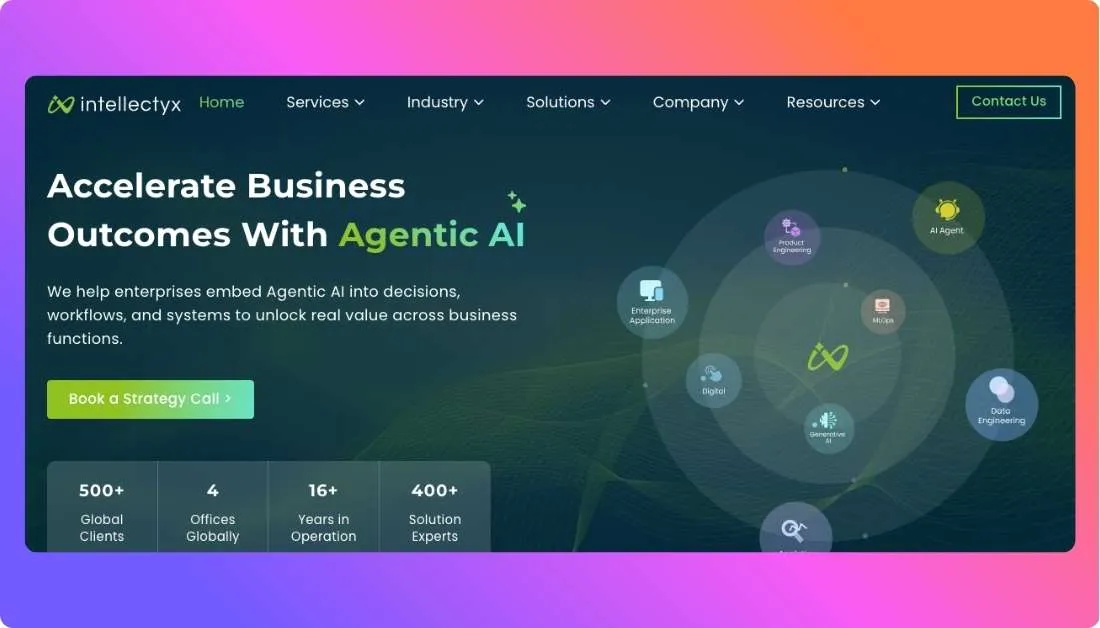
Intellectyx combines AI implementation with data engineering, analytics, cloud, and digital transformation. Its AI capabilities emphasize production-grade agents, making the company relevant to organizations exploring agentic AI use cases that require integration, monitoring, governance, and ongoing operational support.
- Company size: 400+ professionals
- Year founded: 2010
- Headquarters: Denver, Colorado, USA
- Specialties: Agentic AI, custom AI agents, AgentOps, generative AI, data engineering, analytics, MLOps
- Clutch rating: 4.9/5.0
- Website: intellectyx.com
AI implementation companies comparison
The companies above vary significantly in delivery scale, technical focus, and implementation model. The table below gives enterprise teams a faster way to compare their core AI implementation strengths before evaluating individual providers in greater detail.
| Company |
Core AI implementation strengths |
Suitable for |
| Prismetric |
Custom AI implementation, agents, RAG, integration, data engineering |
Mid-market and enterprise custom AI projects |
| Accenture |
Enterprise transformation, GenAI, data modernization |
Large global transformation programs |
| IBM Consulting |
Hybrid cloud, automation, governance, enterprise AI |
Complex hybrid and regulated environments |
| Deloitte |
AI strategy, governance, risk, transformation |
Governance-intensive enterprise programs |
| Infosys |
Topaz, GenAI, enterprise agents, scaled delivery |
Large-scale platform-led implementations |
| Cognizant |
AI engineering, data and application modernization |
Enterprises modernizing legacy environments |
| Slalom |
Cloud AI, data platforms, organizational adoption |
Collaborative cloud-focused implementations |
| EffectiveSoft |
AI integration, LLMs, RAG, legacy modernization |
Integration-heavy enterprise projects |
| RTS Labs |
Applied AI, data engineering, production deployment |
Mid-market implementation programs |
| Intellectyx |
Agentic AI, data engineering, AgentOps |
Data-intensive and agentic AI projects |
How to choose the right AI implementation partner
AI implementation affects data, software architecture, security, employees, business processes, and long-term technology ownership. The right provider should therefore match both the technical environment and the business outcome rather than simply offering the largest portfolio of AI services.
Match the partner to your business goals
Start with the operational outcome AI needs to improve. An AI workflow discovery exercise can help identify where automation, forecasting, knowledge retrieval, decision support, or other AI capabilities can create measurable value.
Separate AI consulting from implementation ownership
Some AI consulting companies concentrate primarily on strategy and opportunity identification, while AI implementation companies remain involved through engineering, integration, testing, deployment, and support. Organizations should clarify exactly which implementation stages the provider will own before engagement begins.
Validate data and system readiness
AI depends on the systems and information surrounding it. Before development, the partner should assess APIs, databases, CRM and ERP platforms, data quality, permissions, and any modernization required to support AI implementation in existing business environments.
Review security and governance early
Security should be designed into the implementation rather than addressed immediately before launch. Ask how the provider manages sensitive data, role-based access, audit trails, model evaluation, human oversight, output monitoring, and regulatory obligations.
Clarify monitoring and post-launch ownership
Production systems change as models, APIs, source data, and business rules evolve. Organizations should establish who owns monitoring, updates, incident response, model evaluation, infrastructure, and optimization after deployment, including the required LLMOps capabilities.
Prove value with a controlled first release
Complex implementations can begin with a focused AI PoC or AI MVP that validates data access, integration, security, output quality, user adoption, and business impact before the solution expands across additional workflows.
Validate Your AI Use Case Before Scaling
Start with a focused AI PoC or MVP to test data readiness, integration, security, output quality, and business value before full deployment.
Build Your AI PoC
Conclusion
AI implementation creates value when it becomes part of the systems, data, and workflows where work already happens. The right AI implementation company should combine technical delivery with integration expertise, data readiness, security, governance, monitoring, and clear post-launch ownership.
For organizations moving from experimentation to production, Prismetric provides AI implementation services covering use-case validation, AI development, enterprise integration, deployment, and ongoing optimization. The objective is to build AI systems that fit existing operations and can expand as business requirements evolve.
FAQ about AI implementation companies
An AI implementation company helps organizations turn AI use cases into working production systems. Its responsibilities can include discovery, data preparation, model or application development, AI integration services, testing, deployment, monitoring, governance, and optimization.
AI consulting services primarily help organizations identify opportunities, define strategy, and plan adoption. AI implementation covers building and deploying the solution, while AI integration focuses on connecting AI with existing applications, databases, APIs, and workflows.
Prominent AI implementation companies include Prismetric, Accenture, IBM Consulting, Deloitte, Infosys, Cognizant, Slalom, EffectiveSoft, RTS Labs, and Intellectyx. The right choice depends on project complexity, enterprise systems, regulatory requirements, delivery scale, and required technical expertise.
Evaluate production experience, integration capabilities, data engineering, security, governance, industry knowledge, cloud expertise, and post-launch support. A structured set of questions to ask an AI development company can also help compare vendors beyond their service descriptions.
There is no fixed cost because scope varies by data preparation, model choice, integrations, infrastructure, security requirements, and deployment complexity. Reviewing the major AI development cost factors helps organizations establish a more realistic implementation budget.
A focused PoC or MVP may take weeks, while multi-system enterprise implementations can require several months. The difference between an AI PoC and AI MVP also affects how much engineering, integration, and production readiness is required.
Yes. AI can connect with legacy systems through APIs, middleware, data pipelines, and modernization layers. However, successful AI implementation in business depends on data accessibility, system architecture, security controls, and integration quality.
Common causes include unclear business goals, poor data quality, disconnected pilots, weak integration planning, security concerns, insufficient testing, and unclear ownership after deployment. Addressing governance and AI compliance requirements early reduces avoidable production barriers.