Top 10 AI MVP Development Companies in 2026
Choosing an AI MVP development company can determine whether an early product proves a business case or stays at the prototype stage. The right partner needs to validate user demand, data readiness, AI performance, product usability, and technical feasibility without overbuilding the first release.
This guide compares AI MVP development companies across product discovery, AI engineering, application development, testing, integration, deployment, and post-MVP scaling. The focus is not only on who can build quickly, but who can help teams learn what should be built next.
How we selected the best AI MVP development companies
AI MVP development sits between product validation and production engineering. A vendor may be strong at application development but weak in model evaluation, data preparation, or AI integration. Another may understand machine learning but lack the product and deployment capability needed for real users.
We looked for companies that can support the path from discovery to a working release: defining the riskiest assumptions, selecting a practical AI approach, building the core workflow, testing performance, and preparing the product for the next stage.
The companies were assessed using the following criteria.
AI and MVP development expertise
We prioritized providers that combine AI engineering with disciplined MVP delivery. Relevant experience includes generative AI, machine learning, LLM applications, RAG, AI agents, and AI-enabled web or mobile products rather than isolated demos.
Product discovery and scope discipline
A strong AI MVP development partner should narrow the first release to one clear user problem and a measurable hypothesis. Early AI workflow discovery helps identify the workflow, user, data, and business outcome that deserve validation first.
AI evaluation and production readiness
AI output needs defined acceptance criteria. We considered whether a company can test response quality, failure cases, latency, cost, guardrails, and user feedback instead of treating a successful model response as proof that the MVP is ready.
Data and architecture capability
Many AI MVPs depend on fragmented or poorly structured data. Relevant providers should understand APIs, databases, cloud architecture, retrieval pipelines, and how LLMs connect with enterprise databases when the product depends on business data.
End-to-end product engineering
An AI feature still needs a usable product around it. We looked for teams that cover UI/UX, frontend, backend, APIs, QA, cloud deployment, and AI integration architecture so the MVP can operate inside a real workflow.
Security, governance, and compliance readiness
AI MVPs may handle customer records, internal documents, or financial information. Providers should address access controls, logging, privacy, human review, and relevant AI compliance requirements early in the build.
Delivery speed and commercial transparency
Speed matters only when the scope is clear. We considered whether providers define discovery, milestones, assumptions, acceptance criteria, and what is included in the first release rather than relying on an attractive headline estimate.
Post-MVP scalability and support
The first release should create evidence for the next decision. We favored companies that can improve architecture, monitoring, model performance, infrastructure, security, and cost after validation instead of rebuilding the product when pilot usage grows.
Turn Your AI Idea Into a Focused MVP
Prismetric helps define the right scope, validate core assumptions, and build an AI MVP around real user and business needs.
Build Your AI MVP
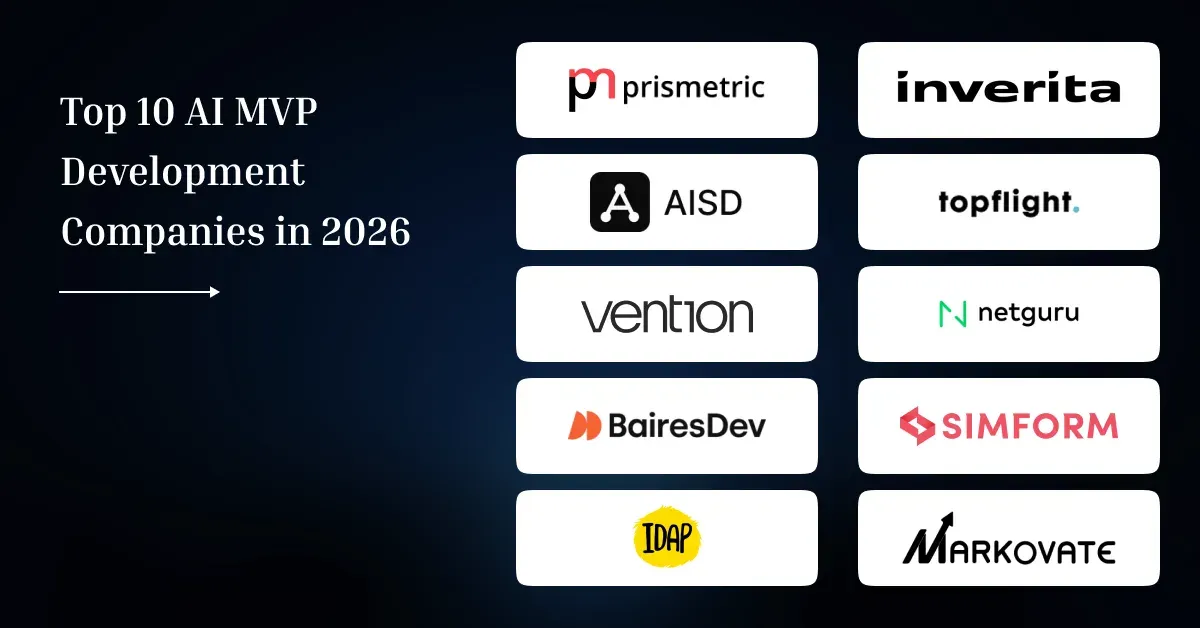
Top 10 AI MVP development companies
The companies below serve different product needs. Some are better suited to AI-native startups, while others are stronger for regulated workflows, enterprise integrations, or products expected to scale quickly after validation.
1. Prismetric
Prismetric is an AI and software development company founded in 2008 that works with startups, product teams, and enterprises building AI-enabled digital products. Its AI MVP development services cover idea validation, MVP scope planning, rapid prototyping, model and technology selection, product engineering, testing, deployment, and post-launch improvement. The company positions AI MVPs around validating user demand, data readiness, model performance, and business value before teams commit to full-scale development.
Its AI capabilities span generative AI, machine learning, LLM applications, RAG, AI agents, NLP, and computer vision. Prismetric also combines these capabilities with frontend, backend, APIs, cloud infrastructure, databases, and integrations, which is relevant when an MVP needs to operate as a usable product rather than an isolated AI prototype. Its delivery approach supports progression from early validation to deployment, monitoring, and future scaling.
- Company size: 76–100 employees
- Year founded: 2008
- Headquarters: Gandhinagar, Gujarat, India
- Specialties: AI MVP development, generative AI, RAG, AI agents, machine learning, NLP, computer vision, AI SaaS development
- Clutch rating: 4.8/5.0
- Website: prismetric.com
2. inVerita
inVerita is a custom software, data, and AI development company that works with startups and enterprises across healthcare, fintech, supply chain, and other complex business environments. Its AI delivery process covers data preparation, model design, proof-of-concept and MVP development, implementation, integration, and continuous model optimization.
For AI MVP projects, the company is particularly relevant when the product requires more than a standalone AI feature. Its teams combine AI engineering with product design, cloud, DevOps, data engineering, and application development, which can help organizations validate an idea while keeping integration and future scalability in view. inVerita also has experience with regulated healthcare software and AI systems that depend on structured enterprise data.
- Company size: 150+ employees
- Year founded: 2015
- Headquarters: Lviv, Ukraine
- Specialties: AI MVP development, machine learning, generative AI, data engineering, AI integration, product design, cloud modernization, healthcare software
- Clutch rating: 4.9/5.0
- Website: inveritasoft.com
3. AISD
AISD is an AI-native software development company founded in 2025 with a focus on production AI, AI MVPs, AI agents, software modernization, and workflow automation. Its MVP model emphasizes tightly scoped releases, senior-only engineering teams, weekly demonstrations, security controls, and an evaluation harness designed to measure AI performance from the beginning of an engagement.
The company is a stronger fit for teams building products where AI is the core capability rather than a secondary feature. AISD works with RAG, agentic systems, generative AI, automation platforms, and full-stack software, while its published process also addresses model selection, testing, observability, handoff, and post-launch support.
- Company size: 10–49 employees
- Year founded: 2025
- Headquarters: San Francisco, California, USA
- Specialties: AI MVP development, AI agents, generative AI, RAG, AI modernization, AI workflow automation, LLM applications
- Clutch rating: Not yet reviewed on Clutch
- Website: aisoftwaredev.io
4. Topflight Apps
Topflight Apps is a product development company founded in 2016 with a strong focus on healthcare, MedTech, fintech, and AI-enabled applications. Its healthcare MVP approach combines product discovery, prototyping, engineering, security, cloud infrastructure, and integrations with systems such as EHR platforms using standards including FHIR and HL7.
The company is particularly relevant for regulated AI MVPs where a usable first release also needs privacy controls, auditability, secure data flows, and a realistic path to production. Its AI work includes LLM and RAG pipelines, machine learning, MLOps, and healthcare workflows where human oversight and compliance requirements can influence architecture from the start.
- Company size: 10–49 employees
- Year founded: 2016
- Headquarters: Irvine, California, USA
- Specialties: Healthcare MVP development, AI/ML applications, RAG, EHR/FHIR integration, UX/UI, cloud infrastructure, AI in healthcare, MLOps
- Clutch rating: 4.9/5.0
- Website: topflightapps.com
5. Vention
Vention is a software development company founded in 2002 that provides engineering services to startups and enterprises. Its AI capabilities cover consulting, data preparation, model selection, PoC and MVP development, AI product engineering, software integration, model training, and ongoing support.
With more than 3,000 engineers globally, Vention is better suited to growth-stage startups and larger organizations that expect a successful AI MVP to progress into a broader production system. Its engineering coverage extends beyond AI into web and mobile development, QA, cloud, and DevOps, making it relevant for products that require substantial application infrastructure around the AI layer.
- Company size: 3,000+ engineers
- Year founded: 2002
- Headquarters: New York, New York, USA
- Specialties: AI MVP development, AI software development, machine learning, AI integration, web and mobile development, cloud, DevOps, product scaling
- Clutch rating: 4.9/5.0
- Website: ventionteams.com
6. Netguru
Netguru is a digital product and AI development company founded in 2008. Its AI practice covers discovery, solution design, proof-of-concept validation, MVP implementation, generative AI, RAG, agentic systems, custom models, and MLOps. The company is a good fit for product teams that want AI engineering combined with product strategy and UX rather than model development in isolation.
Its delivery process moves from feasibility and architecture through AI MVP implementation, testing, deployment, and model monitoring. This is relevant when teams need to build an AI MVP that can progress beyond early validation without replacing its technical foundation.
- Company size: 250–999 employees
- Year founded: 2008
- Headquarters: Poznań, Poland
- Specialties: AI MVP development, generative AI, RAG, agentic AI, custom AI models, MLOps, product design
- Clutch rating: 4.8/5.0
- Website: netguru.com
Validate AI Performance Before You Scale
Test model quality, data readiness, integrations, latency, cost, and user adoption with a focused MVP before committing to full development.
Start Your MVP Validation
7. BairesDev
BairesDev is a software engineering company founded in 2009 that works with startups, mid-market businesses, and enterprises. Its AI capabilities span generative AI, machine learning, LLM applications, agentic systems, data engineering, predictive analytics, and model deployment, supported by broader backend, cloud, mobile, and software engineering teams.
The company is better suited to technically demanding MVPs that may require significant engineering capacity after validation. Its machine learning work covers data preparation through deployment, while its GenAI teams handle model integration, proprietary data, and production architecture. Teams evaluating AI development costs should account for that broader engineering scope when comparing vendors.
- Company size: 1,000–9,999 employees
- Year founded: 2009
- Headquarters: San Francisco, California, USA
- Specialties: AI development, generative AI, machine learning, LLMs, data engineering, software product development
- Clutch rating: 4.9/5.0
- Website: bairesdev.com
8. Simform
Simform is a digital engineering company founded in 2010 with capabilities across AI, cloud, data engineering, product engineering, and application modernization. Its generative AI practice includes feasibility workshops, agentic AI, model fine-tuning, RAG, data readiness, governance, and MLOps.
For AI MVP development, Simform is particularly relevant when the first release depends on a strong data or cloud foundation. Its product engineering practice also uses prototypes and PoCs to test ideas before larger engineering commitments, which can help teams separate technical validation from full product investment. Related AI PoC development can serve the same purpose when feasibility remains the primary uncertainty.
- Company size: 1,000–9,999 employees
- Year founded: 2010
- Headquarters: Orlando, Florida, USA
- Specialties: Generative AI, agentic AI, RAG, MLOps, data engineering, cloud engineering, product development
- Clutch rating: 4.8/5.0
- Website: simform.com
9. IDAP (now part of Globaldev Group)
IDAP was founded in 2012 in Kyiv as a software product engineering company focused on mobile, web, backend, and custom application development. In April 2025, Globaldev Group acquired IDAP, bringing its team into a broader organization with web, data, mobile, and AI capabilities.
Under Globaldev, the wider delivery capability now includes AI consulting, generative AI, RAG, AI agents, NLP, computer vision, data engineering, and product development. This makes the former IDAP team relevant for AI-enabled web and mobile MVPs where AI integration needs to sit inside a complete digital product.
- Company size: 450+ employees (Globaldev Group)
- Year founded: 2012 (IDAP)
- Headquarters: Kyiv, Ukraine (IDAP); Globaldev headquarters in Warsaw, Poland
- Specialties: Mobile and web products, AI development, generative AI, RAG, AI agents, data engineering
- Clutch rating: 4.9/5.0 (GLOBALDEV, formerly IDAP)
- Website: globaldev.tech
10. Markovate
Markovate is an AI and digital product development company founded in 2015. Its work spans generative AI, AI agents, machine learning, conversational AI, computer vision, web development, and mobile applications. Its GenAI process covers data evaluation, model selection, experimentation, RAG, output evaluation, deployment, and production monitoring.
The company is relevant for teams building generative-AI-heavy MVPs where model behavior needs to be tested before wider investment. Its approach also uses PoCs and MVPs to evaluate real-world feasibility, making it suitable when businesses need to validate an AI workflow before moving into larger-scale generative AI development.
- Company size: 50–249 employees
- Year founded: 2015
- Headquarters: San Francisco, California, USA
- Specialties: Generative AI, AI agents, RAG, machine learning, conversational AI, computer vision, AI product development
- Clutch rating: 5.0/5.0
- Website: markovate.com
AI MVP development companies comparison
The right provider depends on what the MVP needs to prove. Some teams prioritize fast AI validation, while others need stronger compliance, data engineering, or a clearer path from pilot to production.
| Company |
Best fit |
Core AI focus |
Post-MVP strength |
| Prismetric |
End-to-end AI MVPs |
GenAI, RAG, agents, ML |
Product scaling |
| inVerita |
Regulated, full-product MVPs |
AI/ML, data, integrations |
Enterprise engineering |
| AISD |
AI-native startups |
LLMs, agents, RAG |
Production AI evaluation |
| Topflight Apps |
Healthcare and fintech |
Secure AI workflows, ML |
Regulated scaling |
| Vention |
Growth-stage products |
ML, GenAI, data |
Large engineering capacity |
| Netguru |
Product-led AI MVPs |
GenAI, RAG, agentic AI |
UX and product development |
| BairesDev |
Engineering-heavy MVPs |
GenAI, ML, data |
Broad software engineering |
| Simform |
Cloud- and data-heavy MVPs |
GenAI, RAG, MLOps |
Cloud scaling |
| IDAP / Globaldev |
Mobile and web AI MVPs |
GenAI, agents, data |
Cross-platform engineering |
| Markovate |
GenAI-focused MVPs |
GenAI, agents, RAG |
AI product development |
How to choose the right AI MVP development partner
Choosing an AI MVP development company should start with the uncertainty you need to reduce. The strongest partner is one that can define what success means, test it with real users, and leave you with a product that can move forward.
Start with what the MVP needs to prove
Identify whether the biggest risk is user demand, technical feasibility, data availability, model quality, workflow adoption, or willingness to pay. If technical feasibility is still uncertain, an AI PoC may be the better first step.
Check how AI quality will be evaluated
Ask how the team will test outputs, failure cases, latency, cost, hallucinations, and human-review requirements. For RAG-based products, evaluation should cover retrieval quality as well as generated responses.
Evaluate data, integration, and security readiness
An AI MVP may depend on APIs, internal databases, or third-party systems. The partner should explain how data will be accessed, protected, transformed, and connected through an appropriate AI integration architecture.
Compare scope, timeline, and budget together
Two vendors may quote different prices because they are solving different problems. Compare what discovery, design, development, testing, deployment, documentation, and post-launch support actually include rather than evaluating the initial quote alone.
Clarify ownership and the path to production
Define ownership of source code, prompts, datasets, evaluation assets, infrastructure, and documentation before development starts. Also ask how the team will handle monitoring, security, model updates, MLOps, and cost control if usage grows.
Build an AI MVP Ready for the Next Stage
Prismetric combines AI engineering, product development, testing, deployment, and scalable architecture to help your MVP move beyond early validation.
Talk to Our AI MVP Experts
Conclusion
There is no universal best AI MVP development company. The right choice depends on what you need to validate, AI complexity, data and integration requirements, compliance needs, budget, and what happens after the first release.
For teams that need one partner across discovery, AI engineering, product development, testing, deployment, and iteration, Prismetric’s AI MVP development services provide an end-to-end path from concept to a working release prepared for further scaling.
FAQ about AI MVP development companies
It is a software partner that builds minimum viable products whose core workflow uses AI, machine learning, generative AI, or related technologies.
A PoC tests technical feasibility; an MVP tests whether a usable product built around that capability creates value for real users.
Cost depends on scope, data readiness, model choice, integrations, UX, compliance, and infrastructure. AI development costs should therefore be compared against the same project scope.
Focused projects can take several weeks, while products involving regulated data, custom models, or complex integrations usually require longer phased delivery.
It should include the smallest usable workflow needed to test the product hypothesis, plus AI evaluation, data access, basic security, logging, and user feedback.
Review its AI expertise, MVP process, data and integration capability, security practices, evaluation approach, delivery transparency, and post-MVP support.
Not always. Existing models or APIs are often enough for validation; custom training becomes useful when domain performance, control, or proprietary data justify it.
Yes, when the product genuinely needs grounded retrieval, tool use, or multi-step task execution through AI agents.
Teams typically harden architecture, improve monitoring and security, optimize model performance and cost, and prepare the product for larger-scale production use.