AI in Business Intelligence: How It Works, Use Cases, Benefits and Future

AI in business intelligence combines artificial intelligence with traditional BI systems to analyze data, automate analytical tasks and produce faster insights. Modern business intelligence services increasingly pair dashboards and reporting with machine learning, natural language processing and generative AI.
Traditional BI primarily helps organizations understand what has happened through reports, dashboards and historical analysis. The relationship between business intelligence, data warehousing and analytics provides the foundation for collecting, organizing and interpreting this information.
AI-powered business intelligence extends that model. Instead of relying only on predefined dashboards or waiting for analysts to create new reports, users can ask questions in everyday language, uncover patterns automatically and generate forecasts. AI tools for data analysis are also bringing advanced analytical capabilities to more business users.
The result is a more interactive and forward-looking approach. AI in business intelligence helps organizations move from asking “What happened?” to exploring why it happened, what might happen next and which actions deserve attention.
Why AI is reshaping business intelligence
Organizations collect information from applications, customer interactions and operational systems faster than traditional reporting teams can analyze it. This growth is accelerating enterprise AI adoption and changing what businesses expect from analytics.
Static dashboards remain useful, but they are built around predefined metrics and questions. When conditions change, leaders often need follow-up analysis or new reports. AI-powered BI can shorten that cycle by interpreting questions, finding relevant data and surfacing insights without routing every request through a technical team.
The wider AI transformation is also pushing organizations toward real-time and predictive decision-making. Machine learning can identify patterns across large datasets, while generative AI can summarize findings and make complex information easier to understand.
However, AI does not repair weak data foundations. Reliable results depend on accurate data, consistent business definitions, governance and a strong data engineering foundation. Organizations building an AI strategy should address these requirements before scaling AI-generated insights.
Turn Business Data Into Smarter, Faster Decisions
Prismetric builds AI-powered BI solutions that combine predictive analytics, machine learning, and governed business data for faster insights.
Explore AI-Powered BI
Key components of AI in business intelligence
Several technologies work together to turn business data into accessible, predictive and increasingly automated insights.
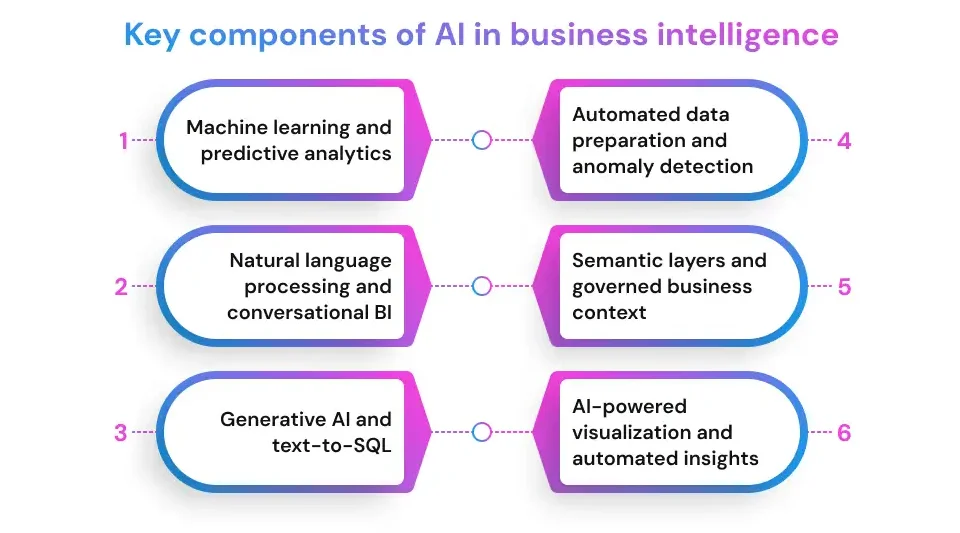
Machine learning and predictive analytics
Machine learning uses historical and real-time data to recognize patterns, detect anomalies and forecast outcomes. Businesses can build predictive models to estimate sales, demand, customer churn or operational risks rather than relying only on past performance.
As machine learning systems receive new information, they can improve pattern detection and help BI teams identify changes that manual analysis might miss.
Natural language processing and conversational BI
Natural language processing allows BI systems to understand questions expressed in ordinary language. Through conversational BI, a manager might ask why regional sales declined or which customers have the highest churn risk without writing SQL.
Businesses developing natural-language data interfaces can use NLP to translate user intent into queries and return answers that nontechnical users can understand.
Generative AI and text-to-SQL
Generative AI can convert plain-language questions into database queries, summarize reports, explain charts and help analysts refine SQL or documentation.
When organizations connect LLMs with enterprise databases, these capabilities can reduce repetitive analytical work. Generative AI in business intelligence is most useful when queries remain grounded in governed data and can be reviewed before important decisions.
Automated data preparation and anomaly detection
AI-powered BI can automate repetitive data preparation tasks such as classification, cleansing, schema matching and identifying missing or unusual values. AI workflow automation helps analysts spend less time preparing datasets and more time interpreting results and investigating business problems.
Anomaly detection adds another layer of intelligence by continuously monitoring data for unexpected changes. Instead of discovering a sudden revenue decline or operational issue in a scheduled report, teams can be alerted as soon as unusual patterns emerge.
Semantic layers and governed business context
AI in business intelligence depends on more than a capable model. It also needs consistent definitions for metrics such as revenue, active customer, qualified lead and churn. A semantic layer connects these business terms to governed data so users receive answers based on the same definitions.
Organizations can further improve reliability by grounding AI answers in enterprise knowledge. Understanding how retrieval-augmented generation works helps teams connect models with relevant business information while maintaining stronger context around the data being analyzed.
AI-powered visualization and automated insights
Modern AI-powered business intelligence can recommend suitable charts, summarize dashboard changes and explain important KPI movements in natural language. Instead of requiring users to examine every visualization manually, the system can direct attention toward trends, exceptions and relationships that warrant investigation.
This moves BI beyond dashboard creation toward continuous insight discovery. As business intelligence companies expand AI capabilities, users can receive an explanation, ask a follow-up question and explore underlying data without restarting the reporting process.
Key use cases for AI in business intelligence
AI can support business intelligence across reporting, forecasting, customer analysis and operational decision-making. Many generative AI use cases now extend into everyday analytics workflows:
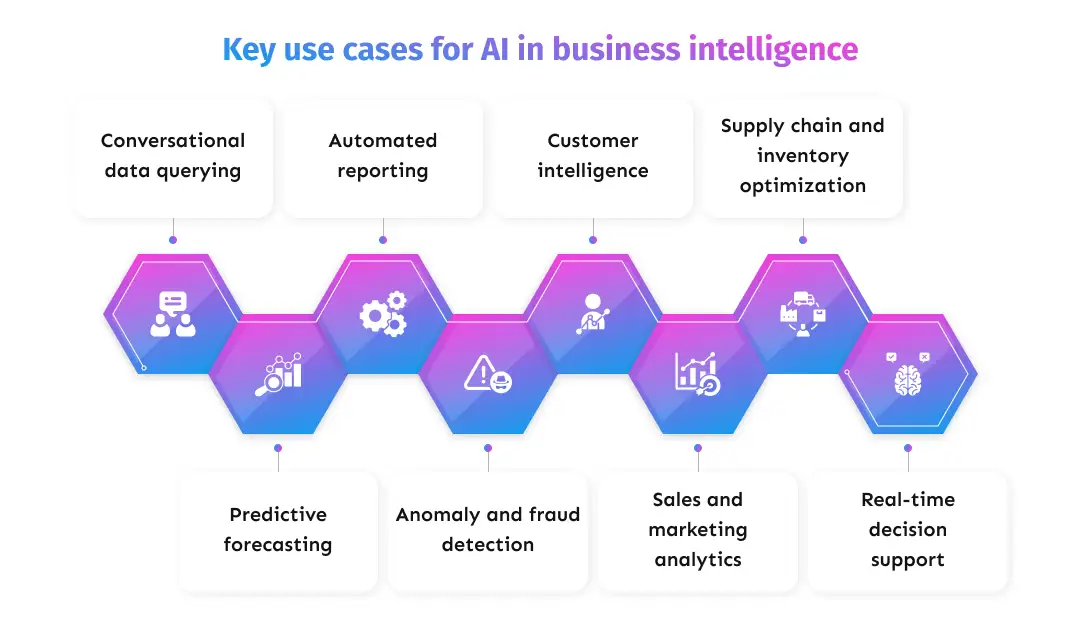
- Conversational data querying: Conversational BI allows users to ask questions in everyday language and receive relevant metrics, visualizations or summaries without manually writing complex SQL queries.
- Predictive forecasting: AI models analyze historical patterns and current signals to forecast sales, demand, cash flow, customer churn or inventory requirements. AI-powered demand forecasting can help teams prepare for changing market conditions.
- Automated reporting: Generative AI can create report summaries, explain changes in KPIs and assist with recurring analytical work. It can also support automated financial reporting by turning complex datasets into clearer business narratives.
- Anomaly and fraud detection: Machine learning can flag unusual transactions, performance changes or deviations from expected behavior, giving analysts a smaller set of high-priority events to investigate.
- Customer intelligence: AI business intelligence can segment customers, identify behavioral trends and detect signals associated with churn, retention or purchase intent. These insights can support more personalized customer experiences.
- Sales and marketing analytics: Teams can analyze pipelines, campaign performance and conversion patterns while using generative AI in sales andAI-supported marketing to summarize findings and identify opportunities for follow-up.
- Supply chain and inventory optimization: Predictive analytics in business intelligence can forecast demand, identify bottlenecks and help organizations allocate inventory, labor and other resources more efficiently.
- Real-time decision support: AI-powered BI can monitor key metrics continuously and generate alerts when important thresholds or patterns change, helping decision-makers respond before an issue becomes visible in a scheduled report.
Ask Your Data Questions in Plain Language
Prismetric develops conversational BI solutions that connect LLMs, NLP, enterprise databases, and semantic layers to deliver accurate, contextual answers.
Build Conversational BI
Who uses AI in business intelligence?
AI in business intelligence can support decision-making across departments, although each team uses the technology differently. Organizations building enterprise-grade AI capabilities can connect governed analytics with the needs of specific business roles.
- Executives and business leaders: Use AI-powered BI to monitor KPIs, compare scenarios and identify performance changes that require strategic attention.
- BI and data analysts: Generate queries, investigate anomalies and automate recurring analytical work, giving analysts more time for modeling, validation and deeper analysis.
- Finance teams: Apply AI in finance to forecasting, risk analysis, fraud detection and performance monitoring while using deeper analytical models for complex financial patterns.
- Sales and marketing teams: Examine pipeline performance, customer segments and campaign results. Generative AI in business can also summarize findings and help teams identify opportunities faster.
- Operations and supply chain teams: Use predictive analytics to forecast demand, monitor bottlenecks and improve resource allocation.
- Customer and product teams: Analyze behavior, retention and product usage to improve customer experience and guide product decisions.
Benefits of AI in business intelligence
The benefits of AI for business intelligence extend beyond faster reporting. AI-powered BI can make analytics more accessible, predictive and scalable across an organization.
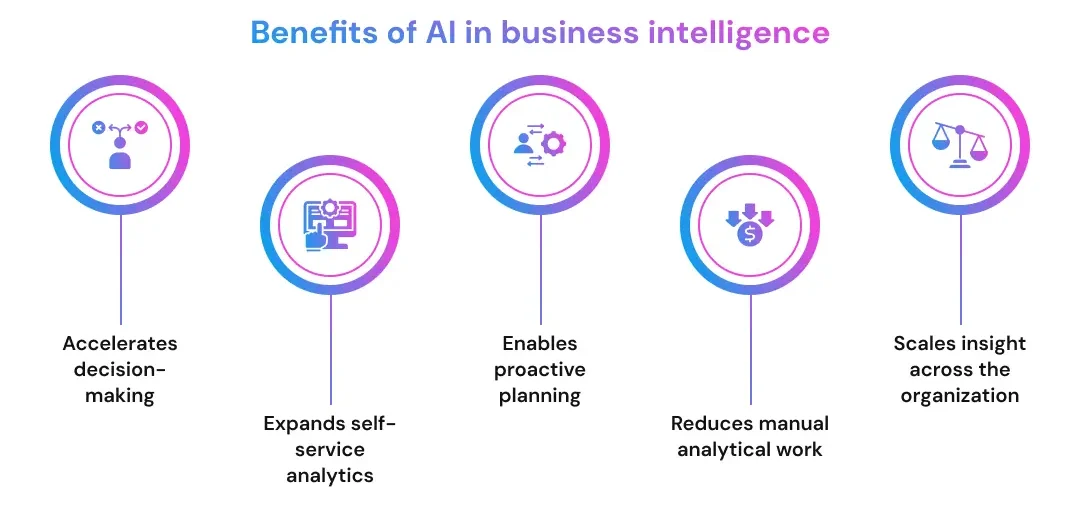
- Accelerates decision-making: Automated analysis reduces the time between asking a question and receiving usable insight, helping teams act on changing conditions sooner.
- Expands self-service analytics: Conversational BI allows nontechnical users to explore governed data without depending on an analyst for every follow-up question.
- Enables proactive planning: Predictive analytics helps organizations forecast likely outcomes and prepare for risks or opportunities before they appear in historical reports.
- Reduces manual analytical work: AI workflow automation can handle repetitive query generation, summaries and reporting tasks. This is one way AI helps businesses cut costs while allowing analysts to focus on higher-value work.
- Scales insight across the organization: Companies developing AI-powered business applications can deliver consistent analytical capabilities to more users without increasing analyst workload at the same rate.
Challenges of AI in business intelligence
AI-powered business intelligence can improve analytics, but implementation introduces technical, governance and organizational challenges that need to be addressed before systems are trusted at scale.
Successful adoption depends on balancing automation with reliable data, governed access and human oversight. Organizations should scale AI in business intelligence only when analytical accuracy and business value can be measured.
Bring AI Into Your Existing BI and Data Stack
Prismetric helps integrate AI with data warehouses, ERP, CRM, dashboards, APIs, and analytics platforms while maintaining security and governance.
Talk to Our AI & BI Experts
How Can Prismetric Help With AI in Business Intelligence?
Turning AI in business intelligence from an idea into a reliable analytics capability requires more than adding a generative AI assistant to an existing dashboard. Organizations need clean data, consistent business definitions, suitable models, secure integrations and governance practices that keep AI-generated insights grounded in trusted information.
Prismetric helps businesses plan, build and integrate AI-powered business intelligence solutions around their existing data, analytics platforms and operational systems. Its capabilities span machine learning, generative AI, natural language processing, RAG, AI agents, data engineering and business intelligence development.
For organizations adopting AI-powered BI, Prismetric can support areas such as:
- AI strategy and use-case discovery: Teams can evaluate existing BI workflows, data sources and business objectives to identify where AI can provide measurable value, such as automated reporting, forecasting, anomaly detection or conversational analytics.
- Custom AI-powered BI development: Prismetric can develop intelligent dashboards, predictive analytics solutions, conversational BI interfaces, recommendation systems and other AI applications designed around specific business requirements.
- Machine learning and predictive analytics: Using machine learning development, businesses can develop models for demand forecasting, churn prediction, sales forecasting, risk analysis and other predictive BI use cases.
- Conversational BI and natural language analytics: Natural language processing services can help organizations create interfaces where users ask business questions in everyday language and receive relevant metrics, explanations or visualizations.
- Generative AI and RAG integration: Prismetric can connect generative AI with enterprise data and knowledge sources to summarize reports, explain KPI movements and provide contextual answers. RAG-based solutions can help keep responses grounded in relevant organizational information.
- Data engineering and BI foundations: AI analytics depends on reliable data. Prismetric’s data engineering services and business intelligence services can support data pipelines, integrations, transformation, reporting and analytics infrastructure.
- Integration with existing systems: AI capabilities can be connected with data warehouses, CRM and ERP platforms, operational databases, cloud services, APIs and existing BI tools rather than operating as isolated applications.
- Testing, security and governance: Development can include model and output validation, access controls, data protection, monitoring and human-review mechanisms to help organizations use AI-generated insights more responsibly.
- Deployment and continuous improvement: After launch, teams can monitor model performance, data quality, costs and business outcomes and refine AI workflows as organizational requirements and data change.
Prismetric can support organizations from early AI and BI assessment through development, integration, deployment and ongoing optimization. The objective is not simply to add AI features to dashboards, but to build analytics systems that help users understand business performance, investigate changes and make better-informed decisions from governed data.