I Tried 7 AI Voice Agents to Find the Best in 2026 (Here’s What Actually Worked)

Key Takeaways
- AI voice agents now handle real conversations, but performance varies widely once you test them in real business calls.
- Latency, voice quality, and barge-in support determine how human-like an AI agent feels during fast, unscripted calls.
- The best platforms balance ease of use and deep customization, giving teams control without overwhelming complexity.
- Enterprise tools like PolyAI excel in multilingual, high-volume environments where natural dialogue is essential.
- Pricing transparency is crucial, as costs can rise quickly with usage-based billing across large call volumes.
Let’s be real. The first time you spin up an AI voice agent, it feels like living in the future. You type in a few lines, maybe hook up a number, and suddenly there’s this voice on the other end answering calls, holding conversations, and handling business like it’s no big deal. It’s wild. And honestly, kind of addictive.
But then reality checks in. That slick voice that wowed you in a demo? It starts tripping over real customer questions. Customizing anything turns into a maze of settings, prompts, and hidden docs. One platform has great voice quality but no integrations.
Another’s easy to set up but buckles under real traffic. Meanwhile, the market keeps exploding. The global voice AI agents industry is projected to grow from about $2.4–$3.1 billion in 2024 to nearly $47.5 billion by 2034, with a CAGR of ~34.8% which means more tools, more hype, and more noise.
Suddenly, you’re knee-deep in trial accounts and call logs, trying to figure out which one actually delivers when it counts. If that’s where you’re at, you’re not alone. I spent weeks testing and comparing 7 of the top AI voice agents out there. The good, the not-so-great, and the ones that genuinely surprised me. This guide is what I wish I had when I started.

What is an AI voice agent?
An AI voice agent is a software-powered voice assistant that can talk to people on the phone just like a human would. It listens, understands, and responds in real time using natural language. Think of it as a smarter, faster, always-available teammate that handles calls without sounding like a robot.
Behind the scenes, it’s running on speech recognition, large language models, and text-to-speech tech. That combo lets it follow conversations, answer questions, book appointments, and even handle support tasks. You’ve probably already talked to one without even realizing it.
How i evaluated the best AI voice agents
To give you a list that’s actually useful, I didn’t just chase the most hyped features or prettiest dashboards. I focused on what matters when you’re relying on voice tech to handle real conversations with real people. Here’s the criteria I used:
Call Quality and Responsiveness: Does the agent sound natural, or like it’s reading from a script? Can it handle interruptions, awkward pauses, and keep up in real time without lagging or glitching?
Customizability and Control: Can you actually shape how it talks and responds, or are you locked into canned flows? I looked for platforms that let you tweak intent handling, voices, and workflows without begging a developer.
Integrations and Workflow Support: Does it connect with your CRM, help desk, or backend logic? I wanted agents that could do more than just talk; they had to trigger actions and pull data where needed.
Ease of Use vs. Flexibility: Some tools are no-code and easy to launch, but fall apart under complexity. Others are powerful but overkill. I looked for that sweet spot where you get both control and speed.
Scalability: Can it handle more than five calls a day? I tested how these platforms performed under pressure, especially with simultaneous conversations.
Pricing Transparency: Is the pricing predictable, or does it sneak up on you after a few extra calls? Clear, fair pricing mattered just as much as the features.
A quick comparison of the top AI voice agents
For those of you who just want the highlights, here’s a quick rundown of the voice agents we’ll be covering.
| Tool |
Best For |
Key Strength |
Starting Price |
| Retell AI |
Real-time call handling |
Voice latency under 400ms + call summaries |
$0.015/minute |
| Vapi |
Developer-first customization |
Full API access and SDKs for voice control |
$0.02/minute |
| Synthflow |
No-code voice bot building |
Drag-and-drop builder with voice cloning |
$39/month |
| Bland AI |
Simple AI calling at scale |
Pay-as-you-go pricing with real phone numbers |
$0.015/minute |
| PolyAI |
Enterprise-grade customer service |
Human-like conversations with high uptime |
Custom pricing |
| Sierra |
AI voice for sales and retention |
Built-in workflows tailored for CX teams |
Custom pricing |
| Lindy |
Automating support workflows |
Fast setup with natural-sounding voices |
$150/month |
The 7 Best AI Voice Agents for Real-World Business Use
1. Retell AI
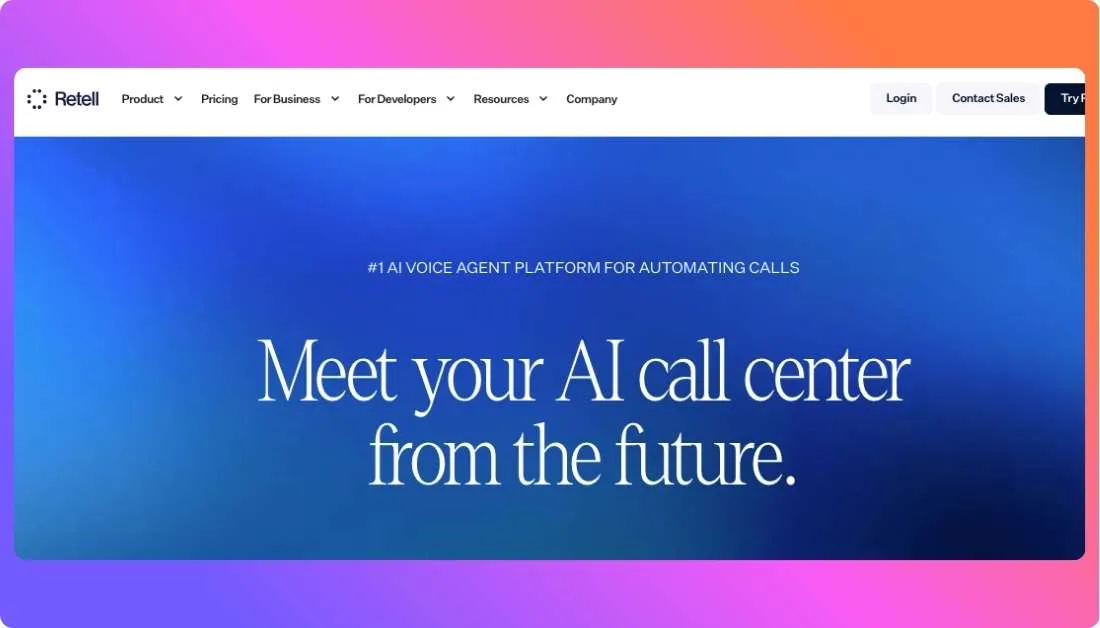
Let’s face it. Most voice AI platforms sound impressive in demos, but fall apart the moment you throw them into a real-world call center. Retell AI is different. It’s built specifically for businesses that want real-time voice agents that don’t just sound smart, but act smart under pressure.
What makes Retell stand out is how focused it is on real-time performance and post-call intelligence. Instead of just handling a conversation, it captures and breaks down what happened after each call. That means your team can learn, optimize, and keep improving without guesswork or clunky third-party tools.
Key Features & Benefits:
Handles live calls like a pro: With latency under 400ms and support for barge-ins (when a caller talks over the AI), it feels more like a natural human conversation, not a slow, robotic back-and-forth.
Built-in call summaries and analytics: Every call gets transcribed, tagged, and summarized automatically. You get instant visibility into what’s working and what needs tweaking without having to manually review recordings.
API-first design for full control: Developers can integrate Retell directly into their phone stack or product. From call routing to logging, everything is customizable.
Pricing:
Retell AI uses a pay-per-minute model, which is great for teams that want to scale at their own pace.
- Usage-based: Starting at $0.015/minute, with volume discounts as you grow
- Custom plans available for higher volume teams or enterprise rollouts with support and SLAs
Bottom Line:
Retell AI is ideal for fast-moving teams who want their AI voice agents to handle real conversations, not just scripted flows. If you care about call quality, live responsiveness, and insights you can act on immediately, Retell is a solid pick.
2. Vapi
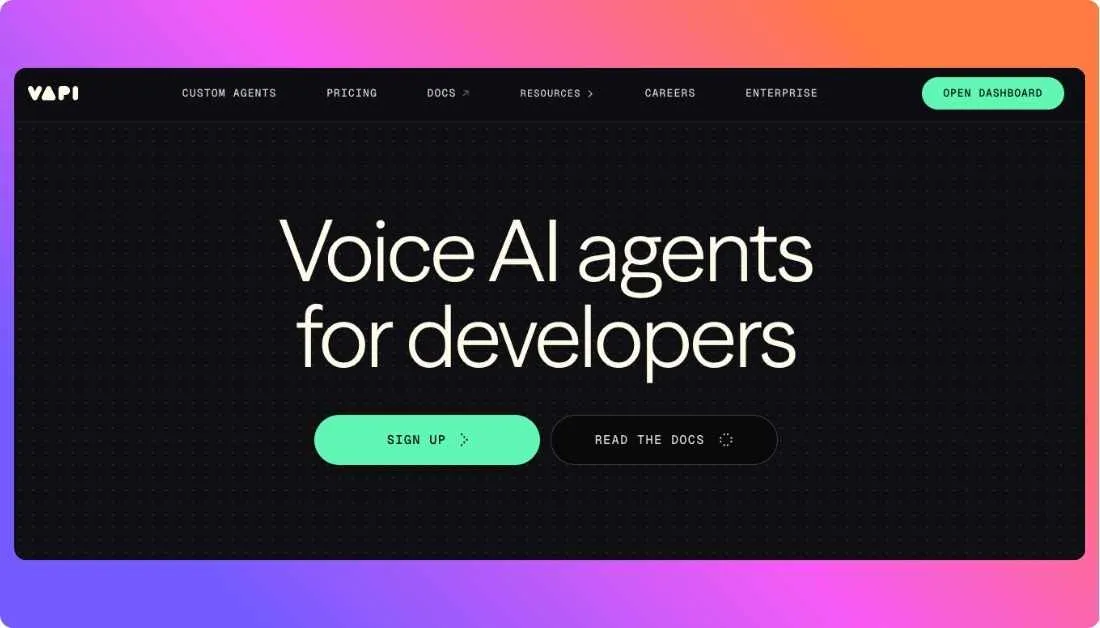
If you’re looking to build fully custom voice experiences with code-level control, Vapi is your tool. It’s built for developers who want to go beyond drag-and-drop builders and design voice agents that fit into their exact tech stack. While other tools give you templates, Vapi hands you the engine.
Key Features:
Built for Developers: Vapi is API-first, which means you can program everything from how it talks to when it transfers a call using simple REST calls.
LLM Flexibility: Plug in your own OpenAI, Anthropic, or other LLM keys and define how your agent behaves, thinks, and responds.
Streaming Voice Support: It doesn’t just wait for you to finish talking. Vapi streams audio in real time so your agent can interrupt, clarify, or respond as you speak, just like a human would.
Multichannel Ready: You can use it for phone calls, web widgets, or even integrate it into mobile apps. It’s not locked to one use case.
Pricing:
Vapi is priced on usage, which makes it flexible for testing or scaling.
- Free tier: 100 minutes and 50 conversations per month to test things out
- Paid plans: Starting at $0.02/minute, with volume-based discounts
- Custom pricing: For large-scale implementations with priority support
Bottom Line:
Vapi is ideal if you want total control over your AI voice agent and aren’t afraid to get technical. It’s fast, flexible, and developer-friendly. Perfect for startups building voice into their product or teams that need full customization without the bloat.
3. Synthflow
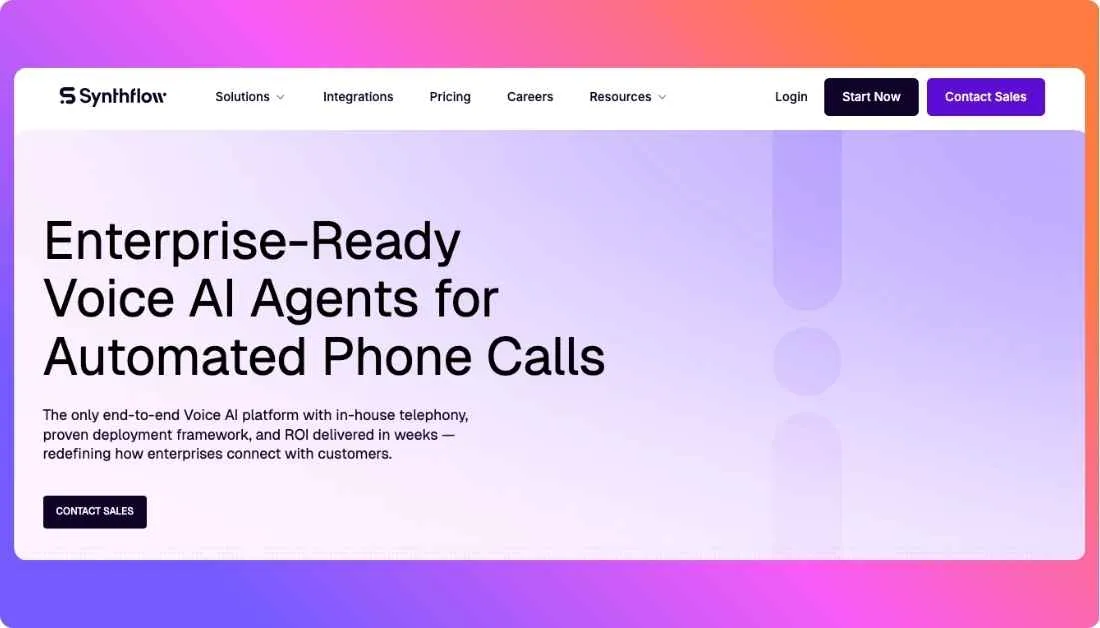
If you’re not a developer but still want to build powerful AI voice agents from scratch, Synthflow is your platform. It’s a true no-code builder that makes it easy to design, test, and launch custom voice agents in minutes. You don’t need to touch a single line of code.
What makes Synthflow stand out is its smooth editor, built-in voice cloning, and easy integrations. Whether you’re handling support calls, lead gen, or appointment booking, it gives you the tools to create something that sounds real and works reliably.
Key Features:
No-Code Visual Builder: Create conversation flows using a clean, drag-and-drop interface. Anyone on your team can build and iterate without technical help.
Voice Cloning: Upload samples and generate a voice that matches your brand. You can also choose from a library of natural-sounding voices.
Pre-Built Templates: Choose from use-case-specific blueprints like support agents, outbound sales, or booking assistants. Launch faster with less guesswork.
Zapier and Webhook Integrations: Easily connect your flows to CRMs, calendars, or internal systems without writing custom scripts.
Pricing:
Synthflow offers simple monthly pricing to match different use cases.
- Starter: $39/month with access to the builder and basic AI minutes
- Pro: $89/month with more minutes, voice cloning, and integrations
- Business: Custom pricing for high volume or advanced use cases
Bottom Line:
Synthflow is perfect for teams that want to move fast without a dev team in the loop. It gives you just enough power to build and launch voice agents that sound natural and get work done, without getting stuck in technical weeds.
4. Bland AI
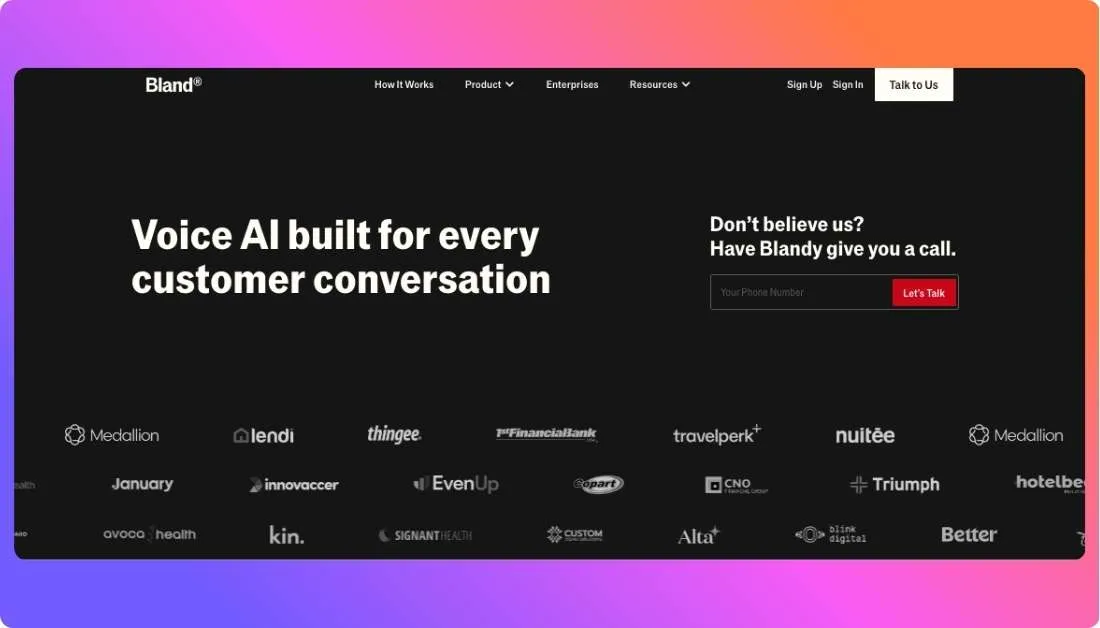
Sometimes you don’t need a huge platform with every feature under the sun. You just want an AI voice agent that can make phone calls, say what you tell it to, and get the job done. That’s where Bland AI comes in. It keeps things simple, and that’s its biggest strength.
Bland is all about fast, scalable outbound calling with a focus on performance and ease of use. You write a prompt, set up a number, and it starts dialing. It’s surprisingly effective for basic tasks like lead follow-ups, appointment reminders, or feedback calls.
Key Features:
Prompt-to-Call Setup: Just type what you want the AI to say, and it builds the voice logic for you. No complex flow editors or training data required.
Real Phone Numbers: Bland lets you use real US and international numbers so your calls look and feel legit to customers.
Real-Time API Access: Trigger calls programmatically from your app or CRM. It fits neatly into your existing workflows.
Built-in Call Logging: Track outcomes, listen to recordings, and monitor performance right from the dashboard.
Pricing:
Bland uses a pay-as-you-go model, making it great for teams that want control over usage.
- Pay-as-you-go: Starting at $0.015/minute
- Monthly plans available for high-volume callers with discounts and premium support
Bottom Line:
Bland AI is a great pick for straightforward outbound use cases. It’s not fancy, but it’s fast, reliable, and easy to plug into whatever you’re already doing. If you need to scale simple calls without the complexity, this is your tool.
5. PolyAI
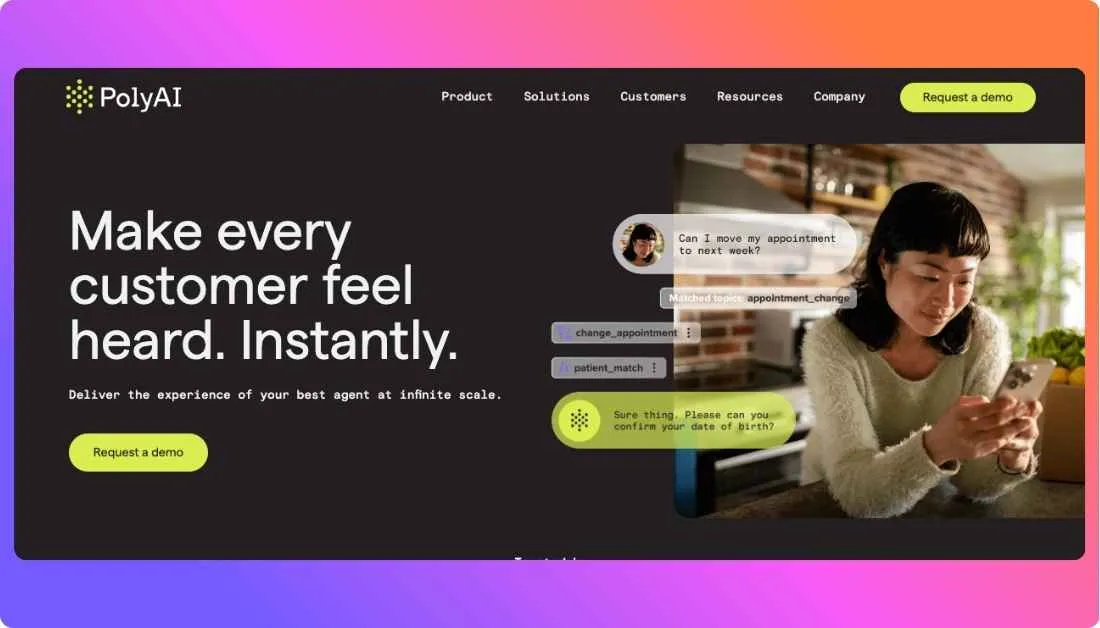
If your business runs at enterprise scale and you need voice agents that can hold complex conversations without sounding robotic, PolyAI is worth a serious look. It’s designed for customer service teams that need high-volume call handling with a human touch.
What sets PolyAI apart is the voice quality. It’s one of the few platforms where the AI actually sounds like someone you’d want to talk to. It can manage back-and-forth conversations, understand intent across multiple languages, and stay cool under pressure.
Key Features:
Near-Human Voice Quality: The conversations sound natural, even when customers ask unexpected questions or change topics mid-call.
Multi-Language Support: Built to handle global audiences, PolyAI can switch between languages or handle multilingual interactions in real time.
Deep Integrations: It works with your existing contact center stack and CRMs so you can pull in customer context, update records, and keep your data in sync.
Real-Time Escalation: If the AI gets stuck, it can instantly hand off to a human rep, making the transition feel seamless.
Pricing:
PolyAI is built for larger teams and custom deployments.
- Custom pricing only: Based on usage, integration depth, and support needs
- Pilot programs available for testing with limited volume before full rollout
Bottom Line:
PolyAI is made for companies that need enterprise-level voice automation without compromising on quality. If your customer experience depends on smooth, intelligent conversations at scale, this platform delivers.
6. Sierra
If you’re focused on sales, retention, or customer engagement, Sierra is built with your goals in mind. It’s not a generic voice bot platform, it’s designed specifically for teams that want voice AI agents that can guide, persuade, and convert.
Sierra takes a different approach by offering ready-made agents trained on proven conversation frameworks. You don’t need to build every detail from scratch. That makes it fast to launch and easy to measure success right away.
Key Features:
Sales-Centric Design: Built-in flows for outbound sales, onboarding, and re-engagement calls. The AI knows how to drive action, not just deliver info.
Behavioral Tuning: Sierra lets you adjust the tone and strategy of your agents, from friendly and casual to formal and direct.
Human-Like Recovery: If a conversation starts to go sideways, the AI can gracefully reset or pivot without sounding confused.
Live Handoff and CRM Sync: Qualified leads or complex questions can be handed to real reps with full context passed along.
Pricing:
Sierra offers pricing tailored to performance-driven teams.
- Custom pricing: Based on call volume, use case, and level of customization
- Free trial available with guided setup for qualified teams
Bottom Line:
Sierra is a strong choice for companies that want voice AI to drive results, not just save time. If your team is focused on conversations that close deals or build loyalty, this platform gives you the tools to make it happen.
7. Lindy
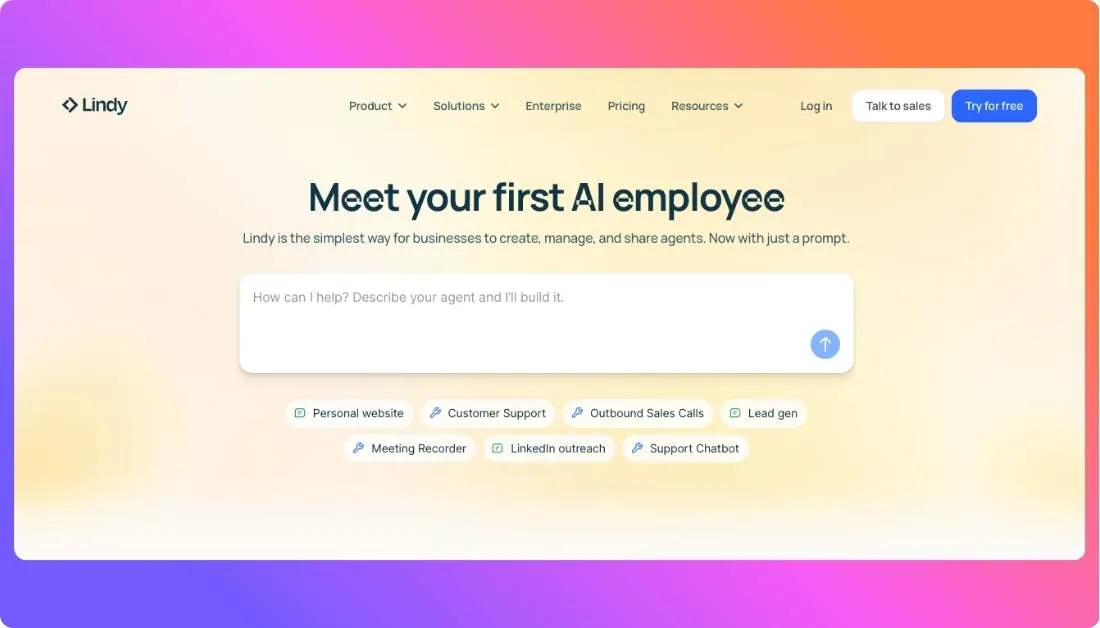
Lindy is for teams that want a voice agent that feels more like a smart coworker than a chatbot with a voice. It’s flexible, fast to set up, and designed to automate real business workflows without sounding robotic or stiff.
Unlike many tools that require heavy setup or dev involvement, Lindy is focused on usability. You can deploy agents that handle scheduling, support calls, follow-ups, and more all with a voice that sounds surprisingly human.
Key Features:
Natural Conversation Flow: Lindy agents can ask questions, handle interruptions, and follow multi-turn conversations without losing track.
Workflow Automation: It can take actions beyond just talking. Book meetings, log notes, route calls, or trigger events in your tools.
Fast Setup: Go from idea to live agent in a matter of hours, not weeks. No coding or technical background required.
Integrates with Your Stack: Easily connect to CRMs, calendars, ticketing systems, and more using built-in connectors or APIs.
Pricing:
Lindy keeps pricing simple and team-friendly.
- Starting at $150/month for core features and basic usage
- Custom plans available for higher volume or advanced automation needs
Bottom Line:
Lindy strikes a great balance between voice quality, speed, and ease of use. It’s a solid pick for businesses that want a reliable AI voice agent that gets to work quickly and feels like part of the team.

How to Choose the Right AI Voice Agent for You
Feeling a bit overwhelmed? Don’t worry. The right choice really just comes down to what you’re building and how much control you want over it.
If you’re a support or CX leader… and your goal is to automate call handling without a huge setup, Lindy and Retell AI are your best bets. They’re quick to launch, easy to train, and get the job done without needing engineering help.
If you’re a non-technical founder… and you want to build voice experiences fast without writing code, Synthflow gives you the flexibility to create custom flows using a visual builder. It’s ideal for lead gen, bookings, or simple customer interactions.
If you’re focused on outbound sales or retention… and you want voice agents that actually convert, go with Sierra. It’s purpose-built for driving results in customer conversations and doesn’t require you to design the flow from scratch.
If you’re a developer… and want complete control over logic, voice behavior, and APIs, Vapi gives you the freedom to build exactly what you want. You’ll love the customization and real-time streaming capabilities.
If you’re running a high-volume contact center… and need quality at scale with multilingual support, PolyAI offers the most enterprise-ready solution with voice quality that can handle complex conversations and global customers.
If you just need simple AI calls at scale… and don’t want to mess with anything complicated, Bland AI keeps things easy. It’s perfect for high-volume outbound tasks like reminders, updates, or basic follow-ups.
Frequently Asked Questions
AI voice agents can answer calls, book appointments, qualify leads, troubleshoot customer issues, and even escalate complex cases to a human. They’re like digital team members that never sleep, never forget a script, and can handle dozens of calls at once.
It depends on the platform and setup, but the best ones handle natural speech surprisingly well. Tools like PolyAI and Retell AI support barge-in, understand accents, and can keep up with real-time back-and-forth. It’s not perfect, but it’s getting close.
Not at all. Platforms like Synthflow and Lindy are designed for non-technical users. You can build full voice flows with visual editors, prebuilt templates, and no-code tools. That said, if you’re a developer, platforms like Vapi give you way more control under the hood.
Not exactly. They’re great for handling repetitive or routine tasks, but for emotionally sensitive or high-stakes conversations, you still want a human. The best approach is a hybrid one, use AI to handle the bulk and let humans step in when it matters.
Yes, and they’re important to take seriously. Make sure the tool you choose follows local regulations (like GDPR or TCPA) and offers proper consent and call recording options. Most reputable platforms build these protections by default.
If you’re just getting started and want something simple and affordable, Bland AI or Synthflow are solid picks. They’re easy to set up, don’t require technical skills, and won’t blow your budget.
Start with your goal. Do you want to automate support? Run outbound sales? Qualify leads? Then match that with the right tool. Lindy is great for support automation, Sierra shines in sales conversations, and Vapi works best when you want to build something custom.