AI in Smart Homes: How Artificial Intelligence Is Transforming Everyday Living
Key Takeaways
- AI is transforming smart homes from rule-based automation into adaptive systems that learn habits, anticipate needs, and personalize everyday living.
- Key use cases include intelligent climate control, lighting optimization, predictive appliance maintenance, smart security, and routine automation.
- AI-driven energy management helps reduce costs and environmental impact by optimizing heating, lighting, appliance usage, and solar integration.
- Modern smart home security relies on AI-powered anomaly detection to reduce false alarms and improve real-time threat awareness.
- Challenges such as privacy risks, bias, limited contextual understanding, and regulatory uncertainty must be addressed for responsible adoption.
- With the right strategy and integration, AI-powered smart homes deliver safer, more efficient, and highly personalized living experiences.
With artificial intelligence becoming more deeply woven into our daily lives, it’s no surprise that our homes are getting smarter too. From voice-controlled lights to energy systems that learn your routine, AI is quietly transforming how we live, move, and relax at home. And the shift is accelerating fast. The global smart home market is expected to grow from about $127.8 billion in 2024 to $537.3 billion by 2030, rising at a 27% CAGR, showing just how rapidly this technology is reshaping everyday living.
This article explores the relationship between AI and smart homes, breaking down how this technology is reshaping modern living. You’ll discover real-world examples, practical use cases, and a clear view of what AI-powered home automation looks like today and where it’s headed next.
Understanding the Role of AI in Smart Homes
Artificial intelligence, at its core, relies on technologies like machine learning (ML), natural language processing (NLP), and computer vision. While smart home devices have been around for years, AI takes them to the next level by allowing systems to not only respond to commands but to anticipate needs, recognize patterns, and learn from behavior over time.
So, what makes AI in smart homes different from traditional automation? Instead of pre-set routines or one-way controls, AI systems use real-time data and adaptive algorithms to personalize the experience. They can detect your habits, adjust settings accordingly, and even predict future preferences. For example, a smart thermostat powered by AI won’t just follow a schedule. It learns when you’re home, what temperatures you prefer, and adjusts automatically.
This level of adaptability is what gives AI its edge in the home. It understands context, learns continuously, and delivers an experience that feels both intuitive and seamless.
Now that we’ve got a solid understanding of how AI functions in a smart home setting, let’s look at the key technologies and components that make it all work behind the scenes.
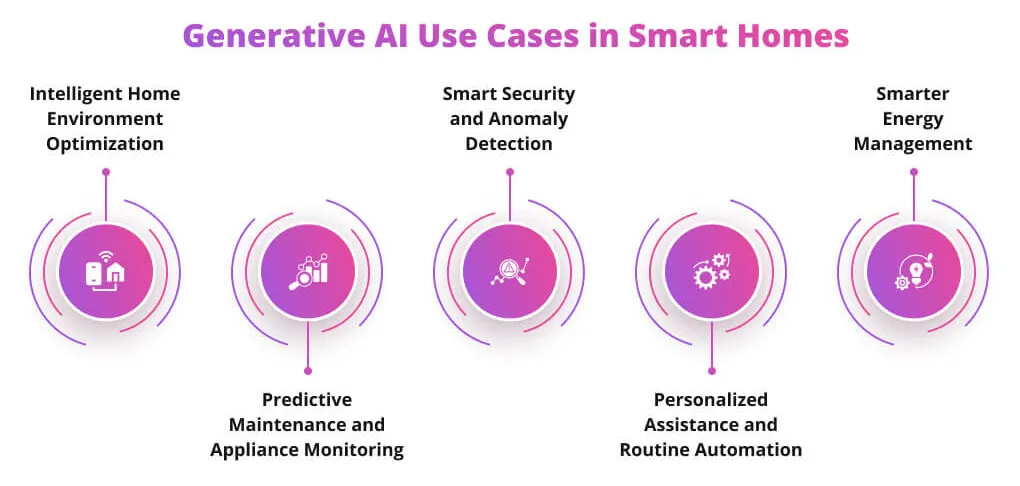
Generative AI Use Cases in Smart Homes
AI is steadily reshaping how smart homes function by making them more adaptive, responsive, and personalized. Instead of reacting only to direct commands, modern AI-powered systems can learn from context, past behavior, and real-time data to make thoughtful adjustments and suggestions. The result feels less like managing a collection of gadgets and more like living in a home that understands you.
This shift is happening globally. While North America continues to lead in adoption, countries across Europe and Asia are also investing in AI-driven home automation. In many connected households today, AI assistants are already managing lighting, temperature, security, and entertainment with little need for manual input. Some platforms even take it a step further by automating daily routines, learning over time, and making smarter decisions based on how you actually live.
In the sections below, we explore some of the most practical and impactful AI use cases in smart homes and how they’re improving everyday living in ways that feel seamless and intuitive.
1. Intelligent Home Environment Optimization
AI technology is at the heart of creating more comfortable, efficient living spaces. Instead of relying on fixed schedules or basic automation, AI systems learn from your routines and adjust your environment in real time.
Climate Control:
Behavior-Based Adjustments: AI-powered thermostats track your daily patterns and adjust heating or cooling automatically, keeping you comfortable while reducing energy waste.
Weather-Aware Settings: These systems also factor in outdoor conditions and adjust indoor temperatures before the weather changes.
Lighting Systems:
Natural Light Coordination: AI can detect ambient sunlight and dim or brighten interior lighting to match your preferences throughout the day.
Mood-Based Scenes: It can generate lighting moods based on your activities, such as reading, cooking, or relaxing, without requiring manual input.
Air Quality and Ventilation:
Sensor-Based Airflow: AI can monitor indoor air quality and adjust air purifiers or fans to maintain a healthy atmosphere.
Routine Integration: It can sync ventilation systems with your daily schedule, ensuring fresh air when you’re home and saving power when you’re not.
With AI constantly learning and adapting, your home environment becomes more responsive, more efficient, and easier to live in without needing constant attention.
2. Predictive Maintenance and Appliance Monitoring
One of the most practical benefits of AI in smart homes is its ability to monitor appliances and detect issues before they turn into problems. These systems help reduce costly breakdowns and unexpected failures by spotting early warning signs through pattern recognition and sensor data.
Appliance Performance Tracking:
Usage Pattern Learning: AI tracks how your devices typically operate and notices any unusual changes in performance.
Early Warning Alerts: If your dishwasher starts taking longer cycles or your fridge uses more power than normal, the system flags it and suggests next steps.
Maintenance Recommendations:
Task Generation: Based on wear and tear, AI can remind you to clean filters, service equipment, or check for possible part replacements.
Automatic Scheduling: In some systems, AI can connect directly with service providers or maintenance apps to help you set up repairs or inspections quickly.
Energy Efficiency Monitoring:
Optimized Usage: AI ensures that appliances only run when needed, reducing energy waste and helping them last longer.
System Coordination: When devices are connected, AI can balance their operation to avoid overloading circuits or wasting power.
This kind of predictive support gives homeowners peace of mind. Your appliances run better, last longer, and you avoid costly surprises.
3. Smart Security and Anomaly Detection
AI has redefined what home security looks like. Instead of simply reacting to motion, modern systems learn what’s typical around your home and alert you only when something seems out of place. This reduces false alarms and improves response accuracy.
Cameras and Motion Detection:
Behavioral Learning: AI can tell the difference between expected movement, like kids coming home from school, and unusual activity like someone approaching the house at night.
Contextual Alerts: You get notifications only when the system detects something out of the ordinary, not every time a leaf blows across the driveway.
Threat Identification:
Pattern Recognition: AI can detect recurring suspicious behavior, like the same unfamiliar vehicle passing by repeatedly.
Sound and Visual Analysis: Some systems combine sound and video data to identify breaking glass, forced entry, or voices when no one should be home.
Proactive Deterrence:
Simulated Presence: AI can activate lights, blinds, or sound systems while you’re away to mimic normal activity and deter intruders.
Real-Time Communication: AI-enabled systems can sync with smart doorbells or intercoms, letting you engage with visitors instantly, even when you’re not home.
AI doesn’t just react. It pays attention, learns what’s normal, and helps you stay ahead of potential security issues with a more thoughtful, less intrusive approach.
4. Personalized Assistance and Routine Automation
AI-powered systems play a big role in personalizing everyday routines, making the smart home feel less like a gadget and more like an attentive assistant. By learning behavior patterns and responding to real-time data, AI can automate repetitive tasks and create experiences that match your lifestyle.
Morning Routines:
Dynamic Wake-up Sequences: AI systems can gradually brighten lights, start the coffee maker, and play your preferred playlist based on your usual wake-up time and habits.
Calendar-Aware Adjustments: The system can scan your calendar and adjust the home environment accordingly, optimizing lighting and temperature to help you stay focused or energized.
Evening and Entertainment:
Adaptive Lighting and Audio Scenes: AI can learn your evening preferences and automatically adjust lighting, blinds, or sound systems to match your mood or activity.
Content Recommendations: Based on your past choices and time of day, AI can suggest TV shows, music, or podcasts tailored to your taste.
Behavior-Based Learning:
Routine Evolution: If your habits shift, such as waking up later on weekends or changing workout times, AI adapts without needing to be reprogrammed.
Scenario Generation: The system can create custom routines based on location, occupancy, and other contextual factors.
These capabilities make everyday living feel smoother and more responsive. You don’t need to micromanage every device. Instead, AI takes over the small stuff while keeping you in control of the big picture.
5. Smarter Energy Management
AI is becoming essential in managing home energy use more efficiently. Instead of relying on fixed schedules or manual input, AI systems learn your daily patterns, track real-time usage, and adjust settings to reduce waste while maintaining comfort.
Heating and Cooling:
Behavior-Based Scheduling: AI adjusts the thermostat based on when you’re usually home, asleep, or away, instead of following a rigid timer.
Weather Integration: The system can use local weather forecasts to optimize heating or cooling in advance, saving energy without sacrificing comfort.
Lighting and Electronics:
Occupancy Detection: AI can turn off lights or appliances when rooms are empty, then reactivate them when someone enters.
Energy Scene Creation: Based on natural light, time of day, and usage trends, AI can optimize lighting setups to reduce energy consumption.
Smart Grid and Solar Coordination:
Peak Load Management: AI can shift high-energy tasks like charging devices or running laundry machines to off-peak hours when electricity is cheaper.
Solar Power Optimization: For homes with solar panels, AI can decide when to store energy, use it, or send it back to the grid depending on usage and production patterns.
Benefits for Homeowners
With AI handling the adjustments, homes can lower utility costs and minimize their environmental impact without sacrificing convenience. Over time, these systems continue learning and fine-tuning energy decisions, making smart living more sustainable and cost-effective.
Challenges of Leveraging AI in Smart Homes
Even with all the benefits AI brings to smart home living, it’s important to recognize that the technology has its limitations. As with any evolving system, there are gaps that need to be addressed for it to be fully reliable, safe, and accepted at scale. Here are a few of the key challenges:
Limited contextual understanding
Most consumer-facing AI tools are trained to respond based on patterns in data, not real-world nuance. In some cases, this leads to misinterpretations. For example, an AI might turn off lights or adjust the temperature at the wrong time because it doesn’t understand why someone broke their usual routine.
Bias in facial and motion detection
AI-based security systems and recognition tools may reflect biases based on the data they were trained on. If the dataset lacks diversity, facial recognition might fail to identify people accurately across different skin tones or facial structures. This can lead to false alarms or inconsistent performance across households.
Inaccurate predictions and false positives
While AI is designed to learn and improve, it still makes mistakes. Anomalies in home activity like a guest staying over or a pet moving unexpectedly can confuse the system. This might trigger unnecessary alerts or override user preferences.
Difficulty with complex scenarios
AI handles repetitive or predictable routines well. But more complex human behaviors like hosting a dinner party, managing multiple guests, or shifting sleep schedules due to illness can throw it off. The system may struggle to adapt quickly without manual intervention.
Privacy concerns
Smart homes generate a lot of personal data. From movement and voice patterns to appliance usage and camera footage, all of this information can become a privacy risk if not properly protected. Consumers worry about where their data is stored, how it’s used, and who has access to it.
Lack of emotional intelligence
AI can adjust lighting, control music, and manage appliances, but it can’t read emotions or sense tone. For example, if someone’s feeling unwell or stressed, the system won’t automatically respond with care unless it’s explicitly programmed to. This makes the experience feel efficient but not always emotionally aware.
Regulatory uncertainty
As AI in smart homes becomes more mainstream, regulatory bodies are starting to pay closer attention. New laws focused on data privacy, facial recognition, and AI ethics are emerging in different parts of the world. Staying compliant with these evolving regulations can be both complex and costly for smart home tech developers and platforms.
Start With AI in Smart Homes Industry
Now that you’ve seen the benefits and limitations of using AI in smart homes, you might be wondering how to actually begin integrating it into your products, services, or daily living systems.
AI in smart homes isn’t just about automating tasks. The real value comes from creating experiences that feel personalized, intuitive, and responsive, while also opening up opportunities for innovation and growth.
If you’re a homeowner, tech provider, or smart systems developer looking to leverage AI for home automation, you’re in the right place. Prismetric is an expert in developing AI-driven automation services and integration solutions that help businesses and individuals bring smart home visions to life. From custom AI models and intelligent agents to seamless integration with existing devices, Prismetric builds solutions tailored to your unique goals.
Prismetric’s AI services cover everything from initial strategy and design to deployment and ongoing optimization. This includes:
- AI solution development that brings smart decision-making to connected devices and systems
- Intelligent automation and workflow integration that reduces manual intervention and enhances system responsiveness
- Data science, machine learning, and advanced analytics to help your AI system learn from real usage patterns and improve over time
- End-to-end AI support from proof of concept to production, ensuring your project works smoothly in real environments
Whether you’re a startup experimenting with next-gen smart home apps or an established tech provider looking to expand your AI capabilities, Prismetric has the tools and expertise to help you begin your AI journey confidently and effectively.
Conclusion
AI is quietly but powerfully changing the way we live at home. From personalized comfort and energy efficiency to smarter security and predictive maintenance, it’s making everyday life easier, safer, and more responsive without demanding our constant attention.
As technology continues to evolve, the smartest move is to start exploring how AI can fit into your home or product strategy today. Whether you’re a homeowner looking for convenience or a tech company building the future, the potential is already here and growing fast.