How to Hire LLM Developers in 2026: Skills, Costs, and Best Practices

Key Takeaways
- With 67 percent of organizations using LLMs, hiring skilled LLM developers is now essential for real-world AI impact.
- Defining clear goals, success metrics, and required capabilities helps teams avoid mismatches and hire with confidence.
- The right hiring model whether full-time, freelance, or agency depends on project scope, speed needs, and in-house expertise.
- Strong LLM developers go beyond prompts, bringing skills in RAG, fine-tuning, vector databases, and production deployment.
- Soft skills matter as much as technical depth; clear communication and adaptability shape long-term project success.
- LLM developer costs vary widely, but senior and specialized talent deliver the fastest ROI for complex AI initiatives.
As we jump into 2026, it feels like everything around us is suddenly powered by language models. Not long ago, tools like GPT and Claude were cool experiments. Today, most companies depend on them to automate support chats, generate content, or level up internal workflows. That shift has huge consequences for teams building real-world products.
Right now, about 67% of organizations worldwide are using LLMs as part of their operations, and that number is climbing fast as more industries embrace what generative AI can do.
But here’s the thing: the tech is only half the story. Models, APIs, and open source code are everywhere. What actually drives impact, the kind that moves the needle on revenue or efficiency, is the people building, tuning, and maintaining them.
That’s where hiring Prompt Engineering stops being a nice-to-have and becomes mission critical. You can roll out a pre-built chatbot in an hour, sure, but if you want something that truly understands your workflows, your data, and your business goals, you need developers who speak both AI and real-world needs.
This guide is your roadmap for finding those people. The ones who won’t just plug in an off-the-shelf AI model, but will help you build a custom generative AI solution you can count on.
Hire LLM Developers Who Can Build Beyond Basic Prompts
Work with Prismetric developers skilled in RAG, fine-tuning, vector databases, LLM integration, evaluation, and production deployment.
Hire LLM Developers
How to Hire LLM Developers: Step-by-Step Guide and Common Mistakes to Avoid
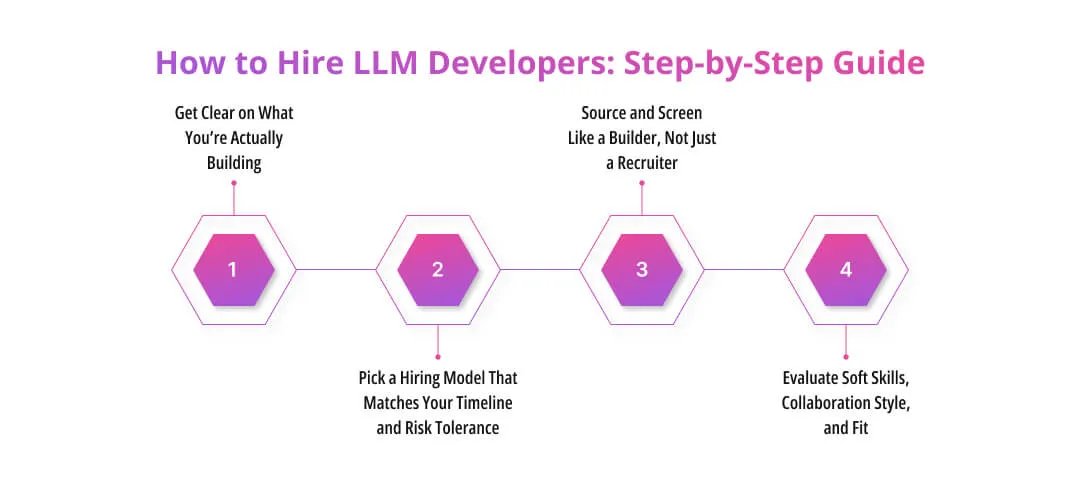
1. Get Clear on What You’re Actually Building
Before jumping into job posts or interviews, hit pause and define the problem you’re solving with language models. This single step can save you weeks of wasted effort and mismatched hires.
For example, if you’re building a chatbot that integrates with your internal systems, you’re not just looking for someone who knows prompts. You need someone who understands APIs, user context, and when to use RAG or fine-tuning with the right guardrails. Or, maybe your goal is to pull insights from a massive knowledge base. In that case, you’ll want a developer with experience setting up retrieval-augmented generation (RAG), vector databases, and semantic search.
This kind of clarity helps you figure out which skills to prioritize, what seniority level makes sense, and even what kind of collaboration model works best.
Pro tip: Don’t forget to define what success looks like. A lot of teams hire fast and then wonder whether the person they brought on is actually “doing well.” You can avoid that by turning your goals into trackable outcomes. For instance:
- Lower response time by 30% in your AI assistant
- Boost knowledge base retrieval accuracy to 90%+
- Cut hallucination rate by half within the first two months
Now you’re not guessing. You’re managing with clear expectations.
2. Pick a Hiring Model That Matches Your Timeline and Risk Tolerance
Once you know the problem you’re solving and the kind of talent it requires, the next step is choosing the right hiring model for bringing that talent in. Do you need to hire generative AI engineers full-time or part-time, work with a freelancer, or go through an agency? If location is flexible, hiring remote developers can also broaden the talent pool.
This usually depends on three things:
- How fast you need results
- How much budget flexibility you have
- Whether someone on your team can steer or validate the work
Let’s say LLMs are a core part of your product. Maybe you’re building a learning tool or a smart assistant baked into your SaaS. In that case, hiring in-house gives you long-term ownership and deeper alignment. Yes, it’ll take more time up front, but it pays off with speed and focus down the road.
If you’re just running an experiment or automating a specific task like summarizing customer feedback or auto-generating ticket replies, a freelancer could be the right fit. You get speed and agility without long-term commitment.
On the flip side, if your project spans multiple layers, you may need data engineering services for data preparation and machine learning development services for model customization. Production rollout may also require AI implementation services. And if you don’t have strong AI leadership in-house, working with an LLM-focused development firm might be the safest bet. The upfront cost is higher, but so is the chance of getting it right the first time.
3. Source and Screen Like a Builder, Not Just a Recruiter
Now that you’ve nailed the scope and selected a hiring model, it’s time to actually find your LLM dev. This is where most teams start and where many go off-track.
Here’s the thing: plenty of people can run a notebook and call an OpenAI API. Fewer can design full LLM workflows, embeddings, and orchestration and push reliable systems into production. So don’t stop at resumes.
Dig deeper. Look at what they’ve built. Have they contributed to open-source projects on Hugging Face? Do they have a GitHub history that shows more than toy examples? Have they shared Jupyter notebooks with actual data pipelines or performance benchmarks?
And when you talk to them, don’t just ask technical questions. Ask about the last project where they shipped something real. How did they make model choices? How did they handle unexpected behavior in outputs? What trade-offs did they have to make for latency or cost?
This tells you how they think, how they balance ideal outcomes with real-world constraints, and whether they can build enterprise-grade AI systems that won’t break under load.
4. Evaluate Soft Skills, Collaboration Style, and Fit
At this point, you probably know they can do the work. Now the question is: will they work well with your team?
This part is easy to skip, but it’s just as important as the technical stuff. You want someone who’s not just smart, but also easy to work with. Someone who communicates clearly, asks the right questions, and adapts as things evolve.
Watch how they engage in your conversations. Do they share updates early instead of going dark? Can they explain technical decisions without hiding behind jargon? Do they adjust when goals or data shift mid-project? For distributed teams, a strong remote work culture makes these habits easier to sustain.
Set expectations up front so everyone knows what a “win” looks like. The smoother the onboarding and collaboration, the faster you’ll see results.
Also Read: How to Hire AI developers
Need LLM Expertise Without Building a Full In-House Team?
Prismetric lets you hire individual LLM specialists or a dedicated team based on your project scope, timeline, and technical needs.
Build Your LLM Team
Skills and Capabilities to Prioritize When Hiring LLM Developers
Hiring someone who can prompt ChatGPT is easy. Hiring someone who can build reliable, scalable, and context-aware language systems? That’s a whole different game.
Here’s a breakdown of the skills and capabilities that matter most when hiring LLM developers. These go way beyond the surface-level stuff and focus on what separates average from excellent.
| Skill Area |
What to Look For |
Why It Matters |
| Model Understanding |
Familiarity with transformer architecture, tokenization, and LLM limitations |
Helps them choose the right model and avoid common issues like context loss or hallucinations |
| Prompt Engineering |
Ability to write, test, and iterate on prompts with precision and intent |
Crafting effective prompts is core to performance, especially when using APIs like OpenAI or Claude |
| Fine-Tuning & Custom Training |
Experience fine-tuning models on domain-specific data |
Boosts relevance and accuracy of outputs in your specific business context |
| Vector Databases & RAG |
Hands-on with tools like Pinecone, Weaviate, or FAISS |
Retrieval-Augmented Generation is key to making LLMs useful beyond their base training |
| Data Preprocessing |
Skills in cleaning, chunking, and embedding unstructured data |
Better input data leads to better model performance garbage in, garbage out |
| LLM Tooling Ecosystem |
Experience with LangChain, LlamaIndex, or similar frameworks |
These tools speed up development and reduce reinventing the wheel |
| Deployment & Scaling |
Comfortable with Docker, Kubernetes, and cloud infra (AWS, GCP, Azure) |
You need someone who can get the system live and keep it reliable under real usage |
| Evaluation & Monitoring |
Knows how to measure output quality, latency, cost, and failure cases |
Monitoring LLMs in production isn’t optional it’s critical for trust and stability |
| Security & Privacy |
Understands risks around data leakage and PII in prompts or logs |
Especially important in healthcare, finance, and customer service use cases |
| Cross-Team Communication |
Can explain technical decisions to product, ops, or leadership teams |
Collaboration saves time and ensures the solution actually fits the business need |
What is the Cost of Hiring LLM Developers in 2026?
Below is a practical breakdown of typical costs for hiring LLM talent in 2026 in US dollars. These are general ranges based on industry surveys and hiring data from current market benchmarks, aggregated across regions and hiring types. For broader project budgeting, generative AI development cost and overall AI development cost can help explain how architecture, infrastructure, integrations, and deployment affect total spend beyond developer compensation.
| Role |
Annual Full-Time Salary (USD) |
Hourly Contract / Freelance Rate (USD) |
| Junior LLM Developer (1–2 yrs) |
$70,000 – $100,000 |
$50 – $90 / hr |
| Mid-Level LLM Developer (3–5 yrs) |
$100,000 – $150,000 |
$80 – $140 / hr |
| Senior LLM Developer (5+ yrs) |
$150,000 – $220,000 |
$120 – $200 / hr |
| Lead / Architect LLM Engineer |
$220,000 – $300,000+ |
$180 – $250 / hr |
| Specialized LLM Consultant (RAG, Agents, Production) |
$180,000 – $280,000+ |
$150 – $300 / hr |
How to Interpret These Costs
- Junior Developers are great for straightforward tasks like prompt engineering, simple integrations, or supporting senior staff. They usually require mentoring and oversight.
- Mid‑Level Developers can take ownership of components, tune models, and help build pipelines that move toward production quality.
- Senior Developers bring system design skills, deep knowledge of backbone tools like vector databases and RAG workflows, and reliability for production‑grade deployments.
- Leads and Architects are the specialists who shape your entire LLM strategy, from infrastructure to governance and scaling.
- Specialized Consultants often command premium rates because they bring rare skills that solve high‑impact problems quickly.
Why Partner with Prismetric for Hiring LLM Developers?
Hiring the right LLM developer isn’t just about finding someone who can prompt ChatGPT. You need people who understand real-world problems, can fine-tune models to your data, and build systems that actually perform in production. That’s exactly where Prismetric fits in.
With over 15 years of experience in AI and custom software development, Prismetric brings more than just technical skills. Their team understands how to turn business goals into working LLM solutions. Whether you’re building a chatbot, setting up a RAG pipeline, or integrating AI into your SaaS platform, they’ve likely done something similar before.
They also offer flexible engagement models, so you can bring in a single expert or a full development team depending on your needs. And unlike many dev shops, they focus on clarity and transparency, which makes collaboration smooth and predictable.
Turn Your LLM Idea Into a Production-Ready Solution
From RAG pipelines and fine-tuning to AI agents and integrations, Prismetric helps you move from concept to a scalable LLM application.
Talk to Our LLM Experts
Final Thoughts
Hiring the right LLM developer who can provide LLM fine tuning services or solutions development isn’t just about checking off technical boxes. It’s about finding someone who understands your problem and can build something that actually works in the real world. The better the fit, the faster you’ll see results.
Whether you’re scaling a product or experimenting with AI for the first time, getting the right talent makes all the difference. Take your time, define what you need, and partner with people who truly get it. That’s how you build something that lasts.