What Are Agent Swarms and How Do They Work? A Practical Enterprise Guide
Key Takeaways
- Agent swarms bring multiple specialized AI agents together to work toward one shared business or technical goal.
- Each agent handles a defined role, such as planning, research, execution, analysis, or validation, instead of one agent managing the entire task.
- Agents can exchange context, use connected tools and data, hand work to one another, and complete independent tasks in parallel.
- This collaborative approach can help with complex workflows, but it also increases model usage, coordination overhead, latency, security risks, and governance needs.
- A swarm makes the most sense when specialization and coordinated work provide clear value over a single agent or simpler automation.
AI agents are starting to move beyond standalone tasks toward systems where several specialized agents work together. Gartner predicts that 40% of enterprise applications will include task-specific AI agents by the end of 2026, up from less than 5% in 2025. It also predicts that one-third of agentic AI implementations will combine agents with different skills by 2027. These forecasts show why collaborative agent architectures are becoming an important part of enterprise AI.
An agent swarm applies this idea by dividing a larger objective among agents with different responsibilities. For example, one agent can research a market, another can analyze the findings, and a third can check the final output before it reaches a human reviewer. This structure can make complex, divisible work easier to manage, but only when the gains from specialization and coordination justify the added cost and complexity.
See Where an Agent Swarm Can Actually Add Value
Prismetric helps assess whether your workflow truly needs multiple specialized agents or can be solved more efficiently with a simpler architecture.
Assess Your Agent Swarm Use Case
What Are Agent Swarms?
An agent swarm is a group of specialized AI agents that work toward one shared goal. Instead of asking one agent to plan, research, act, and review everything, the system divides the work across agents with different roles, tools, or areas of focus.
Consider market research. One agent can collect competitor data, another can study pricing, and a third can check whether the findings are supported before a final report is produced. This type of role-based collaboration appears across many agentic AI use cases.
Agent swarms belong to the broader family of multi-agent systems, but the terms are not exact synonyms. A multi-agent system only requires several agents to operate within the same environment or workflow. A swarm puts more emphasis on coordination, handoffs, and shared work. IBM also notes that swarms can use centralized, hierarchical, or decentralized coordination, so a swarm does not have to be fully peer-to-peer.
A useful way to separate the concepts is:
- Single AI agent: One agent handles most planning and execution.
- Multi-agent system: Several agents perform different tasks, but they may not collaborate closely.
- Agent swarm: Several specialized agents actively exchange work, information, or feedback to complete one larger objective.
This distinction also helps when comparing AI chatbots, AI agents, and LLM applications. A chatbot mainly responds to requests. An agent can plan actions and use tools. A swarm adds another coordination layer by allowing several agents to contribute to the same outcome.
Not every business needs that extra layer. A narrow, predictable workflow may work better with one agent or conventional automation. Organizations with specific data, security, or integration requirements may first compare custom AI with off-the-shelf AI. When a use case genuinely needs custom roles, tools, permissions, and orchestration, an AI agent development company can help design the system around the business process.
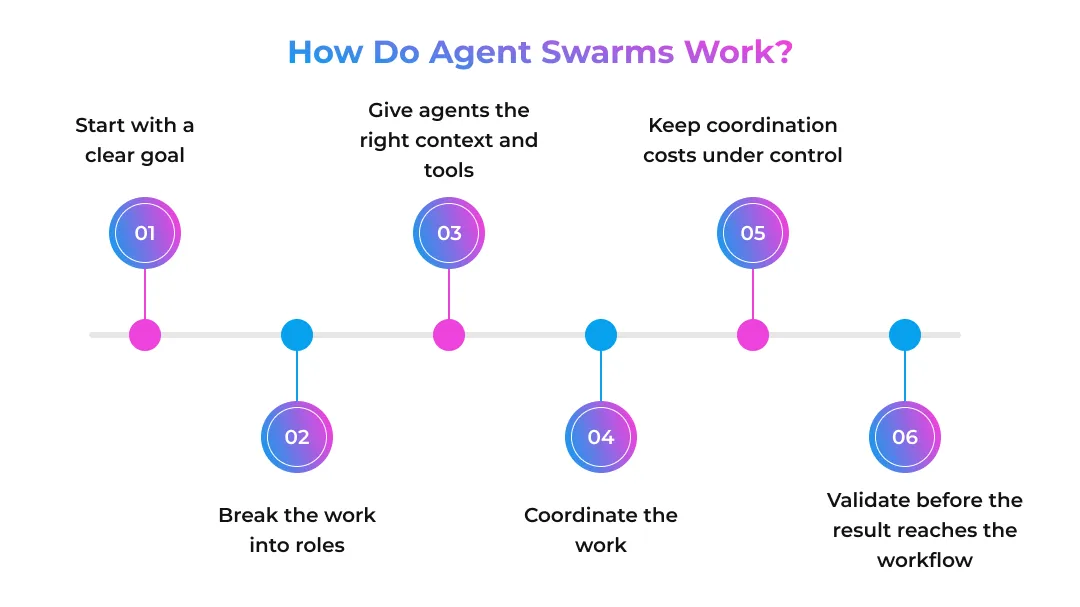
How Do Agent Swarms Work?
Agent swarms work by turning one larger objective into coordinated pieces of work. The system decides what needs to happen, assigns tasks to suitable agents, gives them the right context and tools, and brings their outputs back together.
Goal → task breakdown → specialist agents → shared context and tools → coordination → validation → final output
1. Start with a clear goal
The swarm needs a defined outcome, constraints, and success criteria. “Research a new market” is broad; “compare five competitors on pricing, product scope, customer segments, and recent expansion” gives the agents clearer boundaries.
2. Break the work into roles
A planner or orchestration layer separates the goal into tasks. A research workflow might use:
- a planner to decide what information is needed;
- several agents to investigate different sources in parallel;
- a reviewer to check evidence and combine the findings.
Teams often learn more by building an individual AI agent first and adding specialists only when one agent becomes overloaded or different tools are clearly needed.
3. Give agents the right context and tools
Agents need enough information to complete their work, but not every agent needs the full workflow history. A researcher may only need the question and source criteria, while a reviewer may need outputs from all research agents.
Retrieval-augmented generation can supply approved business knowledge when needed. Companies may alsocconnect LLMs with enterprise databases or usecModel Context Protocol (MCP) to give agents structured access to tools and systems.
Weak data can affect the whole swarm. Stale records, inconsistent permissions, or poor retrieval can cause several agents to repeat the same mistake.
4. Coordinate the work
There is no single coordination pattern that fits every swarm:
- Sequential: One agent finishes before another starts.
- Parallel: Independent agents work at the same time.
- Hierarchical: A supervisor delegates work to specialists.
- Peer-to-peer: Agents hand work directly to one another.
A swarm can combine these patterns. Three research agents may work in parallel, pass their findings to an analyst, and then send the result to a reviewer. The supporting LLM application technology stack needs to track state, messages, tool calls, and failures across those handoffs.
5. Keep coordination costs under control
Adding agents can improve coverage on suitable tasks, but it also increases model calls, context processing, and tool usage.
| Cost Driver |
Why Cost Grows |
Practical Control |
| More agents |
Each agent makes separate model calls |
Add agents only where specialization helps |
| Shared context |
Information may be processed repeatedly |
Send only task-relevant context |
| Tool/API calls |
Search and external systems add usage |
Set limits and reuse results |
| Review loops |
Critiques and retries create more calls |
Use retry limits and acceptance rules |
| Larger models |
Stronger models often cost more per call |
Route simpler tasks to smaller models when testing supports it |
Research signal: Anthropic reported that its multi-agent research system outperformed a single-agent Claude Opus 4 setup by 90.2% on its internal research evaluation. That result is specific to a research workload, but it shows why parallel specialization can help when a problem can be divided into independent paths.
The performance gain also came with a cost trade-off. Anthropic reported that its multi-agent systems used about 15 times more tokens than ordinary chat interactions. This does not mean every swarm will have the same cost profile, but it shows why businesses need to compare the value of better coverage with the extra compute required.
6. Validate before the result reaches the workflow
The final stage should check the agents’ work rather than accept every output automatically. Reviewer agents, rule-based checks, confidence thresholds, or human approval can catch problems before the system takes an important action.
For example, a financial analysis swarm may collect and compare data automatically while keeping transaction approval with a person. Teams can also compare prompt engineering, fine-tuning, and RAG when an agent needs better instructions, current knowledge, or more specialized behavior.
In production, monitoring should track handoff failures, tool errors, latency, retries, model usage, and final task success. The goal is not to maximize the number of agents. It is to coordinate the smallest useful group well enough to produce a better result than a simpler design.
Where Agent Swarms Can Create Real Enterprise Value
Agent swarms create the most value when a workflow is too broad for one agent but can still be divided into clear pieces of work. The advantage comes from specialization and coordination, not simply from adding more AI agents.
This matters because many enterprise processes cross documents, databases, applications, and teams. A swarm can assign different parts of that work to suitable agents while keeping the overall objective connected.
Where the Benefits Are Most Meaningful
- Parallel execution: Independent agents can work on separate tasks at the same time. A due-diligence swarm, for example, might analyze financial records, market conditions, and competitor activity in parallel before combining the findings. This can improve efficiency when the work is genuinely divisible.
- Role specialization: Each agent can have its own instructions, tools, data access, and model. A planning agent may need strong reasoning, while a classification agent may only need to process well-defined inputs. This keeps responsibilities clearer than asking one general-purpose agent to handle every step.
- Independent validation: One agent can review another agent’s output before the workflow continues. For example, a research agent may collect facts while a separate validator checks whether the sources support the conclusion. This does not remove errors, but it adds another control point.
- Better handling of broad information: Large research or analysis tasks can overwhelm a single context window. A swarm can divide the information across agents and bring back only the findings that matter. This is especially useful when different parts of a task require different sources or subject knowledge.
- Cross-system coordination: Some workflows require actions across CRM platforms, ERP systems, databases, ticketing tools, and internal documents. Agentic process automation can connect these steps so agents do more than generate text. Businesses may use AI workflow automation services when the workflow also requires secure integrations, business rules, and approval paths.
- Flexible use of models and resources: A swarm does not need the strongest model for every task. Teams can reserve more capable models for planning or complex decisions and use smaller models for bounded work where testing shows they are sufficient. This can help businesses control operating costs as AI usage scales, although additional agents still add compute and coordination costs.
What adoption data shows: McKinsey’s 2025 global survey found that 62% of respondents said their organizations were at least experimenting with AI agents. This included 23% that were scaling an agentic system somewhere in the enterprise and another 39% that had begun experimenting. However, no more than 10% reported scaling agents in any individual business function. The gap suggests strong interest, but also shows that broad production deployment is still developing.
Practical Agent Swarm Use Cases
The strongest use cases usually combine several distinct capabilities. A simple repetitive task may be better handled by conventional automation, while a multi-stage workflow can benefit from agents that research, reason, act, and check one another.
Software development: A planner can break a feature into tasks, coding agents can work on separate components, and test or review agents can check the output before a developer approves it. Similar patterns are appearing in AI in SDLC and AI in DevOps, where different stages require different tools and checks.
Research and business intelligence: Several agents can investigate separate sources or hypotheses, while another agent compares the evidence and prepares a combined result. This structure works well when research branches can run independently and the final answer needs cross-checking.
Customer service and operations: One agent can classify a request, another can retrieve account or policy information, and a third can prepare or execute the next action. When the process crosses several systems, businesses can coordinate AI across business processes or use an AI automation approach for multi-step operations rather than rely on an isolated chatbot.
Software engineering at scale: Specialized coding, testing, documentation, and review agents can collaborate on larger engineering workloads. Organizations exploring AI agents for software development also need to consider how agent-assisted development workflows fit existing repositories, CI/CD pipelines, and developer approval processes.
Industry-specific operations: Healthcare, finance, retail, manufacturing, and logistics can use different agent combinations because their data, workflows, and risk levels differ. Companies designing industry-specific enterprise AI scenarios may need to build enterprise-wide AI systems that connect agent behavior with existing applications, permissions, and governance.
These examples do not mean a swarm is automatically the best architecture. The business case depends on whether separate agents improve quality, speed, coverage, or workflow execution enough to justify the extra complexity.
Build Multi-Agent Workflows With the Right Controls
Design agent roles, permissions, handoffs, tools, human approvals, and monitoring so collaboration does not create unnecessary security or operational risk.
Plan Your Swarm Architecture
The Hard Part: Coordination, Cost, Security, and Governance
The main challenge with agent swarms is not creating more agents. It is making sure those agents behave reliably as a system. Every added agent creates another set of model calls, permissions, handoffs, tools, and possible failure points.
Coordination problems can appear when agents duplicate work, disagree about what should happen next, pass incomplete context, or enter repeated handoff loops. One wrong result can also move downstream and affect other agents. This makes end-to-end AI agent evaluation more important than checking each model response in isolation.
Cost grows for similar reasons. The final AI agent development cost depends on the number of agents, model choices, integrations, evaluation requirements, and infrastructure. Teams also need to manage LLM inference costs because repeated prompts, shared context, retries, and review loops can increase token usage quickly.
For enterprise use, five controls become especially important:
- Clear accountability: Each workflow needs a business owner and a technical owner. Teams should know who is responsible when an agent makes a recommendation, triggers an action, or produces an incorrect result.
- Least-privilege access: A research agent should not automatically receive the same permissions as an agent that can update customer records or financial systems. Access should match the role.
- Controlled autonomy: Some actions can run automatically, while higher-risk actions may require human approval. Organizations seeking strategic guidance on architecture and governance should define these boundaries before expanding agent authority.
- End-to-end observability: Teams need to see prompts, messages, handoffs, tool calls, latency, errors, and costs across the complete workflow. Strong operational practices can also help teams monitor agent workloads in production.
- Evaluation and stop conditions: A swarm needs retry limits, token budgets, acceptance rules, and escalation paths. Teams should test model behavior before production instead of assuming that individual agents will continue to behave correctly when combined.
Governance becomes more important as agents receive greater authority. Gartner predicts that by 2027, 40% of enterprises will demote or decommission autonomous AI agents because of governance gaps discovered after production incidents. The forecast highlights why autonomy, permissions, and accountability need to grow together rather than treating every agent as equally trusted.
Security and regulatory requirements also vary by industry and location. Businesses therefore need to map agent identities, data access, audit trails, and human approvals to their wider AI compliance requirements. A swarm becomes enterprise-ready only when organizations can understand not just what each agent can do, but also what it is allowed to do, how its actions are monitored, and when a person must take control.
Building an Enterprise-Ready Agent Swarm
An enterprise-ready agent swarm starts with a business workflow, not with a target number of agents. Teams first need to identify where work slows down, which decisions require reasoning, what data each step needs, and where human approval must remain. This workflow-first approach also helps connect the project with a broader AI strategy instead of treating multi-agent technology as an isolated experiment.
A good candidate usually has three characteristics:
- The workflow contains several distinct tasks that need different skills, data, or tools.
- Some tasks can run independently or benefit from specialist reasoning.
- The expected business value is high enough to justify extra orchestration, model usage, monitoring, and governance.
Teams can map these steps before choosing AI workflow automation tools or redesigning the process around AI workflow automation. If a standard workflow engine or one agent can handle the work reliably, adding a swarm may create complexity without adding enough value.
Start Small Before Expanding the Swarm
A practical approach is to establish a single-agent or deterministic baseline first. Teams can then build a controlled proof of concept around the part of the workflow where specialization or parallel work appears most useful.
If the test shows measurable improvement, the organization can move the validated system into an MVP with real integrations, permissions, monitoring, and selected users. This staged approach makes it easier to compare the swarm against a simpler alternative rather than assuming that more agents will perform better.
The scaling gap matters: McKinsey reported in April 2026 that nearly two-thirds of enterprises had experimented with agents, yet fewer than 10% had scaled them to deliver tangible value. It also reported that eight in ten companies cited data limitations as a barrier to scaling agentic AI. The figures suggest that successful deployment depends as much on reliable data and operating foundations as on the agents themselves.
Design the Data, Integration, and Permission Layer
Once the workflow is clear, teams need to define what each agent can read, change, and trigger. An inventory agent may need product and warehouse data, for example, but it may not need permission to approve a supplier payment.
Existing enterprise systems also matter. AI integration services can connect agent workflows with APIs, databases, CRM platforms, ERP software, and other operational systems. Companies working with older technology may first need an AI integration architecture for legacy systems so agents can access approved capabilities without bypassing existing controls.
Choose Orchestration Technology Around the Workflow
Framework choice should follow architectural needs rather than popularity. OpenAI’s Agents SDK supports specialist agents, handoffs, guardrails, human review, and tracing, while Microsoft Agent Framework includes sequential, concurrent, handoff, group-chat, and manager-led orchestration patterns. OpenAI Developers Strands Agents also provides a swarm pattern where specialists can hand work to one another dynamically.
The important questions are more practical: Does the system need fixed execution paths or dynamic handoffs? How will state persist? Where will approvals occur? Can teams trace a failed result back through the agents and tool calls that produced it?
Evaluate the Swarm as One System
Testing should measure the complete business outcome, not only whether individual agents produce convincing answers. Useful measures include task success, failed handoffs, retry rates, latency, tool errors, model cost, human interventions, and final output quality.
Organizations may need to evaluate generative AI architecture choices before deciding which models, retrieval methods, and orchestration patterns fit the use case. Once those choices are validated, teams can support enterprise AI implementation with production controls, monitoring, and governance rather than treating deployment as the end of the project.
When Should You Use an Agent Swarm? A Practical Decision Framework
An agent swarm is worth considering when a complex workflow benefits from specialization, parallel work, or several independent perspectives. If those advantages are missing, a single agent or conventional automation is usually easier to build, test, and operate.
- Can the work be divided into meaningful tasks?
A good swarm problem has clear work streams. Competitive research, for example, can split by company, market, or data source. A simple form submission with fixed rules does not need several agents discussing what happens next.
- Do the tasks need different capabilities?
Separate agents make more sense when roles require different tools, instructions, models, or permissions. A software workflow may need a coding agent, a test agent, and a security reviewer. If every agent performs almost the same work, the additional roles may only duplicate model calls.
- Can important work happen in parallel?
Parallel execution is useful when independent tasks can run at the same time. If every step must wait for the previous one and the path is already predictable, a structured workflow may provide the same control with less coordination overhead.
- Does the expected value justify the added cost and risk?
The organization should compare improvements in quality, speed, coverage, or automation with model usage, integrations, monitoring, security, and human review. A clear AI automation ROI framework can help connect technical performance with measurable business outcomes instead of judging success by the number of agents deployed.
Where Agent Swarms Are Heading and What Leaders Should Do Now
Agent swarms are likely to become easier to manage as orchestration, memory, identity, and monitoring improve. Instead of building fixed teams of agents for every workflow, organizations may use systems that assemble the right specialists for a task, share only the context each agent needs, and apply policies based on the action being taken. Better interoperability between models, tools, and enterprise systems can also make these architectures easier to connect with existing operations.
For business leaders, the practical goal is not to deploy as many agents as possible. The better approach is to treat swarm architecture as part of a broader AI transformation program. Teams should start with one valuable workflow, define a measurable baseline, test whether a simpler architecture can meet the requirement, and introduce multiple agents only when specialization, parallel work, or independent review produces a clear advantage.
What this means in practice
A mature swarm strategy focuses on a few core capabilities:
- reliable agent identities and permissions;
- shared but controlled memory and context;
- traceable handoffs and tool calls;
- human approval for higher-risk actions;
- continuous evaluation of quality, cost, and business impact.
These controls help organizations increase agent autonomy without losing visibility over how decisions and actions are produced.
Validate the Swarm Before You Scale the Complexity
Start with a focused PoC, compare it against a single-agent baseline, and expand only when specialization or parallel execution delivers measurable gains.
Start Your Agent Swarm PoC
How Can Prismetric Help Businesses Build Agent Swarms?
Building an agent swarm involves more than connecting several AI agents. Businesses need to decide where multiple agents add value, how responsibilities should be divided, what systems each agent can access, and where human approval is required. Prismetric can support this process from early use-case validation through production deployment.
A typical engagement can cover four areas:
- Strategy and use-case validation: Prismetric’s AI consulting services can help teams assess workflows, data readiness, technical constraints, and measurable business goals before deciding whether a swarm is the right architecture. Prismetric describes its consulting approach as connecting strategy, data, governance, architecture, and implementation requirements.
- Custom agent and orchestration design: As an AI agent development company, Prismetric develops custom agents around business workflows and supports multi-agent collaboration, system integration, and ongoing optimization. Agent roles can be designed around tasks such as research, analysis, workflow execution, or review rather than adding agents without a defined purpose.
- Enterprise integration: Agent swarms often need access to databases, APIs, CRM platforms, ERP systems, and existing applications. Prismetric’s AI integration services cover integration planning, data connectivity, AI APIs, and implementation across existing business systems.
- Production implementation and improvement: Once a proof of concept shows value, Prismetric can support enterprise AI implementation with deployment, monitoring, governance, and ongoing optimization.
The goal should not be to create the largest possible swarm. Prismetric can help businesses start with the workflow, test whether several specialized agents outperform a simpler approach, and scale the architecture only when the results justify the added coordination and operating cost.
Final Takeaway
Agent swarms can make complex AI workflows more capable by distributing work across specialized agents that plan, research, act, review, and coordinate with one another. Their strongest advantage appears when a task can be divided into meaningful parts and several agents can contribute different skills or work in parallel.
That same structure also creates more model calls, handoffs, permissions, and failure points. For that reason, the right question is not whether an organization can build an AI agent swarm. It is whether the added coordination improves the business outcome enough to justify the additional cost and operational complexity.
The most practical path is to begin with the simplest architecture that can solve the problem, measure its performance, and expand into a swarm only when the evidence supports it.
An agent swarm is a group of specialized AI agents that work together toward one shared goal. Each agent can handle a different task, exchange information with other agents, use tools, and contribute its output to the final result.
An AI agent swarm usually works through a coordinated process:
- A goal is defined.
- The work is divided into smaller tasks.
- Specialized agents handle different tasks.
- Agents share context, tools, or results.
- A reviewer, orchestrator, or human checks the final output.
The exact workflow can be sequential, parallel, hierarchical, or more decentralized.
A single AI agent handles most of a task on its own, although it may use several tools.
An agent swarm distributes the work across multiple agents. This can help when a task requires different skills, independent research, parallel execution, or separate validation.
Not exactly. A multi-agent system is the broader category for systems that contain multiple agents.
An agent swarm usually describes a more collaborative setup in which agents actively coordinate, exchange work, or adapt their roles around a shared objective.
The terms can overlap because there is no single industry-wide definition of an agent swarm.
Multiple agents can be useful when one task contains several distinct types of work.
For example, a software project may use one agent for planning, another for coding, and another for testing.
This approach can provide:
- role specialization;
- parallel execution;
- independent review;
- clearer task boundaries.
However, it also adds cost and coordination overhead.
Yes. Some swarms use a supervisor or planner that assigns tasks, while others allow agents to communicate and hand work directly to one another.
A central orchestrator usually provides more predictable control. Peer-to-peer coordination can provide more flexibility, but it may also make debugging, permissions, and workflow monitoring harder.
The main risks include inaccurate outputs, conflicting decisions, repeated handoffs, excessive model usage, weak access controls, and errors spreading from one agent to another.
Businesses therefore need controls such as:
- least-privilege permissions;
- retry and spending limits;
- workflow monitoring;
- output evaluation;
- human approval for higher-risk actions.
More autonomy should come with stronger visibility and governance.
A business should consider an agent swarm when the workflow can be divided into meaningful tasks and those tasks benefit from different skills, tools, data sources, or parallel execution.
A swarm is usually unnecessary when one agent or a deterministic automation workflow can complete the task reliably. The added complexity should produce a measurable improvement in quality, speed, coverage, or business outcomes.
Prismetric can help businesses move from an agent-swarm concept to a controlled implementation by defining agent roles, orchestration logic, integrations, data access, security boundaries, evaluation methods, and human approval points.
A practical engagement can begin with a proof of concept, test whether multiple agents outperform a simpler approach, and then move toward production only when the results support the additional complexity.
Internal-link note for final assembly: We can move one of the already planned Prismetric service links into this FAQ rather than adding another service URL, which keeps the 15-service-link limit and no-repeat rule intact.
Prismetric can support organizations that need a swarm designed around specific business processes rather than a generic multi-agent demo.
The work can cover:
- custom agent roles and workflows;
- LLM, RAG, database, and API integration;
- permission and governance design;
- agent evaluation and monitoring;
- POC, MVP, and production deployment.
The key is to start with the business problem and use multiple agents only where specialization or coordination creates clear value.