6 Types of AI Software Restaurants Should Consider in 2026
At 7:15 p.m., a restaurant manager has little time to answer a ringing phone, check tomorrow’s prep order, and work out why labor costs are running high. Those problems look different. Increasingly, they are being handled with AI.
Adoption is still early. National Restaurant Association research published in 2026 found that about 26% of operators use tools or technologies that incorporate AI. That leaves most restaurants deciding where the technology can produce a practical return.
The useful question is not whether AI belongs in a restaurant. It is where it can remove a measurable bottleneck. Current uses of AI in the food industry span ordering, forecasting, staffing, customer service and marketing, while other applications focus on improving day-to-day efficiency behind the scenes.
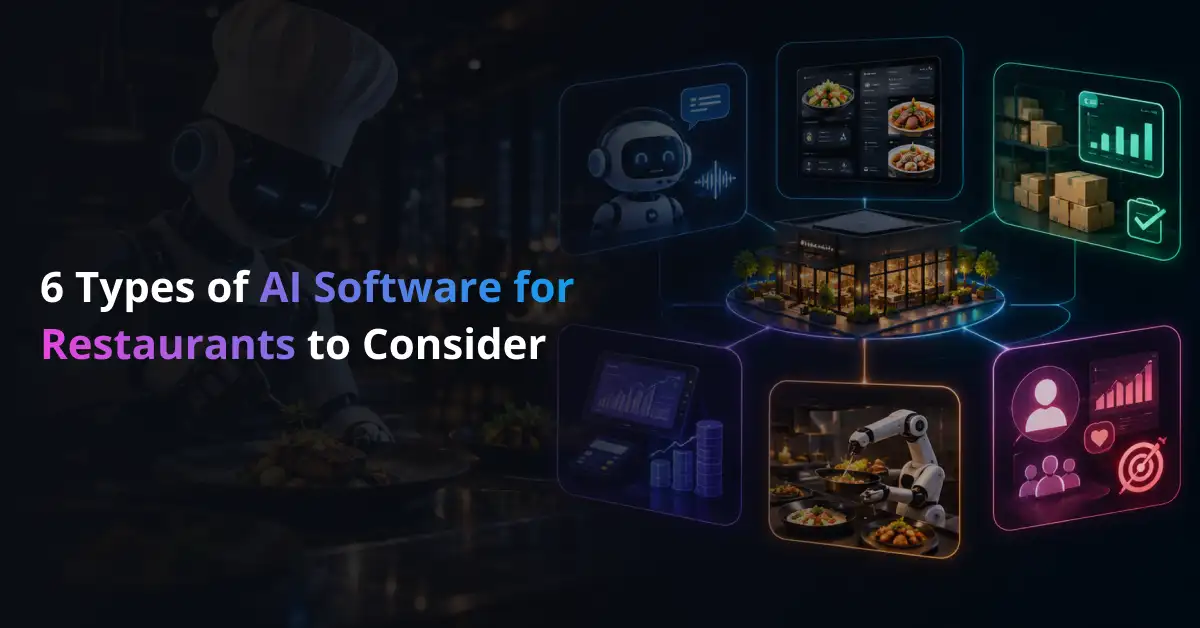
The six categories below cover the main types of AI software for restaurants worth evaluating in 2026.
Find the Right AI Software for Your Restaurant
Prismetric helps identify whether voice AI, forecasting, scheduling, computer vision, or customer automation fits your biggest operational challenge.
Explore Restaurant AI Solutions
6 Types of Restaurant AI Software at a Glance
Not every restaurant needs all six. A takeout-heavy operation may gain more from voice and ordering automation; a multi-unit group with volatile food costs may care more about forecasting and inventory control.
| Type |
Main Problem |
Typical Capabilities |
KPI |
| Voice AI and chatbots |
Missed calls |
Reservations, orders, FAQs, upselling |
Answer rate, conversion |
| AI ordering systems |
Ordering friction |
Kiosks, recommendations, automated upsells |
Order value, speed |
| Predictive inventory AI |
Waste and stockouts |
Forecasting, stock monitoring, purchasing |
Food cost, waste |
| AI scheduling software |
Poor labor allocation |
Demand forecasts, schedule optimization |
Labor %, overtime |
| Computer vision |
Operational blind spots |
Queue, kitchen and safety monitoring |
Service time |
| AI CRM and marketing |
Weak retention |
Segmentation, campaigns, review analysis |
Repeat visits |
“Restaurant AI software” is therefore not a single product category. Each type works on a different operational problem, relies on different data and should be measured against a different outcome.
What Counts as AI Software for Restaurants?
A digital tool does not become AI simply because it automates a task. Traditional restaurant automation follows predefined rules: send a reservation confirmation, flag low stock, or launch a promotion at a scheduled time.
AI systems can respond to patterns or language instead. Machine learning can forecast demand from historical sales, while AI agents can interpret requests and act across connected systems. A voice agent, for example, might understand that a caller wants to move a reservation, check availability and complete the change without forcing staff through a fixed script.
That is why AI increasingly appears inside POS platforms, scheduling applications, CRMs, ordering interfaces and inventory tools rather than as a separate product. It also explains the difference between a basic chatbot, an AI agent and an LLM-powered application.
For operators evaluating AI software for restaurants, the practical choice is often between adding off-the-shelf AI to an existing workflow and building something tailored. The better option depends on the restaurant’s data, integrations and the problem being solved.
1. Voice AI Agents and Chatbots
A phone call arriving during the dinner rush creates an awkward choice: interrupt service to answer it or risk losing a reservation or takeout order. Voice AI is designed for exactly that gap.
Modern AI voice agents can understand spoken requests rather than forcing callers through a fixed “press one, press two” menu. They can answer questions about hours and menu items, capture reservations, take orders and pass unusual requests to employees. Chat-based assistants perform similar work through websites, apps and messaging channels.
SoundHound, for example, offers restaurant voice assistants for answering and ordering. Its documentation shows support for menu management, special requests, call transfers and direct order flows into supported POS systems.
Where the conversation becomes operational
Answering a question is the easy part. Restaurant AI software becomes more useful when the conversation can trigger an action.
A caller might ask to move a reservation from 7:00 to 7:30, add an item to a takeout order or check whether a restaurant is still accepting orders. Systems built around the broader features of AI voice agents can combine language recognition with business rules and connected restaurant systems instead of stopping at a scripted response.
That distinction also separates conversational AI from many traditional chatbot capabilities. The objective is not simply to keep a customer talking to software. It is to complete routine requests without pulling an employee away from guests already in the restaurant.
What should restaurants test?
Restaurant conversations are messy. Customers change their minds, use shorthand, pronounce menu items differently and call from noisy environments. A useful system needs to recognize those variations and know when to hand the interaction to a person.
Menu synchronization matters too. Prices, sold-out items, modifiers and operating hours can change frequently; an assistant working from stale information quickly creates more work than it removes. Restaurants building a more specialized system may therefore need AI voice agent development services that connect conversational workflows with existing operational software.
The underlying language layer deserves equal attention. Natural language processing can help systems interpret customer intent, but restaurants should still test real calls rather than judge performance from a polished demonstration.
The useful metrics are straightforward: calls answered, orders or reservations completed, transfers to staff, abandoned interactions and revenue captured from calls that previously went unanswered.
2. AI Ordering and Self-Service Software
A digital menu can display a burger and ask whether the customer wants fries. That alone is not AI.
AI ordering systems go further by using context to decide which recommendation makes sense. Depending on the data available, that context might include the current basket, past purchases, time of day, menu availability or customer loyalty history. A breakfast customer and a late-night takeout customer do not necessarily need to see the same suggestion.
Restaurants can apply that intelligence across kiosks, mobile apps, drive-thru systems, web ordering and QR-based menus. Many of the underlying capabilities already sit inside the broader set of restaurant app features, including digital menus, ordering, reservations, payments and loyalty functions.
The interface is only one part of the system
The real work happens behind the screen.
Suppose a kiosk recommends an item that the kitchen has already run out of. Or a mobile app accepts an order but fails to send the correct modifiers into the kitchen workflow. The recommendation model may be sophisticated, but the customer still gets a poor experience.
That is why the shift from basic digital ordering to intelligent ordering depends heavily on integration. The restaurant’s menu, POS, payment system, loyalty data and kitchen workflow need to exchange information reliably. Mobile technology has already changed how restaurants handle ordering, payment, reservations and delivery; adding AI introduces another decision layer on top of those existing workflows. Restaurant and food-delivery apps provide much of that digital foundation.
For restaurant groups creating their own customer experience, mobile app development may also provide the interface through which recommendations, loyalty profiles and ordering features come together. The AI component still needs access to the systems that know what can actually be sold.
Look beyond average order value
Upselling is an obvious metric, but it should not be the only one.
Restaurants should also track order completion, ordering time, abandoned carts, incorrect orders and the number of transactions requiring employee intervention. A recommendation that adds a dollar to the basket but slows every order is not automatically a win.
The better question is whether the system reduces friction while helping customers make relevant choices. That is where careful AI integration with existing software becomes more valuable than simply adding another ordering screen.
3. Predictive Inventory and Demand Forecasting Software
A kitchen has to make tomorrow’s decisions before tomorrow’s customers arrive.
Prepare too much and ingredients become waste. Prepare too little and the restaurant runs out of a high-demand item halfway through service. Managers have always forecast demand in some form; AI changes how much information can go into that decision.
AI in demand forecasting can analyze historical sales alongside variables such as day of week, seasonality, promotions, weather and local events. Instead of producing only a restaurant-wide sales estimate, more granular systems can forecast demand by menu item or ingredient.
That distinction matters. Knowing that Friday sales may reach USD 8,000 does not tell the kitchen how many portions of chicken, pizza dough or prepared sauce it needs.
From a forecast to tomorrow’s prep sheet
ClearCOGS provides a useful example of the category. The company says its platform connects with restaurant POS data and uses historical sales, seasonal patterns and other demand signals to generate recommendations for prep, ordering and labor. Its 2026 guidance also argues that item-level forecasts are more actionable for kitchens than revenue-level predictions alone.
That moves predictive software beyond reporting. A traditional dashboard can tell a manager what sold yesterday; a forecast should help decide what to buy or prepare before the next service begins.
The same data can support a mobile inventory management system by connecting expected demand with current stock. Depending on the platform, restaurants can use that information for reorder suggestions, prep quantities, low-stock warnings or purchasing decisions.
Forecast accuracy is only useful if someone can act on it
More data does not automatically produce a better operation. Forecasts need reliable POS history, consistent menu mapping and enough context to distinguish a normal Thursday from a holiday weekend or local event.
Restaurants should track forecast accuracy alongside food waste, inventory variance, emergency purchases, stockouts and food-cost percentage. AI tools for data analysis can surface patterns, but the operational value comes from turning those patterns into decisions before ingredients are ordered or prepared.
For groups with unusual menus, multiple locations or proprietary operational data, machine learning development can support forecasting models tailored to those patterns rather than relying entirely on standardized assumptions.
The goal is not perfect prediction. Restaurant demand will always move. The goal is to make tomorrow’s prep and purchasing decisions with better evidence than a manager’s memory of last Tuesday.
Connect Restaurant AI With the Systems You Already Use
Integrate AI with POS, CRM, inventory, workforce, ordering, and customer data so automation works inside your existing operations.
Discuss Your AI Integration
4. AI Labor Forecasting and Scheduling Software
A schedule built on last week’s staffing pattern can look sensible on Monday and fail completely by Saturday. Rain changes patio demand. A nearby concert fills the dining room earlier than expected. A promotion pushes delivery orders well above normal levels.
AI scheduling software for restaurants tries to account for those shifts before managers assign hours.
Platforms such as 7shifts and Fourth can combine historical sales with demand patterns to estimate how much labor a restaurant is likely to need. Instead of treating every Friday evening alike, forecasting models can account for changes by daypart, location or expected sales volume.
The scheduling problem is part of a broader move toward AI in business process automation: using data to make repeatable operating decisions with less manual work.
A better schedule starts with a better forecast
Generating shifts automatically is not the most interesting part. The harder question is how many people the restaurant needs in the first place.
If expected covers rise sharply between 6 p.m. and 8 p.m., the system can recommend more front-of-house coverage. A slower lunch forecast might support fewer scheduled hours without asking a manager to rebuild the entire week manually. Some platforms can also flag overtime exposure, coverage gaps or mismatches between projected labor and expected sales.
Restaurants considering automation should first identify workflows that are suitable for AI rather than automate every scheduling decision. Employee availability, role requirements, labor rules and last-minute absences still require operational judgment.
That human layer matters.
An optimized schedule that repeatedly conflicts with staff availability will not remain optimized for long.
Restaurants should measure labor cost as a percentage of sales, overtime, understaffed periods, forecast accuracy and schedule-building time. For larger groups connecting forecasts, approvals and workforce systems, AI workflow automation services can help tie those steps together rather than creating another isolated scheduling tool.
5. Computer Vision and Video Analytics Software
A drive-thru camera already records a queue. Computer vision changes what the restaurant can learn from it.
Instead of waiting for someone to review footage, computer vision systems can analyze visual data to detect events, objects or movement patterns. In restaurants, that can mean measuring queue length, observing order handoffs, identifying kitchen bottlenecks or monitoring whether a service area needs attention.
The idea is similar to vision-based stock detection in retail, where cameras help systems recognize when products are missing or running low. In a restaurant environment, the objects and workflows change, but the underlying challenge remains: turn a continuous visual feed into something staff can act on.
Seeing the slowdown before the report arrives
Consider a busy quick-service kitchen. Order data might show that ticket times rose between noon and 1 p.m., but it does not necessarily explain where the delay occurred.
Video analytics can add operational context. A system might detect a growing drive-thru queue, longer dwell times at a handoff point or repeated congestion around one preparation station. That makes computer vision for restaurants less about watching employees and more about finding patterns that conventional transaction data cannot show.
Similar applications of computer vision in retail environments include traffic analysis, inventory visibility and process monitoring.
The technology is not equally useful everywhere. High-volume QSRs, drive-thrus, multi-unit kitchens and operations with existing camera infrastructure have clearer use cases than a small restaurant with limited visual data.
Privacy also belongs in the evaluation. Restaurants need clear rules for camera placement, access, retention and employee or customer data. Human review remains important whenever a system flags behavior related to safety or compliance.
Where off-the-shelf analytics cannot recognize a restaurant’s specific environment, computer vision development services can support models built around particular cameras, objects or operating workflows.
6. AI-Powered CRM, Marketing and Reputation Management Software
A regular guest may have ordered the same vegetarian entrée six times, booked three birthday dinners and stopped visiting two months ago. Most restaurants already generate those signals. The harder part is connecting them.
AI-powered CRM and marketing software attempts to turn reservation, POS, loyalty and campaign data into a more useful view of customer behavior. Platforms such as SevenRooms and Popmenu illustrate how restaurant technology is moving beyond storing guest details toward segmentation, personalized communication and automated engagement.
That makes AI in customer experience less about one chatbot interaction and more about what the restaurant learns across repeated visits.
From a customer list to customer context
A conventional campaign might send the same discount to 20,000 subscribers. AI marketing for restaurants can divide that audience by visit frequency, spending patterns, menu preferences or likelihood of returning.
A frequent lunch customer might receive a different offer from someone who has not visited in six months. Review data can also be classified by topic or sentiment, helping restaurant teams separate recurring complaints about wait times from comments about food quality or service.
Generative systems add another layer. Restaurants can use generative AI for marketing to draft campaign variations, while generative AI in CRM can support personalized messages based on customer context.
Automation can go further still. Agentic AI in marketing can coordinate multi-step activities such as identifying a customer segment, selecting an action and triggering a campaign within defined rules.
More personalization, however, does not automatically mean better marketing.
Restaurants still need consent controls, accurate customer records and sensible frequency limits. A highly targeted message sent too often is still unwanted.
The useful measures are repeat visits, campaign conversion, redemption rate, customer lifetime value, review response time and opt-outs. For restaurant groups building personalized experiences into proprietary software, generative AI development can connect language models and customer data with defined business workflows.
The objective is not to send more messages. It is to recognize which customer needs which message—and when sending nothing may be the better choice.
How to Choose the Right AI Software for Your Restaurant
The most sophisticated AI system can still be the wrong purchase.
A restaurant losing orders because employees cannot answer the phone has a different problem from one throwing away excess prepared food every night. The first might benefit from voice AI; the second has a forecasting problem. Starting with the technology reverses that logic.
Start with the cost you can already see
Identify one operational problem and establish its current cost. That might be unanswered calls, food waste, overtime, slow drive-thru service, abandoned digital orders or declining repeat visits.
A useful AI strategy connects that problem to a measurable outcome before anyone starts comparing vendors. The same discipline makes it easier to calculate AI automation ROI later because the restaurant already has a baseline.
The metric should be specific. “Improve operations” is difficult to measure. Reducing weekly food waste, lowering overtime hours or increasing the percentage of calls converted into reservations gives a manager something concrete to test.
Follow the data
Restaurant AI is only as useful as the information it can reach.
An inventory model may need POS history and ingredient data. Scheduling software needs sales patterns and employee availability. Personalized marketing works better when reservation, loyalty and transaction records connect to the same customer profile.
That makes integration part of the buying decision, not an implementation detail to discuss afterward. Restaurants with fragmented or inconsistent data may need to prepare and organize data pipelines before advanced forecasting or personalization delivers much value.
Security matters here as well. Operators should know what customer or employee data the system collects, where it is stored, who can access it and how long the provider retains it.
Decide whether standard software is enough
Most restaurants do not need to build every AI capability themselves. Established products can make sense when the workflow—reservations, scheduling or inventory forecasting, for example—is common across the industry.
Custom development becomes more relevant when a restaurant group has proprietary systems, unusual workflows or needs several applications to operate as one system. Before taking that route, it helps to review questions to ask an AI development company and understand how scope, integrations and model requirements affect AI development cost.
Larger deployments may also require AI implementation support to connect the technology with existing systems and operating processes. For more complex architecture or rollout decisions, restaurants can work with AI consultants before committing to a full deployment.
The buying decision should eventually come back to one question: did the technology improve the restaurant metric it was purchased to change?
A Practical Restaurant AI Implementation Roadmap
Buying software is faster than changing an operation.
A restaurant can activate a platform in days and still spend months discovering that employees do not trust its recommendations, integrations fail during busy periods or nobody agreed on how success would be measured.
A smaller pilot exposes those problems earlier.
Begin with one workflow
Pick a process with enough volume to generate useful evidence. Missed phone calls, daily prep forecasting or review management are easier to evaluate than a broad mandate to “use AI across the restaurant.”
Document the baseline first. Then define what the system can do automatically and what still requires employee approval.
Restaurants experimenting with conversational technology, for example, can first examine how to build an AI chatbot before deciding whether the use case needs a more autonomous agent. More advanced workflows may justify developing an AI agent around existing restaurant processes.
Test before expanding
A single location can reveal problems that a product demonstration will not: menu synchronization errors, unusual customer phrasing, inaccurate forecasts or staff workarounds.
For custom systems, a limited proof of concept can answer the technical question before a larger investment. Understanding the distinction between an AI PoC and AI MVP helps teams separate technical validation from a product ready for regular users. Restaurants that need to validate a proprietary use case can also begin with a small AI proof of concept rather than deploying across every location.
Measurement comes next. Compare the pilot with the original baseline, review errors and decide whether performance justifies expansion. Dashboards built through business intelligence systems can help multi-location operators compare those results across stores and periods.
Scale follows evidence not enthusiasm.
Test One Restaurant AI Use Case Before You Scale
Start with a focused PoC, compare results against your baseline, and expand only after the workflow proves measurable operational value.
Start Your Restaurant AI PoC
How Prismetric Supports Restaurant Businesses
Restaurant AI works best when it connects with the systems teams already use. Prismetric’s restaurant AI development services can bring AI into existing restaurant workflows without creating another disconnected tool.
Depending on the use case, Prismetric can support:
- voice ordering and reservation assistants,
- demand and inventory forecasting,
- personalized recommendations and customer segmentation,
- POS, CRM, inventory, and workforce integrations.
| Restaurant Need |
AI Approach |
| Reduce missed orders |
Voice and ordering AI |
| Improve planning |
Forecasting and analytics |
| Connect operations |
AI agents and system integrations |
For restaurants with proprietary workflows, Prismetric can also build custom AI around existing business processes and validate the solution through focused proofs of concept before wider deployment.
Restaurant groups expanding across markets can access Prismetric’s AI development expertise in the USA, Australia, and Germany.
The goal is to solve a measurable operational problem first, validate results in real restaurant conditions, and expand only when the workflow proves useful.
Frequently Asked Questions
There is no single type that fits every restaurant. The useful category depends on the constraint creating the most measurable loss.
A restaurant missing calls may start with voice AI. High food waste points toward forecasting and inventory software, while excessive overtime may make labor forecasting more relevant. Restaurants struggling with retention may get more value from CRM and marketing AI.
The better first investment is usually the system attached to a problem the restaurant can already quantify.
A small restaurant does not need an enterprise AI stack.
It can start with one feature already available through its ordering, scheduling, marketing or reservation software. A narrow deployment reduces integration work and makes results easier to measure. Before expanding, operators can use an AI implementation guide to think through data, processes and adoption rather than adding disconnected tools.
AI is better suited to specific repeatable tasks than to replacing the full range of work performed by restaurant employees.
Software can answer routine calls, predict demand, flag scheduling gaps or classify customer feedback. People still handle exceptions, hospitality, judgment, conflict and unpredictable situations. Even sophisticated enterprise chatbot systems need escalation rules for requests the software cannot resolve safely or accurately.
The practical question is usually which tasks can be automated without weakening service.
Not every AI application requires a POS connection, but many high-value restaurant use cases depend on it.
Forecasting software may need transaction history. Ordering AI needs current menu and pricing information. Scheduling tools can use sales data to estimate staffing requirements, while CRM platforms may use transactions to understand customer behavior.
Integration determines whether the AI works with current operating data or becomes another disconnected dashboard.
Yes. Prismetric can support AI implementations that connect with existing applications, APIs and data sources instead of requiring restaurants to replace their technology stack. That can be useful when an AI system needs access to POS data, customer records, inventory information, ordering platforms or other operational systems. Restaurants with more complex requirements can also use AI implementation services to plan integrations, validate workflows and move a tested solution into production.
Traditional automation follows predetermined instructions. A system might send a confirmation after every reservation or notify a manager when inventory falls below a fixed number.
AI can make decisions from changing inputs. It might forecast tomorrow’s ingredient demand, interpret a spoken order or decide which customers are most likely to respond to an offer.
The distinction is becoming less visible to users because both capabilities increasingly exist inside the same software. Even voice AI used for conversions can combine automated workflows with language models and decision logic behind a single conversation.
Start with evidence from the restaurant’s own workflow.
Ask whether the system integrates with existing platforms, how it handles errors, what data it needs and which results the vendor expects operators to measure. A controlled pilot should also test performance during real service conditions rather than relying entirely on demonstrations.
For custom development, restaurants can review how to choose an AI development company and define testing requirements before deployment. An AI model testing process becomes especially relevant when predictions or automated decisions influence everyday operations.
A good demonstration shows what the software can do. A good pilot shows whether it works in your restaurant.
Prismetric can help restaurants turn specific operational problems into practical AI applications rather than adding technology for its own sake. Its team supports use cases such as voice assistants, demand forecasting, customer personalization, workflow automation and AI integrations with existing business systems. For restaurants that need a solution built around their own data and processes, Prismetric’s AI development services can cover the path from use-case planning and prototyping to integration and deployment.