Agentic AI in Healthcare: Use Cases, Benefits, Risks & Implementation
Key Takeaways
- Agentic AI in healthcare can understand goals, plan steps, use approved tools, and complete defined tasks across clinical and administrative workflows.
- Healthcare organizations can use AI agents for prior authorization, scheduling, documentation, patient follow-up, claims processing, and care coordination.
- The value comes from connecting reasoning with action, not only generating answers or summaries.
- Safe adoption depends on human oversight, secure integrations, clear permissions, and continuous evaluation.
- Organizations should start with bounded, measurable workflows before giving AI agents broader autonomy.
Healthcare organizations already use many digital systems, yet staff still spend significant time moving information between EHRs, payer portals, scheduling tools, messaging systems, and internal applications. As artificial intelligence trends shift toward more autonomous systems, the focus is moving from AI that only answers questions to AI that can help complete work.
Agentic AI in healthcare brings this change into clinical and administrative operations. These systems can understand a goal, gather relevant information, decide what to do next, use approved tools, and continue working until the task is completed or needs human input. This makes agentic AI use cases especially relevant for workflows that involve several connected steps.
For healthcare organizations exploring practical adoption, AI healthcare solutions development can support use cases that combine automation, data access, security, and human oversight.
This guide explains:
- how agentic AI works in healthcare;
- where healthcare organizations can use it; and
- what it takes to implement it safely and effectively.
Automate Complex Healthcare Workflows With Agentic AI
Prismetric helps build AI agents for prior authorization, claims, scheduling, referrals, documentation, and patient follow-up with clear human checkpoints.
Explore Healthcare AI Agents
What Is Agentic AI in Healthcare, and Why Does It Matter Now?
Agentic AI in healthcare refers to AI systems that work toward a defined goal with limited human direction. Instead of only generating an answer, they can plan steps, use approved tools, take action, check results, and escalate when human judgment is needed.
An AI agent is one software component working within defined limits, while agentic AI describes the broader system created when one or more agents coordinate a workflow. Understanding what AI agents are shows how agentic systems can manage multi-step workflows rather than simply respond to prompts.
For example, generative AI may draft a referral note. An agentic system can use that information to check requirements, find a specialist, schedule an appointment, notify the patient, and record the outcome. This is why generative AI use cases can support agentic workflows without being agentic on their own.
Why is agentic AI gaining attention now?
- Better reasoning and tool use support more complex tasks.
- Healthcare APIs make system integration easier.
- Administrative workload creates demand for end-to-end automation.
- More healthcare data is available digitally.
- Stronger AI governance supports controlled deployment.
Organizations can work with an AI agent development company to design these systems, while generative AI development services can provide the language-model layer for reasoning and content generation.
What Are the Main Applications of Agentic AI in Healthcare?
Agentic AI can support healthcare workflows that require several connected actions rather than a single prediction or response. The strongest early opportunities are often repetitive, rules-based processes where the system can work within clear limits and hand exceptions to people. This makes it useful for automating repetitive healthcare workflows across clinical, financial, and administrative operations.
| Agentic AI Application |
What the Agent Can Do |
Potential Outcome |
| Prior authorization |
Collect records, check requirements, flag missing information, and track status |
Faster processing and fewer manual steps |
| Claims and revenue cycle |
Review claim data, identify exceptions, route issues, and monitor follow-up |
Lower administrative effort and quicker resolution |
| Clinical documentation |
Retrieve context, draft notes, organize inbox tasks, and route requests |
Less repetitive work for care teams |
| Scheduling and referrals |
Match needs with providers, find slots, book visits, and send updates |
Faster patient access |
| Patient engagement |
Send reminders, answer bounded questions, and coordinate follow-up |
More consistent communication |
| Remote monitoring |
Watch approved data signals and trigger predefined escalation |
Faster response to possible problems |
| Clinical decision support |
Retrieve evidence and organize relevant patient context |
Better-informed clinician review |
| Clinical research |
Support trial matching, monitoring, and research synthesis |
More efficient research workflows |
Administrative use cases are often easier to define because the rules, systems, and outcomes are clearer. Because these workflows are measurable, teams can track turnaround time, manual touches, errors, and escalation rates. For example, AI-powered operational intelligence can help teams identify delays or exceptions, while an agent handles the next approved step in the workflow.
Patient-facing applications require more careful boundaries. Conversational AI in healthcare can answer routine questions, while voice-based patient access workflows can support appointment reminders, scheduling, and follow-up. Clinical decisions, however, still need stronger validation and appropriate human oversight.
As healthcare organizations connect more workflows, several specialized agents may work together. A scheduling agent, documentation agent, and follow-up agent can share workflow state while operating inside defined permissions. This approach is especially relevant for secure digital health applications and reflects how mobile technology is reshaping healthcare delivery across connected care environments.
Which Technologies Power Agentic AI Systems in Healthcare?
An agentic healthcare system combines several technologies. The language model may handle reasoning, but it still needs trusted data, memory, integrations, security controls, and monitoring to complete real tasks safely.
| Technology |
Role in an Agentic Healthcare System |
| Large language models |
Interpret instructions, reason about tasks, and plan next steps |
| Retrieval-augmented generation |
Pull relevant information from approved knowledge sources |
| Memory and workflow state |
Keep track of context across multiple steps |
| Tool calling |
Connect the agent with EHRs, scheduling tools, claims systems, and other software |
| FHIR and HL7 interfaces |
Support healthcare data exchange between systems |
| Orchestration layer |
Coordinate agents, tools, rules, and workflow state |
| Guardrails |
Limit actions, permissions, and unsafe behavior |
| Observability |
Record actions, errors, and performance for review |
What RAG is and how it works matters because healthcare agents often need current information from approved sources rather than relying only on model memory. Teams may also compare fine-tuning, prompt engineering, and RAG or evaluate RAG vs fine-tuning depending on the use case.
For production systems, organizations can ground agent responses in trusted enterprise knowledge and design domain-aware LLM workflows around healthcare policies, data access rules, and human approval points. The goal is not to give the model unlimited control, but to connect reasoning with carefully governed actions.
Connect AI Agents With Your Healthcare Systems Securely
Integrate agents with EHRs, FHIR/HL7 interfaces, APIs, scheduling tools, and internal platforms using controlled permissions, guardrails, and audit trails.
Discuss Your Agent Architecture
How Is Agentic AI Used in Healthcare Day to Day?
In day-to-day healthcare operations, agentic AI is most useful when work moves across several systems, people, or approval steps. Instead of helping with only one task, the agent can maintain context and continue the workflow until it reaches a defined outcome or needs human input.
| Clinical and Patient Workflows |
Administrative and Operational Workflows |
| Documentation support |
Prior authorization |
| Patient follow-up |
Claims processing |
| Care-gap identification |
Appointment scheduling |
| Remote-monitoring escalation |
Referral coordination |
| Evidence retrieval |
Revenue-cycle tasks |
| Discharge coordination |
Workforce and resource coordination |
Prior authorization: An agent can gather the required records, compare them with payer requirements, identify missing information, prepare the submission, and track the case. Understanding how to build an AI agent is especially relevant here because the workflow depends on clear goals, tools, rules, and escalation points.
Referral coordination: The agent can receive a referral, check whether the required information is complete, identify an appropriate provider, find available appointments, communicate with the patient, and update the referring team. Connecting agents with EHRs and existing clinical software allows these steps to happen without forcing staff to move information manually between systems.
Clinician inbox management: An agent can classify incoming messages, retrieve relevant patient context, draft routine responses, and route requests that need clinical judgment. Similar agent-driven software workflow patterns show how AI can coordinate several tools while keeping people in control of higher-risk decisions.
Patient follow-up: After a visit or discharge, an agent can send reminders, collect predefined responses, provide approved information, and escalate concerns based on set rules. This can support remote-care models, where understanding telemedicine workflow economics and planning the budget for healthcare applications helps organizations connect operational value with implementation cost.
What Are the Benefits of Agentic AI in Healthcare?
Agentic AI creates value when it removes unnecessary handoffs and keeps defined healthcare workflows moving. The main benefit is connecting information, decisions, and approved actions across systems.
- Reduced administrative work: Agents can handle repetitive steps such as collecting documents, routing requests, checking status, and updating records.
- Faster workflow completion: Agents can coordinate several steps automatically, reducing delays caused by manual transfers between teams and systems.
- Greater workforce capacity: Automating routine work gives clinicians and administrative teams more time for tasks that require judgment or patient interaction.
- More consistent patient follow-up: Agents can track pending actions and trigger reminders or escalation based on defined rules.
- Better operational scalability: Organizations can support higher workflow volumes without increasing manual work at the same rate.
| Stakeholder |
Potential Value |
| Clinicians |
Less repetitive administrative work |
| Patients |
Faster access and more consistent follow-up |
| Administrators |
Shorter processing cycles |
| Finance teams |
More efficient revenue-cycle workflows |
| IT leaders |
Reusable automation architecture |
An AI automation ROI framework helps connect cycle time, manual touches, error rates, and staff hours to business impact. Organizations can also embed AI into wider digital transformation initiatives.
This matters as organizations move from individual pilots to operating-model change and scale AI across enterprise healthcare operations. The goal is measurable workflow improvement, not AI adoption for its own sake.
What Are the Risks and Challenges of Agentic AI in Healthcare?
Agentic AI introduces a different risk profile because it can act on information, not only generate it. A poor answer may be corrected before use, but an incorrect automated action can affect records, workflows, payments, or patient care.
The biggest risks include:
- Patient safety and incorrect actions: An agent may take the wrong step when context is incomplete, instructions are unclear, or the model reasons incorrectly.
- Hallucinations and unreliable reasoning: AI can produce unsupported information or make incorrect assumptions, making explainable AI and validation important in higher-risk workflows.
- Privacy and PHI exposure: Agents may access sensitive information across several systems, so permissions, authentication, and data handling controls must remain tightly defined.
- Bias and poor data quality: Incomplete or unrepresentative data can influence outputs and may produce uneven results across patient groups.
- Unauthorized tool access: Broad permissions can allow an agent to change records or trigger actions beyond its intended role.
- Unclear accountability: Organizations need to know who owns the workflow, approves high-risk actions, and responds when the system fails.
The risk increases as autonomy expands in production. Teams therefore need to choose between custom, off-the-shelf, and hybrid AI based on the workflow and decide when sensitive workloads need private model infrastructure. Reliable healthcare data pipelines and machine-learning models that support prediction and pattern detection also require ongoing quality checks.
A safer design gives each agent only the permissions it needs, records important actions, and defines clear escalation points. Human review should remain mandatory when a task involves clinical judgment, irreversible actions, safety-critical decisions, or uncertain outcomes that could affect patients.
Which Regulations and Compliance Requirements Apply to Agentic AI in Healthcare?
Agentic AI is not governed by one healthcare regulation. Requirements depend on what the system does, what data it handles, who operates it, and whether its function falls within a regulatory category.
| Framework or Requirement |
Why It Matters to Agentic AI |
| HIPAA |
Protects PHI and sets privacy and security requirements for covered entities and business associates |
| FDA oversight |
May apply when software performs a regulated medical-device function |
| ONC health IT requirements |
Address interoperability and transparency for certain predictive tools in certified health IT |
| Section 1557 |
Nondiscrimination requirements can affect certain patient-care decision support uses |
| NIST AI RMF |
Provides a voluntary framework for governing and managing AI risk |
| Organizational controls |
Define permissions, logging, approvals, monitoring, and accountability |
HIPAA matters when an agent creates, receives, maintains, or transmits electronic protected health information. HHS requires appropriate administrative, physical, and technical safeguards, and business associate obligations may also apply.
FDA oversight depends on intended use. The agency maintains guidance for digital health and software functions, including clinical decision support and AI-enabled device software. ONC’s HTI-1 rule also introduced transparency requirements for predictive algorithms used in certified health IT.
For implementation, organizations can use AI regulation and compliance in the US as a planning reference, automate compliance workflows with generative AI where appropriate, and plan the lifecycle cost of a production GenAI system. Business intelligence services can help teams monitor compliance metrics.
NIST’s AI Risk Management Framework also provides voluntary guidance through its Govern, Map, Measure, and Manage functions.
Compliance should shape architecture from the start. Because healthcare rules change, organizations should verify which requirements apply to each use case before deployment.
How Much Does It Cost to Implement Agentic AI in Healthcare?
The cost of agentic AI in healthcare depends mainly on workflow complexity. A simple internal assistant costs far less than a production system that connects with EHRs, payer portals, clinical data, and approval workflows.
| Cost Driver |
Why It Affects Budget |
| Number of workflows |
More workflows create more rules, exceptions, and testing needs |
| EHR and API integrations |
Each connection adds engineering, security, and validation work |
| Data readiness |
Poor or fragmented data increases preparation effort |
| Level of autonomy |
More autonomy requires stronger guardrails and evaluation |
| Security and compliance |
Healthcare systems need access controls, logging, and documentation |
| Production monitoring |
Agents need ongoing testing, observability, and maintenance |
Several factors can increase project scope:
- custom integrations with legacy systems;
- real-time access to sensitive patient data;
- complex approval and escalation rules;
- multi-agent coordination; and
- extensive clinical or regulatory validation.
Organizations can use an AI development cost framework to estimate project needs. They should also consider the underlying LLM cost structure and whether they need developers who understand healthcare AI workflows.
Total cost should include development, integration, testing, model usage, monitoring, security, maintenance, and future workflow updates.
How Do You Implement Agentic AI in Healthcare Successfully?
A successful agentic AI implementation starts with a narrow business problem, not with a broad goal to “use AI.” Healthcare organizations need clear workflow boundaries, reliable data, defined permissions, and measurable outcomes before they increase agent autonomy.
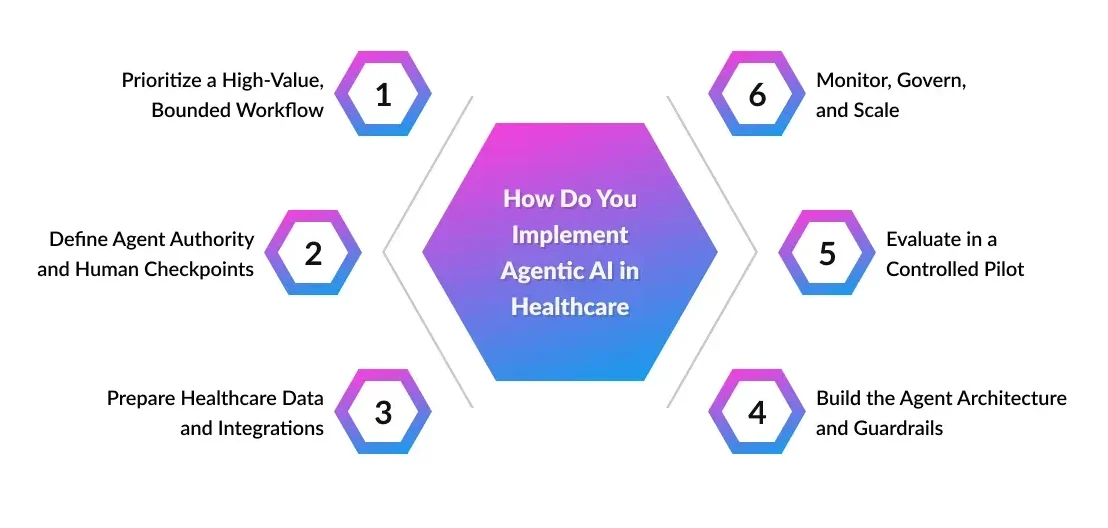
Step 1: Prioritize a High-Value, Bounded Workflow
Start with a process that has clear inputs, outputs, and recurring friction. Prior authorization, referral coordination, or appointment scheduling are easier to measure than open-ended clinical decision making. A strong AI strategy built around measurable outcomes helps teams connect the use case with business value. Baseline the current cycle time and manual effort first.
Step 2: Define Agent Authority and Human Checkpoints
Decide what the agent can do automatically, what needs approval, and what must always go to a person. This reduces risk and prevents the system from acting beyond its intended role. Teams should also define fallback behavior for missing data or failed integrations.
Step 3: Prepare Healthcare Data and Integrations
Map the EHR, FHIR or HL7 interfaces, internal knowledge sources, identity controls, and external APIs the agent needs. Data quality matters because an agent can only make reliable decisions with accurate information. Teams can validate feasibility with an AI proof of concept before investing in a larger production build.
Step 4: Build the Agent Architecture and Guardrails
Connect the reasoning model with retrieval, memory, tools, authentication, audit logs, and fallback rules. Organizations should also choose a focused PoC with measurable value so technical testing reflects a real workflow. Limit tool access by role and record important actions.
Step 5: Evaluate in a Controlled Pilot
Measure task completion, tool-call accuracy, incorrect actions, escalation quality, latency, and cost. A structured approach to AI agent evaluation helps teams test whether the system behaves consistently before wider deployment. Compare pilot results with the original workflow baseline.
Step 6: Monitor, Govern, and Scale
After launch, track workflow drift, model changes, failures, overrides, and user feedback. Teams that move AI experiments into production need ongoing monitoring rather than one-time testing. An experienced partner can also help shape a risk-aware AI roadmap as additional use cases are added.
Key metrics to track: task success rate, cycle time, manual touches, escalation rate, tool-call accuracy, override rate, error rate, cost per completed workflow, and user satisfaction.
Agentic AI should scale only after a workflow shows reliable performance. In healthcare, greater autonomy should follow evidence, measured safety, and reliable performance.
What Does the Future of Agentic AI in Healthcare Look Like?
The future of agentic AI in healthcare is likely to develop workflow by workflow rather than through fully autonomous clinical systems. Organizations will expand agent capabilities where reliability, integration quality, and human oversight support safe action.
Key shifts are likely to include:
- More specialized multi-agent workflows: Different agents can handle retrieval, scheduling, documentation, verification, and follow-up.
- Stronger interoperability: Better EHR and API connections can help agents move information across systems with fewer manual handoffs.
- More formal evaluation and observability: Teams will need clearer ways to track agent actions, errors, and decision paths.
- Gradual increases in autonomy: Systems may move from recommendation to approved action only where performance supports it.
Organizations that build GenAI software that is secure and scalable will be better positioned for these workflows. Understanding how enterprise-grade AI differs from isolated AI tools also helps teams plan for governance, integration, and long-term operations.
Start With One Workflow Before Scaling Agent Autonomy
Validate task completion, tool accuracy, escalation quality, latency, cost, and safety in a controlled pilot before expanding agent capabilities.
Start Your Agentic AI Pilot
How Can Prismetric Help Build Agentic AI Solutions for Healthcare?
Building agentic AI for healthcare requires more than connecting an LLM to existing software. The system needs reliable data, secure integrations, defined permissions, clear escalation rules, and continuous monitoring.
Prismetric supports businesses from AI use-case discovery and architecture planning through development, integration, testing, deployment, and post-launch optimization. Its AI development services include AI agents, RAG systems, machine learning solutions, and workflow automation that connect with existing business systems.
For healthcare-focused projects, the development process can cover:
- Agent architecture and workflow design: Define goals, tools, permissions, human checkpoints, and exception paths.
- Data and system integration: Connect agents with approved databases, APIs, healthcare applications, and enterprise systems.
- Testing and production monitoring: Evaluate accuracy, workflow completion, failures, security controls, and performance after deployment.
The right approach starts with one measurable workflow and expands only after the system shows reliable results.
Frequently Asked Questions
Agentic AI in healthcare refers to AI systems that can understand a goal, plan multiple steps, use approved tools, take actions, and check results. Unlike a standard chatbot, an AI agent can continue working toward a defined outcome with limited human direction.
Prior authorization is one example. An AI agent can collect required records, compare them with payer requirements, identify missing information, prepare a submission, track its status, and send unusual cases to staff for review.
Generative AI mainly creates content such as answers, summaries, or clinical-note drafts. Agentic AI can use generative models as part of a larger system that plans tasks, connects with tools, and takes approved actions across a healthcare workflow.
Safety depends on the use case, system design, validation, permissions, and level of human oversight. Higher-risk clinical workflows require stronger testing and tighter human control than administrative tasks such as scheduling or document routing.
Yes. AI agents can connect with EHRs and other healthcare software through approved APIs and interoperability standards such as FHIR and HL7. Access controls should limit which information an agent can retrieve and which actions it can perform.
Agentic AI can operate within a HIPAA-compliant environment, but the technology itself does not automatically guarantee compliance. Organizations must address PHI handling, access controls, security safeguards, vendor responsibilities, logging, and the complete deployment architecture.
Development cost varies with workflow complexity, EHR integrations, data requirements, model choice, autonomy, security, and validation needs. An AI agent development cost estimate should also include ongoing model usage, monitoring, maintenance, and future workflow changes.