How to Hire Healthcare AI Software Developers: A Complete Guide for 2026
Key Takeaways
- Hiring healthcare AI developers requires a mix of ML expertise, domain knowledge, and compliance awareness to build safe and reliable tools.
- Reviewing real healthcare AI portfolios helps you spot developers who understand clinical workflows, patient safety, and data challenges.
- Strong technical and clinical interviews reveal how candidates solve medical problems and design AI that fits into daily care.
- Choosing the right hiring model depends on your goals, budget, and timeline, whether you need speed, long-term control, or flexibility.
- The U.S. healthcare software market is projected to reach nearly 389 billion dollars by 2030, driving demand for skilled AI talent.
Healthcare software is no longer a supporting tool. It has become the backbone of how modern care actually works. The global medical software market reached $67.54 billion in 2025 and is projected to grow to $122.89 billion by 2030, which shows how quickly the industry is expanding.
But growth alone does not solve the hiring challenge. You need people who understand real clinical workflows, patient data, privacy rules, and the tricky balance between building AI that is powerful and still safe to use in healthcare. A general software developer cannot fill that gap. You need someone who understands both healthcare and AI at a deeper level.
In this guide, I will walk you through what it truly takes to hire Healthcare AI software developers who can build reliable healthcare applications that are secure and meaningful. You will learn what skills matter, how to evaluate candidates, and what separates an average developer from someone who can build tools that improve real patient outcomes. If you are ready to build something that lasts, you are in the right place.
Hire Healthcare AI Developers Who Understand More Than Code
Work with developers skilled in AI, clinical workflows, healthcare data, FHIR/HL7 integrations, and privacy-focused development.
Hire Healthcare AI Developers
What Is Healthcare AI Software Development and Why Do You Need AI Healthcare Developers?
Healthcare AI software development focuses on building digital tools that can learn from medical data and support clinicians in real time. Instead of relying only on rule-based logic, these systems analyze patterns, spot risks, predict outcomes, and help automate tasks that usually drain a clinician’s time. When AI is built into healthcare software with the right expertise, it can strengthen decision-making, reduce errors, and improve the overall patient experience. Patient-facing applications can also use conversational AI in healthcare to support routine interactions and communication.
You need AI healthcare developers because they bring a rare mix of technical skill and clinical understanding that general developers usually do not have.
- They know how to work with sensitive medical data while respecting privacy rules like HIPAA and GDPR.
- The U.S. healthcare software market alone was valued at around $166.83 billion in 2024 and is expected to grow strongly toward nearly $389 billion by 2030, which shows how big the demand for capable software talent is in this space.
- They understand machine learning, natural language processing, and other AI tools that power modern diagnostic and predictive systems.
- They can build AI features that fit real clinical workflows instead of slowing them down.
- They know how to train, test, and deploy AI models in a way that keeps them reliable and safe for patient use.
How to Hire AI healthcare Software Developers in 2026
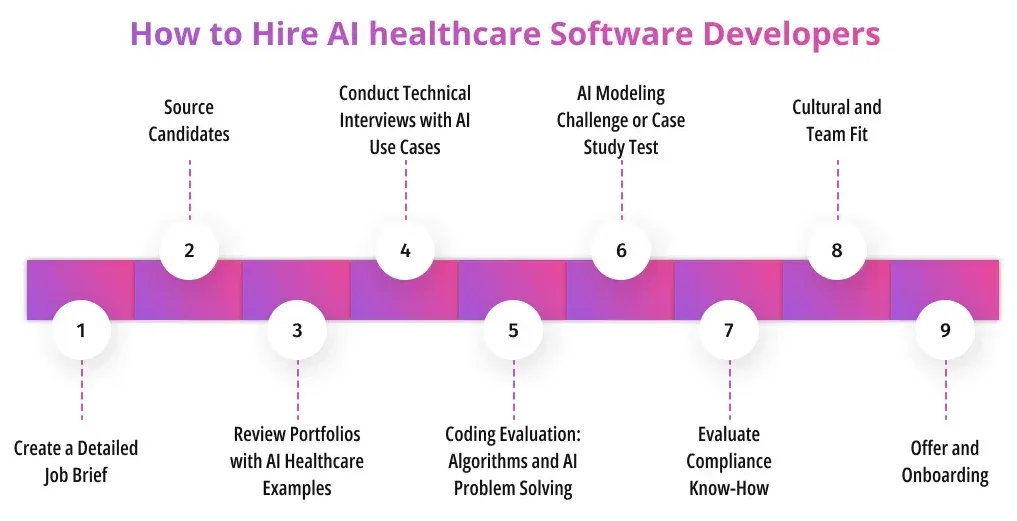
Step 1: Create a Detailed Job Brief (skills + domain + tools)
A clear job brief sets the tone for your entire hiring process. It helps candidates understand exactly what kind of AI healthcare solution you want to build and what level of experience they need to bring. A broader guide to hiring AI developers can also help you structure requirements before screening begins. Think of the job brief as your foundation. If you get this part right, the rest of the hiring journey becomes much smoother.
If you are still narrowing down the product direction, reviewing practical healthcare app ideas can help clarify the workflows, users, and technical capabilities your developers may need.
What to include:
- Core technical skills such as Python, ML frameworks, data engineering basics, and experience with large healthcare datasets.
- Understanding of healthcare systems like EHRs, telehealth platforms, patient portals, or claims software.
- Familiarity with AI tools and workflows, including model training, evaluation, and deployment.
- Knowledge of medical regulations such as HIPAA or GDPR to ensure your AI features stay compliant.
- Any specific tools or platforms you rely on, like FHIR APIs, MLOps pipelines, cloud services, or healthcare data standards.
A strong job brief filters out mismatched applicants early, which saves time and lets you focus on people who genuinely fit your goals.
Step 2: Source Candidates (job boards, specialized AI communities)
Once you know what you’re looking for, the next decision is how you want to engage that talent. Understanding different software development engagement models can help you decide whether you need an individual developer, contractor, dedicated team, or external partner.
General job boards offer volume, but niche communities often bring candidates who already understand the complexities of healthcare AI. You want developers who can handle real clinical challenges, not just people who can write code.
Where to look:
- AI-focused communities like Kaggle, Hugging Face, or AI engineering groups where developers share hands-on projects.
- Healthcare tech forums and industry Slack groups that attract professionals already working with clinical data.
- Targeted job boards such as Wellfound, LinkedIn, and specialized healthcare tech hubs. If geography is not a limitation, expanding your search to remote developers can give you access to a wider technical talent pool.
- Verified software development outsourcing partners or agencies that work in healthcare and have pre-screened AI talent.
The goal is to bring in people who already think in terms of patient outcomes, safety, and data integrity. That mindset matters just as much as their technical skillset.
Step 3: Review Portfolios with AI Healthcare Examples
Reviewing portfolios gives you a window into how a developer thinks and what kinds of healthcare challenges they have tackled before. A strong portfolio shows more than technical skill. It reveals whether the developer understands clinical workflows, patient safety, and the subtle requirements that come with medical data. Real projects speak louder than any resume.
What to look for:
- Experience with datasets that resemble your use case, such as EHR data, medical imaging, or patient monitoring streams.
- Examples of AI models used in real healthcare settings, like risk prediction, triage automation, decision support, or clinical NLP.
- Evidence that they understand healthcare regulations and have built features that respect privacy and data rules.
- Clear explanations of the problem they solved, the AI approach they used, and how their solution helped clinicians or patients.
- Code samples or repositories that show how they structure AI pipelines, testing, and model deployment.
Step 4: Conduct Technical Interviews with AI Use Cases
Once you have promising candidates, you can dig deeper into how they think. A strong technical interview is not just about checking skills. It is about understanding how candidates approach real healthcare scenarios. You want to see how they solve problems with incomplete data, unclear requirements, or unpredictable clinical environments. These situations happen every day in AI health projects.
Questions to explore:
- Healthcare-specific challenges. For example, how they would handle missing patient data or design a model that stays reliable across different hospitals.
- Problem solving. Ask them to walk through a familiar medical scenario and explain step by step how they would approach it.
- Technical depth. Explore their experience with the tools, frameworks, and workflows your project depends on. Look for confidence, not memorized answers.
- Practical AI reasoning. See how they think about bias, model drift, performance monitoring, and AI testing in clinical environments.
Step 5: Coding Evaluation: Algorithms and AI Problem Solving
A coding evaluation helps you understand how a developer thinks when they are under the hood, turning messy healthcare data into something useful. It is not just about writing clean code. You want to see how they approach uncertainty, how they test their ideas, and whether they can break a big clinical challenge into smaller steps they can solve.
What to look for:
- Their ability to work with real-world data irregularities like missing values or inconsistent patient records.
- How they write functions that support machine learning model training, evaluation, and error analysis.
- Whether they can explain their approach in simple terms that non-technical stakeholders can follow.
- How they design small experiments to validate ideas quickly.
Step 6: AI Modeling Challenge or Case Study Test
This step lets you watch their problem-solving skills in motion. Give them a realistic scenario that mirrors the kind of AI your team wants to build. It could be as simple as predicting patient readmissions, summarizing clinical notes, or designing a focused AI diet planner. What matters most is seeing how they think, what trade-offs they make, and whether they stay mindful of safety and ethics while designing a model.
What a good challenge reveals:
- Their ability to choose a modeling approach that fits the problem instead of forcing a complex solution where it isn’t needed.
- How they handle bias, drift, and other issues that often appear in medical data.
- Their mindset around explainability, especially when clinicians depend on the model’s output.
- How clearly they communicate results, limitations, and next steps.
- Whether they consider patient impact while building and evaluating the model.
Step 7: Evaluate Compliance Know-How
Healthcare AI development lives in a world where rules and safeguards matter just as much as good engineering. A developer might build a clever model, but if they do not understand privacy laws or data-handling standards, the entire project can collapse. This step helps you see whether they can keep your product safe, legal, and trustworthy from day one.
What to assess:
- Their familiarity with HIPAA, GDPR, and other regional AI regulation and compliance requirements.
- How they manage PHI, anonymization, encryption, and secure storage practices.
- Whether they have experience integrating AI systems into regulated environments like hospitals or telehealth platforms.
- Their understanding of model safety, auditability, and documentation practices required in healthcare.
You want someone who treats compliance as a natural part of the workflow, not an afterthought.
Step 8: Cultural and Team Fit
Technical skills get your product built. Cultural fit keeps the process smooth, collaborative, and steady when challenges show up. This step is where you learn how a candidate communicates, handles feedback, and works with people who may not speak the language of AI. In healthcare especially, empathy and clear communication carry real weight.
What to look for:
- How they describe past team experiences and the role they naturally take.
- Whether they can translate technical ideas into simple terms during discussions.
- How they respond when you give them ambiguous or evolving requirements.
- Signs that they appreciate the real-world impact of healthcare tools on patients and clinicians.
A great developer brings both skill and heart, and you will feel the difference in conversation.
Step 9: Offer and Onboarding
Once you find the right developer, you want to bring them into your team with clarity and momentum. A thoughtful onboarding process sets expectations early, gives them access to the tools and data they need, and connects them with the clinical or product stakeholders who will shape their work. The smoother this transition feels, the faster they can contribute.
Try including:
- A clear outline of responsibilities and immediate goals for the first few weeks.
- Access to datasets, documentation, and any internal tools they will rely on.
- Introductions to clinicians, product leads, or domain experts they will collaborate with.
- A simple roadmap that shows how their work fits into your long-term vision.
Key AI Skills and Expertise to Look For
When you hire Healthcare AI developers, you want people who can move comfortably between technical work, clinical needs, and regulatory guardrails. A quick skills check helps you spot candidates who can handle that mix without getting overwhelmed.
Technical Skills
- Strong programming skills in Python, R, or JavaScript.
- Hands-on experience with ML frameworks like TensorFlow, PyTorch, or Scikit-Learn.
- Familiarity with NLP tools such as spaCy or BERT.
- Confidence in deploying models and working with MLOps pipelines.
Healthcare Domain Skills
Soft and Team Skills
- Clear communication with clinicians and non-technical partners.
- Strong problem-solving habits and a design mindset that keeps patient impact in view.
Build Your Healthcare AI Team Around Your Project Needs
Prismetric gives you flexible access to dedicated developers, specialized AI experts, or a complete healthcare AI development team.
Build Your AI Team
Different Types of Healthcare AI Developer Hiring Models You Should Know
Choosing the right hiring model shapes your project’s speed, cost, and long-term flexibility. This table gives you a quick snapshot of how each option works so you can decide what fits best with your goals.
| Hiring Model |
What It Is |
Pros |
Cons |
| Freelancers / Contractors |
Independent developers you bring in for short or focused tasks. |
Lower cost, flexible availability, good for prototypes or small features. |
Limited long-term commitment, harder to ensure deep healthcare knowledge, inconsistent availability. |
| In-house AI Team |
Full-time employees who stay involved across projects. |
Strong control, consistent communication, deeper understanding of your product and clinical workflows. |
Higher cost, longer hiring timeline, ongoing training required to keep skills current. |
| Outsourced Healthcare AI Partners |
Specialized companies that provide full AI development support. |
Immediate access to trained experts, predictable timelines, domain knowledge already in place. |
Can feel less personal, quality varies by vendor, long-term cost may add up. |
| Hybrid Model |
A mix of in-house staff supported by contractors or external partners. |
Balanced cost, scalable, faster progress, flexibility to bring in specialists when needed. |
Requires coordination across teams, quality control depends on strong communication. |
How to Choose the Best Healthcare AI Developer Hiring Model for Your Project
Finding the right hiring model comes down to understanding what your project truly needs and how fast you want to move.
If you are building an MVP or testing an idea
Freelancers or contractors work well when you need quick progress without a long-term commitment. They help you validate features, build an AI MVP, and move fast while keeping costs predictable. If technical feasibility is the main uncertainty, an AI Proof of Concept can help validate the core idea before a larger build.
If you plan to use an external company for that first release, comparing AI MVP development companies can also help you evaluate product, model, integration, and deployment capabilities together.
If your product needs long-term development and steady iteration
An in-house team gives you deeper control and a shared vision. This works best for companies building a core healthcare platform or planning AI features that evolve over time. If you want similar continuity with an external team, a dedicated team model can be another option.
If you want immediate access to healthcare AI expertise
Outsourced partners bring specialized talent, established workflows, and domain experience that can save you months of trial and error. This is a strong choice when you want expert execution from day one. You can also hire dedicated developers when you need an external team that stays focused on your project.
If you want flexibility without losing consistency
Hybrid models let you combine internal stability with external speed. Your in-house staff sets direction, while outside specialists handle spikes in workload or specific AI tasks your team cannot cover yet.
If compliance and clinical accuracy are top priorities
Choose a model where at least part of your team has proven experience in regulated healthcare environments. This reduces risk and helps keep your AI features safe, explainable, and aligned with medical standards.
What Is the Cost of Hiring Healthcare AI Software Developers?
The cost of hiring Healthcare AI developers can vary a lot depending on where the talent comes from, how experienced they are, and how complex your project is. AI work in healthcare sits at the higher end of the pay scale because it blends two difficult worlds: advanced machine learning and strict medical regulations. When someone can do both well, they are in high demand.
| Region |
Typical Hourly Rate |
Notes |
| United States |
$70 to $150 per hour for mid-level developers (higher for senior AI specialists) |
Highest talent availability but also the highest cost. |
| Western Europe |
$50 to $120 per hour |
Strong technical skill and healthcare experience, moderate cost range. |
| Eastern Europe |
$35 to $70 per hour |
Great value, strong AI expertise, growing healthcare tech ecosystem. |
| Asia and Latin America |
$25 to $60 per hour |
Budget-friendly, scalable talent for long-term or large projects. |
Typical cost ranges you might see:
- United States: $70 to $150 per hour for mid-level developers, and much higher for senior AI specialists.
- Western Europe: $50 to $120 per hour depending on experience and industry background.
- Eastern Europe: $35 to $70 per hour with strong value for complex AI tasks.
- Asia and Latin America: $25 to $60 per hour, offering more budget flexibility for long-term projects.
Turn Your Healthcare AI Idea Into a Secure, Production-Ready Solution
Prismetric helps you build AI solutions around clinical workflows, patient data, compliance requirements, testing, and scalable architecture.
Talk to Our Healthcare AI Experts
Why Prismetric Is the Right Partner for Hiring Healthcare AI Software Developers
If you want developers who understand both intelligence in software and the realities of healthcare workflows, picking the right partner matters more than picking the first name you see on Google. Prismetric brings real-world experience building AI solutions that speak the language of clinicians and patients, not just code. They help healthcare teams turn complex data into tools that support better decision-making, smoother operations, and safer patient experiences.
Here’s why many businesses trust Prismetric for healthcare AI work:
- Deep AI expertise with healthcare focus — Prismetric builds custom AI solutions that tackle real clinical problems like workflow automation, diagnostic support, and patient engagement tools tailored to medical environments.
- Deep AI expertise with healthcare focus — Prismetric builds custom AI solutions that tackle real clinical problems like workflow automation, diagnostic support, and patient engagement tools tailored to medical environments. Teams exploring patient-facing automation can also look at how healthcare mobile apps improve care delivery.
- End-to-end development process — From AI consulting and strategy and model selection to design, development, testing, and deployment, they guide you through every step so nothing gets lost between requirements and execution.
- Strong foundation in data security and compliance — Their teams build solutions with security in view and respect key regulations, helping you avoid costly rework later.
- Versatile talent and flexible hiring models — Prismetric supports in-house augmentation, outsourcing, and blended approaches so you can scale your team based on needs and budgets.
- Proven track record across industries — With a long history of delivering AI and software solutions worldwide, their experience spans healthcare, enterprise systems, analytics, and more.
FAQ: Hiring Healthcare AI Software Developers
Look for someone who understands both AI and the realities of healthcare. They should know how to work with medical data, follow privacy rules, and build models that stay reliable in clinical settings. Strong skills in Python, ML frameworks, and healthcare standards like FHIR or HL7 are a good sign.
Most teams feel comfortable hiring developers with at least three to five years of AI experience, plus some exposure to healthcare systems. If the project is complex or involves clinical decision support, someone with deeper experience in regulated environments is usually worth the investment.
Yes. Anyone working with patient data should understand the rules that protect it. They don’t need to be legal experts, but they should know how to handle PHI safely, when to anonymize data, and what security practices keep your product compliant.
It depends on your goals. In-house teams are great for long-term development and roadmap planning. External partners can move faster, bring specialized AI talent, and reduce hiring overhead. Many companies end up choosing a mix of both.
A simple feature like a basic predictive model can take a few weeks. More complex tools, such as clinical NLP systems or imaging models, may take several months. Timelines depend on data availability, model complexity, testing requirements, and regulatory considerations.
Healthcare data is messy, sensitive, and often incomplete. Models need to be accurate, explainable, and safe enough for real patient environments. Developers must think carefully about bias, errors, and edge cases because the stakes in healthcare are much higher than in most industries.