AI Voice Ordering for Restaurants: How It Works, Benefits & Use Cases
Key Takeaways
- AI voice ordering for restaurants captures spoken requests, understands menu intent and modifiers, and turns the conversation into a structured order.
- Modern AI voice agents can answer phone calls, support drive-thru ordering, handle common questions, confirm selections, and transfer complex requests to staff.
- Restaurants can use voice AI to reduce repetitive order-taking work, improve availability, and create more consistent ordering experiences.
- Reliable performance depends on accurate menu data, POS/KDS integration, testing, monitoring, and a clear human-handoff process.
Restaurant rush hours leave little room for extra tasks. Staff may need to serve guests, prepare orders, answer phone calls, and manage drive-thru conversations at the same time. When call volumes rise, customers can face longer waits, unanswered calls, or rushed order-taking.
This is where AI voice ordering for restaurants becomes useful. Built on technologies such as speech recognition and conversational AI, modern AI voice agents can listen to customers, understand what they want, ask follow-up questions, and capture orders without forcing people through rigid phone menus.
For restaurants, the value goes beyond automating a conversation. Voice ordering can connect customer requests with menu data, prices, modifiers, availability, and restaurant systems. This broader use of AI in the food industry helps turn spoken requests into structured information that staff and kitchen systems can act on.
This guide explains how restaurant voice ordering works from the first spoken request to POS or KDS submission. It also covers practical use cases, operational benefits, implementation steps, common challenges, and the factors restaurants should consider before adopting the technology.
Turn Restaurant Calls Into Accurate, Structured Orders
Prismetric helps build AI voice ordering systems that understand menu items, modifiers, prices, availability, and customer changes in real time.
Build Your Voice Ordering System
How Does AI Voice Ordering for Restaurants Work?
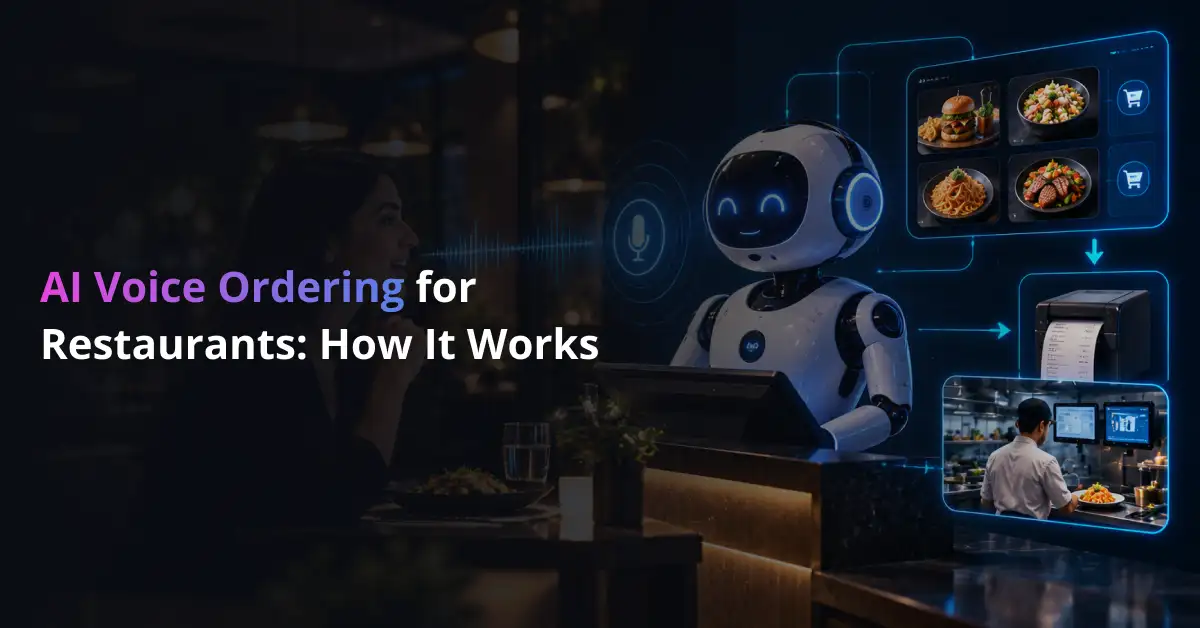
AI voice ordering for restaurants turns a spoken request into structured order data that restaurant systems can process. The workflow combines speech recognition, language understanding, live menu data, business rules, and system integrations so the AI can do more than transcribe a customer’s words.
- Voice Capture and Speech Recognition: The process starts when a customer speaks through a phone line, drive-thru microphone, kiosk, or mobile interface. Automatic speech recognition converts the audio into text. Restaurants may use patterns similar to an AI receptionist to answer calls, greet customers, and begin the ordering flow.
- Intent and Order Interpretation: The system identifies what the customer means, not just what was said. Natural language processing helps recognize item names, quantities, sizes, modifiers, substitutions, and questions. Natural language processing services can also support restaurant-specific vocabulary and conversation rules.
- Menu and Business-Rule Validation: Once the request is understood, the AI checks pricing, available sizes, required modifiers, store hours, and item availability. Connecting language models with trusted business data matters because the system should answer from current restaurant information rather than guess. Integrating LLMs with enterprise databases shows how this grounding layer can work.
- Conversation, Clarification, and Upselling: Conversational AI keeps track of context as the order develops. If a customer says, “Make that large” or changes a side midway through the conversation, the system must connect the instruction to the right item. An LLM integration can help maintain context, while a production-ready conversational model can support natural follow-up questions and relevant recommendations.
- Order Confirmation and Payment: Before submission, the AI reads back key details and lets the customer correct them. Payment may be completed through an approved payment flow, depending on the restaurant’s setup and security requirements.
- POS/KDS Submission and Human Handoff: After confirmation, the system sends structured order data to the POS or kitchen display system. AI integration services can connect the conversational layer with restaurant software, while API development supports reliable data exchange. If confidence is low or a request becomes unusual, the system can transfer the conversation to staff.
| For the Restaurant |
For the Customer |
| Menu rules and integrations are configured |
The customer speaks naturally |
| AI maps items and modifiers |
Questions and changes are handled in conversation |
| Price and availability are checked |
The order is reviewed and confirmed |
| Structured data moves to POS/KDS |
The customer receives order confirmation |
| Staff handle exceptions when needed |
A human can step in when required |
The key difference is that restaurant voice ordering is not one AI model working alone. Conversation logic, live data, and integration architecture work together to move an order from speech to kitchen execution.
Prismetric Insight: Accuracy improves when the AI is grounded in current menu data, clear modifier rules, and reliable integrations. The voice may sound natural, but the operational value comes from what happens behind the conversation.
Benefits of AI Voice Ordering for Restaurants
AI voice ordering can improve restaurant operations when it is connected to accurate menu data and reliable workflows. Its value is not limited to answering calls. A well-designed system can reduce repetitive work, support customers more consistently, and create useful data for restaurant teams. The practical impact depends on where the system is deployed and how reliably it performs.
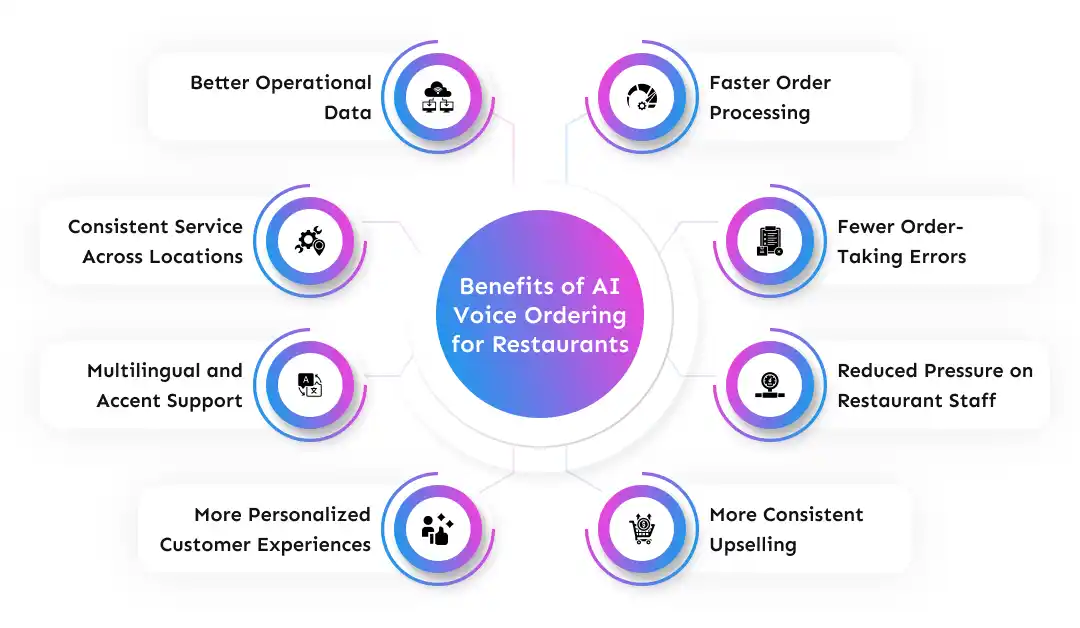
1. Faster Order Processing
Voice AI can handle an order as soon as the customer starts speaking, without waiting for a staff member to become available. It can also manage multiple conversations at once. This helps restaurants improve response times during busy periods and supports the broader goal of using AI to improve operational efficiency.
2. Fewer Order-Taking Errors
A restaurant voice ordering system can capture items and modifiers in a structured format and confirm important details before sending the order forward. This reduces errors caused by rushed note-taking or manual re-entry. Accuracy still depends on speech quality, menu configuration, and how well the system handles unclear requests.
3. Reduced Pressure on Restaurant Staff
Phone and drive-thru ordering can pull employees away from guests, food preparation, and other tasks. Restaurants can automate repetitive order-taking workflows so employees spend less time handling routine conversations. This reflects the wider use of AI workflow automation to reduce repetitive operational work.
4. More Consistent Upselling
Voice AI can apply the same upselling rules across conversations instead of relying on whether a busy employee remembers to make a suggestion. For example, it can offer a drink, larger size, side, or relevant combo after understanding the order. Voice AI agents for sales and conversions use the same principle: make suggestions when they fit the customer’s intent.
5. More Personalized Customer Experiences
When connected to approved customer or loyalty data, voice AI can recognize preferences, previous orders, or eligible rewards. This can make repeat interactions faster and more relevant. The broader role of AI in customer experience is similar: use available context to create a smoother interaction without making the process harder for the customer.
6. Multilingual and Accent Support
Modern voice systems can be designed to understand multiple languages and speech patterns, helping restaurants serve a broader customer base. Performance is not automatically equal across every language or accent, so restaurants still need real-world testing. Well-designed customer-facing conversational systems can also keep service logic consistent across supported channels.
7. Consistent Service Across Locations
Multi-location restaurants often need the same menu rules, promotions, and ordering standards across stores. Voice AI can apply centrally defined conversation logic while still using location-specific information. Features such as routing, context handling, and standardized responses are common benefits covered in broader discussions of AI voice agent features and implementation.
8. Better Operational Data
Every completed or abandoned conversation can produce useful signals, such as commonly requested items, frequent corrections, peak call periods, failed intents, or popular modifiers. Restaurants can study this information to improve menus and workflows. Over time, these insights can also support decisions about where AI may help reduce operating costs without treating cost reduction as an automatic outcome.
Connect Voice AI With Your POS, KDS, and Restaurant Systems
Integrate conversational AI with menu data, ordering systems, payments, loyalty tools, and kitchen workflows without creating disconnected operations. Pasted markdown
Discuss Your Restaurant AI Integration
8 Practical Use Cases of AI Voice Ordering in Restaurants
AI voice ordering for restaurants can support more than one ordering channel. The same conversational layer can handle calls, drive-thru requests, app interactions, and routine customer questions when it connects with the right restaurant data and systems.
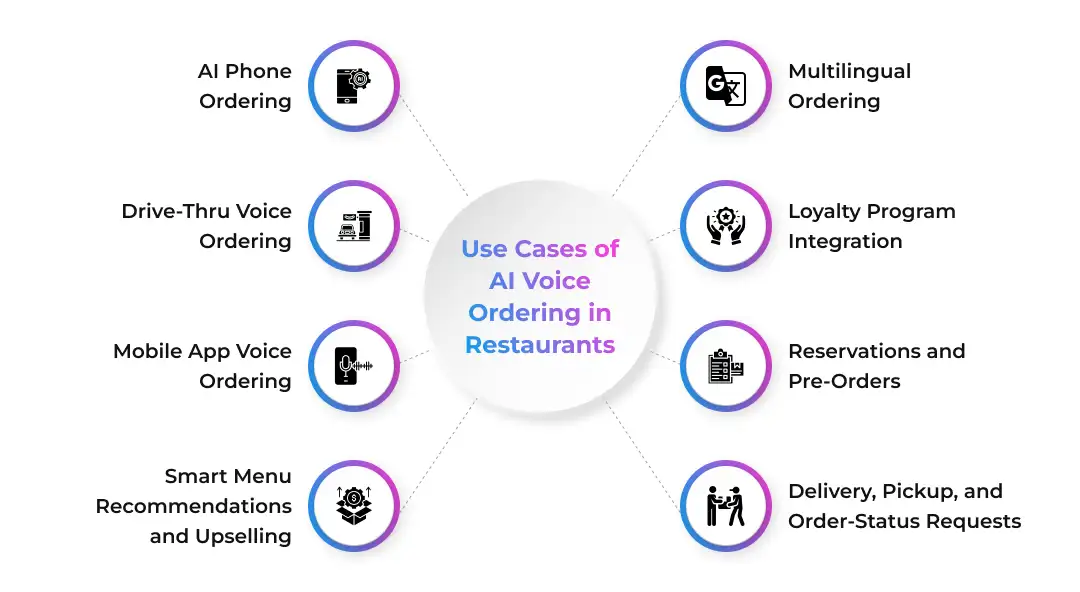
1. AI Phone Ordering
An AI phone ordering system can answer incoming calls, capture menu items, ask about modifiers, and confirm pickup details without keeping customers on hold. This is especially useful during lunch and dinner rushes when employees are already serving in-store guests.
Restaurants building these workflows can use an AI agent that understands and acts on customer requests rather than relying on a basic recorded phone menu.
2. Drive-Thru Voice Ordering
AI drive-thru ordering helps restaurants capture spoken orders while employees focus on preparation, payment, and handoff. The system can clarify unclear requests, confirm sizes, and recognize common changes such as removing ingredients or adding extras.
This use case fits the wider adoption of AI in hospitality, where conversational technology supports faster customer interactions without removing human assistance when it is needed.
3. Mobile App Voice Ordering
Voice ordering can also become part of a restaurant’s mobile experience. Instead of searching through several menu screens, a customer can describe an order and let the system guide the interaction.
Restaurants already planning to create a restaurant app can treat voice as another input method alongside search, touch navigation, and saved orders.
4. Smart Menu Recommendations and Upselling
Conversational AI can suggest relevant extras based on the active order. For example, a customer ordering a burger may receive a suggestion for fries, a drink, or an available meal combination.
The recommendation should remain relevant rather than interrupting every order. This is one example of how AI agents can take goal-based actions using context from an ongoing conversation.
5. Multilingual Ordering
Restaurants serving customers who speak different languages can configure voice AI to support multiple languages within the same ordering workflow. The system can capture an order, apply restaurant rules, and produce structured data for the kitchen.
Similar multilingual and conversational patterns are also used in enterprise chatbot systems, although voice ordering adds speech recognition and spoken responses to the process.
6. Loyalty Program Integration
When customers identify themselves and appropriate integrations are available, a restaurant voice ordering system can check rewards, previous preferences, or eligible offers. This can make repeat orders faster without requiring customers to explain the same choices each time.
Features such as profiles, personalization, offers, and repeat ordering are also common considerations when planning restaurant app features.
Prismetric Insight: Personalization works best when voice AI uses verified customer and restaurant data. The system should not guess preferences simply because it can generate a natural response.
7. Reservations and Pre-Orders
Voice AI can support reservation requests and collect meal selections before a scheduled visit where the restaurant’s workflow allows it. A customer might reserve a table, confirm the time, and submit a pre-order through one conversation.
A custom conversational assistant can connect these requests with booking or ordering systems instead of treating each interaction separately.
8. Delivery, Pickup, and Order-Status Requests
Voice ordering can continue helping after checkout by answering common questions about pickup times, delivery status, or order changes. This creates a broader service workflow instead of limiting AI to the initial purchase.
Restaurant businesses already use digital channels to support these journeys, reflecting how mobile apps have changed restaurant and food-delivery operations.
How to Implement AI Voice Ordering in Your Restaurant
Successful restaurant phone ordering automation starts with the workflow, not the AI model. Restaurants need to understand what should be automated, which systems are involved, and when employees must take control before moving the system into live operations.
1. Define the Problem and Success Metrics
Start by identifying the operational problem. It may be missed calls, long drive-thru queues, repetitive phone work, or inconsistent order capture.
An AI workflow discovery process can help restaurants map these problems before choosing technology. Set measurable goals such as order completion rate, response time, escalation rate, or abandoned-call reduction.
2. Choose the Right Voice AI Approach
Restaurants can select a ready-made platform or build a system around their own workflows and integrations. The decision depends on menu complexity, locations, required languages, data control, and customization needs.
Comparing custom AI with off-the-shelf AI helps clarify these trade-offs. Businesses with complex requirements may also use AI implementation services to plan deployment.
3. Map the Menu and Conversation Flow
The AI needs more than a list of menu items. Teams should define sizes, modifiers, combos, substitutions, unavailable items, dietary questions, and situations requiring clarification.
Starting with an AI proof of concept can help test these conversation flows before a restaurant commits to a wider rollout.
4. Integrate POS, KDS, Payment, and Restaurant Systems
The voice layer must exchange accurate information with existing systems. That includes menu data coming into the AI and confirmed order data moving into the POS or KDS.
Restaurants can use generative AI consulting support to define architecture and integration requirements while following a structured approach to implementing AI in business operations.
5. Test Real Restaurant Conversations
Testing should reflect actual restaurant conditions. Teams need to check background noise, accents, interruptions, uncommon item names, several modifiers, unavailable products, and customers who change decisions midway through an order.
An AI model testing framework helps evaluate performance systematically rather than relying only on successful demo conversations.
6. Train Employees and Design Human Handoff
Employees should understand when the AI handles a request and when the conversation moves to a person. A clear fallback process helps staff solve exceptions without forcing customers to repeat the entire order.
A limited AI MVP can make this operational testing easier before the restaurant expands across more channels or locations.
7. Monitor and Optimize Performance
Deployment is not the final step. Restaurants should monitor accuracy, completion rate, response latency, escalation frequency, failed intents, average order value, and customer complaints.
The supporting AI technology stack should make these signals measurable so teams can identify weak points and improve conversation rules over time.
Planning a restaurant voice ordering system? Prismetric can help connect conversational AI, menu logic, restaurant applications, and production workflows, including the mobile systems that support digital restaurant experiences.
AI Voice Ordering Challenges and How to Solve Them
AI voice ordering can remove repetitive work, but restaurant environments create conditions that voice systems must handle carefully. Strong performance depends on testing, reliable data, system design, and clear fallback rules rather than assuming every conversation can be fully automated.
Background Noise, Accents, and Misheard Orders
Challenge: Drive-thrus, busy kitchens, different accents, and unclear pronunciation can reduce speech-recognition accuracy. Misunderstanding a single item or modifier may change the entire order.
Solution: Restaurants should test real audio conditions and set confidence thresholds that trigger clarification or human support. Continuous AI model evaluation and testing helps teams identify speech patterns that need improvement.
Complex Menus and Modifiers
Challenge: Restaurant menus often contain sizes, substitutions, optional toppings, required choices, and rules that depend on other selections. Natural conversation makes these combinations even harder to manage.
Solution: Keep menu information structured and define clear modifier relationships. Machine learning development support can contribute to specialized recognition or prediction needs, while business rules should still control valid orders.
POS and Legacy-System Integration
Challenge: Older POS, KDS, inventory, and payment systems may not exchange information easily. Poor synchronization can cause outdated prices, unavailable-item errors, or duplicate data entry.
Solution: Restaurants should define the required data flow before launch, test integrations under realistic loads, and maintain fallback processes when a connected system becomes unavailable.
Latency, Downtime, and Peak Demand
Challenge: Voice conversations depend on fast responses. Even a capable AI system can feel difficult to use when speech recognition, model processing, or external integrations introduce long delays.
Solution: Teams should monitor response time, system availability, and infrastructure bottlenecks. Production monitoring and capacity planning help ensure that performance remains stable when order volumes increase.
Privacy, Payments, and Customer Preference
Challenge: Voice platforms may process names, phone numbers, payment information, or conversation recordings. Restaurants also serve customers who may prefer talking to an employee.
Solution: Collect only necessary information, use secure payment systems, define retention policies, and make human assistance accessible. Restaurants operating in regulated environments should also review relevant AI regulation and compliance requirements and consider how private and public LLM architectures affect data control.
Launch Voice Ordering That Works in Real Restaurant Conditions
Prismetric helps test accents, noise, complex modifiers, latency, peak demand, integrations, and human handoff before wider rollout.
Start Your Voice AI Pilot
How Prismetric Can Help Build an AI Voice Ordering System
Building AI voice ordering for restaurants involves more than connecting a speech model to a phone line. The system must understand restaurant-specific language, follow menu rules, maintain conversational context, and move confirmed orders into the right operational systems. This often requires broader restaurant AI development services that bring together voice interfaces, menu intelligence, ordering workflows, and backend integrations.
Prismetric can support this process through AI voice agent development services that connect speech recognition, conversational intelligence, business logic, and system integrations. Teams can also use AI consulting services to define the right architecture, deployment approach, and integration requirements before development begins.
A production-ready restaurant voice solution may need menu synchronization, POS/KDS connectivity, payment workflows, analytics, monitoring, and clear human escalation. Understanding how conversational AI works helps restaurants decide which interactions should stay automated and which should move to staff.
Deployment requirements can also vary by market, particularly when restaurants operate across different regions or need development support aligned with local business requirements. Prismetric supports AI initiatives across markets including the USA, Australia, and Germany, while helping businesses design systems around their existing restaurant operations and technology environment.
Businesses evaluating broader autonomous capabilities can also explore what AI agents are and how they differ from basic rule-based automation.
FAQs About AI Voice Ordering for Restaurants
AI voice ordering for restaurants uses speech recognition, natural language processing, and conversational AI to understand spoken orders. It can capture menu items, modifiers, customer questions, and confirmations before sending structured order data to restaurant systems.
The system converts speech into text, identifies the customer’s intent, and maps the request to menu data and business rules. It then checks items, quantities, modifiers, prices, and availability before continuing the conversation.
Yes, if the menu structure and conversation logic support them. The system can ask follow-up questions for sizes, toppings, substitutions, or missing choices. Restaurants should still test complex requests and define when human assistance is required.
Yes. The same conversational technology can support phone and drive-thru channels, although each environment needs different testing. Drive-thrus require stronger noise handling, while phone ordering may need call routing and simultaneous-call management.
The voice system converts a confirmed conversation into structured order data and sends it through an API or integration layer to the POS or KDS. Integration quality is critical because menu, pricing, and availability information must stay synchronized.
Cost depends on call volume, languages, menu complexity, integrations, customization, model usage, and ongoing support. Restaurants planning a custom solution can review broader AI agent development cost factors and use an AI automation ROI framework to compare expected value with implementation costs.
Not necessarily. Voice AI is better suited to repetitive ordering tasks and routine questions. Human staff remain important for exceptions, complaints, unusual requests, and hospitality. Regular AI agent evaluation helps restaurants decide where automation performs reliably and where human involvement still adds value.