Top 10 Restaurant AI Software Development Companies to Partner With in 2026
Key Takeaways
- Restaurant expertise matters alongside AI skills. A capable partner should understand ordering, reservations, inventory, customer engagement, multi-location operations, and the systems connecting these workflows.
- Integration depth can determine whether AI creates value. Restaurant AI often needs POS, CRM, loyalty, inventory, delivery, and workforce data, so workflow automation must fit existing operations.
- The right solution depends on the problem. Voice ordering, AI agents, forecasting, personalization, and analytics solve different needs, making AI workflow discovery important before development starts.
- Custom development does not always need to start big. Businesses can validate one focused use case through an MVP or proof of concept before building a larger platform.
- Vendor selection should go beyond a company list. Compare technical expertise, restaurant experience, integration capability, delivery evidence, and the questions to ask an AI development company before signing a contract.
- Scalability matters for restaurant groups. AI systems should support multiple locations, changing menus, peak order periods, and growing data volumes without adding unnecessary complexity.
Restaurants are using AI for much more than chatbots. Modern systems can support ordering, demand forecasting, inventory planning, reservations, customer personalization, and day-to-day operations. For restaurant groups that want these capabilities to work with existing POS, CRM, loyalty, and workforce systems, strong AI integration is just as important as the model itself.
This is where restaurant AI software development companies play a practical role. Instead of relying only on ready-made tools, businesses can compare custom AI with off-the-shelf AI and choose an approach that fits their data, workflows, and growth plans.
This guide compares leading restaurant AI development partners based on industry experience, technical capabilities, integration expertise, scalability, and their ability to turn restaurant problems into usable AI software.
Find the Right AI Development Partner for Your Restaurant
Prismetric helps you evaluate restaurant workflows, data, integrations, AI requirements, and scalability before committing to a development partner.
Discuss Your Restaurant AI Needs
Our Criteria for Selecting the Top Restaurant AI Software Development Companies
We evaluated each company on factors that matter when AI moves from a demo into daily restaurant operations. We focused on partners that combine restaurant knowledge with reliable AI engineering.
Restaurant Industry Experience. We looked for work involving ordering, reservations, inventory, delivery, loyalty, or multi-location operations. Knowing how to choose an AI development company helps separate relevant evidence from broad claims.
AI Engineering Expertise. Strong candidates should understand machine learning, generative AI, agents, voice systems, NLP, and predictive analytics. Their AI tech stack should fit the restaurant’s data and performance needs.
Integration Capabilities. Restaurant AI often depends on POS, CRM, reservation, inventory, payment, and workforce systems. We considered experience with AI integration architecture for existing systems.
Custom Development Capability. Partners should build around real workflows instead of only configuring existing software. Businesses can test feasibility through a focused PoC before committing to a larger system.
Data, Security, and Scalability. We considered data quality, access controls, monitoring, reliability, and multi-location growth. A structured AI model testing process helps find issues before production.
Delivery Evidence. Case studies, technical documentation, and a clear process matter. After validation, teams can turn a proven use case into an AI MVP.
Long-Term AI Capability. We also considered whether a partner can build predictive models from restaurant data and improve them as operations grow.
The Ultimate List of Restaurant AI Software Development Companies
The shortlist includes companies with restaurant software and AI engineering experience. When comparing AI implementation companies, restaurants should also check specialist areas such as AI voice agent development when phone ordering or reservations matter.
| Company |
Restaurant AI Focus |
Key Capabilities |
Best Fit |
| Prismetric |
Custom restaurant AI |
Agents, voice AI, forecasting, integrations |
Connected AI systems |
| LeewayHertz |
Hospitality AI |
GenAI, ML, NLP, agents |
Enterprise hospitality |
| Appinventiv |
Restaurant applications |
GenAI, agentic AI, analytics |
Large platforms |
| JPLoft |
AI restaurant apps |
Personalization, automation, integration |
Customer apps |
| MindInventory |
Custom restaurant software |
AI/ML, NLP, predictive systems |
Software ecosystems |
| Quokka Labs |
AI-native restaurant products |
ML, GenAI, agents, forecasting |
AI-centric products |
| MindStack Labs |
Restaurant engineering |
POS integrations, AI workflows |
Integration-heavy platforms |
| Code Brew Labs |
AI restaurant apps |
Recommendations, forecasting, analytics |
Ordering and engagement |
| SparxIT |
Restaurant operational AI |
Voice AI, forecasting, analytics |
Operational automation |
| Vegavid |
Restaurant AI agents |
LLMs, agents, automation |
Agent-led automation |
1. Prismetric
Best for: Restaurant groups that need custom AI solutions connected with existing operational systems.
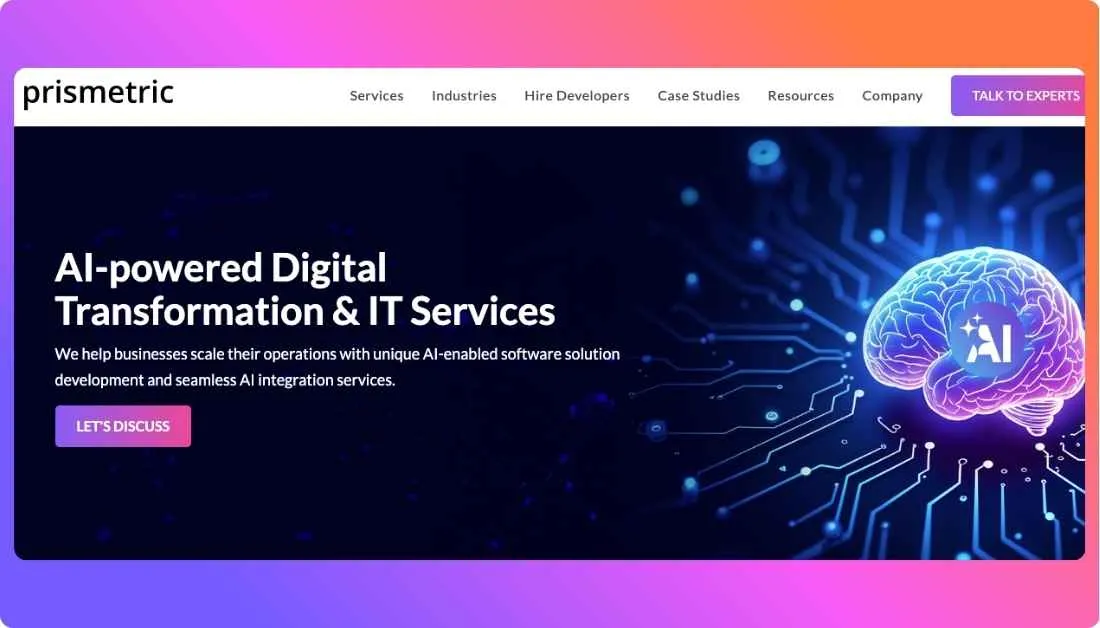
Prismetric builds restaurant-specific AI solutions for ordering, reservations, inventory, forecasting, customer engagement, and operational analytics. Its approach covers strategy, PoC and MVP validation, development, integration, deployment, and ongoing optimization rather than treating AI as a standalone feature.
The company also develops AI agents for multi-step workflows that can work across POS, CRM, ordering, reservation, inventory, and workforce platforms. For customer-facing operations, its restaurant AI offering includes voice ordering and conversational systems, making an understanding of how AI voice agents work relevant when planning phone or drive-thru automation.
Expertise:
- Restaurant AI agents and automation
- Voice ordering and conversational AI
- Demand and inventory forecasting
- Recommendation and personalization systems
- Restaurant analytics and predictive models
- POS and restaurant-system integrations
Advantages:
- PoC-to-production development process
- Human oversight and AI guardrails
- Architecture designed for multi-location growth
Industries served: Restaurants, food-service businesses, hospitality companies, and multi-location operators.
Validate Your Restaurant AI Idea Before Full-Scale Development
Start with a focused PoC or MVP to test voice ordering, forecasting, automation, or another high-value workflow before expanding across locations.
Start Your Restaurant AI PoC
2. LeewayHertz
Best for: Hospitality enterprises that need broad AI consulting and custom AI engineering.
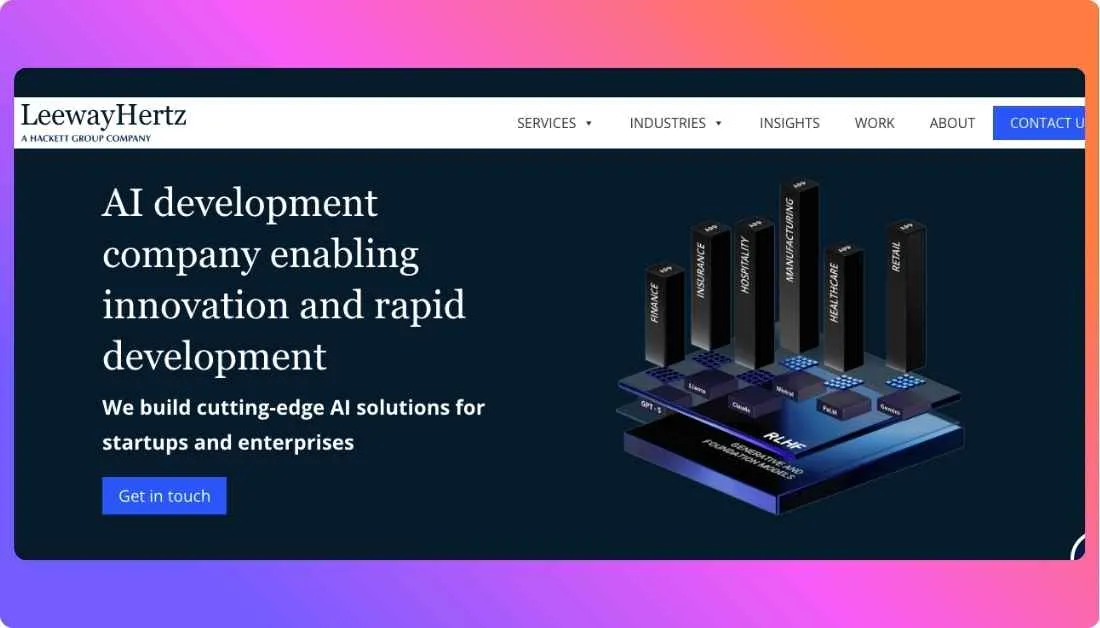
LeewayHertz provides AI consulting and development for hospitality businesses using machine learning, NLP, generative AI, computer vision, and AI agents. Its services cover custom solution development, LLM fine-tuning, data engineering, system integration, and ongoing support.
Its hospitality work includes booking systems, customer-service assistants, dynamic pricing, reservation workflows, and operational automation. Businesses evaluating these capabilities can first understand the wider generative AI development process and how technologies such as natural language processing support conversational and text-based restaurant applications.
Expertise:
- Generative AI and LLMs
- AI agents and copilots
- Machine learning and NLP
- Hospitality data engineering
- CRM and reservation integrations
Advantages:
- Broad hospitality AI coverage
- Custom enterprise integrations
- Strategy-to-maintenance support
Industries served: Hospitality organizations, including hotels, resorts, restaurant groups, and related service businesses.
3. Appinventiv
Best for: Large restaurant brands that need customer-facing applications connected with AI-driven operational tools.
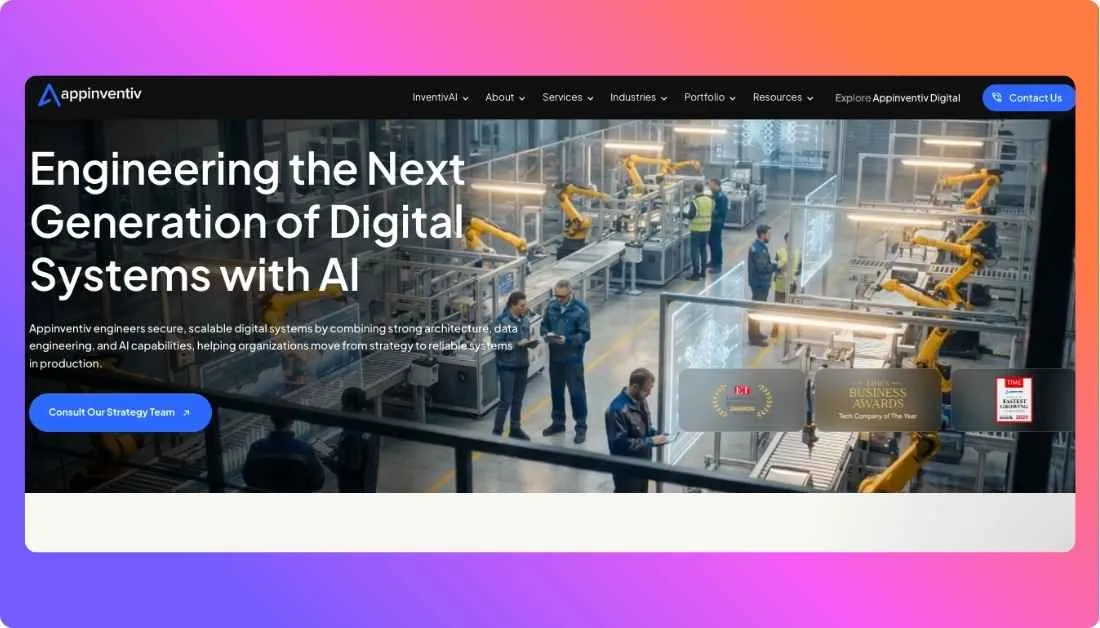
Appinventiv develops restaurant platforms for ordering, reservations, delivery, loyalty, and restaurant management. Its restaurant practice combines mobile and web engineering with AI, cloud technology, data analytics, and integrations such as POS and payment systems. The broader shift in how mobile apps have changed restaurant and food-delivery businesses shows why these functions increasingly need to work as one connected experience.
Its AI capabilities include menu personalization, inventory tracking, demand-based pricing, customer analytics, sales forecasting, and agentic automation. This makes the company relevant for restaurant enterprises that want to build scalable mobile applications while adding AI to both customer and operational workflows.
Expertise:
- AI-powered restaurant applications
- Predictive sales and demand planning
- Personalized menu experiences
- Inventory and order automation
- POS and loyalty integrations
Advantages:
- Restaurant-focused product engineering
- Mobile, web, and cloud capabilities
- Support for enterprise-scale platforms
Industries served: Restaurants, food delivery businesses, hospitality companies, and multi-location food brands.
4. JPLoft
Best for: Restaurants and food-tech businesses building AI-enabled customer-facing mobile applications.
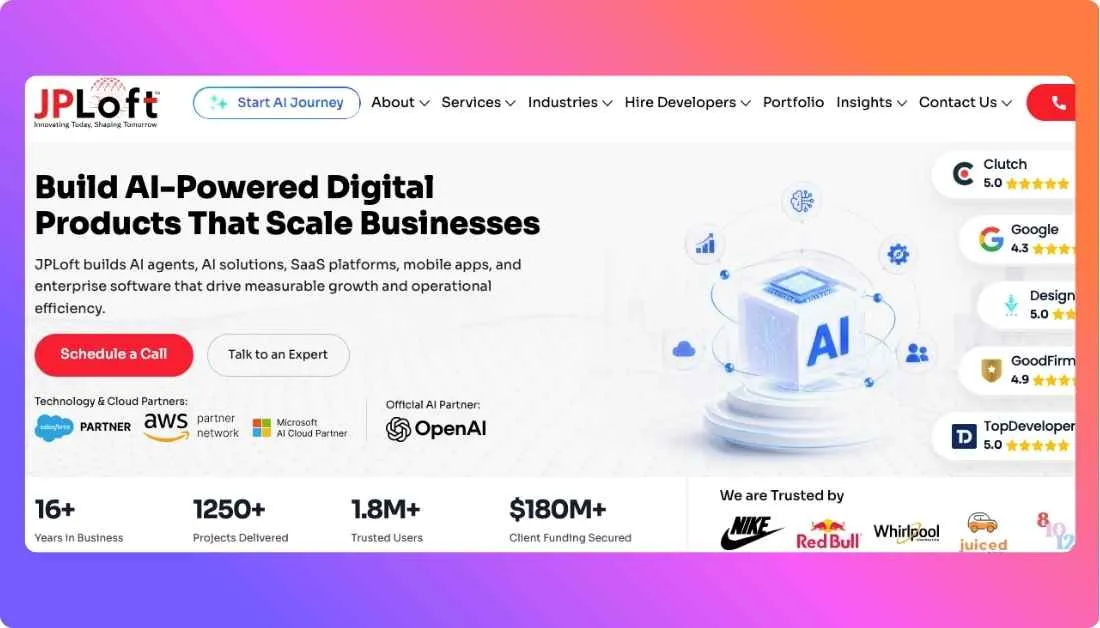
JPLoft develops restaurant applications for food ordering, reservations, delivery, loyalty, and customer engagement. Its restaurant offering includes Android and iOS development, scalable architecture, automation, and AI integration. Businesses planning similar products can first review the core process required to create a restaurant app around real operational and customer needs.
The company uses AI for personalized menu recommendations, inventory and order management, customer analytics, and feedback monitoring. These capabilities connect customer behavior with restaurant operations, helping businesses provide more relevant digital experiences while managing workflows efficiently. This also reflects the broader benefits of mobile apps for food businesses, where ordering, loyalty, and direct engagement work together.
Expertise:
- Personalized menu recommendations
- Smart order and inventory management
- Customer behavior analytics
- Reservations and table booking
- AI-powered feedback analysis
Advantages:
- Mobile-first restaurant development
- Built-in AI and automation
- Scalable app architecture
Industries served: Restaurants, cloud kitchens, food-delivery businesses, and food-tech startups.
5. MindInventory
Best for: Restaurant businesses that need custom operational software with AI and machine learning features.
MindInventory builds restaurant software for ordering, POS connectivity, customer engagement, inventory management, and omnichannel operations. Its restaurant services combine cloud-based software with AI, machine learning, and natural language processing to help businesses use customer and operational data more effectively.
Its AI capabilities include recommendation engines, chatbots, customer sentiment analysis, hyper-personalization, and predictive inventory analytics. For restaurants managing changing sales patterns, AI-based demand forecasting can help connect historical data with purchasing and stock decisions. These applications form part of the wider use of AI across the food industry, where data supports faster operational decisions.
Expertise:
- AI and machine learning
- Predictive inventory analytics
- Recommendation engines
- NLP and sentiment analysis
- Omnichannel ordering systems
Advantages:
- Custom restaurant software development
- AI and data engineering capabilities
- Support for different restaurant models
Industries served: Full-service restaurants, QSRs, cafés, cloud kitchens, franchises, and food-service businesses.
6. Quokka Labs
Best for: Restaurant brands that want AI built into the core product rather than added as a separate feature.
Quokka Labs develops restaurant software for ordering, delivery, loyalty, POS-connected operations, inventory, and multi-location management. Its restaurant practice also covers AI consulting, machine learning, generative AI, and agentic systems that can support customer and operational workflows.
The company applies AI to demand forecasting, personalized offers, guest communication, inventory alerts, and operational recommendations. It also builds LLM-powered assistants for support and internal workflows through generative AI development. For restaurants exploring autonomous workflows, understanding what AI agents are can help clarify how these systems plan and complete multi-step tasks.
Expertise:
- Generative and agentic AI
- Demand forecasting and personalization
- Restaurant operations automation
- POS and inventory integrations
- Data analytics and ML models
Advantages:
- AI-native product engineering
- Restaurant-specific integration experience
- Support for multi-location platforms
Industries served: QSRs, cafés, cloud kitchens, franchises, food-delivery businesses, and restaurant groups.
7. MindStack Labs
Best for: Restaurant businesses where POS integration, menu logic, and operational workflows are the difficult parts of development.
MindStack Labs builds custom restaurant applications, ordering platforms, admin systems, and restaurant management software. Its services cover POS, payment, delivery aggregator, loyalty, CRM, menu management, and multi-location integrations. The company also places AI inside transactional restaurant workflows rather than limiting it to standalone chatbots.
Its restaurant work includes voice-assisted ordering, analytics, menu administration, and operational software. Businesses defining a similar product can use common restaurant app features to separate essential workflows from optional functions. Integration complexity also affects the overall restaurant app development cost, especially when several operational systems need two-way synchronization.
Expertise:
- POS and payment integrations
- AI-enabled ordering workflows
- Menu and modifier management
- Multi-location restaurant systems
- Loyalty and CRM connectivity
Advantages:
- Integration-focused engineering
- Restaurant workflow knowledge
- Peak-load and transactional planning
Industries served: Independent restaurants, franchises, cloud kitchens, hospitality groups, and multi-location operators.
8. Code Brew Labs
Best for: Restaurant and food-delivery businesses focused on intelligent ordering, personalization, and customer engagement.
Code Brew Labs develops restaurant applications with ordering, reservations, delivery, customer management, and administrative tools. Its current restaurant offering includes AI-powered menu recommendations, dynamic pricing, predictive delivery estimates, inventory forecasting, chatbots, customer segmentation, and sentiment analysis.
These features use behavioral and operational data to improve the customer journey and restaurant decisions. For example, personalization can use past orders to recommend relevant dishes, while AI in customer experience can support more relevant interactions across ordering and loyalty journeys. Restaurants can also use AI chatbots to answer routine questions and assist with order-related support.
Expertise:
- AI menu recommendations
- Predictive inventory forecasting
- Dynamic pricing
- Customer segmentation
- AI chatbots and sentiment analysis
Advantages:
- Strong customer-facing AI features
- Ordering and delivery experience
- Built-in analytics and automation
Industries served: Restaurants, food-delivery businesses, cloud kitchens, food startups, and multi-location brands.
9. SparxIT
Best for: Restaurant groups that need operational AI for forecasting, voice ordering, inventory, and management analytics.
SparxIT develops AI-powered restaurant software that connects operational data with tools for demand forecasting, inventory planning, customer engagement, and restaurant management. Its restaurant AI capabilities also include voice ordering, reservation systems, personalized loyalty experiences, and management dashboards.
The company also works with computer vision for food-quality monitoring and kitchen safety, while AI models can use sales and operational data to support faster decisions. Restaurants exploring similar systems can first understand AI workflow automation and how computer vision can support business operations before deciding where automation provides practical value.
Expertise:
- AI voice ordering
- Demand and inventory forecasting
- Restaurant management analytics
- Personalized loyalty systems
- Computer vision applications
Advantages:
- Operational AI focus
- POS-connected workflows
- Custom management dashboards
Industries served: Restaurants, hospitality businesses, food-service companies, and multi-location operators.
10. Vegavid
Best for: Restaurant businesses that want AI agents to automate reservations, ordering, support, and back-office workflows.
Vegavid develops restaurant AI agents using large language models, NLP, machine learning, and workflow automation. Its solutions cover reservation management, order taking, customer support, inventory workflows, staff coordination, delivery operations, and restaurant analytics.
These agents can connect with POS platforms, CRM systems, payment gateways, delivery platforms, and inventory tools to complete multi-step tasks across restaurant operations. Businesses evaluating this approach can review common agentic AI use cases and compare the capabilities offered by AI agent development companies before choosing a development model.
Expertise:
- Reservation and booking agents
- Order management agents
- Customer-support automation
- Inventory and staff coordination
- Multi-agent restaurant workflows
Advantages:
- Strong agentic AI focus
- LLM and NLP capabilities
- Multi-location automation support
Industries served: QSRs, cloud kitchens, restaurant chains, hotel restaurants, franchises, and food-delivery businesses.
The Ultimate Cooperation Roadmap With Restaurant AI Software Development Companies
Choosing a development partner is only the beginning. A clear process helps restaurants move from an AI idea to a practical system that fits existing workflows, data, and business goals.
1. Define the Restaurant Problem You Want AI to Solve
Start with a specific operational problem instead of choosing a technology first. The goal may be to reduce missed calls, forecast demand, control inventory, improve reservations, or personalize offers. A clear AI strategy helps connect the use case with measurable business outcomes.
2. Search for Restaurant-Specific AI Expertise
Look for companies that understand both AI engineering and restaurant operations. Experience with POS systems, ordering, loyalty, inventory, reservations, and multi-location workflows reduces the learning curve. Businesses with unclear requirements can also work with AI consultants to define the right technical approach.
3. Review Relevant Projects and Case Studies
Past work shows whether a company can turn technical skills into usable software. Check projects with similar workflows, integrations, data needs, and deployment scale. When evaluating teams, the same principles used to hire AI developers can help assess technical depth, delivery experience, and problem-solving ability.
4. Assess AI and Integration Expertise
A restaurant AI solution must work with the systems already running the business. Review experience with POS, CRM, loyalty, inventory, reservations, payments, and data platforms. For data-heavy use cases, understanding how teams approach integrating AI with enterprise databases helps reveal whether the proposed architecture can support reliable information flow.
5. Evaluate Their Development Methodology
A strong partner should explain how it handles discovery, data preparation, model selection, development, testing, deployment, and monitoring. The process should also show how AI fits into the wider software development lifecycle rather than treating model development as a separate technical exercise.
6. Discuss Scope, Data, Timeline, and Budget
Define which workflows the first release covers, what data is available, which systems need integration, and how success will be measured. Cost can change significantly with model complexity, data preparation, infrastructure, and integrations, so reviewing the main AI development cost factors helps businesses set realistic expectations.
7. Interview the Actual Development Team
Meet the architects, AI engineers, developers, and project leads who will work on the system. Ask how they would handle restaurant-specific issues such as menu changes, peak ordering periods, incomplete data, integration failures, and AI errors. Their answers should show practical problem-solving skills, not only familiarity with AI terminology.
8. Validate the Idea Through a PoC or MVP
Before rolling AI across multiple locations, test the core assumption on a smaller scale. A structured AI PoC development process can confirm technical feasibility and data readiness, while an MVP can test the workflow with real users before the restaurant invests in broader deployment.
9. Define KPIs, Monitoring, and Post-Launch Support
Before deployment, define how the AI system will be measured after launch. Metrics may include order accuracy, response time, forecast error, reservation conversion, labor savings, or customer satisfaction. Restaurants can also use business intelligence services to bring operational and AI performance data into clear dashboards for ongoing review.
Benefits of Working With an Experienced Restaurant AI Development Company
A specialized development partner can help restaurants connect AI with real operational problems instead of introducing technology that works separately from existing systems.
Access Specialized Restaurant and AI Expertise
Experienced teams combine software engineering with machine learning, generative AI, data engineering, and restaurant workflows. For conversational applications, natural language processing development helps systems understand customer requests, menu terminology, and natural language more accurately.
Accelerate AI Development and Deployment
Established teams already understand model selection, integrations, testing, cloud deployment, and monitoring. For example, restaurants implementing phone automation can use voice AI development expertise instead of building speech, language understanding, and workflow orchestration from the ground up.
Integrate AI With Existing Restaurant Systems
AI creates more value when it connects with POS, CRM, loyalty, ordering, and booking systems. A restaurant can also connect AI with an existing table reservation system so availability, bookings, and customer information remain synchronized.
Reduce Technical and Implementation Risk
Experienced developers test data quality, model behavior, integrations, and fallback workflows before wider deployment. Restaurants exploring visual applications can also use computer vision development for use cases such as food-quality checks, kitchen monitoring, or occupancy analysis where appropriate.
Scale AI Across Multiple Locations
A scalable architecture helps restaurant groups handle more locations, menu changes, transaction volumes, and connected systems without rebuilding the core platform. Centralized models can support common processes while still allowing location-specific rules and data.
Turn Restaurant Data Into Business Value
AI can convert sales, inventory, customer, and operational data into forecasts, recommendations, and automated actions. These outcomes reflect the broader benefits of AI for business, where better use of data can support faster decisions and more efficient processes.
How Much Does Restaurant AI Software Development Cost in 2026?
Restaurant AI software development cost varies based on the problem being solved, data readiness, AI complexity, integrations, and deployment scale. A focused proof of concept requires far less engineering than a multi-location platform connecting several AI models with restaurant systems. Businesses can review the main AI development cost factors before defining a realistic budget.
| Project Type |
Typical Scope |
| AI PoC |
Tests one AI hypothesis, such as demand forecasting or voice ordering |
| AI MVP |
Builds one usable restaurant workflow with production-focused features |
| Mid-complexity AI platform |
Combines several AI capabilities, interfaces, and system integrations |
| Enterprise restaurant AI system |
Supports multiple locations, AI systems, data sources, and advanced integrations |
Major Cost Drivers
The largest cost factors usually include AI model complexity, the number of POS or restaurant-system integrations, data preparation, voice AI usage, custom machine learning models, and multi-location architecture. Mobile or web interfaces, security requirements, model monitoring, and post-launch support also affect the overall investment.
Restaurants should also consider expected value, not only development expense. An AI automation ROI framework can help compare implementation costs with potential labor savings, revenue improvement, waste reduction, or operational efficiency.
Development timelines depend on similar factors. Clean data and well-documented APIs can speed up delivery, while legacy systems, complex menu structures, multiple integrations, extensive model testing, and enterprise deployment requirements can extend the schedule. Starting with a focused AI MVP can help validate business value before expanding the system.
Build Restaurant AI That Connects With Your Existing Systems
Prismetric can integrate AI with POS, CRM, loyalty, ordering, reservations, inventory, and workforce platforms while planning for multi-location growth.
Talk to Our Restaurant AI Experts
Why Prismetric for Restaurant AI Software Development?
Prismetric provides restaurant-focused AI development services that cover the full path from strategy and feasibility testing to production deployment. Its restaurant AI offering includes AI agents, voice ordering, generative AI, machine learning, predictive analytics, recommendation systems, and restaurant data analytics.
The development process starts by identifying useful restaurant AI opportunities and assessing data and technology readiness. Teams can then validate the idea through a PoC, develop an MVP or production solution, and connect it with POS, CRM, ordering, reservation, inventory, and workforce systems. Prismetric also supports multi-system workflows where AI agents coordinate tasks while keeping human approval in sensitive decision paths.
After deployment, monitoring helps track model behavior, reliability, and workflow performance so the system can improve as restaurant operations change. This approach is relevant for businesses that need custom AI capabilities rather than another disconnected software tool.
Frequently Asked Questions
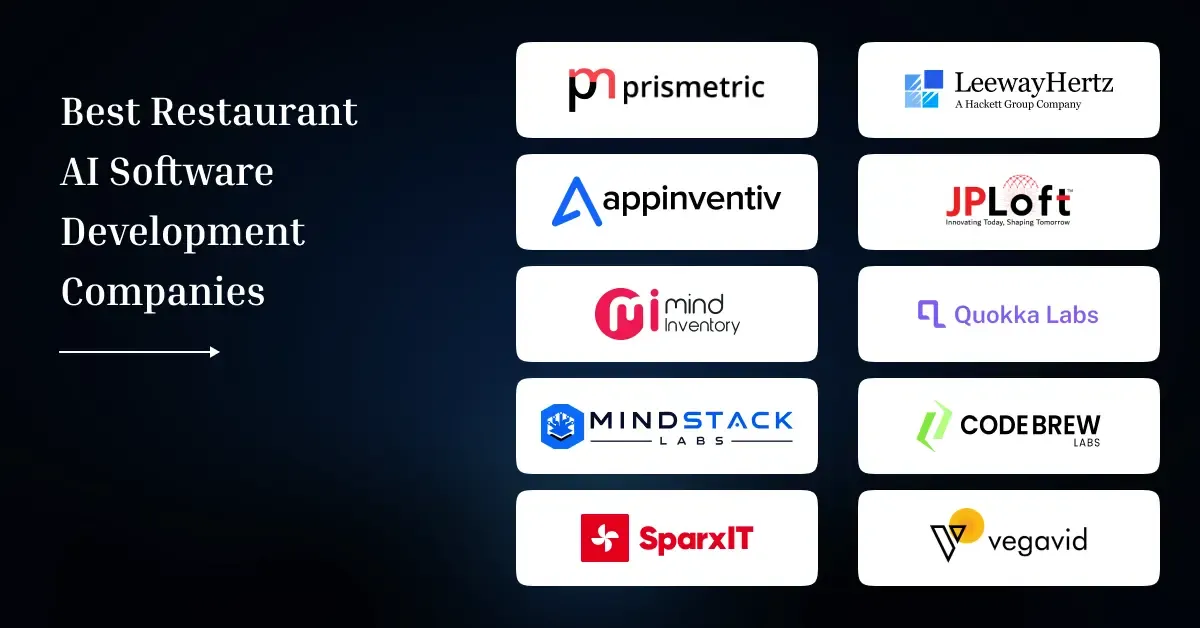
This shortlist includes Prismetric, LeewayHertz, Appinventiv, JPLoft, MindInventory, Quokka Labs, MindStack Labs, Code Brew Labs, SparxIT, and Vegavid. Each offers a different mix of restaurant software, AI engineering, integrations, and automation capabilities.
Common solutions include voice ordering, reservation agents, recommendation engines, demand forecasting, inventory optimization, customer-support assistants, predictive analytics, computer vision, and workflow automation.
Cost depends on AI complexity, data preparation, integrations, model usage, platform scope, security requirements, and deployment scale. A focused PoC or MVP generally requires fewer resources than a multi-location enterprise AI platform.
Compare restaurant experience, AI engineering skills, integration capabilities, case studies, development methodology, security practices, and post-launch support. The best fit depends on the specific problem the restaurant needs to solve.
Off-the-shelf tools can suit standardized needs and faster deployment. Custom AI makes more sense when a restaurant has unique workflows, proprietary data, complex integrations, or requirements that existing products cannot support well.
Yes, when the POS provides suitable APIs or other supported integration methods. The development team must map data carefully so orders, menus, inventory, payments, and customer information remain consistent across systems.
A PoC is useful for testing technical feasibility. An MVP is better when the restaurant needs a usable product that real employees or customers can test before wider deployment.