Top 15 AI Product Development Companies Building Production-Ready Products in 2026
Key Takeaways
- Strong providers combine AI engineering with product design, backend development, integrations, testing, deployment, and ongoing support.
- A capable partner should show production experience, because a prototype still needs reliable data, evaluation, security controls, monitoring, and cost management.
- Businesses should decide whether custom AI or off-the-shelf AI better fits their workflow, data, integration, and control requirements.
- Larger products may need enterprise AI architecture that connects models with business systems, data sources, access controls, and governance.
- The right provider depends on product scope, industry knowledge, data maturity, compliance needs, budget, and required AI capabilities.
- Prismetric provides AI development services across discovery, PoC and MVP development, integration, deployment, and post-launch improvement.
TL;DR: The best AI product development companies turn AI ideas into production-ready software. They combine product strategy, AI engineering, software development, data integration, security, deployment, and monitoring so products work with real users, business data, and existing systems.
AI adoption is widespread, but financial impact remains uneven. McKinsey’s August 2026 State of AI survey found that nearly nine in ten respondents report regular AI use in at least one business function, while only 37% report a positive contribution to enterprise EBIT. The finding shows that broad adoption has not yet translated into enterprise-level financial impact for most organizations.
For businesses comparing AI product development companies, execution matters. A company may need to build an AI app for business around a clear workflow, usable data, and measurable goals. A practical AI strategy helps teams decide where AI fits before they choose models or start development.
Turn Your AI Product Idea Into a Production-Ready Solution
Prismetric helps businesses move from AI product strategy and PoC development to MVP, integration, deployment, and long-term optimization.
Build Your AI Product
What Does an AI Product Development Company Do?
An AI product development company is a technology partner that designs, builds, integrates, deploys, and maintains AI-powered software products. It connects product requirements, software engineering, data, AI models, security, and operations into one working system.
Typical products include AI-powered SaaS platforms, enterprise copilots, intelligent search, recommendation systems, predictive applications, and AI agents. Different technologies solve different problems. Machine learning can predict outcomes from historical data, retrieval-augmented generation (RAG) can ground responses in approved knowledge, and computer vision can analyze images or video. Businesses may also build generative AI features into a product for content generation, conversational assistance, or knowledge retrieval.
Production development also requires software around the model. Teams may need APIs, data pipelines, authentication, evaluation, monitoring, cloud infrastructure, and human review points. When a product relies on ERP, CRM, databases, or legacy applications, companies may need to connect AI with existing systems instead of creating an isolated tool. This end-to-end responsibility separates AI product development companies from providers that only advise on AI or build demonstrations.
3 Types of AI Product Development Companies
AI product development companies generally fall into three groups. The right type depends on product stage, business size, technical environment, and the specialist engineering required.
- Enterprise AI and technology consultancies: Best suited to large programs involving multiple business units, complex integrations, governance, and broader AI transformation.
- AI product engineering specialists: Turn ideas into usable software through discovery, PoC, MVP, application engineering, and the wider AI software development lifecycle. They fit projects where AI is part of digital product development, not a separate experiment.
- Specialized AI and ML firms: Go deeper into RAG, machine learning, computer vision, model evaluation, or AI agents when a product needs focused technical expertise.
Choosing among AI product development companies should start with the product problem, not the provider’s brand size. A startup validating one AI feature may need a focused engineering team, while a global enterprise changing several connected workflows may need broader integration and governance support.
The 15 Best AI Product Development Companies in 2026
The top AI product development companies vary in product strategy, AI engineering depth, software delivery, and enterprise integration. This ranking favors providers that can move beyond prototypes and support usable, production-ready AI products.
Disclosure: Prismetric appears on this list. We have been transparent about our inclusion and the criteria used.
| Company |
Best For |
Core AI Strengths |
Company Type |
| Prismetric |
End-to-end custom AI products |
Agents, RAG, GenAI, ML, computer vision |
AI product engineering specialist |
| Goji Labs |
Strategy-led AI products |
RAG, agents, product design |
Digital product agency |
| ELEKS |
Enterprise AI modernization |
GenAI, agents, ML, MLOps |
Engineering consultancy |
| BairesDev |
Large AI engineering teams |
LLMs, agents, ML, GenAI |
Nearshore engineering firm |
| Itransition |
AI plus enterprise software |
GenAI, agents, ML, data |
Software engineering firm |
| Provectus |
Production AI in regulated sectors |
Agents, data, enterprise AI |
AI systems integrator |
| 10Pearls |
Enterprise agentic AI |
Agents, RAG, copilots |
Digital engineering firm |
| Master of Code Global |
Customer-facing AI |
GenAI, conversational AI, agents |
AI development specialist |
| LeewayHertz |
Governed enterprise AI |
Agents, GenAI, custom AI |
AI development company |
| Azumo |
RAG and model engineering |
RAG, fine-tuning, ML |
AI engineering company |
| Vention |
AI-enabled product engineering |
PoC/MVP, NLP, vision, ML |
Software engineering firm |
| HatchWorks AI |
AI-native products |
Agents, data, model tuning |
Pure-play AI partner |
| Globant |
Enterprise-scale AI transformation |
AI Pods, agents, AI-native services |
Technology services firm |
| Simform |
Cloud and production AI |
GenAI, ML, RAG, MLOps |
Digital engineering firm |
| IBM |
Regulated enterprise AI |
Agents, GenAI, governance |
Global technology consultancy |
Top 15 AI Product Development Companies in 2026: 15 Firms Worth Shortlisting
Explore leading AI product development companies helping businesses build, launch, and scale custom AI products, generative AI solutions, AI agents, and machine learning applications.
1. Prismetric
Prismetric builds custom AI products around business workflows, data, and existing systems. Its portfolio covers agents, RAG, generative AI, machine learning, computer vision, and monitoring. Teams can validate an AI concept before full development and later move a validated concept into an AI MVP as requirements become clearer.
Core capabilities: AI agents, RAG, GenAI, ML, computer vision
Delivery scope: Strategy through deployment and monitoring
Project evidence: Published custom AI agent platform case study
Best for: End-to-end AI and software product engineering
Need a Custom AI Product Built Around Your Business Workflow?
Build AI agents, RAG applications, generative AI features, machine learning systems, and computer vision products that connect with your existing data and software.
Discuss Your AI Product Idea
2. Goji Labs
Goji Labs combines product strategy, UX, software engineering, and AI implementation. Its AI work includes retrieval over business data, agentic workflows, foundation-model integration, evaluation, and continuous optimization. This makes it a strong fit when product discovery and user experience matter as much as the AI architecture.
Core capabilities: AI products, RAG, agents, full-stack software
Delivery scope: Strategy, design, engineering, launch, optimization
Project evidence: Public AI and digital product case studies
Best for: Strategy-led AI product development
3. ELEKS
ELEKS brings AI into wider enterprise software and modernization programs. Its current capabilities include generative AI, agentic AI, conversational AI, machine learning, intelligent automation, and MLOps. Among AI product development companies, its broader engineering base is useful when AI must work with legacy systems, security controls, and complex operations.
Core capabilities: GenAI, agents, ML, automation, MLOps
Delivery scope: Product engineering, modernization, data, security
Project evidence: 1,000+ end-to-end software projects
Best for: Enterprise AI modernization
4. BairesDev
BairesDev combines a large nearshore engineering workforce with custom AI development. Its services cover agentic systems, custom LLM applications, machine learning, generative AI products, data platforms, and model monitoring. Companies reviewing providers with proven AI implementation experience may find this model useful when they need additional senior engineering capacity.
Core capabilities: Agentic AI, LLMs, ML, GenAI, data engineering
Delivery scope: Staff augmentation, dedicated teams, outsourcing
Project evidence: 1,480+ projects for 500+ companies
Best for: Scaling AI engineering teams
5. Itransition
Itransition combines software engineering with data and AI services. Its portfolio includes generative AI, agents, machine learning, computer vision, and analytics. This breadth helps when teams need to connect LLMs with enterprise databases or compare fine-tuning, prompt engineering, and RAG within a larger product architecture.
Core capabilities: GenAI, agents, ML, computer vision, data
Delivery scope: Consulting, engineering, implementation, support
Project evidence: 800+ clients across 40 countries
Best for: AI integrated with enterprise software and data
6. Provectus
Provectus focuses on enterprise AI applications, infrastructure, and production operations. Its work connects models with company data, cloud resources, tools, permissions, monitoring, and cost controls. This makes the firm relevant when an AI product needs a broader AI tech stack rather than a standalone model or chatbot. Provectus also builds systems that support deployment and ongoing AI operations.
Core capabilities: Enterprise AI applications, AI infrastructure, agents, data systems
Delivery scope: Architecture, engineering, deployment, monitoring
Project evidence: Public enterprise AI frameworks and production systems
Best for: Complex AI products that need enterprise infrastructure and operational controls
7. 10Pearls

10Pearls combines AI product engineering with data, integration, MLOps, governance, and security. Its current AI services cover generative AI, RAG, copilots, predictive models, and single- or multi-agent systems. Companies can evaluate AI agents before expanding their autonomy, while teams that need implementation support can build governed AI agents with defined permissions and human approval points. 10Pearls reports more than 700 completed projects and 225 enterprise clients.
Core capabilities: Agentic AI, RAG, GenAI, ML, MLOps
Delivery scope: Consulting, development, integration, governance, managed AI
Project evidence: 700+ projects across 225+ enterprise clients
Best for: Enterprise AI products that require governance and integration
8. Master of Code Global
Master of Code Global develops AI agents, generative AI applications, and conversational systems for customer and internal workflows. Its agent-development approach covers business goals, architecture, APIs, guardrails, deployment, and continuous monitoring. This lifecycle is useful when businesses want to identify suitable AI workflows before they automate multi-step business processes. The company reports more than 1,000 delivered projects and ISO 27001 certification.
Core capabilities: AI agents, GenAI, conversational AI, voice AI
Delivery scope: Consulting, pilots, development, integration, support
Project evidence: 1,000+ delivered projects
Best for: Customer-facing AI and workflow automation
9. LeewayHertz
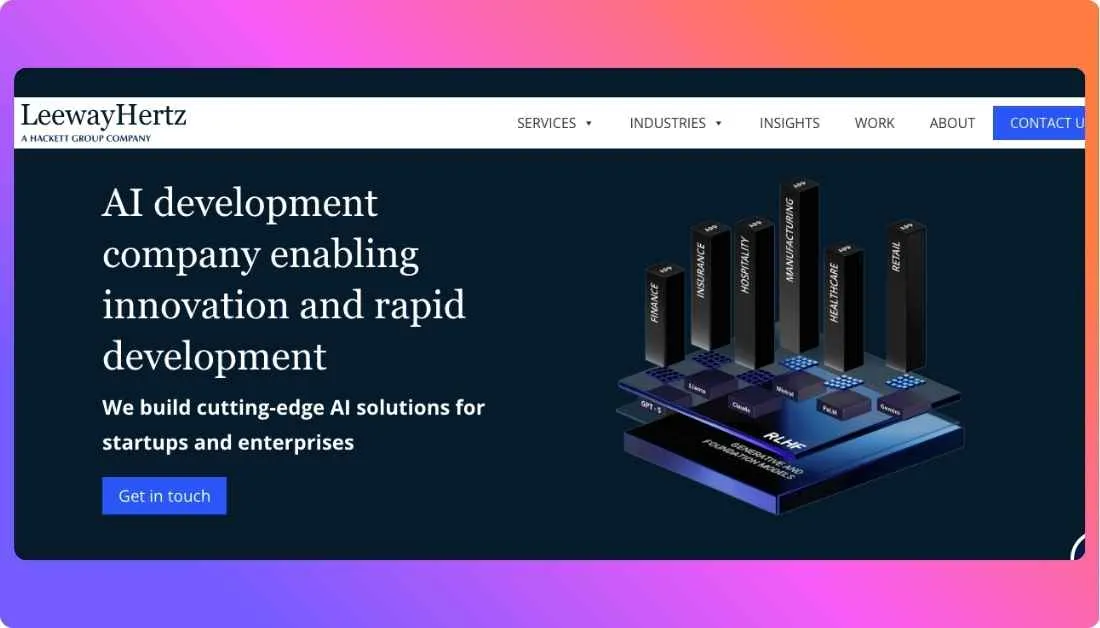
LeewayHertz combines AI engineering with software development, data engineering, and enterprise integration. Its capabilities include AI agents, machine learning, NLP, computer vision, recommendation systems, and generative AI. The company also emphasizes governance through access management, human oversight, monitoring, and evaluation. These capabilities matter when businesses need an AI integration architecture for legacy systems rather than replacing existing enterprise software.
Core capabilities: Agents, GenAI, ML, NLP, computer vision
Delivery scope: Strategy, software development, integration, deployment
Project evidence: 160+ digital solutions reported by the company
Best for: Enterprise AI products with governance and legacy integration needs
10. Azumo

Azumo builds production AI systems across agents, RAG, computer vision, NLP, generative AI, model evaluation, and fine-tuning. Its approach separates retrieval problems from model problems and tests systems against real project data before scaling them. That distinction matters because teams may need to reduce LLM inference costs or build an enterprise RAG application without automatically training a custom model. Azumo also states that it operates deployed systems and improves models after launch.
Core capabilities: RAG, agents, fine-tuning, computer vision, ML
Delivery scope: PoC, development, production deployment, operation
Project evidence: Published production RAG and computer vision implementations
Best for: AI products requiring deeper model, retrieval, and evaluation engineering
11. Vention
Vention combines AI engineering with full-cycle software product development. Its services cover AI product development, agents, machine learning, NLP, computer vision, quality engineering, and ongoing maintenance. This breadth helps when companies need to integrate an LLM into an application while also building the backend, interfaces, infrastructure, and testing needed around the model.
Core capabilities: AI agents, ML, NLP, computer vision, AI-enabled products
Delivery scope: Discovery, product engineering, quality assurance, maintenance
Project evidence: Public AI product and software engineering portfolio
Best for: AI products that require broader software engineering support
12. HatchWorks AI
HatchWorks AI focuses on AI-native products, agentic automation, data modernization, and model optimization. Its approach connects AI strategy with engineering and adoption, which can help businesses avoid treating model development as a separate technical project. Teams can measure AI automation ROI before scaling investment and fine-tune models for specific business tasks when general-purpose model behavior is not enough.
Core capabilities: AI-native products, agents, model tuning, ML, data modernization
Delivery scope: Strategy, development, adoption, AI and data transformation
Project evidence: Published enterprise client work across multiple industries
Best for: AI-native products tied closely to enterprise data
13. Globant

Globant serves large organizations that need AI across products, workflows, and technology operations. In 2026, it introduced Glob.AI and AI Pods, where specialized AI agents perform defined tasks under human supervision. This model reflects how agent swarms and coordinated AI systems can divide complex work while keeping people accountable for outputs.
Core capabilities: Agentic AI, AI Pods, enterprise platforms, software engineering
Delivery scope: AI adoption, modernization, engineering, managed operations
Project evidence: Current enterprise AI platform and major technology partnerships
Best for: Large-scale AI adoption across complex organizations
14. Simform
Simform combines product engineering with AI, data, cloud, and enterprise-platform services. Its current capabilities include agentic AI, machine learning, AIOps, data integration, product modernization, and agentic software development. This makes it relevant when AI products need reliable infrastructure and AI-supported DevOps practices alongside model development. Companies with predictive use cases can also develop machine learning models as part of the wider application architecture.
Core capabilities: Agentic AI, ML, AIOps, data platforms, product engineering
Delivery scope: Product, data, cloud, AI, enterprise integration
Project evidence: Published engineering case studies and AI accelerators
Best for: AI products with substantial cloud and engineering requirements
15. IBM
IBM combines AI consulting, software platforms, hybrid-cloud experience, data services, and governance. Its current AI work covers strategy, agentic AI, enterprise integration, and systems designed for controlled deployment at scale. Organizations comparing cloud and on-premise LLM deployment may find this breadth useful when data residency, security, or existing infrastructure limits where models can run.
Governance is a particular strength. IBM expanded watsonx.governance in 2026 to improve visibility, monitoring, policy controls, and accountability across AI models and agents, including assets running on third-party platforms. This makes IBM a strong fit for regulated or complex enterprise environments where controlling AI after deployment matters as much as building it.
Core capabilities: Agentic AI, GenAI, governance, data, hybrid cloud
Delivery scope: Strategy, engineering, integration, governance, operations
Project evidence: Enterprise AI consulting and watsonx ecosystem
Best for: Large and regulated enterprise AI programs
How an AI Product Goes From Idea to Production
A working prototype is only one step in AI product development. Gartner reported in January 2026 that at least 50% of generative AI projects had been abandoned after proof of concept by the end of 2025 because of poor data quality, weak risk controls, rising costs, or unclear business value. This shows why production planning needs to start before launch.
A typical path moves through discovery, data planning, PoC or MVP development, evaluation, integration, deployment, and monitoring. Businesses that want to implement AI in business workflows should define success measures and human review points early. They can then move validated AI into production with security and monitoring in place. Enterprise products may also need to integrate AI with SAP and ERP systems or scale AI across enterprise systems without replacing existing applications.
How to Evaluate an AI Product Development Company
The best AI product development companies can explain how they turn a business problem into a maintained production system. Evaluate shortlists against these criteria:
- Production evidence: Look for deployed products and measurable project outcomes.
- Product engineering: Check UX, backend, APIs, testing, cloud infrastructure, and AI capabilities.
- Technical depth: Relevant skills may include RAG, agents, evaluation, computer vision, and large language model development services.
- Data and integration: Assess how models connect with databases, APIs, ERP platforms, and governed business data.
- Security and governance: Check access controls, privacy, auditability, human oversight, and compliance experience.
- Commercial fit: Compare AI development cost factors, ownership terms, engagement models, and AI agent costs by complexity.
- Post-launch support: Ask how the team monitors quality, drift, latency, and model spend.
McKinsey’s 2026 State of AI survey found that about one in five respondents said AI operating costs, including token costs, had constrained AI use. This makes cost control an ongoing product requirement, not only a budgeting exercise. Businesses can use questions to ask an AI development company and a framework to select the right AI development partner before signing an engagement. When the opportunity is still unclear, AI consulting services can help define use cases, data requirements, and delivery priorities.
How Prismetric Builds Production-Ready AI Products
Prismetric connects business requirements with product engineering and AI delivery. Work can move from discovery and validation through architecture, application development, model integration, testing, deployment, and monitoring.
Depending on the product, teams can ground model responses in enterprise knowledge through RAG or use AI for business intelligence to help users analyze operational data. Broader programs may require support to scale AI across enterprise systems while keeping integrations, access controls, and human oversight inside the architecture.
Validate Your AI Product Before Investing in Full Development
Start with a focused AI PoC or MVP to test feasibility, user value, data quality, integrations, model performance, and business impact before scaling.
Start Your AI Product MVP
Case Study: AI-Powered Platform for Building Custom AI Agents
One Prismetric project involved a no-code platform designed to simplify custom AI-agent development. The client wanted businesses to configure and deploy agents without relying on large specialist teams.
Challenges
- Agent development required specialist machine learning and NLP skills.
- Traditional development increased cost and deployment time.
- The product needed CRM and enterprise integrations.
Solution
Prismetric built a no-code agent builder with templates, configurable behavior, NLP, API and CRM integrations, workflow automation, and analytics. Its published case study reports 12× faster development, 68% cost reduction, 93% process automation, and 100% code ownership.
The underlying product-engineering approach can also support teams that need to develop visual inspection and image-analysis systems, although computer-vision products require different data and evaluation methods.
Wrapping Up
No single provider is the best choice for every AI product. Companies should match the partner to the problem, data, integrations, compliance needs, budget, and required AI skills. Production evidence and clear ownership matter more than a long list of AI tools.
Frequently Asked Questions
An AI product development company designs and builds AI-powered software around a defined business or user problem, then supports integration, deployment, evaluation, and maintenance.
Review production evidence, product-engineering depth, integration skills, security practices, domain knowledge, ownership terms, and post-launch support.
Cost depends on scope, data readiness, integrations, model choice, security, and deployment complexity. A PoC generally costs less than a production product with ongoing monitoring.
Common technologies include LLMs, RAG, machine learning, AI agents, NLP, and computer vision. The right stack depends on the workflow and product requirements.
Yes. AI in digital transformation can support automation, knowledge access, analytics, and decision support when models connect to governed data and existing workflows.