AI Voice Agent Architecture and Telephony Stack: How It Works
Key Takeaways
- AI is becoming a practical part of asset management, helping firms improve investment research, portfolio analysis, risk monitoring, client servicing, and operational workflows.
- The biggest benefits come from faster analysis and greater efficiency, as AI processes large volumes of market, portfolio, and research data while reducing repetitive manual work.
- AI works best as decision support, not a replacement for investment professionals. Human judgment, validation, oversight, and accountability remain essential for high-impact decisions.
- Data quality and governance determine AI reliability. Poor data, model bias, security risks, limited explainability, and weak controls can undermine otherwise promising AI initiatives.
- Asset managers should start with clearly defined, high-value use cases, pilot them with appropriate controls, measure measurable outcomes, and scale only after proving value.
- The next phase of AI adoption will increasingly involve agentic and integrated workflows, but competitive advantage will still depend on proprietary data, investment expertise, disciplined processes, and client trust.
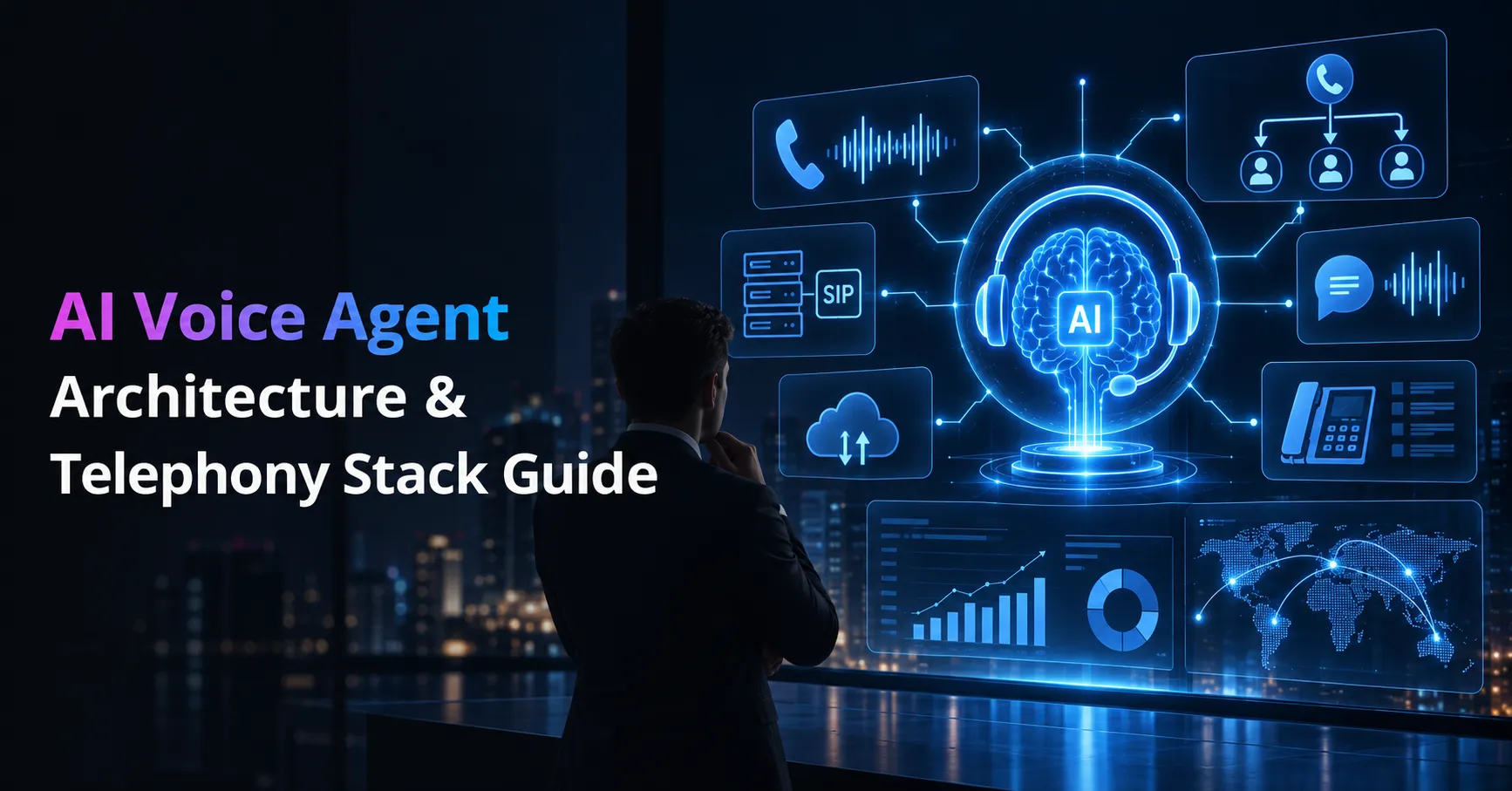
Building an AI voice agent for a live phone call is different from connecting a language model to a microphone. The system must answer or place a call, move audio through telecom infrastructure, understand speech as it arrives, choose an action, and respond quickly enough to keep the conversation natural.
That is why AI voice agents span two connected environments: the telephony stack and the AI conversation stack. One handles carrier connectivity, SIP sessions, and media transport. The other manages speech recognition, orchestration, business tools, and speech synthesis.
This guide follows that call path from the public telephone network to the AI runtime and back to the caller, focusing on production architecture, latency, integrations, reliability, and control.
AI Voice Agent Architecture at a Glance
An AI voice agent is not a single model. It is a connected system combining telecom infrastructure with speech processing, reasoning, business tools, and operational controls. Looking at these layers separately makes latency, failures, and integration points easier to understand.
| Layer |
Core Components |
Primary Responsibility |
| Telephony |
PSTN, SIP, SBC, RTP |
Connect calls and transport media |
| Conversation |
VAD, STT, LLM, TTS |
Understand speech and generate responses |
| Action |
Memory, RAG, APIs, tools |
Retrieve data and complete tasks |
| Operations |
Security, monitoring, evaluation, failover |
Keep the system reliable |
The conversational AI layer manages interaction, while AI agents add tool use and workflow execution. This is why the difference between chatbots, AI agents, and LLM apps matters when planning the architecture.
For production systems,AI voice agent development services can help connect these layers into one controlled call flow.
Build the Right Architecture for Your AI Voice Agent
Prismetric helps design the complete voice stack across telephony, STT, LLM orchestration, TTS, tools, and enterprise integrations.
Plan Your Voice AI Architecture
How an AI Voice Agent Handles a Live Phone Call
A live AI voice call passes through several systems, with many stages running at the same time instead of waiting for the previous step to finish completely.
- The caller dials a provisioned phone number.
- The carrier routes the call through the PSTN.
- SIP establishes and manages the session.
- RTP carries the caller’s audio stream.
- Voice activity detection identifies speech and turn boundaries.
- Speech-to-text streams partial and final transcription.
- The orchestrator sends conversation state to the LLM.
- The agent retrieves knowledge or invokes an approved tool.
- Text-to-speech begins generating the response.
- Audio streams back while interruption logic stays active.
This streaming design is central to AI voice agent implementation because processing every stage one after another would make calls feel slow. Teams that need more control over memory, tools, and business rules may build an AI agent around the voice pipeline or use a custom AI agent development approach for complex enterprise workflows.
Core Components of the AI Conversation Stack
The AI conversation stack turns live audio into a useful response. Each layer has a different job, so separating them makes latency, errors, and integration problems easier to trace.
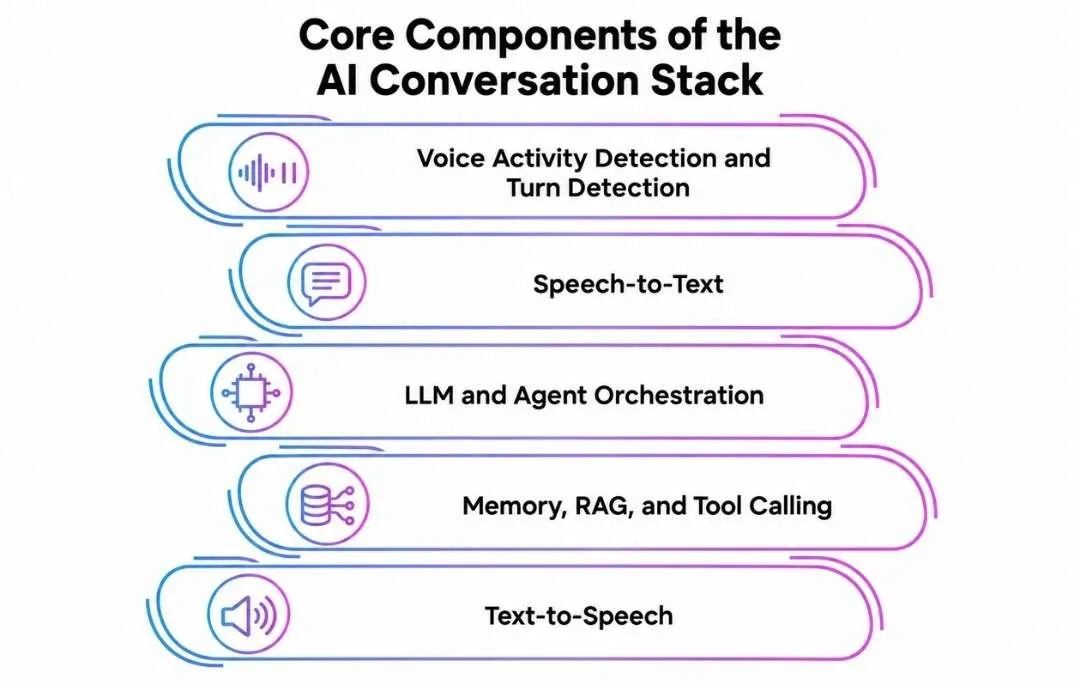
Voice Activity Detection and Turn Detection
Voice activity detection identifies when speech is present. Turn detection estimates when the caller has finished speaking.
- Separate speech from silence and background noise.
- Detect conversational start and end points.
- Handle pauses without cutting callers off.
- Support barge-in when callers interrupt.
Poor endpointing can make a capable model feel slow or cause the agent to respond before the caller is finished.
Speech-to-Text
Streaming speech-to-text converts incoming audio into partial and final transcripts. Enterprise calls also require accurate capture of names, dates, addresses, account numbers, and product terms.
Teams handling domain-specific language may need stronger natural language processing and speech-processing support for normalization, intent handling, and validation.
LLM and Agent Orchestration
The LLM generates or selects a response. The orchestrator controls how that response fits into the workflow.
- Maintain conversation state.
- Apply instructions and business rules.
- Route requests to suitable models.
- Control tool permissions and fallbacks.
- Handle errors and escalation.
This distinction matters when designing an LLM application stack or comparing current LLM options. For complex systems, enterprise LLM development can focus on model selection, orchestration, and controlled execution.
Memory, RAG, and Tool Calling
Short-term memory keeps the conversation coherent. Retrieval-augmented generation supplies approved business knowledge, while tools let the agent perform actions in external systems.
A practical stack may combine RAG with tool interfaces. The distinction between MCP and RAG helps clarify whether the agent needs information, executable capabilities, or both.
Text-to-Speech
Text-to-speech turns the response into streamed audio. Production systems need fast first audio, pronunciation, pacing, and immediate cancellation when a caller interrupts.
The goal is not just a realistic voice. TTS must behave predictably under latency and telephony-quality audio constraints.
Telephony Stack for AI Voice Agents
The telephony stack connects the AI runtime to real phone networks. It handles call setup, routing, media transport, transfers, and controls that do not exist in a simple browser microphone demo.
Phone Numbers, Carriers, and PSTN Routing
A production deployment usually starts with provisioned phone numbers. Those numbers connect callers to a carrier, which routes the call across the Public Switched Telephone Network before it reaches the voice application.
Key requirements include:
- Inbound and outbound call support.
- Caller ID and number presentation.
- Regional number availability.
- Routing rules for different destinations.
- Capacity for concurrent calls.
These choices affect reach, call quality, compliance, and how traffic can be redirected if a provider becomes unavailable.
SIP Signaling and SIP Trunking
Session Initiation Protocol, or SIP, handles call signaling. It establishes, modifies, transfers, and terminates voice sessions.
A SIP trunk provides the IP connection between the carrier or enterprise telephony environment and the voice application. SIP manages the session; the audio normally travels over a separate media protocol.
For teams building an AI receptionist, this layer determines how calls are answered, routed, transferred, and ended.
Session Border Controllers
A session border controller, or SBC, sits at the edge of a voice network and controls traffic between systems.
Typical responsibilities include:
- Enforcing signaling and media policies.
- Protecting network boundaries.
- Handling SIP interoperability.
- Managing routing and topology hiding.
- Supporting media anchoring or transcoding.
The SBC is part of the telephony control plane, not the AI layer.
RTP, Codecs, and Media Transport
Real-time Transport Protocol carries audio packets after the call is established. Codecs such as G.711 encode and decode that audio for network transport.
Packet loss, jitter, buffering, network distance, and transcoding can reduce call quality or add delay. Telephony design therefore contributes directly to the voice AI latency budget.
| Component |
Primary Role |
| PSTN |
Public telephone connectivity |
| SIP |
Call and session signaling |
| SIP trunk |
IP connectivity between carrier and application |
| SBC |
Boundary control, routing, and interoperability |
| RTP |
Real-time audio transport |
| Codec |
Audio encoding and decoding |
| WebRTC |
Real-time media for browsers and applications |
Call Control, Transfers, and Human Handoff
Production systems also need DTMF input, call recording where permitted, queue routing, call termination, and transfer to a person.
A warm transfer passes context before the caller reaches the human agent. A cold transfer moves the call without that assisted handoff. Both require clear fallback logic.
Voice AI agents for sales still need reliable transfer paths when a conversation requires a person. Teams moving these controls into production may also need broader AI implementation support across telephony, orchestration, testing, and deployment.
Cascaded, Speech-to-Speech, and Hybrid Voice Architectures
Voice agents can use separate speech and language components or models that process audio more directly. The choice depends on control, latency, auditability, integrations, and deployment requirements.
| Criterion |
Cascaded STT → LLM → TTS |
Speech-to-Speech |
Hybrid |
| Control |
High |
Platform dependent |
High |
| Transcript visibility |
Strong |
Varies |
Available where needed |
| Latency |
Multiple streamed stages |
Fewer intermediate stages |
Path dependent |
| Provider choice |
Flexible |
More consolidated |
Flexible |
| Debugging |
Easier by stage |
Less transparent |
Moderate |
| Tool orchestration |
Explicit |
Platform dependent |
Explicit where required |
| Best fit |
Controlled enterprise workflows |
Real-time conversation |
Balance of speed and control |
Cascaded systems suit workflows that need transcripts, provider choice, or control over tools and business logic. Speech-to-speech can shorten the processing path, although integration and observability depend on the platform.
Hybrid designs can use direct audio where it helps while retaining text-based orchestration for tools or governed actions. Teams comparing options should review LLM integration patterns and inference cost optimization. Generative AI consulting can help evaluate architecture tradeoffs before implementation.
Latency, Barge-In, and Turn-Taking Design
A fast model does not guarantee a fast voice agent. Perceived responsiveness depends on the entire call path, including endpointing, transcription, orchestration, tool execution, speech synthesis, and network return. Small delays across several layers can combine into a noticeably awkward pause.
End-to-End Latency = Network + Endpointing + STT + Orchestration + LLM + Tools + TTS + Network Return
Key latency contributors include:
- Slow end-of-turn detection.
- LLM time to first token.
- CRM, database, or API calls.
- TTS time to first audio.
- Network distance, jitter, and transcoding.
Turn-taking adds another challenge. The agent must detect barge-in, stop audio that is already playing, preserve conversation state, and resume without repeating or losing context.
Teams should measure more than averages. p50 shows typical performance, while p95 exposes slower calls that users are more likely to notice. A practical AI agent evaluation process should test latency together with interruption handling, tool success, and recovery behavior. AI model testing should also include realistic telephony audio, background noise, and concurrent calls rather than only clean microphone recordings.
Enterprise Integration and Action Architecture
A voice agent becomes operationally useful when it can read from and write to business systems. That requires controlled tool execution, authenticated APIs, and clear rules for which actions the agent is allowed to perform.
Tool Calling and API Execution
A production tool layer should define:
- Structured input and output schemas.
- Authentication and authorization checks.
- Validation before side effects.
- Retry and idempotency rules.
- Timeouts and error handling.
MCP can provide a standardized way to expose tools, while direct APIs may be better for tightly controlled enterprise workflows.
CRM, ERP, Calendars, and Business Systems
Typical actions include retrieving customer history, checking an order, booking an appointment, updating CRM notes, or creating a support ticket. Integrating LLMs with enterprise databases can provide context, while legacy-system integration may require adapters or middleware.
Well-designed enterprise APIs keep those interactions predictable. AI integration services and AI workflow automation services can help connect these actions without giving the model unrestricted system access. Speech provides the interface; integrations provide the operational value.
Connect Voice AI With the Systems That Power Your Business
Integrate AI voice agents with CRM, ERP, calendars, databases, APIs, and enterprise tools using controlled permissions and reliable workflows.
Discuss Your Voice AI Integration
Production Reliability, Observability, and Security
Production voice agents need more than accurate responses. Teams also need traceability, security controls, failure handling, and clear escalation paths when the automated flow cannot complete the task.
Observability and Conversation Tracing
Each call should produce a trace that links the session ID with transcription, model output, retrieval results, tool calls, TTS timing, errors, and transfer outcomes. This makes it easier to locate whether a failure started in telephony, speech processing, orchestration, or an external business system.
| Metric |
What It Reveals |
| p50/p95 turn latency |
Typical and slow-path responsiveness |
| Entity accuracy |
Reliability of captured business data |
| Tool success rate |
Whether actions complete correctly |
| Interruption success |
Quality of barge-in handling |
| Task completion |
Whether the workflow reached its goal |
| Human transfer rate |
Where automation reaches its limits |
Security and Governance
Controls should cover authentication, least-privilege access, encryption, PII handling, recording consent, audit logs, and restrictions on high-impact actions. AI compliance requirements vary by industry and jurisdiction, so governance should follow the specific deployment context.
Failover and Human Escalation
Plan for carrier outages, provider timeouts, failed tool calls, and degraded model behavior. A safe fallback may include retries, a restricted mode, or transfer to a human with the conversation context attached.
AI model testing and AI agent evaluation should include these failure paths before launch. Teams can also use an AI workflow discovery process to identify actions that need human approval or stricter controls. Enterprise AI development support can help design monitoring, scaling, and recovery controls around the complete call stack.
Modular vs. Full-Stack Voice AI Platforms
A modular stack lets teams select separate providers for telephony, STT, LLMs, TTS, and orchestration. A full-stack platform packages more of those layers together and can reduce setup work.
| Factor |
Modular Stack |
Full-Stack Platform |
| Provider control |
Higher |
Platform dependent |
| Development effort |
Higher |
Lower |
| Customization |
High |
Varies by platform |
| Vendor management |
Multiple providers |
More consolidated |
| Switching flexibility |
Higher by component |
Potential platform dependency |
| Best fit |
Complex workflows |
Faster standard deployments |
The right choice depends on integration depth, compliance needs, engineering capacity, and how often teams expect to change providers. A custom stack may fit workflows with unusual routing or data requirements, while a platform can shorten implementation.
A broader custom AI vs. off-the-shelf AI comparison can help frame that decision. Teams should also consider AI agent development cost before choosing an architecture. An AI proof of concept can test call quality, latency, and integration assumptions before a larger rollout.
Implementation Blueprint for an AI Voice Agent Stack
Implementation works best when the team starts with one bounded call workflow and validates the full path before adding more intents, tools, or regions.
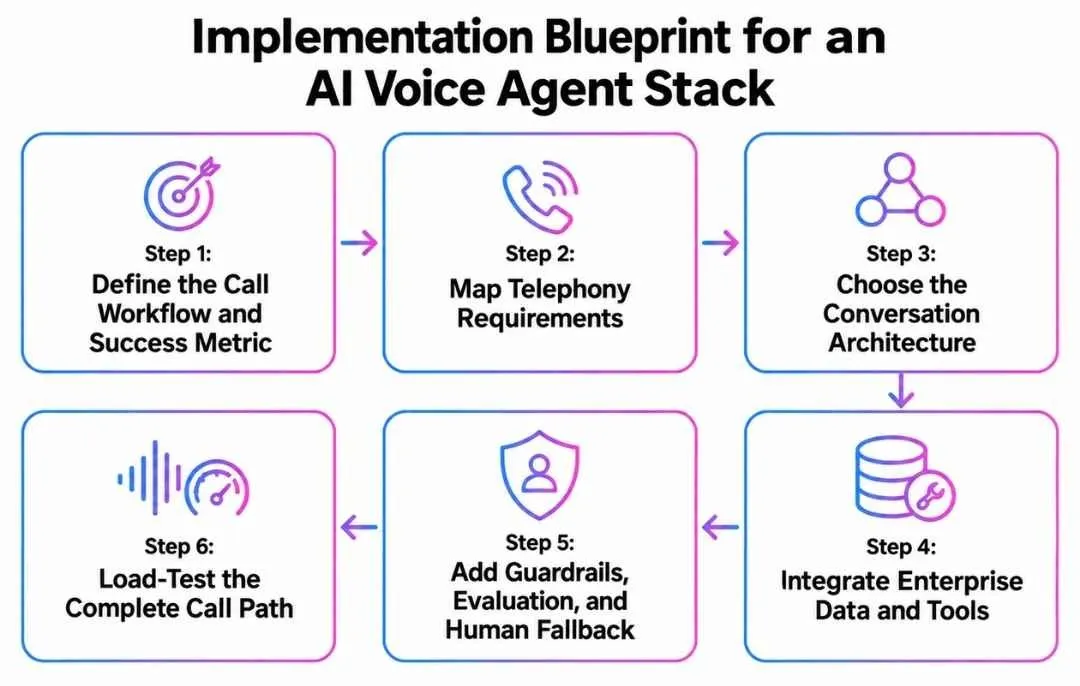
Step 1: Define the Call Workflow and Success Metric
Specify what the caller needs to accomplish, where human approval is required, and how success will be measured. An AI automation ROI framework can connect technical metrics with business outcomes.
Step 2: Map Telephony Requirements
Document phone numbers, countries, inbound or outbound traffic, transfers, recording rules, concurrency, and carrier failover.
Step 3: Choose the Conversation Architecture
Select cascaded, speech-to-speech, or hybrid processing based on latency, auditability, model control, and integration requirements. Prompting, RAG, and fine-tuning solve different problems, so customization should follow a tested need.
Step 4: Integrate Enterprise Data and Tools
Connect only the systems required for the workflow. AI workflow automation should define permissions, validation, retries, and side effects. Governed knowledge retrieval may use RAG as a service when the agent needs approved enterprise information.
Step 5: Add Guardrails, Evaluation, and Human Fallback
Test risky actions, ambiguous inputs, failed tools, and escalation paths.
Step 6: Load-Test the Complete Call Path
Measure carrier-to-agent performance under realistic concurrent traffic, not only isolated model latency.
Move Your Voice Agent From Demo to Production
Prismetric helps test latency, barge-in, tool execution, failover, security, observability, and human handoffs before you scale call volume.
Talk to Our Voice AI Experts
How Prismetric Can Support Production Voice AI Architecture
Organizations may need a custom development partner when voice workflows span telephony providers, enterprise systems, strict latency targets, regulated data, or complex human handoffs. The main challenge is coordinating these layers so the complete call path remains observable, secure, and controllable as call volume grows.
Prismetric can support architecture planning, voice-agent development, enterprise integrations, orchestration, evaluation, testing, and production deployment. Its generative AI development services can also support custom model workflows and connected applications where packaged platforms do not match the required architecture, security controls, integration depth, or business process.
Frequently Asked Questions About AI Voice Agent Architecture
AI voice agent architecture is the system design that connects telephony, real-time audio processing, speech recognition, language models, orchestration, business tools, and speech synthesis. It defines how a caller’s voice moves through the system, how the agent decides what to do, and how the response returns to the caller.
The telephony stack manages the connection between phone networks and the AI runtime. It typically includes phone numbers, carriers, PSTN routing, SIP signaling, SIP trunks, session border controllers, RTP media transport, codecs, call control, recording, transfers, and failover mechanisms.
SIP and RTP serve different purposes. SIP manages call signaling, including starting, modifying, transferring, and ending a session. RTP carries the live audio packets after the session is established. In simple terms, SIP controls the call while RTP transports the voice.
Neither architecture is better for every use case. Speech-to-speech can reduce intermediate processing and support highly responsive conversations. A cascaded STT–LLM–TTS pipeline gives teams more control over transcripts, models, tools, auditing, and debugging. Enterprise systems may also combine both approaches.
There is no single latency target that fits every workflow. Teams should measure the complete conversational turn, including endpointing, transcription, model processing, tool calls, speech synthesis, and network transport. Consistent p95 performance and reliable interruption handling often matter more than one fast average response.
Voice agents usually connect with CRMs, ERPs, scheduling platforms, databases, and support systems through authenticated APIs or controlled tools. These integrations allow the agent to retrieve customer information, update records, book appointments, check order status, and trigger approved workflows during a call.
Yes. Voice agents can transfer calls when a request falls outside their permissions, confidence thresholds, or supported workflow. A well-designed handoff can pass conversation context, collected information, and the reason for escalation so the customer does not need to repeat everything.
Prismetric can design voice AI systems around the organization’s actual call workflow rather than forcing every use case into a fixed platform. The approach can cover telephony architecture, speech processing, agent orchestration, enterprise integrations, testing, deployment, monitoring, and human-handoff requirements.
Yes. Prismetric can connect voice agents with existing APIs, databases, CRMs, workflow platforms, and other enterprise applications where the required interfaces are available. The integration architecture can include authentication, permission controls, structured tool calls, validation, and fallback handling for failed transactions.
A custom architecture becomes useful when an organization has complex call routing, specialized integrations, strict data controls, unusual workflow logic, multiple regions, or specific latency requirements. Simpler use cases may be served effectively by an existing full-stack voice AI platform.
Prismetric can help turn a working prototype into a production system by addressing telephony integration, concurrency, latency, security controls, observability, failure recovery, enterprise integrations, evaluation, and deployment. The goal is to test the complete call workflow rather than only the underlying AI model.