What Is AI Transformation? A Practical Guide to Strategy, Roadmap & Enterprise Scale
Key takeaways:
- AI transformation goes beyond adopting AI tools; it redesigns end-to-end business workflows, decisions, products, and operating models around AI.
- Sustainable AI transformation depends on three connected pillars process, people, and platform with governance providing the controls needed to scale responsibly.
- A practical AI transformation roadmap moves from readiness assessment and high-value use-case prioritization to foundation building, workflow pilots, integration, and enterprise-wide scaling.
- Data silos, legacy-system integration, weak governance, model reliability, skills gaps, and stalled pilots are among the biggest barriers to production-scale AI transformation.
- AI transformation success should be measured through business outcomes such as faster workflows, lower costs, better customer experiences, higher productivity, improved quality, and reduced risk—not by the number of AI tools deployed.
Artificial intelligence is already part of everyday business. Teams use AI to summarize documents, generate content, analyze data, answer customer questions, and automate repetitive tasks. But using a few AI tools does not mean an organization has transformed.
AI transformation happens when a business redesigns how work gets done, how decisions are made, and how value is created by embedding artificial intelligence across its operations. It goes beyond isolated experiments and connects AI with business processes, people, data, technology, and governance.
For organizations pursuing enterprise AI, the real objective is not to use more AI. It is to build a business that can apply AI consistently, responsibly, and at scale.
What Is AI Transformation?
AI transformation is the strategic, organization-wide integration of artificial intelligence into core business processes, decision-making, products, services, and operating models to improve performance and create new sources of value.
The important word here is transformation.
A company may use artificial intelligence without changing the way the business operates. An employee might use a generative AI assistant to draft an email, summarize a meeting, or create a report. These are useful examples of AI adoption, but their impact is usually limited to individual tasks.
AI transformation changes the broader workflow.
Consider customer service. In a basic AI adoption scenario, an agent might use a chatbot to help draft a response. In a transformed customer-support operation, AI could identify customer intent, retrieve account information, recommend or execute an appropriate action, update connected systems, and route complex situations to a human employee.
The difference is not simply better software. It is a redesigned operating process.
Organizations may combine technologies such as machine learning, generative AI, predictive analytics, intelligent automation, and AI agents depending on the problem being solved.
Turn AI Experiments Into a Clear Transformation Roadmap
Prismetric helps assess AI readiness, prioritize high-value use cases, and build a practical roadmap across workflows, data, technology, people, and governance.
Plan Your AI Transformations
AI Adoption vs. AI Transformation
| Area |
AI Adoption |
AI Transformation |
| Scope |
Individual tools or use cases |
Multiple workflows, teams, and business functions |
| Primary goal |
Improve a specific task |
Redesign how the business operates and creates value |
| Example |
Using AI to summarize customer tickets |
AI interprets requests, retrieves context, resolves routine cases, and escalates exceptions |
| Organizational change |
Limited |
Process, people, technology, data, and governance changes |
| Success measurement |
Tool usage or productivity |
Business outcomes, adoption, efficiency, quality, and risk |
This distinction matters because organizations can deploy dozens of AI tools and still struggle to achieve meaningful business results. Successful transformation requires connecting AI capabilities to the processes where decisions and work actually happen.
AI transformation is also related to digital transformation, but the two are not identical. Digital transformation focuses on using digital technologies to modernize systems, services, and operations. AI transformation builds on that digital foundation by introducing systems that can analyze, generate, predict, recommend, and increasingly perform parts of business workflows.
Why Is AI Transformation Important for Businesses?
The value of AI transformation comes from changing business outcomes rather than simply increasing the number of AI tools in use.
1. Improve Operational Efficiency
AI can reduce repetitive manual work, shorten process cycles, and help teams handle larger workloads without simply adding more steps or systems.
The biggest gains often come when companies redesign the entire workflow instead of automating one isolated task. This is why organizations increasingly explore AI workflow automation and broader business process automation as part of their transformation efforts.
2. Make Faster, Better-Informed Decisions
AI systems can analyze large volumes of operational and customer data faster than manual analysis alone. They can identify patterns, surface anomalies, forecast likely outcomes, and provide decision-makers with relevant information when it is needed.
The goal is not to remove human judgment from every decision. It is to give people better context and automate decisions that are repetitive, well-defined, and sufficiently controlled.
3. Improve Customer Experience
AI can make customer interactions faster, more personalized, and more consistent across channels.
For example, businesses can use AI to understand customer intent, recommend next actions, personalize offers, predict support needs, or help employees respond with better information. When these capabilities are connected across the customer journey, AI-powered customer experience becomes part of the operating model rather than a standalone chatbot project.
4. Create New Products, Services, and Business Models
AI transformation is not only about reducing costs.
Companies can use AI to build intelligent products, introduce new digital services, personalize experiences at scale, and create capabilities that were previously too expensive or technically difficult to deliver.
That is why the business benefits of AI increasingly extend beyond productivity into innovation, revenue growth, and competitive agility.
The 3 Pillars of AI Transformation
A sustainable AI transformation depends on three interconnected pillars: process, people, and platform.
Treating only one of these areas as the transformation usually creates problems. A strong model with poor data will underperform. A modern platform without employee adoption will remain underused. Automating a poorly designed process can simply make inefficiency happen faster.
1. Process: Redesign How Work Gets Done
Process transformation starts by examining how work currently moves through the organization.
Before choosing an AI model or automation platform, businesses should identify:
- repetitive tasks;
- decision bottlenecks;
- manual handoffs;
- fragmented workflows;
- areas where employees repeatedly search for information;
- processes with measurable cost, speed, or quality problems.
An AI workflow discovery process helps determine where AI can create meaningful value and where traditional automation or process improvement may be more appropriate.
The objective should not be to place AI on top of every existing process. Instead, organizations should ask a more important question:
If this workflow were designed today with AI available from the beginning, how should it work?
That mindset separates genuine transformation from simple automation.
Businesses that need to redesign and automate end-to-end processes may also use AI workflow automation services to connect AI capabilities with existing systems and operational requirements.
2. People: Build AI Skills, Trust, and Adoption
Technology cannot transform an organization if employees do not understand when, why, or how to use it.
AI transformation therefore requires more than technical training. Leaders need to establish clear priorities, employees need practical AI literacy, and teams need guidance about where human judgment remains essential.
Important areas include:
- executive sponsorship;
- role-specific AI training;
- reskilling and upskilling;
- change management;
- experimentation;
- clear accountability;
- employee trust and feedback.
Employees should understand both the capabilities and limitations of AI systems. This reduces unrealistic expectations while helping teams identify practical ways to improve their work.
Successful transformation also gives employees a role in redesigning workflows. People closest to a process often understand its exceptions, bottlenecks, and real-world constraints better than a centralized technology team.
3. Platform: Build the Data and Technology Foundation
AI needs reliable access to the information and systems required to perform useful work.
A transformation platform may include data infrastructure, machine learning systems, large language models, APIs, enterprise applications, security controls, monitoring tools, and integration layers.
A well-designed AI technology stack should make it possible to move from experimentation to repeatable, production-ready AI capabilities.
Data is particularly important. Organizations need accurate, accessible, governed information that AI systems can use without exposing sensitive data or creating conflicting versions of the truth.
This often requires stronger data engineering services and the ability to integrate AI with existing enterprise systems, databases, APIs, and legacy applications.
Governance Connects All Three Pillars
Governance should not be treated as an afterthought once AI is already deployed.
It acts as a control layer across process, people, and platform. Organizations need policies covering data access, privacy, security, model quality, explainability, human oversight, accountability, and regulatory requirements.
For higher-risk decisions, businesses may also need explainable AI practices that help teams understand how important outputs or recommendations are produced.
Effective governance does not exist simply to restrict AI. Its purpose is to make AI dependable enough to scale.
When process, people, platform, and governance develop together, AI can move beyond isolated experiments and become part of how the organization actually operates.
Redesign Business Workflows Around AI, Not Just Add More Tools
Prismetric helps connect AI with enterprise data, applications, approvals, and business processes to reduce manual work and improve operational efficiency.
Explore AI Workflow Transformation
AI Transformation Roadmap: From Experimentation to Enterprise Scale
AI transformation works best as a staged business initiative rather than a collection of disconnected technology projects. Organizations need to identify valuable problems, build the right foundation, test solutions in real workflows, and scale what produces measurable results.
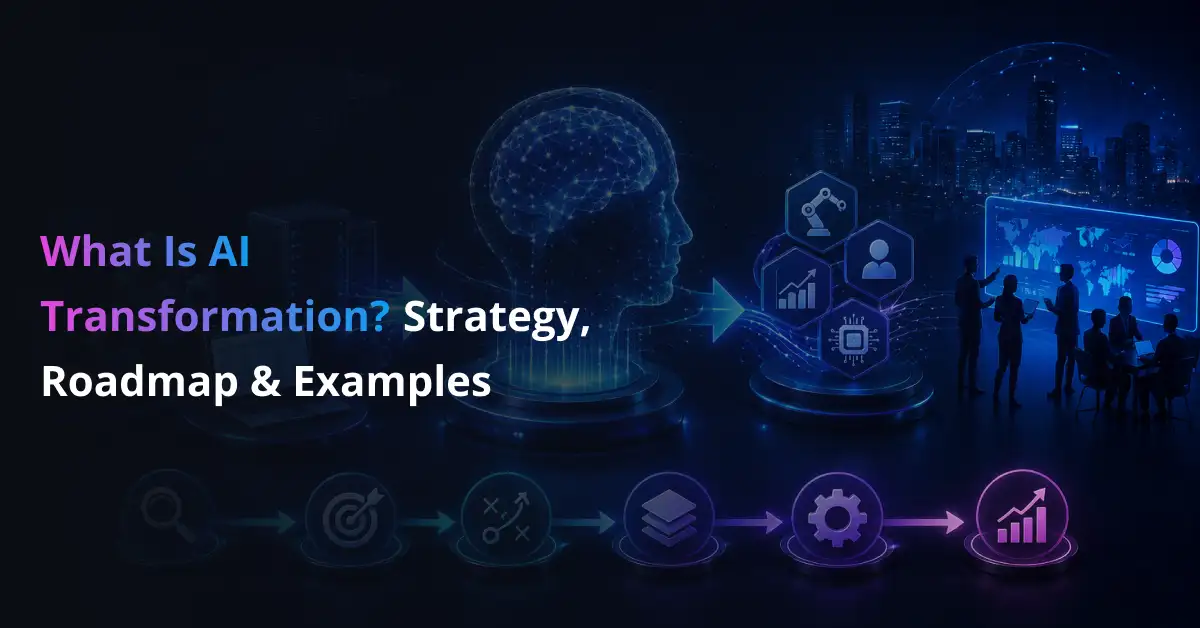
A practical AI transformation roadmap can be organized into five steps.
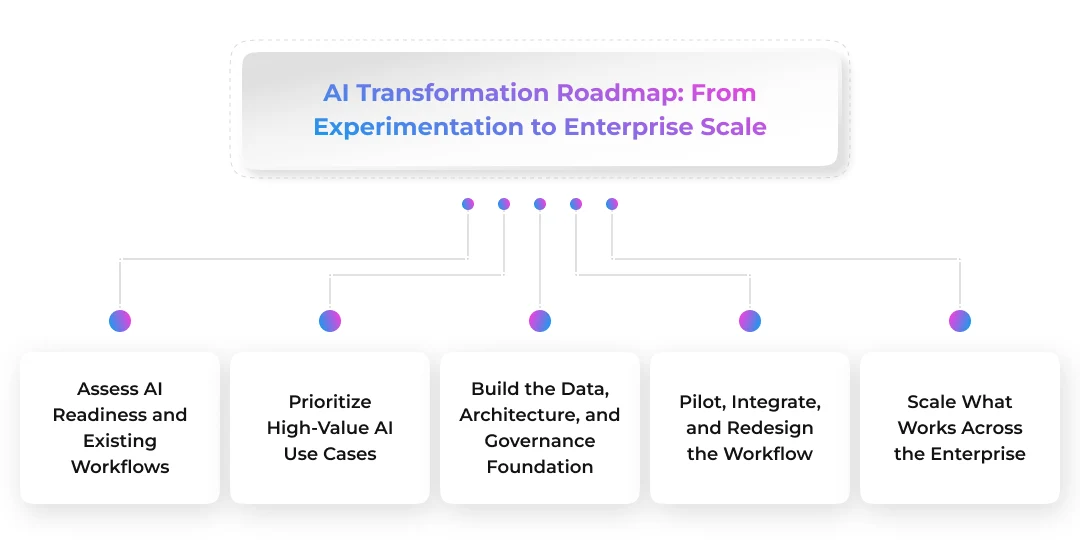
Step 1: Assess AI Readiness and Existing Workflows
Start by understanding where the organization stands today.
An AI readiness assessment should examine:
- existing business processes;
- current AI tools and experiments;
- data availability and quality;
- legacy systems and integrations;
- employee capabilities;
- security and compliance requirements;
- governance maturity.
The goal is to identify where AI can solve a real operational problem rather than searching for places to use AI simply because the technology is available.
Teams should also document how work moves between people, applications, databases, and departments. This often exposes repetitive work, delays, duplicated effort, and decision points where AI could provide meaningful support.
Step 2: Prioritize High-Value AI Use Cases
Not every process deserves AI investment.
Organizations should evaluate potential use cases based on three factors:
Business impact: Will the initiative improve revenue, cost, speed, customer experience, quality, or another important outcome?
Technical feasibility: Is the required data available, and can AI be integrated into the existing workflow?
Risk: What could happen if the system produces an incorrect output or takes an inappropriate action?
For example, businesses exploring generative AI use cases may begin with knowledge retrieval or employee assistance before moving into higher-risk autonomous processes.
Similarly, agentic AI use cases become valuable when a workflow requires systems to reason through multiple steps, interact with tools, and complete bounded tasks with limited human intervention.
Organizations that need help identifying where these technologies make business sense can use generative AI consulting services before committing resources to full-scale development.
Step 3: Build the Data, Architecture, and Governance Foundation
Once use cases are prioritized, the organization needs an architecture capable of supporting them reliably.
This may involve:
- consolidating relevant data;
- building secure data pipelines;
- defining access permissions;
- connecting enterprise applications;
- selecting appropriate AI models;
- establishing evaluation and monitoring processes;
- creating governance controls.
The right technical approach depends on the use case.
For instance, an organization building an enterprise knowledge assistant may need to determine whether RAG or fine-tuning is more appropriate. A system that needs current internal knowledge might benefit from retrieval-augmented generation, while other applications may require additional model customization.
For more advanced implementations, businesses may use RAG as a service or large language model development services to connect AI applications with approved enterprise knowledge and business systems.
Step 4: Pilot, Integrate, and Redesign the Workflow
A pilot should test more than whether an AI model can generate a good response.
It should test whether AI can function successfully inside the real business process.
That includes examining:
- output quality;
- user adoption;
- integration reliability;
- response times;
- exception handling;
- human approval points;
- security;
- measurable business impact.
A practical AI implementation should therefore include both technical deployment and workflow redesign.
For example, adding an AI assistant beside a customer support platform may save agents a few minutes. Integrating AI directly with ticketing, customer records, knowledge systems, and escalation rules can change the entire support process.
Businesses moving from proof of concept to production may require AI implementation services to connect models, applications, governance controls, and existing operational systems.
Step 5: Scale What Works Across the Enterprise
A successful pilot is not the end of AI transformation.
The next challenge is turning isolated success into a repeatable organizational capability.
Scaling requires businesses to:
- standardize successful approaches;
- create reusable AI components;
- integrate systems across departments;
- train employees;
- monitor performance;
- strengthen governance;
- continuously identify new use cases.
This is where many AI initiatives stall. A solution that works for 20 users may face very different requirements when deployed across thousands of employees, multiple business units, or regulated environments.
Organizations may therefore need enterprise AI development services to move successful AI applications into secure, scalable production environments.
The AI transformation process should remain continuous. As models improve, business priorities change, and employees become more capable with AI, organizations should repeatedly evaluate where workflows can be redesigned further.
AI Transformation Examples Across Business Functions
The easiest way to understand AI transformation is to compare isolated AI adoption with redesigned AI-enabled workflows.
Customer Service
AI adoption: A support agent uses AI to draft a response.
AI transformation: AI identifies customer intent, retrieves account history, searches approved knowledge, recommends or performs an action, updates the support system, and routes complex cases to a human.
This may involve a combination of conversational systems, enterprise data, and AI agents capable of completing controlled multi-step tasks.
Operations
AI adoption: A manager uses AI to summarize operational reports.
AI transformation: AI continuously analyzes operational data, predicts delays or bottlenecks, recommends corrective actions, and triggers approved workflows automatically.
This changes AI from a reporting tool into part of the operating process itself.
Sales and Marketing
AI adoption: A marketer uses generative AI to produce campaign copy.
AI transformation: AI helps identify promising leads, personalize communications, recommend next-best actions, update CRM records, and coordinate follow-ups across the sales process.
The shift is from content generation to an interconnected decision and execution system.
IT and Software Development
AI adoption: Developers use an AI coding assistant.
AI transformation: AI becomes embedded across requirements analysis, development, testing, documentation, incident response, and application modernization.
Companies building these capabilities at production scale may use broaderAI development services or specialized machine learning development services depending on the application.
Across each example, the pattern is the same: AI transformation changes the complete workflow, while AI adoption usually improves an individual task.
Common AI Transformation Challenges
AI transformation rarely fails because an organization cannot access an AI model. The bigger obstacles are usually fragmented data, legacy systems, weak governance, unclear ownership, and difficulty turning experiments into reliable business processes.
Understanding these barriers early helps organizations build an AI transformation strategy that can move beyond pilots and deliver measurable results.
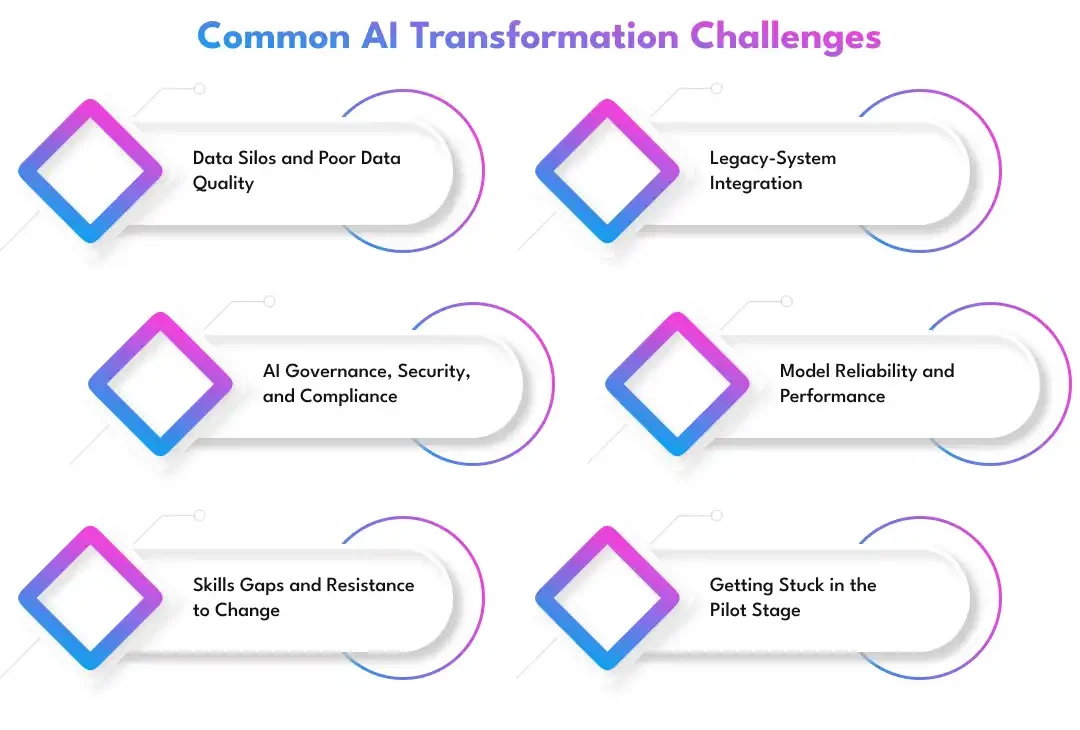
1. Data Silos and Poor Data Quality
AI is only as useful as the information it can access.
When customer, financial, operational, or product data is scattered across disconnected systems, AI may work with incomplete context and produce unreliable results. Duplicate records, outdated information, inconsistent formats, and unclear data ownership can make the problem worse.
This becomes especially important when integrating LLMs with enterprise databases, where businesses must provide useful context without exposing information users or AI applications should not access.
Before scaling AI, organizations should establish clear data ownership, improve quality, and define secure access rules.
2. Legacy-System Integration
Most established businesses cannot replace their ERP, CRM, databases, and other core systems just to support AI.
The challenge is making new AI capabilities work with the technology already running the business.
A carefully designed AI integration architecture for legacy systems can connect models with existing applications through APIs, middleware, data pipelines, and controlled integration layers.
Without this foundation, AI often remains a standalone tool rather than becoming part of the real workflow.
3. AI Governance, Security, and Compliance
The deeper AI moves into business operations, the more important governance becomes.
Organizations need policies that define:
- which data AI systems can access;
- who is responsible for AI-generated actions;
- where human approval is required;
- how models and outputs are monitored;
- how sensitive information is protected;
- how decisions can be audited;
- which regulatory requirements apply.
Businesses operating in regulated environments should consider AI regulation and compliance during planning rather than waiting until deployment.
Strong AI governance makes transformation safer and easier to scale because teams know what AI systems are permitted to do and where additional controls are required.
4. Model Reliability and Performance
An impressive prototype does not automatically make an AI system production-ready.
Real business environments introduce incomplete information, unusual requests, adversarial inputs, changing data, and edge cases that may never appear during an initial demonstration.
A structured AI model testing process should evaluate accuracy, consistency, latency, failure modes, security, and escalation behavior before a system is trusted with important workflows.
Businesses should also choose the right degree of autonomy. A chatbot, LLM application, and autonomous agent solve different types of problems. Understanding the difference between an AI chatbot, AI agent, and LLM app can prevent unnecessary complexity and risk.
5. Skills Gaps and Resistance to Change
Employees are more likely to use AI effectively when they understand what the technology is expected to improve and how their roles fit into the redesigned workflow.
Problems arise when organizations introduce AI without sufficient training, communicate only the technology rather than the business purpose, or ignore concerns about accuracy and accountability.
Leaders should involve employees in process redesign, provide role-specific AI education, create feedback channels, and establish clear boundaries between automated actions and human judgment.
6. Getting Stuck in the Pilot Stage
Many organizations successfully experiment with AI but struggle to move those experiments into production.
A pilot may demonstrate technical feasibility while still lacking:
- integration with core systems;
- workflow ownership;
- production infrastructure;
- governance controls;
- employee adoption;
- measurable KPIs.
Businesses that need to align technology choices with broader organizational goals may use AI consulting services to connect AI opportunities with implementation, governance, and scaling requirements.
The goal should not be to accumulate AI pilots. It should be to turn the right pilots into repeatable business capabilities.
How to Measure AI Transformation Success
AI transformation cannot be measured simply by counting how many AI tools a company has deployed.
The most meaningful metrics show whether AI is improving the business outcome that originally justified the investment.
| Measurement Area |
Example KPIs |
| AI adoption |
Active users, utilization rates, AI-enabled workflows |
| Operational efficiency |
Cycle time, hours saved, throughput, error reduction |
| Business impact |
Revenue growth, cost reduction, conversion rate, productivity |
| Customer impact |
Response time, resolution rate, CSAT, retention |
| AI quality and risk |
Accuracy, failed actions, escalations, compliance incidents |
For example, an AI automation initiative designed to improve efficiency should measure time, cost, errors, or throughput rather than simply prompt volume.
Organizations evaluating financial impact can also examine how AI helps businesses cut costs by reducing manual work, improving resource allocation, and shortening process cycles.
When transformation is focused on decision-making, business intelligence services can help businesses connect AI-generated insights with operational and strategic performance metrics.
The best KPI is always connected to the original business problem.
How Prismetric Helps Enterprises Drive AI Transformation at Scale
Prismetric can help enterprises move from isolated AI experiments to secure production-ready systems aligned with business outcomes.
AI transformation requires more than models. Organizations need strong data foundations, redesigned workflows, governance, integration, and reliable execution. The goal is to connect AI capabilities directly with measurable workflow, decisions, and outcomes.
Prismetric supports initiatives from use-case discovery and architecture planning to implementation, integration, monitoring, and scale.
Prismetric helps enterprises build:
Our teams support transformation across:
- Healthcare
- Fintech
- Retail and eCommerce
- Logistics
- Real estate
- Travel and education
| AI Transformation Area |
Prismetric Delivery Focus |
| Strategy |
AI readiness and use-case prioritization |
| Data |
Data engineering and knowledge integration |
| Integration |
Legacy and enterprise connectivity |
| Automation |
AI-enabled workflow redesign |
| Governance |
Human oversight and monitoring |
| Scale |
Production deployment |
We help enterprises establish:
- Secure AI integration architectures
- Human-in-the-loop workflows
- Governed data and model access
- Scalable automation pipelines
- Monitoring and feedback loops
Our teams focus on reliability, interoperability, data security, model quality, auditability, and maintainability.
Explore Prismetric’s AI implementation services to turn high-value AI opportunities into scalable business capabilities without creating another disconnected AI project.
Conclusion
AI transformation is much more than deploying AI software. It is the structural redesign of business processes, people practices, technology platforms, data foundations, and governance around AI capabilities that can produce measurable business outcomes.
Successful organizations start with valuable problems, establish a strong foundation, integrate AI into real workflows, measure its impact, and scale what works.
As transformation matures, businesses may use specialized AI development services or work with an AI automation agency to build and integrate production-ready capabilities across more complex operations.
The principle remains simple: AI adoption adds a tool. AI transformation changes how the business works.
Move From Successful AI Pilots to Enterprise-Scale Impact
Prismetric can help integrate, govern, monitor, and scale AI solutions across departments while keeping business outcomes, security, and reliability in focus.
Talk to Our AI Transformation Experts
Frequently Asked Questions About AI Transformation
AI transformation is the process of redesigning how a business works by integrating artificial intelligence into its workflows, decisions, products, and services.
It goes beyond using isolated AI tools. The objective is to use AI across connected business processes to create measurable improvements in efficiency, customer experience, decision-making, or growth.
AI adoption usually improves an individual task, while AI transformation changes an entire workflow or operating model.
For example, using generative AI to draft a sales email is AI adoption. Using AI to qualify leads, analyze customer data, personalize outreach, update a CRM, recommend the next action, and coordinate follow-ups represents transformation because the broader sales process has changed.
Businesses can explore additional applications of AI in business to identify where this type of redesign is possible.
The three core pillars of AI transformation are process, people, and platform.
Process focuses on redesigning workflows.
People covers leadership, AI literacy, skills, adoption, and change management.
Platform includes data, AI models, infrastructure, applications, and integrations.
Governance works across all three by establishing security, accountability, compliance, and human oversight.
Start with a business problem, not an AI tool.
Identify workflows where cost, speed, quality, revenue, or customer experience can be improved. Assess the available data and technology, prioritize feasible use cases, establish governance, run a focused pilot, measure the results, and scale only after the solution demonstrates value.
This approach prevents businesses from adopting AI simply because a new technology is available.
No.
Traditional business automation is generally best suited to predictable, rules-based processes.
AI can extend automation into workflows that involve language understanding, prediction, content generation, pattern recognition, or adaptive decisions.
In practice, organizations often combine both approaches. The objective is to use the simplest reliable technology that solves the business problem.
No. AI transformation is an ongoing organizational capability.
AI models, regulations, customer expectations, business processes, and available technologies continue to evolve. Businesses therefore need to monitor performance, update governance, retrain employees, improve data, and regularly reassess where AI can create additional value.
Following important artificial intelligence trends can help organizations evaluate new opportunities without chasing every new technology.
An AI transformation strategy is a structured plan for using AI to improve business processes, decisions, products, and customer experiences.
It typically connects AI investments with business goals, data readiness, technology architecture, workforce capabilities, governance, and measurable KPIs.
AI transformation can look different depending on the business function.
Common examples include:
- AI agents resolving routine customer requests
- Predictive systems optimizing inventory and demand
- AI-assisted fraud and risk monitoring
- Automated document and knowledge workflows
- AI-powered sales recommendations and personalization
The key difference is that AI becomes part of the end-to-end workflow rather than remaining a standalone productivity tool.
There is no fixed timeline. A focused AI use case may reach production within months, while enterprise-wide transformation can continue for several years.
Most organizations progress gradually from readiness assessment and pilots to integration, adoption, governance, and enterprise-scale deployment.
AI transformation should have executive sponsorship, but it should not belong to one department alone.
Successful programs usually involve:
- Business leaders defining outcomes
- IT and data teams building the foundation
- Security and legal teams setting controls
- Functional teams redesigning workflows
- Employees providing operational feedback
Cross-functional ownership helps ensure AI solves real business problems rather than becoming an isolated technology initiative.
Digital transformation modernizes how a company operates using digital platforms, cloud systems, software, data, and connected processes.
AI transformation builds on that foundation by introducing systems that can predict, generate, interpret information, recommend actions, and automate parts of decision-making.
In simple terms, digital transformation makes operations digital; AI transformation makes those digital operations more intelligent and adaptive.
A company does not need perfect infrastructure before starting, but it should understand its current readiness.
Important signals include:
- Clearly defined business problems
- Accessible and reasonably reliable data
- Executive sponsorship
- Integration capabilities
- Employees willing to adopt new workflows
- Basic security and governance controls
Readiness gaps do not necessarily stop transformation. They help determine what the organization needs to fix before scaling AI.
The biggest risks are rarely limited to inaccurate model outputs.
Organizations also need to manage:
- Data privacy and security
- Bias and unreliable decisions
- Poor system integration
- Unclear accountability
- Employee resistance
- Regulatory compliance
- Over-automation of high-risk decisions
These risks are easier to manage when governance and human oversight are designed into the AI transformation process from the beginning.
AI transformation can automate specific tasks, but its broader purpose is to redesign how work is performed.
In many workflows, AI handles repetitive analysis, retrieval, generation, or routine actions while employees focus on judgment, exceptions, customer relationships, and higher-value decisions.
The workforce impact depends on the industry, role, workflow, and level of automation being introduced.
There is no standard AI transformation cost because the investment depends on scope, infrastructure, integrations, data readiness, model requirements, security, and the number of workflows involved.
A small internal AI workflow may require relatively limited investment, while enterprise transformation can include data engineering, custom AI development, system integration, governance, training, and ongoing monitoring.
The better question is whether the expected business value justifies the total cost of implementation and operation.
The first step is to identify a measurable business problem rather than select an AI tool.
Start by asking:
- Where is work slow, expensive, repetitive, or error-prone?
- Which decisions could benefit from better data or prediction?
- Where could AI improve customer or employee experience?
- What outcome would prove the initiative worked?
Once the opportunity is clear, the organization can assess data, feasibility, risk, and implementation requirements.
Generative AI expands transformation beyond prediction and analytics by allowing systems to work directly with language, documents, images, code, and enterprise knowledge.
Organizations can use it to build intelligent assistants, knowledge systems, content workflows, software-development tools, and customer-facing applications.
Combined with AI agents and enterprise integrations, generative AI can also support multi-step workflows rather than simply generating an isolated response.
Successful AI transformation is visible in business performance, not in the number of AI tools deployed.
You should see measurable changes such as faster workflows, lower operating costs, better customer experiences, improved decision-making, higher employee productivity, or new AI-enabled products and services.
Most importantly, AI becomes a repeatable organizational capability rather than a collection of disconnected experiments.