Top 10 Machine Learning Development Companies for Your Next Project in 2026
Key Takeaways
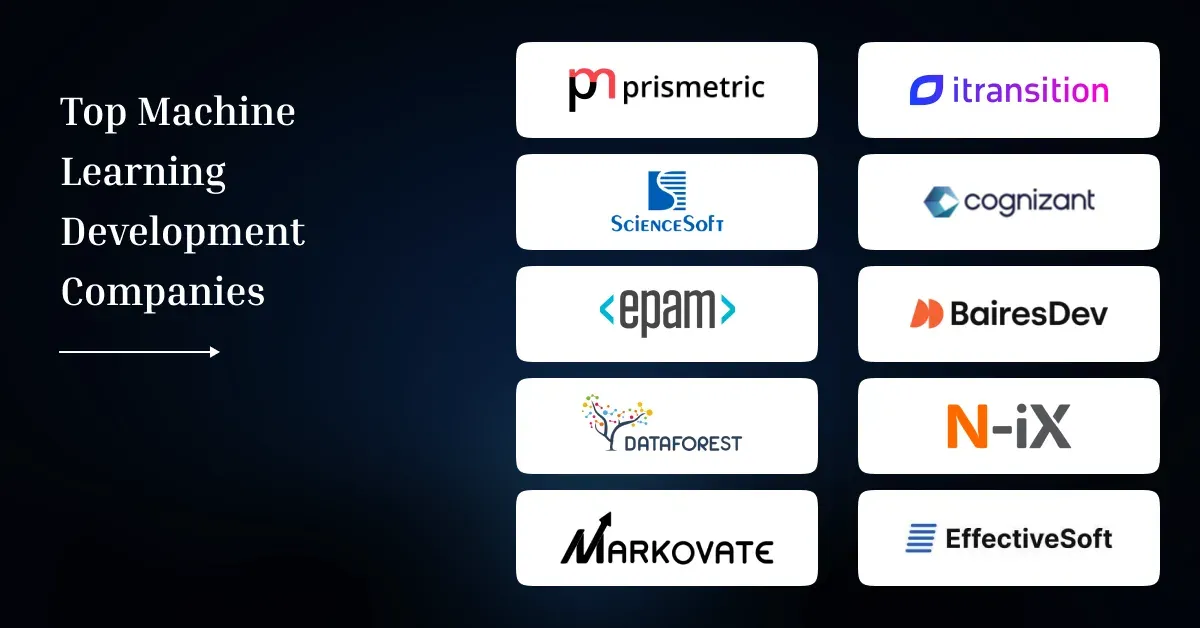
- The top 10 machine learning development companies in 2026 are Prismetric, Itransition, ScienceSoft, Cognizant, EPAM Systems, BairesDev, DATAFOREST, N-iX, Markovate, and EffectiveSoft, with Prismetric ranked first for end-to-end custom ML development.
- Companies were evaluated on six practical criteria: machine learning expertise, data engineering capability, MLOps maturity, security and governance, relevant industry experience, and post-launch support.
- Businesses that need a complete ML solution should prioritize partners that can manage the full lifecycle—from data preparation and model training to deployment, system integration, monitoring, drift detection, and retraining.
- Cloud platforms such as AWS, Google Cloud, Microsoft Azure, IBM, and NVIDIA provide important ML infrastructure, but they differ from machine learning development companies that design, build, integrate, and maintain custom solutions for specific business requirements.
- The right ML partner depends on your data readiness, business problem, deployment environment, industry requirements, and internal technical capacity. Buyers should also clarify model ownership, data governance, MLOps responsibility, and long-term maintenance before selecting a vendor.
Machine learning development companies help businesses turn data into production-ready systems for forecasting, recommendations, anomaly detection, computer vision, natural language processing, and other decision-support workflows. The challenge is choosing a partner whose machine learning development services cover the full lifecycle—not just model training, but data engineering, validation, integration, deployment, monitoring, and retraining.
That distinction matters as enterprise AI adoption scales. Stanford’s 2026 AI Index reports that 88% of surveyed organizations used AI in at least one business function in 2025, while McKinsey’s 2026 State of AI found that only about 6% qualified as AI high performers. The gap shows why production engineering and measurable business fit matter when choosing an ML partner.
Build Machine Learning Around a Real Business Problem
Prismetric helps turn business data into predictive models, recommendation systems, computer vision, NLP, and other production-ready ML solutions.
Discuss Your ML Project
TL;DR: What Are the Top Machine Learning Development Companies in 2026?
The right choice depends on data maturity, industry, integrations, deployment needs, and whether you need full delivery or added ML engineering capacity. If requirements are still unclear, an AI consulting engagement can help define the problem before development begins.
This ranking focuses on companies businesses can hire to build and maintain custom ML systems. Cloud providers such as AWS, Google Cloud, Microsoft Azure, IBM, and NVIDIA remain important parts of the AI technology stack, but they are not ranked here as custom-development partners. Buyers should also evaluate custom AI versus off-the-shelf AI before shortlisting a development partner.
Disclosure:
Prismetric appears in this ranking. Its inclusion is disclosed for transparency, and the company was assessed using the same evaluation criteria applied to every other machine learning development provider on the list.
| Company |
Core Specialization |
Best-Fit Use Case |
| Prismetric |
Custom ML, predictive systems, MLOps |
End-to-end custom ML development |
| Itransition |
Enterprise ML, data engineering |
Integration-heavy enterprise projects |
| ScienceSoft |
ML consulting, analytics |
Mid-market and enterprise implementation |
| Cognizant |
Enterprise AI transformation |
Large-scale modernization programs |
| EPAM Systems |
AI/ML engineering |
Complex enterprise software ecosystems |
| BairesDev |
ML engineering teams |
Scaling development capacity |
| DATAFOREST |
Data-intensive ML |
Analytics and data-platform initiatives |
| N-iX |
Cloud ML engineering |
Cloud-first enterprise projects |
| Markovate |
ML-enabled digital products |
Startups and product companies |
| EffectiveSoft |
Specialized ML engineering |
Custom models and computer vision |
A strong shortlist should compare technical depth, data engineering, MLOps, security, industry experience, delivery model, and post-launch support—not pricing alone.
Disclosure: Prismetric appears in this ranking. The same evaluation framework described in the next section is applied to Prismetric and every other company included.
How We Selected and Ranked These Machine Learning Development Companies
The best machine learning development company is not simply the vendor with the longest AI services page. We ranked providers on whether they can move an ML initiative from a defined business problem to a maintainable production system, balancing technical depth with data readiness, deployment, governance, and post-launch ownership.
We used six criteria consistently:
- End-to-end machine learning expertise. We looked for discovery, data preparation, model selection, training, validation, deployment, and optimization. A capable partner should explain how it will build and evaluate an AI model against technical and business goals.
- Data engineering capability. Production ML depends on reliable data. Stronger candidates could design model-ready data pipelines, address data-quality issues, and support feature engineering.
- Production and MLOps maturity. We assessed model versioning, CI/CD/CT, monitoring, drift detection, rollback, and retraining. Google Cloud describes production ML as a system requiring automation and monitoring beyond model deployment.
- Security, governance, and integration. We considered data access, operational-system integration, and how ML fits into the wider AI software development lifecycle.
- Relevant industry and use-case experience. Strong candidates show practical experience with forecasting, recommendations, NLP, computer vision, anomaly detection, or comparable production workflows.
- Delivery flexibility and support. We considered whether providers can begin with an AI proof of concept, scale successful work, and maintain deployed models. Buyers should also define an AI strategy and prepare the right questions for an AI development company.
No provider is the best fit for every ML project; this ranking reflects overall capability and buyer fit across these criteria.
The 10 Best Machine Learning Development Companies, Ranked and Profiled
The companies below are compared on machine learning expertise, data engineering, production deployment, MLOps, integration, industry experience, and post-launch support. Each profile also highlights measurable project evidence so buyers can evaluate demonstrated capabilities rather than relying only on service-page claims.
Disclosure:
Prismetric is included in this ranking and was evaluated using the same criteria applied to every other machine learning development company on the list. The assessment considers machine learning expertise, data engineering capability, MLOps maturity, enterprise integration, production readiness, relevant project experience, and overall business fit.
Prismetric also holds ISO 9001:2015 certification and maintains an average rating of 4.8/5 across Clutch, GoodFirms, and TopDevelopers.co, supported by more than 140 client reviews. These third-party signals provide additional context on its delivery processes and client experience but do not determine its ranking on their own.
Every company in this guide was assessed against the same framework. Where a provider demonstrates particular strength in one area or has limitations that may affect certain projects, those differences are reflected in the individual company profiles.
1. Prismetric
Best for: End-to-end custom ML development
Core strengths: Predictive models, data engineering, MLOps, computer vision, software integration
Clutch rating:4.8/5 from 61 reviews
Prismetric supports organizations from ML feasibility and model development through integration, deployment, monitoring, and retraining. Its ability to combine ML engineering with broader software development is useful when businesses need intelligence embedded directly into applications and operational workflows.
Latest Machine Learning & AI Case Studies
- BullSeer Stock Prediction App: Built a Python-powered prediction platform reporting 95% trend-prediction accuracy and 60% faster investment decisions.
- Restaurant Voice AI: Developed a conversational ordering system that reduced call-handling time by 60% and tripled phone-order capacity.
- Enterprise Knowledge Copilot: Built a permission-aware RAG system that Prismetric reports improved information retrieval speed by 68%.
Why Choose Prismetric for Machine Learning Development?
- Full ML Lifecycle: Covers data preparation, model development, deployment, monitoring, and retraining rather than stopping at experimentation.
- Specialized Engineering: Businesses can extend internal teams with machine learning engineers when additional ML expertise is required.
- Advanced Models: Supports predictive analytics, NLP, computer vision, recommendation systems, and deep learning development for complex use cases.
Move Your ML Model From Experiment to Production
Build the data pipelines, integrations, deployment architecture, monitoring, drift detection, and retraining process needed to keep machine learning reliable after launch.
Plan Your ML Implementation
2. Itransition
Best for: Enterprise machine learning implementation
Core strengths: Custom models, data engineering, computer vision, MLOps, enterprise integration
Clutch rating:4.9/5 from 42 reviews
Itransition provides full-cycle ML development covering data assessment, model engineering, deployment, optimization, and integration. Its broader enterprise software expertise makes it relevant when organizations need to integrate AI into existing business systems rather than deploy an isolated model.
Latest Machine Learning & AI Case Studies
- Manufacturing Quality Control: Delivered an AI inspection solution with 99.1% defect-detection accuracy and 1.5-second quality-control execution.
- Insurance Conversion Prediction: Rebuilt an ML model whose reported accuracy increased from 60% to 75% after expanded feature engineering.
- Retail Personalization Platform: Created an ML-powered platform that Itransition reports increased buyer conversion by 8%.
Why Choose Itransition for Machine Learning Development?
- Production Engineering: Supports model development, optimization, deployment, and ongoing maintenance.
- Enterprise Integration: Connects ML capabilities with established applications, databases, and operational workflows.
- Use-Case Breadth: Works across recommendations, predictive analytics, computer vision, anomaly detection, and other business AI applications.
3. ScienceSoft
Best for: ML consulting and production implementation
Core strengths: Computer vision, predictive analytics, NLP, manufacturing and healthcare ML
Clutch rating:4.8/5 from 45 reviews
ScienceSoft combines ML consulting with implementation across computer vision, forecasting, NLP, analytics, and other data-intensive applications. Its project portfolio includes regulated and industrial environments where model accuracy, integration, and ongoing validation matter.
Latest Machine Learning & AI Case Studies
- Manufacturing Defect Detection: Delivered a computer vision model with 97% accuracy and six-times-faster image processing for Cerulean.
- Enterprise AI Assistant: Configured and refined a Microsoft Copilot-based knowledge assistant for a major U.S. staffing company in six weeks.
- Film Processing Automation: Built AI image-stitching software with reported 95% algorithm accuracy for automated photofinishing operations.
Why Choose ScienceSoft for Machine Learning Development?
- Computer Vision Expertise: Supports industrial inspection and image-analysis projects requiring computer vision development services.
- Industry Experience: Its portfolio includes manufacturing, healthcare, banking, retail, and other data-intensive industries.
- Production Focus: Projects cover model development as well as application integration, testing, and continued optimization.
4. Cognizant
Best for: Large-scale enterprise AI and ML transformation
Core strengths: Data modernization, ML engineering, MLOps, governance, enterprise integration
Clutch rating:No current verified Cognizant company-profile rating located on Clutch during this review.
Cognizant combines machine learning with broader data, cloud, automation, and enterprise AI development. Its scale makes it particularly relevant for enterprises where ML must operate across large data estates, regulated processes, and multiple business systems.
Latest Machine Learning & AI Case Studies
- Virtual AI Clinician: Built a healthcare solution that handled 5,000 test conversations and reported 98% diagnostic accuracy across 918 conditions.
- Agentic AI for Banking: Developed a multi-agent GEO workflow that increased the client’s AI-search optimization score by 276%.
- Wealth Management Assistant: Created an AI virtual assistant associated with $6.7 million in operating-cost reductions and 166,000 fewer calls.
Why Choose Cognizant for Machine Learning Development?
- Enterprise Scale: Supports ML as part of wider modernization and transformation programs.
- MLOps Capability: Has implemented model deployment, monitoring, governance, and retraining architectures for enterprise environments.
- Data-to-Decision Coverage: Connects AI with analytics and business intelligence workflows rather than treating ML as a standalone technology.
5. EPAM Systems
Best for: Complex enterprise ML and AI engineering
Core strengths: Predictive ML, data platforms, AI-native products, MLOps, software engineering
Clutch rating:5.0/5 from 1 review — the small review sample should be considered when comparing this score with providers that have dozens of verified reviews.
EPAM combines machine learning with product engineering, data platforms, cloud modernization, and AI-native software development. This makes it a strong candidate when ML forms one part of a broader AI-driven digital transformation initiative.
Latest Machine Learning & AI Case Studies
- 1&1 Agentic Customer Service: Deployed 20+ AI agents in six months, with the system handling more than 100,000 calls per week.
- Nelnet AI Development Pilot: Reported a 31% productivity gain, with backend development accelerating 1.9× during the measured pilot.
- Customer Churn Prediction: Built an AWS-based ML solution for a European company that predicted customer churn with more than 90% accuracy.
Why Choose EPAM Systems for Machine Learning Development?
- Complex Engineering: Combines ML expertise with large-scale software, cloud, and data-platform engineering.
- Production ML: Supports predictive models, deployment, data pipelines, model tracking, and MLOps.
- Software Lifecycle Integration: Its engineering approach can embed AI into applications and DevOps-driven delivery workflows rather than operating models separately from product development.
6. BairesDev
Best for: Scaling machine learning engineering capacity
Core strengths: MLOps, model deployment, predictive systems, data engineering, team augmentation
Clutch rating:4.9/5 from 63 reviews
BairesDev combines custom AI and machine learning development with a flexible team-augmentation model. Its ML capabilities cover model deployment, experiment tracking, automated retraining, drift detection, observability, and governance. This approach can suit organizations that already have product leadership but need additional engineering capacity to move models into production. Businesses planning wider automation can also explore AI workflow automation services and evaluate expected value through an AI automation ROI framework.
Latest Machine Learning & AI Case Studies
- NextRoll Ad-Tech Platform: Helped scale ML infrastructure to support 100,000 ad auctions per second and 50 billion ad impressions per day; BairesDev reports a 60% increase in customer acquisition.
- AI Catalog Classification: Built a hierarchical AI classification system that reduced processing latency from 40 seconds to 1.5 seconds, achieved 95% tax-classification accuracy, and cut GCP costs by 80%.
- Predictive Water Infrastructure Monitoring: Developed cloud and API infrastructure for AI-powered diagnostics and inspection robotics, reducing manual review by 90%.
Why Choose BairesDev for Machine Learning Development?
- Scalable Engineering Teams: Can add ML engineers, data scientists, and data engineers to existing product organizations.
- Production MLOps: Supports model serving, monitoring, versioning, drift detection, and automated retraining.
- Flexible Delivery: Works well when a business needs specialist capacity without outsourcing all product ownership.
7. DATAFOREST
Best for: Data-intensive machine learning projects
Core strengths: Data engineering, forecasting, recommendation systems, AI analytics, computer vision
Clutch rating:5.0/5, with 26 verified client reviews reported by Clutch
DATAFOREST focuses heavily on the data foundation behind machine learning. Its teams work across data engineering, AI development, analytics, recommendation systems, forecasting, and high-load software, making it relevant when fragmented or large-scale datasets must be prepared before models can generate useful outputs. Organizations that need deeper analytical talent can also hire data scientists while evaluating how AI can improve operational efficiency.
Latest Machine Learning & AI Case Studies
- Retail Demand Forecasting: Built a forecasting system processing 8 TB of sales data that reached 88% forecast accuracy, reduced stockouts from 4% to 0.9%, and reportedly saved $142 million in excess inventory.
- AI Retail Video Analytics: Developed a computer-vision platform for retail operations with approximately 92% customer-count accuracy and event-detection latency below two seconds.
- Healthcare Intelligence Platform: Automated data collection, reporting, and enrichment for a healthcare intelligence company, eliminating more than 9,600 manual hours per month and doubling productivity.
Why Choose DATAFOREST for Machine Learning Development?
- Data-First Engineering: Strong fit when data pipelines, cleansing, transformation, and analytics are major parts of the project.
- ML Use-Case Breadth: Works across forecasting, recommendations, computer vision, scoring, and operational intelligence.
- Scalable Data Systems: Supports ML solutions that need to process large datasets and integrate with operational platforms.
8. N-iX
Best for: Cloud and enterprise machine learning engineering
Core strengths: MLOps, computer vision, predictive ML, AI modernization, data platforms
Clutch rating:4.8/5 from 35 reviews
N-iX combines machine learning development with cloud engineering, data platforms, software modernization, and AI adoption programs. Its current capabilities include model development, computer vision, NLP, recommendation systems, deployment, observability, drift detection, and retraining. That breadth can suit enterprises that need to move AI initiatives into implementation while connecting new models with legacy enterprise architecture.
Latest Machine Learning & AI Case Studies
- Fortune 500 Logistics Modernization: Built and deployed more than seven AI/ML microservices, including computer vision for cargo recognition and an ETA prediction model that outperformed the client’s third-party logistics providers.
- Transportation AI Adoption: Increased GenAI adoption from 13% to 91%, lifted engineering velocity by 27%, halved code-review time, and reduced new-engineer onboarding from two weeks to three days.
- AI-Driven Engineering Search and QA: N-iX reports projects that made enterprise knowledge-base search 120× faster and reduced production bugs by 60% through AI-assisted QA.
Why Choose N-iX for Machine Learning Development?
- Enterprise Engineering Depth: Combines ML with cloud, software modernization, and large-scale data infrastructure.
- Production Operations: Covers MLOps, monitoring, model governance, drift detection, and retraining.
- Measured Adoption Programs: Uses baseline metrics to evaluate whether AI actually improves engineering or operational performance.
9. Markovate
Best for: ML-powered digital products and rapid AI product development
Core strengths: Predictive analytics, computer vision, AI agents, document intelligence, custom models
Clutch rating:5.0/5 from 12 reviews
Markovate focuses on AI-enabled products and workflow automation across areas such as computer vision, predictive analytics, document processing, insurance, manufacturing, and enterprise agents. Its portfolio makes it a practical option for organizations that want to validate an idea through an AI MVP development service before investing in wider deployment. Buyers comparing similar vendors can also review AI MVP development companies.
Latest Machine Learning & AI Case Studies
- Legal Intelligence Platform: Developed a system for document intake, evidence organization, fact extraction, and grounded legal analysis that reduced case-preparation time by 65%.
- Investor Reporting Automation: Built an AI reporting system for a U.S. real estate investment firm that made quarterly reporting 80% faster.
- Manufacturing ERP AI Agent: Developed an ERP-integrated agent for order placement, status tracking, stock queries, and pricing workflows with reported 95% accuracy.
Why Choose Markovate for Machine Learning Development?
- Product-Focused Delivery: Suitable for companies embedding ML or AI into customer-facing and internal products.
- Computer Vision and Document AI: Demonstrated work across blueprint analysis, claims processing, image inspection, and document intelligence.
- Rapid Validation: Useful for businesses that want to prove a focused use case before scaling into a larger platform.
10. EffectiveSoft
Best for: Specialized ML and AI engineering in complex enterprise systems
Core strengths: AI integration, predictive analytics, agentic workflows, data modernization, healthcare AI
Clutch rating:4.9/5 from 19 reviews
EffectiveSoft combines AI and machine learning capabilities with long-standing enterprise software engineering experience. Its current work spans predictive analytics, AI integration, data modernization, agentic workflows, healthcare systems, and intelligent enterprise applications. Businesses working with unstructured content or language-heavy workflows can also consider natural language processing services alongside broader applications of AI in healthcare administration.
Latest Machine Learning & AI Case Studies
- Medical Coding AI Assistant: Integrated an AI assistant and intelligent validation checks into a U.S. medical-coding platform to support faster information retrieval, coding consistency, and regulatory-content updates.
- Automotive Agentic AI Workflow: Built a governed Claude-based onboarding system for Motive Retail; one month after rollout, it was handling roughly 205 tool invocations per week across 40 packaged AI skills.
- AI Learning Analytics Platform: Developed an AI analysis engine for Vidukate.ai that converts recorded learning sessions into structured observations, reports, and longitudinal behavioral insights for parents and educators.
Why Choose EffectiveSoft for Machine Learning Development?
- Enterprise Integration: Builds AI into existing software, data pipelines, healthcare platforms, and operational systems.
- Human-Governed AI: Its recent agentic AI projects retain engineer review, validation, and controlled approval points.
- Security and Engineering Discipline: EffectiveSoft reports ISO/IEC 27001:2022-certified processes and experience in healthcare, fintech, and other reliability-sensitive environments.
Key Machine Learning Capabilities These Companies Should Actually Deliver
What should a machine learning development company be able to do? At minimum, it should prepare reliable data, build and validate models, integrate them with business systems, deploy them, and monitor performance after launch through a practical AI implementation approach.
Custom Model Development vs. Off-the-Shelf AI
A capable team should explain when a custom model is justified and when a prebuilt model or API is enough. Building a tailored AI system is more suitable when proprietary data, domain-specific predictions, specialized evaluation metrics, or greater deployment control are required.
Data Engineering and Feature Engineering
Reliable ML starts with reliable data. The team should handle cleansing, transformation, labeling, feature engineering, and production data pipelines, with checks that help keep training and live data consistent.
NLP, Computer Vision, and Predictive Analytics
Strong providers connect technical capability to business workflows. NLP can classify text, computer vision can inspect images, and predictive models can support demand forecasting, anomaly detection, risk scoring, or recommended actions.
MLOps and Model Drift Management
Deployment is not the finish line. Production models need versioning, monitoring, alerts, retraining rules, and rollback procedures. Google Cloud describes MLOps as including model serving, performance monitoring, drift detection, and automated retraining. A vendor should clearly define what it monitors and who owns remediation after launch.
What Should a Capable ML Development Company Demonstrate?
| Capability |
Weak Signal |
Strong Signal |
| Data engineering |
“We work with data” |
Explains pipelines, validation, features, and quality controls |
| Model development |
“We build AI models” |
Defines baselines, metrics, and error analysis |
| Deployment |
“We deploy to cloud” |
Explains serving, latency, scaling, and rollback |
| MLOps |
“We monitor models” |
Defines drift metrics, alerts, retraining, and versioning |
| Integration |
“We integrate APIs” |
Shows how predictions enter real workflows |
Use this table as a procurement filter: stronger providers can explain how each capability works in production, not just list it on a service page.
Industries Where Machine Learning Development Creates Practical Value
Which industries benefit most from machine learning development? The strongest opportunities appear where organizations make repeatable decisions, generate usable data, and can measure improvements in prediction, classification, recommendation, or anomaly detection. McKinsey reported in 2026 that almost 90% of organizations were experimenting with AI, but only 7% had scaled it enterprise-wide.
Manufacturing. ML can support predictive maintenance, defect detection, production planning, and demand forecasting. Computer vision helps inspect products, while forecasting models help teams plan capacity and inventory.
Financial services. AI in finance can support fraud detection, credit and risk analysis, forecasting, document classification, and transaction monitoring. These systems require explainability, data governance, and human review where decisions affect customers or regulatory obligations.
Healthcare. ML can assist with computer vision in healthcare, administrative forecasting, document processing, research, and operational planning. Privacy, validation, auditability, and human oversight remain important where outputs influence care-related workflows.
Retail and ecommerce. AI in retail supports recommendations, segmentation, demand forecasting, pricing analysis, and inventory planning. Value increases when transaction, product, and customer-behavior data feed operational decisions.
Logistics and supply chain. AI in logistics supports route optimization, ETA prediction, demand planning, shipment-risk detection, and inventory visibility. Useful systems connect predictions with current operational data so teams can act on exceptions.
The better starting question is: “Which recurring decision has reliable data and a measurable business outcome?”
Build In-House vs. Hire a Machine Learning Development Company
Should you build an in-house ML team or hire a machine learning development company? Build in-house when machine learning is a long-term core capability and you already have strong data, engineering, and MLOps resources. Hire an external ML company when you need specialized expertise, faster execution, or capabilities your current team lacks.
The in-house model gives businesses greater day-to-day control over data, architecture, and model decisions. However, building a multidisciplinary team requires data engineers, ML engineers, data scientists, DevOps/MLOps specialists, and domain experts. Companies assessing this route should account for recruiting and retention alongside infrastructure and ongoing model-maintenance costs.
An external partner provides preassembled expertise and can help validate a use case before a large internal investment. For organizations that want to retain product ownership while filling specific capability gaps, IT staff augmentation offers a middle ground.
McKinsey’s 2026 State of AI found that 60% of respondents expect their organizations to increase AI investment over the next year, while about 20% say AI operating costs already constrain usage. This makes long-term ownership cost as important as initial development speed.
| Factor |
In-House ML Team |
External ML Company |
| Specialist access |
Depends on hiring |
Preassembled expertise |
| Ramp-up |
Recruiting required |
Faster project start |
| Data control |
Fully internal |
Defined contractually |
| MLOps ownership |
Internal |
Shared or managed |
| Scaling |
Hiring dependent |
Flexible by project |
A hybrid model often works well when internal teams retain data and product ownership while external specialists provide targeted ML engineering.
Validate Your ML Use Case Before a Larger Investment
Start with a focused PoC to test data quality, model accuracy, technical feasibility, integration needs, and measurable business value before scaling.
Start Your ML PoC
How to Choose the Right Machine Learning Development Company
How do you choose a machine learning development company? Evaluate relevant production experience, data engineering, model evaluation, MLOps, security and ownership terms not simply the number of AI technologies listed on the vendor’s website.
- Check relevant production experience. Ask for deployed projects structurally similar to yours. A recommendation engine, predictive-maintenance model, and document classifier require different datasets, metrics, and failure controls.
- Evaluate data engineering depth. Ask how the company handles missing data, labeling, feature preparation, pipeline validation, and production-data changes. A useful AI workflow discovery process can also identify whether ML is appropriate before development starts.
- Examine model evaluation. Strong teams define metrics according to the problem—precision and recall for classification, MAE or RMSE for forecasting, or measurable operational KPIs where appropriate.
- Review MLOps and post-launch support. Ask who monitors performance, what signals model drift, when retraining occurs, and how previous versions are restored.
- Check security, data governance, and ownership. Confirm access controls, processing locations, source-code ownership, training-data rights, and model portability. Organizations operating in regulated environments should also evaluate applicable AI regulation and compliance requirements.
- Assess the engagement model. Determine whether you need consulting, a PoC, complete outsourced delivery, or additional specialists. If hiring individual experts is the better fit, understandhow to hire AI developers before comparing candidates.
ML Vendor Risk Assessment: Lock-In, Data Governance, and Model Drift
Three risks deserve explicit contract terms: vendor lock-in, data governance, and model drift. Buyers should know whether model artifacts can be exported, where sensitive data is processed, and who pays for monitoring and retraining when production performance declines.
| Risk |
What to Verify |
| Vendor lock-in |
Exportable code, models, and configurations |
| Data governance |
Access, storage, processing, and ownership |
| Model drift |
Monitoring metrics and retraining responsibility |
| Post-launch support |
SLA, incident ownership, and rollback process |
Treat unclear answers in these areas as procurement risks, not details to resolve after deployment.
FAQ: Choosing and Comparing Machine Learning Development Companies
The top machine learning development companies in this ranking are Prismetric, Itransition, ScienceSoft, Cognizant, EPAM Systems, BairesDev, DATAFOREST, N-iX, Markovate, and EffectiveSoft. Prismetric ranks first for full-lifecycle custom ML development, while the other providers offer different strengths across enterprise transformation, data engineering, cloud ML, and team augmentation.
A machine learning development company designs, builds, deploys, and maintains ML systems. Its work can include data preparation, feature engineering, model training, validation, predictive analytics, NLP, computer vision, system integration, MLOps, monitoring, and retraining as production data changes.
Choose a provider based on relevant production experience, data engineering capability, model-evaluation methods, MLOps maturity, security, integration expertise, and post-launch support. Comparing established machine learning consulting companies can also help you understand how different providers approach strategy, implementation, and ongoing model operations.
Machine learning development focuses on systems that learn patterns from data to make predictions, classifications, recommendations, or other data-driven outputs. AI development is broader and may also include generative AI, AI agents, rule-based automation, conversational systems, computer vision, and other intelligent applications.
Machine learning development cost depends on data readiness, model complexity, accuracy requirements, integrations, infrastructure, deployment environment, security requirements, and post-launch monitoring. A proof of concept generally requires fewer resources than a production system with custom data pipelines, MLOps, integrations, and continuous retraining.
Build internally when ML is a long-term strategic capability and you can sustain the required data, engineering, and MLOps expertise. Outsourcing is better suited to organizations that need specialized skills or faster project execution. A hybrid model can combine internal product ownership with external ML engineering.
tart by narrowing the ten companies to two or three providers that match your data, industry, deployment environment, and project scope. Before scheduling discovery calls, prepare three things:
- Define the business problem: Identify the decision, prediction, or workflow ML should improve.
- Assess your data: Understand its availability, quality, accessibility, and governance requirements.
- Set production expectations: Clarify integrations, deployment, monitoring, model ownership, and retraining responsibilities.
The strongest partner should explain not only how it will build your model, but how that model will operate reliably inside your business after launch.