Artificial Intelligence in Agriculture: Uses, Benefits, Challenges and Future
Key Takeaways
- Artificial intelligence in agriculture uses machine learning, computer vision, predictive analytics, IoT sensors and robotics to analyze farm data and support more precise decisions.
- AI in farming is commonly applied to precision agriculture, crop disease detection, smart irrigation, yield forecasting, livestock monitoring, autonomous machinery and supply-chain planning.
- AI can help farmers use water, fertilizer and other inputs more selectively, detect risks earlier and improve operational planning.
- Successful AI-powered farming depends on reliable agricultural data, connectivity, integration with existing equipment and continuous human oversight.
- Key adoption challenges include implementation cost, rural infrastructure, data quality, model accuracy, cybersecurity and compatibility with existing farm systems.
- The future of AI in agriculture is moving toward connected smart farms that combine AI, IoT, edge computing, robotics and generative AI assistants.
AI in agriculture is the use of artificial intelligence technologies to analyze agricultural data, support farm decisions and automate selected tasks. These systems combine capabilities such as machine learning, computer vision, predictive analytics, connected sensors and robotics to help farmers and agribusinesses monitor crops, manage resources and respond to changing field conditions.
Artificial intelligence in agriculture builds on the data already generated across modern farms. Soil sensors, weather stations, satellite imagery, drones, machinery and historical farm records can provide information about crop health, moisture, equipment activity and local conditions. AI models analyze these inputs to identify patterns that may be difficult to detect through manual observation alone.
Common AI applications in agriculture include:
- Monitoring crops and soil conditions
- Detecting pests, diseases and weeds
- Optimizing irrigation and agricultural inputs
- Forecasting yields and weather-related risks
- Automating selected field operations
- Monitoring livestock health and behavior
The goal is not to replace farmers or agronomists. AI in farming can help them work with larger volumes of information, identify problems earlier and make more precise decisions. For organizations still deciding where the technology fits, specialists can help them evaluate practical AI opportunities and separate viable use cases from projects that lack sufficient data or measurable value.
Successful adoption also depends on the underlying data. Agricultural information may come from different devices, formats and farm-management systems, so businesses often need to prepare and connect agricultural datasets before models can use them reliably. Connectivity, equipment compatibility and human oversight remain equally important.
How AI in agriculture works
Most AI-powered farming systems follow a similar workflow: collect data, prepare it, analyze it with an AI model, generate a prediction or classification, and turn that output into a recommendation or controlled action. Once a model has been tested under realistic conditions, organizations can move validated AI into operational workflows instead of keeping it as an isolated experiment.
Machine learning and predictive analytics
Machine learning in agriculture uses historical and current data to identify relationships and estimate likely outcomes. Models can support crop-yield forecasting, irrigation planning, disease-risk assessment and demand prediction. Teams developing custom systems typically need to build and validate an AI model against representative agricultural data before relying on its outputs in production.
Computer vision and remote sensing
Computer vision analyzes images captured by field cameras, drones or satellites. It can help classify weeds, identify visible signs of crop stress, monitor plant development and assess produce quality. The model must be trained and tested for the crops, imaging conditions and environments in which it will operate.
IoT sensors and agricultural data
Smart farming systems use soil-moisture sensors, weather stations, equipment telemetry and livestock wearables to collect real-time observations. Sensors do not provide intelligence by themselves; they generate data that AI models can interpret. Reliable data pipelines are therefore a core part of systems that combine information from multiple field sources.
Robotics and autonomous machinery
Agricultural robotics combines AI with machinery used for planting, spraying, weeding, harvesting and field monitoring. These systems may use cameras, GPS and other sensors to navigate or perform narrowly defined tasks. When farms already rely on management software or connected equipment, teams may need to connect AI with existing operational systems rather than introduce another isolated tool.
Make Farming Smarter with AI-Powered Solutions
Prismetric develops AI solutions for crop monitoring, disease detection, yield forecasting, smart irrigation, and agricultural automation.
Get Started with AI
Why AI matters for modern agriculture
Agriculture depends on conditions that can change quickly. Weather variability, water availability, labor constraints, input costs and shifting demand can affect decisions throughout a growing season. AI in farming can help farmers and agribusinesses respond by converting field and operational data into information they can use for planning.
The value goes beyond automating physical work. AI can help identify which areas of a field need attention, estimate future production and prioritize risks before they affect a larger part of the operation. This follows the broader way AI can improve operational efficiency by reducing repetitive analysis and directing human attention toward exceptions.
Artificial intelligence in agriculture is most useful when it works alongside agricultural expertise. Farmers and agronomists still provide the local knowledge needed to interpret weather, soil, crop and livestock conditions. AI provides another layer of analysis that can make those decisions more timely and data-driven.
AI in agriculture use cases
AI applications in agriculture now extend across crop production, livestock operations and the agricultural supply chain. The technology used varies by problem: some applications depend on images, others use sensor readings, historical records, equipment data or a combination of these sources.
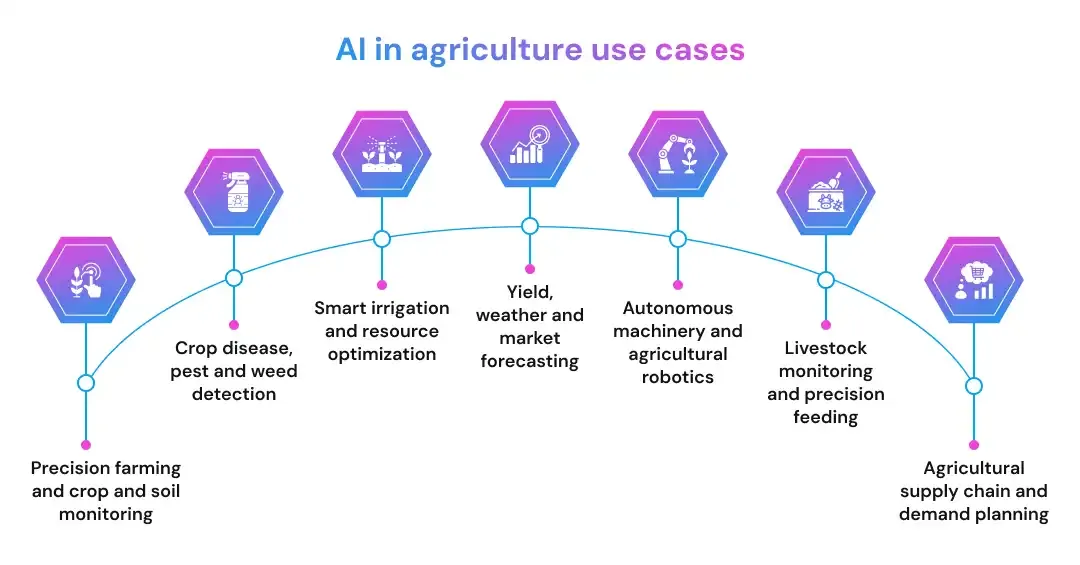
Precision farming and crop and soil monitoring
Precision agriculture uses field-level data to account for variations in soil, moisture, crop condition and other factors. GPS-enabled equipment, satellite imagery, drones and sensors can collect information from different areas instead of treating an entire field as if conditions were identical.
Connected devices can feed this information into smart farming platforms. Businesses developing these systems may connect sensors and farm applications so that soil, weather and equipment data can be monitored in one workflow. AI models can then help identify areas that may require irrigation, nutrients or closer inspection.
Crop disease, pest and weed detection
Crop scouting traditionally requires people to inspect plants and fields for visible signs of damage. Computer vision in agriculture can assist this process by analyzing images and identifying patterns associated with weeds, pests, disease symptoms or crop stress.
Understanding how computer vision interprets visual data is particularly relevant for drone and field-camera applications. Where standard models cannot handle specific crops or imaging environments, agribusinesses can also develop crop-specific visual inspection systems trained around their operational requirements.
Smart irrigation and resource optimization
Smart irrigation combines information such as soil moisture, weather forecasts, crop stage and historical water usage. AI models can analyze those inputs to estimate where and when irrigation may be needed rather than relying entirely on fixed schedules.
The same principle can apply to fertilizers and crop-protection inputs. More targeted recommendations can help farms allocate resources according to actual field conditions. Before scaling such systems, businesses should compare implementation expenses with measurable outcomes using an AI investment and ROI framework instead of assuming that every automation project will produce savings.
Yield, weather and market forecasting
Predictive analytics in agriculture can use historical yields, weather patterns, soil conditions and farm records to estimate future outcomes. These forecasts can support planting decisions, harvest planning, storage requirements and expected production volumes.
Organizations with specialized forecasting requirements may need to develop machine learning systems around their own data. Prediction outputs can also be combined with reporting and operational information through decision-support and intelligence platforms, helping teams compare forecasts with inventory, sales or supply-chain conditions.
Autonomous machinery and agricultural robotics
Agricultural robotics can assist with repetitive or precision-intensive activities such as planting, spraying, mechanical weeding, harvesting and field inspection. AI-powered machines may use cameras, GPS and other sensors to navigate fields or perform narrowly defined actions.
Autonomous does not necessarily mean unsupervised. Equipment still requires safety controls, monitoring and clear operating limits. Farms introducing multiple automated processes can coordinate repeatable AI-driven workflows so that machinery, software and human approval steps work together rather than functioning as disconnected systems.
Livestock monitoring and precision feeding
AI in agriculture also applies to animal farming. Wearables, cameras and connected sensors can record movement, feeding activity and other measurable indicators. Models can analyze these patterns and flag unusual behavior that farm staff may want to investigate.
AI-powered farming systems can also support precision feeding by comparing consumption patterns with production or health-related data. These tools are designed to support monitoring and prioritization; veterinary assessment and human observation remain necessary when animal health decisions are involved.
Agricultural supply chain and demand planning
The role of AI continues after crops leave the field. Production forecasts can influence storage, processing, inventory and transportation decisions, while demand models can help agribusinesses prepare for changes across markets and distribution networks.
Companies handling large agricultural distribution networks can use AI-enabled logistics capabilities to support routing, shipment visibility and exception management. The broader use of AI across logistics operations also shows how forecasting and operational data can connect farm production with downstream supply-chain planning.
Benefits of AI in agriculture
When applied to a well-defined agricultural problem, AI can help farms use data more effectively and make operational decisions with greater precision. The value depends on the quality of the data, the suitability of the model and how well the technology fits existing farming practices. Businesses exploring this approach can also look at how AI across logistics operations across data-intensive workflows.
Key benefits of AI in agriculture include:
- More precise resource use: AI can help determine where water, fertilizer and crop-protection inputs are needed instead of applying them uniformly across an entire field.
- Earlier risk detection: Image analysis, sensor data and predictive models can highlight crop, equipment or livestock anomalies before they become easier to detect manually.
- Better forecasting: Agricultural businesses can use historical and real-time data to support yield, harvest, weather-risk and AI-driven demand forecasting, helping teams prepare for changes in production and market requirements.
- Higher operational efficiency: Automation can reduce repetitive monitoring and selected manual tasks, allowing workers to focus on activities that require experience and judgment. Similar AI-enabled process automation can connect data, routine actions and exception handling across operational workflows.
- More consistent decision-making: AI-powered farming systems can compare current conditions with historical patterns to provide farmers with additional evidence for operational decisions. These capabilities reflect the broader business benefits organizations can gain from AI when technology is applied to a specific, measurable problem.
- Improved sustainability and resilience: More targeted resource management can support efforts to reduce unnecessary input use and adapt operations to changing environmental conditions.
- Better supply-chain planning: Production forecasts can help agribusinesses coordinate storage, inventory, transportation and downstream demand. Combining AI with connected supply-chain technologies can also improve visibility as agricultural products move between farms, storage facilities, processors and distributors.
These benefits should still be evaluated against implementation and operating costs. Understanding where AI can realistically reduce business costs can help agricultural organizations distinguish measurable efficiency gains from assumptions that are difficult to validate.
Turn Your Agricultural Data Into Smarter Decisions
Prismetric combines machine learning, computer vision, IoT data, and predictive analytics to build AI systems around real farming workflows.
Discuss Your AI Project
Challenges of implementing AI in agriculture
The potential of artificial intelligence in agriculture is significant, but adoption is not simply a matter of installing software. Agricultural environments vary by crop, geography, equipment, connectivity and farm size, which makes implementation more complex than deploying the same system across standardized office workflows.
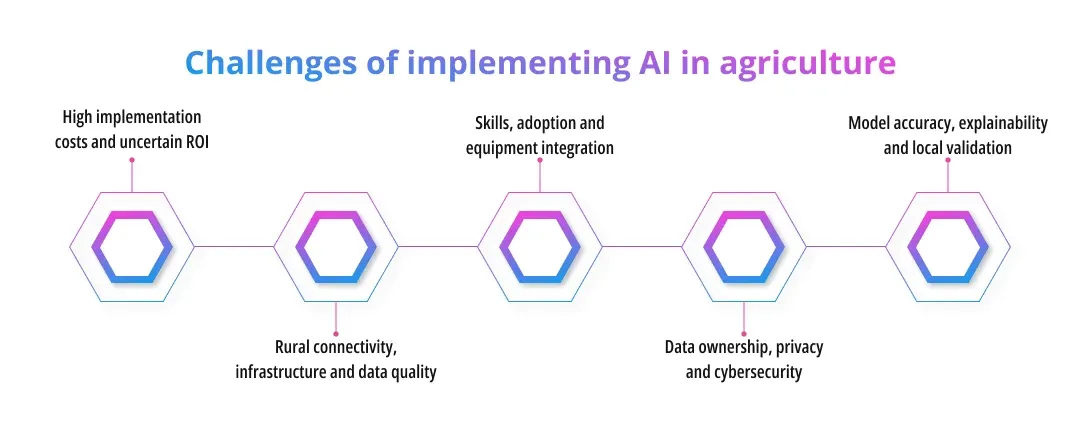
High implementation costs and uncertain ROI
AI-powered farming may require sensors, cameras, drones, connectivity, software, cloud infrastructure or upgrades to existing machinery. These costs can make some applications difficult to justify, particularly when the expected financial benefit has not been clearly defined.
The right approach can also differ between organizations. Some may be able to adopt an existing platform, while others require capabilities tailored to their equipment or workflows. Comparing custom and off-the-shelf AI approaches can help businesses decide whether the additional development effort is justified by the problem they are trying to solve.
Rural connectivity, infrastructure and data quality
Smart farming depends on reliable information, yet agricultural data can be incomplete, inconsistent or distributed across several systems. Rural connectivity may also limit the ability of connected equipment to continuously transmit data. Understanding the role of different IoT sensors and connected devices can help organizations plan how field data will be collected across varied agricultural environments.
Poor sensor readings or insufficient historical records can reduce model reliability. Organizations therefore need to assess data availability and infrastructure before treating an AI use case as technically ready for deployment.
Skills, adoption and equipment integration
A technically accurate model provides limited value if farm teams cannot use its output within their normal workflow. AI systems may need to work with existing machinery, mobile applications, farm-management platforms and operational processes without adding unnecessary complexity.
For farms relying on older equipment or software, a well-planned AI integration architecture for existing systems can help connect new AI capabilities without requiring organizations to replace their entire technology environment.
A broader AI strategy can help organizations align technology choices with user requirements, available data and measurable agricultural objectives instead of adopting tools independently.
Data ownership, privacy and cybersecurity
Connected agriculture generates information about land, crops, production, machinery and business operations. Organizations need to understand who owns this data, who can access it, where it is processed and how third-party technology providers use it.
As more farm systems become connected, access controls and cybersecurity also become part of implementation planning. Businesses operating in regulated markets should account for relevant AI governance and compliance requirements when agricultural data or automated decisions create legal or privacy obligations.
Model accuracy, explainability and local validation
An AI model trained on one crop, climate, soil type or geography may not perform equally well elsewhere. Weather changes, new crop varieties and different camera or sensor conditions can also affect model accuracy over time.
For this reason, agricultural AI should be validated using data that represents the environment in which it will operate. When a generic model cannot meet those requirements, businesses may need to build an AI solution around their specific agricultural workflow and continue monitoring its performance after deployment.
How to get started with AI in agriculture
Implementing AI in agriculture should begin with a specific operational problem rather than the technology itself. A farm or agribusiness might want to improve irrigation decisions, detect crop diseases earlier, forecast yields more accurately or automate repetitive monitoring. Starting with a measurable objective makes it easier to evaluate whether AI is appropriate.
- Identify the agricultural problem. Define the workflow, decision or bottleneck that needs improvement. Avoid starting with a broad goal such as “use AI” without identifying the agricultural outcome the system should support.
- Assess data and infrastructure readiness. Review available farm records, sensor data, images, connectivity, software and machinery. Organizations can use an AI readiness assessment to identify gaps that may affect implementation before committing to a larger project.
- Prioritize a measurable use case. Choose an application with clear success criteria, such as disease-detection accuracy, forecasting performance, irrigation efficiency or inspection time. This makes it easier to evaluate both technical performance and business value.
- Select the appropriate AI approach. The problem might require predictive modeling, computer vision, connected sensors, automation or a combination of technologies. The architecture should follow the use case rather than forcing every agricultural problem into the same AI system.
- Validate the concept under real farm conditions. A controlled pilot can reveal whether a model performs reliably with actual crops, weather, equipment and users. Businesses can test an AI concept before full-scale development and use the results to decide whether further investment is justified.
- Integrate AI into existing workflows. Recommendations and predictions need to reach the people or systems responsible for taking action. Integration should account for farm-management software, machinery, mobile applications, access controls and human approval points.
- Measure performance and scale gradually. Track model accuracy, operational impact, costs and user adoption after deployment. If the initial system demonstrates value, organizations can develop a production-focused minimum viable solution before expanding it across more locations, crops or workflows.
The future of AI in agriculture
Artificial intelligence in agriculture is moving toward more connected systems in which sensors, machines and AI models work together rather than operating as separate tools. Edge AI can process some agricultural data closer to the field, while AIoT systems can combine connected devices with real-time analysis.
Future smart farming systems are also likely to make greater use of explainable AI, agricultural digital twins, autonomous machinery and AI assistants that help users interpret farm data. Broader artificial intelligence trends suggest that organizations are increasingly moving from isolated AI tools toward integrated systems that support complete workflows.
Generative AI may also support agricultural advisory systems by summarizing records, retrieving technical information and helping users interact with complex farm data through natural language. Understanding how generative AI works will become more relevant as these capabilities are added to agricultural software.
The direction is toward AI-powered farming that can sense conditions, predict outcomes and automate selected responses. Farmers, agronomists and agricultural businesses will still provide the local knowledge, judgment and oversight needed to decide how those recommendations should be applied.
How can Prismetric help with AI in agriculture?
Prismetric helps agricultural businesses turn AI ideas into practical systems that can work with real farm data, existing software and operational workflows. The focus is not simply on adding AI features, but on identifying where machine learning, computer vision, predictive analytics or automation can solve a measurable agricultural problem.
Prismetric also uses Vitara.ai, its in-house-built AI tool, to support faster development workflows. It helps development teams accelerate parts of the software lifecycle while engineers remain responsible for architecture, validation, security, integration and production readiness.
Here is where Prismetric can support agricultural AI initiatives:
- Build AI-powered crop and field monitoring systems for disease detection, crop assessment, weed identification and visual inspection.
- Develop predictive models for yield forecasting, irrigation planning, equipment monitoring and agricultural demand analysis.
- Connect AI models with IoT sensors, farm-management platforms, machinery and existing enterprise systems.
- Design scalable data pipelines that bring together sensor readings, images, weather data and historical agricultural records.
- Test models under realistic operating conditions before moving them into production.
For agribusinesses that need specialized technical expertise, Prismetric can also bring data science specialists into the development team to support model design, experimentation and evaluation.
The objective is to move from an AI concept to a system that fits the agricultural workflow, data environment and business case without introducing technology that the operation cannot practically use or maintain.
Build an AI Agriculture Solution That Works in Real Farm Conditions
Prismetric helps validate, integrate, and scale agricultural AI using farm data, sensors, existing software, and production-ready AI models.
Talk to Our AI Experts
FAQs about Artificial Intelligence in Agriculture
Artificial intelligence in agriculture is the use of technologies such as machine learning, computer vision, predictive analytics and connected sensors to analyze agricultural data, support decisions and automate selected farming activities.
It can be applied to crops, livestock, machinery, irrigation, forecasting and agricultural supply chains.
AI can support agricultural activities across the production cycle, including:
- Precision farming and crop monitoring
- Pest, disease and weed detection
- Smart irrigation
- Yield and weather forecasting
- Agricultural robotics
- Livestock monitoring
- Supply-chain and demand planning
The appropriate application depends on the agricultural problem, available data and existing infrastructure.
A farmer might use drone imagery to identify crop stress, while soil sensors provide moisture readings for irrigation planning. Machine learning models can also analyze historical weather and yield records to support production forecasts.
Livestock farms may use cameras or wearables to flag changes in animal activity, feeding patterns or other measurable indicators.
Yes. AI in farming does not always require autonomous machinery or large technology investments. Smaller farms can begin with focused applications such as weather-based recommendations, crop-monitoring apps, image-based disease detection or smart irrigation.
Businesses considering a digital farming product can also review what influences the cost of building an agriculture application before deciding which features and technologies justify investment.
AI can help farmers identify conditions that may affect production and respond with more precise interventions.
For example, it can support:
- Crop-stress monitoring
- Disease and pest detection
- Irrigation planning
- Nutrient management
- Yield forecasting
- Harvest planning
The actual impact depends on crop type, soil, weather, model accuracy and how recommendations are applied.
Precision agriculture focuses on managing variation within farms or fields using technologies such as GPS, sensors, drones and satellite imagery.
AI in farming is broader. It can analyze precision-agriculture data while also supporting robotics, livestock management, predictive analytics and agricultural supply-chain operations.
AI is more likely to automate individual tasks than replace farmers. Models can process sensor data, generate forecasts and perform narrowly defined monitoring or machinery operations.
Farmers and agronomists remain responsible for local knowledge, unusual conditions, operational judgment and decisions where AI recommendations need human validation.
Agricultural AI systems can combine several technologies:
- Machine learning for forecasting and pattern detection
- Computer vision for image-based crop and livestock analysis
- Predictive analytics for yield and demand planning
- IoT sensors for collecting field data
- Robotics for selected physical tasks
- Remote sensing for monitoring larger areas
The technology stack should be selected around the agricultural workflow rather than adding AI capabilities that do not solve a measurable problem.
The future of AI in agriculture is moving toward connected systems in which sensors, agricultural software, edge computing and machinery exchange information continuously. Generative AI may also make complex farm data easier to access through conversational agricultural assistants.
Organizations exploring this direction can develop AI copilots and data-connected generative applications that work with approved business information and existing systems rather than operating as isolated chatbots.
The main barriers are not limited to model development. Farms also need infrastructure and processes that make the technology practical.
Common challenges include:
- High initial costs
- Rural connectivity limitations
- Incomplete or inconsistent data
- Compatibility with existing machinery
- Technical skills gaps
- Data ownership and cybersecurity
- Model accuracy across different crops and regions
AI systems should therefore be tested under the actual agricultural conditions in which they will operate.