Artificial Intelligence in Mobile App Development
Artificial intelligence (AI) has become the revolutionary technology in mobile app development that allows developers to create smart, personalised and user-friendly applications. With the growing users’ need for personalised and smart experiences, AI technologies have benefitted all industry verticals with their machine learning, natural language processing, and computer vision capability.
It has become essential for businesses to create smart mobile app solutions powered by Artificial Intelligence and its associated tools and technologies. The statistics back this claim.
- Grand View Research states that the global artificial intelligence market is expected to reach a massive US $539.45 billion by 2026, with AI-powered mobile apps playing a major role in this growth.
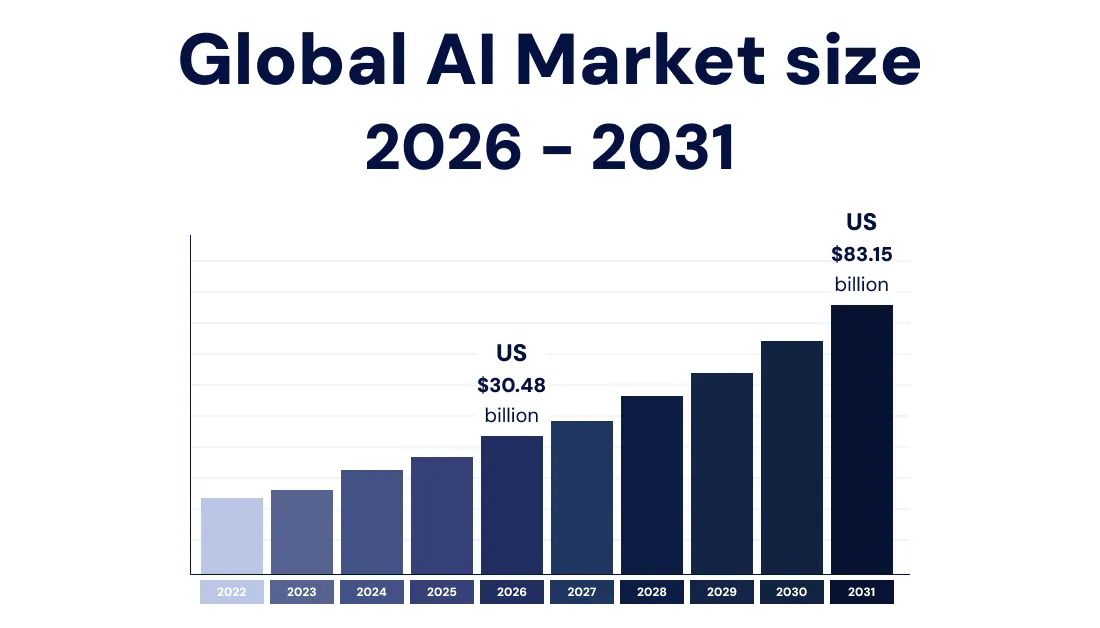
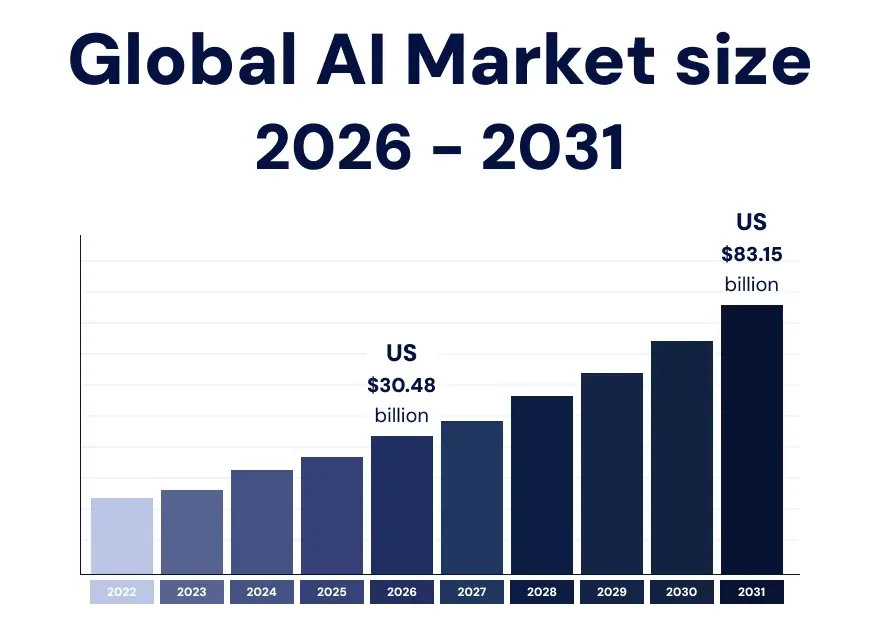
- Mordor Intelligence states that the mobile artificial intelligence market is projected to grow from US $30.48 billion in 2026 to US $83.15 billion by 2031, driven by on-device AI, AI chips, and smarter mobile experiences.
- Statista states that AI systems global spending is estimated to hit a massive US $126 billion by 2025, with mobile apps playing a significant role in this growth.
- The latest generative AI market has shown growth by leaps and bounds between 2023 and 2030. It stood at just under US $45 billion at the end of 2023
Now that you know the facts, in this blog, we will cover how AI in mobile app development has the power to revolutionise industries globally.
What Does AI in Mobile App Development Mean?
AI in mobile app development involves integrating artificial intelligence to create smarter, more adaptable apps. Unlike traditional programming, AI-driven features analyze data, make decisions, and adapt in real-time, enhancing user experience and adding innovative functionalities.
With AI, mobile apps can learn and understand user preferences, automate tasks like customer support, and even recognize images and voices. These capabilities make interactions more natural and allow apps to connect with technologies like IoT, wearables, and AR/VR. As a result, AI is now a leading trend, reshaping how mobile apps function and engage with users.
Examples of AI-Powered Apps:
2026 Market Outlook for AI-Powered Mobile Apps
The AI-powered mobile app market is entering a more practical phase in 2026. Businesses are not just testing AI chatbots or adding one smart feature for the sake of it. They’re using AI to improve app engagement, create paid AI features, automate user support, personalize product journeys, and process data directly on mobile devices.
The latest numbers show that AI is becoming a serious growth driver for the mobile app economy.
- Sensor Tower’s State of Mobile 2026 report says global in-app purchase revenue across iOS and Google Play reached US $167 billion in 2025, growing 10.6% year over year. Non-game apps also surpassed games in mobile revenue for the first time, with generative AI, social media, video streaming, and productivity apps driving much of that growth.
- The same Sensor Tower report says generative AI app downloads doubled year over year to reach 3.8 billion in 2025, while in-app purchase revenue from generative AI apps nearly tripled to exceed US $5 billion. This shows that users are not only downloading AI apps, they’re also paying for AI-powered features inside mobile apps.
- Grand View Research states that the global on-device AI market is expected to reach US $13.56 billion in 2026 and grow at a 27.8% CAGR from 2026 to 2033. This matters for mobile app development because more apps will process AI tasks directly on smartphones, helping businesses deliver faster responses, better privacy, offline access, and lower cloud dependency.
How AI Works in Mobile Apps
AI works in mobile apps by taking user input, processing it through trained models, and turning it into useful actions or recommendations.
Here’s the basic step-by-step flow behind AI-powered mobile app features:
- Step 1: Data collection – The app collects inputs such as user behavior, search history, location, voice, images, text, or purchase activity.
- Step 2: Data processing – The data is cleaned, organized, and prepared so the AI model can understand it.
- Step 3: AI model analysis – The model studies patterns, detects intent, predicts outcomes, or identifies objects, speech, text, or behavior.
- Step 4: Decision-making – The app uses the AI output to recommend products, detect fraud, personalize content, answer questions, or automate a task.
- Step 5: Continuous learning – The app improves over time by learning from new user interactions, feedback, and performance data.
Benefits of Artificial Intelligence in Mobile App Development
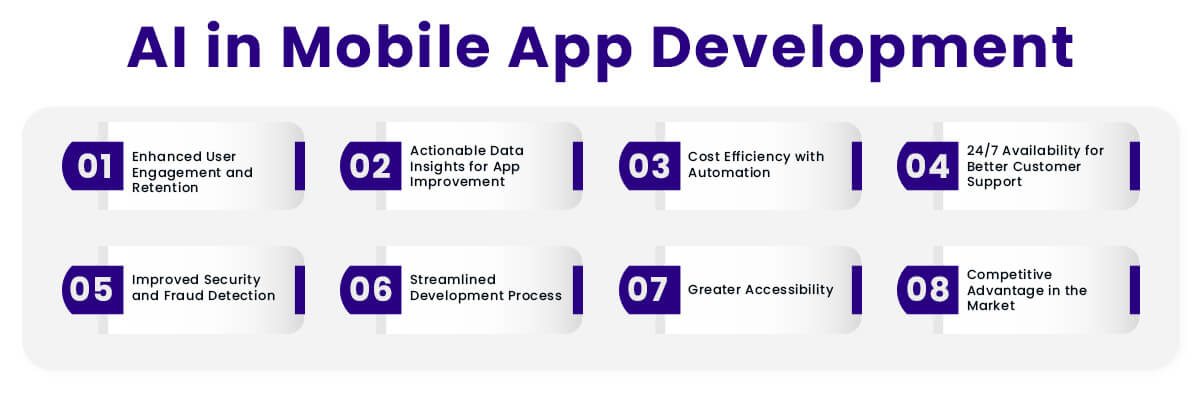
AI offers a range of benefits for mobile app development, from boosting user engagement to enhancing security and personalization. By integrating AI, apps can deliver smarter, more responsive, and highly tailored experiences. Here are some of the core advantages AI brings to mobile applications:
Enhanced User Engagement and Retention
AI’s personalization capabilities keep users engaged by creating app experiences tailored to individual preferences and behaviors. By making users feel valued and understood, AI boosts loyalty and retention.
To illustrate how Artificial Intelligence enhances engagement, consider these examples:
- News Apps: Recommend articles that match users’ favorite topics.
- Fitness Apps: Suggest workouts aligned with a user’s goals and past activities.
- Impact: Personalized experiences lead to higher retention, as users are more likely to stay with an app that “gets” them.
Actionable Data Insights for App Improvement
AI’s data analysis capabilities provide developers with a wealth of actionable insights, helping them understand how users interact with their app on a granular level. By analyzing patterns in user behavior—such as the features used most, navigation paths, and common drop-off points—AI offers clear insights into what’s working and what isn’t.
This data-driven approach empowers developers to make informed decisions about app improvements. For instance, if analytics show that a particular feature isn’t being used, developers might streamline it or replace it with something more relevant. Similarly, if a certain path leads to high user engagement, that element can be highlighted or expanded.
With these insights, developers can create a user experience that is continuously refined and optimized, ensuring the app remains relevant and effective over time. AI’s data analysis not only enhances app functionality but also leads to a more satisfying user journey.
Cost Efficiency with Automation
AI cuts costs by automating repetitive tasks such as customer support, data analysis, and maintenance. This frees up resources for critical areas like development and user experience improvements.
Here are some ways automation delivers cost efficiency:
- Automated Customer Support: AI chatbots handle common inquiries, allowing support teams to focus on complex issues.
- Efficient Data Processing: AI analyzes user data automatically, minimizing manual intervention.
- Resource Allocation: Cost savings from automation can be redirected to enhance app features and user satisfaction.
- Partner With an Expert: Contact a professional AI automation agency, they will help you installed complete business automation by creating custom AI software solution.
24/7 Availability for Better Customer Support
AI-powered chatbots offer the significant advantage of 24/7 customer support, allowing users to get immediate assistance whenever they need it. Unlike traditional support, which relies on fixed hours, AI-driven support can address user questions and concerns at any time of day, making it especially valuable for global audiences.
These chatbots can handle a wide variety of inquiries, from answering FAQs to guiding users through basic troubleshooting steps. If a question requires further assistance, the AI can seamlessly escalate it to human support, ensuring a smooth transition without leaving users waiting.
This constant availability improves user satisfaction, as users feel assured that help is always accessible. It also reduces the load on human agents, allowing them to focus on more complex issues. Ultimately, AI-driven 24/7 support enhances the overall user experience, making users feel supported and valued around the clock.
Also Read:
How AI Transforming Customer Experience
Improved Security and Fraud Detection
AI strengthens app security by continuously monitoring for threats and detecting unusual activity patterns, making it a crucial tool for protecting sensitive data.
Key benefits of AI-driven security include:
- Threat Monitoring: AI flags suspicious activities, like unexpected login attempts or abnormal transactions.
- Quick Response: Real-time detection allows AI to block unauthorized access instantly.
- Trust Building: With robust security, users feel safer, enhancing their trust and loyalty to the app.
Streamlined Development Process
AI-assisted tools are transforming the app development process, helping developers work more efficiently and with fewer errors. Tasks like automated testing, debugging, and even some code generation can now be handled by AI, speeding up the development cycle and reducing repetitive workloads.
For example, AI can automatically run test cases to identify potential bugs, allowing developers to fix issues earlier in the process. Debugging tools powered by AI can also detect code errors, offering solutions to streamline the process. Furthermore, AI-assisted code generation tools can suggest code snippets, accelerating coding tasks for common functionalities.
By simplifying these aspects of development, AI enables developers to focus on creative, high-level work. This streamlined process not only speeds up time-to-market but also ensures higher code quality, making AI an indispensable tool in modern app development.
Greater Accessibility
AI enhances mobile app accessibility, making digital experiences more inclusive and user-friendly for everyone. Features like voice commands enable users to interact with apps hands-free, which is especially beneficial for those with physical disabilities. With AI-powered voice recognition, users can navigate, search, or control app functions simply by speaking, creating a more accessible experience.
Another vital feature is real-time language translation. AI-driven translation tools break down language barriers, allowing users from diverse backgrounds to interact with content in their preferred language. This accessibility is crucial for global audiences, ensuring that language is never a limitation.
By incorporating these AI-driven features, apps become more inclusive, catering to users of all abilities and backgrounds. Ultimately, accessibility isn’t just a technical advantage; it fosters a positive user experience, showing that the app values all its users.
Competitive Advantage in the Market
In today’s tech landscape, users expect more from their apps, including smart, responsive, and personalized experiences. Integrating AI into mobile apps provides a significant competitive edge, allowing businesses to differentiate their products in a crowded market. These advancements highlight the growing applications of AI in business, enabling apps with AI-driven features like personalization, predictive analytics, and advanced search to stand out, capturing user interest and loyalty.
AI doesn’t just enhance the app’s functionality; it signals to users that the app is at the forefront of technology. For instance, users are more likely to trust and engage with an app that offers smart recommendations, responsive support, or advanced security features, all powered by AI.
This competitive advantage is a powerful draw for users who seek intelligent, engaging apps. By meeting and exceeding user expectations with AI capabilities, businesses position their apps as leaders in innovation, driving growth and user retention.
Ready to revolutionize your mobile app with AI capabilities? Hire our AI developers today
Use Cases of AI in Mobile App Development
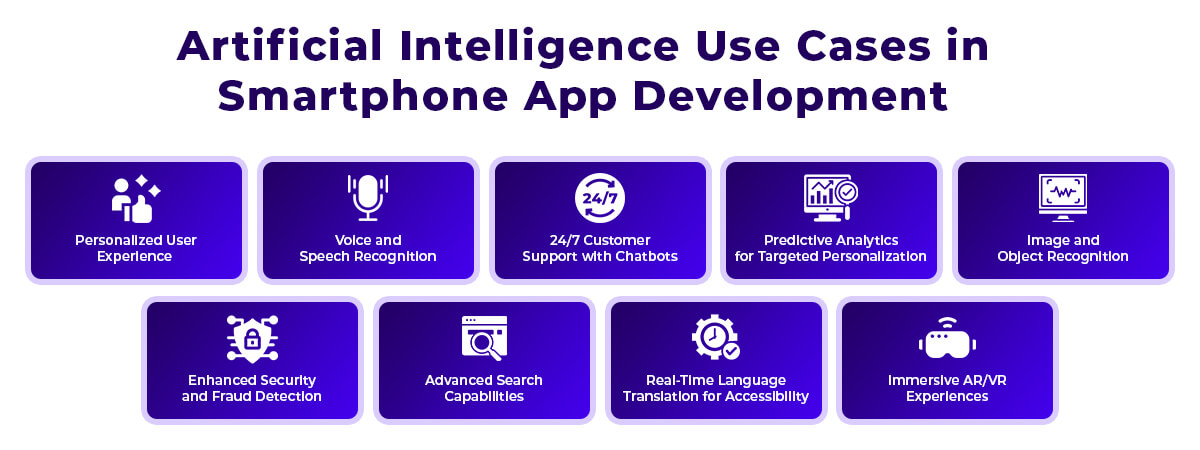
AI is revolutionizing mobile app development by enhancing functionality and delivering personalized experiences. From predicting user preferences to enabling hands-free interactions, AI elevates app usability and engagement. Let’s explore some key use cases demonstrating AI’s impact on mobile apps:
Personalized User Experience for Higher Engagement and Retention
AI empowers mobile apps to offer a unique, user-centered experience by tailoring content and app interfaces to individual preferences. This goes beyond simple customization AI observes user behavior, tracks interactions, and learns patterns to provide relevant suggestions and interfaces that resonate with each user.
For example, an AI-powered streaming app might recommend movies or music based on a user’s past choices, while a shopping app could display products aligned with their browsing history and interests. This level of personalization keeps users engaged and returning to the app, boosting retention rates. Ultimately, when users feel the app “understands” them, they’re more likely to stay loyal and satisfied.
Voice and Speech Recognition
AI-driven voice and speech recognition opens up a world of hands-free interaction within mobile apps, making them more accessible and convenient. With the rise of virtual assistants like Siri, Google Assistant, and Alexa, users expect to engage with apps simply by speaking. This technology enables users to issue commands, search, and navigate the app without touching the screen a crucial benefit for busy, on-the-go users.
For example, in a fitness app, users might start a workout or log a meal using only their voice, while a productivity app can schedule tasks or set reminders through simple spoken commands. This voice-enabled interaction isn’t just a convenience; it enhances accessibility for all users, including those with physical limitations, making apps more inclusive and user-friendly.
To meet these evolving expectations, businesses are increasingly investing in AI voice agent development, creating intelligent voice-driven solutions that deliver more natural, human-like conversations and elevate the overall user experience.
24/7 Customer Support with Chatbots
AI-powered chatbots have transformed the customer service landscape in mobile apps. By providing instant, round-the-clock assistance, they ensure that users can get answers to common questions any time they need. This convenience not only satisfies user expectations but also enhances app usability, reducing friction for those needing help outside of standard business hours.
These chatbots can handle a wide range of tasks, from providing basic troubleshooting to addressing frequently asked questions. And if the inquiry is too complex, the chatbot can direct the user to a human representative. This balance between automation and human touch keeps users engaged and builds trust in the app’s responsiveness.
Predictive Analytics for Targeted Personalization
AI’s predictive analytics capability is a game-changer for personalizing the user experience. By analyzing historical data and user interactions, AI can forecast user behaviors and preferences with impressive accuracy. This allows mobile apps to deliver tailored experiences that feel intuitive and relevant to each user.
Here’s how predictive analytics enhances personalization:
- Targeted Recommendations: Apps can recommend products, content, or services that align with the user’s past behavior.
- Anticipated Needs: Based on user patterns, apps can suggest features or services the user may need, enhancing engagement.
- Optimized Marketing Efforts: By understanding user preferences, predictive analytics supports targeted marketing that drives conversions and retention.
With this customized approach, users are more likely to feel understood and valued, which translates into higher engagement and loyalty.
Image and Object Recognition
AI’s ability to recognize images and objects has opened up new possibilities in mobile app functionality. For instance, in e-commerce apps, users can upload an image of a product to find similar items for purchase, making shopping faster and more convenient. Social media apps leverage object recognition for AR filters, allowing users to interact with virtual elements layered over real-world images.
Beyond convenience, this technology also enhances security. In banking apps, for example, AI can authenticate users through facial recognition, adding an extra layer of protection. By combining visual recognition with interactive experiences, AI offers both practicality and engaging user experiences that make apps more versatile and user-friendly.
Enhanced Security and Fraud Detection
AI is essential for mobile app security, particularly in sensitive areas like finance and healthcare. With the ability to analyze user behavior in real time, AI algorithms can detect and prevent potential fraud by identifying unusual patterns, such as unexpected login locations or atypical transaction amounts. This proactive approach safeguards users’ data and protects against unauthorized access.
In the financial sector, this goes a step further with fintech AI software development which not only strengthens fraud prevention but also helps institutions predict risks, ensure regulatory compliance, and deliver more secure digital banking experiences.
Key security benefits include:
- Continuous Monitoring: AI maintains round-the-clock vigilance, making real-time threat detection possible.
- Adaptive Learning: AI algorithms evolve as new security threats emerge, strengthening defenses over time.
This high level of protection not only builds trust but also provides peace of mind to users, knowing their sensitive information is secure.
Advanced Search Capabilities
AI-driven Natural Language Processing (NLP) services improve in-app search functionality even more intuitive than ever. Instead of relying on exact keywords, AI-powered search can understand the intent behind user queries, providing more relevant results even when users type in conversational phrases.
This advanced search goes beyond text-based queries. Users can now perform visual searches by uploading images or conduct voice-based searches for hands-free convenience. Whether it’s locating a product or finding a specific piece of information, AI-powered search ensures users spend less time searching and more time engaged with the content they need.
Real-Time Language Translation for Accessibility
AI-powered translation tools make apps accessible to a global audience. Users can switch languages seamlessly, breaking down language barriers within seconds. This feature allows people from different regions to interact with content in their preferred language.
Real-time translation goes beyond just words. It adapts to cultural nuances and context, making the translations more natural and user-friendly. For example, travel and messaging apps often use AI to translate phrases accurately, helping users communicate across borders.
By supporting multiple languages, apps cater to diverse demographics. This broadens their reach and appeals to users who might otherwise face language challenges. Ultimately, AI-driven translation fosters inclusivity and a more connected user experience.
Immersive AR/VR Experiences
AI brings life to AR/VR experiences in ways that feel dynamic and engaging. In gaming, AI enables realistic character interactions, making virtual worlds feel alive. Gamers encounter lifelike NPCs (non-playable characters) that respond intelligently, enhancing gameplay.
In educational apps, AI-driven AR/VR offers interactive learning experiences. Students can explore historical events, conduct virtual experiments, or even visualize complex subjects, deepening their understanding. Training apps also use AI in VR for simulations, like hands-on practice in medical or technical fields.
AI doesn’t just support immersion; it responds to user actions, adapting the experience in real-time. This makes AR/VR applications feel responsive and personalized, enhancing their appeal across various industries.
Start Building Your Mobile App Today!
AI Mobile App Development Tech Stack
The right AI mobile app development tech stack depends on the app’s features, platform, data needs, and whether AI will run on-device, in the cloud, or through a hybrid setup.
Here are the common technologies used to build AI-powered mobile apps:
- iOS AI tools – Core ML, Vision, Natural Language, Create ML, and Apple Foundation Models framework.
- Android AI tools – ML Kit, Gemini Nano, LiteRT, TensorFlow Lite, and Android Neural Networks API.
- Cross-platform frameworks – Flutter, React Native, and Kotlin Multiplatform for building AI apps across iOS and Android.
- Generative AI APIs – OpenAI, Gemini, Claude, Azure AI, AWS Bedrock, and other LLM APIs for chatbots, copilots, content generation, and AI agents.
- Data and RAG stack – Vector databases like Pinecone, Weaviate, Chroma, or FAISS for search, recommendations, and knowledge-based AI apps.
- Backend and cloud – Node.js, Python, FastAPI, Firebase, AWS, Google Cloud, and Azure for model hosting, APIs, authentication, and data processing.
- Analytics and monitoring – Firebase Analytics, Mixpanel, Datadog, LangSmith, and model evaluation tools to track usage, errors, costs, and AI performance.
Industry-Specific Examples of AI in Mobile Apps
AI-powered mobile apps create the most value when they solve clear industry problems, whether it’s improving patient engagement, reducing fraud, increasing sales, or automating daily operations.
| Industry |
AI mobile app feature |
Business value |
| Healthcare |
Symptom checker, medical report summarizer, medication reminders |
Better patient engagement and care support |
| Fintech |
Fraud detection, spending insights, risk scoring |
Safer transactions and smarter financial decisions |
| Retail/eCommerce |
Visual search, product recommendations, AI shopping assistant |
Higher conversions and better customer experience |
| Education |
AI tutor, adaptive quizzes, progress tracking |
Personalized learning and improved student outcomes |
| Travel |
AI itinerary planner, language translation, booking assistant |
Faster trip planning and real-time travel support |
| Logistics |
Route optimization, demand forecasting, delivery tracking |
Lower operational cost and faster deliveries |
| Real estate |
AI property recommendations, valuation assistant, lead scoring |
Faster lead conversion and better property matching |
Key Steps for Seamless AI Integration in Mobile App Development
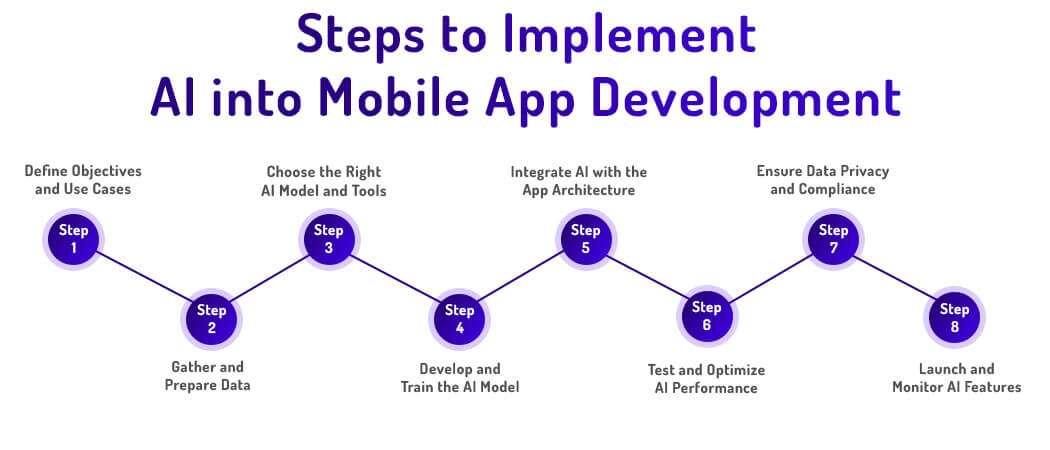
Step 1. Define Objectives and Use Cases
Overview: Start by defining your goals for integrating AI technologies and identifying which app features will benefit most. Clear objectives will help you focus on areas where AI can add real value.
Example: For engagement, AI can personalize content; for security, it can detect fraud. If customer service is key, AI-powered chatbots can provide 24/7 support. This clarity ensures your AI strategy aligns with app goals and user needs.
Step 2. Gather and Prepare Data
Overview: AI depends on high-quality data. Collect user data ethically, ensuring it’s clean, relevant, and accessible for your AI model to perform effectively.
Action: Set up processes for data collection, storage, and management to support AI training. Proper data handling builds a strong foundation for accurate AI predictions.
Step 3. Choose the Right AI Model and Tools
Overview: Select AI models and tools that align with your app’s specific needs, such as machine learning development services for predictions or NLP for chatbots.
Example: For building chatbots, consider NLP tools like Dialogflow or Microsoft Bot Framework. The right tools enhance functionality and deliver better user experiences.
Step 4. Develop and Train the AI Model
Overview: Build and train your AI model using collected data, fine-tuning it to improve accuracy and responsiveness over time.
Action: Use data to continually refine the model, ensuring it can reliably predict user needs and respond accurately to interactions.
Step 5. Integrate AI with the App Architecture
Overview: Embed the AI model within the app’s existing infrastructure, ensuring it works smoothly alongside other app features.
Example: For instance, add an AI-powered recommendation engine to an e-commerce app’s product display. Seamless integration keeps the user experience consistent and intuitive.
Step 6. Test and Optimize AI Performance
Overview: Thoroughly test AI features to ensure they function as expected and deliver a seamless user experience. Rigorous testing helps identify areas for improvement before launch.
Action: Gather user feedback and review performance analytics to refine AI functionalities. Continuous optimization based on real user data enhances reliability and effectiveness.
Step 7. Ensure Data Privacy and Compliance
Overview: Safeguarding user data is essential when integrating AI. Implement data protection measures and ensure compliance with relevant privacy regulations.
Example: For apps in the EU, follow GDPR guidelines to handle user data responsibly. Meeting privacy standards builds user trust and helps prevent regulatory issues.
Step 8. Launch and Monitor AI Features
Overview: Once AI features are ready, roll them out carefully and monitor their impact on user experience and app performance.
Action: Track AI’s effectiveness over time and make adjustments as needed. Regular monitoring ensures the AI continues to deliver value and meet user needs.
Cost to Build an AI-Powered Mobile App
The cost of AI mobile app development depends on the app type, AI feature complexity, data needs, integrations, security, and whether the app uses third-party AI APIs or custom AI models.
| AI mobile app type |
Estimated cost |
| Basic AI chatbot app |
US $15,000 – US $35,000 |
| AI customer support app with NLP |
US $30,000 – US $70,000 |
| AI recommendation or personalization app |
US $40,000 – US $100,000 |
| Predictive analytics AI app |
US $50,000 – US $120,000 |
| Generative AI mobile app |
US $60,000 – US $150,000 |
| AI agent or enterprise copilot app |
US $100,000 – US $250,000+ |
| Custom AI app with deep learning or complex model training |
US $150,000 – US $500,000+ |
You must note this: These are broad 2026 estimate ranges based on current AI app development pricing.
The final cost depends on scope, design, backend, data pipelines, model choice, API usage, and post-launch maintenance.
Future Trends of AI in Mobile App Development
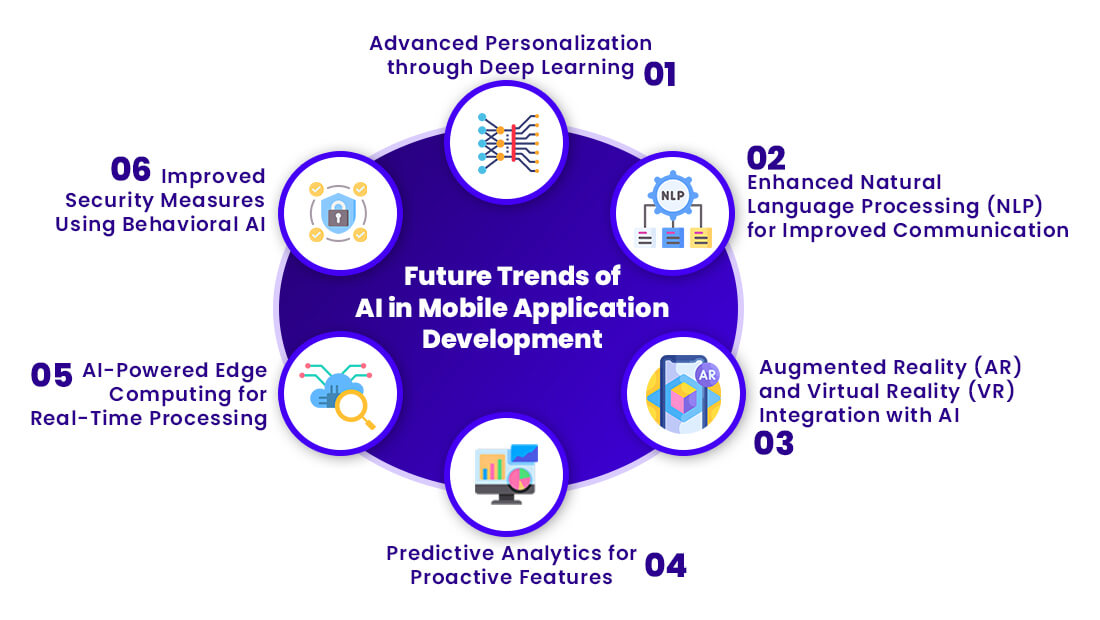
Advanced Personalization through Deep Learning
Overview: Deep learning is set to elevate personalization in mobile apps by delving deeper into user behavior and preferences. Unlike traditional methods, deep learning algorithms analyze complex datasets, understanding subtleties in user interactions, preferences, and usage patterns.
This advanced analysis enables apps to deliver more precise, tailored experiences to each individual user. It’s a step beyond standard personalization, enhancing relevance and user connection.
Impact: The result is hyper-personalized, real-time interactions. Apps can adjust recommendations, content, and features on-the-fly, adapting to each user’s unique needs and moods.
This creates a more engaging experience, as users feel understood and valued. Such personalization drives higher retention and overall user satisfaction, making it a crucial future trend.
Enhanced Natural Language Processing (NLP) for Improved Communication
Overview: Future developments in Natural Language Processing (NLP) are poised to make voice assistants and chatbots more intuitive and contextually aware. Advanced NLP will enable AI to understand nuances like slang, idioms, and regional dialects.
This improvement will make AI-driven communication tools feel more human-like. Responses from AI will be more relevant and natural, mimicking human dialogue.
Impact: This evolution in NLP will result in smoother, more conversational interactions. Users will experience fluid exchanges that feel personalized and context-aware, enhancing usability.
Whether for information, troubleshooting, or simple interactions, users will find AI-based communication tools easier and more enjoyable to use. Stronger engagement is likely as AI becomes more conversationally adept.
Also Read:
A Complete Guide to Natural Language Processing
Augmented Reality (AR) and Virtual Reality (VR) Integration with AI
Overview: AI’s integration with AR and VR will create immersive, responsive environments. Users will experience highly interactive digital spaces.
In gaming, education, and retail, AI-driven AR/VR will transform user engagement by adding layers of realism. For businesses, leveraging retail AI solutions development can create smarter shopping experiences that respond to users’ movements and choices, creating a richer experience.
Impact: By combining AI with AR and VR, apps will offer simulations that adjust in real-time to user input. This interactive quality provides a unique user experience.
Whether users are learning, shopping, or gaming, they’ll spend more time engaged with these immersive apps. Enhanced engagement and loyalty will naturally follow, as each virtual experience feels captivating.
Predictive Analytics for Proactive Features
Overview: AI’s predictive capabilities are transforming how mobile apps anticipate user needs. By analyzing user patterns, predictive analytics helps apps foresee what users might need next.
This allows apps to proactively offer relevant recommendations, from reminders to product suggestions. It creates a seamless experience where users feel understood without having to search.
Impact: The result is a more convenient, streamlined user experience. Proactive features save users time by delivering suggestions or reminders before they even need them.
This predictive approach not only enhances usability but also keeps users engaged. Apps that anticipate needs build a stronger, more satisfying user experience.
AI-Powered Edge Computing for Real-Time Processing
Overview: Edge computing brings AI processing directly onto mobile devices, reducing the need for cloud-based processing. This minimizes latency, allowing for faster response times.
With edge computing, real-time data processing happens on the device, which is ideal for apps requiring immediate feedback. This is especially crucial for applications in AR/VR and IoT.
Impact: Users benefit from faster, more efficient app performance. Real-time processing enhances the functionality of interactive apps that need instant responses.
This technology improves user satisfaction and app reliability, particularly in time-sensitive applications. Edge computing ensures smooth, responsive interactions without cloud dependence.
Improved Security Measures Using Behavioral AI
Overview: AI is advancing in fraud detection by leveraging behavioral analysis to identify potential threats. By monitoring user patterns, AI can recognize unusual behavior that might indicate fraud.
Behavioral AI learns and adapts to user habits over time, improving its ability to detect anomalies. This makes security measures more proactive and personalized.
Impact: With stronger security, users feel more confident in apps handling sensitive data. Behavioral AI safeguards user information more effectively, enhancing trust.
These advanced security features reduce the risk of breaches. By using behavioral insights, apps maintain a higher level of protection, benefiting both users and businesses.
Also Read: App Modernization Strategy: A Step-by-Step Guide
How Prismetric Can Help You Build AI-Powered Mobile App Solutions for Your Business
At Prismetric, we offer comprehensive mobile app development services that leverage the power of AI to create intelligent, responsive apps tailored to your business needs. With a focus on delivering user-centric solutions, our team integrates AI-driven features, ensuring your app stands out in the competitive market. Whether you’re looking for personalized recommendations, automated support, or advanced analytics, we bring cutting-edge technology to every app we build.
Staying updated with the latest AI trends and mobile design trends, our team of experts develops apps that are both innovative and user-friendly. We prioritize user engagement and functionality, following the top mobile app development trends to create forward-looking solutions. By implementing the most effective AI tools, we ensure that your app not only meets today’s standards but is also prepared for the future.
As an experienced AI development company in the USA, Prismetric combines expertise in AI with a deep understanding of business requirements. From concept to launch, we work closely with you, providing end-to-end support and guidance. Our goal is to build apps that elevate your brand and offer a seamless, intelligent experience for your users, positioning your business for sustained growth in the digital landscape.
Ready to build AI-powered business apps?
In the end, the influence of Artificial Intelligence in mobile phone app development brings about a serious transformation across various industries worldwide. So, businesses must not miss this chance to make smart, personalised, and efficient applications that not only fulfil but also surpass user expectations. Contact for AI development services now to discuss your business idea and get a pitch-perfect solution to tap potential customers with your customized business mobile apps.
AI in mobile app development means using technologies like machine learning, natural language processing, computer vision, voice recognition, and generative AI to make apps smarter, more personal, and more useful for users.
AI improves app experience by helping users get faster, more relevant, and more personalized results.
- Personalized content and product suggestions
- Smarter in-app search
- AI chatbots and voice assistants
- Fraud alerts and security checks
- Predictive reminders and recommendations
The most common AI use cases in mobile apps include:
- AI chatbots and virtual assistants
- Product recommendations
- Voice and image recognition
- Fraud detection
- Predictive analytics
- AI-powered search
- Generative AI content creation
- Personalized notifications
The cost to build an AI-powered mobile app usually starts from US $15,000 for a basic AI chatbot app and can go above US $250,000 for complex AI agents, enterprise copilots, or custom AI model-based apps. The final cost depends on features, platform, AI model type, data, integrations, and security needs.
A basic AI mobile app can take 2 to 4 months, while a complex AI-powered app may take 6 to 12 months or more. Timeline depends on the app’s features, design, backend, AI model, data quality, third-party integrations, and testing needs.
Yes, AI can be added to an existing mobile app. Businesses can integrate AI features such as:
- Chatbots
- Smart search
- Product recommendations
- Predictive analytics
- Fraud detection
- Voice recognition
- AI report summaries
This is often faster and more cost-effective than building a new app from scratch.
On-device AI runs directly on the user’s smartphone, while cloud AI processes data on remote servers.
- On-device AI is faster, works offline, and offers stronger privacy.
- Cloud AI is better for complex tasks like large language models, advanced analytics, and image or video generation.
- Hybrid AI uses both methods for better speed, performance, and cost control.
Use an AI API if you want to launch faster and reduce development cost. Build a custom AI model if your app needs industry-specific intelligence, private data handling, unique predictions, or higher control over AI behavior.
For many businesses, the best option is a hybrid approach: start with trusted AI APIs, then build custom models as the product grows.
The data depends on the AI feature you want to build. Common data types include:
- User behavior data
- Search and browsing history
- Text, voice, image, or video inputs
- Transaction data
- Product or content catalog data
- Customer support conversations
- Business documents or knowledge base content
Clean, relevant, and permission-based data leads to better AI performance.
The main challenges include:
- Poor data quality
- High AI API or cloud cost
- Slow response time
- Privacy and compliance risks
- Model hallucinations
- Bias in AI output
- Battery and performance issues
- Complex testing and monitoring
A good AI app development strategy solves these issues early through proper architecture, data planning, security, and model evaluation.
AI-powered mobile apps handle security and privacy through secure data storage, encryption, user consent, access control, anonymization, and privacy-first architecture.
For sensitive apps, businesses can also use:
- On-device AI processing
- Role-based access control
- Secure APIs
- Data minimization
- Compliance with GDPR, HIPAA, CCPA, or industry-specific rules
Many industries benefit from AI mobile app development, especially those that depend on personalization, automation, predictions, or large volumes of user data.
- Healthcare
- Fintech
- Retail and ecommerce
- Education
- Travel and hospitality
- Logistics
- Real estate
- Insurance
- Fitness and wellness
- Media and entertainment