AI in Healthcare Administration: Use Cases, Benefits, Challenges & Implementation
Key Takeaways
- AI in healthcare administration is most useful for high-volume work such as billing, claims, prior authorization, scheduling, document processing, and patient communication.
- The biggest gains come from automating complete workflows rather than isolated tasks.
- Human review still matters for low-confidence outputs, sensitive cases, and decisions that can affect patient access or payment.
- Data quality, EHR integration, security, and governance determine whether administrative AI works reliably at scale.
- ROI should be measured through processing time, manual effort, error rates, exceptions, and workflow costs—not AI adoption alone.
Healthcare administration is no longer just background work. Billing queues, prior authorization, appointment scheduling, documentation, and patient requests directly affect how quickly care moves and how much administrative effort healthcare organizations carry.
Research has estimated administrative spending at roughly 15% to 25% of total U.S. healthcare expenditure, which helps explain why organizations are looking closely at how AI can improve operational efficiency.
AI in healthcare administration has now moved beyond simple chatbots and task automation. Hospitals and healthcare organizations can use it to read documents, predict demand, prepare claims, support authorization workflows, manage appointments, and route administrative work. The real challenge is not finding another AI tool. It is deciding where automation creates value without adding new risks or manual rework.
That is where AI healthcare solutions development becomes practical. The value depends on how well AI fits existing systems, data, staff workflows, and review processes rather than on the model alone.
This guide explains:
- where AI fits into healthcare administration,
- which technologies and use cases matter most,
- what benefits and risks organizations need to consider, and
- how to implement and measure administrative AI in practice.
The wider benefits of AI in healthcare become clearer when the technology solves a specific operational problem instead of being deployed simply because AI is available.
Automate High-Volume Healthcare Admin Workflows With AI
Prismetric helps streamline claims, prior authorization, scheduling, document processing, and patient communication while keeping exception handling under human control.
Explore Healthcare AI Automation
What Is AI in Healthcare Administration?
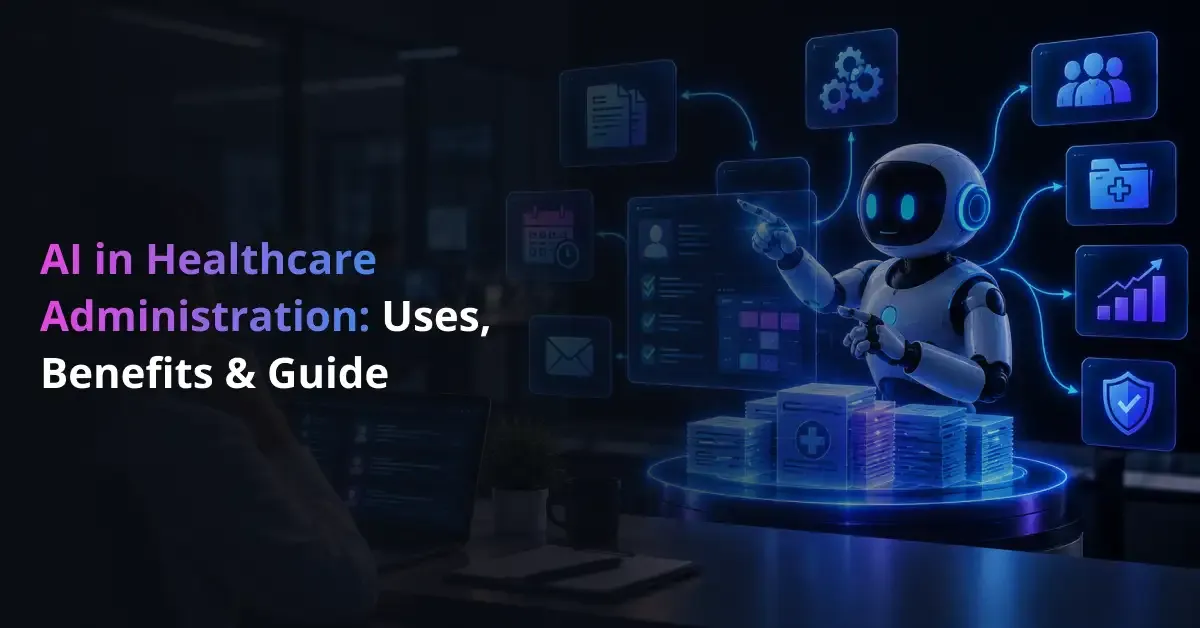
AI in healthcare administration is the use of artificial intelligence to support non-clinical operations such as scheduling, billing, claims, prior authorization, records, patient communication, staffing, and reporting. It applies systems that perform human-like analytical tasks to work that would otherwise require manual coordination.
Artificial intelligence in healthcare administration can classify documents, find patterns, draft content, predict demand, and route information between systems. This fits an enterprise AI model in which technology supports business processes.
Administrative AI differs from clinical AI. Clinical systems may support diagnosis, imaging, risk assessment, or treatment decisions, while administrative systems focus on financial workflows. Keeping the distinction clear helps organizations plan an AI transformation with controls that match each workflow’s risk. Health systems also need to consider the consequences of an incorrect output when deciding which processes can be automated.
A practical approach to planning an AI program starts with an administrative problem and measurable outcome.
| Area |
Administrative AI |
Clinical AI |
| Focus |
Operations and administration |
Patient care |
| Examples |
Billing, scheduling, claims, records |
Diagnosis, imaging, treatment support |
| Users |
Administrative and operations teams |
Clinicians and care teams |
| Oversight |
Based on workflow risk |
Greater scrutiny when care is affected |
Key Applications of AI in Healthcare Administration
AI in healthcare administration works best when the technology matches the task. Machine learning can identify patterns in structured data, natural language processing can interpret text-heavy records, generative AI can draft or summarize content, and automation can move information through connected workflows.
In 2026, these tools are increasingly being applied to practical administrative work. The American Hospital Association notes that AI is helping providers reduce administrative burden in billing, coding, and documentation, while newer healthcare AI initiatives are also focusing on document processing, interoperability, and smarter administrative workflows.
| Administrative Area |
What AI Can Support |
Typical Human Role |
| Billing and claims |
Coding checks, claim review, denial analysis |
Validate exceptions |
| Prior authorization |
Document extraction and packet preparation |
Review and escalate |
| Documentation |
Draft notes and structure records |
Verify accuracy |
| Document processing |
Extract, classify, and route information |
Handle exceptions |
| Scheduling |
Booking, reminders, waitlists |
Resolve complex cases |
| Patient communication |
Routine questions and routing |
Handle sensitive issues |
| Staffing and resources |
Demand and capacity forecasting |
Make allocation decisions |
| Compliance and reporting |
Monitoring and report preparation |
Validate and approve |
Medical Billing, Coding, Claims, and Denial Management
AI can review encounter data, clinical documentation, and billing rules to support coding and claim preparation. When automating billing processes with AI, the system can flag missing information, identify coding inconsistencies, or route low-confidence cases to a billing specialist before a claim is submitted. Automated coding systems are already being used to analyze EHR and clinical-system data, with human review applied when confidence is too low.
The same approach can support denial management by finding patterns in rejected claims and helping teams prepare follow-up work. Organizations that need to automate multi-step billing workflows can connect AI with revenue-cycle systems, while staff continue to review exceptions and higher-risk cases.
Prior Authorization Automation
AI for prior authorization can reduce manual document handling by reading clinical notes, payer rules, and supporting records, then identifying the information required for a request. An AI workflow automation approach can assemble data, prepare documentation, track status, and route requests that need human review.
This use case is becoming more important as electronic prior authorization expands. CMS requires impacted payers to implement Prior Authorization APIs beginning in 2027 so providers can determine requirements and exchange requests and decisions electronically. AI can support that workflow, but approval, denial, and exception handling still need clear oversight.
Ambient Documentation and EHR Management
Ambient AI can capture a patient-clinician conversation and create a draft note, helping reduce time spent on manual documentation.Tools that generate and summarize content can also structure information before it moves into an electronic health record. Ambient documentation is one of the administrative applications hospitals are using to reduce manual transcription and note-writing work.
Healthcare organizations can build domain-specific generative AI workflows that combine transcription, summarization, field mapping, and review. Clinicians still need to verify documentation when errors could affect coding, reimbursement, or care.
Intelligent Document Processing and Referral Management
Healthcare administration still depends heavily on unstructured information such as referrals, faxes, PDFs, lab reports, and insurance forms. Software that reads and interprets healthcare text helps identify names, dates, diagnoses, payer details, and other relevant fields inside those documents. Natural language processing is particularly useful because much of healthcare information does not arrive in neatly structured database fields.
Once the information is extracted, teams can combine AI with rule-based process automation to create work items or update systems. Organizations can also extract data from unstructured healthcare documents when standard templates or manual entry cannot handle the volume efficiently.
Patient Scheduling and Appointment Management
AI for patient scheduling can match appointment demand with provider availability, identify likely no-shows, manage waitlists, and send reminders. Conversational AI in healthcare can also let patients request, confirm, or reschedule appointments through text or chat without waiting for staff. Scheduling systems can use capacity, patient preferences, and demand information to reduce the manual effort involved in booking and rescheduling visits.
These tools work best when routine requests are automated and complex situations move to staff. Healthcare organizations can deploy patient-service chatbots for common scheduling tasks, while chatbot systems connected to business data can link conversations with approved workflows.
Patient Communication and Administrative Support
AI can handle routine questions about appointments, forms, billing steps, office hours, or pre-visit instructions. This gives administrative teams another channel for high-volume requests and can reduce avoidable call-center work when the system has access to current scheduling and policy information. Healthcare organizations are already using chatbots, virtual assistants, and automated messaging for common patient interactions.
The important design choice is escalation. A chatbot or voice assistant should recognize when a request involves a billing dispute, sensitive health issue, unusual insurance problem, or another case that needs a person. Administrative automation should shorten the path to help, not create another barrier.
Staffing, Patient Flow, and Resource Allocation
AI for healthcare operations can analyze historical patient volumes, seasonal patterns, appointment demand, and current capacity to support staffing and resource planning. AI in demand forecasting helps administrators estimate where demand may rise before schedules and resources become constrained. Predictive systems can also support planning around patient volumes and peak service periods.
Teams can also analyze operational data with AI to examine bottlenecks in patient flow, room use, or service demand. Organizations that need tailored forecasting can develop predictive staffing models while keeping final allocation decisions with operational leaders.
Compliance, Reporting, and Administrative Audit Support
AI can help administrative teams review documents, identify missing information, prepare reports, and monitor workflows for unusual activity. Generative AI for compliance can assist with summarization and report drafting when outputs are based on approved policies and source material.
However, AI does not make a healthcare organization compliant by itself. Teams still need access controls, audit trails, validation, accountable reviewers, and policies that reflect applicable requirements. Understanding U.S. AI rules and compliance requirements helps organizations place automation inside a governed process rather than treating generated output as final authority. Research on AI in hospital management similarly identifies ethical, legal, and operational considerations as part of responsible adoption.
Connect AI With Your Existing Healthcare Systems
Integrate AI with EHRs, revenue-cycle platforms, scheduling tools, payer systems, and document workflows without creating another isolated application.
Discuss Your Healthcare AI Integration
What Technologies Power AI in Healthcare Administration?
AI in healthcare administration combines several technologies. The right choice depends on whether the task requires prediction, text understanding, content generation, conversation, or system actions.
Machine Learning
Machine learning finds patterns in historical data. In healthcare administration, it can estimate no-show risk, denial likelihood, staffing demand, or patient volumes, helping teams focus on cases that need attention.
Natural Language Processing
Natural language processing, or NLP, helps software understand clinical notes, referrals, payer documents, and other text-heavy records. It can extract fields, classify documents, and convert unstructured text into data that administrative systems can process.
Generative AI and Large Language Models
Large language models can summarize records, draft correspondence, and prepare administrative content. Organizations with specialized requirements may develop LLM applications for controlled workflows instead of relying on general-purpose tools.
Record Summarization and Drafting
Generative AI can shorten long records into drafts for staff review, reducing reading and writing time while keeping people responsible for accuracy.
Retrieval-Augmented Generation
Retrieval-augmented generation, or RAG, retrieves approved information before a model answers. Healthcare organizations can ground AI responses in controlled knowledge sources so outputs rely more on relevant organizational information.
Conversational AI
Conversational systems handle text or voice exchanges. Organizations can build voice-based administrative assistants for appointment questions, reminders, and call routing while escalating sensitive requests to staff.
AI Agents and Workflow Automation
AI agents can use approved tools to complete several steps in a process.
Tool Access and Workflow Execution
Organizations can build governed agents for administrative workflows that collect information, update work queues, or prepare responses across connected systems.
Human Approval and Exception Handling
High-impact actions need approval points, confidence thresholds, and escalation rules so uncertain outputs do not move through billing, authorization, or patient-facing workflows unchecked.
Benefits of AI in Healthcare Administration
The value of AI in healthcare administration comes from improving specific workflows. When the technology fits the process and data, healthcare administrative automation can reduce repeated manual work and help teams respond faster.
- Reduced manual workload: AI can extract information, route documents, prepare drafts, and handle routine requests, giving staff more time for exceptions and complex cases.
- Faster processing: Automation can move claims, authorization requests, and appointment changes through defined steps with fewer handoffs. This is one reason organizations study how AI can help reduce operating costs.
- Better information consistency: AI can flag missing fields, conflicting details, or unusual patterns before data moves into billing, records, or reporting workflows.
- Improved patient access: Scheduling tools, reminders, and self-service systems can reduce administrative friction. Generative AI in healthcare operations can also support document-heavy and communication-heavy work when appropriate controls are in place.
- Better resource use: Forecasting helps administrators plan staffing and capacity around expected demand rather than relying only on manual estimates.
- More scalable operations: Healthcare organizations can scale administrative automation as transaction volumes grow.Agentic process automation can coordinate multi-step work when permissions and human review are clearly defined.
These benefits depend on data quality, integration, workflow design, and staff adoption. Poorly designed automation can simply shift work between teams instead of reducing it, which makes end-to-end workflow measurement important.
Challenges and Risks of AI in Healthcare Administration
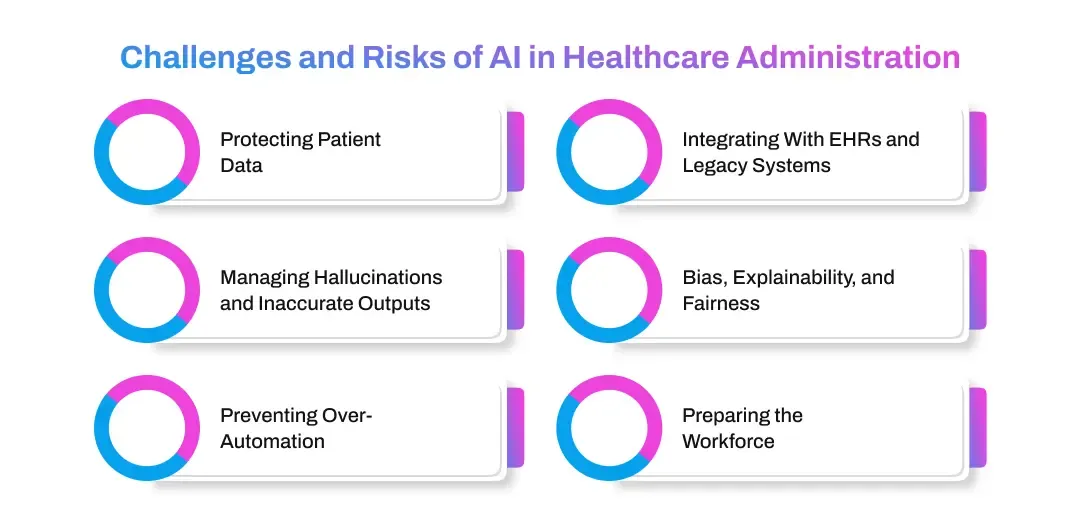
AI in hospital administration can reduce repetitive work, but healthcare organizations also need to manage data privacy, integration, unreliable outputs, fairness, over-automation, and workforce readiness.
Protecting Patient Data
Administrative workflows often contain protected health information and billing details. Organizations need clear rules for access, retention, model-provider use, encryption, and logging. The choice between private and public LLM environments can also affect how much control an organization has over data and deployment.
Integrating With EHRs and Legacy Systems
AI must connect with the systems that hold the required information. Healthcare organizations often use EHRs, revenue-cycle platforms, scheduling tools, and older applications that do not exchange data cleanly.
A clear AI integration architecture for legacy systems defines how that data moves. Organizations may also need to connect AI with existing healthcare systems through APIs and controlled interfaces rather than creating isolated tools.
Managing Hallucinations and Inaccurate Outputs
Generative AI can produce plausible but incorrect information. A wrong code, payer requirement, summary, or patient message can create rework or affect access and payment.
A structured AI model testing process helps teams test real workflow cases, identify failure patterns, and decide when human review is required.
Bias, Explainability, and Fairness
Models can reflect patterns in historical data that lead to uneven results, especially in prioritization, outreach, coverage-related work, or resource allocation. Explainable AI helps teams understand factors behind an output so unexpected patterns can be investigated.
Preventing Over-Automation
Not every administrative step should run without approval. High-impact decisions, unusual cases, low-confidence outputs, and sensitive interactions need escalation paths. Regular AI agent evaluation can help teams check whether automated behavior stays within expected boundaries.
Preparing the Workforce
Administrative AI changes how work is divided. Staff may spend less time entering data and more time reviewing exceptions, checking outputs, resolving complex cases, and improving workflows. Training should explain what the system does, where it can fail, and who remains accountable for the final outcome.
How to Implement AI in Healthcare Administration
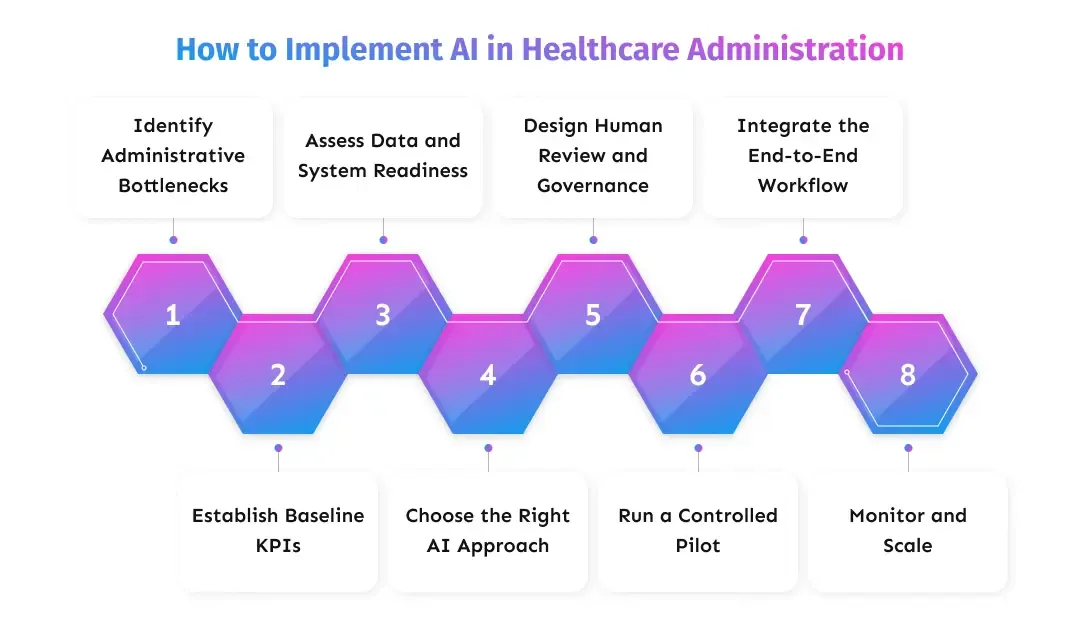
Healthcare organizations get better results when they start with an administrative problem rather than a general goal to “use AI.” An implementation plan connects the workflow, data, systems, people, and controls before automation moves into operations.
Step 1: Identify Administrative Bottlenecks
Map repeated tasks, manual handoffs, document review, and data entry. An AI workflow discovery checklist can help teams compare processes by volume, delay, error risk, and automation potential instead of choosing use cases based on novelty.
Step 2: Establish Baseline KPIs
Measure current performance before introducing AI. Useful baselines include processing time, manual touches, backlog, denial rate, no-show rate, exception rate, and cost per transaction. These measures show whether the new workflow improves operations.
Step 3: Assess Data and System Readiness
Review EHRs, scheduling platforms, revenue-cycle systems, payer portals, document repositories, APIs, and access controls. Organizations can use AI implementation services when they need technical support connecting data, systems, security, and deployment requirements.
Step 4: Choose the Right AI Approach
Not every task needs an LLM or AI agent. Rules can handle predictable steps, machine learning supports prediction, and NLP works with text-heavy documents. Comparing custom AI with off-the-shelf AI also helps teams weigh control, speed, integration, and cost.
Step 5: Design Human Review and Governance
Define which outputs can move automatically and which need approval. Set confidence thresholds, permissions, audit logs, escalation rules, and ownership. For generative AI workflows, specialized consulting support can help plan model use, data controls, and evaluation.
Step 6: Run a Controlled Pilot
Test one bounded workflow in real conditions. Track accuracy, exceptions, user feedback, integration problems, and time saved. A structured AI proof-of-concept process helps validate fit before larger investment.
Step 7: Integrate the End-to-End Workflow
AI creates limited value if it automates one task but leaves several manual handoffs around it. The output should move into the next approved system or queue. Organizations can build a focused AI proof of concept before wider production rollout.
Step 8: Monitor and Scale
After deployment, monitor accuracy, exception rates, staff adoption, system performance, and business outcomes. Scale only after the workflow is stable, and update models or integrations as policies, payer rules, data, or operating conditions change.
Best Practices for Safe and Human-Led Administrative AI
AI in healthcare administration works best when automation has clear limits. The goal is to reduce repetitive work while keeping people responsible for sensitive, uncertain, or high-impact decisions.
- Define human approval points: Decide which actions can proceed automatically and which require review. Denials, disputed billing cases, and low-confidence outputs may need escalation.
- Use role-based access controls: Give systems and users access only to the data and tools required for their tasks, limiting unnecessary exposure of protected health information.
- Maintain auditable activity logs: Record important inputs, outputs, approvals, and system actions. Audit trails support internal review and broader IT compliance requirements.
- Validate high-impact outputs: Test administrative AI against realistic records, edge cases, and known failure scenarios before relying on it in production.
- Monitor after deployment: Performance can change as data, payer rules, prompts, or integrations change. Teams should also watch for security risks such as prompt injection.
- Provide clear escalation paths: Staff and patients should know how to reach a person when automation cannot resolve a request or produces an uncertain result.
This human-in-the-loop model lets AI handle routine work while people review exceptions, approve sensitive actions, and remain accountable for final outcomes.
How to Measure ROI From AI in Healthcare Administration
ROI should show whether AI improves a specific administrative workflow, not simply whether the organization has deployed the technology. Teams should compare operational gains with implementation, integration, infrastructure, monitoring, training, and governance costs.
| Workflow |
Useful KPI |
| Claims |
Processing time, clean-claim rate, denial rate |
| Prior authorization |
Turnaround time, touches per request |
| Scheduling |
Booking time, fill rate, no-show rate |
| Documentation |
Review time, correction rate |
| Patient communication |
Response time, escalation rate |
| Automation |
Touchless completion rate, exception rate |
An AI automation ROI framework can connect these measures with financial and operational outcomes. For example, faster prior authorization matters only if it reduces manual effort or delays without increasing errors, rework, or inappropriate automated decisions.
The same principle applies across AI for healthcare administration: measure the whole workflow. Time saved in one step can disappear if staff must correct poor outputs, resolve more exceptions, or complete extra manual work later. ROI therefore needs both efficiency measures and quality measures, not a single headline figure.
The Future of AI in Healthcare Administration
AI in healthcare administration is moving from single-task tools toward connected systems that support several steps in the same workflow. The change is not simply more automation; it is better coordination between data, software, staff, and review.
More Agentic Administrative Workflows
AI agents can collect information, call approved tools, update records, and route cases across systems. These agentic AI use cases can reduce manual handoffs when organizations define permissions, monitoring, and approval points.
More Connected Provider-Payer Workflows
Standardized data exchange can make prior authorization and claims easier to automate. Better interoperability can reduce repeated data entry, while structured APIs help providers and payers exchange requirements, status updates, and supporting information consistently.
More Predictive Healthcare Operations
Healthcare organizations can use predictive models to forecast appointment demand, staffing needs, patient flow, and workload. Governance and human oversight remain important because operational decisions can affect patient access and staff workload.
Prove Administrative AI Value Before You Scale
Start with a focused workflow, measure processing time, manual effort, errors, exceptions, and cost, then expand only after the results are clear.
Start Your Healthcare AI Pilot
How Can Prismetric Help with AI in Healthcare Administration?
Prismetric helps healthcare organizations turn administrative AI ideas into working systems by connecting workflow design, AI development, integration, and deployment. Its healthcare-focused AI capabilities can support use cases such as claims processing, prior authorization, scheduling, document handling, and patient-service automation without treating human oversight as optional.
Here is where Prismetric can help:
Prismetric can also connect new AI capabilities with EHRs, administrative platforms, and existing software so automation fits the wider workflow instead of becoming another isolated tool.
Frequently Asked Questions About AI in Healthcare Administration
AI in healthcare administration refers to the use of artificial intelligence to support non-clinical work such as billing, claims, prior authorization, scheduling, documentation, patient communication, staffing, and reporting. It helps organizations process information, identify patterns, and automate repeatable tasks while staff handle exceptions.
Healthcare organizations use AI to extract data from documents, predict no-shows, assist coding, prepare prior-authorization requests, summarize records, answer routine patient questions, and support staffing decisions. These systems can connect with EHRs, scheduling tools, revenue-cycle platforms, and other administrative software to reduce manual handoffs.
AI can automate or assist appointment reminders, document classification, data extraction, claim checks, referral routing, patient intake, and routine communications. It can also prepare drafts for staff. Higher-risk work, unusual cases, disputed claims, and low-confidence outputs usually need human review.
AI itself is not automatically HIPAA compliant. Compliance depends on how protected health information is collected, stored, shared, accessed, and processed. Healthcare organizations need to evaluate vendors, contracts, access controls, encryption, data retention, audit logs, and other safeguards before using AI with regulated health information.
AI is more likely to change specific tasks than remove the need for healthcare administrators. Repetitive data entry and document handling may decline, while staff spend more time reviewing exceptions, resolving complex patient or payer issues, managing workflows, checking automated outputs, and improving administrative processes.
A practical approach starts with one measurable administrative problem. Organizations can follow an AI implementation framework to map the workflow, set baseline KPIs, assess data and integration readiness, run a controlled pilot, define human review, and scale only after results remain stable.