AI in Digital Transformation: How AI Is Reshaping Businesses in 2026
Key Takeaways
- AI expands digital transformation beyond basic digitization by adding prediction, generation, interpretation and adaptive automation to business processes.
- Successful AI transformation starts with business outcomes, not technology, connecting AI to real workflows, reliable data and measurable operational value.
- Machine learning, generative AI, NLP, computer vision, intelligent automation and AI agents are key technologies powering AI-driven transformation across enterprises.
- AI delivers value across functions such as process automation, customer experience, decision support, IT, supply chains, sales and product innovation.
- The biggest benefits include faster decisions, greater efficiency, improved customer experiences and better operational adaptability, but results depend on effective integration with business data and systems.
- Data quality, legacy-system integration, governance, security, skills and change management remain major barriers to scaling AI successfully.
- A staged implementation approach helps organizations move from pilots to scalable business value by prioritizing use cases, preparing data, integrating AI, establishing governance and measuring KPIs.
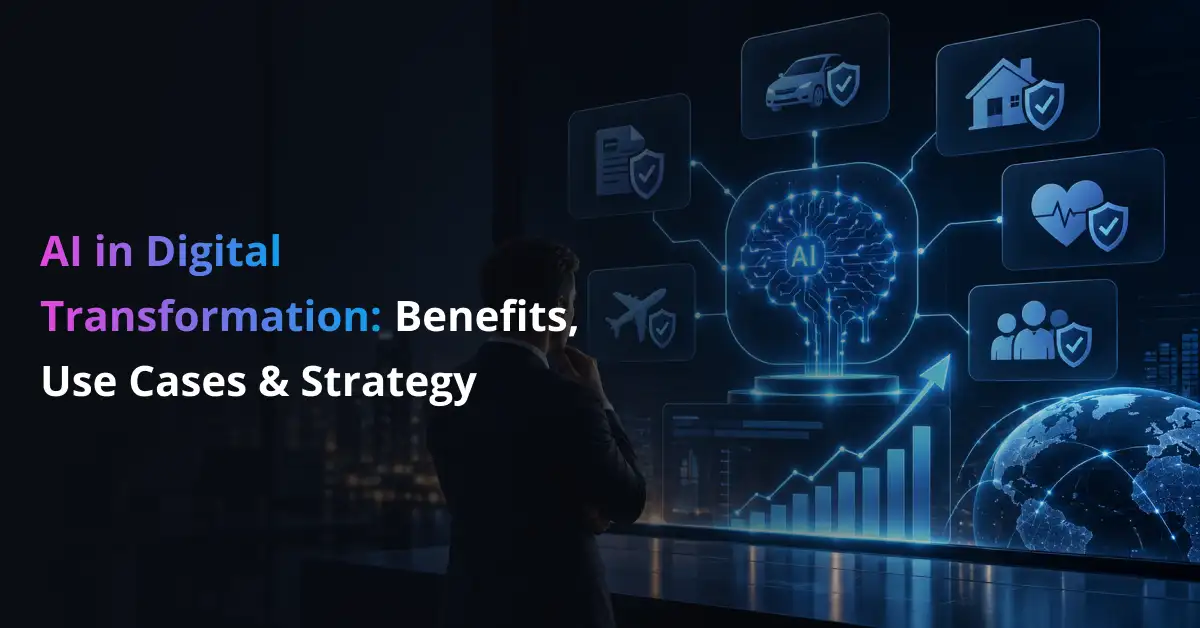
AI in digital transformation is the strategic integration of artificial intelligence into business processes, technology systems and customer experiences to automate work, improve decisions and create new ways of delivering value.
It goes beyond adding isolated AI tools. A broader AI transformation connects models, data and workflows so systems can support employees, respond to changing conditions and improve how work moves across the organization.
For enterprises, the scope can include operations, finance, customer service, sales, supply chains and product development. Enterprise AI can analyze large datasets, interpret unstructured information and support decisions that previously depended on manual review.
Technologies such as machine learning, generative AI, natural language processing, computer vision and AI agents extend digital systems beyond basic automation. Organizations building these capabilities may need to develop enterprise-wide AI systems that fit existing applications, data sources and governance requirements.
The result is a shift from static digital processes toward more adaptive, data-driven operations. AI in digital transformation helps businesses use digital infrastructure more intelligently instead of treating application modernization as simply replacing legacy processes with newer software.
AI transformation vs. traditional digital transformation
Traditional digital transformation typically digitizes processes, moves workloads to modern platforms and connects systems. AI-driven digital transformation builds on that foundation by adding prediction, generation, interpretation and adaptive automation.
| Traditional Digital Transformation |
AI-Driven Digital Transformation |
| Digitizes existing processes |
Redesigns and augments processes |
| Often follows predefined rules |
Uses models that learn from data |
| Automates repeatable actions |
Handles prediction, generation and interpretation |
| Reports what happened |
Can anticipate likely outcomes |
| People initiate most workflows |
AI can trigger or coordinate selected actions |
| Focuses on technology modernization |
Also changes data, skills and operating models |
This distinction matters because AI is not a replacement for digital transformation. It extends it. Businesses still need modern applications, connected data and reliable infrastructure before AI can improve workflows at scale.
A strong AI strategy therefore starts with the business process and desired outcome, not the model. AI becomes useful when it is connected to a real workflow, reliable data and measurable operational value.
Turn Digital Transformation Into AI-Driven Business Value
Prismetric helps identify high-value AI opportunities, prepare the right data foundation, and redesign workflows around measurable business outcomes.
Plan Your AI Transformation
Why AI is reshaping digital transformation
Organizations already generate large amounts of operational, customer and transaction data, but much of it remains difficult to analyze quickly. AI in digital transformation can turn that data into forecasts, recommendations, summaries and alerts that support faster, data-driven decision-making.
Traditional automation works well when every step can be defined in advance. AI-powered automation can handle more variable work, such as interpreting documents, classifying requests or identifying patterns, helping organizations improve operational efficiency without forcing every situation into fixed rules.
The change also affects how companies design workflows. Teams can use AI workflow discovery to identify repetitive tasks, decision bottlenecks and data gaps before deciding where automation or AI should be applied.
For leaders, the bigger issue is organizational readiness. A successful AI strategy requires clear ownership, skilled teams, usable data and governance. Organizations that need specialized guidance may use AI consulting services to align technology decisions with business priorities.
AI in digital transformation therefore involves more than deploying software. It changes how organizations use data, assign work and make decisions, which is why leadership, culture and operating-model changes matter alongside the technology itself.
Key technologies powering AI-driven digital transformation
AI in digital transformation depends on several technologies working together rather than a single model. The right combination depends on the business problem, available data, existing systems and level of automation required across the broader AI technology stack.
Machine learning and predictive analytics
Machine learning models identify patterns in historical and real-time data to estimate likely outcomes. Businesses can use machine learning development services for demand forecasting, fraud detection, predictive maintenance and customer churn analysis, helping teams act before a problem becomes more expensive.
Natural language processing and generative AI
Natural language processing helps systems interpret emails, contracts, support tickets and enterprise documents. Generative AI extends this capability by creating summaries, responses and reports. Organizations implementing these capabilities at scale may use generative AI development services to connect models with business data and workflows.
Computer vision
Computer vision analyzes images and video to detect objects, defects, activities or visual patterns. In AI in digital transformation initiatives, organizations can build visual inspection and monitoring systems for manufacturing quality checks, inventory tracking, workplace safety and other image-intensive processes.
Intelligent automation
Traditional automation follows predefined rules. Intelligent automation combines automation with AI so workflows can classify information, interpret documents and handle variable inputs. The combination of AI with robotic process automation can support more complex processes, while organizations can automate connected business workflows across operational systems.
AI agents and agentic workflows
AI agents can work toward defined goals by retrieving information, using approved tools and completing multiple workflow steps. Businesses developing goal-driven agentic systems still need clear permissions, guardrails, monitoring and human approval for actions carrying operational, financial or compliance risk.
Data and cloud infrastructure
AI in digital transformation requires accessible, reliable data and infrastructure capable of supporting model workloads. Organizations can prepare enterprise data pipelines and use cloud-based AI infrastructure to connect information with AI applications while supporting security and scalability.
Key use cases of AI in digital transformation
AI in digital transformation becomes valuable when it improves a specific workflow, decision or customer interaction. Common applications of AI in business span front-office experiences, back-office operations and technology functions.
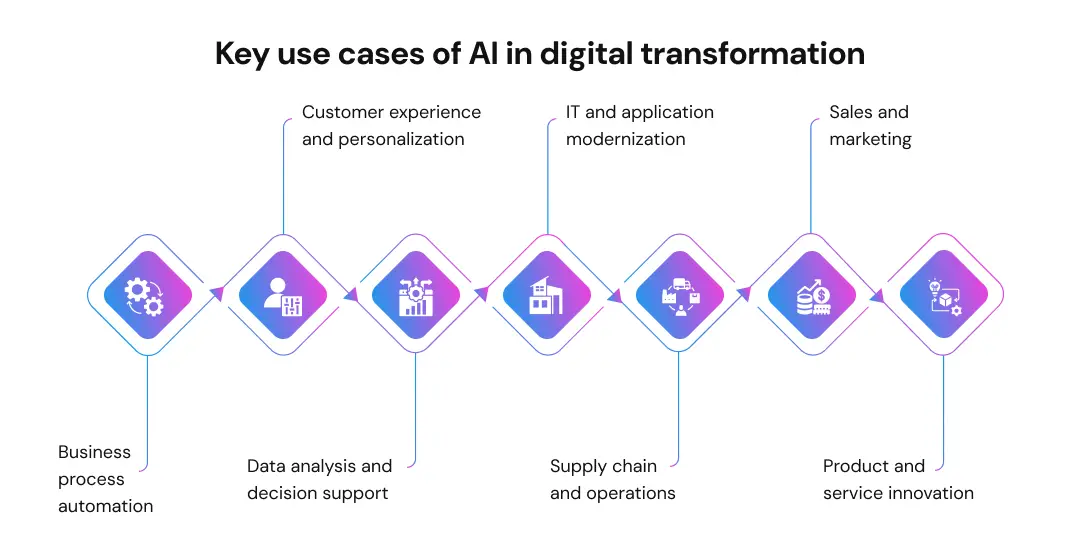
- Business process automation: AI can extract document data, classify requests, route work and manage exceptions. This extends AI-enabled business process automation beyond fixed rules and can reduce repetitive administrative work.
- Customer experience and personalization: AI can analyze behavior, preferences and conversation history to recommend products, personalize interactions and support service teams, creating more responsive AI-powered customer experiences across digital channels.
- Data analysis and decision support: AI can process large datasets, identify anomalies and generate forecasts or summaries. Businesses can turn these capabilities into decision-ready business intelligence for faster data-driven decision-making.
- IT and application modernization: Development and IT teams can use AI for code assistance, testing, incident analysis and knowledge retrieval. Generative AI for IT operations can also help teams work with complex technical information.
- Supply chain and operations: Predictive models can improve demand forecasting, inventory planning, route optimization and disruption detection, giving operations teams earlier signals when supply or logistics conditions change.
- Sales and marketing: AI can support lead prioritization, segmentation, forecasting and personalized communication. Teams can also use generative AI within CRM workflows to summarize interactions and prepare context for follow-up activities.
- Product and service innovation: AI in digital transformation can add intelligent search, recommendations, automation and decision support to digital products, helping organizations create new services while improving existing customer and employee experiences.
Connect AI With the Systems Your Business Already Runs On
Prismetric integrates AI with CRM, ERP, databases, APIs, cloud platforms, and legacy applications to create connected, intelligent workflows.
Discuss Your AI Integration
Where businesses are applying AI-led digital transformation
AI in digital transformation varies by industry because workflows, data and risk requirements differ. The strongest applications solve a defined problem.
- Manufacturing: AI applications in manufacturing support predictive maintenance, production planning, visual inspection and equipment monitoring.
- Retail and ecommerce: Retailers use AI for recommendations, forecasting, pricing and inventory. Businesses can develop AI-powered retail systems around customer and product data.
- Financial services: AI supports fraud detection, document analysis and risk assessment, reflecting enterprise AI applications across industries.
- Healthcare: AI can assist with administration, clinical documentation and patient communication. AI-enabled healthcare applications require privacy controls, validation and human oversight.
- Logistics: AI across logistics operations can improve route planning, shipment visibility, forecasting and exception handling.
- Enterprise IT: AI supports incident analysis, service management, cybersecurity monitoring and knowledge retrieval, expanding AI use cases and applications internally.
Benefits of AI in digital transformation
AI in digital transformation creates value when it improves a measurable workflow, decision or customer interaction. The benefit depends on how effectively models connect with business data and operational systems.
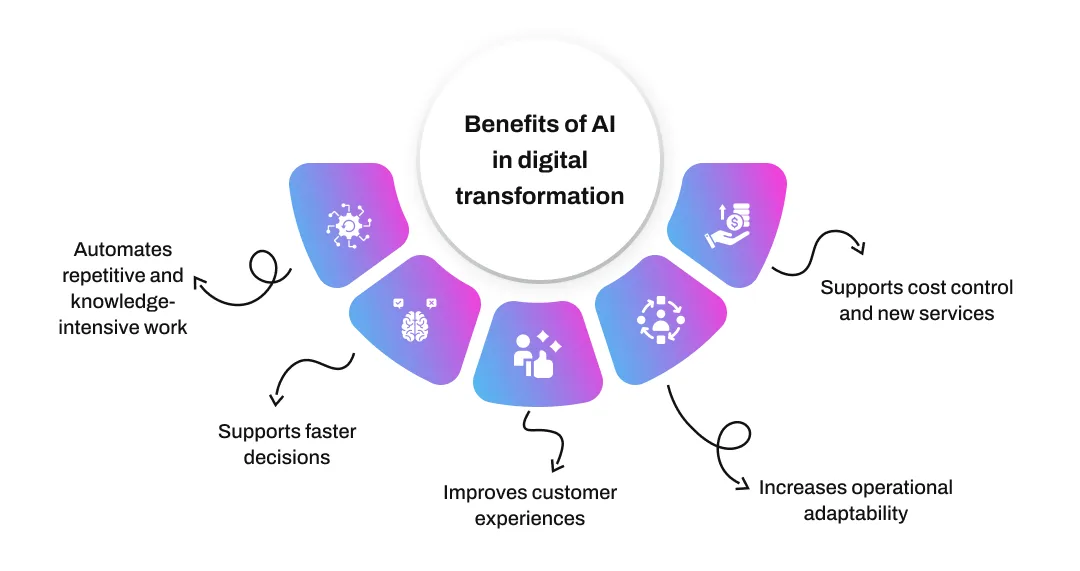
- Automates repetitive and knowledge-intensive work: AI can classify documents, route requests and prepare reports. Agentic process automation can coordinate several steps while preserving approval points for sensitive actions.
- Supports faster decisions: Predictive models can identify patterns, anomalies and likely outcomes from large datasets, helping teams respond faster without relying entirely on manual analysis.
- Improves customer experiences: AI can personalize recommendations, summarize customer history and support faster responses while employees handle interactions that require judgment or empathy.
- Increases operational adaptability: AI-enabled systems can react to changing demand and exceptions. Parallel AI in business operations can support several connected activities at the same time.
- Supports cost control and new services: Better forecasting and automation can help businesses reduce operating costs with AI while creating opportunities for AI-enabled products and services.
Challenges of AI in digital transformation
The same capabilities that make AI useful also introduce implementation risks. Organizations need to address data, integration, governance and workforce readiness before expanding AI across critical processes.
- Data quality and silos: AI models depend on accurate, accessible data. Fragmented databases, incomplete records and unclear ownership can reduce output reliability.
- Legacy systems and integration: Older applications might not provide the APIs or data access AI requires, making integration a significant part of transformation work.
- Governance, privacy and security: Teams need policies for access, model use, monitoring and accountability. Understanding AI regulation and compliance helps organizations build controls around sensitive workflows.
- Explainability and trust: Some decisions require users to understand how an AI output was produced. Explainable AI can improve transparency, but validation and human review remain necessary.
- Skills and change management: Employees need AI literacy and clear guidance on how workflows and responsibilities will change. Poor adoption can limit value even when the technology performs well.
- Scaling and proving value: Successful pilots do not automatically create enterprise ROI. Teams need KPIs, monitoring and governance when scaling systems, particularly for generative AI in compliance workflows or other high-impact applications.
How to implement AI in digital transformation
Organizations can approach AI in digital transformation as a staged business initiative rather than a technology rollout. A practical implementation plan connects business priorities, data readiness, system integration, governance and measurable outcomes while defining how employees will work with AI outputs.
- Define the business outcome: Start with a specific operational problem, such as reducing processing time, improving forecast accuracy or accelerating customer service. A practical guide to implementing AI in business can help teams translate business goals into realistic use cases and success measures.
- Prioritize high-value use cases: Evaluate opportunities by business value, technical feasibility, data availability and risk. Organizations can validate a small proof of concept before committing to a larger deployment, especially when the workflow or model approach is still uncertain.
- Assess data and infrastructure: Review data quality, access controls, integrations, cloud capacity and legacy dependencies. AI tools for data analysis can help teams explore available information, but weak or fragmented data still needs to be addressed before models can produce dependable outputs.
- Choose the right AI approach: The problem might require machine learning, generative AI, computer vision, intelligent automation, AI agents or a combination. Comparing custom and off-the-shelf AI can help organizations decide how much control, integration and customization the use case requires.
- Integrate AI into existing workflows: Connect models with CRM, ERP, databases, APIs and employee applications so outputs can influence real work. Organizations may need help integrating AI with existing systems, particularly when legacy architecture limits AI integration.
- Establish governance and human oversight: Define permissions, privacy controls, evaluation criteria, escalation rules and approval points. AI agent evaluation becomes especially relevant when systems can use tools or complete multi-step actions affecting customers, employees or business operations.
- Pilot, measure and scale: Compare results against baseline KPIs for cost, cycle time, accuracy, adoption or service quality. Organizations may need support to move AI pilots into production while maintaining monitoring, integration and governance requirements.
The future of AI in digital transformation
AI in digital transformation is moving toward systems embedded more deeply in enterprise workflows. The next phase will focus less on isolated assistants and more on connected AI capabilities operating across data, applications and processes.
- Agentic AI: AI agents will increasingly coordinate multi-step tasks, retrieve information and use approved tools. Organizations looking to automate connected business processes will still need guardrails, monitoring and human approval for consequential actions.
- Human-AI operating models: Employees will work alongside AI systems that prepare analysis, complete repeatable tasks and escalate exceptions, shifting more human effort toward judgment and oversight.
- Embedded enterprise AI: AI capabilities will become more common inside CRM, ERP, analytics and operational software.Integrating LLMs with enterprise databases shows how AI can use approved business context instead of operating as a disconnected interface.
- Real-time and edge AI: More AI processing will occur closer to devices and operational environments where latency, connectivity or privacy requirements make centralized processing less practical.
- Stronger governance and evaluation: As adoption grows, model monitoring, security, transparency and ongoing evaluation will become standard parts of digital transformation architecture.
Move From AI Pilots to Scalable Digital Transformation
Prismetric can help validate, build, integrate, govern, and scale AI solutions across business processes without creating another disconnected tool.
Talk to Our AI Experts
How Can Prismetric Help You With AI-Driven Digital Transformation?
AI in digital transformation works best when strategy, data, applications and business workflows are designed as one connected system. Prismetric helps organizations plan, build and integrate AI solutions around real operational requirements rather than deploying isolated AI tools that are difficult to scale.
Our teams work across AI strategy, data engineering, system integration, intelligent automation and enterprise software development. This allows businesses to move from identifying a high-value AI opportunity to deploying it within the systems employees and customers already use.
Here is how Prismetric can support an AI-driven digital transformation initiative:
- AI readiness and use-case discovery: We assess business processes, existing applications, available data and operational bottlenecks to identify AI use cases with practical business value and realistic implementation requirements.
- Data and architecture planning: Our team evaluates data quality, APIs, legacy systems, cloud infrastructure and security requirements to determine what needs to be prepared before AI models are introduced into production workflows.
- AI solution development: Prismetric develops machine learning, generative AI, computer vision, intelligent automation and AI agent solutions based on the workflow, data environment and level of human oversight the business requires.
- Faster AI-powered development with Vitara.ai: For development, Prismetric also uses its in-house vibe coding platform, Vitara.ai, to support faster and more accurate AI-powered development. It helps development teams accelerate coding activities while keeping engineering review, architecture decisions and quality controls within the delivery process.
- Integration with existing enterprise systems: We connect AI capabilities with CRM, ERP, databases, APIs, cloud environments and custom applications so AI becomes part of the actual business workflow instead of operating as a separate tool.
- Governance, testing and deployment: Our teams incorporate model evaluation, access controls, monitoring, human approval points and deployment planning so organizations can introduce AI with clearer operational oversight.
- Continuous improvement and scaling: After deployment, AI systems can be monitored and refined as data, workflows and business requirements change, helping organizations scale successful use cases across additional processes.
For businesses planning AI in digital transformation, Prismetric can support the journey from initial use-case selection and architecture planning through development, integration and production deployment while keeping the technology aligned with measurable business needs.
Frequently Asked Questions
AI helps businesses move beyond basic digitization by adding prediction, interpretation, generation and adaptive automation to digital processes. It enables organizations to use data more effectively, improve decisions and automate complex workflows.
Traditional digital transformation mainly focuses on digitizing processes, modernizing applications and connecting systems. It typically relies on predefined workflows and rule-based automation.
AI-driven digital transformation builds on that foundation by introducing systems that can learn from data, predict outcomes, interpret information and coordinate selected actions.
AI-driven transformation usually combines multiple technologies depending on the business problem, available data and required level of automation.
- Machine learning and predictive analytics
- Natural language processing and generative AI
- Computer vision
- Intelligent automation
- AI agents and agentic workflows
- Data and cloud infrastructure
AI can improve business performance when it is connected to reliable data, existing systems and measurable workflows. It helps organizations process information faster and respond more effectively to operational changes.
It can also improve customer and employee experiences by reducing repetitive work and supporting faster, data-driven decisions.
Key benefits include:
- Faster decision-making
- Greater operational efficiency
- Better customer experiences
- Improved business adaptability
- Better cost control
- Opportunities for new AI-enabled products and services
Common challenges include poor data quality, fragmented systems, legacy technology, governance requirements and difficulty integrating AI into existing workflows.
Organizations must also address privacy, security, explainability and human oversight, especially when AI affects sensitive or high-impact processes.
Skills and change management are equally important because even technically successful AI systems may deliver limited value if employees do not understand or adopt new workflows.
Businesses should begin with a clearly defined operational problem instead of selecting an AI technology first. The chosen use case should have measurable value, suitable data and realistic implementation requirements.
A practical implementation approach includes:
- Define the desired business outcome
- Prioritize high-value AI use cases
- Assess data and infrastructure readiness
- Select the appropriate AI approach
- Integrate AI with existing workflows and systems
- Establish governance and human oversight
- Pilot, measure and scale based on KPIs
The future of AI-driven digital transformation will increasingly involve AI capabilities embedded directly into enterprise applications, data environments and business processes.
AI agents are expected to coordinate more multi-step activities, while employees focus more on judgment, exception handling and oversight.
At the same time, real-time AI, edge AI, stronger model evaluation, security and governance will become increasingly important as organizations scale AI across operations.