AI Coding Agent Development Cost in 2026: Enterprise Pricing, Architecture, and ROI Guide
Key Takeaways
- Development cost rises with autonomy. An agent that suggests code is considerably simpler than one that reads a repository, edits multiple files, executes commands, runs tests, fixes failures, and prepares pull requests.
- Enterprise pricing goes beyond seat licenses. Token consumption, model APIs, secure sandboxes, repository indexing, observability, storage, integrations, and engineering support all contribute to the actual cost per developer.
- Agentic workflows can make usage unpredictable. A single task may involve several planning, coding, testing, and retry cycles. Gartner has warned that multistep autonomous workflows can consume substantially more tokens than simpler chatbot-style interactions.
- Architecture directly affects the budget. Model routing, codebase retrieval, tool permissions, CI/CD connections, secure execution, audit logs, and human approval points determine how much engineering an enterprise deployment requires.
- ROI should measure accepted engineering output, not generated code. Metrics such as cost per merged pull request, developer hours saved, PR cycle time, rework, defect rates, and AI spend per completed task provide a clearer picture of whether the investment is producing business value.
AI coding agents are moving beyond autocomplete. They can inspect repositories, plan changes, modify files, run tests, interact with development tools, and iterate on failures. That wider scope changes the economics. A company evaluating AI agents in software development has to budget for more than an LLM API or developer license.
For planning purposes, a custom AI coding agent can range from roughly $10,000–$30,000 for a controlled proof of concept, $20,000–$60,000 for an MVP, and $60,000–$150,000+ for an enterprise implementation. The final investment depends on repository complexity, model selection, tool integrations, execution environments, security controls, evaluation requirements, and the level of autonomy expected from the agent.
The recurring bill matters just as much. Gartner Peer Insights research reported by Computer Weekly found that 23% of technology leaders were spending $200–$500 per developer per month on AI coding-agent tokens, while 6% reported spending more than $2,000 per developer per month.
That is why calculating AI coding agent development cost requires two budgets: what it takes to build the system and what it costs to operate it across the software development lifecycle.
AI Coding Agent Development Costs by Complexity
The cost of building an AI coding agent changes significantly once the system moves from generating isolated code snippets to working inside real repositories. A basic prototype may only need access to an LLM and a small codebase. An enterprise deployment may need repository indexing, secure execution environments, CI/CD access, audit logs, evaluation pipelines, role-based permissions, and human approval controls.
This is why AI agent development cost by complexity is usually a more useful budgeting method than assigning one flat price to every project.
| Development Level |
Typical Scope |
Estimated Development Cost |
Typical Timeline |
| Proof of concept |
Narrow coding task, limited repository access, basic model integration |
$10,000–$30,000 |
4–8 weeks |
| MVP |
Repository-aware agent, testing, Git workflows, basic integrations |
$20,000–$60,000 |
8–16 weeks |
| Enterprise implementation |
Multiple repositories, secure execution, governance, monitoring, deep integrations |
$60,000–$150,000+ |
4–9+ months |
These ranges are planning estimates rather than fixed quotes. Model choice, integration depth, security requirements, development location, and the amount of existing infrastructure can push the final budget higher or lower.
Know What Your AI Coding Agent Will Cost Before You Build
Prismetric helps estimate development, model usage, infrastructure, integrations, security, and ongoing operating costs based on your required level of autonomy.
Estimate Your Coding Agent Cost
Proof-of-Concept Coding Agent
A proof of concept is designed to answer one question: can an AI coding agent perform a specific engineering task reliably enough to justify further investment?
The scope is normally narrow. The agent may inspect one repository, respond to developer instructions, generate or modify code, and run a limited set of tests. It may use a hosted LLM API rather than a complex multi-model architecture.
A PoC generally does not require full enterprise identity management, extensive observability, production-scale infrastructure, or broad CI/CD access. That keeps both engineering effort and infrastructure costs relatively low.
Organizations that need to validate technical feasibility before funding a larger program can use an AI PoC development approach to test model quality, repository understanding, task completion rates, and security assumptions under controlled conditions.
MVP AI Coding Agent
An MVP is where the agent starts behaving like part of an engineering workflow instead of an isolated experiment.
It may need to:
- retrieve relevant files from a larger repository;
- understand project documentation and coding conventions;
- modify several related files;
- run tests and static analysis;
- create branches or pull requests;
- connect with ticketing or source-control systems;
- record task outcomes for evaluation.
The cost increases because the development team is no longer building only the agent interface. They are also building the surrounding orchestration, retrieval, tool integration, testing, and permission layers.
Companies evaluating broader AI development costs should separate these engineering expenses from model API consumption. The LLM is only one part of the total system.
Enterprise AI Coding Agent
Enterprise implementations introduce requirements that rarely appear in early prototypes.
The coding agent may need to work across several repositories, comply with access policies, operate inside private cloud environments, integrate with CI/CD pipelines, respect branch protections, prevent secret exposure, produce audit records, and require approval before executing sensitive actions.
Some organizations may also use several models rather than one. A smaller model can classify tasks or summarize code, while a more capable model handles complex debugging or architectural changes. This can control inference spending, but it adds routing and evaluation logic.
Enterprise projects can therefore exceed the upper end of standard generative AI development cost ranges when the agent becomes deeply connected to internal engineering infrastructure.
The practical budgeting lesson is simple: agent autonomy creates engineering work. Every additional action the system is allowed to perform needs corresponding controls, testing, monitoring, and failure handling.
Enterprise AI Coding Agent Pricing Models
Development cost is only one part of enterprise AI coding agent pricing. Organizations also need to decide how the system will be purchased and operated.
Commercial products commonly use seat-based subscriptions, usage-based billing, or a combination of both. Custom systems typically involve an upfront engineering investment followed by recurring model, infrastructure, maintenance, and monitoring costs.
| Pricing Model |
How It Works |
Suitable For |
Main Cost Risk |
| Per-seat pricing |
Fixed monthly or annual charge for each developer |
Predictable teams using standardized tools |
Cost rises directly with headcount |
| Usage-based pricing |
Charges depend on tokens, model calls, compute, or tasks |
Variable workloads |
Heavy agent loops can make spending unpredictable |
| Hybrid pricing |
Base subscription plus metered usage |
Enterprise commercial platforms |
Difficult forecasting at high usage |
| Custom development |
Upfront engineering plus ongoing operating costs |
Proprietary workflows and internal systems |
Higher initial investment |
Per-Seat Subscription Pricing
Per-seat pricing is straightforward to budget. An enterprise pays for each developer who can use the coding assistant or agent.
The challenge appears when usage varies sharply between users. One developer may use the system occasionally for code completion, while another may delegate long-running refactoring or debugging tasks. A fixed seat price does not always show the real compute cost behind those workloads.
For organizations comparing standardized platforms with proprietary systems, a custom AI versus off-the-shelf AI analysis can help separate licensing convenience from long-term flexibility.
Usage- and Token-Based Pricing
Usage-based pricing is more closely tied to actual model consumption.
A coding agent can make several model calls while completing one task. It may first inspect the request, retrieve repository context, create a plan, generate a patch, run tests, analyze failures, revise the code, and test again.
Each loop consumes additional tokens and compute.
This makes cost per task more meaningful than cost per prompt. Enterprises should track model spending against completed engineering outcomes, particularly for long-running autonomous tasks.
The economics become even more important when working with large context windows or premium models. A broader comparison of LLM development cost helps explain why model selection, context size, and request volume can materially change monthly operating expenses.
Custom and Hybrid Pricing
A custom AI coding agent usually combines capital and operating expenses.
The organization pays to design and build the system, then continues paying for model access, cloud infrastructure, repository indexing, logging, observability, security, evaluation, and engineering support.
Hybrid architectures can reduce vendor dependency. For example, an enterprise might use a commercial coding platform for general developer assistance while deploying a custom agent for sensitive repositories or specialized workflows.
This approach can improve flexibility, but finance teams need to model both licensing costs and internal platform expenses before comparing alternatives.
AI Coding Agent Architecture and Cost by Component
Architecture is one of the strongest predictors of AI coding agent development cost because every layer adds engineering work and operating overhead.
A production system usually contains more than an LLM. It needs a way to understand repositories, connect to engineering tools, execute code safely, evaluate results, and control what the agent is allowed to do.
| Architecture Component |
Purpose |
Typical Cost Impact |
| Foundation model layer |
Planning, code generation, debugging, explanation |
Medium to high |
| Repository context layer |
Retrieves relevant code and documentation |
Medium |
| Tool integration layer |
Connects Git, IDEs, CI/CD, tickets, databases, and APIs |
Medium to high |
| Secure execution environment |
Runs commands, builds, and tests safely |
Medium |
| Evaluation and observability |
Measures quality, traces actions, detects failures |
Medium |
| Security and governance |
Controls permissions, secrets, approvals, and audits |
High |
Foundation Model and Model Routing Layer
The model layer determines how the agent interprets tasks and produces code.
Enterprises can use one model for every task, but that is not always economical. A model-routing layer can send simple classification or summarization tasks to a lower-cost model while reserving stronger models for complex coding, debugging, or planning.
Model selection also affects latency, context-window size, privacy options, and infrastructure requirements. A private or self-hosted model may provide additional control but can introduce GPU, deployment, maintenance, and optimization expenses.
The trade-offs between private and public LLMs become especially relevant when source code contains proprietary logic or regulated data.
Codebase Context and Retrieval Layer
A coding agent cannot work effectively if it sends an entire enterprise repository to the model for every request.
Instead, the system needs to identify relevant files, dependencies, documentation, previous changes, coding standards, and configuration before constructing model context.
This layer may use code search, embeddings, metadata, dependency graphs, repository indexing, or retrieval pipelines. The larger and more fragmented the codebase becomes, the more engineering effort is required to keep context accurate and current.
The architecture often resembles parts of a modern LLM application technology stack, but code retrieval introduces additional challenges because source files are highly interconnected.
Tool, IDE, Git, CI/CD, and MCP Integration Layer
The tool layer determines what the agent can actually do.
A simple coding assistant may only return text. An agent may need permission to read repositories, create branches, modify files, execute commands, run tests, inspect build logs, update tickets, or create pull requests.
Each integration adds authentication, permission management, failure handling, and testing requirements.
Model Context Protocol can also provide a standardized way for AI applications to connect with approved external tools and data sources. Enterprises considering this architecture can review how MCP works in AI systems before deciding where it fits into their development stack.
Secure Execution and Testing Environment
Allowing an AI agent to execute code introduces risks that do not exist with simple code generation.
The agent may run shell commands, install packages, execute tests, or modify configuration. These actions should normally occur inside isolated environments rather than directly on developer machines or production infrastructure.
Containers, ephemeral sandboxes, network restrictions, resource limits, secret controls, and restricted credentials all add cost. They also make the system safer and easier to audit.
Enterprises integrating agents with existing engineering environments may need a broader AI integration architecture for legacy systems when older build tools, internal APIs, or private repositories are involved.
Security, Governance, Evaluation, and Observability
An enterprise coding agent needs more than a successful test run.
Teams also need to know what the agent changed, which tools it accessed, what model produced the result, how much the task cost, whether a human approved the action, and whether the final code met quality requirements.
That usually requires audit logs, role-based access controls, policy checks, tracing, cost monitoring, task evaluation, and human approval points.
Evaluation is particularly important because generated code can compile and still be incorrect, insecure, or inconsistent with the wider system. A structured AI agent evaluation framework can measure task completion, test success, code quality, failure modes, and human acceptance before the agent receives broader autonomy.
For enterprise buyers, this governance layer is often the difference between a promising prototype and a system that engineering teams can safely use at scale.
Build an AI Coding Agent Around Your Engineering Workflow
Prismetric can connect repository context, LLMs, Git, CI/CD, secure sandboxes, evaluation, and approval controls into one governed coding workflow.
Discuss Your Agent Architecture
AI Coding Agent Development Cost by Team Role and Location
Team composition has a direct impact on AI coding agent development cost. A small proof of concept may be handled by two or three engineers, while an enterprise deployment usually requires specialists across AI, backend development, DevOps, security, testing, and product delivery.
Roles Required for Development
A typical project may involve:
- AI or LLM engineers for model selection, prompting, tool use, and agent orchestration
- Backend engineers for APIs, repository services, permissions, and workflow logic
- DevOps or MLOps engineers for deployment, sandboxing, monitoring, and CI/CD integration
- QA and evaluation engineers for testing agent behavior and code quality
- Security specialists for access controls, secrets management, auditability, and policy enforcement
Organizations without these skills internally may choose to hire engineers experienced in generative AI systems rather than build the entire team from scratch.
How Development Location Changes Cost
Location can change labor costs substantially. Based on commonly cited market ranges, offshore development teams may charge around $20–$40 per hour, while US-based specialists can range from roughly $150–$250 per hour.
These figures should be treated as planning benchmarks rather than fixed rates. Seniority, AI expertise, security requirements, and project complexity often matter more than geography alone.
For a broader comparison, Prismetric’s guide to developer rates across different countries provides useful context.
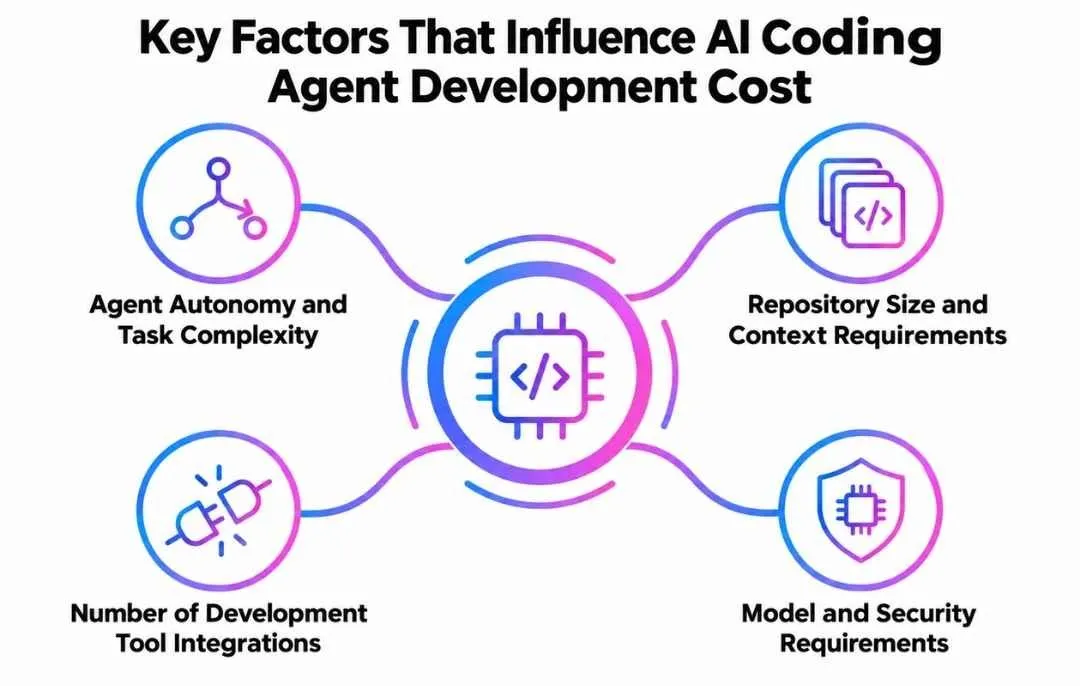
Key Factors That Influence AI Coding Agent Development Cost
Two projects with similar goals can have very different budgets because cost depends on how much the agent must understand, access, and execute.
Agent Autonomy and Task Complexity
An assistant that suggests code is cheaper to build than an agent that plans changes, edits multiple files, runs commands, diagnoses failed tests, and retries independently. More autonomy requires additional safeguards and evaluation.
Repository Size and Context Requirements
Large repositories require stronger indexing, retrieval, dependency analysis, and context-selection mechanisms. Monorepos and fragmented legacy systems can add further engineering effort.
Number of Development Tool Integrations
Connections to GitHub, GitLab, Jira, IDEs, CI/CD platforms, databases, or internal APIs require authentication, permissions, error handling, and testing. Enterprises with many existing systems may need structured AI implementation support to connect the agent safely to production workflows.
Model and Security Requirements
Premium models, large context windows, private deployment, strict access controls, audit trails, and approval gates can all increase development and infrastructure costs.
Testing requirements also matter. A structured AI model testing approach helps teams evaluate quality before expanding agent permissions.
Hidden and Ongoing AI Coding Agent Costs
The initial build is only part of the budget. Once an AI coding agent reaches production, operating expenses continue for every task the system processes.
Agentic Token and Reasoning-Loop Costs
Coding agents rarely make a single model request. They may inspect files, create a plan, generate changes, run tests, analyze failures, and repeat the process.
Long contexts and repeated retries can increase inference spending quickly. Techniques for reducing LLM inference costs therefore become important as adoption grows.
Sandboxing, Infrastructure, and Observability
Secure execution environments require compute, storage, containers, logging, and monitoring. Enterprises may also need isolated networks or private infrastructure for sensitive repositories.
Evaluation and Maintenance
Model updates, changing repositories, new integrations, regression testing, and prompt or workflow adjustments create ongoing engineering work.
Teams should also budget for tracing, task evaluation, security reviews, and support. These costs are easy to overlook during the prototype stage but become significant when an agent is used across hundreds or thousands of development tasks.
Build vs. Buy an AI Coding Agent
Enterprises do not always need to build an AI coding agent from scratch. Commercial tools can be a practical choice when teams need fast deployment, standard repository integrations, and common coding workflows. Custom development becomes more relevant when the agent must work with proprietary systems, internal engineering policies, or tightly controlled data.
The decision should compare total ownership cost rather than initial price alone.
| Criteria |
Commercial Coding Agent |
Custom AI Coding Agent |
| Upfront investment |
Lower |
Higher |
| Deployment speed |
Faster |
Longer implementation cycle |
| Customization |
Limited to vendor capabilities |
Designed around internal workflows |
| Integration flexibility |
Prebuilt integrations |
Custom integrations possible |
| Data and access control |
Depends on vendor architecture |
Greater architectural control |
| Ongoing cost |
Seats and usage fees |
Infrastructure, models, and maintenance |
| Vendor dependency |
Higher |
Lower when architecture is portable |
When Commercial Coding Agents Make More Sense
Commercial products work well when the development workflow is relatively standardized. Teams can often connect repositories, IDEs, and source-control platforms without building a dedicated orchestration layer.
They are also useful for companies that want to evaluate AI-assisted development before funding a larger engineering program. Comparing the top AI agents for software development can help teams understand how existing platforms approach coding, debugging, repository context, and developer workflows.
The trade-off is control. Enterprises may have limited influence over model selection, data handling, execution environments, or how deeply the agent can connect with internal systems.
When Custom Development Makes More Sense
Custom development becomes more practical when the coding agent must follow proprietary engineering processes or interact with systems that commercial tools do not support.
For example, an enterprise may need an agent that reads internal architecture documents, works across private repositories, creates changes under specific branch policies, runs tests in isolated environments, and requests approval before modifying sensitive components.
A custom agent also gives the organization more control over model routing, security, logging, evaluation, and infrastructure choices.
The higher upfront cost can be justified when those capabilities are central to the workflow rather than optional features.
AI Coding Agent Development Process, Cost, and Timeline
A structured development process helps control both technical risk and cost. Instead of building every enterprise feature at once, teams can validate the core workflow first, then add integrations, governance, and scale in stages.
| Development Phase |
Main Output |
Typical Timeline |
Relative Cost Share |
| Discovery and PoC |
Validated use case and technical feasibility |
4–8 weeks |
10–20% |
| MVP development |
Functional coding agent with core integrations |
8–16 weeks |
35–45% |
| Enterprise hardening |
Security, governance, monitoring, and scale |
8–20+ weeks |
35–50% |
Discovery and Proof of Concept
The first phase identifies which engineering task the agent should perform and how success will be measured.
Teams define repository access, target workflows, model options, tool permissions, evaluation criteria, and security boundaries. A narrow use case such as fixing selected test failures is usually easier to validate than attempting broad autonomous development from the start.
The distinction between a PoC and an AI MVP matters here because each stage has a different purpose, budget, and level of production readiness.
MVP Development and Integration
Once the core workflow works reliably, the team can build the surrounding application.
This stage may include repository indexing, code retrieval, Git integration, CI/CD connections, agent orchestration, test execution, logging, and developer interfaces.
An AI MVP development approach keeps the scope focused on features that prove operational value before the organization invests in enterprise-wide rollout.
Enterprise Hardening and Rollout
Production deployment introduces requirements that prototypes often avoid.
The agent may need role-based access, audit logs, approval gates, secret protection, observability, cost monitoring, security testing, and clear failure-handling rules.
Rollout should also be gradual. A small engineering group can expose reliability issues before the system reaches dozens or hundreds of developers.
Organizations that need support moving from a validated prototype to production can use AI MVP development services to formalize architecture, testing, integrations, and deployment.
How to Reduce AI Coding Agent Development and Operating Costs
Cost control should begin in the architecture rather than after monthly usage becomes expensive. The goal is not to minimize every model call. It is to avoid spending premium compute on work that simpler components can handle.
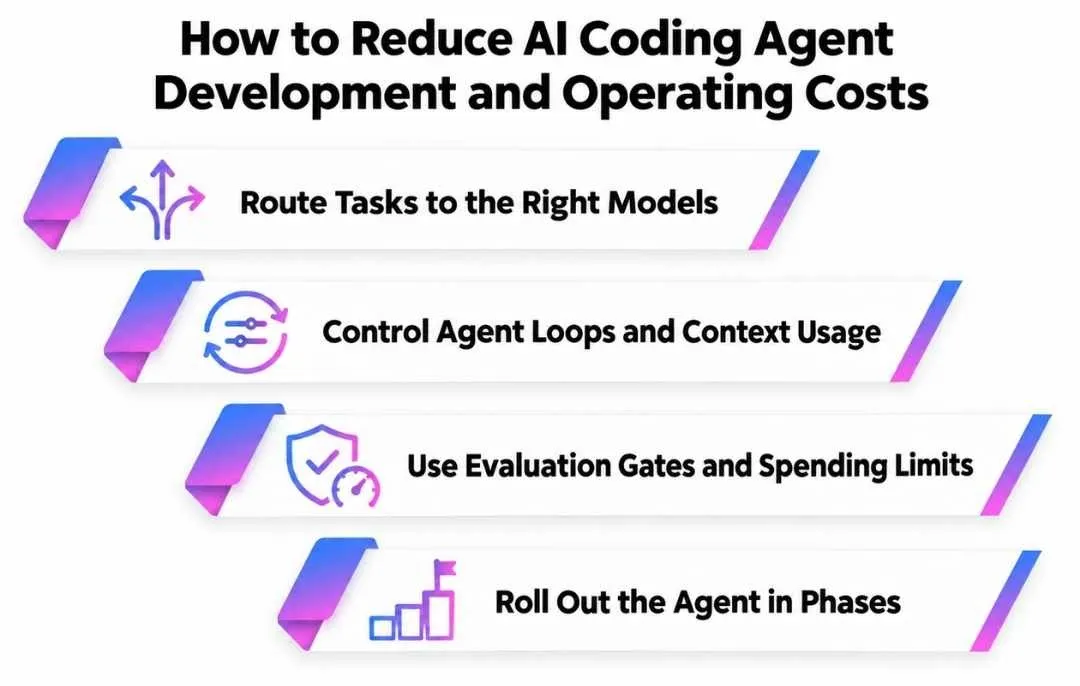
Route Tasks to the Right Models
Not every coding task requires the most capable model.
Smaller or lower-cost models can handle classification, summaries, basic retrieval, and routine transformations. More capable models can be reserved for debugging, complex code generation, or architectural reasoning.
Model routing can reduce average inference cost while preserving performance where stronger reasoning is actually needed.
Control Agent Loops and Context Usage
Agentic workflows can become expensive when the system repeatedly retrieves large amounts of code, retries failed actions, or sends oversized context to the model.
Teams can set limits on:
- maximum retry cycles;
- context size;
- execution time;
- number of tool calls;
- token spending per task.
These limits also help identify workflows where the agent should stop and ask a developer for input.
Use Evaluation Gates and Spending Limits
Organizations should monitor cost per completed task rather than only total token usage.
Thresholds can be created for unusually expensive tasks, repeated failures, or workflows that exceed expected runtime. Human approval can also be required before the agent continues with high-cost or high-risk operations.
This creates a financial control layer alongside technical guardrails.
Roll Out the Agent in Phases
A phased rollout prevents teams from paying to scale a workflow that has not been proven useful.
Start with one repository or engineering team, measure task acceptance and operating cost, then expand only when the results justify broader deployment.
Teams exploring lighter AI-assisted development methods can also evaluate vibe coding tools before committing to a fully custom agent architecture. This can help determine which workflows truly require custom automation and which can be handled with existing tools.
How to Calculate AI Coding Agent ROI
AI coding agent ROI should be measured against accepted engineering output, not the amount of code the system generates. A tool can produce thousands of lines of code and still create little value if developers spend substantial time reviewing, correcting, or rewriting the result.
A practical ROI calculation is:
ROI = (Annual quantified benefit − Annual AI coding agent cost) ÷ Annual AI coding agent cost × 100
Annual cost should include development amortization, software licenses, model usage, sandbox compute, repository indexing, monitoring, maintenance, and engineering support. Annual benefit can include developer time saved, shorter delivery cycles, reduced repetitive work, and measurable improvements in engineering throughput.
Organizations already using an AI automation ROI framework can apply the same principle to coding agents, but the metrics need to reflect software-development outcomes.
Metrics Enterprises Should Track
Useful measurements include:
- cost per accepted code change;
- cost per merged pull request;
- developer hours spent per completed task;
- pull-request cycle time;
- percentage of AI-generated changes accepted;
- rework required after agent-generated changes;
- escaped defects linked to AI-assisted code;
- token and compute cost per completed task.
Cost per merged pull request is particularly useful because it connects AI spending with an engineering outcome that has already passed review.
Enterprises should also monitor agent evaluation results over time. A system that initially performs well can become less reliable as repositories, dependencies, development standards, or underlying models change.
Sample AI Coding Agent ROI Scenario
Consider a hypothetical engineering organization spending $120,000 per year on licensing, model usage, infrastructure, maintenance, and support.
If measured productivity gains and reduced engineering effort create an estimated annual benefit of $180,000, the calculation would be:
($180,000 − $120,000) ÷ $120,000 × 100 = 50%
That does not mean every deployment will produce a 50% return. The example simply shows how finance and engineering teams can convert measured workflow improvements into a common financial model.
| ROI Metric |
What to Measure |
Why It Matters |
| Cost per merged PR |
Total agent cost divided by accepted pull requests |
Connects spending with delivered engineering work |
| Developer hours saved |
Difference in human effort before and after adoption |
Helps quantify labor value |
| PR cycle time |
Time from task start to accepted change |
Shows whether delivery becomes faster |
| Rework rate |
Changes requiring significant human correction |
Indicates output quality |
| Cost per completed task |
Tokens, compute, and platform cost per successful task |
Reveals expensive workflows |
ROI becomes more credible when these measurements are collected before deployment and compared with results after adoption.
Prove the ROI Before Scaling AI Across Your Engineering Team
Start with a focused PoC or MVP, measure accepted code changes, developer time saved, task cost, rework, and PR cycle time before wider rollout.
Start Your AI Coding Agent PoC
Why Enterprises Work With Prismetric for AI Coding Agent Development
Building an AI coding agent for enterprise use involves more than connecting an application to a language model. The system must understand internal repositories, work with approved engineering tools, execute actions in controlled environments, and provide enough visibility for engineering and security teams to review what it does.
Prismetric supports organizations across this lifecycle through its AI agent development services. Engagements can cover use-case discovery, architecture planning, model selection, repository context, tool integration, evaluation, deployment, security controls, and governance requirements.
Prismetric also brings hands-on product experience through Vitara.AI, its in-house AI-powered vibe coding platform. Prismetric describes Vitara as a platform developed by its internal team to accelerate software development, while Vitara itself supports natural-language full-stack application generation, editable source code, GitHub integration, and prompt-based development workflows. This gives Prismetric practical exposure to many of the same engineering questions enterprises face when adopting AI-assisted coding, including code generation, developer workflows, application architecture, deployment, and human review.
For organizations moving from experimentation into production, the focus should remain on the engineering problem being solved. A coding agent should not receive broader autonomy simply because the technology makes it possible. Repository permissions, execution rights, approval points, monitoring, and evaluation should increase in proportion to the risk of the task.
US organizations planning custom AI initiatives can also work with Prismetric as an AI development company in the USA for projects that require AI architecture, development, integration, and production deployment. Businesses operating in Germany can explore Prismetric’s KI-Entwicklungsunternehmen in Deutschland when they need AI development support aligned with their local market and enterprise requirements.
Prismetric can also help organizations integrate AI with existing enterprise systems rather than replacing established repositories, CI/CD pipelines, development tools, and internal platforms. The aim is to fit AI coding capabilities into the engineering environment teams already use while maintaining appropriate control over security, quality, and production readiness.
Frequently Asked Questions
A custom AI coding agent can cost roughly $10,000–$30,000 for a proof of concept, $20,000–$60,000 for an MVP, and $60,000–$150,000 or more for an enterprise implementation. The final cost depends on agent autonomy, repository complexity, integrations, security controls, deployment requirements, model selection, and evaluation infrastructure.
There is no single per-developer figure because pricing may combine seat licenses, token usage, compute, and platform fees. Gartner Peer Insights data reported by Computer Weekly found that 23% of surveyed technology leaders were spending $200–$500 per developer per month on coding-agent tokens, while 6% reported more than $2,000 per developer per month. Actual enterprise cost depends heavily on usage patterns and agent autonomy.
The main cost driver is often the number of steps required to complete a task. An agent may retrieve code, plan a change, generate files, execute tests, analyze errors, and retry several times. Large context windows, premium models, secure sandboxes, logging, evaluation, and integrations add further operating costs.
Commercial tools usually have a lower upfront cost and faster implementation. Custom development requires more initial investment but gives enterprises greater control over architecture, integrations, model selection, security, and workflow design. The better financial choice depends on whether existing products can support the required engineering processes without excessive customization or recurring licensing costs.
A custom AI coding agent can cost roughly $10,000–$30,000 for a proof of concept, $20,000–$60,000 for an MVP, and $60,000–$150,000 or more for an enterprise implementation. The final budget depends on repository complexity, agent autonomy, integrations, model selection, security controls, deployment requirements, and the evaluation infrastructure needed to monitor performance.
Per-developer cost varies because enterprise pricing can combine subscriptions, tokens, compute, and platform charges. Gartner Peer Insights data reported by Computer Weekly found that 23% of technology leaders were spending $200–$500 per developer per month on coding-agent tokens, while 6% reported spending more than $2,000. Actual costs depend heavily on usage intensity and agent behavior.
Coding agents may perform several model and tool calls for one task. They can retrieve repository context, plan changes, generate code, execute tests, diagnose errors, and retry failed attempts. Large context windows, premium models, secure execution environments, observability, repository indexing, and continuous evaluation add further operating expenses.
Yes. Prismetric can help organizations define the intended coding workflows, required integrations, model strategy, security controls, and deployment architecture before development begins. Its AI consulting services can help turn those requirements into a more realistic scope, timeline, and cost estimate instead of relying on a generic industry price range.
Yes. Prismetric can support organizations building coding agents that work with private repositories, internal development tools, approval workflows, and enterprise security requirements. Its enterprise AI development services can support architecture design, development, testing, deployment, governance, and integration with existing engineering environments.
Prismetric can help evaluate model options based on code quality, latency, privacy, context requirements, and operating cost. Through its large language model development services, enterprises can design model routing, repository context handling, evaluation workflows, and integrations that fit the technical and financial requirements of the coding-agent system.