AI in Insurance: Use Cases, Benefits, Challenges & Future Trends
Key Takeaways
- AI is transforming the entire insurance lifecycle, including underwriting, claims processing, fraud detection, pricing, customer service, policy administration, and compliance.
- Machine learning, generative AI, NLP, computer vision, and AI agents help insurers analyze large amounts of data, automate repetitive work, and support faster decisions.
- The biggest benefits come from faster claims, better risk assessment, improved fraud detection, personalized customer experiences, and higher employee productivity.
- AI should support, not replace, human judgment, especially for high-impact decisions involving coverage, pricing, claims, and regulatory requirements.
- Data quality, bias, explainability, privacy, cybersecurity, legacy-system integration, and regulatory compliance remain major challenges for insurers adopting AI.
- Successful AI adoption starts with a clear business problem, measurable KPIs, reliable data, strong governance, and a focused pilot before scaling.
- The future of AI in insurance is moving toward agentic, multimodal, and predictive systems that can coordinate complete workflows and help insurers shift from simply managing losses to predicting and preventing risks.
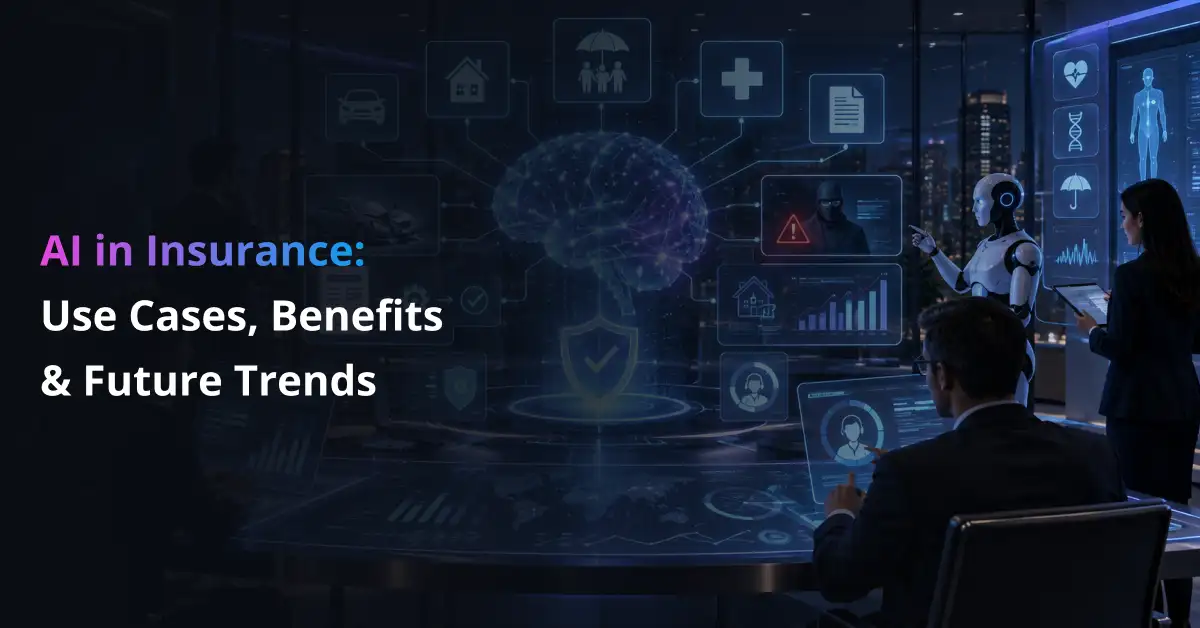
AI in insurance is the use of artificial intelligence technologies to analyze risk, automate insurance workflows, support decisions and improve how insurers serve policyholders throughout the insurance lifecycle.
The technology combines machine learning, predictive analytics, natural language processing, computer vision, generative AI and intelligent automation. These capabilities help insurers process structured and unstructured information faster than traditional manual methods.
Insurance is especially suited to AI because the industry depends heavily on data, probability, documents and repeatable decisions. AI models can identify patterns across claims histories, customer records, images, policy documents and third-party data.
Artificial intelligence in insurance now extends across underwriting, claims, pricing, fraud detection, policy administration, customer service and compliance. It also connects with AI in finance initiatives as insurers modernize data systems and automate business processes.
AI does not remove the need for human judgment. Underwriters, actuaries, claims professionals, agents and service teams remain important when decisions require context, empathy, accountability or review of high-consequence outcomes.
Why AI is reshaping the insurance industry
Insurance companies generate information from applications and policy documents to accident images, telematics, medical records and customer conversations. AI can organize this data and surface patterns that are difficult to identify manually.
Policyholders also expect faster digital experiences. They want quick quotes, straightforward onboarding, timely claim updates and convenient support. AI in the insurance industry helps improve customer experience while giving employees more time for complex needs.
The business case extends beyond speed. AI can help reduce claims leakage, identify suspicious activity, improve risk selection, support more accurate pricing and increase workforce productivity. The value comes from redesigning workflows around better decisions, not simply adding another software tool.
Adoption is already widespread. NAIC surveys report that 88% of responding auto insurers, 70% of home insurers, 58% of life insurers and 92% of health insurers use, plan to use or plan to explore AI or machine learning.
Turn Insurance Workflows Into Smarter AI-Powered Processes
Prismetric helps insurers apply AI across underwriting, claims, fraud detection, policy administration, and customer service around real business workflows.
Explore AI for Insurance
Key technologies powering AI in insurance
Several technologies work together behind modern AI use cases in insurance. Each handles a different part of the information and decision-making process, from recognizing historical patterns to interpreting documents and coordinating multi-step workflows.
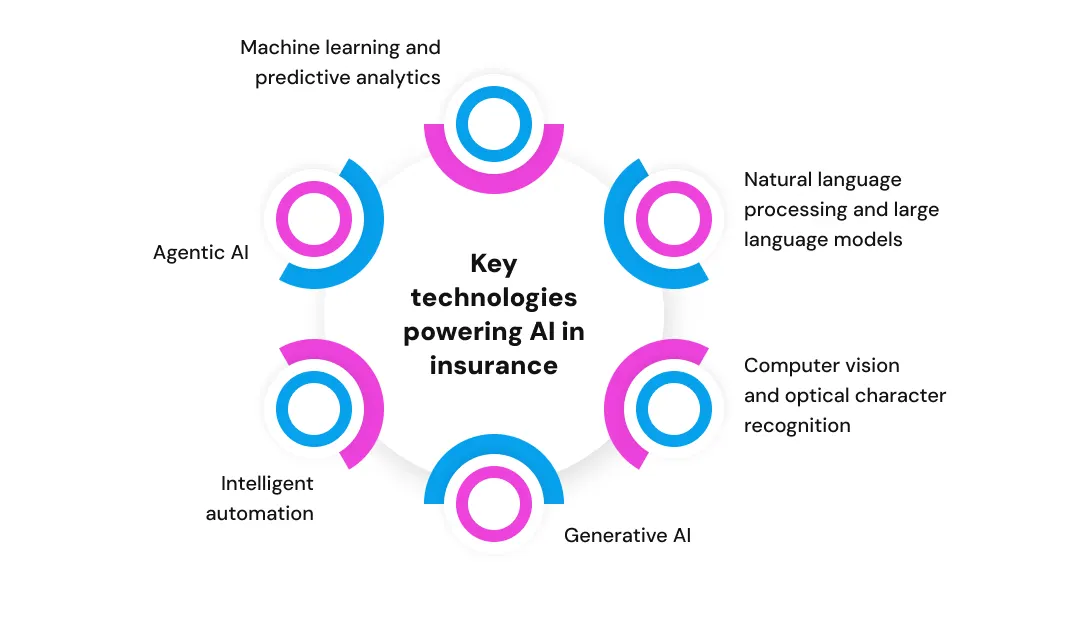
Machine learning and predictive analytics
Machine learning models learn from historical insurance data to identify relationships and estimate future outcomes. Predictive analytics supports risk scoring, pricing, claim severity forecasting, fraud detection and lapse prediction by turning past patterns into decision-ready signals.
Specialized machine learning development services can translate underwriting rules, claims histories and customer data into models that learn from new information while remaining aligned with business objectives.
Natural language processing and large language models
Natural language processing helps insurers interpret policy wording, claim notes, emails, call transcripts and medical documents. Large language models extend these capabilities by summarizing information, answering questions and generating context-aware responses.
When connected with governed enterprise databases, LLMs can help employees retrieve internal knowledge without manually searching multiple systems, provided access controls, validation and human review are built into the workflow.
Computer vision and optical character recognition
Computer vision analyzes images and video, while optical character recognition converts scanned text into machine-readable data. In insurance, these capabilities support vehicle-damage assessment, property inspections, document verification and information extraction from forms.
Insurers can develop image-analysis capabilities that combine visual evidence with policy and claims data, helping adjusters prioritize cases and review damage more consistently.
Generative AI
Generative AI creates new content from the information and instructions it receives. In insurance, it can summarize claims, draft communications, prepare underwriting reports, search policy knowledge and help employees work with lengthy documents.
Generative AI in insurance differs from predictive AI: predictive models estimate likely outcomes, while generative systems create or transform information. The two can work together inside the same insurance workflow.
Intelligent automation
Intelligent automation combines AI with workflow rules, APIs and business systems. It can route claims, collect missing information, trigger reviews, update records and move routine tasks between systems with less manual coordination.
AI workflow automation creates the most value when it removes friction from an end-to-end process rather than automating an isolated task while leaving the surrounding workflow unchanged.
Agentic AI
Agentic AI allows systems to plan and execute a sequence of actions toward an objective. AI agents can coordinate onboarding, gather documents, profile risk, prepare recommendations and escalate exceptions across connected insurance systems.
These systems still require defined permissions and human oversight. High-impact decisions involving coverage, pricing, claims or regulatory obligations should include clear escalation paths instead of allowing autonomous actions without appropriate review.
Key use cases for AI in insurance
AI in insurance is being applied across the policy lifecycle, from evaluating risk before coverage is issued to supporting customers after a claim. The most valuable use cases combine automation with better data analysis and clear human oversight.
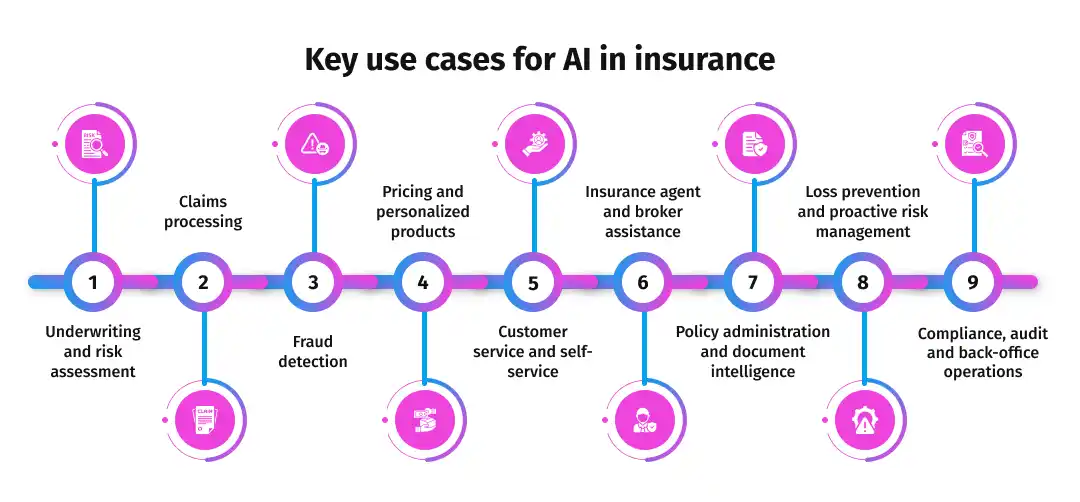
- Underwriting and risk assessment: AI in insurance underwriting helps carriers analyze applicant information, historical losses, third-party data and behavioral signals more efficiently. Machine learning models can identify risk patterns, prefill application data and flag cases that need deeper review. This can shorten underwriting cycles while helping underwriters focus on exceptions and complex risks.
- Claims processing: AI in insurance claims can help extract information from forms, classify incoming claims, analyze supporting documents and prioritize cases based on complexity. Computer vision can support damage assessment from property or vehicle images, while generative AI can summarize claim files for adjusters. When insurers connect AI with core insurance systems, these capabilities can reduce manual handoffs and improve claim-cycle efficiency without removing human review from disputed or high-value cases.
- Fraud detection: AI fraud detection in insurance uses historical claims, behavioral patterns and anomaly detection to identify activity that differs from expected behavior. Models can flag unusual claim timing, inconsistent documentation, suspicious relationships or repeated patterns across accounts. Rather than automatically declaring fraud, AI should prioritize cases for investigation so fraud teams can review the evidence, apply context and make the final determination.
- Pricing and personalized products: AI risk assessment in insurance can help carriers create more granular views of policyholder risk by combining traditional rating factors with approved behavioral, telematics or contextual data. These insights can support usage-based insurance, personalized coverage recommendations and more responsive product design. Insurers can also identify changes in customer needs and offer relevant coverage without relying solely on broad demographic segments.
- Customer service and self-service: Conversational AI, chatbots and virtual assistants can answer routine policy questions, explain coverage, provide claim-status updates and guide customers through common service requests. Enterprise chatbots can reduce pressure on contact centers while keeping human representatives available for sensitive or complicated conversations. AI can also summarize prior interactions so service teams have more context when a case is escalated.
- Insurance agent and broker assistance: AI can help agents prepare for meetings, summarize customer histories, identify policy gaps and surface next-best actions. Voice assistants for policyholder conversations can support call handling and information retrieval, while generative AI can draft follow-up messages or policy explanations. These tools are most useful when they reduce administrative work and give agents more time for advice, relationship building and complex sales discussions.
- Policy administration and document intelligence: Insurance operations rely on applications, endorsements, renewal documents, policy forms and supporting records. AI can classify these documents, extract key fields and compare information across systems. AI tools for data analysis can help teams identify inconsistencies, missing information and process bottlenecks, while OCR and NLP reduce manual data entry across policy administration workflows.
- Loss prevention and proactive risk management: AI can help insurers move from responding to losses toward identifying conditions that increase the likelihood of a loss. Telematics, connected devices, weather information and property data can support earlier warnings and more targeted risk recommendations. In commercial insurance, similar models can help prioritize inspections or identify conditions that warrant attention before an incident occurs.
- Compliance, audit and back-office operations: Artificial intelligence in insurance also supports functions behind customer-facing workflows. AI can assist with compliance reviews, reporting, internal audit, actuarial analysis, finance and technology operations. Generative AI for compliance can help teams summarize requirements and review documentation, while supporting internal audit workflows can reduce repetitive analysis. Human control remains essential where outputs affect regulatory obligations, financial reporting or policyholder rights.
Who uses AI in insurance?
AI in insurance supports teams across the organization, with each role applying it to different decisions, data and customer interactions.
- Underwriters and actuaries: AI helps analyze submissions, forecast outcomes and identify cases that require specialist judgment. Actuaries can also assess pricing and portfolio risk.
- Claims teams and adjusters: AI can classify cases, summarize documents, estimate damage and prioritize complex claims while keeping disputed or high-value decisions with experienced adjusters.
- Agents and brokers: AI can prepare customer summaries, surface policy gaps and suggest next-best actions, giving producers more time for customer advice.
- Fraud, compliance and risk teams: Models can identify anomalies and surface patterns that deserve investigation or regulatory review.
- Customer-service teams: Chatbots, voice systems and copilots can answer routine questions, retrieve policy information and summarize previous interactions.
- IT, data and product teams: These teams manage integrations, models and data pipelines. Data engineering services can make fragmented insurance data usable across AI applications.
Connect AI With Your Existing Insurance Systems
Integrate AI with claims platforms, policy administration systems, CRM, databases, APIs, and legacy applications without disrupting core operations.
Discuss Your AI Integration
Benefits of AI in insurance
The benefits of AI in insurance extend beyond automation. In the right workflows, AI can improve decision speed, risk visibility, employee productivity and policyholder experience.
- Speeds up insurance decisions: AI can process applications, documents and claims information faster, helping insurers shorten quote, underwriting and settlement cycles while retaining review where judgment is required.
- Improves risk assessment and pricing: Models can evaluate more variables and detect relationships that manual analysis might miss. Better risk visibility can support more consistent underwriting and more responsive pricing decisions.
- Reduces fraud and claims leakage: Anomaly detection can surface suspicious patterns earlier, helping investigators focus their attention where potential financial loss is greatest.
- Increases workforce productivity: Automating information gathering, classification and repetitive administration gives insurance professionals more time for complex decisions and customer-facing work. Organizations can use AI to improve operational efficiency without treating headcount reduction as the only measure of value.
- Personalizes policyholder experiences: AI can use customer context, policy information and interaction history to provide more relevant recommendations, communications and service. This can make digital experiences more useful while supporting stronger agent relationships.
- Supports proactive risk prevention: By combining historical and real-time signals, insurers can identify conditions associated with potential losses and provide earlier warnings or risk-reduction recommendations. This shifts part of the insurance relationship from paying for loss toward helping prevent it.
Challenges, risks and regulation of AI in insurance
AI can improve insurance operations, but poor data, weak governance or uncontrolled automation can create financial, operational and consumer risks. Insurers need controls that match the consequence of each AI-supported decision.
- Data quality and fragmentation: Insurance information often sits across policy systems, claims platforms, documents and third-party sources. Incomplete data can reduce model accuracy. Teams may need to turn insurance data into decision-ready insights before broad AI deployment.
- Bias and unfair discrimination: Models trained on historical data can reproduce or amplify problematic patterns. Insurers need representative data, fairness testing, documented review and escalation procedures where AI influences pricing, underwriting or claims.
- Explainability and model reliability: Insurance teams must know whether a model is performing as expected and where it can fail. Generative systems add risks such as hallucinated responses. A disciplined process to validate models before production can reduce these risks.
- Privacy and cybersecurity: Insurance records can contain financial, health, identity and behavioral information. Access controls, encryption, vendor assessment and data-governance policies are necessary when AI systems process sensitive policyholder data.
- Legacy systems and integration: Older policy and claims platforms can make AI deployment difficult. A well-designed AI integration architecture for legacy systems can connect new capabilities without replacing every core system, while anapplication modernization strategy can address longer-term technical debt.
- Human oversight, skills and change management: Employees need to know when to trust, question or escalate AI outputs. Training, ownership and clear decision rights help keep automation aligned with business, ethical and regulatory expectations.
Regulation is increasingly part of that operating model. The NAIC adopted its Model Bulletin on the Use of Artificial Intelligence Systems by Insurers in December 2023. It emphasizes governance and reminds insurers that AI-supported decisions remain subject to applicable insurance laws and regulations. Insurers should therefore treat AI regulation and compliance in the US as a design requirement rather than a final-stage legal review.
How to implement AI in insurance
Successful AI adoption starts with a business problem, not a model. Insurers should identify where decisions are slow, data is fragmented or manual work creates unnecessary cost before selecting technology.
- Audit insurance workflows and data: Map underwriting, claims, servicing and back-office processes to find repetitive tasks, handoff delays and decision bottlenecks. An AI workflow discovery checklist can help identify where automation is practical and where human judgment must remain central.
- Prioritize high-value use cases: Rank opportunities by business value, feasibility, data readiness and risk. A focused AI strategy should connect each use case to a measurable operational problem rather than treating experimentation as the end goal.
- Set measurable KPIs: Define success before development begins. Useful measures include claim cycle time, underwriting turnaround, fraud detection rate, cost per policy, retention and employee productivity. An AI automation ROI framework can connect technical performance with business outcomes.
- Decide whether to build, buy or partner: Some insurers can use packaged platforms, while others need custom models or domain-specific controls. Comparing custom AI with off-the-shelf AI helps clarify trade-offs involving speed, flexibility, cost and governance.
- Modernize the data and technology foundation: AI needs reliable access to policy, claims, CRM and document systems. Insurers should define an AI technology stack that supports secure data access, model monitoring and integration without creating another isolated technology layer.
- Build governance and human oversight into the workflow: Define which decisions AI can support, which require approval and when cases must be escalated. Controls should cover explainability, audit trails, security, model monitoring and clear ownership.
- Pilot, measure and scale: Start with a focused initiative that can demonstrate value. Choosing between an AI POC and AI MVP can help determine the right validation path. After results are proven,AI implementation services can support integration and broader rollout.
The future of AI in insurance
AI in the insurance industry is moving from isolated prediction tools toward systems that can understand multiple data types, coordinate actions and support decisions across complete insurance journeys.
- Agentic and multiagent workflows: AI agents can coordinate onboarding, underwriting, servicing, claims and compliance. Emerging agentic AI use cases show how specialized agents can perform steps and escalate exceptions to people.
- Multimodal claims handling: Claims systems can combine text, images, video, voice and structured policy data, giving adjusters a more complete view of an incident while reducing manual information gathering.
- Predict-and-prevent insurance: Telematics, connected devices, weather data and behavioral signals can help insurers identify changing risk conditions and provide recommendations before a loss occurs.
- Dynamic and personalized products: AI can support usage-based coverage, responsive pricing and recommendations that reflect changing customer circumstances rather than relying only on broad segments.
- Human-AI operating models: The future of AI in insurance will depend on combining machine speed with human judgment, empathy and accountability. Broader AI transformation will require redesigned roles and decision rights.
The strongest results will come from insurers that pair reliable technology with governed data, measurable business goals and clear human responsibility. As these capabilities mature, competitive advantage will depend less on isolated tools and more on how effectively insurers redesign end-to-end workflows.
Move Your Insurance AI From Pilot to Production
Prismetric can help validate use cases, build secure AI solutions, add human oversight, measure performance, and scale successful workflows.
Talk to Our Insurance AI Experts
How Can Prismetric Help You With AI in Insurance?
Turning an AI use case into a production-ready insurance solution requires more than selecting a model. Insurers need reliable data, secure integrations, clear governance and AI workflows that fit existing underwriting, claims and policy administration processes.
Prismetric helps businesses plan, build, integrate and deploy custom AI solutions around their existing data, systems and operational goals. Its AI capabilities span machine learning, generative AI, AI agents, RAG, natural language processing and computer vision.
For an insurance organization, that can include:
- AI strategy and use-case discovery: Prismetric can assess existing workflows, business objectives and available data to identify where AI can create measurable value instead of starting with disconnected experiments.
- Custom insurance AI development: Teams can build underwriting assistants, claims automation systems, fraud-detection models, document intelligence solutions, customer-service copilots and other AI-powered applications around specific insurance requirements.
- Data and model engineering: AI systems depend on reliable information. Prismetric can prepare data pipelines, select suitable models and design RAG or machine learning architectures around the information insurers already manage.
- Integration with existing systems: New AI capabilities can be connected with policy administration platforms, claims systems, CRMs, databases, APIs and other enterprise applications rather than operating as isolated tools.
- Testing, security and governance: Development can include output testing, access controls, human-review mechanisms, monitoring and other safeguards required when AI supports sensitive business decisions. Prismetric states that its AI consulting approach incorporates security and regulation-friendly development practices.
- Deployment and continuous improvement: After launch, teams can monitor model quality, latency, cost, errors and user feedback and refine the system as business requirements and data change.
Prismetric also uses Vitara.AI, its in-house AI-powered vibe coding platform, during development. Vitara uses AI-driven code generation to simplify and accelerate application development, allowing engineers to move from ideas to working software faster. Prismetric’s engineering team can then focus more attention on architecture, insurance-specific business logic, integrations, testing and output validation helping improve both development speed and solution reliability.
For insurers moving from an AI concept or pilot toward production, Prismetric can support the journey from strategy and development through integration, deployment and post-launch optimization. Its AI development services are designed around real business workflows rather than standalone AI demonstrations.
Frequently Asked Questions
AI in insurance refers to using technologies such as machine learning, predictive analytics, NLP, computer vision, and generative AI to analyze risk, automate workflows, and support insurance decisions.
It is used across underwriting, claims, pricing, fraud detection, customer service, policy administration, and compliance while keeping human judgment involved in high-impact decisions.
Insurance companies use AI throughout the policy lifecycle to process information faster, identify patterns, automate repetitive tasks, and support employees in making more informed decisions.
Common AI use cases include:
- Underwriting and risk assessment
- Claims processing and damage assessment
- Fraud detection
- Personalized pricing and products
- Customer service and self-service
- Policy administration and compliance
- Loss prevention and proactive risk management
AI can help insurers make faster decisions, improve risk assessment, detect suspicious activity earlier, and reduce repetitive administrative work.
It can also improve policyholder experiences by enabling faster service, more relevant recommendations, and proactive risk-prevention measures.
AI can extract information from claim forms, classify cases, analyze documents, summarize claim files, and prioritize claims based on complexity.
Computer vision can also analyze property or vehicle images to support damage assessment.
Key advantages include:
- Fewer manual handoffs
- Faster claim processing
- Better case prioritization
- More efficient support for adjusters
Human review remains important for disputed, complex, or high-value claims.
AI adoption can create risks when insurers rely on incomplete data, poorly governed models, or excessive automation.
Major challenges include data fragmentation, bias and unfair discrimination, explainability, privacy, cybersecurity, legacy-system integration, and regulatory compliance.
Insurers also need employees who understand when to trust an AI output, question it, or escalate a decision for human review.
AI is more likely to support insurance professionals than completely replace them. It can handle activities such as information gathering, document classification, summarization, and routine analysis, allowing employees to spend more time on complex work.
Human involvement remains particularly important when decisions require:
- Professional judgment
- Customer empathy
- Contextual understanding
- Accountability
- Regulatory review
Underwriters, actuaries, claims professionals, agents, and service teams therefore continue to play an important role in AI-enabled insurance workflows.
The future of AI in insurance is moving beyond isolated automation toward intelligent systems that can understand different types of information and coordinate complete workflows.
Agentic AI could help coordinate underwriting, onboarding, servicing, claims, and compliance while escalating exceptions to people.
Multimodal AI will increasingly combine documents, images, video, voice, and structured policy information.
Predictive systems may also help insurers move from simply responding to losses toward identifying changing risks and helping policyholders prevent them before they occur.