15 Best Robotic Process Automation Companies in 2026
Key Takeaways
- RPA development companies do more than build bots. They assess workflows, integrate systems, test automation, and support production.
- Vendors and service firms play different roles. RPA service providers turn platform capabilities into working processes.
- Not every repetitive task suits RPA. AI workflow discovery helps compare rules, exceptions, feasibility, and expected value.
- Integration design affects reliability. APIs may suit stable system exchange, while RPA remains useful for user-interface work.
- Governance matters as automation grows. Access controls, logs, monitoring, exception handling, and change management support reliable operation.
- AI extends traditional automation. Combining AI with RPA can support document processing, classification, and language-heavy tasks.
Robotic process automation (RPA) uses software bots to complete repetitive, rule-based tasks across business applications. The best RPA development companies do more than configure bots. They identify suitable processes, connect systems, plan exceptions, secure bot access, and support automations after deployment. Businesses evaluating robotic process automation need to assess technical delivery and long-term operational fit.
Grand View Research values the global RPA market at $4.7 billion in 2025 and estimates it will reach $6.0 billion in 2026 and $35.8 billion by 2033, a 29% CAGR. The growth shows why organizations increasingly treat automation as an enterprise capability.
The market includes two provider groups. Platform vendors such as UiPath, Automation Anywhere, Microsoft Power Automate, and SS&C Blue Prism supply RPA software. RPA development companies and RPA implementation companies use those platforms, APIs, custom software, and AI workflow automation services to solve specific process problems.
Ready to Automate Repetitive Tasks With Custom RPA Development?
Prismetric builds secure RPA solutions that automate data entry, reporting, document processing, approvals, and other rule-based business workflows.
Explore RPA Development Services
What an RPA Development Company Does
An RPA development company designs, builds, deploys, and maintains bots that perform defined actions across business systems. Examples include moving data, filling forms, generating reports, validating records, processing invoices, and updating customer information. These robotic process automation services reduce repetitive work while allowing companies to keep existing applications.
A typical engagement starts with process discovery. Teams map rules, systems, handoffs, and exceptions, then decide whether RPA is the right approach. RPA consulting companies should also identify cases where APIs or business process automation provide a more stable solution. Software development may support middleware or custom workflow components.
After testing, teams configure attended or unattended bots, permissions, queues, and failure handling. Strong RPA development companies also monitor performance and update automations when applications change. AI integration services may help when workflows require document understanding, classification, or other AI capabilities.
Gartner’s June 2026 Magic Quadrant states that RPA remains a cost-effective and reliable technology for automating user-interface interactions in task-based workflows. Capable RPA automation companies therefore use RPA where it fits instead of treating it as the answer to every integration problem.
3 Types of RPA Development Companies
These providers generally fall into three groups. The right choice depends on program size, systems, governance needs, and automation maturity.
- Global consulting firms: Support enterprise-wide automation, process redesign, governance, change management, and multi-region programs.
- Specialist automation companies: Focus on RPA, intelligent automation, Centers of Excellence, orchestration, monitoring, and optimization.
- Software and AI engineering companies: Build workflows that combine RPA with APIs, enterprise applications, data, AI, or new software.
A single finance bot and a multi-department program rarely need the same delivery model. Businesses comparing AI automation companies or other robotic process automation companies should assess engineering depth, platform experience, governance, and post-launch support rather than brand size alone.
RPA platform vendors form a separate category. They supply bot-building tools, while development partners turn process requirements into production systems. These solutions can also support wider business automation programs that combine RPA, APIs, workflow software, and AI.
15 Best RPA Development Companies in 2026
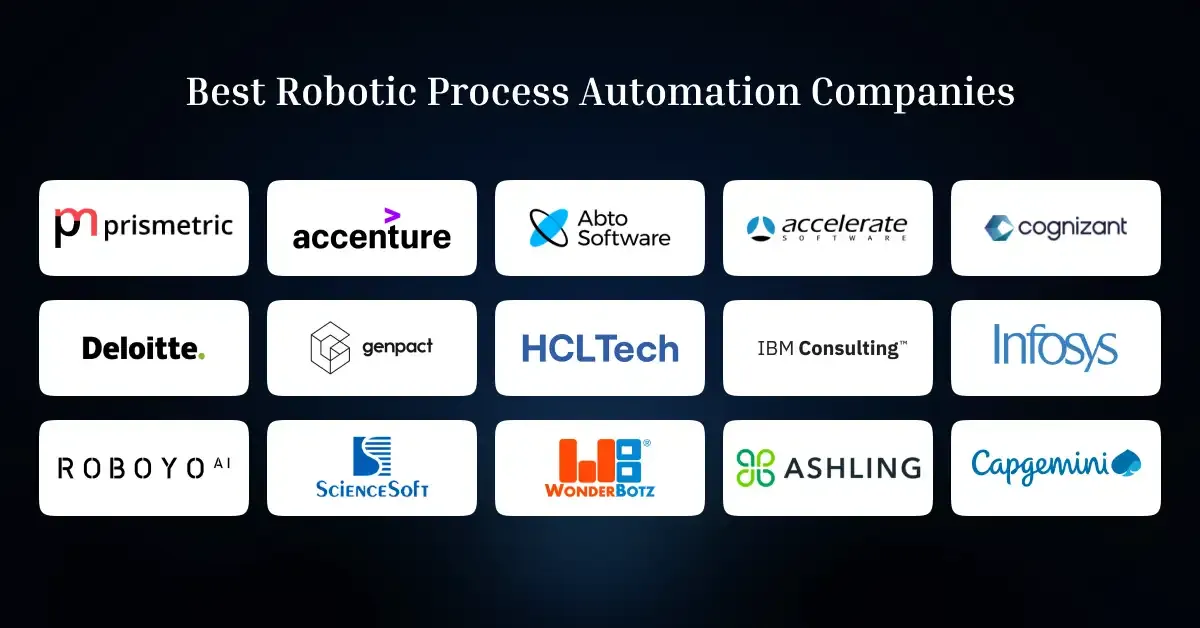
The following RPA development companies serve different automation needs, from focused bot development to enterprise-wide process transformation. The comparison highlights where each provider fits before examining its capabilities in more detail.
Disclosure: Prismetric appears on this list. We have been transparent about our inclusion and the evaluation criteria used.
| Company |
Best For |
Core RPA and Automation Strengths |
Provider Type |
| Prismetric |
Custom RPA and AI-enabled workflows |
RPA, APIs, AI automation, custom software |
Software & AI engineering |
| Accenture |
Large enterprise programs |
RPA, intelligent automation, transformation |
Global consulting |
| Abto Software |
Complex custom automation |
RPA, AI/ML, OCR, legacy integration |
Software engineering |
| Accelirate |
Scaling intelligent automation |
RPA, orchestration, AI agents |
Automation specialist |
| Cognizant |
Operational automation at scale |
RPA, Power Automate, process modernization |
Global technology services |
| Deloitte |
Strategy and governance-led programs |
RPA strategy, process assessment, implementation |
Global consulting |
| Genpact |
Back-office process transformation |
Process automation, finance operations, AI |
Operations specialist |
| HCLTech |
Enterprise RPA programs |
RPA implementation, monitoring, CoE |
Global technology services |
| IBM Consulting |
Complex enterprise environments |
Automation, AI, integration, modernization |
Global consulting |
| Infosys |
Large-scale RPA implementation |
Bot development, assessment, governance |
Global technology services |
| Roboyo |
Automation-first transformation |
RPA, hyperautomation, orchestration |
Automation specialist |
| ScienceSoft |
Custom RPA engineering |
RPA, software development, integrations |
Software engineering |
| WonderBotz |
Mature automation programs |
RPA, orchestration, agentic automation |
Automation specialist |
| Reveal Group |
RPA governance and scaling |
CoE, monitoring, optimization |
Automation specialist |
| Capgemini |
Enterprise process transformation |
RPA, integration, process redesign |
Global consulting |
Here are Robotic Process Automation(RPA) service providers around the world
Disclosure: Prismetric appears on this list. We included Prismetric because it was assessed using the same criteria applied to every other RPA development company, including RPA delivery capabilities, integration expertise, security and governance, technical depth, enterprise fit, and post-launch support. Marketing claims alone were not treated as sufficient evidence.
Every company on this list was evaluated against the same selection framework. Where a provider is strong in one area but has limitations in another, the assessment reflects those differences.
1. Prismetric
Prismetric develops custom automation systems that combine RPA with APIs, enterprise applications, AI, and software engineering. This approach suits organizations whose workflows require more than standard bot configuration. Its broader specialized automation engineering capabilities also support processes where several technologies need to work together.
Prismetric has documented the use of RPA for form filling, data synchronization, and report generation within a finance workflow automation project. The same solution combined process automation, machine learning, APIs, monitoring, and audit logging, showing how RPA can work as one part of a larger automation architecture.
Founded: 2008
Major Locations: USA, India, Australia, Germany
Automation Focus: RPA, workflow automation, AI integration
Best Fit: Custom and integration-heavy automation
Other Services: AI, software development, data and digital transformation
Build Intelligent Automation That Works With Your Existing Systems
Combine RPA, APIs, AI, ERP, CRM, and legacy applications to automate complex workflows without replacing the technology your business already uses.
Discuss Your RPA Automation Project
2. Accenture
Accenture is suited to large enterprises that need automation across departments, applications, and operating models. Its automation work covers process discovery, RPA architecture, UiPath, Automation Anywhere, Blue Prism, AI/ML integration, and workflow orchestration. Current Accenture roles also describe developing, testing, deploying, and supporting end-to-end RPA solutions.
Established: 1989
Global Base: Dublin, Ireland
Automation Focus: RPA, intelligent automation, process transformation
Best Fit: Large and multi-region programs
Other Services: Consulting, cloud, AI, cybersecurity
3. Abto Software
Abto Software combines RPA development with AI, machine learning, computer vision, and custom software engineering. Its current automation portfolio includes RPA task automation, hyperautomation, and RPA-plus-AI orchestration, making it relevant for workflows involving legacy applications or less-structured information.
Founded: 2007
Major Locations: Ukraine, USA, Cyprus
Automation Focus: RPA, AI/ML, hyperautomation
Best Fit: Technically complex custom workflows
Other Services: Computer vision, modernization, R&D, software engineering
4. Accelirate
Accelirate is an automation specialist that has worked in enterprise automation since 2016. Its evolution spans major RPA platforms, document understanding, automation operations, analytics, and agentic AI. This makes it relevant to businesses moving from individual bots toward broader intelligent automation programs.
Founded: 2016
Base: South Florida, USA
Automation Focus: RPA, intelligent automation, AI agents
Best Fit: Scaling established automation programs
Other Services: Analytics, testing automation, enterprise AI
5. Cognizant
Cognizant supports RPA across desktop, web, cloud, and legacy environments. Its current Power Automate engineering roles cover attended and unattended workflows, deployment, OCR, UI automation, and cloud-flow integration, while its broader services are moving toward agent-based process redesign.
Founded: 1994
Headquarters: Teaneck, New Jersey, USA
Automation Focus: RPA, Power Platform, agentic automation
Best Fit: Enterprise operational modernization
Other Services: AI, application services, cloud, engineering
6. Deloitte

Deloitte approaches RPA through strategy as well as implementation. Its published RPA framework covers operating models, business cases, roadmaps, vendor selection, opportunity identification, pilots, and execution support. This makes the firm relevant when automation requires governance and process redesign alongside technical deployment.
Origin: 1845, London
Presence: Global
Automation Focus: RPA strategy, governance, implementation
Best Fit: Large governance-heavy programs
Other Services: Consulting, risk, technology transformation
7. Genpact
Genpact brings automation into operations such as finance, supply chain, banking, and insurance. The company began inside GE in 1997 and has built its current strategy around process intelligence, AI, and agentic operations. This operational background makes it relevant to high-volume, process-heavy environments.
Founded: 1997
Headquarters: New York, USA
Automation Focus: Process automation, AI, operational workflows
Best Fit: Back-office and operations transformation
Other Services: Finance, supply chain, analytics, risk operations
8. HCLTech
HCLTech provides end-to-end RPA services covering strategy, process discovery, solution design, development, testing, deployment, monitoring, and Center of Excellence support. Its automation stack also combines RPA with AI, machine learning, and business process management for workflows that need more than fixed rules.
Provider Type: Global technology services
Automation Focus: RPA, intelligent automation, agentic AI
RPA Platforms: UiPath, Blue Prism, Automation Anywhere
Best Fit: Large enterprise automation programs
Other Services: AI, cloud, engineering, digital operations
HCLTech is particularly relevant to organizations that need automation governance after deployment. Its current RPA services include command-center monitoring, exception handling, application changes, and CoE enablement. These capabilities become important when businesses move from isolated bots toward wider AI implementation programs.
9. IBM Consulting
IBM Consulting approaches automation as an end-to-end business capability rather than a collection of individual bots. Its automation practice covers strategy, process improvement, orchestration, managed services, and the coordination of human and digital work across enterprise processes.
Provider Type: Global consulting and technology
Automation Focus: Enterprise automation, AI, orchestration
Best Fit: Complex and regulated technology environments
Core Strength: Connecting automation with wider enterprise systems
Other Services: Hybrid cloud, AI, data, application modernization
10. Infosys
Infosys provides RPA consulting and implementation across use-case selection, process assessment, bot development, governance, and ongoing support. Its RPA practice works with platforms including UiPath, Automation Anywhere, Blue Prism, and its own AssistEdge technology.
Provider Type: Global technology services
Automation Focus: RPA and intelligent automation
Best Fit: Large-scale enterprise implementations
Core Strength: Assessment, development, governance, and scaling
Other Services: AI, cloud, application services, consulting
11. Roboyo
Roboyo was founded in Germany in 2015 as an automation-focused professional services company. Its current services span RPA, process mining, intelligent document processing, low-code development, managed services, and agentic AI, making it one of the more specialized intelligent automation companies on this list.
Provider Type: Automation specialist
Automation Focus: RPA, hyperautomation, agentic automation
Best Fit: Automation-first enterprise programs
Core Strength: Process discovery through implementation and support
Other Services: Process mining, IDP, low-code, managed services
12. ScienceSoft
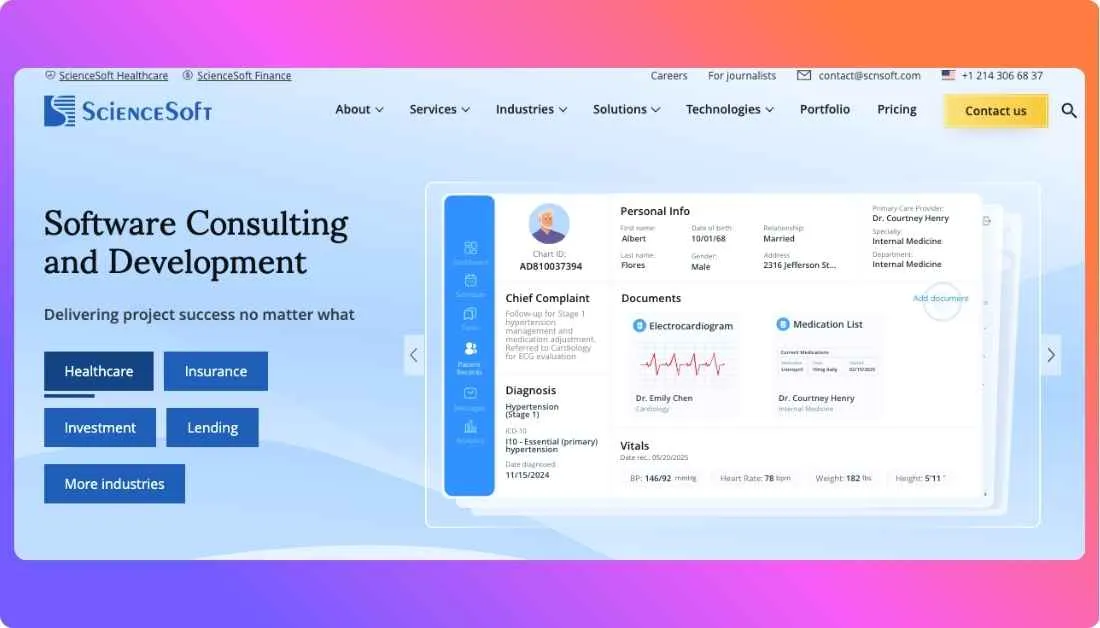
ScienceSoft provides business automation and custom software engineering, including RPA for repetitive, rule-based work. Its automation approach starts with process analysis and can combine Power Automate, enterprise applications, custom integrations, and AI where workflows involve more complex data or decisions.
Provider Type: Software engineering company
Automation Focus: RPA, BPA, custom workflow automation
Best Fit: Integration-heavy custom automation
Core Strength: Automation combined with software development
Other Services: AI, data, enterprise software, modernization
13. WonderBotz
WonderBotz began in 2017 as an RPA-focused consultancy and now positions its services around Agentic Process Management. It combines bots, AI agents, human approvals, orchestration, monitoring, governance, and data foundations while allowing organizations to modernize existing automation without replacing everything at once.
Provider Type: Automation specialist
Automation Focus: RPA, agentic automation, orchestration
Best Fit: Modernizing mature automation programs
Core Strength: Connecting bots, AI, people, and governance
Other Services: Managed support, AI agents, custom applications
14. Reveal Group
Reveal Group has specialized in intelligent automation and RPA since 2005. Following its 2024 acquisition by Ashling Partners, its automation expertise and Reveal RoboSuite tools became part of a broader multimodal automation offering covering program operations, technology, and enterprise transformation.
Provider Type: Intelligent automation specialist
Automation Focus: RPA, governance, automation management
Best Fit: Scaling and governing established RPA programs
Core Strength: CoE development and program optimization
Other Services: Process automation, change management
15. Capgemini
Capgemini combines RPA, artificial intelligence, and analytics within its intelligent process automation practice. Its approach covers the automation journey from initial planning through production and scaling, making it suitable for enterprises that want automation tied to broader process redesign.
Provider Type: Global consulting and technology
Automation Focus: RPA and intelligent process automation
Best Fit: Large enterprise transformation programs
Core Strength: Process redesign combined with automation
Other Services: AI, data, cloud, enterprise transformation
Looking for the Right RPA Development Partner?
The right provider depends on process complexity, existing applications, governance requirements, and whether the initiative needs conventional RPA, custom integrations, AI, or a combination of these technologies.
How an RPA Project Reaches Production
A working bot is only one part of an RPA project. Production automation must handle real users, application changes, exceptions, security requirements, and business volumes without creating new operational problems. Experienced RPA development companies therefore follow a structured path from process discovery to ongoing optimization.
A typical RPA implementation moves through six stages: process discovery, feasibility assessment, solution design, development, testing and deployment, and ongoing monitoring. During discovery, teams map process rules, systems, exceptions, and expected outcomes. An AI workflow automation approach can help when a process combines deterministic steps with decisions that require AI.
Architecture comes next. Developers decide whether each step should use an API, RPA bot, workflow engine, or another integration method. This is especially important when connecting automation with legacy systems, where unstable interfaces can make UI-based bots difficult to maintain.
Before a large rollout, organizations can test the automation concept through a focused proof of concept. A validated workflow can then move toward a production-ready MVP with security, monitoring, exception handling, and integration requirements built into the solution.
After deployment, teams track failed runs, queue performance, application changes, and business outcomes. This lifecycle approach helps RPA implementation companies treat automation as an operating system capability rather than a one-time bot project.
How to Evaluate an RPA Development Company
Choosing among RPA development companies requires more than comparing hourly rates or platform certifications. The stronger evaluation question is whether the provider can design an automation that remains useful, secure, and maintainable after launch.
- RPA delivery experience: Look for production deployments and evidence of solving real process problems, not only bot demonstrations.
- Process discovery: Strong RPA consulting companies identify unsuitable workflows before development, reducing the risk of automating inefficient processes.
- Platform expertise: Compare experience with UiPath, Automation Anywhere, Microsoft Power Automate, Blue Prism, and relevant workflow automation tools.
- Integration capability: The team should understand APIs, ERP and CRM systems, databases, desktop software, web applications, and legacy environments.
- Security and governance: Review access controls, credential management, audit logs, testing, human approval points, and change-management practices.
- Technical depth: Some workflows need more than rules. Understanding machine learning and natural language processing helps when automation must classify documents or interpret text.
- Post-launch support: RPA service providers should explain who monitors failures, handles application changes, performs regression testing, and updates bots after deployment.
Gartner’s 2026 Critical Capabilities research evaluates RPA products across areas such as unattended and attended automation, governance, security, deployment, UI integration, and AI-augmented automation. These categories also provide useful questions when businesses evaluate an implementation partner.
How Prismetric Builds Production-Ready RPA and Intelligent Automation
Prismetric starts with the business process rather than assuming RPA is automatically the right answer. Teams examine process volume, rules, systems, exceptions, data, and expected value. This helps determine whether the workflow needs an API integration, deterministic bot, custom software component, AI capability, or a combination of these approaches.
For text-heavy workflows, organizations may add language-processing capabilities to classify, extract, or interpret information before an RPA bot performs the next defined action. Where generative AI has a valid role, businesses can also seek specialist guidance for generative AI implementation instead of adding it to a workflow without a clear purpose.
The next step is production engineering. Prismetric connects automation with existing applications, defines authentication and permissions, tests exception paths, and adds monitoring before deployment. AI in DevOps can also support wider software delivery and monitoring practices where automation becomes part of a larger technology environment.
RPA and AI agents can complement each other rather than compete. Rule-based bots remain useful for predictable UI tasks, while agents can support workflows that need more flexible reasoning or tool selection. Gartner’s 2026 RPA market research continues to identify agentic automation and business orchestration as trends influencing the RPA market. (Gartner) Organizations exploring this direction can first understand agentic process automation and decide where greater autonomy creates measurable business value.
Move From RPA Proof of Concept to Production-Ready Automation
Prismetric helps validate workflows, design integrations, handle exceptions, add monitoring, and deploy scalable RPA and AI-powered automation with measurable business outcomes.
Start Your RPA Automation Project
Case Study: Finance Workflow Automation Using RPA and AI
A mid-sized finance company worked with Prismetric to reduce manual work across document verification, approvals, customer support, and other high-volume processes. The solution combined machine learning, APIs, process automation, and RPA tools rather than relying on one technology for every task.
Challenges
- Employees spent significant time on repetitive data entry, document verification, and approval tasks.
- Manual checks and disconnected communication slowed loan-processing workflows.
- Data errors created rework, delays, and compliance risks.
Solution
- Prismetric built an automated workflow that combined rule-based processing, machine learning, and enterprise integrations.
- RPA tools handled repetitive steps such as form filling, data synchronization, and report generation.
- Monitoring and audit logging provided visibility into workflow activity and supported governance.
The project also shows how automation can support customer service workflows without requiring every interaction to be fully automated. Organizations with similar financial processes may need AI solutions for fintech operations when RPA must work with document processing, decision support, APIs, and existing financial systems.
Results
- 70% reduction in manual processing time
- 30% lower operational costs
- 80% drop in document-related errors
The published case study also reports a 2× improvement in customer response time. These results show why RPA works best when it is connected to a clearly defined process and supported by the right integration, data, and monitoring architecture.
Wrapping Up
The best RPA development companies are not necessarily the largest providers. The right choice depends on process complexity, existing systems, governance needs, and the type of automation required. Global consultancies suit large transformation programs, automation specialists bring focused RPA expertise, and software engineering firms can handle custom integrations. Industry-specific workflows, such as automation across logistics operations, may also require domain knowledge alongside technical capability.
Frequently Asked Questions
An RPA development company designs, builds, integrates, deploys, and maintains software bots that automate rule-based business tasks. These companies can automate data entry, form processing, system updates, reporting, and other repetitive work. Strong providers also assess whether RPA, APIs, AI, or another integration approach best fits the process.
An RPA software vendor provides the platform used to create and manage bots. An RPA development company uses those platforms to build working business solutions. Development partners handle process analysis, integrations, testing, governance, deployment, and support, while vendors such as UiPath and Automation Anywhere primarily provide automation technology.
RPA development cost depends on process complexity, bot count, integrations, platform licensing, exception rates, testing, security, and maintenance. A simple rule-based workflow costs less to implement than an automation that connects several enterprise systems or processes unstructured documents. Businesses should estimate cost against expected operational value rather than bot count alone.
For finance teams, the potential value may extend into accounting processes that use AI and automation for document handling, reconciliation, reporting, and repetitive data work.
Businesses should evaluate process-discovery skills, platform experience, integration depth, security practices, governance, testing, and post-launch support. Industry knowledge also matters because workflows and compliance requirements differ by sector. For example, insurance operations can involve AI-supported automation across claims, policy documents, and customer communication.
Finance, insurance, healthcare, manufacturing, retail, logistics, and HR commonly use RPA because they manage high volumes of repetitive, structured work. Examples include claims processing, employee onboarding, inventory updates, invoice handling, and administrative tasks.
Healthcare organizations may combine RPA with AI-supported administrative workflows and healthcare AI implementation capabilities where document processing or decision support requires more than fixed automation rules.
There is no single implementation timeline. Project duration depends on process complexity, application count, API availability, exception paths, security reviews, testing, and deployment requirements. A focused workflow can move faster than a multi-department automation program. Manufacturing projects, for instance, may connect RPA with AI-supported production and operational processes.
Strong RPA service providers treat security and governance as part of development. Common controls include role-based access, credential management, audit logs, approval points, bot monitoring, and change management. This becomes especially important in regulated environments and employee-related workflows, where AI and automation in HR can involve sensitive workforce data.
No. AI agents and RPA solve different types of automation problems. RPA remains useful for predictable, rule-based UI interactions, while agents can support work involving context, variable decisions, and tool selection. Gartner’s 2026 RPA research says rule-based UI automation remains relevant even as agentic automation develops.
The technologies can also work together. A retailer, for example, might use RPA for structured system updates while applying AI to retail workflows that involve demand, customer, or product information.