How to Build an AI MVP for Your Product: Complete Guide
Many startups begin their AI journey with a bold product vision. A founder identifies a promising opportunity, hires a development team, integrates advanced AI models, builds multiple features, and spends months preparing the product for launch. But when the product finally reaches users, the team discovers a difficult reality: users do not fully trust the AI-generated output, the model is too expensive to run at scale, or the problem is not painful enough for customers to pay for.
This is where building an AI MVP becomes essential. Instead of investing heavily in a full-scale AI product from the beginning, businesses can start with a focused, lean, and testable version of the product. An AI MVP helps you validate whether artificial intelligence can solve one real user problem before you commit to complex development, infrastructure, and long-term scaling.
For startups, product teams, and enterprises, an AI MVP is not just a faster way to launch. It is a strategic approach to reducing development risks, improving product-market fit, testing AI performance with real users, and building a scalable foundation for future growth.
Quick Answer:
An AI MVP is the simplest working version of a product that uses one AI capability to solve a validated user problem. To build one, define the problem, confirm AI is necessary, choose one core AI feature, prepare usable data, select the right model or API, build a thin prototype, test with real users, measure AI quality, and iterate before scaling.
By focusing on one core AI-powered feature, businesses can understand what users actually need, how reliable the AI system is, how much it costs to operate, and whether the solution can deliver measurable business value. This makes AI MVP development a crucial first step for any organization planning to build an AI-powered product.
What Is an AI MVP?
An AI MVP, or artificial intelligence minimum viable product, is a lean version of a product that uses AI to solve one specific user problem. It is designed to test the core value of an AI-powered solution without building a complete platform, advanced feature set, or large-scale infrastructure from day one.
Unlike a traditional MVP, an AI MVP does not only validate whether users want a feature. It also validates whether the AI system can perform the task accurately, reliably, affordably, and safely in a real-world environment. This makes AI MVP development more complex than standard MVP development, as it involves both product validation and AI performance validation.
For example, if you are building an AI-powered customer support assistant, your MVP does not need advanced analytics, multi-language support, admin dashboards, CRM automation, and voice capabilities in the first version. Instead, the AI MVP may focus only on answering frequently asked customer questions using your company’s help documents. This allows you to test whether users trust the responses, whether the AI reduces support workload, and whether the solution is worth scaling.
In simple terms, an AI MVP helps businesses answer one critical question:
Can this AI-powered product solve a real problem well enough for users to adopt it, trust it, and pay for it?
AI MVP Definition
An AI MVP is not a complete AI platform. It is a focused, functional, and testable version of an AI-powered product that proves one core value proposition.
The goal is not to build every possible feature. The goal is to validate the most important AI capability that makes the product useful. This could be an AI chatbot that answers customer queries, a recommendation engine that suggests relevant products, a document processing tool that extracts key information, or an AI copilot that helps employees complete repetitive tasks faster.
A well-built AI MVP usually includes:
- One clearly defined user problem
- One core AI-powered feature
- A simple user interface
- A usable dataset or knowledge source
- A selected AI model, API, or machine learning approach
- Basic performance tracking
- A feedback loop for continuous improvement
This lean approach allows businesses to reduce unnecessary development costs, identify technical limitations early, and collect real-world feedback before investing in a full-scale AI product.
For instance, instead of building a complete AI-powered sales automation platform, a company can start with an AI MVP that summarizes sales calls and suggests next steps for sales representatives. If users find the feature valuable and the AI output is accurate, the business can gradually expand the product with CRM integrations, automated follow-ups, lead scoring, and sales forecasting.
This makes an AI MVP a practical bridge between an idea and a scalable AI product.
AI MVP vs Traditional MVP
A traditional MVP focuses on validating whether a product feature is useful for users. An AI MVP goes one step further by validating both the product experience and the intelligence behind it. Since AI-powered products depend on data, model quality, accuracy, latency, and user trust, businesses must evaluate more than just usability.
Here is how an AI MVP differs from a traditional MVP:
| Factor |
Traditional MVP |
AI MVP |
| Core validation |
Feature usefulness |
Feature usefulness + AI performance |
| Main dependency |
UX and functionality |
UX, data, model quality, latency, trust |
| Risk |
Feature-market mismatch |
Bad data, hallucinations, bias, cost, drift |
| Testing |
User behavior |
User behavior + model evaluation |
| Iteration |
Feature updates |
Feature updates + prompt/model/data changes |
In a traditional MVP, a team may test whether users can complete a task, such as booking an appointment, creating an account, or managing a workflow. In an AI MVP, the team must also test whether the AI-generated output is accurate, useful, explainable, and cost-effective.
For example, a traditional project management MVP may validate whether users want a simple task board. But an AI-powered project management MVP must also validate whether the AI can summarize tasks, predict delays, recommend priorities, or generate project updates accurately.
This is why AI MVP development requires a stronger focus on data quality, model evaluation, user trust, and continuous optimization. A product may have a smooth interface, but if the AI produces unreliable results, users will quickly lose confidence in the solution.
AI MVP vs Prototype vs PoC
While building an AI-powered product, businesses often use terms like prototype, proof of concept, and MVP interchangeably. However, each one serves a different purpose in the product development journey. Understanding the difference helps teams choose the right approach and avoid unnecessary development costs.
A prototype shows what the product may look like. It is usually a visual or interactive representation of the user experience. A prototype may include screens, workflows, clickable designs, or mockups, but it does not always include real AI functionality. Its main purpose is to validate design, usability, and user flow before development begins.
A proof of concept, or PoC, proves that the AI or technical approach can work. It is usually built to test feasibility. For example, a company may create a PoC to check whether an AI model can classify support tickets, summarize legal documents, detect fraud patterns, or extract information from invoices. A PoC is more technical than a prototype, but it may not be ready for real users.
An AI MVP lets real users complete a real task with the AI-powered product. It combines the product experience with working AI functionality, allowing businesses to test usability, performance, trust, adoption, and business value in a practical environment.
Here is a simple way to understand the difference:
| Product Stage |
Main Purpose |
User Readiness |
| Prototype |
Shows how the product may look and feel |
Usually not ready for real-world use |
| PoC |
Proves the AI or technical approach can work |
Mostly used internally |
| AI MVP |
Allows real users to complete a real AI-powered task |
Ready for controlled user testing |
For example, if you are building an AI document analysis product, a prototype may show how users upload files and view summaries. A PoC may test whether an AI model can extract key clauses from sample documents. An AI MVP would allow real users to upload actual documents, receive AI-generated summaries, review the output, and provide feedback.
This makes the AI MVP the most important stage for validating whether your AI product can deliver real business value. It helps businesses move beyond assumptions and understand how the product performs with actual users, real data, and practical use cases.
Should You Build an AI MVP in the First Place?
Building an AI MVP can be a strategic move for startups and enterprises planning to validate an intelligent product idea. However, not every product needs artificial intelligence from day one. In many cases, businesses rush into AI development because the technology sounds innovative, only to realize later that a simpler workflow, automation script, or rule-based system could have solved the problem faster and at a lower cost.
Before investing in AI MVP development, businesses must evaluate whether AI is truly required to solve the user problem. The goal is not to add AI for the sake of innovation. The goal is to use AI where it can meaningfully improve speed, accuracy, personalization, decision-making, or operational efficiency. This is where expert AI consulting services can help businesses confirm whether AI is the right path before investing in development.
An AI MVP makes the most sense when the product depends on intelligence, adaptability, large-scale data processing, or natural language understanding. If the core value of your product comes from the AI capability itself, then building an AI MVP can help you validate demand, test model performance, reduce technical risks, and create a scalable foundation for future product growth.
Build an AI MVP When the Problem Involves
AI MVP development is most valuable when your product idea requires more than basic software functionality. If your product needs to understand data, generate content, identify patterns, recommend actions, or automate complex workflows, AI can become a powerful differentiator.
You should consider building an AI MVP when the problem involves:
- Prediction: AI can help forecast outcomes, such as customer churn, product demand, sales performance, fraud risk, or maintenance needs.
- Personalization: AI can tailor recommendations, content, offers, learning paths, or user experiences based on individual behavior.
- Natural language understanding: AI can interpret user queries, customer messages, documents, emails, support tickets, or internal knowledge bases.
- Content generation: Generative AI can create drafts, summaries, product descriptions, reports, emails, marketing content, or design ideas.
- Pattern recognition: AI can identify trends, anomalies, fraud signals, behavioral patterns, or hidden insights from large datasets.
- Document processing: AI can extract, classify, summarize, and analyze information from PDFs, invoices, contracts, medical records, or legal documents.
- Repetitive workflow automation: AI can reduce manual effort by automating tasks such as ticket routing, data entry, lead qualification, and report generation.
- Decision support at scale: AI can help teams make faster and more informed decisions by analyzing large volumes of structured and unstructured data.
For example, if your product helps HR teams shortlist candidates from thousands of resumes, AI can add measurable value by analyzing skills, experience, job fit, and role-specific criteria faster than manual screening. In this case, an AI MVP allows you to test whether the system improves hiring efficiency while maintaining fairness, accuracy, and recruiter trust.
Do Not Use AI When
Although AI can unlock significant business value, it is not always the right solution. Businesses should avoid building an AI MVP when the problem can be solved with a simpler, cheaper, and more predictable approach.
You may not need AI when:
- A simple rule-based workflow can solve the problem effectively.
- Users need the same deterministic output every time.
- You do not have access to usable data or reliable knowledge sources.
- The AI feature is being added only for marketing appeal.
- The cost of generating AI output is higher than the value created.
- The product does not require prediction, personalization, automation, or natural language processing.
- Users are unlikely to trust AI for the task without extensive human review.
For instance, if your product only needs to send reminders based on fixed dates, AI is unnecessary. A basic automation system can handle the workflow with greater predictability and lower cost. However, if the product needs to prioritize reminders based on user behavior, urgency, historical patterns, and context, AI may become valuable.
The smartest approach is to start with the business problem first and then decide whether AI is the right solution. This prevents unnecessary development complexity and ensures the MVP remains focused on real user value.
AI MVP Decision Checklist
Before moving into development, businesses should use a clear decision framework to evaluate whether an AI MVP is worth building. This helps founders, product managers, and technology leaders avoid costly assumptions and validate whether AI can create measurable value.
Use the following checklist before starting AI MVP development:
- Is the user problem frequent and painful?
- Does AI improve the outcome meaningfully?
- Can the result be measured with clear success metrics?
- Can users tolerate occasional AI uncertainty?
- Can you create a fallback when AI fails?
- Do you have access to usable data or reliable knowledge sources?
- Can the AI-powered workflow be tested with real users in 2–8 weeks?
- Is the cost of AI output justified by the value it creates?
- Can the product start with one focused AI capability instead of a full platform?
- Can the AI system improve over time with user feedback?
If the answer to most of these questions is yes, building an AI MVP can be a smart next step. It allows your business to test the idea, validate user demand, evaluate AI performance, and make informed decisions before investing in a complete product.
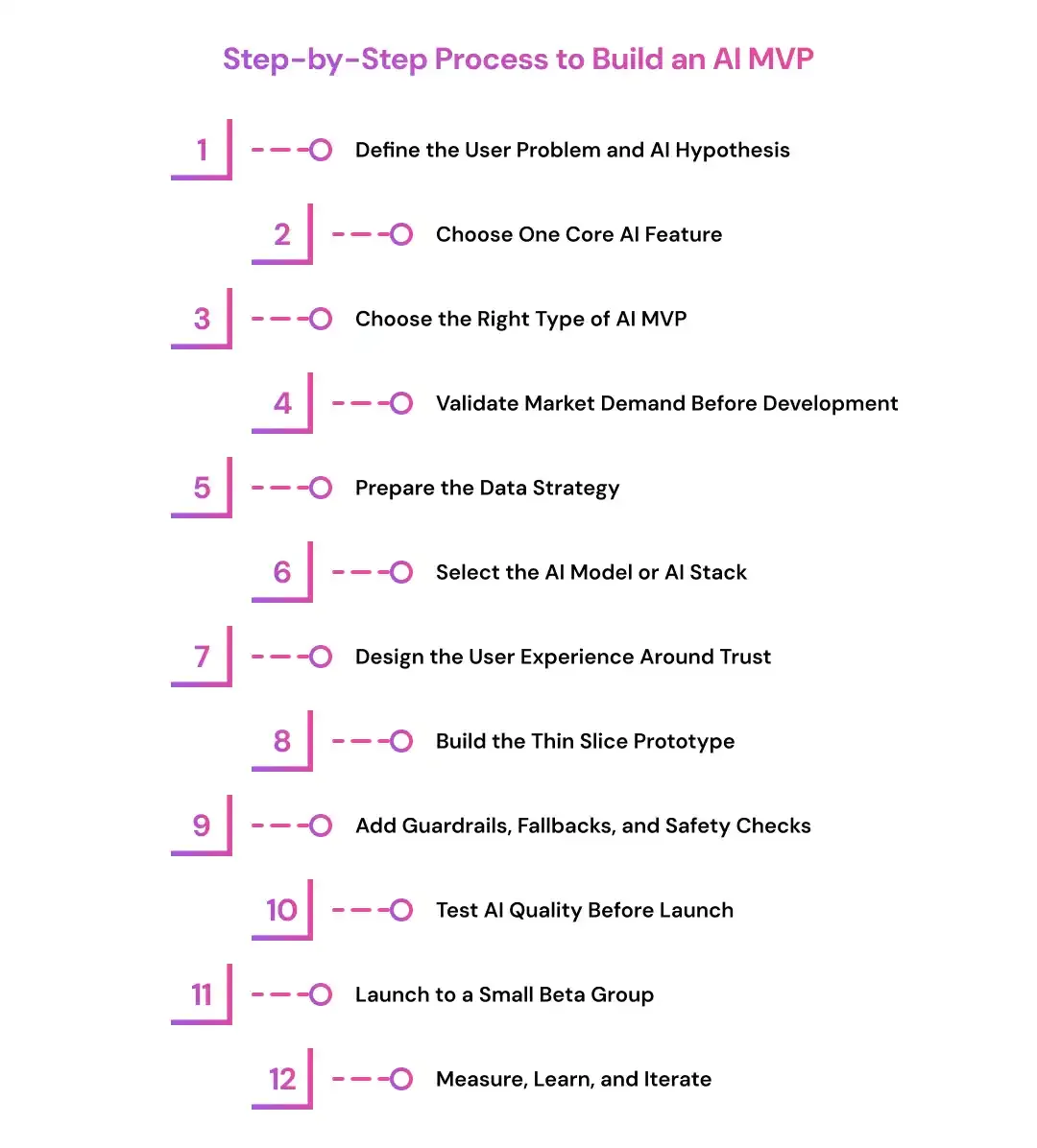
Step-by-Step Process to Build an AI MVP
Building an AI MVP requires a structured approach that balances product strategy, AI feasibility, user experience, data readiness, and business outcomes. Unlike traditional MVP development, an AI MVP must validate both user demand and AI performance. This means businesses need to test not only whether users want the product, but also whether the AI system can deliver accurate, reliable, and cost-effective results.
A successful AI MVP development process starts with a clearly defined problem and gradually moves toward model selection, data preparation, prototype development, user testing, and continuous optimization. Each stage should help reduce uncertainty and bring the product closer to real market validation.
Step 1: Define the User Problem and AI Hypothesis
The first step in building an AI MVP is defining the user problem with clarity. Many AI products fail because businesses start with the technology instead of the pain point. They decide to build an AI chatbot, AI assistant, or AI recommendation engine before understanding whether users actually need it.
A strong AI MVP starts with the target user, the problem they face, the current workaround they use, and the business outcome they want to achieve. This ensures the product is not just technically advanced but also aligned with real user needs.
At this stage, define:
- Who the target user is
- What pain point they experience
- How they currently solve the problem
- Why existing tools or workflows fail
- Why AI is needed to improve the outcome
- What measurable improvement you expect
The AI hypothesis should clearly connect the AI capability with the expected business or user outcome. A simple formula can help:
If we use AI to [perform task], then [target user] will achieve [measurable outcome] faster, cheaper, or more accurately than before.
For example:
If we use AI to summarize customer support tickets, support managers can reduce triage time by 50% while maintaining response quality.
This hypothesis gives your team a clear direction. It defines what the AI MVP should prove and what metrics should be tracked during testing. Without this clarity, the MVP can easily turn into a feature-heavy product with no clear validation goal.
Step 2: Choose One Core AI Feature
Once the problem is defined, the next step is selecting one core AI feature. This is one of the most important principles of AI MVP development: one AI feature, one workflow, one success metric.
Trying to build multiple AI capabilities in the first version can increase development complexity, delay launch, raise costs, and make it difficult to understand what users actually value. A focused AI MVP allows businesses to test the most important capability quickly and improve it based on real feedback.
Examples of focused AI MVP features include:
- An AI chatbot that answers only billing-related questions
- A resume screener that ranks candidates based on job fit
- An AI assistant that summarizes uploaded PDFs
- A recommendation engine that suggests five relevant products
- An AI copilot that drafts first responses for support agents
- A document extraction tool that pulls invoice details into a dashboard
- A sales assistant that summarizes calls and suggests next actions
The core feature should be closely tied to the primary user pain point. If the AI feature does not directly solve the problem, it should not be part of the MVP.
At this stage, businesses should also define what not to build yet. These features may be useful later, but they can distract from the core validation goal.
Avoid building too early:
- Admin dashboards
- Complex settings pages
- Multi-agent workflows
- Advanced personalization
- Full automation without human review
- Enterprise integrations unless required for validation
- Advanced analytics that are not needed for the first test
- Multi-language support unless it is central to the use case
By limiting the scope, businesses can reduce costs, launch faster, and focus on validating the AI capability that matters most.
Step 3: Choose the Right Type of AI MVP
Not all AI MVPs are built the same way. The right approach depends on the product idea, available data, technical complexity, user expectations, and validation goals. Some AI MVPs can be built with simple API integrations, while others may require retrieval-augmented generation, fine-tuning, or custom machine learning models.
Choosing the right type of AI MVP helps businesses balance speed, cost, performance, and scalability.
| AI MVP Type |
Best For |
Pros |
Risks |
| Wizard-of-Oz MVP |
Testing demand before automation |
Fast, cheap, useful for early validation |
Manual effort is hidden behind the product |
| API-wrapper MVP |
LLM-based apps, summarizers, copilots, chatbots |
Quick launch, lower development effort |
API cost, vendor dependency, limited control |
| RAG MVP |
AI that must answer from company-specific data |
More factual, source-backed, useful for enterprise knowledge |
Retrieval quality and data structure matter |
| Fine-tuned Model MVP |
Domain-specific language, classification, structured outputs |
Better task fit and improved consistency |
Needs quality data and continuous evaluation |
| Custom ML MVP |
Prediction, scoring, fraud detection, recommendations |
More control and business-specific optimization |
Higher cost and longer development timeline |
| Agentic MVP |
Multi-step autonomous workflows |
Powerful automation and task execution |
Harder to debug, monitor, and control |
For most founders and early-stage teams, the best starting point is usually an API-wrapper MVP, RAG MVP, or Wizard-of-Oz MVP. These approaches allow businesses to test demand, collect feedback, and understand user behavior before investing in custom model development.
Custom machine learning models and agentic systems can be powerful, but they usually require more data, engineering effort, monitoring, and governance. Unless the product’s core value depends on proprietary AI performance, starting with a simpler approach is often more cost-effective.
Step 4: Validate Market Demand Before Development
Before investing in AI MVP development, businesses should validate whether users actually need the solution. Many AI products fail not because the technology is weak, but because the problem is not urgent enough, users are unwilling to change their current workflow, or the product does not deliver a clear return on investment.
Market validation helps businesses understand the user problem, buying intent, current alternatives, and expected output quality before development begins.
Effective ways to validate demand include:
- Interviewing 10–15 target users
- Analyzing support tickets, reviews, forums, and competitor complaints
- Running a landing page test
- Offering a manual concierge version
- Testing willingness to pay
- Reviewing existing workflows and manual bottlenecks
- Validating the workflow, not just the AI novelty
For example, if you plan to build an AI assistant for financial analysts, do not only ask whether they would use AI. Instead, understand how they currently research companies, prepare reports, analyze documents, and verify information. The goal is to identify where AI can reduce manual effort without compromising trust or accuracy.
Useful interview questions include:
- How do you solve this problem today?
- What happens if you do not solve it?
- How often does this problem occur?
- How much time or money does this problem cost you?
- What would make you switch from your current workflow?
- Would you trust AI to help with this task?
- What output quality would be acceptable?
- What would make the AI-generated result trustworthy?
- Would you pay for a solution that solves this problem?
This stage ensures that your AI MVP is built around real demand, not assumptions. It also helps define the right feature scope, pricing direction, success metrics, and go-to-market strategy.
Step 5: Prepare the Data Strategy
Data is one of the most critical components of AI MVP development. Even the most advanced AI model can produce poor results if the data is incomplete, outdated, biased, unstructured, or irrelevant. A strong data strategy ensures that the AI MVP has the right foundation to generate useful, accurate, and trustworthy outputs.
Before development begins, businesses must identify what data the AI system needs and how that data will be collected, prepared, stored, and used. This is especially important for AI MVPs involving document processing, customer support automation, enterprise search, recommendation engines, predictive analytics, or personalized user experiences.
Your data strategy should cover:
- What data the AI needs
- Where the data comes from
- Whether the data is structured or unstructured
- How clean and complete the data is
- Whether data labeling is required
- How sensitive information will be handled
- Whether user consent is needed
- What bias risks may exist
- Whether synthetic data can support testing
- How feedback data will be collected after launch
For example, a RAG-based AI support assistant may need help center articles, product documentation, previous support tickets, refund policies, and troubleshooting guides. If these documents are outdated or inconsistent, the AI system may generate unreliable answers. Preparing the data before launch helps reduce hallucinations and improve user trust.
Minimum Data Checklist
Use this checklist before integrating data into your AI MVP:
- Is the data relevant to the task?
- Is it clean enough for testing?
- Is it representative of real users?
- Does it include common edge cases?
- Is the data updated and accurate?
- Can sensitive information be removed or anonymized?
- Can users correct bad AI outputs?
- Can feedback be stored for future improvement?
- Is there enough data to evaluate the AI system?
- Are privacy, consent, and compliance requirements addressed?
A well-prepared data strategy helps businesses improve AI performance, reduce technical risks, and create a stronger foundation for scaling the product.
Step 6: Select the AI Model or AI Stack
The next step is choosing the right AI model or technology stack for the MVP. There is no single best model for every AI product. The right choice depends on the use case, expected output quality, data availability, response time, security requirements, budget, and scalability goals.
For example, a simple AI writing assistant may work well with a large language model API. A company knowledge assistant may require a RAG architecture. A fraud detection MVP may need a custom machine learning model trained on historical transaction data. A multilingual customer support bot may require a model with strong language capabilities and low latency.
Model Selection Criteria
When selecting an AI model or stack, evaluate the following factors:
- Accuracy: Can the model produce reliable results for your use case?
- Latency: Can it respond fast enough for the user experience?
- Context window: Can it process the amount of information required?
- Cost per request: Is the output cost sustainable at scale?
- Security requirements: Can the model handle sensitive or enterprise data safely?
- Rate limits: Can the system support expected usage volume?
- Fine-tuning support: Can the model be customized if needed?
- Multilingual needs: Can it support users across different languages?
- Deployment options: Can it be hosted through API, cloud, private infrastructure, or on-premise setup?
- Vendor reliability: Is the provider stable, secure, and suitable for long-term use?
Businesses should also consider whether they need generative AI, traditional machine learning, computer vision, NLP, recommendation algorithms, or a hybrid approach. The selected stack should support the MVP goal without creating unnecessary complexity.
When to Use No Model at All
In some cases, businesses should validate demand before investing in full AI automation. Early MVPs can sometimes use manual workflows, rules, or human-in-the-loop processes to simulate the AI experience.
For example, a founder building an AI travel planner may initially collect user preferences through a form and manually generate personalized itineraries. This helps validate whether users value the outcome before building a fully automated recommendation engine.
This approach reduces cost, speeds up validation, and helps businesses understand user expectations before investing in AI model development.
Step 7: Design the User Experience Around Trust
AI MVPs often fail when users do not understand, trust, or feel in control of the AI system. Unlike traditional software, AI products may produce uncertain, incomplete, or variable outputs. This makes trust a critical part of the user experience.
A strong AI MVP should clearly show what the AI is doing, where the output comes from, and how users can correct or approve the result. The goal is not to make AI look perfect. The goal is to make the system useful, transparent, and safe enough for real-world use.
To design the user experience around trust:
- Show what the AI is doing.
- Let users edit or approve AI output.
- Add confidence indicators when useful.
- Provide source citations for factual answers.
- Give users a clear fallback when AI fails.
- Avoid pretending the AI is always correct.
- Build human-in-the-loop review for high-risk decisions.
- Explain limitations in simple language.
- Make it easy for users to report incorrect outputs.
Examples of trust-focused microcopy include:
“AI-generated draft — please review before sending.”
“Sources used: customer policy, refund FAQ, previous ticket history.”
“Low confidence answer — route to human support.”
For high-risk industries such as healthcare, finance, legal, and insurance, human review becomes even more important. The AI MVP should support decision-making rather than fully replace expert judgment in the early stages.
Step 8: Build the Thin Slice Prototype
After defining the problem, selecting the core AI feature, preparing data, and choosing the AI stack, the next step is building a thin slice prototype. A thin slice is the smallest end-to-end workflow that delivers the promised value to the user.
Instead of building a full platform, the MVP should focus on one complete journey from input to output. This allows users to experience the core value of the product without unnecessary features.
For example, an AI document summarization MVP may follow this workflow:
User uploads document → AI extracts key points → user reviews summary → user exports result.
This simple workflow is enough to validate whether users find the output useful, whether the AI performs reliably, and whether the product solves a real problem.
Suggested AI MVP Tech Stack
The technology stack depends on the team’s technical capabilities, product complexity, data needs, and scalability goals.
| Team Type |
Frontend |
Backend |
AI Layer |
Database |
Analytics |
| Non-technical founder |
Bubble, Softr, Glide |
Zapier, Make, n8n |
OpenAI, Claude, Gemini APIs |
Airtable, Supabase |
PostHog, Mixpanel |
| Lean technical team |
Next.js, React |
Node.js, Python, FastAPI |
OpenAI, Anthropic, Cohere |
Supabase, Postgres |
PostHog |
| RAG MVP |
Next.js |
FastAPI |
LLM + embeddings |
Pinecone, Weaviate, pgvector |
LangSmith, Arize |
| Enterprise MVP |
React |
Python, Java, .NET |
Private LLM or hosted API |
Cloud database |
Datadog, MLflow |
The stack should be selected based on the MVP’s immediate validation goal. Early-stage teams should avoid overengineering the architecture before proving demand. However, the foundation should still be secure, maintainable, and flexible enough to support future iterations.
Step 9: Add Guardrails, Fallbacks, and Safety Checks
AI systems can generate incorrect, incomplete, biased, or unsafe outputs if they are not properly controlled. This is why guardrails are essential in AI MVP development. They help businesses improve reliability, reduce risk, and create safer user experiences.
Guardrails are especially important for AI products that generate recommendations, analyze sensitive data, make decisions, or interact directly with customers.
Teams working with sensitive data should also consider AI regulation and compliance early, especially when the MVP involves healthcare, finance, legal, or enterprise workflows.
Important guardrails and safety checks include:
- Input validation
- Output format validation
- Prompt constraints
- Hallucination checks
- Toxicity and safety filters
- Human review triggers
- Usage limits
- Logging and monitoring
- Retry logic
- Fallback responses
- Escalation to human support
- Role-based access controls
For example, if an AI assistant cannot find enough reliable information to answer a question, it should not invent a response. Instead, it should provide a safe fallback message.
Example fallback response:
“I could not generate a reliable answer from the available information. Please review this manually or upload more context.”
This approach protects user trust and reduces the risk of incorrect outputs affecting business decisions.
Step 10: Test AI Quality Before Launch
Testing an AI MVP is different from testing a traditional software product. In addition to checking whether the interface works, businesses must evaluate whether the AI output is accurate, useful, consistent, safe, and cost-effective.
This stage can significantly differentiate your AI MVP from competitors because it helps identify model weaknesses before users experience them.
Build a Golden Test Set
A golden test set is a collection of real or realistic examples used to evaluate AI performance. For an early AI MVP, businesses can create 30–100 test cases that reflect the most common user inputs, expected outputs, edge cases, and failure scenarios.
For each test case, define what a good response looks like. This helps the team compare AI-generated outputs against expected results and improve prompts, models, retrieval logic, or data quality.
For example, if you are building an AI support assistant, your golden test set may include common refund questions, billing issues, account problems, product troubleshooting requests, and ambiguous customer queries.
Track AI Quality Metrics
To understand whether the AI MVP is ready for launch, track both product and AI performance metrics.
Important AI quality metrics include:
- Accuracy
- Precision and recall
- Hallucination rate
- Task completion rate
- Human correction rate
- Latency
- Cost per successful task
- Fallback rate
- User trust score
- Output acceptance rate
These metrics help businesses evaluate whether the AI system is creating real value or introducing new risks. For example, if users frequently edit AI-generated responses, the product may still be useful, but the model, prompt, or data layer may need improvement.
Run Edge-Case Tests
AI MVPs should also be tested against difficult and unusual scenarios. This helps ensure the system behaves safely when inputs are incomplete, confusing, or unexpected.
Edge-case tests should include:
- Missing data
- Ambiguous prompts
- Long inputs
- Adversarial inputs
- Sensitive data
- Unusual user behavior
- Conflicting information
- Unsupported requests
- Low-quality documents
- Repeated or duplicate inputs
Testing edge cases before launch helps businesses reduce failure points and create a more reliable user experience.
For LLM-based MVPs, LLMOps tools can also support monitoring, evaluation, prompt tracking, and performance improvement after launch.
Step 11: Launch to a Small Beta Group
Once the AI MVP has passed internal testing, it should be launched to a small beta group. A controlled launch allows businesses to observe real user behavior, collect actionable feedback, and identify performance issues without exposing the product to a large audience too early.
A practical beta launch plan can include:
- 5–10 users for the first usability test
- 25–50 users for a private beta
- 100–500 users only after reliability is stable
During the beta phase, the goal is not just to collect compliments or feature requests. The goal is to understand whether users complete the core workflow, trust the AI output, return to the product, and experience measurable value.
Track the following:
- Activation
- Retention
- Repeat usage
- Task success
- Time saved
- AI output acceptance
- User corrections
- Support tickets
- Willingness to pay
- User-reported trust and satisfaction
For example, if you are testing an AI writing assistant, monitor how often users accept the generated draft, how much they edit it, whether they return to generate more content, and whether the tool saves measurable time.
This feedback helps businesses improve the MVP before expanding to a larger audience.
Step 12: Measure, Learn, and Iterate
An AI MVP is successful only if it proves or disproves the original hypothesis. The goal is not to launch once and assume the product is ready. The goal is to learn from real users, analyze performance, improve the AI system, and decide whether the product should be scaled, changed, or simplified.
Businesses should review both product metrics and AI performance metrics to understand the full picture.
Product Metrics
Product metrics help determine whether users find value in the AI MVP.
Track:
- Activation rate
- Weekly active users
- Retention
- Conversion rate
- Revenue
- NPS
- Feature adoption
- Time saved
- User engagement
- Willingness to pay
If users are not returning, completing tasks, or showing buying intent, the problem may be with the product positioning, workflow, or value proposition.
AI Performance Metrics
AI performance metrics help determine whether the intelligent system is reliable and scalable.
Track:
- Output quality
- Accuracy
- Latency
- Cost per request
- Model drift
- Escalation rate
- Human override rate
- Hallucination rate
- Fallback rate
- Correction frequency
If users like the product but frequently correct the AI output, the team may need to improve prompts, data quality, retrieval logic, fine-tuning, or model selection.
Decision After MVP
After testing the AI MVP, businesses should make a clear decision based on user feedback, product metrics, AI performance, and cost sustainability.
| Result |
What to Do |
| Users love it, AI works well |
Scale gradually |
| Users love it, AI is unreliable |
Improve model, data, UX, and guardrails |
| Users do not care, AI works well |
Revisit the problem, positioning, or target audience |
| Users care but will not pay |
Test pricing, packaging, and buyer persona |
| AI is not needed |
Replace it with a simpler workflow |
| Costs are too high |
Optimize model, caching, batching, or product scope |
This decision framework helps businesses avoid emotional product decisions. Instead of scaling too early or abandoning the idea too quickly, teams can use real evidence to decide the next move.
A well-executed AI MVP gives your business more than a working product. It gives you clarity. It helps you understand what users need, how AI can create value, what technical risks must be solved, and whether the product has the potential to become a scalable AI-powered solution.
How Much Does It Cost to Build an AI MVP?
Building an AI MVP typically costs between $15,000 and $150,000+, depending on the product complexity, AI architecture, data requirements, and development approach. An API-based AI MVP is usually the fastest and most cost-effective way to validate demand, while custom AI models, complex data pipelines, and compliance-heavy solutions can significantly increase the overall cost.
The final cost depends on whether you are using pre-built AI APIs, implementing retrieval-augmented generation, fine-tuning existing models, or building proprietary machine learning systems from scratch.
Cost by AI MVP Type
| AI MVP Type |
Estimated Cost |
Best For |
| API-Driven AI MVP |
$15,000 – $30,000 |
Chatbots, summarizers, email drafters, simple automation tools |
| Mid-Range AI MVP |
$30,000 – $80,000 |
RAG assistants, recommendation engines, AI search tools, workflow automation |
| Custom AI MVP |
$80,000 – $200,000+ |
Predictive analytics, computer vision, proprietary algorithms, custom ML models |
| Regulated AI MVP |
$100,000 – $250,000+ |
Healthcare, fintech, legal AI, insurance, compliance-heavy platforms |
API-Driven AI MVP: $15,000 – $30,000
An API-driven AI MVP uses existing foundation models such as OpenAI, Anthropic, Gemini, or open-source models through hosted APIs. This is the most affordable and fastest approach for startups that want to validate user demand before investing in custom AI development.
This type of MVP is ideal for:
- AI chatbots
- Content generation tools
- Email assistants
- Document summarizers
- Simple workflow automation tools
Since the model is already available, the main development cost goes into UX/UI design, API integration, prompt engineering, backend setup, and basic testing.
Mid-Range AI MVP: $30,000 – $80,000
A mid-range AI MVP usually requires more than a simple API connection. It may involve retrieval-augmented generation, moderate fine-tuning, vector databases, data pipelines, third-party integrations, and user-specific workflows.
This type of MVP is suitable for:
- AI knowledge assistants
- RAG-based support bots
- Internal enterprise search tools
- AI recommendation engines
- AI document processing platforms
The cost increases because the product needs better data handling, backend logic, retrieval accuracy, authentication, analytics, and performance monitoring.
Custom AI MVP: $80,000 – $200,000+
A custom AI MVP is required when the core value of the product depends on proprietary algorithms, custom machine learning models, computer vision, predictive analytics, or large-scale data processing.
This type of MVP is best for:
- Fraud detection systems
- Predictive analytics platforms
- Computer vision products
- Custom recommendation engines
- Industry-specific machine learning tools
Custom AI MVPs cost more because they require data scientists, ML engineers, model training, testing datasets, experimentation, infrastructure setup, and continuous optimization.
Regulated AI MVP: $100,000 – $250,000+
Regulated AI MVPs are more expensive because they require stronger security, compliance, auditability, data governance, and human oversight. Products in healthcare, fintech, legal, insurance, and enterprise AI often fall into this category.
The cost may include:
- Secure data storage
- Role-based access control
- Compliance documentation
- Audit logs
- Data anonymization
- Human-in-the-loop review
- Risk management workflows
These MVPs need more planning because inaccurate or unsafe AI outputs can create legal, financial, or reputational risks.
Key Cost Drivers in AI MVP Development
Several factors can increase or reduce the cost of building an AI MVP:
- Model complexity: Using existing APIs is cheaper than training a custom model from scratch.
- Data preparation: Data cleaning, labeling, formatting, and integration can consume a major part of the budget.
- RAG implementation: Adding retrieval-augmented generation requires embeddings, vector databases, document processing, and retrieval testing.
- Infrastructure and APIs: Cloud hosting, vector databases, storage, and AI inference costs can range from $100 to $5,000+ per month, depending on usage.
- Security and compliance: Products handling sensitive data need encryption, access controls, privacy safeguards, and compliance checks.
- Team location: Development rates vary significantly by region. Teams in India or Eastern Europe are usually more cost-effective than teams in Silicon Valley or Western Europe.
- Testing and monitoring: AI MVPs require software testing as well as AI output evaluation, hallucination checks, and performance tracking.
Tips to Optimize AI MVP Development Cost
The best way to reduce AI MVP cost is to avoid overbuilding in the first version. Your goal should be to validate one core AI capability before investing in a full-scale product.
To optimize your budget:
- Start with a pre-built model or API before developing a custom model.
- Use open-source models only when they reduce long-term cost or improve control.
- Limit the MVP to one core AI feature and one user workflow.
- Avoid enterprise-grade architecture until user demand is validated.
- Use no-code or low-code tools for early prototypes when possible.
- Prepare clean and relevant data before development begins.
- Track API usage from day one to avoid unexpected operational costs.
- Use human-in-the-loop workflows before fully automating high-risk decisions.
In most cases, startups should begin with an API-driven or RAG-based AI MVP. Once the product proves real user demand, reliable AI performance, and cost sustainability, the business can gradually invest in custom models, advanced automation, and scalable infrastructure.
How Long Does It Take to Build an AI MVP?
The timeline to build an AI MVP depends on the complexity of the product, availability of data, development approach, team expertise, model selection, and level of testing required. A simple AI MVP using existing APIs and no-code tools can be launched much faster than a custom AI product that requires data pipelines, model training, compliance checks, and advanced backend development.
In most cases, the AI MVP development timeline should be planned around validation, not perfection. Teams planning the next stage can also study how to build AI software once the MVP proves real user demand. The goal is to launch a focused product quickly enough to collect real user feedback while still ensuring the AI output is reliable, safe, and useful.
Here is a practical timeline breakdown:
| Stage |
Timeline |
| Problem validation |
1–2 weeks |
| Prototype design |
1 week |
| Data preparation |
1–3 weeks |
| AI integration |
1–4 weeks |
| MVP development |
2–6 weeks |
| Beta testing |
2–4 weeks |
Problem Validation: 1–2 Weeks
The first stage involves validating the user problem, target audience, current workflow, pain points, and willingness to use or pay for an AI-powered solution. This stage usually includes user interviews, competitor research, workflow analysis, and hypothesis definition.
Skipping this stage can lead to wasted development time because the team may build an AI feature that users do not actually need.
Prototype Design: 1 Week
The prototype design stage focuses on creating the core user flow and interface. For an AI MVP, the design should clearly show how users provide input, how the AI generates output, how users review or edit the result, and what happens when the AI cannot provide a reliable response.
A simple AI MVP may need only a few screens, while a workflow-heavy product may require more detailed UX planning.
Data Preparation: 1–3 Weeks
Data preparation can take a few days or several weeks depending on the quality and availability of data. If the data is already clean, structured, and accessible, this stage can move quickly. If the data is scattered across documents, databases, PDFs, support tickets, or internal systems, additional time is needed for cleaning, formatting, labeling, and privacy checks.
Data availability is often the biggest timeline risk in AI MVP development. Poor data quality can delay AI integration and reduce output accuracy.
AI Integration: 1–4 Weeks
AI integration includes connecting the selected AI model or API with the product workflow. This may involve prompt engineering, API setup, RAG implementation, embeddings, vector database configuration, model testing, output formatting, and fallback logic.
A basic API-based AI assistant can be integrated quickly, while a RAG assistant or custom ML workflow requires more time for testing and optimization.
MVP Development: 2–6 Weeks
MVP development includes frontend development, backend development, user authentication, database setup, AI workflow integration, analytics, and basic admin controls if needed. The timeline depends on the number of user roles, integrations, workflows, and product features.
The MVP should remain focused on the core AI-powered workflow. Adding too many features at this stage can extend the timeline without improving validation.
Beta Testing: 2–4 Weeks
Beta testing allows businesses to launch the AI MVP to a small group of users and collect real feedback. During this stage, the team should monitor task completion, AI output quality, user corrections, latency, cost per request, support issues, and willingness to pay.
The insights collected during beta testing help determine whether the product should be improved, scaled, repositioned, or simplified.
Simple AI MVPs can be built faster with existing APIs, no-code tools, low-code platforms, and limited datasets. These are ideal for founders who want to validate demand before investing in a larger product.
Custom AI MVPs take longer because they require data engineering, model training, experimentation, performance evaluation, and infrastructure planning. Products involving computer vision, predictive analytics, regulated data, or complex decision-making usually need a longer development cycle.
In most cases, data availability is the biggest timeline risk. If the data is clean, accessible, and relevant, the MVP can move quickly. If the data needs to be collected, cleaned, labeled, or anonymized, the timeline can extend significantly.
How Long Does It Take to Build an AI MVP?
Building an AI MVP typically takes 4 to 12 weeks, depending on product complexity, data readiness, AI architecture, and the development approach. A simple API-based AI MVP can be launched faster, while custom AI models, RAG systems, regulated workflows, or advanced backend requirements can extend the timeline.
The goal is not to build a perfect AI product in the first version. The goal is to launch a focused MVP quickly enough to test real user demand, AI output quality, and cost sustainability.
| Stage |
Estimated Timeline |
| Problem validation |
1–2 weeks |
| Prototype design |
1 week |
| Data preparation |
1–3 weeks |
| AI integration |
1–4 weeks |
| MVP development |
2–6 weeks |
| Beta testing |
2–4 weeks |
Timeline by AI MVP Type
| AI MVP Type |
Estimated Timeline |
Example |
| Simple API-Based MVP |
4–6 weeks |
Chatbot, summarizer, email drafter |
| RAG-Based MVP |
6–10 weeks |
Knowledge assistant, document search tool |
| Custom AI MVP |
10–16+ weeks |
Predictive analytics, computer vision, custom ML |
| Regulated AI MVP |
12–20+ weeks |
Healthcare, fintech, legal AI |
What Impacts the Timeline?
The biggest timeline factors include:
- Data readiness: Clean, structured data speeds up development. Scattered or unstructured data slows it down.
- Model approach: Pre-built APIs are faster than custom model training.
- Product scope: One core AI feature is faster than a multi-feature platform.
- Integrations: CRM, ERP, payment, or enterprise system integrations add development time.
- Testing needs: AI quality testing, hallucination checks, security reviews, and beta testing can extend the timeline.
- Compliance requirements: Healthcare, fintech, legal, and enterprise AI products require more validation and governance.
In most cases, startups should begin with a simple API-based or RAG-based MVP to validate demand quickly.
Custom AI models should be considered only after the product proves real user value, reliable AI performance, and long-term business potential.
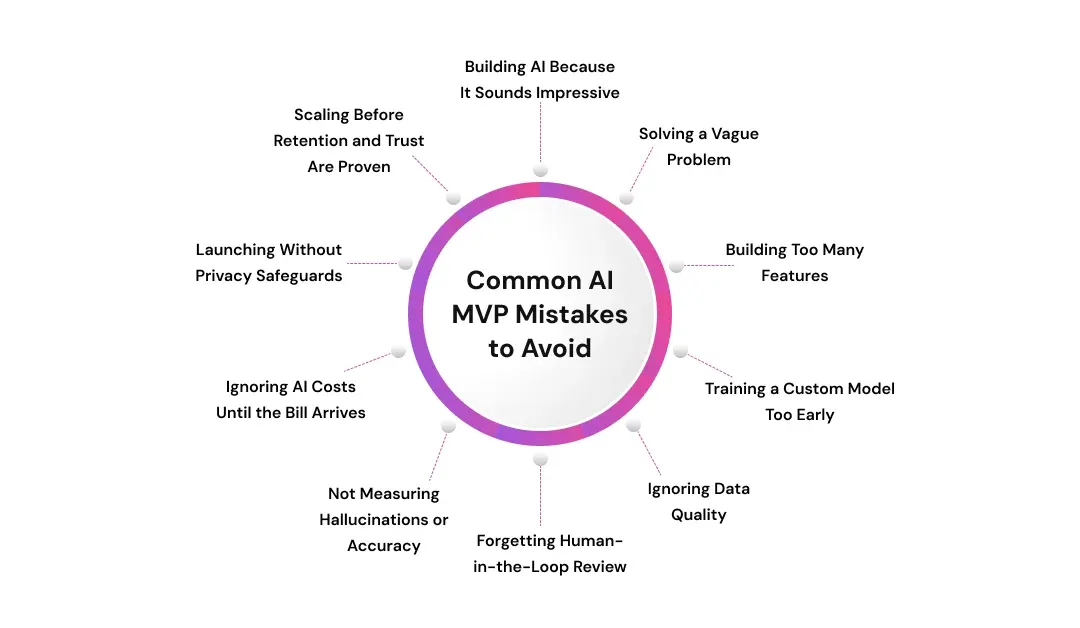
Common AI MVP Mistakes to Avoid
Building an AI MVP can help businesses validate ideas faster, but the wrong approach can increase cost, delay launch, and reduce user trust. Here are the most common mistakes to avoid.
Building AI Because It Sounds Impressive
AI should solve a real business problem, not just make the product sound innovative. If a simple workflow or automation can deliver the same result, AI may add unnecessary cost and complexity.
Solving a Vague Problem
A successful AI MVP starts with a clear user pain point. Building around a broad idea like “AI for productivity” is risky. Instead, define the exact problem, user, workflow, and measurable outcome.
Building Too Many Features
Adding multiple features in the first version makes the MVP harder to test. Focus on one AI feature, one user workflow, and one success metric.
Training a Custom Model Too Early
Many AI MVPs can be built using existing APIs, open-source models, or RAG systems. Training a custom model too early increases cost, time, and technical risk before market demand is proven.
Ignoring Data Quality
Poor data leads to poor AI output. Incomplete, outdated, biased, or unstructured data can reduce accuracy and damage user trust.
Forgetting Human-in-the-Loop Review
AI should not fully automate high-risk decisions in the MVP stage. Human review helps improve accuracy, prevent errors, and build user confidence.
Not Measuring Hallucinations or Accuracy
An AI MVP must be tested for output quality, hallucination rate, accuracy, latency, and user corrections. Without these metrics, teams cannot know whether the AI is reliable.
Ignoring AI Costs Until the Bill Arrives
API calls, vector databases, cloud hosting, and model inference can become expensive as usage grows. Track cost per request and cost per successful task from day one.
Launching Without Privacy Safeguards
AI MVPs often handle user data, documents, conversations, or business information. Encryption, access control, consent, and data anonymization should be planned before launch.
Scaling Before Retention and Trust Are Proven
Do not scale just because the MVP works technically. Scale only when users return, trust the AI output, and receive measurable value from the product.
When Is Your AI MVP Ready to Scale?
An AI MVP is ready to scale when it proves user demand, stable AI performance, sustainable costs, and reliable infrastructure. Before expanding the product, use the following readiness checklist.
Model Readiness
Your AI model is ready to scale when:
- Accuracy is stable across real use cases
- Hallucination rate is low
- Latency is acceptable for users
- Common failure cases are known
- Guardrails and fallback flows are working
- Cost per task is sustainable
User Readiness
Your users are ready for scale when:
- Users return repeatedly
- Users trust the AI output
- Users correct less over time
- Users would be disappointed without the product
- Paid conversion or buying intent exists
Business Readiness
Your business is ready to scale when:
- You have a clear ideal customer profile
- Pricing has been validated
- Acquisition channels are repeatable
- Onboarding is simple and effective
- A support process is in place
Infrastructure Readiness
Your infrastructure is ready to scale when:
- Monitoring is active
- Logs are properly stored
- Rate limits are handled
- Data storage is secure
- Architecture can support more users
- Backup and fallback plans are ready
Example: Building an AI MVP from Idea to Launch
Let’s take an example of an AI customer support triage assistant. This MVP helps support teams categorize, prioritize, and review incoming tickets faster.
Problem
Support teams spend too much time manually reading, categorizing, and prioritizing customer tickets. This slows down response time and increases workload for support agents.
Hypothesis
If we use AI to classify and prioritize support tickets, support managers can reduce ticket triage time by 50% while keeping categorization accuracy above 85%.
MVP Scope
The first version should focus only on the core triage workflow:
- User connects the support inbox
- AI classifies the ticket category
- AI suggests ticket priority
- Human agent approves or edits the suggestion
- Dashboard shows time saved and correction rate
Data Needed
To build and test this AI MVP, the team needs:
- 500–1,000 historical support tickets
- Existing ticket categories
- Priority labels
- Resolution time data
- Agent corrections and feedback
MVP Architecture
A simple architecture can include:
- Frontend: Simple dashboard for ticket review
- Backend: Ticket ingestion and workflow management
- AI: LLM-based classification with prompt guardrails
- Database: Ticket history, AI suggestions, and corrections
- Analytics: Time saved, correction rate, and category accuracy
Launch Plan
Start with a controlled beta:
- Test with 5 support agents
- Run the MVP for 2 weeks
- Compare manual triage vs AI-assisted triage
- Measure time saved, accuracy, correction rate, and user satisfaction
Scale Decision
After testing, decide the next step based on real results:
| Result |
Next Step |
| Accuracy is strong |
Expand to more ticket types |
| Users correct too much |
Improve prompts, data, and category logic |
| Feature saves time but users do not trust it |
Add explainability and source-based reasoning |
| Cost per ticket is too high |
Optimize model usage and reduce unnecessary calls |
| Agents use it repeatedly |
Prepare for broader rollout |
AI MVP Development Checklist
Use this checklist before moving from idea to development or from MVP to scale.
| Checklist Item |
Status |
| Problem clearly defined |
✅ |
| Target user identified |
✅ |
| AI use case justified |
✅ |
| One core AI feature selected |
✅ |
| Success metric chosen |
✅ |
| Data source confirmed |
✅ |
| Model/API selected |
✅ |
| UX prototype created |
✅ |
| Human fallback designed |
✅ |
| Guardrails added |
✅ |
| Test dataset prepared |
✅ |
| Analytics installed |
✅ |
| Beta users recruited |
✅ |
| Feedback loop created |
✅ |
| AI cost monitored |
✅ |
| Scale criteria defined |
✅ |
A strong AI MVP should not try to prove everything at once. It should validate one user problem, one AI-powered workflow, and one measurable business outcome. Once these checklist items are complete, your team can move forward with development, beta testing, and continuous optimization.
How Prismetric Helps AI Startups Build and Scale Their MVP
Building an AI MVP requires more than integrating a model into an app. Startups need the right product strategy, clean data workflows, scalable architecture, and continuous AI performance monitoring to ensure the MVP solves a real user problem. Prismetric helps startups move from idea validation to AI-powered product development with services across AI consulting, AI development, generative AI, AI agents, RAG systems, NLP, computer vision, and machine learning solutions.
Our approach to AI MVP development is focused on building practical, usable, and scalable products. We help startups define the core AI use case, choose the right model or API, prepare the data, design the user workflow, and build a lean MVP that can be tested with real users.
For startups that want to launch quickly, we build API-driven MVPs using existing AI models and reusable development components. This helps reduce development time, control costs, and validate demand before investing in custom AI models or complex infrastructure.
For products that need company-specific intelligence, we develop RAG-based AI MVPs that connect with internal documents, databases, CRMs, knowledge bases, or support records. This helps improve response accuracy, reduce hallucinations, and make AI outputs more reliable for users.
Beyond development, Prismetric also helps startups prepare their MVPs for real-world usage. We add guardrails, fallback flows, human-in-the-loop review, analytics, logging, and performance monitoring so founders can track accuracy, user adoption, correction rates, and cost per AI task.
As the MVP gains traction, our team supports startups in scaling the product with stronger backend systems, optimized AI workflows, secure cloud infrastructure, and continuous model improvement. With experience across AI-powered software, mobile apps, and custom digital solutions, Prismetric helps startups build AI MVPs that are not just technically functional but also ready for growth. To discuss your AI MVP idea, get a custom AI project quote from Prismetric’s AI team.
FAQs About Building an AI MVP
An AI MVP is the simplest working version of an AI-powered product that solves one validated user problem. It helps businesses test demand, AI performance, user trust, and cost before building a full-scale product.
To build an AI MVP, define the user problem, validate the AI use case, choose one core feature, prepare the data, select a model or API, build a thin prototype, test with real users, measure AI quality, and iterate based on feedback.
Building an AI MVP typically costs between $15,000 and $150,000+. API-based MVPs are usually more affordable, while custom AI models, RAG systems, and regulated AI products require higher investment.
AI MVP development usually takes 4 to 12 weeks. Simple API-based MVPs can be launched faster, while custom models, complex data pipelines, and compliance-heavy products may take longer.
In most cases, no. Many AI MVPs can start with pre-built APIs, open-source models, or RAG-based systems. Custom models should be considered only when your product depends on proprietary AI performance.
Yes, early AI MVPs can be built using no-code or low-code tools like Bubble, Softr, Zapier, Make, Airtable, and AI APIs. This is useful for validating demand before investing in custom development.
The best tech stack depends on the use case. A simple MVP may use Bubble, Supabase, and OpenAI APIs. A more advanced MVP may use Next.js, FastAPI, PostgreSQL, LangChain, vector databases, and analytics tools like PostHog.
Your product needs AI if the core problem involves prediction, personalization, natural language understanding, content generation, pattern recognition, document processing, or decision support at scale. If a rule-based system solves the problem, AI may not be necessary.
You need data that is relevant, clean, representative, and usable for the AI task. This may include documents, support tickets, customer records, product data, user behavior, labeled examples, or internal knowledge bases.
You can reduce hallucinations by using RAG, source citations, prompt guardrails, output validation, human review, fallback responses, and continuous AI quality testing.
Use RAG when the AI needs to answer from company-specific data. Use fine-tuning when the model needs better domain-specific behavior or structured outputs. Use AI agents only when the product requires multi-step autonomous workflows.
Scale your AI MVP when users return repeatedly, trust the AI output, correction rates decrease, costs are sustainable, and there is clear buying intent or paid conversion.