How AI Is Transforming the Legal Industry: Tools, Use Cases, and the Future of Law

Key Takeaways
- AI saves 30 to 50 lawyer hours per month by automating contract review, legal research, and document drafting.
- Legal workflows are shifting as AI handles routine tasks, allowing lawyers to focus on strategy and client engagement.
- Predictive analytics uses past rulings to forecast outcomes and support stronger, data-backed legal arguments.
- Law firms are moving from hourly billing to value-based pricing as AI reduces repetitive legal work.
- AI enables new services such as legal chatbots, contract generators, and subscription-based compliance tools.
- Risks around data privacy, bias, and transparency require careful and ethical supervision of AI systems.
AI is actively reshaping the legal industry. From automating document reviews to streamlining legal research, AI is helping law firms work faster, smarter, and more efficiently through advanced AI development services. What once took hours of manual effort can now be done in minutes with precision. And the shift is accelerating. The global AI legal services market is forecast to grow from about USD 1.74 billion in 2025 to over USD 10.4 billion by 2035, showing how quickly firms are adopting intelligent legal solutions.
But this transformation is not just about speed. It is about changing how lawyers deliver value. As AI tools become more advanced, legal professionals are rethinking everything from billing models to client services. In this article, we will explore how AI is revolutionizing the legal profession, what challenges lie ahead, and how firms can stay competitive in an AI-driven world.
How AI Is Transforming Legal Workflows
AI is not replacing lawyers. It is freeing them from repetitive, time-consuming tasks through AI integration and automation services, allowing them to focus on higher-value legal work. The legal workflow is being restructured, and automation is leading the way.
Automation of Routine Tasks
Document Review and Summarization
Traditionally, lawyers would spend countless hours combing through large volumes of documents. Now, AI-powered tools can scan, categorize, and summarize legal documents with impressive accuracy. AI document review systems reduce human error and handle thousands of pages in minutes.
This is especially useful in litigation and compliance cases, where speed and precision are critical. By automating this process, legal teams save time and deliver faster results to clients.
Contract Review and Drafting
AI contract automation tools help legal professionals review and draft contracts faster and with fewer risks. These systems flag unusual clauses, suggest alternatives, and ensure compliance with standard language.
For in-house legal departments and law firms handling high volumes of agreements, this technology speeds up negotiation cycles and reduces the burden of manual checks. The result is a faster, more consistent workflow with reduced legal exposure.

E-discovery and Research Automation
E-discovery tools powered by AI can analyze email chains, messages, and file repositories to extract relevant evidence. What once took weeks of manual review can now be completed in hours.
These systems understand context, identify patterns, and prioritize information. They support attorneys by surfacing the most important details first, cutting through the noise. Legal research is also becoming smarter, with AI tools delivering case law and insights based on natural language queries.
Enhanced Legal Research and Analytics
Predictive Analytics
Legal research has always been a critical but time-consuming task. AI is now turning it into a strategic advantage. With predictive analytics, legal professionals can evaluate case outcomes, legal risks, and litigation strategies using historical data. These tools analyze trends and patterns in past rulings to forecast how future cases may unfold.
This kind of insight helps lawyers prepare stronger arguments and make data-backed recommendations to clients. It also supports smarter decisions in areas like dispute resolution and contract negotiation.
Data‑Driven Outcomes and Trend Analysis
AI tools don’t just retrieve information. They extract insights. By scanning thousands of legal documents, statutes, and case histories, AI platforms can uncover trends that humans might miss.
For example, AI-powered analytics can identify how a particular judge tends to rule on specific issues. This gives law firms a tactical edge. Tools that process large volumes of data faster than humans are becoming essential in both litigation and advisory practices.
Impact on Efficiency and Productivity
Survey Insights (e.g., Hours Saved per Lawyer Each Year)
AI is boosting legal productivity in measurable ways. According to recent surveys, firms using AI tools report saving 30 to 50 hours per lawyer each month. This time is typically reclaimed from manual tasks like contract review, document drafting, and research.
Legal AI efficiency means more than doing the same work faster. It means shifting focus to higher-value activities like client strategy, negotiation, and case planning. These productivity gains in law help firms lower operational costs while increasing client satisfaction.
How AI Is Changing the Legal Business Model
AI is doing more than speeding up legal tasks. It’s transforming how law firms earn, deliver, and measure value. Traditional billing models are under pressure, and new revenue streams are emerging as firms adopt smarter technologies.
Shifting from Billable Hours to Value Billing
AI is forcing firms to rethink the old model of billing by the hour. As automation handles routine tasks in seconds, clients are no longer willing to pay for time they want results and value.
Key shifts in the legal business model with AI:
- Time-based billing is losing relevance as AI reduces hours needed for research and drafting.
- Clients are demanding fixed fees or value-based pricing for predictable costs and clearer ROI.
- Efficiency becomes a competitive advantage, not a threat to revenue.
- Firms are packaging legal services into productized offerings powered by AI tools.
- SEO keyword tie-in: Legal business model AI, billable hour disruption.
New Legal Services Enabled by AI
AI is not just optimizing old services, it’s unlocking entirely new offerings. Law firms are building tech-forward solutions that provide proactive support, real-time insights, and 24/7 assistance.
Examples of AI-powered legal service innovation:
- Customized client AI tools that automate contract creation, compliance checks, or legal Q&A.
- AI chatbots or assistants to handle client inquiries or triage legal issues instantly.
- Predictive legal dashboards that track risk, litigation trends, or regulatory exposure.
- Subscription-based legal support services for startups and small businesses using AI automation.
- On-demand legal analysis tools tailored for niche industries or recurring client needs.
Things to Watch Out for When Using AI in Law
AI offers big benefits, but it also comes with serious risks if not handled carefully. Legal professionals must be aware of these challenges to stay compliant and protect their clients.
Data Privacy and Confidentiality
AI tools often rely on large datasets, which may include sensitive client information. Without proper safeguards, confidential data could be exposed or misused.
Bias in AI Algorithms
AI can reflect biases present in the data it’s trained on. This could lead to unfair outcomes in legal decisions or case predictions.
Lack of Transparency
Many AI systems are “black boxes” that don’t show how decisions are made. This lack of clarity can raise questions around fairness and accountability.
Malpractice and Liability Risks
If AI gives incorrect advice or misses a key legal issue, lawyers could still be held responsible. Relying too heavily on automation may increase malpractice risks.
Ethical Rules and Professional Standards
Lawyers must follow professional conduct rules, including those related to competence and supervision. Using AI without oversight could lead to ethical violations.
Compliance with Local and Global Laws
Different countries have different AI regulations and data laws. Law firms must stay updated to avoid legal penalties when using AI tools across borders.
AI Tools and Technologies Law Firms Should Know
AI is no longer optional, it’s essential. Law firms that understand and adopt the right tools are gaining a clear edge in speed, accuracy, and client service.
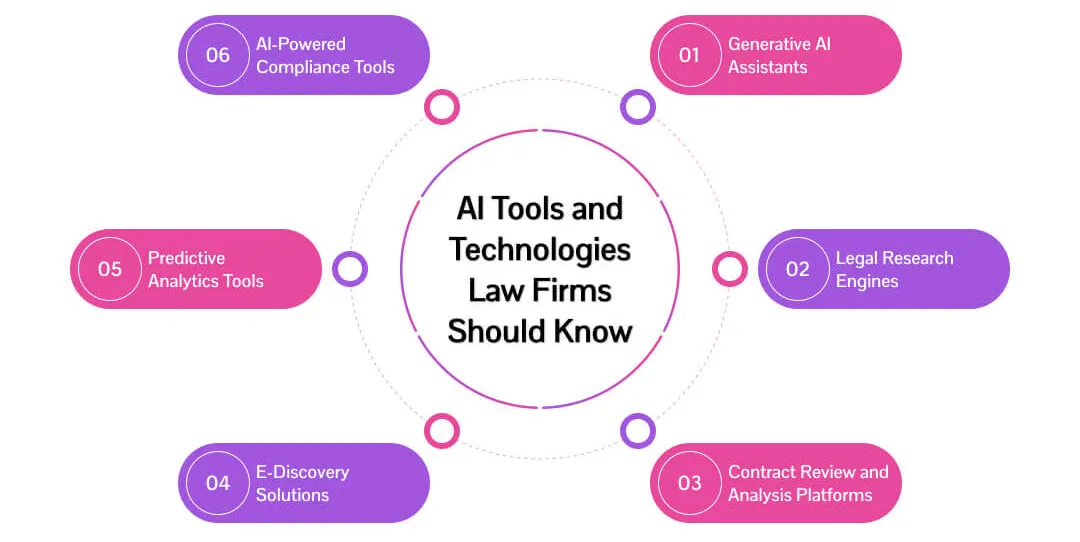
Generative AI Assistants
These tools help draft legal documents, summarize cases, and answer legal questions. They save time and reduce manual writing tasks for lawyers.
Legal Research Engines
AI-powered research tools like Lexis+ AI and Westlaw Precision deliver relevant cases fast. They use natural language to find smarter, more targeted results.
Contract Review and Analysis Platforms
Tools like Kira, Luminance, and Ironclad review contracts in seconds. They highlight key clauses, spot risks, and suggest edits automatically.
E-Discovery Solutions
AI-driven platforms like Relativity and Everlaw speed up document review in litigation. They scan, sort, and rank evidence based on relevance and context.
Predictive Analytics Tools
These platforms forecast legal outcomes by analyzing past data. They help lawyers make better decisions, from settlement options to case strategies.
AI-Powered Compliance Tools
Tools like ComplyAdvantage and Smarsh monitor regulatory changes and flag compliance issues. They help firms stay ahead of legal risk in real time.
How Law Firms Are Using AI Today
- AI reviews contracts faster, flagging risks and unusual clauses.
- Legal research tools find relevant cases in seconds.
- E-discovery software sorts and ranks evidence automatically.
- Generative AI drafts legal documents and emails quickly.
- Predictive tools forecast case outcomes using past rulings.
- Compliance platforms track regulatory changes in real time.
- AI chatbots answer common client questions 24/7.
- Legal spend tools analyze billing data to improve pricing.
What is the Future of Legal Practice?
The legal industry is shifting from manual work to strategic thinking. AI will handle more routine tasks, while lawyers focus on complex advice and client relationships. Skills like tech literacy and data interpretation will become essential.
Firms that adapt early will lead with speed, efficiency, and innovation. We’ll see more hybrid roles combining legal expertise with technology. The future lawyer won’t just know the law, they’ll know how to work alongside AI.

Conclusion
AI is reshaping the legal industry, not by replacing lawyers, but by enhancing how they work. Firms that embrace this change will gain speed, accuracy, and a competitive edge. The future of law belongs to those who adapt and lead with both insight and innovation.
FAQs About AI in the Legal Industry
AI is used for legal research, contract review, document drafting, e-discovery, and compliance tracking. It helps law firms work faster and more accurately.
No, AI will not replace lawyers. It supports them by handling routine tasks, allowing more time for strategy, client work, and complex decisions.
AI improves speed, reduces errors, lowers costs, and boosts productivity. It also helps deliver better value to clients through smarter workflows.
Key benefits include:
- Faster legal research and document review
- Fewer human errors in contracts and filings
- Lower operational costs for law firms
- Better use of lawyers’ time for strategic work
- Improved client service with quicker turnaround
- Enhanced decision-making through data insights
Yes, many affordable AI tools are designed for solo and small firms. These tools help with document automation, research, and client communication.
AI reduces the time spent on routine work, pushing firms to move toward fixed or value-based billing instead of hourly models.
opular tools include Lexis+ AI, Westlaw Precision, Kira, Luminance, and Relativity. They support research, contract review, and litigation.
Key legal AI tools include:
- Lexis+ AI – For advanced legal research and natural language queries
- Westlaw Precision – Helps lawyers find relevant case law quickly
- Kira Systems – Specializes in contract analysis and due diligence
- Luminance – AI for contract review, risk detection, and document analysis
- Relativity – Used for e-discovery and legal data management in litigation
AI is subject to data privacy and legal ethics rules. Some regions are creating AI-specific regulations, so firms must stay informed and compliant.