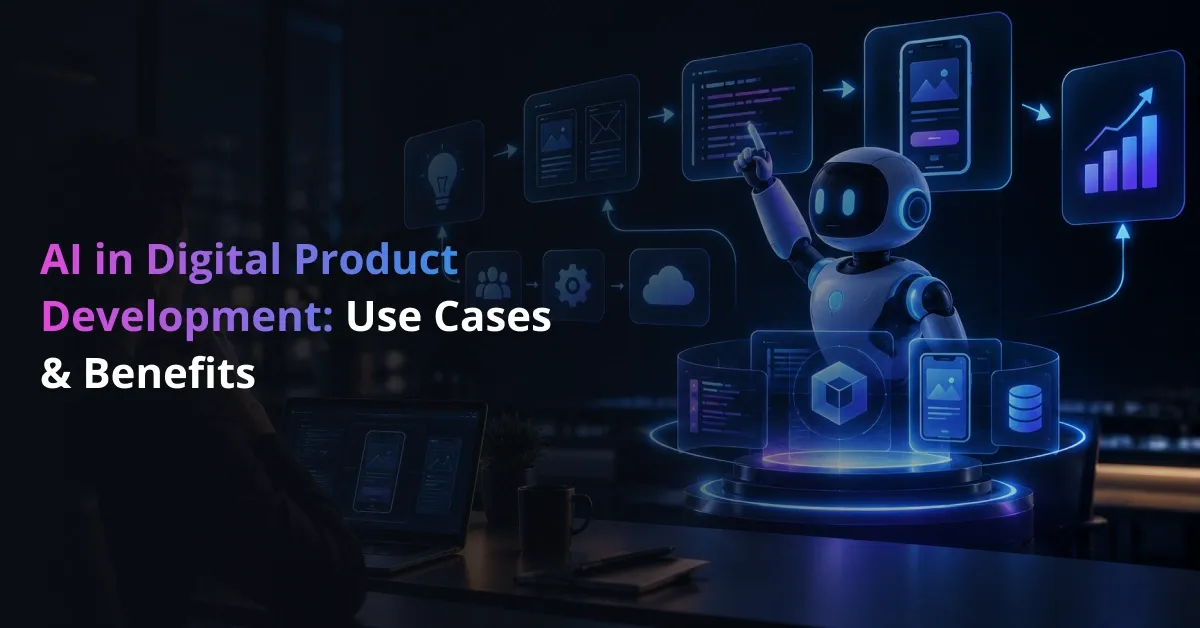
AI in Digital Product Development: Use Cases, Benefits, Process, and Future
Key Takeaways
- AI in digital product development is changing how teams research, plan, design, build, test, launch, and improve digital products.
- Generative AI can create and summarize content, while machine learning and predictive analytics help teams find patterns, predict outcomes, and make faster decisions.
- The biggest gains come from reducing repetitive work while people stay responsible for product strategy, system architecture, security, validation, and final decisions.
- Businesses should start with one clear product problem, set simple success measures, and test AI in a focused workflow before expanding it across the full development lifecycle.
Building a digital product involves many connected steps. Teams study user needs, turn findings into requirements, design the experience, write and review code, test releases, and track what happens after launch. AI is speeding up this process by reducing repetitive work and helping teams handle large amounts of information faster.
It can summarize customer interviews, group similar feedback, draft product documents, suggest design options, assist with coding, create test cases, and analyze product usage data. This gives product managers, designers, developers, and QA teams more time to focus on work that needs experience, creativity, context, and careful judgment.
AI will not replace digital product teams, but it is changing how they research, design, build, test, and improve products. People still decide which customer problems are worth solving, how the product should work, which architecture fits the need, and what security controls are required.
This article explains how AI fits into the digital product development lifecycle, where it adds value, what benefits it can deliver, what risks teams need to manage, and how businesses can adopt it in a practical way.
The Role of AI in Digital Product Development
AI in digital product development is changing how teams move from an early idea to a working digital product. It can support research, planning, design, coding, testing, launch, and post-launch improvement. Instead of replacing product teams, AI helps them process information faster, reduce repetitive tasks, and move through each stage with less manual work.
Different types of AI support different jobs. Generative AI can draft product documents, create design ideas, write code, and produce test cases. Machine learning can find patterns in product data and user behavior. Natural language processing can study reviews, support tickets, interview notes, and other text. Predictive analytics can help teams estimate demand, spot risks, and understand how users may respond.
There is also a clear difference between AI-assisted product development and AI-powered digital products. In AI-assisted development, teams use AI to improve the way they research, design, build, and test a product. In an AI-powered product, AI becomes part of the user experience through features such as recommendations, smart search, virtual assistants, or personalized content.
The strongest approach combines AI speed with human judgment. AI can generate options, summarize information, and automate routine work, but people still decide what to build, how the system should work, what data it can use, and whether the final output meets user, quality, security, and business needs. For businesses deciding where AI fits, planning the right AI approach can be as important as choosing the technology itself.
| Area |
Traditional Development |
AI-Assisted Development |
| Customer research |
Manual review and synthesis |
Faster feedback analysis and pattern detection |
| Requirements |
Written mainly by teams |
AI-assisted drafts and user stories |
| UX/UI design |
Manual design iterations |
Faster concepts and design variations |
| Prototyping |
Time-intensive |
Rapid AI-assisted prototypes |
| Coding |
Mostly manual |
Code suggestions, generation, and refactoring |
| Testing |
Manually created test cases |
AI-generated tests and defect analysis |
| Product decisions |
Reports and human judgment |
Predictive insights with human judgment |
| Iteration |
Periodic review cycles |
Continuous analysis of product usage |
Bring AI Into Your Product Development Workflow
Prismetric helps teams apply AI across research, planning, design, coding, testing, and product improvement without disrupting existing development processes.
Explore AI Product Development
10 Ways AI Is Used Across the Digital Product Development Lifecycle
AI is changing more than one stage of digital product development. Teams can use it to study customer needs, plan features, create designs, write code, test releases, and improve products after launch. The value depends on matching the right AI capability to the right task. Used well, AI reduces manual work, shortens feedback loops, and gives product teams more information to make better decisions throughout the development lifecycle.
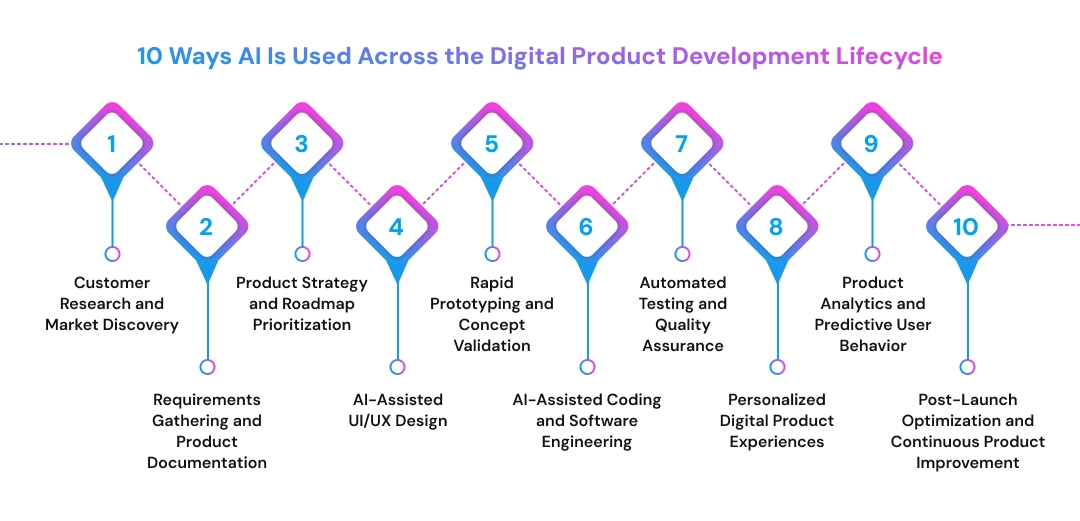
1. Customer Research and Market Discovery
AI helps product teams study large amounts of customer and market data without reviewing every comment or document by hand. It can summarize interviews, group similar feedback, analyze reviews and support tickets, track market trends, and find patterns that may point to unmet customer needs. Teams can also use AI-powered market research to study customer behavior and market signals faster.
For example, AI can organize hundreds of customer comments into common themes and compare them with product usage data. This gives researchers a faster starting point for discovery. Teams still need real customer conversations to understand why people behave in a certain way and decide whether an idea solves a real problem. A structured workflow discovery process can also help identify where AI is useful before adding it to the product process.
Business Impact
- Shorter research and analysis cycles
- Faster discovery of common customer problems
- Better evidence for new product opportunities
Product Leader Takeaway: AI should speed up research analysis, not replace direct customer discovery.
2. Requirements Gathering and Product Documentation
AI is making requirements gathering faster by turning meeting notes, customer feedback, research findings, and stakeholder inputs into structured product documents. It can help draft product requirements, user stories, acceptance criteria, feature descriptions, and technical notes. This reduces the time teams spend organizing information and makes requirements easier for product and engineering teams to review.
A product manager can use AI to summarize a stakeholder meeting, identify missing details, and prepare an initial requirements draft. The team can then check assumptions, remove incorrect information, and confirm what the product actually needs to do. For AI-based products, a focused Natural language processing can also help teams test uncertain requirements before committing to full development.
Business Impact
- Less time spent creating product documents
- Fewer gaps and unclear requirements
- Faster handoffs between product and engineering teams
Product Leader Takeaway: AI can speed up documentation, but teams still need to validate requirements before development begins.
3. Product Strategy and Roadmap Prioritization
AI helps product teams make better roadmap decisions by bringing customer feedback, product usage, market signals, and business data into one view. It can highlight common feature requests, spot changes in adoption, and compare different priorities. A clearAI strategy also helps teams decide where AI can support the product without adding unnecessary complexity.
Product managers can use these insights to compare feature ideas, study possible demand, and identify work that may offer limited value. Predictive analytics can support the process, but the roadmap still depends on customer needs, business goals, technical limits, and product judgment.
Business Impact
- Better-informed roadmap decisions
- Earlier identification of low-value features
- Stronger alignment between product and business goals
Product Leader Takeaway: AI can improve prioritization with better evidence, but the product team still owns the roadmap.
4. AI-Assisted UI/UX Design
AI is speeding up product design by helping teams create and compare more ideas in less time. Designers can use it to generate layouts, suggest user flows, create interface variations, and review repetitive design work. This gives them more time to focus on usability, accessibility, brand consistency, and the overall user experience.
A team might generate several interface concepts, refine the strongest options, and test them with real users before moving ahead. AI can shorten the first design cycle, but it cannot fully understand user emotions, business context, or why a certain experience feels easy or difficult. Teams building mobile products may also need dedicated mobile app design expertise to turn early concepts into usable product experiences.
Business Impact
- More design ideas tested in less time
- Faster UI and UX iteration
- Less repetitive work for design teams
Product Leader Takeaway: AI can speed up design creation, but user testing still shows whether the experience actually works.
5. Rapid Prototyping and Concept Validation
AI is making rapid prototyping easier by helping teams turn early ideas into wireframes, interface concepts, and working product flows much faster. This allows businesses to test how a feature may work before investing heavily in full development.
Teams can build an early version, collect user feedback, and improve the idea before moving to production. For AI-based products, an AI MVP can help test whether users receive enough value from the core idea. Early validation also gives teams a clearer view of technical limits, product risks, and what needs to change before scaling.
A prototype is still not production software. Real products need proper architecture, security, testing, integrations, and performance checks before they are ready for wider use.
Business Impact
- Faster feedback on new product ideas
- Lower investment before full development
- Earlier rejection of weak concepts
Product Leader Takeaway: AI can shorten the path from idea to prototype, but real user feedback should decide what moves forward.
6. AI-Assisted Coding and Software Engineering
AI is changing software engineering by reducing the amount of repetitive code developers need to write by hand. Coding assistants can suggest code, create common functions, explain existing logic, support refactoring, generate documentation, and help teams find bugs faster. The broader use of AI across the software development lifecycle also connects coding with requirements, testing, release, and ongoing product improvement.
Developers can use AI to move through routine tasks faster, but generated code still needs careful review. Engineering teams remain responsible for architecture, dependencies, security, scalability, maintainability, and code quality. Products that add language-model features may also require teams to integrate an LLM into the application while controlling data access, APIs, context, and model behavior.
The goal is not to generate as much code as possible. It is to reduce low-value work so developers can spend more time on complex logic, system design, and product problems that need deeper technical thinking.
Business Impact
- Less time spent on repetitive coding
- Faster implementation of common features
- More developer time for architecture and complex logic
Product Leader Takeaway: Measure AI by the speed and quality of the engineering workflow, not by how much code it produces.
7. Automated Testing and Quality Assurance
AI is helping QA teams test digital products faster by generating test cases, reviewing logs, finding defects, and identifying areas that may fail under real use. It can also create synthetic test data and support regression testing, which reduces the amount of repetitive work testers need to handle manually.
For products that include AI features, testing goes beyond checking whether buttons, APIs, and workflows work correctly. Teams may also need to evaluate output accuracy, consistency, bias, unsafe responses, and hallucinations. A structured AI model testing approach helps teams check how models behave before they reach users. Businesses may also need professional software testing support when releases involve complex integrations, security requirements, or large test environments.
Business Impact
- Wider test coverage across product features
- Earlier detection of bugs and quality issues
- Faster validation before release
Product Leader Takeaway: AI can make testing faster and broader, but teams still need clear quality standards before a product goes live.
8. Personalized Digital Product Experiences
AI is making digital products more personal by changing what users see based on their behavior, preferences, and past interactions. It can support recommendations, personalized onboarding, adaptive interfaces, smart search, and content suggestions that respond to what each user is trying to do.
These experiences depend on good data and clear rules. Teams need to decide what information the product can collect, how it will be used, and where users should have control. Businesses exploring AI-driven customer experiences also need to balance personalization with privacy, transparency, and consistent product behavior.
Personalization works best when it solves a real user problem rather than changing the interface simply because AI makes it possible.
Business Impact
- More relevant product experiences
- Better engagement with useful features
- More opportunities to improve user retention
Product Leader Takeaway: Personalization should make the product easier and more useful, not make the experience feel unpredictable.
9. Product Analytics and Predictive User Behavior
AI helps product teams understand how users move through a digital product and where they may face problems. It can analyze feature adoption, funnel drop-offs, churn signals, user segments, and unusual behavior across large sets of product data.
Predictive models can also help teams identify users who may stop using a product or features that may need improvement. Product managers can combine these signals with business intelligence and analytics to decide where to invest development time. The goal is not to let an algorithm make every product decision, but to give teams clearer evidence about what users are doing.
Business Impact
- Faster discovery of user friction
- Better decisions about feature investment
- Earlier detection of adoption and retention problems
Product Leader Takeaway: AI makes product data easier to act on, but teams still need to understand why user behavior is changing.
10. Post-Launch Optimization and Continuous Product Improvement
AI continues to support development after a product goes live. It can review telemetry, customer support conversations, usage patterns, experiment results, and feature performance to show where the product is working well and where users are struggling.
This creates a continuous feedback loop: launch the product, observe how people use it, learn from the data, improve the experience, and release the next version. Teams can also use AI-powered workflow automation to reduce repetitive work around monitoring, reporting, and product operations.
The value grows when post-launch insights feed directly into future research, roadmap planning, design, and engineering work instead of staying inside separate reports.
Business Impact
- Shorter product feedback loops
- Better post-launch feature decisions
- Continuous improvement based on real usage
Product Leader Takeaway: AI creates more value when every release helps the team make the next product decision with better information.
Key Benefits of AI in Digital Product Development
AI brings the most value when it removes slow, repetitive work and helps teams make better decisions with real product data. The benefits are not limited to coding. They can appear across research, design, engineering, testing, and post-launch improvement.
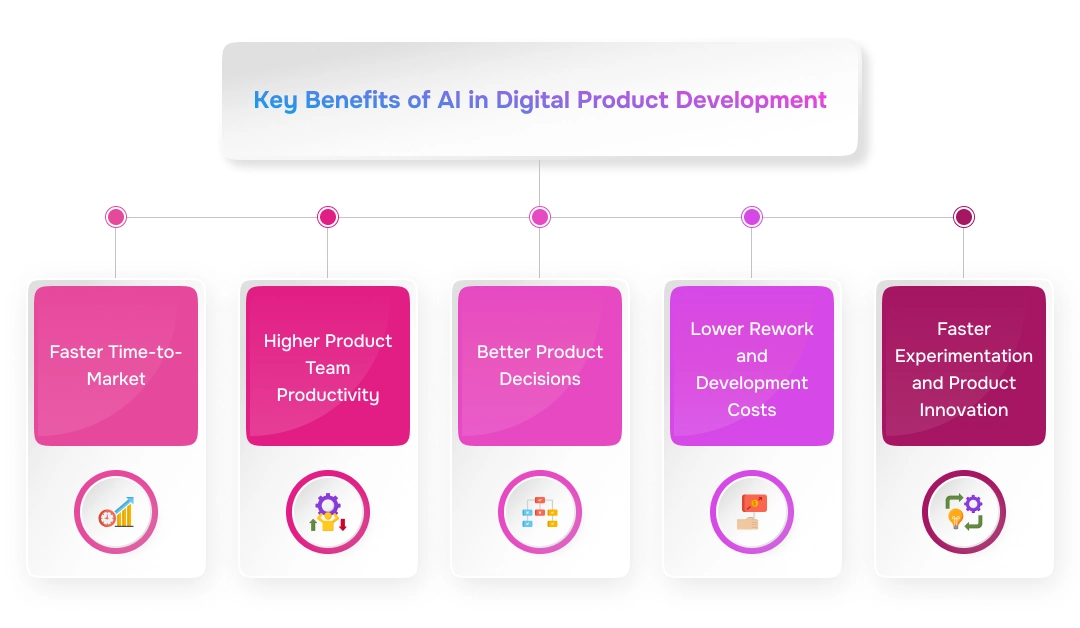
Faster Time-to-Market
AI can shorten the time between an idea and a working release by speeding up research, documentation, design, coding, and testing. Teams spend less time moving information between tools and more time solving product problems. This is one reason businesses are exploring how AI improves operational efficiency across software workflows.
The biggest gains usually come from several small improvements across the lifecycle rather than one tool making development dramatically faster.
Higher Product Team Productivity
Product managers, designers, developers, testers, and analysts all handle repetitive work. AI can summarize meetings, organize research, create first drafts, suggest code, prepare tests, and review large amounts of product data.
This does not remove the need for skilled teams. It shifts more of their time toward planning, problem-solving, design decisions, architecture, and quality. Businesses can use an AI automation ROI framework to compare these productivity gains with the cost of introducing and running AI.
Better Product Decisions
AI can bring customer feedback, product usage, market signals, and business data together faster than manual analysis alone. This helps teams spot patterns, compare options, and understand where users face problems.
The data still needs context. A product manager may see that users leave a certain workflow, but the numbers alone may not explain why. AI supports the decision-making process; customer research and product judgment give those signals meaning.
Lower Rework and Development Costs
Poor requirements, weak designs, missed bugs, and untested assumptions often create expensive rework later. AI can help teams find some of these issues earlier, when they are easier to fix.
It can also reduce time spent on repetitive development and testing tasks. Businesses evaluating this value should look at where AI can reduce operating costs without treating lower headcount as the only measure of success.
Faster Experimentation and Product Innovation
AI lets teams explore more ideas before committing full development time to one option. They can compare product concepts, design variations, workflows, and prototypes faster.
The right approach depends on the product. Some teams may need a custom system, while others can solve the problem with an existing platform or API. Comparing custom AI with off-the-shelf AI can help teams avoid building more technology than the product actually needs.
Turn Your Product Idea Into a Faster, Smarter MVP
Use AI-assisted prototyping, development, testing, and validation to move from concept to a working product while reducing early-stage rework.
Build Your AI-Powered MVP
How to Integrate AI Into Your Digital Product Development Process
Adding AI to product development should start with a business or product problem, not with a tool. A focused process makes it easier to test value, manage risk, and scale only what works.
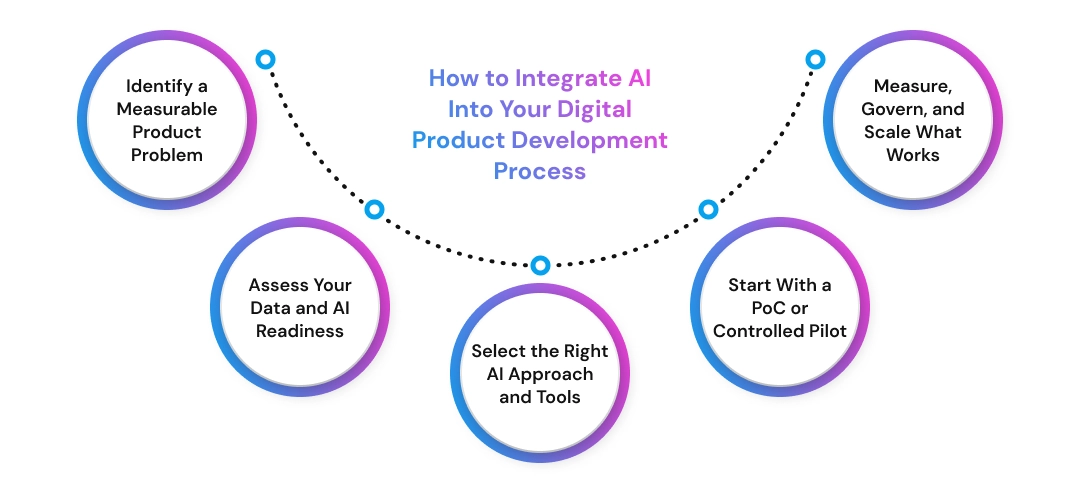
1. Identify a Measurable Product Problem
Start with a clear bottleneck. Research may take too long, developers may spend hours on repetitive work, or QA teams may struggle to keep up with frequent releases.
Define what better looks like before introducing AI. The measure could be shorter cycle time, fewer defects, faster research analysis, lower rework, or better user completion rates. If the idea is still uncertain, understanding the difference between an AI PoC and an AI MVP can help teams choose the right starting point.
2. Assess Your Data and AI Readiness
AI depends on the data, systems, and permissions around it. Teams need to know what information is available, who can access it, how accurate it is, and whether existing systems can support the planned workflow.
For products that use company data, this may include connecting models with approved databases or knowledge sources. A clear approach to integrating LLMs with enterprise databases helps teams control what information the model can reach. Strong data engineering support may also be needed when product data sits across several systems.
3. Select the Right AI Approach and Tools
Not every problem needs the same type of AI. Some workflows may work well with an existing model or software tool. Others may need retrieval-augmented generation, custom machine learning, fine-tuning, or an AI agent.
Teams should compare accuracy, cost, latency, security, data access, and maintenance before choosing an approach. Understanding the difference between fine-tuning, prompt engineering, and RAG can prevent unnecessary technical complexity.
When the choice is unclear, generative AI consulting can help connect the technical approach with the product problem instead of choosing a model first.
4. Start With a PoC or Controlled Pilot
Test the idea on a small workflow before changing the full product process. A PoC can show whether the technology works under real technical limits, while an MVP can test whether users find enough value in the product.
A structured AI PoC development process should define the use case, data, expected output, evaluation method, and success criteria before development begins.
Teams working with older applications may also need to plan how AI connects with current systems. An AI integration architecture for legacy systems can reduce the risk of adding isolated AI features that are difficult to maintain later.
5. Measure, Govern, and Scale What Works
Once the pilot is live, compare the results with the original baseline. Measure cycle time, quality, adoption, cost, accuracy, latency, defects, and the product outcome the AI was meant to improve.
Do not scale every successful demo. Move forward when the workflow creates measurable value and can be operated safely. Organizations that need help moving from experiments to production may use AI implementation services and AI integration expertise to connect models, applications, data, and existing business systems.
Challenges and Risks of Using AI in Digital Product Development
AI can speed up development, but it also introduces new risks. Product teams need clear controls around data, model behavior, generated code, cost, and human approval.
Data Privacy, Security, and Intellectual Property
Product teams may work with customer data, private documents, source code, and business information. Sending this data to an unapproved AI tool can create privacy, security, or intellectual property problems.
Teams need clear access rules, approved models, logging, data controls, and vendor checks. Products using RAG also need to think about storage, permissions, compliance, and architecture. These issues become more important when building enterprise RAG applications.
Hallucinations, Incorrect Outputs, and Quality Control
Generative AI can produce an answer that sounds correct even when the information is wrong. The same problem can affect requirements, code, product summaries, support answers, and generated recommendations.
Teams should test outputs against clear quality rules and keep human review around high-impact decisions. Explainable AI can also help teams understand why certain systems produce a result, especially when users or business teams need more visibility into the decision.
AI-Generated Technical Debt
Generating code quickly does not always mean building better software. Teams can create technical debt when developers accept code they do not fully understand, add unnecessary dependencies, or skip architecture and security reviews.
Code standards, automated checks, documentation, and human review still matter. Strong DevOps guidance can help teams keep testing, deployment, monitoring, and release controls in place as AI speeds up development.
Over-Reliance on Automation
AI should not make every product decision. Teams can lose useful customer context when they depend too heavily on generated research summaries, automated recommendations, or autonomous workflows.
AI agents need even more careful evaluation because they may take actions across several tools or systems. A structured approach to AI agent evaluation can test whether an agent completes tasks correctly, follows instructions, and stays within its allowed boundaries.
Cost also needs attention. AI features that look affordable during testing may become expensive at scale. Teams should plan for reducing LLM inference costs as usage grows.
Future Trends Shaping AI-Powered Product Development
AI-assisted development is moving beyond single-purpose tools. The next stage will connect research, design, engineering, testing, and product operations more closely.
Agentic product development: AI agents may handle multi-step work such as reviewing feedback, preparing product documents, creating engineering tasks, and checking results across connected tools. Teams exploring agentic AI use cases still need clear permissions, monitoring, and approval points.
AI-native digital products: More products will be designed around AI from the start rather than adding a chatbot or recommendation feature later. Conversational products, for example, may require purpose-built enterprise AI chatbot development instead of a simple chat layer placed on top of an existing application.
Multimodal experiences: Digital products will increasingly work across text, voice, images, documents, and other inputs. This will allow users to interact with software in more natural ways while giving product teams new design and testing challenges.
AI evaluation as part of engineering: Teams will test more than software functionality. They will also measure model accuracy, cost, latency, safety, consistency, and task completion. As AI agents become part of software development, these evaluations will become part of normal product engineering.
Build AI-Enabled Products Without Adding Unnecessary Complexity
Prismetric helps choose the right AI approach, connect it with product data and existing systems, and move validated use cases into production.
Talk to Our AI Product Experts
How Prismetric Can Help Build AI-Enabled Digital Products
The hardest part of using AI is often not choosing a model. It is deciding where AI can solve a real product problem, how it should fit into the product architecture, and how the system will stay secure, scalable, and easy to maintain as usage grows.
Prismetric brings this thinking into the complete product development process. Its teams support businesses from early discovery and architecture planning to design, development, testing, deployment, and continuous improvement. Companies can combine custom software development with generative AI product engineering when a product needs AI features built around its users, data, workflows, and existing systems.
What Prismetric Brings to AI Product Development
Prismetric supports businesses across the technical and product decisions that come with building AI-enabled software, including:
- Product discovery and use case validation
- AI architecture and technology planning
- UI/UX design and rapid prototyping
- Custom web and mobile application development
- Generative AI and machine learning integration
- Data engineering and system integration
- Testing, security, and performance checks
- Deployment, monitoring, and ongoing product improvement
This gives businesses one development partner that can work across both traditional software engineering and newer AI-driven product requirements.
Vitara.AI: Prismetric’s AI-Powered Product Development Platform
Prismetric has also built Vitara.AI, its own AI-powered development platform. Vitara helps founders, developers, and product teams turn natural-language ideas into working web and mobile applications. It brings AI directly into the product-building process while giving teams more control over how the application is developed.
Vitara operates in the same fast-growing AI app development market as platforms such as Lovable and Emergent. Its focus on full-stack product creation, editable code, GitHub integration, and code ownership makes it a strong option for teams that want to move quickly without treating AI-generated software as a closed box.
| Area |
Prismetric |
Vitara.AI |
| Main role |
End-to-end product engineering partner |
AI-powered application development platform |
| Best suited for |
Complex, custom, and business-specific digital products |
Rapidly turning ideas into working applications |
| Development support |
Strategy, design, engineering, AI integration, testing, and deployment |
AI-assisted frontend, backend, and app creation |
| Human involvement |
Dedicated product, design, and engineering teams |
Developers and product teams guide and refine AI-generated output |
| Product control |
Custom architecture built around business requirements |
Editable code, GitHub integration, and code ownership |
| AI value |
Helps businesses design and build production-ready AI products |
Helps teams move from prompt to working software faster |
Building Vitara.AI also gives Prismetric first-hand experience with the same challenges its clients face. Its teams are not only advising businesses on AI product development. They are building and improving an AI product of their own, dealing with practical questions around code generation, product usability, development speed, system control, and long-term maintainability.
This combination gives Prismetric a strong position in AI-enabled product development. Prismetric provides the engineering expertise needed to plan, build, integrate, and scale digital products, while Vitara.AI shows how that expertise is being applied to a real AI development platform. Together, they give businesses a practical path from early product ideas to working, maintainable software.
Frequently Asked Questions
AI in digital product development means using technologies such as generative AI, machine learning, predictive analytics, NLP, and AI agents to support the creation and improvement of digital products. Teams may use AI for research, requirements, design, coding, testing, analytics, personalization, and post-launch optimization.
AI can support almost every stage of the lifecycle. Teams use it to analyze customer research, prepare requirements, compare roadmap options, create design ideas, build prototypes, assist with coding, generate tests, study product behavior, and improve released products based on user data.
Generative AI creates new outputs such as text, code, images, product documents, and test cases. Traditional machine learning often focuses more on finding patterns, making predictions, classifying information, or detecting unusual behavior. Many digital products use both approaches together.
AI will not completely replace digital product teams, but it is changing how they work. It can handle more repetitive research, design, coding, and testing tasks. Product managers, designers, and developers still bring customer understanding, creativity, technical judgment, system design, validation, and accountability to the process.
Start by measuring the workflow before AI is introduced. Then compare cycle time, development cost, defects, rework, release frequency, adoption, and product outcomes after implementation. The right metric depends on the original problem. A faster workflow has little value if product quality or user experience becomes worse.