AI in Asset Management: Benefits, Use Cases, Risks & Future Trends
Key Takeaways
- AI is becoming a practical part of asset management, helping firms improve investment research, portfolio analysis, risk monitoring, client servicing, and operational workflows.
- The biggest benefits come from faster analysis and greater efficiency, as AI processes large volumes of market, portfolio, and research data while reducing repetitive manual work.
- AI works best as decision support, not a replacement for investment professionals. Human judgment, validation, oversight, and accountability remain essential for high-impact decisions.
- Data quality and governance determine AI reliability. Poor data, model bias, security risks, limited explainability, and weak controls can undermine otherwise promising AI initiatives.
- Asset managers should start with clearly defined, high-value use cases, pilot them with appropriate controls, measure measurable outcomes, and scale only after proving value.
- The next phase of AI adoption will increasingly involve agentic and integrated workflows, but competitive advantage will still depend on proprietary data, investment expertise, disciplined processes, and client trust.
Artificial intelligence is changing how asset managers research markets, construct portfolios, monitor risk, serve clients, and run investment operations.
Asset managers work with an expanding mix of market data, company filings, research, portfolio records, client information, and regulatory requirements. Reviewing that information manually can slow analysis and leave skilled teams spending too much time on repetitive work. AI in asset management helps firms process information faster, automate selected workflows, and support decisions with more timely insight. This reflects the broader use of AI in finance as financial institutions look for practical ways to improve analytical and operational workflows.
At a practical level, AI in asset management means applying machine learning, predictive models, automation, and generative AI in finance across investment and operational processes. These capabilities can support research, asset allocation, reporting, risk monitoring, and workflow execution. They also fit into a broader enterprise AI environment as firms progress through AI transformation and connect individual tools with governed business systems. Organizations planning this transition also need a clear AI strategy before embedding AI capabilities into financial platforms.
AI asset management adoption is already moving beyond experimentation. Mercer’s 2026 survey of 131 asset managers found that 55% had integrated AI into at least one investment process, while 91% planned to increase their use of AI over the following 12 months. The opportunity, however, is not to automate every decision. AI for asset managers is most useful when reliable data, clear investment objectives, model validation, and human oversight work together.
What are the benefits of using AI in asset management?
AI in asset management can create value across several parts of the investment lifecycle. The biggest gains often come from expanding research capacity, reducing manual processing, improving access to portfolio information, and helping teams respond faster to changing conditions. The business case becomes stronger when firms connect each capability to a measurable outcome and understand how AI improves operational efficiency.
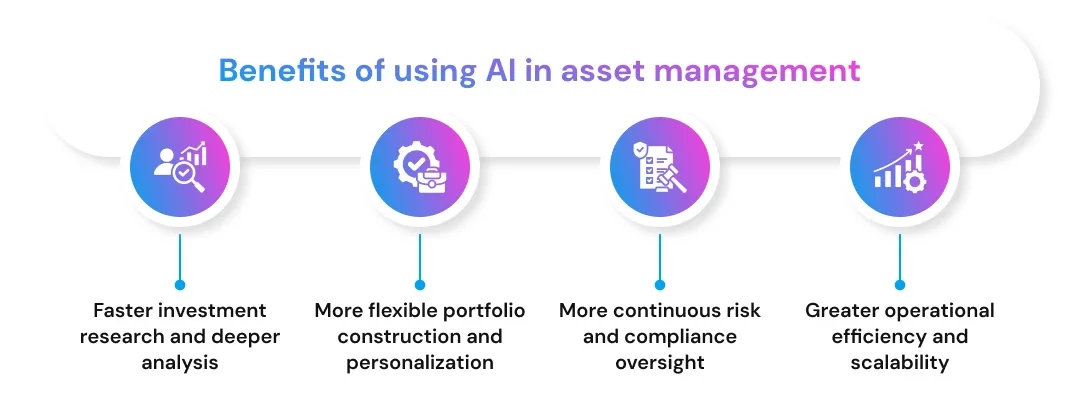
- Faster investment research and deeper analysis: AI can review earnings calls, financial reports, market commentary, news, and other unstructured sources much faster than a manual process. AI tools for data analysis can help analysts compare information across large datasets, while AI in market research can support theme identification and signal discovery. Firms with larger data environments may also need systems designed to analyze high-volume investment data. This gives analysts more time to test ideas and apply human judgment.
- More flexible portfolio construction and personalization: AI models can evaluate portfolio combinations against risk, return, tax, liquidity, sustainability, and mandate constraints. Business intelligence capabilities can bring portfolio and market information together for scenario analysis, while understanding the relationship between business intelligence, data warehousing, and analytics helps firms build the right data foundation. AI portfolio management still depends on investment policy, data quality, and human review.
- More continuous risk and compliance oversight:Machine learning in asset management can monitor portfolio exposures, identify unusual patterns, and flag exceptions for review. Generative AI can also support regulatory documents, internal policies, and financial reporting workflows. The goal is not to remove compliance professionals from the process, but to direct their attention toward exceptions and decisions that require interpretation.
- Greater operational efficiency and scalability:AI in asset management can reduce repetitive work across report preparation, reconciliation, information retrieval, workflow routing, and client communication. AI in business process automation can help coordinate these recurring activities, while an AI automation ROI framework can measure whether the technology is actually reducing cycle time, manual effort, or operating cost. Mercer found operational efficiency was the most commonly reported measurable benefit among surveyed asset managers, cited by 69% of respondents.
Turn Investment Data Into Faster, Smarter Decisions
Prismetric builds AI solutions that help asset managers analyze research, portfolio data, market signals, and risk information more efficiently.
Explore AI for Asset Management
AI in asset management use cases
AI in asset management can support work across the investment value chain, but its role changes by workflow. In research, AI processes information and surfaces patterns. In portfolio construction, it tests options against constraints. In operations, it automates repeatable tasks and routes exceptions to people. The strongest use cases connect the technology to a business need.
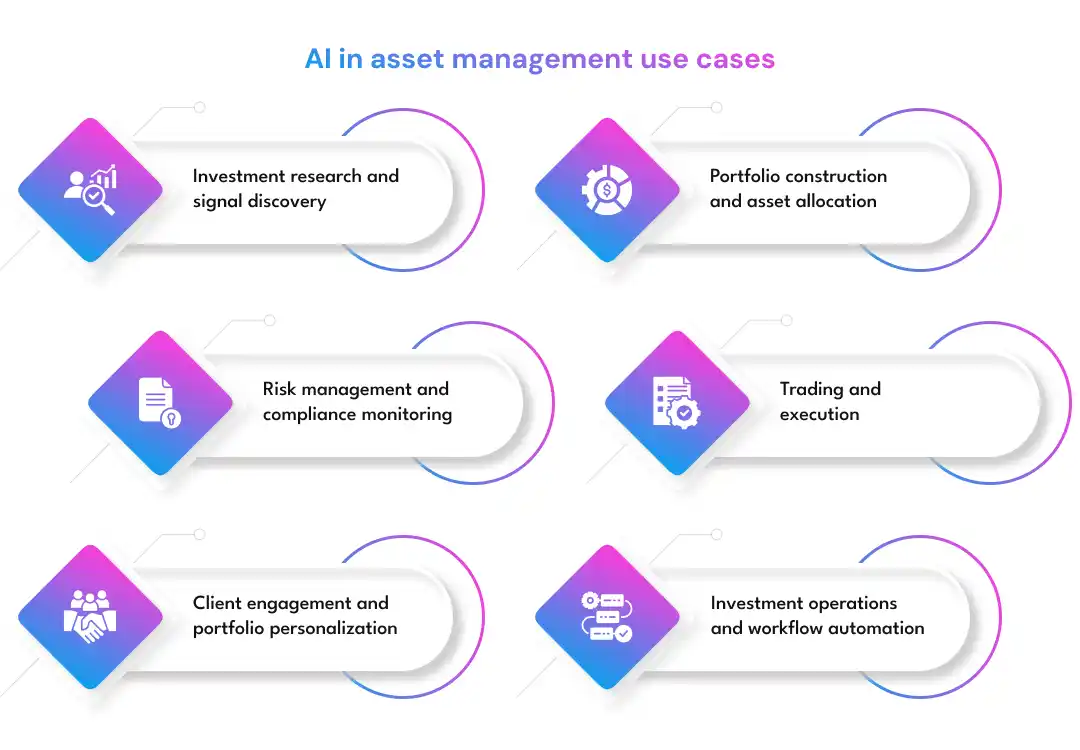
Investment research and signal discovery
Investment teams review filings, earnings calls, research, news, macroeconomic data, and datasets. AI in investment management can shorten that process by extracting information, comparing sources, summarizing documents, and identifying signals for deeper analysis. Natural language processing helps interpret text-heavy sources, while machine learning can detect patterns across historical data.
Generative AI can also help analysts question internal research and retrieve prior investment views. Firms may combine generative AI with retrieval-augmented generation so outputs are grounded in approved research. When proprietary workflows require custom models, machine learning development services can support development and integration.
Portfolio construction and asset allocation
AI portfolio management can help teams evaluate portfolio combinations against risk, return, tax, liquidity, sustainability, and mandate constraints. Models can support scenario analysis, identify concentration issues, and test how assumptions affect outcomes. This helps portfolio managers compare possibilities without handing final decisions to the model.
Generative models can help explain portfolio changes or summarize factors behind a recommendation. Understanding generative AI models helps firms decide where they fit and where traditional statistical methods remain better. Teams building proprietary workflows may develop proprietary generative AI capabilities when they need tighter control over data and outputs.
Risk management and compliance monitoring
AI in asset management can support risk oversight by monitoring exposures, market changes, transaction patterns, and portfolio exceptions. Machine learning models can flag unusual activity, while generative AI can search policies, summarize regulatory information, and prepare documentation. Generative AI for compliance is useful when teams work with large volumes of regulatory text.
The same approach can support internal audit workflows by organizing evidence and surfacing items for investigation. For sensitive use cases, firms can ground AI responses in approved knowledge to reduce unsupported outputs. Human review should remain part of high-consequence decisions.
Trading and execution
AI in investment management can support trading by analyzing liquidity, timing, routing, market impact, and pre-trade conditions. Models can compare execution choices and identify market behavior. Routine checks may be automated, while unusual orders, stressed markets, and illiquid instruments can be escalated to traders.
AI workflow automation can reduce repetitive handoffs between order management, control, and reporting systems. Automation rules and human intervention points are important before these workflows move into production.
Client engagement and portfolio personalization
Generative AI in asset management can reduce administrative work around client servicing. It can prepare meeting briefs, summarize portfolio changes, draft reports, answer questions using approved information, and support RFP or due-diligence responses. These are practical generative AI use cases because they combine information retrieval with controlled content generation.
AI for asset managers can also organize client constraints such as tax preferences, liquidity needs, risk limits, and sustainability requirements. This can make personalization easier to scale while investment judgment and accountability stay with people.
Investment operations and workflow automation
Investment operations include reconciliations, fund reporting, corporate actions, document review, portfolio-data checks, and exception management. AI in asset management can reduce manual processing by collecting information from connected systems, validating fields, preparing reports, and routing unresolved items.
More advanced workflows may use AI agents that complete approved steps across tools. Firms exploring this approach should understand agentic AI use cases and agentic process automation. They may also need to integrate LLMs with enterprise databases so agents can use data. Where custom orchestration and approval controls are required, organizations can build governed AI agents and automate multi-step investment workflows around defined permissions and escalation rules.
Automate Investment Workflows Without Losing Human Oversight
Prismetric helps connect AI with research, reporting, compliance, portfolio systems, and operational workflows while keeping approvals and controls in place.
Discuss Your AI Workflow
What are the risks and ethical considerations of AI in asset management?
AI in asset management introduces new responsibilities alongside its benefits. Investment firms need to know where data comes from, how models produce outputs, who can access sensitive information, and when people must intervene. Governance becomes especially important when AI influences portfolio decisions, compliance workflows, or client-facing information.
Data quality, lineage, and integration
AI systems depend on accurate, timely, and well-structured information. Incomplete portfolio records, inconsistent identifiers, stale market data, or poorly governed alternative datasets can lead to unreliable outputs. Asset managers should know where each dataset originated, how it was transformed, and whether teams have permission to use it.
This often requires data engineering services to connect research, portfolio, client, and operational data while maintaining lineage and access controls. Firms also need to consider how AI connects with order management systems, portfolio accounting platforms, data warehouses, and older applications. AI integration services can help when several systems need to exchange information without disrupting established controls.
Bias, explainability, and model validation
Machine learning in asset management can identify patterns that are difficult to detect manually, but those patterns are only as reliable as the data and validation process behind them. Historical datasets may contain biases, unusual market periods, or relationships that do not continue in future conditions.
Model teams should test for overfitting, data leakage, look-ahead bias, model drift, and inconsistent performance across market regimes. Explainable AI can help investment and risk teams understand the factors influencing an output rather than treating a recommendation as a black box. Firms using AI agents should also perform ongoing AI agent evaluation to assess output quality, tool use, escalation behavior, and policy compliance.
Security, privacy, compliance, and vendor risk
Generative AI in asset management may work with confidential portfolio information, client records, proprietary research, investment models, and licensed datasets. Sending this information to an external model without appropriate controls can create privacy, security, or contractual risks.
Firms should evaluate deployment choices, including the differences between private and public LLMs, and define which data each model can access. Cloud-based systems also require careful identity, encryption, logging, and infrastructure controls, particularly when organizations use AI in cloud environments.
Regulatory requirements also need to be considered throughout development and deployment. Guidance on AI regulation and compliance can help teams understand emerging obligations, while firms building RAG applications should account for security, compliance, cost, and implementation challenges. Organizations developing broader production systems may need to build enterprise-grade AI applications with audit logs, role-based permissions, monitoring, and defined governance controls.
Human oversight and accountability
AI in asset management should support professional judgment rather than make accountability unclear. Firms need defined approval thresholds, escalation paths, override permissions, and ownership for investment or operational decisions.
A portfolio manager may use AI to compare scenarios, but still needs to assess whether the recommendation fits the investment mandate and current market context. Compliance teams may use AI to surface possible issues, but people should review material exceptions. Clear accountability helps ensure that automated workflows remain traceable and that someone remains responsible when a model produces an incorrect or unexpected result.
Trends in AI asset management
The next phase of AI asset management is moving beyond tools that only summarize information or answer questions. Agentic AI systems can coordinate sequences of approved tasks across research, operations, reporting, and compliance workflows. An agent might retrieve portfolio data, review a document, prepare an analysis, update a workflow, and escalate an exception. These systems still require permissions, monitoring, and human approval for high-impact actions.
Asset managers are also moving from isolated pilots toward broader operating-model redesign. Instead of adding separate AI assistants to existing processes, firms are beginning to reconsider how research, investment operations, risk, and client servicing should work when AI is embedded throughout the workflow. This creates new decisions around data architecture, orchestration, governance, and whether custom AI or off-the-shelf AI better fits each use case.
As analytical capabilities become more widely available, access to AI alone may offer less differentiation. Competitive advantage can shift toward proprietary data, investment judgment, portfolio construction, client trust, and the ability to apply AI within a disciplined investment process. AI can make customization more scalable, but asset managers still need people who can challenge model outputs, interpret uncertainty, and decide when the technology should not be followed.
Move Your Asset Management AI From Pilot to Production
Prismetric can help validate use cases, integrate proprietary data, establish governance, and build production-ready AI around your investment processes.
Talk to Our AI Experts
How to get started with AI in asset management
Implementing AI in asset management works best when firms start with a defined business problem rather than a model or platform. The goal is to identify where better analysis, automation, or decision support can create measurable value without weakening investment controls, data governance, or human accountability.
- Identify high-value use cases: Start by reviewing research, portfolio, risk, client, and operational workflows to find tasks that are repetitive, data-heavy, or slow. An AI workflow discovery checklist can help teams evaluate opportunities based on business value, feasibility, data availability, and risk. Firms that need broader guidance may use AI consulting services to prioritize use cases and define an adoption roadmap.
- Assess data and integration readiness: Determine what market, portfolio, research, client, and compliance data each use case requires. Teams should evaluate data quality, permissions, lineage, and how information moves between existing systems. An AI integration architecture for legacy systems can help when older platforms need to connect with newer AI applications without disrupting established processes.
- Choose the appropriate AI approach: Not every problem needs generative or agentic AI. Predictive models may be better for forecasting and anomaly detection, while generative AI is useful for document analysis, knowledge retrieval, and reporting. Firms evaluating more advanced use cases may require specialized generative AI advisory to determine model, data, retrieval, security, and governance requirements.
- Pilot with governance and human review: Test the solution in a controlled environment before giving it access to sensitive investment workflows. Define evaluation criteria, model permissions, approval points, escalation rules, and monitoring requirements. Organizations can use AI implementation services when they need support moving a validated use case from pilot to production while maintaining technical and governance controls.
- Measure results and scale carefully: Set baseline metrics before deployment. Depending on the use case, these may include research time, reporting cycle time, manual processing, exception rates, user adoption, model accuracy, or operating cost. A practical AI implementation guide can help structure the rollout. Firms that need tailored applications can also build production AI capabilities around their investment processes and existing technology environment.
The strongest AI asset management programs usually scale after proving value in specific workflows. This makes it easier to improve the system, strengthen governance, and expand adoption without treating AI as a replacement for established investment discipline.
AI in Asset Management FAQs
AI helps investment teams process filings, earnings calls, market news, research, and other large datasets faster. It can summarize information, compare sources, and identify patterns or signals that analysts can investigate further.
AI portfolio management tools can evaluate different portfolio combinations against factors such as risk, return, liquidity, tax considerations, sustainability requirements, and investment mandates.
They can also support scenario analysis and identify concentration risks. Portfolio managers still review the results and decide whether recommendations fit the investment strategy and current market conditions.
AI can continuously analyze portfolio exposures, transactions, market changes, and other data to identify unusual activity or potential exceptions that need human review.
Common applications include:
- Monitoring portfolio and transaction risks
- Flagging unusual patterns or exceptions
- Searching regulatory and policy documents
- Preparing compliance documentation
- Supporting internal audit workflows
AI systems may use market data, portfolio records, company filings, research, client information, regulatory documents, and operational data. The quality and reliability of these inputs directly affect the usefulness of AI outputs.
Asset managers also need clear data lineage, permissions, integration, and access controls so information can move safely between AI applications and existing investment systems.
Before deployment, firms should evaluate:
- Data accuracy and completeness
- Data ownership and permissions
- Integration with existing platforms
- Security and privacy requirements
- Governance and monitoring controls
Agentic AI can move beyond answering questions by coordinating multiple approved tasks across research, reporting, compliance, and investment operations.
For example, an AI agent could retrieve portfolio information, review documents, prepare an analysis, and update a workflow.
These systems still require defined permissions, monitoring, escalation rules, and human approval when actions could materially affect investments, clients, or compliance.
Asset managers should begin with a clearly defined business problem rather than adopting AI simply because the technology is available. High-value opportunities are often repetitive, data-heavy, or time-consuming workflows where better analysis or automation can create measurable value.
The value of AI should be measured against clear baseline metrics before deployment. Depending on the use case, firms can track improvements in research time, reporting cycles, manual processing, exception rates, model accuracy, user adoption, or operating costs.
Teams should first prove value through controlled pilots, measure results, strengthen governance where needed, and scale successful AI workflows gradually.