5 Best Rocket.new Alternatives in 2026 for Full-Stack App Building
If you are looking for Rocket.new alternatives, you will find a few comparison pages, but most of them stay surface level.
This might be the only guide worth saving.
Rocket.new is an AI app builder built for turning prompts into working products faster.
As promoted, it helps you go from idea to app using AI, with less manual setup and less time spent writing everything from scratch.
You can use it to generate interfaces, workflows, and product logic without starting from a blank screen.
I reviewed the top alternatives pages, compared the tools side by side, and looked at what actually matters when you want to build something beyond a quick demo.
The idea behind Rocket.new is solid, and the speed is appealing. But a few things make people start looking elsewhere:
- You may move fast in the beginning, but that does not always mean you get the control needed for serious product building.
- Some users want better visibility into how the app is structured once the first version is generated.
- Pricing and usage limits can become a concern when you keep testing, editing, and rebuilding flows.
- Not every builder wants to stay locked into one style of workflow when code flexibility and backend control matter more.
- And if the goal is to ship something real, not just prototype it, the gap between quick generation and long term scalability starts to matter.
So I did the research and shortlisted five alternatives that are worth serious attention.
Here is what I found.
TL;DR — Top Rocket.new Alternatives
If you are in a rush, here is the short version:
Vitara.ai — Best Rocket.new alternative overall because it gives you a stronger full-stack app building workflow, code editing and download, GitHub integration, and flexible plans that work well for startups and product teams.
Lovable — Best for fast web MVPs because it makes prompt-based web app creation simple and approachable. It is easy to get started with, but credit-based usage can become a factor if you iterate heavily.
Vercel v0 — Best for developer-led teams because it works especially well for frontend-heavy builds, GitHub sync, and Vercel deployment. It is a strong choice for web-first teams, but paid plans are charged per user.
| Tool |
Price |
Best For |
Code Control |
Backend Support |
GitHub |
Free Plan |
| Vitara.ai |
$20/mo |
Full-stack app building |
Yes |
Yes |
Yes |
Yes |
| Lovable |
$25/mo |
Fast web MVPs |
Yes |
Yes |
Not highlighted like others |
Yes |
| Vercel v0 |
$30/user/mo |
Developer-led web apps |
Yes |
Limited compared to full-stack-focused tools |
Yes |
Yes |
| Bolt.new |
$25/mo |
All-in-one app building |
Yes |
Yes |
Yes |
Yes |
| Emergent |
$20/mo |
Production-ready app workflows |
Yes |
Yes |
Yes |
Yes |
How I Evaluated These Rocket.new Alternatives
I have been following AI app builders and vibe coding tools for years now.
During that time, I have tested more builders than I can count, some genuinely useful, some frustratingly limited, and many that look impressive until you try to build something real with them.
For this list, I did not just scan landing pages and repeat marketing claims.
I compared each tool based on what actually matters when you are trying to go from prompt to usable product, looked at how they approach app generation, and checked where they feel smooth versus where they start getting restrictive.
Here is what I looked for in each tool:
- Full stack app building, can it help you build more than just a nice looking front end?
- Code flexibility, can you edit, export, and keep control over what gets generated?
- Ease of use, can a non technical founder or lean product team actually use it without getting stuck?
- Backend support, does it help with real product logic, database handling, and app workflows?
- Scalability, can the tool support serious product building, or does it feel limited after the first prototype?
I will share my honest take on each tool below, what stands out, where it falls short, and who it is best suited for. Pricing may be mentioned where relevant, but it is always smart to check the official website for the latest details.
5 Best Rocket.new Alternatives in 2026
Alright, now let us get into the tools. I have kept the same evaluation approach for all five full stack app building, code flexibility, ease of use, backend support, and how well each tool holds up when you want to build something more serious than a quick prototype.
⭐ Best For:
Founders, product teams, and businesses that want to build full-stack apps fast without giving up too much control.
If you want a Rocket.new alternative that feels more practical once the product starts getting real, Vitara is the one I would put first.
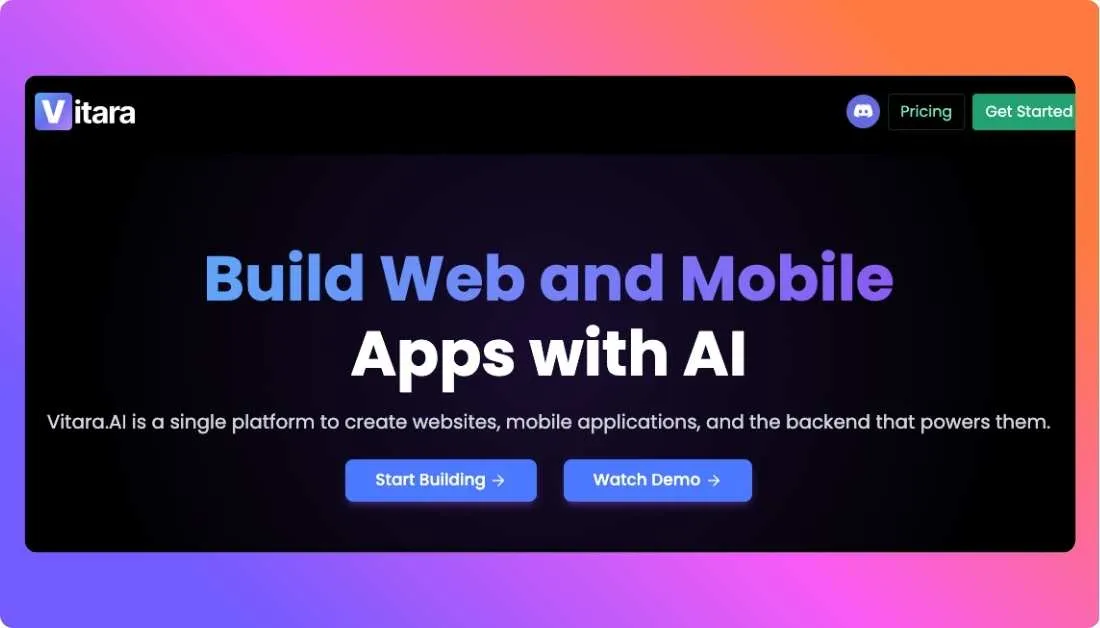
Think of Vitara as an AI-first full-stack builder that helps you go from idea to working product without forcing you to piece everything together manually.
You describe what you want to build, and Vitara can generate frontend and backend code, handle app logic, and support faster launches for web and mobile products. Its official site also highlights GitHub integration, end-to-end app building, and a free tier, which makes it easier to start small and keep moving as the build grows.
What stands out here is the balance.
A lot of AI app builders are fun when you are mocking up ideas, but they start feeling restrictive when you want more ownership, cleaner workflows, or something you can keep improving over time. Vitara leans much more toward that “build something usable” side of the market. Its public positioning across its main site and related product pages repeatedly points to full-stack generation, React-based interfaces, backend support through Supabase-style workflows, and GitHub-connected development.
That said, Vitara is not the kind of tool you pick only for pretty front-end experimentation.
It is a better fit when you want one platform to help with UI, backend, database-related workflows, authentication, and ongoing iteration. If someone only wants a lightweight prototype in the shortest possible time, a more UI-first tool may feel simpler. But if the goal is to build an actual product that has room to grow, Vitara makes a stronger case. That is also how Vitara positions itself in several of its comparison pages, where it is framed as the option for full working apps rather than just a working concept.
For teams that want speed without feeling boxed in later, Vitara is a very strong choice. For that reason alone, it deserves the top spot on this list.
Pros
- AI-powered full-stack app generation from natural language prompts.
- GitHub integration for version control, collaboration, and deployment workflows.
- Supports web and mobile app building with frontend and backend coverage.
- Free tier available, which lowers the barrier for testing ideas.
- Better fit for teams that want to move beyond a quick prototype into a more complete product workflow. This is an inference based on Vitara’s positioning and feature set.
Cons
- It may feel like more tool than you need if all you want is a very simple front-end mockup. This is an inference based on its broader full-stack positioning.
- Some advanced flexibility appears tied to paid usage and higher plans.
- Because the platform covers more than just UI generation, there can be more to evaluate compared with lighter prompt-only builders. This is an inference based on the breadth of features described on the site.
- Starter: Free plan with 5 daily credits and 20 total one-time credits.
- Build: $20/month with 100 monthly credits, code editing and download, custom domain support, and faster AI processing.
- Scale: $50/month with 250 monthly credits.
- Custom: Contact sales for a tailored plan.
2. Lovable
⭐ Best For:
Founders, solo builders, and small teams that want to turn prompts into working web apps without getting buried in setup.
Lovable is one of the most talked-about Rocket.new alternatives right now, and that makes sense.
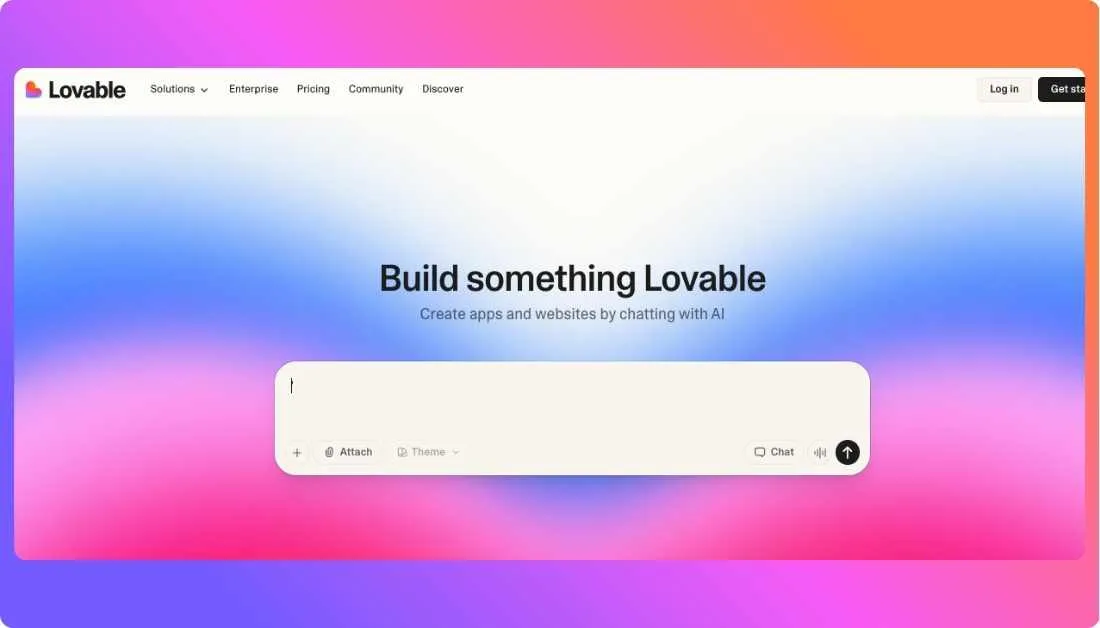
The platform positions itself as a full-stack AI development tool for building, iterating on, and deploying web applications using natural language. Its docs say it can generate frontend, backend, database, authentication, and integrations, all backed by editable code.
That is a strong pitch, especially for people who want more than a landing page mockup.
What I like about Lovable is that it feels very approachable. It is clearly designed for people who want to describe what they need, get a working app quickly, and keep refining it without starting from scratch every time. It also supports project and workspace knowledge, which helps teams define shared rules, architecture preferences, and coding standards that the system can remember across projects.
That said, Lovable leans heavily toward web app creation.
So if your goal includes broader app workflows or you want a tool that feels more open-ended across different product types, that is where the comparison gets more interesting. Lovable is strong for fast web-based product building, but that does not automatically make it the best fit for every team moving away from Rocket.new. Its own pricing and documentation also show that usage is credit-based, which means frequent prompting and iteration can become a real factor once you move past casual experimentation.
Still, if you want something that feels modern, fast, and easier to pick up than many developer-heavy builders, Lovable is a very solid option. It is especially appealing for people who want to go from idea to web app with less friction.
Pros
- Full-stack web app generation using natural language, with frontend, backend, database, authentication, and integrations included.
- Editable code, which gives users more control than tools that stay locked inside a closed visual workflow.
- Workspace and project knowledge help teams keep instructions, architecture decisions, and coding standards consistent.
- Free tier available, so it is easy to test before paying.
- Strong fit for fast web app prototyping and iteration with a relatively approachable experience. This is an inference based on Lovable’s positioning and documentation.
Cons
- It is primarily positioned around web applications, so it may feel narrower for teams comparing broader product-building workflows. This is an inference based on the product’s public positioning.
- Credit-based usage can add pressure for teams that iterate heavily.
- Some higher-end collaboration and business features are tied to paid plans.
- Paid pricing starts at $25 per month, which may feel expensive for casual users testing multiple AI builders side by side.
- Free: $0/mo — limited credits to test the platform
- Pro: $25/mo — 100 monthly credits, 5 daily credits up to 150/mo, credit rollover, custom domains, and team roles
- Business: $50/mo — everything in Pro plus team workspace, SSO, internal publishing, and advanced access control
- Enterprise: Custom pricing — volume-based credits, dedicated support, onboarding, and advanced security features
3. Vercel v0
⭐ Best For:
Developers and product teams that want fast UI generation with a strong Vercel and GitHub workflow behind it.
If your main goal is to move quickly on frontend work, Vercel v0 is one of the strongest Rocket.new alternatives on this list.
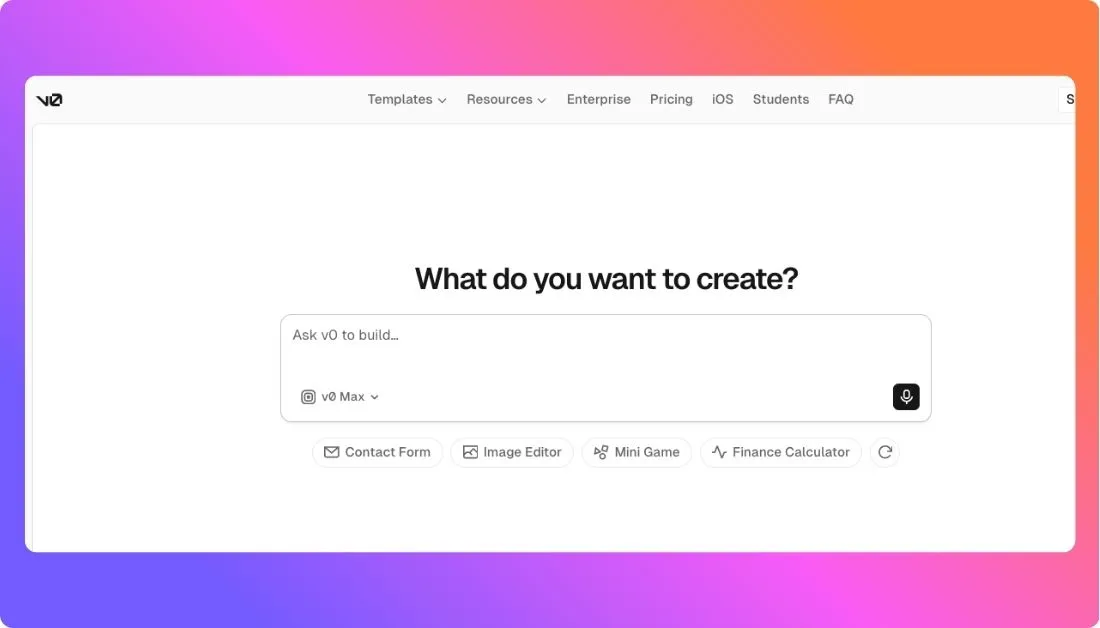
v0 is built by Vercel and is designed to turn prompts into working applications in minutes. The platform highlights fast app generation, live publishing, GitHub sync, and visual editing through Design Mode. That makes it especially appealing for teams already comfortable in the React, Next.js, and Vercel ecosystem.
What makes v0 stand out is how smooth the developer workflow feels.
You can prompt, generate, sync with a repo, and deploy on Vercel without stitching together too many extra steps. For teams that care a lot about UI speed, reusable frontend code, and shipping web experiences quickly, that is a big advantage. Vercel also describes v0 as a way to go from idea to full-stack app in a single prompt, but the product still feels most naturally aligned with frontend-heavy builds and web-first workflows.
That said, v0 is not the easiest pick for everyone.
The pricing is seat-based on paid team plans, and usage is tied to credits and model costs. So if you have a larger team or you iterate heavily, the economics can add up faster than expected. It is also a better fit for people who are already somewhat comfortable with modern web development workflows than for someone looking for a more guided all-in-one builder experience. Those tradeoffs matter when you compare it against tools that are trying to be more broadly accessible.
Still, if you want a Rocket.new alternative that is especially strong for web UI generation, GitHub sync, and fast Vercel deployment, v0 is a very solid choice.
Pros
- Fast AI-powered app generation with live publishing workflows.
- Syncs directly with GitHub, which is a major plus for developer-led teams.
- Includes Design Mode for visual editing.
- Strong fit for React, Next.js, and Vercel-centered product workflows. This is an inference based on Vercel’s product positioning and ecosystem.
- Free plan available for testing the platform.
Cons
- Paid plans are priced per user, which can get expensive for teams.
- Usage depends on credits and model pricing, so heavy iteration can increase cost quickly.
- Best suited to web-first and frontend-heavy workflows, which may feel limiting for users who want a more general-purpose builder. This is an inference based on the platform’s public positioning.
- Free plan has a 7-message-per-day limit.
Pricing (billed monthly)
- Free: $0/month
- Team: $30/user/month
- Business: $100/user/month
- Enterprise: Custom pricing
4. Bolt.new
⭐ Best For:
Builders and teams that want a fast AI coding tool with hosting, databases, and deployment built into the same workflow.
When it comes to speed and all-in-one product building, Bolt.new is one of the most serious Rocket.new alternatives on this list. The platform is built around chatting with AI to create websites, apps, and prototypes, while also giving users hosting, databases, authentication, custom domains, and SEO tools inside the same environment.
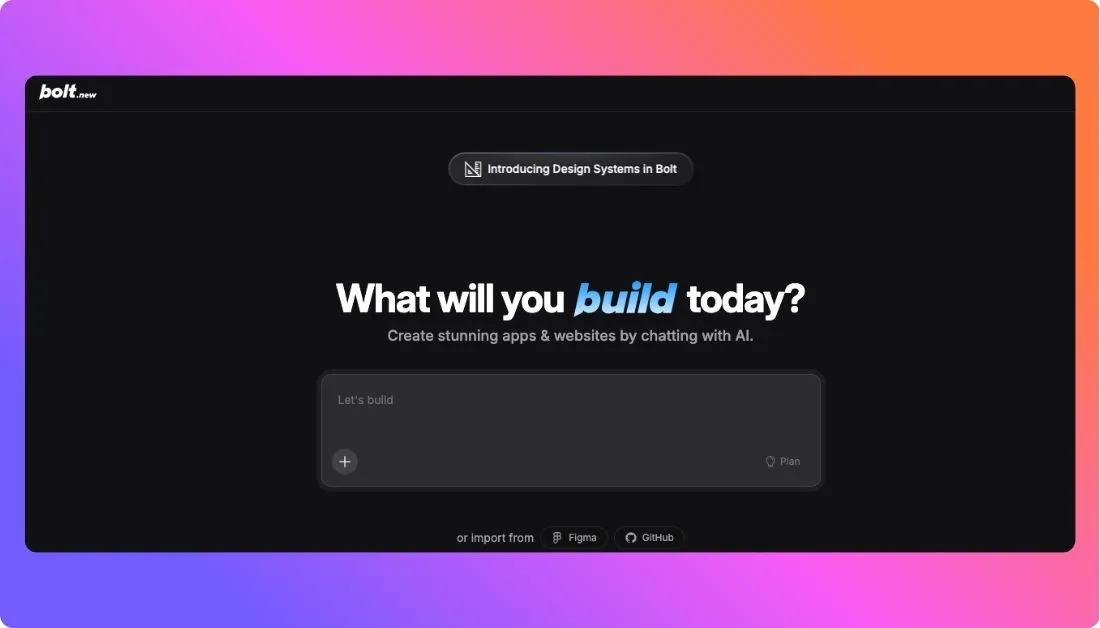
What makes Bolt.new stand out from smaller builders is how much it tries to keep in one place.
It is not just a prompt-to-UI tool. Bolt pushes the idea of building, testing, refining, hosting, and scaling without having to jump between too many services. The site also highlights support for importing from GitHub and Figma, design system usage, private sharing, expanded database capacity, and image editing on paid plans. For teams that want to move quickly without stitching together extra tools, that is a big plus.
Now, here is the catch. Bolt.new runs on tokens, and token usage is closely tied to project size because syncing a larger project file system to the AI consumes more tokens per message. The free plan has both a daily and monthly token limit, and while paid plans remove the daily cap, you still need to think about how quickly usage can grow once your app becomes larger or more complex.
For solo builders and teams that want an all-in-one AI app builder with hosting and backend infrastructure included, Bolt.new is a strong option. For users who want simpler pricing or lighter usage economics, the token model may feel harder to predict over time.
Pros
- AI-powered app, website, and prototype building from a chat-based interface.
- Hosting, databases, authentication, custom domains, and SEO tools are built into the platform.
- Supports GitHub and Figma import workflows.
- Paid plans remove the daily token limit and include monthly token allowances with rollover.
- Team and enterprise plans include centralized billing, access controls, and organization-level collaboration.
Cons
- Token usage can be difficult to predict, especially as projects get larger.
- Free plan is limited to 300,000 tokens per day and 1 million tokens per month.
- Team pricing is charged per member, which can add up for larger groups.
- The platform tries to do a lot in one place, which may feel heavier than needed for very simple prototype workflows. This is an inference based on the breadth of features and plan structure.
Pricing (billed monthly)
- Free: $0/mo
- Pro: $25/mo
- Teams: $30/member/mo
- Enterprise: Custom pricing
5. Emergent
⭐ Best For:
Founders and teams that care more about production-ready app building than quick visual experimentation.
If simplicity is what you are after, Emergent is not the lightest Rocket.new alternative on this list.
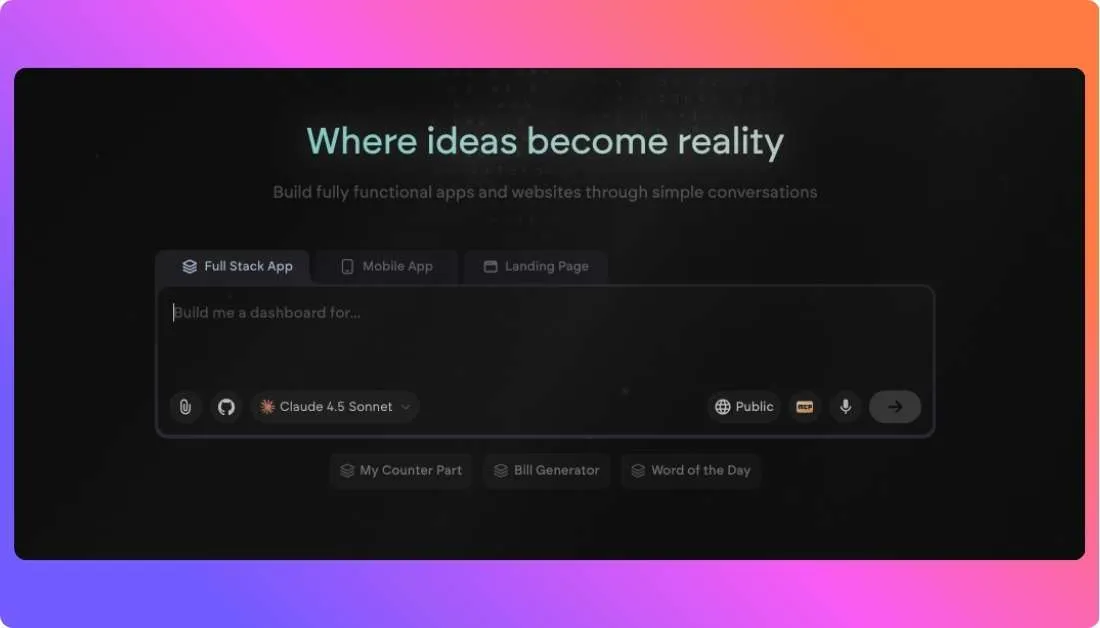
But if the goal is to build something that can grow, Emergent becomes much more interesting. The platform describes itself as a way to build production-ready apps through conversation, with AI agents that design, code, and deploy applications from start to finish. Its own comparison content also leans hard into the same angle by framing Rocket as better for quick launches and early experimentation, while positioning stronger alternatives around scalability, backend control, and long-term product building.
The biggest strength here is depth.
Emergent is clearly built for people who want more than a polished first version. Even on its pricing page, the platform highlights web and mobile app building, private hosting, GitHub integration, forked tasks, large context windows, custom AI agents, and high-performance computing on higher plans. That is a much more serious product-building pitch than what you usually see from lighter prompt-to-app tools.
Where Emergent falls short is accessibility.
The free plan is small at 10 monthly credits, and the jump from Standard to Pro is steep. Standard is priced for first-time builders, but Pro jumps all the way to $200 per month, which makes it harder to justify unless you already know you need the extra intelligence, higher context limits, and custom agent capabilities. For solo builders testing multiple tools, that pricing gap will stand out fast.
If your main focus is building fast demos, there are easier tools higher up on this list. If you care more about scalable apps, deeper control, and a platform that sounds built for serious product work, Emergent is worth a look.
Pros
- Built around production-ready app development through conversation.
- Supports web and mobile app building.
- Includes private project hosting and GitHub integration on Standard and above.
- Higher plans include a 1M context window, custom AI agents, and high-performance computing.
- Stronger fit for teams that care about scalability and long-term product building. This is an inference based on Emergent’s product positioning and comparison article.
Cons
- Free plan is very limited at 10 monthly credits.
- The jump from $20/month Standard to $200/month Pro is steep.
- May feel heavier than needed for simple prototype workflows. This is an inference based on the platform’s feature depth and pricing structure.
- Advanced features are mostly reserved for higher-priced plans.
Pricing
- Free: $0/mo
- Standard: $20/mo
- Pro: $200/mo
- Enterprise: Custom pricing.
Which Alternative Actually Replaces Rocket.new?
Let me be direct with you.
Choosing an AI app builder is not just about how fast it generates something on screen. What matters is what happens after that first build. Can you keep improving it, control the code, handle the backend, and turn it into something real?
So do not get pulled in by tools that look impressive in a quick demo but start feeling limiting once the product needs structure, flexibility, and room to grow.
Go with a tool that gives you speed without boxing you in. And in this list, that tool is Vitara.ai. Here is why:
- Vitara is built for full-stack app building, not just quick front-end generation.
It supports code editing and code download, which gives you more control once the project gets serious.
- It includes GitHub integration, which makes iteration and development workflows much more practical.
- It supports both web and mobile app building, which gives it broader product flexibility.
- The pricing starts with a free plan, and the paid plans are easier to understand than some usage-heavy alternatives.
You can start with the free plan, test how it fits your workflow, and move to Build or Scale only when you need more credits and features.
FAQs About Rocket.new Alternatives
If the goal is to find the best overall replacement, Vitara.ai is the strongest pick in this list. It is positioned around full-stack app building, code editing and download, GitHub integration, and web plus mobile product workflows, which makes it a practical option for teams that want more than a quick prototype.
Vitara.ai and Emergent are the strongest choices if full-stack app building is your priority. Vitara focuses on practical full-stack development with code ownership and broader product flexibility, while Emergent leans more toward production-ready app creation, private hosting, GitHub integration, and deeper AI-assisted workflows on higher plans.
Lovable is one of the easiest options for beginners who want to turn prompts into working web apps without dealing with too much setup. Its documentation and pricing focus on simple prompt-based building, workspace knowledge, and accessible team workflows, which makes it especially appealing for solo builders and early-stage teams.
Vercel v0 is the best fit for developers, especially teams already working with React, Next.js, GitHub, and Vercel. Its product positioning focuses on fast app generation, GitHub sync, live publishing, and Design Mode, which makes it particularly attractive for frontend-heavy and web-first workflows.
Yes. Several alternatives in this category start with free plans or lower-cost entry points. Vitara offers a free plan and paid tiers starting at a lower monthly price than many premium builders, Lovable offers a free plan and a Pro plan starting at $25 per month, and Emergent also has a free tier with a $20 monthly Standard plan.
Rocket.new positions itself as more than a simple builder by combining market research, product direction, code generation, and competitor tracking in one system. At the same time, many competing comparisons frame the decision around what happens after the first build, which suggests the real choice depends on whether you value Rocket’s broader “what to build” workflow or a more focused builder that gives you a different balance of flexibility, pricing, and product control.
If you want a clear answer, here is how to decide based on your situation:
- Vitara.ai if you want a balanced full-stack builder with code control and room to scale
- Lovable if you want to launch a quick web MVP with minimal setup
- Vercel v0 if your team is developer-led and focused on frontend and web apps
- Bolt.new if you want an all-in-one platform with hosting, database, and deployment included
- Emergent if you are building something more serious and care about long-term scalability
If the goal is to build, improve, and scale a real product, Vitara is the safest starting point for most startups.