10 Game-Changing Impacts of Parallel AI on Business Performance in 2026
Key Takeaways
- Parallel AI is transforming enterprise performance by enabling real-time decision-making, intelligent automation, and faster innovation across operations.
- Real-time analytics powered by Parallel AI can reduce decision-making time by up to 80 percent, helping businesses respond faster to market changes and customer needs.
- Parallel AI moves automation beyond basic tasks, allowing end-to-end workflow optimization across finance, HR, operations, and customer experience.
- AI-driven personalization can boost customer engagement by up to 20 percent and increase sales by 15 percent, making Parallel AI a strong driver of revenue growth.
- Predictive maintenance powered by AI can cut equipment downtime by 30 percent and reduce maintenance costs by 20 percent, according to Deloitte.
- By 2026, autonomous and self-optimizing workflows will dominate, with 87 percent of large enterprises adopting AI solutions and the global AI market projected to reach 638.23 billion dollars.
- Parallel AI adoption is helping businesses reduce operational costs by 15 to 30 percent, especially in logistics, manufacturing, and large-scale service operations.
- Over 60 percent of enterprises are expected to use multi-agent AI systems by 2026, making Parallel AI a core competitive advantage rather than an optional upgrade.
- Early adopters are already seeing 10 to 20 percent gains in operational efficiency, driven by faster execution and smarter resource allocation.
- By combining speed, intelligence, and automation, Parallel AI prepares businesses to lead confidently in 2026 and beyond, not just survive the shift.
Imagine having not one, but hundreds of intelligent systems working at the same time across your business. They analyze data, make decisions, and solve problems in real time. That’s the power of Parallel AI. It’s not a future concept. It’s happening now, and it’s changing how businesses operate, compete, and grow. And adoption is accelerating across industries. About 65% of organizations now use generative AI in multiple business functions, showing how quickly AI-driven operations are becoming the new standard.
In this article, we’ll explore 10 powerful ways Parallel AI is transforming business operations. From faster decision-making to smarter automation, you’ll see how this new approach to AI can boost efficiency, cut delays, and help your business scale with confidence.
What Is Parallel AI?
Parallel AI is an advanced approach where multiple AI models work together through AI development services to handle tasks simultaneously at enterprise scale. Unlike traditional AI, which processes tasks step by step, Parallel AI runs several processes simultaneously. This leads to faster decision-making, better scalability, and more efficient use of data across business operations.
10 Game-Changing Impacts of Parallel AI on Business Performance in 2026
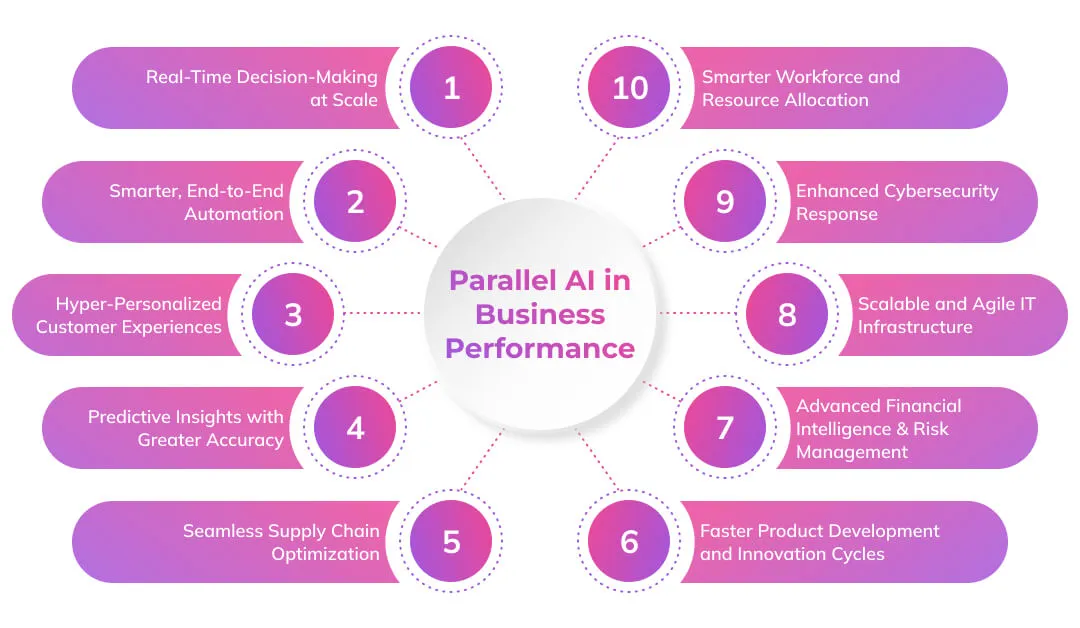
1. Real-Time Decision-Making at Scale
Parallel AI enables multiple models to analyze data at the same time. This means businesses can make critical decisions in seconds, not hours. From pricing adjustments to supply chain responses, insights arrive fast and fresh. It helps teams stay ahead of the curve and respond before competitors even notice the shift.
Takeaway: Start by identifying key decision points in your operations. Apply Parallel AI where speed equals profit like inventory, customer service, or risk management.

2. Smarter, End-to-End Automation
Parallel AI goes beyond simple task automation by enabling intelligent, connected workflows across the entire organization using AI integration and automation services.
- Coordinates complex processes across departments like sales, marketing, HR, and finance
- Allows multiple AI agents to work on different tasks at the same time
- Eliminates bottlenecks by processing workflows in parallel, not in sequence
- Boosts both speed and accuracy across daily operations
- Enables seamless communication between systems and teams through AI-driven orchestration
Takeaway: Look for slow, multi-step processes in your business. These are perfect candidates for intelligent automation with Parallel AI.
3. Hyper-Personalized Customer Experiences
Parallel AI powers multiple models that analyze user behavior, preferences, and intent in real time. This allows businesses to deliver tailored content, offers, and support to thousands of customers at once. Whether it’s a chatbot or product recommendation engine, every interaction feels uniquely designed.
Takeaway: Use Parallel AI to personalize customer journeys at scale. Focus on touchpoints like onboarding, support, and email campaigns to maximize impact.
4. Predictive Insights with Greater Accuracy
Parallel AI doesn’t just process more data. It does it with more precision. By running multiple predictive models at the same time, it analyzes trends, patterns, and risks from different angles. This leads to sharper forecasts in areas like customer behavior, demand planning, and market shifts.
Takeaway: Use Parallel AI to strengthen your forecasting. Start with one high-impact area such as churn prediction or demand planning and expand from there.
5. Seamless Supply Chain Optimization
Parallel AI strengthens supply chain performance by delivering real-time visibility and intelligent coordination.
- Tracks inventory levels across warehouses and locations simultaneously
- Forecasts demand using real-time and historical data
- Optimizes logistics planning across multiple touchpoints
- Identifies delays early and recommends faster delivery routes
- Adjusts stock levels automatically to prevent shortages or overstocking
Takeaway: Integrate Parallel AI into your logistics and procurement systems. Focus on reducing waste, delivery delays, and inventory mismatches.
6. Faster Product Development and Innovation Cycles
R&D teams can test multiple product ideas, features, or prototypes at once using Parallel AI. Instead of waiting weeks for test results, businesses can run thousands of simulations simultaneously. This speeds up innovation and leads to products that better match customer needs.
7. Advanced Financial Intelligence and Risk Management
Parallel AI gives finance teams the power to process large volumes of financial data instantly across departments. It works in real time to identify inconsistencies, flag anomalies, and detect fraud with high accuracy all without slowing down day-to-day operations.
With deeper visibility into cash flow, budgeting, and compliance, finance leaders gain better control over risk and performance. This leads to faster reporting, smarter investment decisions, and a stronger financial foundation for growth.
Takeaway: Use Parallel AI to audit financial data in real time. Focus on fraud prevention, risk scoring, and smarter forecasting for improved control.
8. Scalable and Agile IT Infrastructure
Traditional systems often buckle under high data loads. Parallel AI helps IT teams manage workloads more efficiently by distributing tasks across multiple models. This supports rapid scaling without system slowdowns, making it easier to roll out new services or support a growing customer base.
Takeaway: Strengthen your IT operations with AI-powered workload management. Begin by offloading routine monitoring or support tasks to parallel agents.
9. Enhanced Cybersecurity Response
Parallel AI enhances cybersecurity by monitoring multiple endpoints and network layers at once. It detects unusual patterns, correlates data across systems, and identifies threats in real time, far faster than traditional, step-by-step tools.
This rapid response reduces the window for damage, helping businesses contain breaches before they spread. As threats become more complex, Parallel AI adds a layer of intelligent defense that adapts and improves with every incident.
Takeaway: Implement Parallel AI in your cybersecurity stack. Start with threat detection and real-time incident response to boost defense speed.
10. Smarter Workforce and Resource Allocation
Managing teams, shifts, and resources manually leads to inefficiencies. Parallel AI analyzes workloads, employee performance, and operational needs to recommend the best use of available talent. It helps leaders make informed staffing decisions, reduce burnout, and improve productivity.
What is the Future of Parallel AI for Business Operations?
Here is the possible future of Parallel AI in business:
- Parallel AI will become a core part of real-time decision-making across all industries.
- Businesses will shift from automation to full AI-driven autonomous operations.
- Multi-agent AI systems will collaborate to manage entire departments with minimal human input.
- Parallel AI will power next-gen customer experiences through adaptive personalization.
- Supply chains will rely on AI to self-correct, forecast, and respond instantly to disruptions.
- Financial operations will become more predictive, with AI spotting trends before they emerge.
- Cybersecurity will evolve with always-on AI defense systems that learn and react instantly.
- Parallel AI will enable faster innovation cycles with AI-led R&D and testing.
- Enterprises will scale faster with AI handling infrastructure, resource allocation, and growth planning.
- Businesses that adopt Parallel AI early will gain a long-term competitive edge in speed, accuracy, and agility.
Conclusion
Parallel AI is more than a tech upgrade. It’s a business shift that unlocks real-time decision-making, intelligent automation, and personalized customer experiences at scale. As industries face growing complexity and competition, this AI approach gives companies the speed and precision they need to stay ahead.
Now is the time to explore where Parallel AI fits into your operations. Start small, measure impact, and scale with confidence. Businesses that move early will not only increase efficiency but also build the agility needed for long-term growth.
Frequently Asked Questions
Parallel AI is a system where multiple AI models or agents work at the same time to solve different parts of a problem. This leads to faster, smarter, and more efficient business operations.
Traditional AI often works in a step-by-step process. Parallel AI runs many processes at once, making it better for real-time decisions, large-scale data analysis, and automation.
- Retail – For real-time personalization, inventory optimization, and dynamic pricing.
- Finance – For fraud detection, risk analysis, and automated trading strategies.
- Logistics and Supply Chain – For demand forecasting, route optimization, and live tracking.
- Manufacturing – For predictive maintenance, quality control, and process automation.
- Healthcare – For diagnostics, patient monitoring, and operational efficiency.
- SaaS and Tech – For user behavior analysis, feature testing, and real-time customer support.
- Telecom – For network optimization, customer experience, and fault prediction.
- Energy and Utilities – For grid monitoring, usage forecasting, and resource planning.
No. Small and mid-sized businesses can also use Parallel AI to automate tasks, improve customer service, and make faster decisions without needing massive infrastructure.
- Automated customer support – AI chatbots handle thousands of queries simultaneously with faster, personalized responses.
- Fraud detection – Real-time monitoring of transactions across systems to flag unusual patterns instantly.
- Supply chain tracking – Continuous tracking and adjustment of logistics based on live inventory and shipment data.
- Real-time pricing updates – Dynamic price adjustments based on demand, competitor pricing, and customer behavior.
- Predictive maintenance – Equipment is monitored constantly to predict and prevent breakdowns before they happen.
- Marketing automation – Simultaneous testing of multiple campaigns to optimize performance in real time.
- Financial forecasting – Multiple data models analyze trends to improve accuracy in revenue and expense predictions.
- Product testing and development – Run thousands of simulations to validate features and reduce time to market.
Begin by identifying a workflow that’s time-consuming or data-heavy. Then, explore AI platforms or consult with a provider to develop a pilot project with clear goals.