AI Minimum Viable Product (MVP) Guide for Entrepreneurs
Imagine this.
You have an AI product idea. You know it can save time, reduce manual work, answer customer questions, predict decisions, or automate a process that people in your industry still do the slow way.
You discuss it with your team. You add all the features that sound powerful. A smart chatbot. A dashboard. Predictive analytics. User roles. Workflow automation. Reports. Maybe even a custom model trained on business data.
Everything looks exciting.
But then the real users come in and the excitement drops.
They don’t use the product the way you expected. They don’t trust the AI output. They don’t come back after the first trial. The money, effort, and months you spent on AI product development start feeling heavier than they should.
Painful? Yes.
Unexpected? Not really.
I’ll tell you what could be happening.
You started building the full AI product before building an AI MVP.
Small version. Big lesson.
Come on, let’s settle this before your AI idea turns into an expensive experiment. Let’s see what an AI minimum viable product is, how entrepreneurs can build one, and what process can help you move from assumption to validation without burning unnecessary time and budget.
Before you move ahead, you can also explore Prismetric’s AI development services, generative AI development services, and custom software development expertise to understand how AI-enabled products are planned, designed, developed, and improved for real business use.
TL;DR
An AI minimum viable product is the simplest usable version of your AI product that solves one real problem for one specific user group. It helps entrepreneurs test demand, validate AI performance, and reduce development risk before building a full-scale AI solution.
Here’s the quick version:
- Start with one concrete pain point, not a general-purpose AI idea.
- Define your buyer persona and understand how AI will save them time, money, or manual effort.
- Choose only the must-have features that prove the core value of your AI MVP.
- Use AI APIs, prompt wrappers, pre-trained models, no-code tools, or Wizard of Oz prototypes to validate faster.
- Keep humans in the loop where accuracy, trust, safety, or approval matters.
- Release the AI MVP to a small group of early users and watch how they use it.
- Measure retention, repeated usage, AI output quality, time saved, and willingness to pay.
- Improve the product with real feedback, better prompts, cleaner data, and stronger workflows.
- Scale only when users trust the AI product and see clear value in it.
In simple words, build small, validate fast, learn honestly, and scale your AI product only when the market gives you a clear signal.
Turn AI Ideas into Market Ready MVPs
Prismetric develops AI MVPs that help businesses test demand, user trust, and product value.
Build Your MVP
What is AI Minimum Viable Product?
In the simplest terms, an AI minimum viable product is the smallest functional version of your AI product that solves one clear problem for one clear group of users.
It is not the final product.
It is not a half-baked demo either.
It is the first usable AI-powered version that gives value to your users and gives learning to you.
Suppose you want to build an AI assistant for a healthcare clinic. The big vision may include appointment scheduling, patient history summaries, insurance support, billing automation, prescription reminders, and analytics.
Good vision.
But should all of this go into your first version?
No.
Your AI MVP could simply answer common patient queries, collect appointment requests, and route complex questions to a human staff member. That alone can help you check whether patients use the assistant, whether the clinic team trusts it, and whether the AI saves enough time to justify further development.
That is the real idea behind AI MVP development.
You are not building less because you lack ambition. You are building less because you want to know what deserves to be built more.
An AI minimum viable product helps entrepreneurs test the market before they invest in a complete AI app, AI agent, machine learning system, or generative AI platform. It shows whether users care about the problem, whether the AI output is useful, and whether your business model has room to grow.
Now, before I take you too deep into the world of AI product versions, model choices, prompt engineering, human-in-the-loop validation, data pipelines, and automation workflows, let us first visit the basics.
You already know that AI is powerful.
And I am sure if you are here, you also know that building AI without validation can become costly very quickly.
The tricky part is not understanding the meaning of “AI” or “MVP.”
The tricky part is deciding what makes your AI product viable.
How accurate should the AI be in the first version?
How much automation is enough?
Which part should be handled by AI and which part should still stay with humans?
Should you build a custom AI model or use an existing API?
Should your MVP be a no-code prototype, a prompt wrapper, or a production-ready first release?
Let’s make it simple.
The idea is to give your users an AI product that is useful enough to solve their immediate pain point, but focused enough that you can launch, test, learn, and improve it fast.
You do not need to build a general-purpose AI platform from day one.
You need to build a specific AI solution for a specific user problem.
So instead of saying, “We want to build an AI tool for sales teams,” say, “We want to build an AI assistant that summarizes sales calls and creates follow-up emails for small B2B sales teams.”
See the difference?
The second one has a user.
It has a problem.
It has a workflow.
It has a measurable value.
That is where your AI MVP starts making sense.
Here’s how –
Steps to Build an AI Minimum Viable Product
Now that you know what an AI minimum viable product is, let’s talk about how to build one.
And no, the answer is not “start training a model.”
That comes later. Sometimes, it does not even come in the MVP stage.
The first step is to understand who you are building for, what problem they are tired of facing, and how AI can remove that problem in the simplest possible way.
Because with an AI MVP, the risk is not just building the wrong feature.
The risk is building intelligence where users need clarity, automation where users need control, and complexity where users only need speed.
So, here are the steps entrepreneurs should follow before turning their AI product idea into a full-fledged digital product.
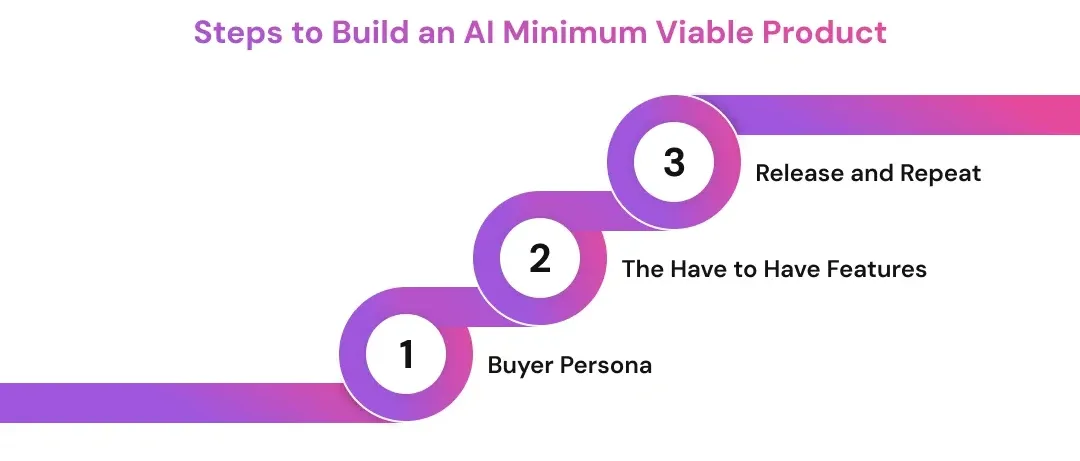
1. Buyer Persona
The first step to building an AI MVP is to know your buyer persona.
Not “everyone.”
Not “businesses.”
Not “people who use AI.”
You need to know the exact user group that will use your AI product, pay for it, and come back to it because it solves a real problem.
Are you building an AI assistant for ecommerce store owners?
A predictive analytics tool for logistics companies?
A generative AI chatbot for customer support teams?
An AI document processing solution for legal firms?
An AI recommendation engine for a healthcare app?
Each user group has a different problem, different workflow, different expectation, and different level of trust in AI.
This is where many entrepreneurs get it wrong.
They start with the AI technology.
They say, “Let’s build something with generative AI.”
Or, “Let’s create an AI automation platform.”
Or, “Let’s use machine learning to solve business problems.”
Sounds good.
But for whom?
Your AI minimum viable product should begin with one target user and one painful job they want to finish faster, cheaper, or better.
For example, if you are building an AI tool for recruiters, your buyer persona can be startup HR managers who spend hours screening resumes for technical roles. Their pain point is not “lack of AI.” Their pain point is time wasted in shortlisting candidates who do not match the job requirement.
Now your AI MVP becomes clear.
You can build a resume screening assistant that reads resumes, matches them with job descriptions, gives a fit score, and lets HR manually approve or reject the suggestions.
That is focused.
That is useful.
That is testable.
And most importantly, that is not trying to become a complete HRMS from day one.
When you define your buyer persona, look at these points:
- Who is the actual user?
- What task do they repeat often?
- What makes that task slow, costly, or confusing?
- What data do they already have?
- How will AI improve the task?
- How will the user judge whether the AI output is good or bad?
- What will make them trust the AI?
The last question matters a lot.
In normal MVP development, you mainly check if users need the feature.
In AI MVP development, you also check if users trust the output.
Because a user may like your interface and still reject your product if the AI gives unclear, inaccurate, biased, or unreliable results.
So, define the user first.
Then define the AI.
Not the other way around.
2. The Have to Have Features
Once you know your buyer persona, the next step is to decide the “have to have” features of your AI minimum viable product.
This is where you stop dreaming about the full product and start thinking like a builder.
An AI MVP does not need every feature your final product will have.
It only needs the features that prove your core AI value.
Let’s say you want to build an AI-powered customer support solution.
The full version may include voice support, ticket routing, CRM integration, analytics, multilingual answers, agent performance dashboard, sentiment analysis, automated refunds, knowledge base management, and escalation workflows.
Great.
But your first AI MVP may only need:
- A simple chat interface
- A connected knowledge base
- AI-generated answers
- Human handoff for difficult questions
- Feedback buttons to mark answers as helpful or not helpful
That’s it.
These features are enough to test whether customers ask questions, whether the AI gives useful answers, whether support teams save time, and whether users trust the experience.
The same applies to every AI product.
If you are building an AI sales assistant, start with call summary and follow-up email generation.
If you are building an AI finance tool, start with expense categorization and anomaly alerts.
If you are building an AI healthcare assistant, start with symptom intake and appointment routing.
If you are building an AI education platform, start with personalized quiz generation and progress tracking.
Do not add every possible AI feature just because the market sounds hot.
More features mean more data handling, more testing, more edge cases, more compliance checks, more development time, and more cost.
And this is where entrepreneurs should choose the right AI-lite approach.
You do not always need to train a custom AI model in the first release.
You can start with a prompt wrapper that uses existing AI APIs and carefully designed prompts.
You can use pre-trained open-source models for specific tasks.
You can create a no-code or low-code workflow to test the process before investing in a scalable platform.
You can even use a Wizard of Oz approach where the interface looks automated, but some decisions are still handled by humans behind the scenes.
No shame in that.
The goal of your AI MVP is not to impress people with how complex the backend is.
The goal is to check whether the product solves the problem.
So, list all the features you have in mind.
Then separate them into three categories:
- Must have
- Good to have
- Later
Keep only the must-have features in your AI MVP.
Everything else can wait.
Your first version should help users complete one valuable task. It should collect feedback. It should show where AI works, where humans are still needed, and where the product needs more training, better prompts, or stronger data.
That is how you build smart.
3. Release and Repeat
Once your have-to-have features are ready, release your AI minimum viable product to a small group of early users.
Not to the whole market.
Not to every industry.
Not to every possible customer segment.
Start with people who feel the pain strongly enough to test your solution and give honest feedback.
This group can include your existing customers, domain experts, startup users, internal team members, pilot clients, or early adopters who already use manual workarounds for the same problem.
Release the AI MVP. Watch how they use it. Ask what confused them. Ask what saved time. Ask where they did not trust the AI.
Then improve it.
In AI MVP development, feedback is not only about design and features. It is also about data quality, response accuracy, prompt performance, model behavior, user confidence, and workflow fit.
You need to track questions like:
- Did users return after the first use?
- Did the AI output save time?
- Did users edit the AI-generated result?
- Did users ignore the AI suggestion?
- Did they ask for more control?
- Did they want human review before final action?
- Did they agree to pay for the solution?
These answers will tell you whether your AI product is moving in the right direction.
Remember this.
Downloads do not validate an AI MVP.
Curiosity does not validate an AI MVP.
A few compliments do not validate an AI MVP.
Retention, repeated use, willingness to pay, and measurable improvement in the user’s workflow validate it.
So, release fast.
Measure honestly.
Improve continuously.
This is where Prismetric can help entrepreneurs move from AI product idea to AI MVP development and then to a scalable AI solution. From product discovery and UI/UX design to AI integration, custom software development, testing, deployment, and continuous improvement, the right technology partner can help you build what users actually need instead of what only looks good in a pitch deck.
AI Design Sprints
You now know that an AI MVP is not about building everything.
It is about building the right thing first.
But how do you know what the right thing is?
This is where AI design sprints come into the picture.
A design sprint is a focused process that helps you move from idea to tested concept in a short time. For AI product development, it becomes even more important because you are not only designing screens, user journeys, and features. You are also deciding where AI should be used, what output it should produce, what data it needs, and how users will trust it.
Sounds a lot?
It is.
And that is why you should not jump straight into development.
In a normal app MVP, you may test whether users like a feature.
In an AI minimum viable product, you also need to test whether users understand the AI output, believe the recommendation, accept the automation, and feel safe using it.
For example, imagine you are building an AI-powered financial assistant for small business owners. The user may like the idea of automatic expense categorization. But will they trust the AI enough to let it flag suspicious transactions? Will they want manual approval? Will they need an explanation for every alert?
These questions are not technical only.
They are product questions.
And an AI design sprint helps you answer them before you spend months building the wrong version.
Here’s how an AI design sprint can work:
- Understand the problem – Start with the user pain point. Know who is struggling, what task is repeated, what takes time, and where AI can create clear value.
- Define the AI role – Decide what the AI will do in the MVP. Will it generate content, classify data, summarize information, recommend actions, detect patterns, or automate a workflow?
- Map the user journey – See where the user enters the product, where AI appears, where the user gives input, where the AI gives output, and where human review is needed.
- Prototype the experience – Create a simple clickable prototype, prompt-based workflow, no-code interface, or Wizard of Oz setup to show how the AI product will behave.
- Test with real users – Put the prototype in front of your target audience. Watch what they trust, what they ignore, what confuses them, and what makes them say, “Yes, I need this.”
There.
Five steps.
But each step can save you from a big mistake.
Because with AI MVP development, the product should not only work. It should also make sense to the user.
Let’s take another example.
Suppose you want to build an AI chatbot for ecommerce businesses. Without a design sprint, you may start building a chatbot that answers every customer question. Product availability, order status, refund policies, product recommendations, complaint handling, delivery tracking, and post-purchase support.
Big scope.
High cost.
More risk.
But after an AI design sprint, you may learn that store owners only care about reducing repetitive pre-purchase questions in the first stage. Questions like “Is this available in my size?”, “How long will delivery take?”, or “What is your return policy?”
Now your AI MVP becomes much sharper.
You do not need a complete customer support automation platform.
You need a focused AI shopping assistant that answers product and policy questions using store data and sends complex issues to a human agent.
That is a better starting point.
This is the real benefit of design sprints. They stop assumptions from becoming features.
They also help entrepreneurs decide the right technology approach.
Should the MVP use an existing AI API?
Should it use a pre-trained model?
Should it use retrieval augmented generation with a company knowledge base?
Should there be human-in-the-loop review?
Should some responses be rule-based instead of AI-generated?
You do not need to solve every technical question at once.
You need to solve enough to launch a useful AI minimum viable product.
And yes, this is also where a team like Prismetric can help. With product discovery, AI consulting, UI/UX design, MVP development, AI integration, and software development experience, the right team can help entrepreneurs avoid overbuilding and focus on the version that should enter the market first.
AI MVP User Story Mapping
Now that your AI design sprint has given shape to your idea, the next step is to map user stories.
User story mapping helps you see your AI product from the user’s point of view.
Not from the founder’s point of view.
Not from the developer’s point of view.
Not from the AI model’s point of view.
The user’s point of view.
And that makes a huge difference.
A user story explains what a user wants to do, why they want to do it, and what value they expect from the product.
In simple words, it answers this:
As a user, I want to do this, so that I can get this result.
Let’s understand this with an example.
Suppose you are building an AI meeting assistant for business teams.
The founder may say, “We need speech-to-text, meeting summary, action items, calendar sync, CRM integration, task management, sentiment analysis, team analytics, and AI follow-up emails.”
Nice list.
But a user story will make it more practical.
As a sales manager, I want the AI to summarize client calls so that I can quickly review what was discussed.
As a sales executive, I want the AI to create follow-up email drafts so that I can respond faster after every meeting.
As a team leader, I want action items from meetings so that I can track who needs to do what.
Now you can see the product clearly.
You do not just see features.
You see user value.
This is why user story mapping is useful for AI MVP development. It helps you decide which feature belongs in the first version and which one should wait.
To create user stories for your AI MVP, follow this simple process:
- Map the user journey – Start from the moment the user faces the problem. Then map how they currently solve it, where they waste time, where errors happen, and where AI can help.
- Write user stories around outcomes – Do not write stories around technology. Write them around value. For example, instead of “user wants an AI model,” write “user wants to identify high-priority support tickets faster.”
- Separate AI tasks from human tasks – Decide where AI will act, where users will review, where humans will approve, and where the system should escalate.
- Pick stories for the MVP – Choose only the stories that prove the core value of your AI product. Keep advanced dashboards, integrations, personalization, and automation for later versions.
- Add success metrics – Define how you will know the story worked. Time saved, fewer manual errors, better response quality, repeated usage, higher conversion, or willingness to pay.
This step is important because AI products can easily become messy.
You may start with a simple AI assistant and suddenly add analytics, workflows, integrations, admin panels, notifications, reports, and custom model training.
And before you know it, your MVP becomes a full product.
That is not the point.
The point is to launch with the smallest AI product that delivers the biggest learning.
User story mapping keeps your AI MVP honest.
It tells you what users need now, what they may need later, and what you should not build at all.
For entrepreneurs, this is where product clarity begins.
Because when you map user stories correctly, your AI minimum viable product stops being a list of exciting features and starts becoming a product people can actually use.
AI Lean Canvas
The last thing to work on before building your AI minimum viable product is the Lean Canvas.
Think of it as a one-page business plan for your AI MVP.
Not a long document.
Not a fancy deck.
Just a clear view of what you are building, who you are building it for, why it matters, how it will make money, and what can go wrong.
For entrepreneurs, this is very important.
Because AI ideas can sound impressive even when the business model is unclear.
“We will build an AI assistant.”
“We will automate operations with machine learning.”
“We will create a generative AI platform.”
“We will use predictive analytics to help businesses grow.”
Nice.
But what problem does it solve?
Who will pay for it?
What data will power it?
What makes your AI better than existing tools?
How will you measure whether the product is working?
These are the questions Lean Canvas helps you answer.
For an AI MVP, Lean Canvas is even more useful because it forces you to think beyond features. It makes you look at data availability, model performance, user trust, monetization, cost, and scalability.
And trust me, you need that clarity before development begins.
Here are the main blocks you should define for your AI Lean Canvas:
- Problem – Mention the top problems your target users face. Be specific. Do not write “businesses need AI.” Write “customer support teams spend too much time answering repetitive product questions.”
- Customer segments – Define who will use your AI product first. Startup founders, ecommerce store owners, healthcare clinics, recruiters, finance teams, sales managers, or any other specific group.
- Unique value proposition – Write what makes your AI MVP worth trying. This could be faster decisions, reduced manual effort, lower operational cost, better personalization, or improved accuracy.
- Solution – Mention the core AI features that solve the problem. Keep it focused on the first version, not the full product vision.
- Channels – Decide how you will reach early users. This can include LinkedIn outreach, founder communities, pilot clients, industry groups, app marketplaces, email campaigns, or direct sales.
- Revenue streams – Define how the AI product can make money. Subscription, usage-based pricing, per-seat pricing, enterprise licensing, freemium upgrade, or custom implementation.
- Cost structure – List the main costs. AI API usage, cloud hosting, development, UI/UX design, data preparation, compliance, model monitoring, support, and ongoing improvements.
- Key metrics – Decide what you will track. User retention, repeated usage, accuracy, response time, task completion, number of human edits, cost saved, revenue generated, or paid conversions.
- Unfair advantage – Mention what others cannot easily copy. Proprietary data, industry expertise, strong integrations, better prompts, human-reviewed dataset, niche workflow knowledge, or a trusted customer base.
That is your AI Lean Canvas.
Simple? Yes.
Powerful? Absolutely.
Let’s say you are building an AI MVP for ecommerce product recommendations.
Your problem is that online stores struggle to personalize product suggestions for every visitor.
Your customer segment is small and mid-sized ecommerce businesses.
Your solution is an AI recommendation engine that suggests products based on user behavior and purchase history.
Your key metric is increase in add-to-cart rate or repeat purchase rate.
Your revenue stream is monthly subscription plus usage-based pricing.
Now the idea is no longer vague.
It has direction.
It has users.
It has business value.
And it has a way to measure success.
This is why entrepreneurs should not skip Lean Canvas while building an AI minimum viable product. It keeps your product vision grounded in business reality.
Because in the end, your AI MVP should not only prove that the technology works.
It should prove that the business can work too.
Now combine everything we discussed.
You start with a buyer persona.
You choose the must-have features.
You release and repeat.
You use AI design sprints.
You map user stories.
You complete the AI Lean Canvas.
And then?
Then you build.
But you build with clarity.
You build with validation.
You build with a smaller risk and a sharper direction.
That is the difference between an AI product idea and an AI MVP entrepreneurs can actually take to market.
AI minimum viable product development is not about creating a weak version of your big idea. It is about creating the strongest first version of it.
A version that users can test.
A version that can collect feedback.
A version that can prove value.
A version that can show whether people will return and pay.
A version that can grow into a complete AI product with the right roadmap.
So, if you are planning to build an AI solution, do not start with every feature, every integration, every model, and every automation.
Start with the problem.
Start with the user.
Start with the smallest useful version.
And if that version works, improve it with real data, real feedback, and real user behavior.
That is how successful AI products are built.
Move from AI Concept to First Launch
Prismetric turns AI ideas into practical MVPs that help businesses test, learn, and improve faster.
Launch Your MVP
At Prismetric, we help entrepreneurs and businesses turn AI product ideas into practical, scalable, and market-ready digital solutions. Whether you want to build an AI MVP, AI-powered mobile app, generative AI solution, chatbot, automation platform, predictive analytics tool, or custom software product, our team can help you move from concept to launch with the right strategy, technology, and development approach.
So, before you invest heavily in a full AI product, build the version that tells you what your users actually want.
Build an AI MVP.
Test it.
Learn from it.
Improve it.
And then scale it with confidence.
FAQs About AI Minimum Viable Product Development
The cost to build an AI MVP usually starts from around $15,000 to $50,000 for a simple version. A more advanced AI MVP with custom models, complex workflows, integrations, or strong data requirements can cost $50,000 to $150,000+.
Key factors that affect the cost include:
- Number of AI features included in the MVP
- Use of AI APIs, pre-trained models, or custom model development
- Data collection, cleaning, and processing needs
- Third-party integrations and backend complexity
- UI/UX design, testing, deployment, and maintenance
- Need for human-in-the-loop review, security, or compliance
An AI MVP can take a few weeks to a few months depending on complexity. A basic prompt-based AI assistant or chatbot can be launched faster, while an AI MVP that needs custom data processing, model fine-tuning, third-party integrations, compliance checks, or human-in-the-loop workflows may take longer. The goal is not to build the final product quickly, but to launch a usable version that helps validate demand, accuracy, and user trust.
No, most AI MVPs do not need a custom AI model in the first version. Entrepreneurs can often start with existing AI APIs, pre-trained models, retrieval augmented generation, prompt wrappers, or no-code AI tools. A custom model makes sense only when your product needs domain-specific accuracy, proprietary data, unique predictions, or performance that existing models cannot provide.
An AI MVP should include only the must-have features that prove the core value of the product. The first version should help users solve one clear problem without adding unnecessary complexity.
For example, an AI MVP may include:
- Simple user interface
- Core AI feature or workflow
- Connected knowledge base or data source
- AI-generated output or recommendation
- Human handoff or manual review option
- Feedback buttons to improve AI performance
- Basic tracking for usage, accuracy, and user response
You validate an AI MVP by testing whether real users use it repeatedly, trust the AI output, save time, reduce manual effort, and show willingness to pay. Important metrics include retention, task completion rate, response accuracy, number of human edits, feedback scores, time saved, and paid conversions. Downloads, demos, and compliments are not enough to prove that an AI MVP is successful.
Many entrepreneurs make the mistake of building too much too early. An AI MVP should test user demand, AI reliability, and business value before moving toward full-scale product development.
Common mistakes include:
- Starting with AI technology instead of a real user problem
- Adding too many features in the first version
- Training a custom AI model too early
- Ignoring data quality and accuracy issues
- Removing human review before users trust the AI
- Measuring downloads or demos instead of retention and paid interest
- Assuming users will trust AI output automatically
A normal MVP mainly tests whether users need a product or feature. An AI MVP also tests whether the AI output is accurate, useful, explainable, and trusted by users. In AI MVP development, entrepreneurs must consider data quality, model performance, prompt behavior, human-in-the-loop review, safety, bias, and user confidence along with the usual product validation process.