AI Development


- AI Services
-

-
 Generative AI
 -
 Data Engineering
 -
 ML Development
 -
 AI Consulting Services
 -
 Chatbot Development
 -
 Computer Vision
 -
 Enterprise AI Development
 -
 AI Agent Development
 -
 LLM Development
 -
 NLP Services
 -
 RAG as a Service
 -
 AI Integration Services
 -
 AI Automation Agency
 -
 Deep Learning Development
 -
 AI Voice Agent Development
 -
 LLM Fine-Tuning
 -
 Enterprise AI Chatbot
 -
 Vibe Coding Agency
 -
 Business Intelligence Services
 -
 AI Workflow Automation
 -
 AI Visual Inspection Development
 -
 Generative AI Consulting
 -
 AI PoC Development
 -
 AI MVP Development
 -
 AI Implementation Services
 -
 Mobile App Development
 -
 SaaS App Development
 -
 E-commerce Development
 -
 Web Development
 -
 Software Development
AI Services
AI-Powered Engineering Services
-
- Industries
-
 AI Solutions for FintechMerging AI technologies with
finance and financial services -
 AI Solutions for LogisticsWe build AI solutions for
Logistics service providers -
 Healthcare AI SolutionsWe build AI-powered
healthcare solutions. -
 Retail AI SolutionsGet robust retail AI solutions built
with the latest smart retail features. -
 AI Solutions for EcommerceWe build AI-powered solutions
for Ecommerce Businesses. -
 AI Solutions for AutomotiveWe Develop AI-Powered Solutions
for Automotive Businesses. -
 AI solutions for travelBuild AI- powered travel app
with all travel essential features -
 AI Solutions for EducationBuild an AI-powered EdTech app
that's fun, instructive, and insightful. -
 Real Estate AI SolutionsGet AI solutions for real estate
business built with the latest features. - Hire AI Developers
-
 AI Developers
 -
 Gen AI Engineers
 -
 Data Engineers
 -
 ML Engineers
 -
 Vibe Coding Experts
 -
 Python Developers
 -
 Hire Data Scientists
 -
 Prompt Engineers
Artificial Intelligence (AI) Engineers
-
- Case Studies
- Resources
- Company
-
-
-






Table of Contents
How Much Does It Cost to Build a Car Rental App Like Hertz?
Key Takeaways
- Building a car rental app like Hertz in 2026 can cost between $45,000 and $200,000, depending on features, platforms, and tech stack.
- Key cost drivers include platform choice, tech stack, feature complexity, design, backend system, and testing requirements.
- App development stages like planning, UI/UX, QA, and deployment together shape both total cost and delivery timeline.
- A basic MVP version can reduce initial spend to $30,000–$50,000 and still validate your idea with essential rental features.
- Partnering with expert agencies like Prismetric ensures scalable builds, AI-ready tech, secure systems, and faster market entry.
Building a car rental app like Hertz doesn’t come cheap, and for good reason. The Cost to Build a Car Rental App typically ranges from $40,000 to $200,000, depending on how ambitious your vision is. That range covers the essentials like account creation, real-time vehicle availability, reservation scheduling, secure payment systems, and all the core tools an admin panel needs to keep things running smoothly. But the price climbs quickly when you start thinking bigger, like adding AI-driven pricing models, GPS tracking, digital key handoffs, or EV fleet support.
So what exactly drives those numbers? And how do you plan smartly without getting blindsided by hidden costs?
In this guide, we break down the Cost to Build a Car Rental App like Hertz in plain English. You’ll see where your money goes and how to stay in control.
Here’s what you’ll learn:
- What makes a car rental app like Hertz different from basic booking apps
- The must-have features and the ones that really bump up your budget
- A breakdown of where your money goes, from design to backend
- The development stages and timeline you should expect
- How pricing varies based on tech stack, region, and features
- And how to build smart without overspending
If you’re serious about launching a rental app that stands toe-to-toe with the big players, you’re in the right place. Let’s get into it.
Table of Contents
How Does Hertz App Work?
When you start thinking about building a car rental app like Hertz, it helps to first understand how the Hertz app actually works for users. At first glance, it might look like one simple app, but behind the scenes it’s handling a lot of moving parts to make car booking smooth and quick.
At its core, the Hertz app lets you search for and reserve a vehicle from thousands of locations around the world. You open the app, pick your dates and location, and browse available cars just like you would on the Hertz website. Once you find the right car, you reserve it, pay securely through the app, and you’re ready to go.
Every moving part here affects the Cost to Build a Car Rental App, especially the reservation management system, real-time vehicle availability, and secure payment workflows. Together, these systems form the foundation of a detailed car rental app cost breakdown.
Here’s how the experience usually flows for a user:
Find and Book a Car
Users start by choosing where and when they need the car. The app shows available vehicles based on location and date, including options like SUVs, vans, or electric cars. You can view special offers before booking.
Manage Your Reservation
Once booked, you can easily view, change, or cancel your reservation right from your phone. Need to update your rental dates or switch vehicle types? You can do that with a few taps.
Rewards and Profiles
If you’re part of Hertz’s Gold Plus Rewards program, you can log in to see your points and status. Members can use rewards to pay for rentals or unlock perks like faster pickup.
Extras and Support
The app also gives you helpful extras like finding nearby Hertz locations, directions, contact details, and even roadside assistance if something goes wrong.
The app’s backend isn’t just one thing either. You need the mobile app that travelers use, plus an admin system that manages inventory, handles payments, updates availability, and keeps everything in sync. That complexity is a big part of why building an app like this involves careful planning and solid technology.
Key Aspects That Impact Hertz App Development Cost
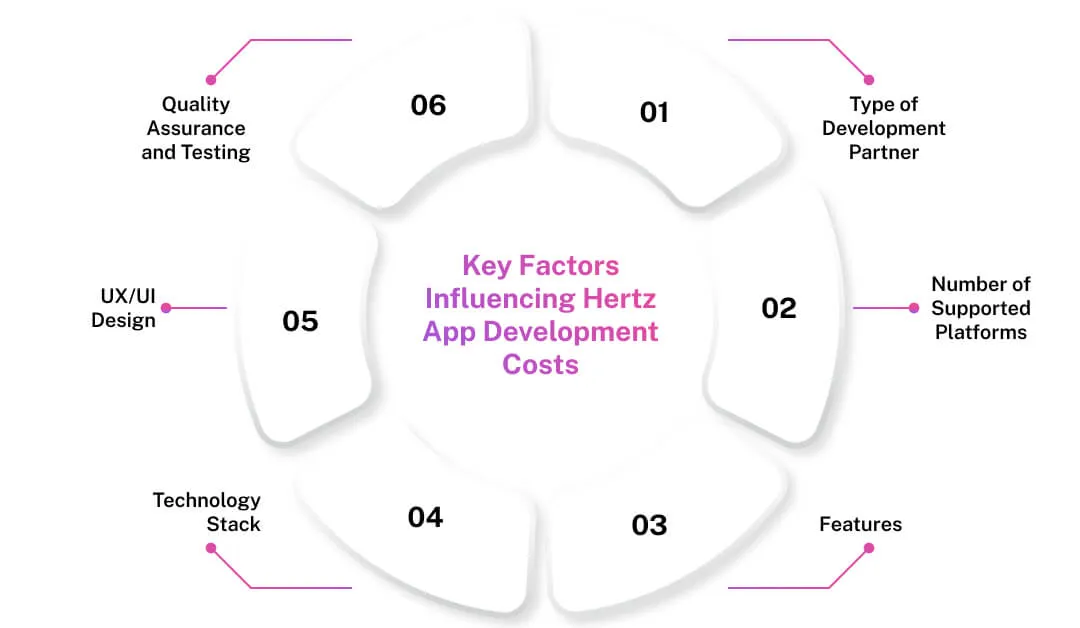
If you’re still with us, good, because this is where things start to get real. While app features play a big role in shaping the final price tag, there are plenty of other moving parts that can swing your budget up or down. Some are purely technical. Others are tied to your business choices and how you decide to bring your app to life.
Let’s take a look at the key factors that influence how much it actually costs to build an app like Hertz.
1. Type of Development Partner
Building a full-featured car rental platform isn’t a quick weekend project. It takes serious technical skill, consistent project management, and a whole lot of attention to detail. The type of team you hire to do the job will directly affect your timeline, cost, and overall experience.
Here are your main options:
Freelancers
This might sound like a cost-effective approach at first glance, but it can come with risks. Freelancers often work solo, which means limited support if something goes wrong. You might find yourself mid-project with unexpected delays, communication breakdowns, or having to start over if they back out. If you’re building a full-scale Hertz-style app, it’s a risky road.
In-House Team
Hiring your own developers gives you control, but it also comes with big responsibilities. You’re paying salaries, covering office expenses, managing onboarding, and dealing with HR, even when there’s not much work happening. For large companies, this can make sense. But for a startup or mid-sized business trying to launch fast and stay lean, this option often slows things down and burns through budget.
Outsourcing to a Development Agency
This is the sweet spot for a lot of companies. When you outsource to a professional app development agency, you get a full team: project managers, designers, developers, QA testers, all working together under one roof. They’re used to launching apps like this and usually offer clear timelines, built-in quality assurance, and tech support. If you want to stay focused on your business while experts handle the build, this is often the most efficient and cost-effective route.
2. Number of Supported Platforms
What mobile platform do your users prefer? Are they on Android, iOS, or both? One of the biggest mistakes you can make early on is assuming everyone uses the same device you do. Before you commit to anything, take a closer look at your audience. Where are they located? What devices do they typically use? The answers might surprise you.
Skipping this research can be a costly misstep. If you guess wrong, you could spend a good chunk of your budget developing for the wrong platform and end up missing a big portion of your potential users.
So why not build for both iOS and Android from the start?
You could, especially if your audience is evenly split across both platforms and you have the budget to go all in. But if you’re still validating your idea or watching your cash flow, it might be smarter to start with one platform, launch an MVP, and then expand based on real user feedback.
3. Features
This is where most of your budget ends up. Every feature you add brings value, but it also adds to the cost. Simple features like user login or location search are relatively affordable. But once you move into areas like AI-powered dynamic pricing, GPS tracking, or integrating digital car keys, the development hours add up quickly.
We’ll go deeper into the full feature list and cost breakdown in the next section, so feel free to keep reading or jump ahead if you want the numbers now.
4. Technology Stack
Your tech stack plays a big role in shaping your development cost. If you’re going with a traditional setup using frameworks like React Native or Flutter, the cost might stay reasonable. But once you start integrating more advanced technologies like machine learning, real-time tracking systems, or deep analytics, the budget starts to climb.
Some companies also invest in custom-built APIs, cloud hosting, and scalable infrastructure that can handle a growing user base. These decisions make sense in the long run but require more up-front investment.
5. UX/UI Design
You know how people say “don’t judge a book by its cover”? That doesn’t really apply in the app world. Users absolutely judge your app the second they open it. If it looks outdated, clunky, or hard to use, they’re gone. Probably off to your competitor.
Good UX and UI design go far beyond pretty screens. It’s about creating a clean, intuitive experience with the right layout, information structure, and flow. Every tap, scroll, and button should feel natural. And that takes real research. You need to understand your users, how they think, and what they expect.
This is where things like user personas, journey mapping, and wireframing come in. Add in branding elements like your logo, color palette, and custom icons, and it’s easy to see how design work adds up in both time and cost. But done right, it pays for itself by keeping users engaged and reducing churn.
6. Quality Assurance and Testing
Even the best-looking app can flop if it’s buggy or slow. That’s why testing isn’t optional. It’s essential.
During the quality assurance phase, your app is put through its paces across different devices, screen sizes, and operating systems. QA engineers look for bugs, broken flows, design glitches, and performance issues. They make sure every feature works as expected and that users won’t run into surprises that could lead to bad reviews or app uninstalls.
Testing covers everything from load times to crash points to whether your app behaves consistently on both Android and iOS. It’s a behind-the-scenes process, but one that directly shapes how your app performs once it goes live.
Hertz App Cost by Development Stages
Building a car rental app like Hertz is a step-by-step journey. Each stage plays a role in shaping the final product and the final cost. Here’s a clear breakdown of what those stages look like and what you can expect to invest at each one.
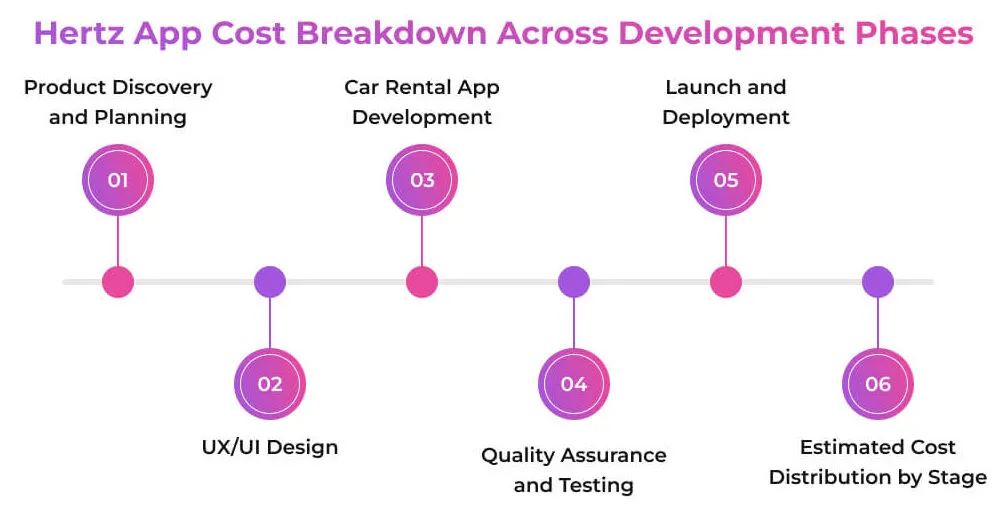
Product Discovery and Planning
Before a single line of code is written, you need a clear roadmap. The discovery phase is all about defining your app’s purpose, core features, and business logic. It’s where big ideas are broken down into a practical plan.
At this stage, you’ll work with business analysts, designers, and solution architects to validate your concept, understand your target audience, and map out technical and user requirements. You’ll also study competitors and identify where your app can stand out. This step helps avoid costly mistakes later by setting the right foundation.
Deliverables here typically include a rough estimate, a technical solution proposal, wireframe sketches, and a documented product plan with timelines.
Estimated timeline: 1 to 3 weeks
Estimated cost: $2,000 to $10,000
UX/UI Design
Your users expect a sleek, intuitive interface that works just as smoothly as the Hertz app. Design isn’t just about how things look. It’s about how easy the experience feels.
In this phase, your design team will create wireframes and polished mockups for all app modules, including the user side, admin panel, and potentially a fleet manager dashboard. The goal is to ensure that your app feels modern, functional, and aligned with your brand.
Estimated cost: $15,000 to $20,000
Car Rental App Development
This is the heart of the process and where most of your budget goes. It involves writing code for all core components, including the customer-facing app, the admin dashboard, and any backend infrastructure needed to support features like real-time availability, payments, GPS, and booking history.
Development costs vary widely depending on whether you choose native or cross-platform development and what features you’re adding in phase one. Basic apps cost less, but the more automation and advanced functionality you build in, the more hours and dollars it takes.
Estimated cost: $40,000 to $150,000
Quality Assurance and Testing
Before you launch, everything needs to be tested thoroughly. Your QA team will check the app across different devices and platforms to make sure it runs smoothly, loads quickly, and doesn’t surprise users with bugs or crashes.
Testing covers functional performance, security, usability, and how well the app handles different user scenarios. It’s your insurance policy against bad reviews and early uninstalls.
Estimated cost: $10,000 to $20,000
Launch and Deployment
Once the app is stable and ready, it’s time to push it live. This phase includes preparing the app for release on the App Store and Google Play, setting up your production servers, and integrating third-party services like analytics, crash reporting, and push notifications.
You’ll also want to plan for a soft launch or beta release to collect early user feedback before going fully public.
Estimated cost: $5,000 to $10,000
Estimated Cost Distribution by Stage
| Development Stage | Approximate Cost | Percentage of Budget |
|---|---|---|
| Discovery and Planning | $2,000 to $10,000 | 5% to 10% |
| UI/UX Design | $15,000 to $20,000 | 10% to 15% |
| App Development | $40,000 to $150,000 | 60% to 70% |
| Quality Assurance and Testing | $10,000 to $20,000 | 10% to 15% |
| Launch and Deployment | $5,000 to $10,000 | 5% to 10% |
Hertz App Cost by Features
Just like Uber, a Hertz-style car rental app is made up of several feature-packed modules, each serving a specific role in the platform. These modules work together to create a smooth experience for renters and an efficient backend system for your team. Below, we’ll break down the core components of a Hertz-like app and what each one typically costs to build.
Renter App (Customer App)
This is the app your users interact with the one they’ll use to search for vehicles, book rentals, manage their reservations, and handle payments. It needs to be sleek, responsive, and intuitive, especially since car rentals involve more steps than a basic ride-hailing app.
Here are the core features and their development implications:
Registration and Profile Setup
Let users quickly sign up with their email or social logins and manage their personal info, ID documents, and preferences.
Estimated dev time: 60 to 100 hours
Vehicle Search and Filters
Users should be able to search available vehicles by type, price, pickup location, rental dates, and more.
Estimated dev time: 100 to 160 hours
Booking System
The booking engine handles real-time availability, reservation management, rental duration selection, and vehicle locking.
Estimated dev time: 150 to 200 hours
Pickup and Return Flow
Guide users through the pickup process, provide directions to the lot or store, and allow digital check-in or return.
Estimated dev time: 80 to 120 hours
Payments and Billing
Support for credit cards, digital wallets, promo codes, and invoices. This also includes pricing logic for hourly or daily rates.
Estimated dev time: 100 to 150 hours
Push Notifications
Keep users informed with real-time alerts for booking confirmations, return reminders, promotions, and payment updates.
Estimated dev time: 60 to 100 hours
Trip History and Receipts
Let users review past bookings, download receipts, and rate their rental experience.
Estimated dev time: 60 to 80 hours
Admin Panel
The admin panel is your control center. It’s where you manage reservations, vehicles, pricing rules, users, and locations. A well-designed admin panel keeps your operations running smoothly and gives you full visibility into your business.
Here are the key features typically built into the admin side:
User and Booking Management
Admins can view customer profiles, booking history, current rentals, and any active issues that need attention.
Estimated dev time: 100 to 150 hours
Fleet Management
Manage your available vehicle inventory, maintenance status, fuel tracking, and vehicle availability based on location.
Estimated dev time: 120 to 180 hours
Pricing and Rules Engine
Set custom pricing rules for different vehicle types, dates, locations, and even loyalty discounts or surge pricing.
Estimated dev time: 80 to 120 hours
Analytics and Reporting
Visual dashboards to track total bookings, revenue trends, vehicle utilization rates, and user behavior over time.
Estimated dev time: 80 to 100 hours
Admin Roles and Permissions
Create role-based access to allow managers, support teams, and finance teams to handle specific tasks securely.
Estimated dev time: 40 to 60 hours
Depending on the complexity, a robust admin panel can cost between $10,000 and $45,000.
Backend Development
This is the behind-the-scenes engine that keeps your app running. It connects the renter app and admin panel, handles all data processing, and ensures everything stays in sync.
Here’s what’s typically included:
- User authentication and session management
- Real-time vehicle availability tracking
- Reservation logic and conflict handling
- Payment gateway integration and billing logs
- Push notification services
- Third-party API connections (Google Maps, Stripe, etc.)
- Secure data storage for user and vehicle data
Because of the level of coordination involved, backend development often takes more hours than individual app modules. For a Hertz-style platform, backend dev usually requires between 300 and 500 hours, with costs ranging from $15,000 to $40,000, depending on the tech stack and scalability needs.
Summary of Hertz App Cost by Feature Modules
| App Module | Estimated Dev Time | Approximate Cost |
|---|---|---|
| Renter App | 500 to 800 hours | $20,000 to $70,000 |
| Admin Panel | 300 to 450 hours | $10,000 to $45,000 |
| Backend System | 300 to 500 hours | $15,000 to $40,000 |
| Total (1 platform) | 1100 to 1750 hours | $45,000 to $155,000 |
Tips to Cut Hertz-Like App Development Cost
One of the first questions that comes up during planning is how to reduce the cost of building a car rental app like Hertz without cutting corners. The good news? There are smart, proven ways to bring down development costs while still delivering a high-quality product. Let’s walk through the most effective ones.
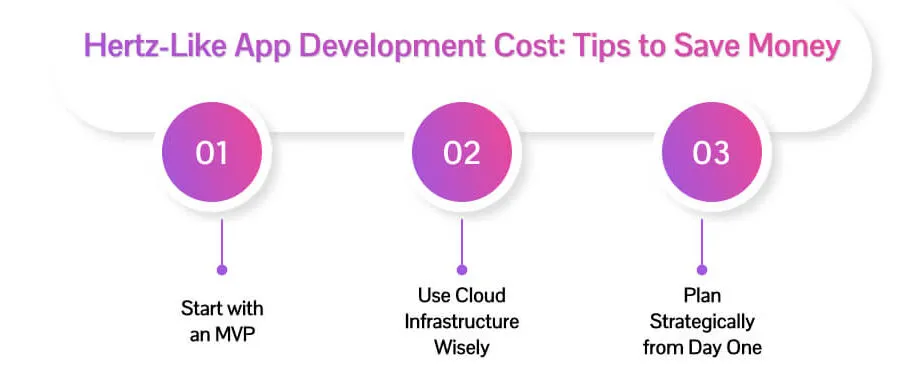
Start with an MVP
A Minimum Viable Product (MVP) is your shortcut to launching faster and spending smarter. Instead of trying to build every possible feature right out of the gate, you focus only on the essentials features like user registration, car search and booking, payments, and basic reservation management.
This lean approach helps you test the waters without burning through your entire budget. You get real-world feedback early, which helps guide future updates. For context, a basic MVP for a rental platform can cost between $30,000 and $50,000, while a full-scale enterprise version can easily go over $100,000. An MVP gives you control over your timeline, spend, and risk.
Use Cloud Infrastructure Wisely
Renting physical servers or building custom infrastructure from scratch can drain your budget fast. Instead, cloud-based services like AWS, Google Cloud, or Microsoft Azure offer scalable, cost-efficient solutions that grow with your app.
For a car rental app, this means you can handle spikes in traffic during peak seasons, manage large databases of cars and users, and keep data secure without overspending on maintenance. Modern cloud platforms also support microservices and serverless architecture, which can reduce long-term development costs by improving efficiency and reliability.
Plan Strategically from Day One
Poor planning leads to rework. Rework leads to overspending. The most cost-effective apps start with a solid plan and stick to it.
Work with a development partner who helps you:
- Identify your must-have features for the first release
- Set realistic timelines and budgets
- Prioritize features that bring immediate value
- Avoid unnecessary complexity in early phases
Prismetric – Your Reliable Partner for Hertz-Like App Development
Prismetric is a trusted custom AI app development company with over 13 years of experience delivering scalable, user-centric mobile and web solutions. We work with startups, SMEs, and enterprise clients across the globe to turn smart ideas into powerful digital products. That includes building car rental platforms inspired by industry leaders like Hertz.

Here’s what you get when partnering with Prismetric:
End-to-end car rental app development
From discovery and prototyping to development, testing, and post-launch support, we build fully tailored rental solutions that align with your goals. Whether you’re launching a new digital car rental service or upgrading an existing one, our team is ready to help.
Security and compliance at the core
We follow globally recognized standards for data privacy and platform security to protect your customers and your business at every level.
Smart system integrations
Our team can seamlessly connect your car rental app with third-party systems such as GPS tracking, payment gateways, identity verification tools, fleet management systems, and CRMs. These integrations help streamline your operations and improve the customer experience.
AI-ready architecture
We offer advanced AI integration services If you’re planning to include dynamic pricing, smart recommendations, or predictive maintenance, we can help. We use modern AI tools like TensorFlow, PyTorch, and Google AI to add intelligent features that scale with your business.
Transparent estimation process
You’ll get a clear breakdown of your project cost and timeline after the discovery phase. We provide structured estimates based on real project data so you know what to expect before writing a single line of code.
A Quick Look at Our Work
We helped a global car rental startup launch a mobile-first platform that made booking easier for travelers in over 20 cities. The solution included multi-language support, tiered pricing, digital ID verification, and a powerful admin dashboard for managing vehicles and reservations.
The result was a reliable and scalable rental app that combined real-time fleet tracking with a seamless user experience. It helped the client expand into new markets while staying lean and efficient.
Frequently Asked Questions
How do I create an app like Hertz?
If you want to create an app like Hertz, start by defining the core experience you want to offer. Think through the key features that matter most to your users, such as vehicle search, real-time availability, secure booking, and smooth payments. Next, map out your development plan with a skilled team who can guide you from idea to launch. That usually involves planning and discovery, design, backend and frontend development, and solid testing before putting the app in users’ hands. Working with experienced developers or a trusted agency can make the process more predictable and efficient.
How much does it cost to create an app like Hertz?
The cost to build a car rental app like Hertz depends on the features, complexity, platforms, and region of your development team. A basic version with essential features like search, booking, and payments can cost between $20,000 and $50,000. If you want a more advanced solution with dynamic pricing, smart dashboards, real-time vehicle tracking, and admin controls, the total cost often falls between $50,000 and $150,000. For enterprise-level apps with custom backend architecture, the cost can go even higher.
What factors influence Uber-like app development cost?
Many different elements come into play when estimating the total cost of building a car rental app. From design to tech stack, your decisions at each step can have a big impact on the final price.
Here are some of the most common cost factors:
- Features and functionality: More features like GPS, payments, or in-app chat add more development hours.
- Platform choice: Building for both iOS and Android increases cost compared to just one.
- Design complexity: Custom user interface and animations require more time and effort.
- Backend and APIs: Secure, scalable backend systems and third-party integrations raise development cost.
- Development team location: Rates vary by region. US and Western Europe are more expensive than South Asia or Eastern Europe.
- Quality assurance and testing: Testing across devices and platforms adds time but helps avoid costly bugs later.
- Post-launch support: Ongoing maintenance, updates, and hosting also need to be factored into the overall budget.

Vijay Chauhan is a pro vibe coder with a passion for AI development and innovation. With deep expertise in crafting smart tools, he knows how to make AI dance to the rhythm of natural language. Always eager to share knowledge, Vijay blends tech mastery with creativity to build next-gen AI experiences.
Our Recent Blog
Know what’s new in Technology and Development
30 Sep, 2025
How Long Does It Take to Build an AI App?

7 Mar, 2025
Vue.js Core Concepts and Features
14+Years’ Experience in IT
Prismetric Success Stories
0+
Happy Clients
0+
Solutions Developed
0+
Countries
0+
Developers