AI PoC Development Process: Step-by-Step Guide
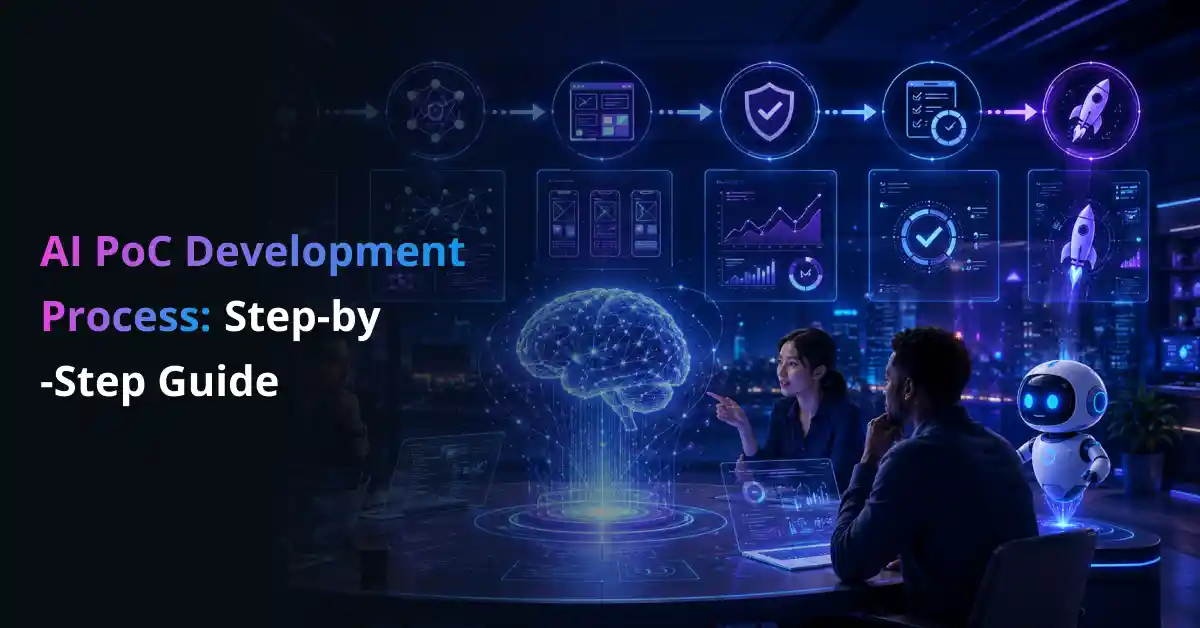
An AI Proof of Concept (PoC) is essential for businesses looking to validate the feasibility, accuracy, and business value of an AI solution before moving toward full-scale development.
Now, we will explore the practical aspects of creating an AI PoC. At Prismetric, we follow a structured AI PoC development process to ensure each solution is aligned with your business goals, data capabilities, and long-term product vision.
This step-by-step guide will walk you through our approach, showcasing how we turn AI ideas into validated, scalable, and business-ready solutions.
AI PoC Development Framework: A Quick Overview
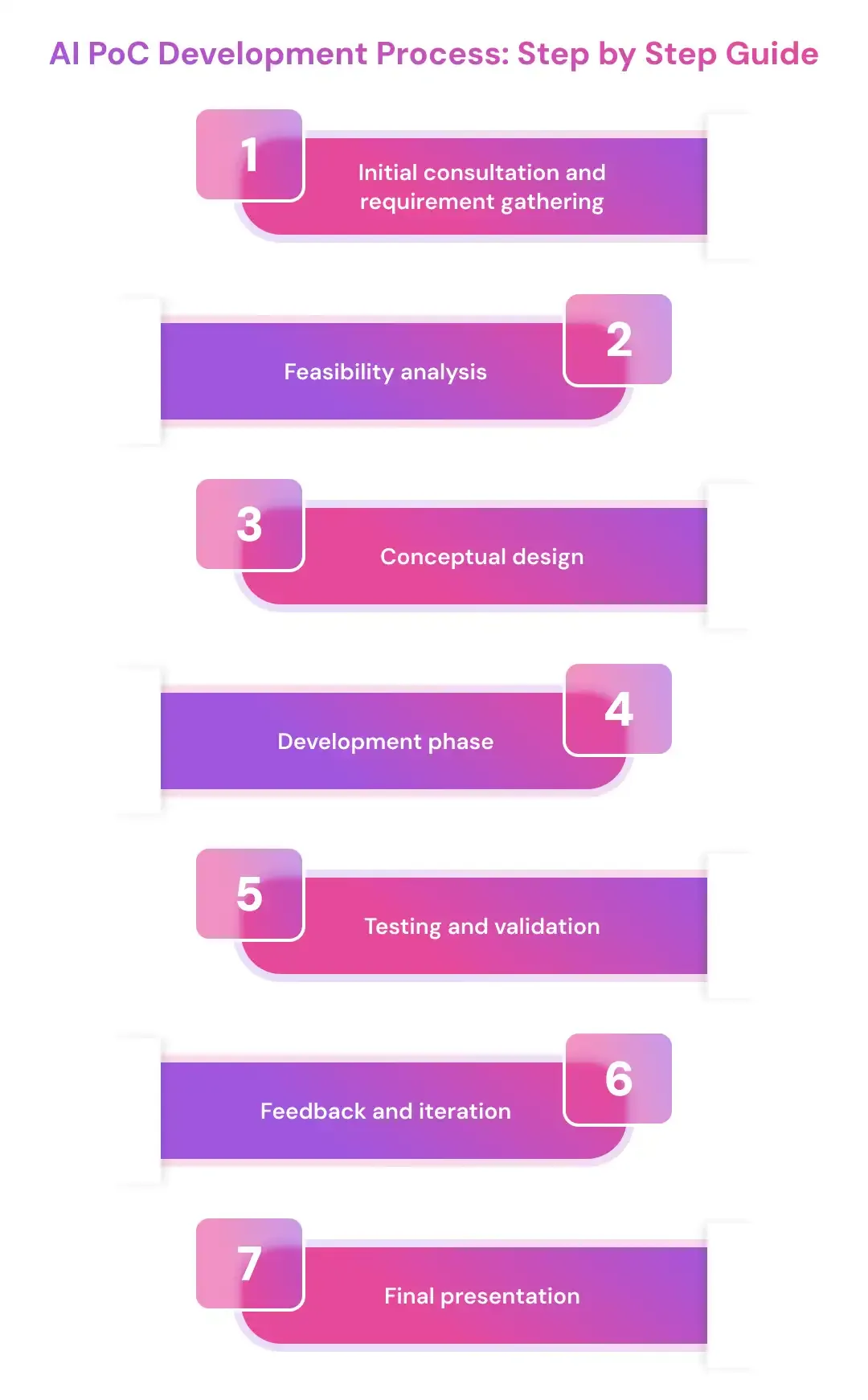
An AI PoC follows a structured process that helps businesses validate the feasibility, performance, and business value of an AI solution before investing in full-scale development. Here is a quick overview of the complete AI PoC development process.
| Step |
Stage |
Key Focus |
Process |
Outcome |
| Step 1 |
Initial consultation and requirement gathering |
Understanding the business problem, goals, users, and AI expectations |
Business consultation, requirement documentation, and objective clarification |
A clear requirement specification document for the AI PoC |
| Step 2 |
Feasibility analysis |
Assessing technical viability, data readiness, and business feasibility |
Technical assessment, data readiness review, and risk analysis |
A feasibility report with insights, risks, and recommendations |
| Step 3 |
Conceptual design |
Defining how the AI solution will work and fit into the business workflow |
AI workflow design, model approach planning, and prototype architecture |
A conceptual AI PoC design with technical and visual direction |
| Step 4 |
Development phase |
Building the core AI functionality needed to prove the concept |
Agile development, core AI feature development, and regular updates |
A functional AI PoC that demonstrates the proposed AI solution |
| Step 5 |
Testing and validation |
Checking performance, accuracy, usability, and business alignment |
Functional testing, model performance testing, and user testing |
A validated AI PoC ready for iteration or scale planning |
| Step 6 |
Feedback and iteration |
Refining the AI PoC based on user, stakeholder, and technical feedback |
Feedback collection, implementing changes, and re-testing |
An improved AI PoC aligned with business goals and user expectations |
| Step 7 |
Final presentation |
Presenting results and planning the next stage of AI development |
Demonstration, stakeholder review, and next steps planning |
A successful AI PoC presentation with clear scaling recommendations |
Reduce AI Development Risk Early
Prismetric develops AI PoCs that help businesses assess feasibility, accuracy, usability, and scaling potential.
Talk to Experts
AI PoC Development Process: 7-Step Guide
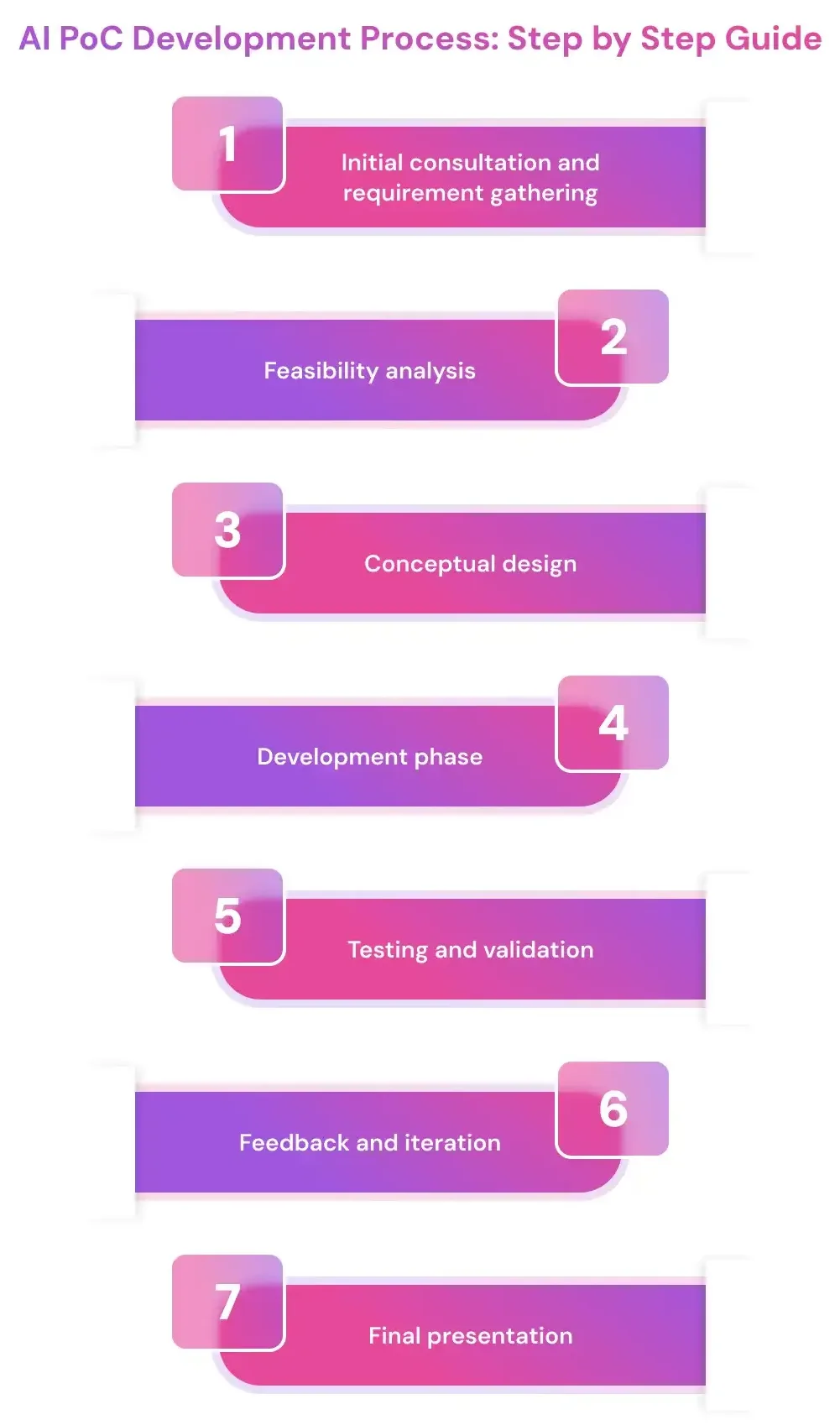
Step 1: Initial consultation and requirement gathering
The first step in the AI PoC development process is understanding your business problem, objectives, and AI expectations. This involves detailed discussions to capture your use case, success metrics, data availability, and operational challenges.
Process:
- Business consultation: We organize meetings with key stakeholders to understand the problem, target users, workflow gaps, and expected business outcomes.
- Requirement documentation: We document the functional requirements, AI capabilities, data sources, integration needs, and compliance considerations.
- Clarifying objectives: We define the core problem your AI PoC aims to solve and the key assumptions that need to be validated.
Outcome:
A clear and detailed requirement specification document that serves as the foundation for the AI PoC development process.
Step 2: Feasibility analysis
The next step is conducting a feasibility analysis to assess the technical, data, and business viability of your AI proof of concept. This helps identify potential risks, limitations, and opportunities early on.
Process:
- Technical assessment: We evaluate the required AI models, algorithms, tools, APIs, cloud infrastructure, and integration possibilities.
- Data readiness review: We assess the availability, quality, volume, format, and governance of the data needed to train or test the AI solution.
- Risk analysis: We identify potential risks related to accuracy, bias, privacy, security, scalability, cost, and user adoption.
Outcome:
A feasibility report that provides insights into the technical and business viability of your AI PoC, along with data readiness findings and risk mitigation strategies.
Step 3: Conceptual design
Once the feasibility is clear, we move to conceptual design. This step helps visualize how the AI solution will work, how users will interact with it, and how the AI model will fit into the existing business workflow.
Process:
- AI workflow design: We create user flows, system flows, and AI decision paths to define how the solution will process inputs and generate outputs.
- Model approach planning: We identify whether the AI PoC requires machine learning, generative AI, natural language processing, computer vision, predictive analytics, or API-based AI integration.
- Prototype architecture: We design the high-level architecture, including data pipelines, model components, integrations, user interface elements, and deployment environment.
Outcome:
A conceptual AI PoC design that provides a clear visual and technical direction for building the AI prototype.
Step 4: Development phase
With a solid design in place, our development team begins building the core version of the AI PoC. This phase focuses on developing the essential features needed to prove the concept and validate its business potential.
Process:
- Agile methodology: We follow an agile development approach, breaking the AI PoC development process into focused sprints for faster execution and regular validation.
- Core AI feature development: We develop the main AI functionality, train or configure the model, connect data sources, and build the minimum required interface.
- Regular updates: We provide frequent progress updates, review sessions, and technical insights to ensure the PoC stays aligned with your goals.
Outcome:
A functional AI PoC that demonstrates the core capabilities of the proposed AI solution and shows how it can solve the defined business problem.
Step 5: Testing and validation
Testing is a crucial step in the AI PoC development process. It ensures the AI solution performs as expected, produces reliable outputs, and meets the success criteria defined during the initial consultation.
Process:
- Functional testing: We test the AI PoC to verify that each feature, workflow, integration, and user action works as planned.
- Model performance testing: We evaluate the AI model for accuracy, consistency, response quality, speed, bias, and relevance based on the selected use case.
- User testing: We involve stakeholders and domain users to review the AI outputs, validate business logic, and identify areas for improvement.
Outcome:
A validated AI PoC that confirms whether the solution is technically reliable, business-ready, and suitable for further iteration or full-scale development.
Step 6: Feedback and iteration
After testing, we collect feedback from stakeholders, users, and technical teams to improve the AI PoC. This step helps refine the solution, address performance gaps, and ensure the AI output aligns with real business needs.
Process:
- Feedback collection: We gather feedback from users, decision-makers, and domain experts to understand how the AI PoC performs in practical scenarios.
- Implementing changes: We improve the model, update workflows, adjust features, enhance prompts, optimize data processing, and refine the user experience.
- Re-testing: We test the updated AI PoC again to ensure the improvements deliver better accuracy, usability, and business value.
Outcome:
An improved and refined AI PoC that is better aligned with your business goals, user expectations, and technical requirements.
Step 7: Final presentation
The final step in the AI PoC development process is presenting the completed PoC to stakeholders. This includes demonstrating the AI solution, explaining the results, and discussing the next steps for full-scale development.
Process:
- Demonstration: We present the AI PoC to showcase its core features, model performance, user workflows, and business impact.
- Stakeholder review: We review the results, success metrics, limitations, cost considerations, and improvement areas with your key stakeholders.
- Next steps planning: We provide recommendations for scaling the AI solution, integrating it with existing systems, improving security, and preparing it for production.
Outcome:
A successful AI PoC presentation that provides clear insights into the solution’s feasibility, business value, and readiness for full-scale AI development.
Developing an AI PoC is a strategic way to validate your AI idea before investing in complete product development. A structured AI PoC development process helps businesses reduce risk, test data readiness, measure performance, and make confident decisions.
At Prismetric, we help businesses transform AI concepts into practical, validated, and scalable solutions. Whether you want to automate workflows, enhance decision-making, improve customer experiences, or build an AI-powered product, our AI development experts can help you move from idea to ai implementation with clarity and confidence.
Ready to validate your AI idea? Contact Prismetric today and take the first step toward building a successful AI solution.
Validate Your AI Idea Before Scaling
Prismetric builds AI PoCs to test feasibility, data readiness, model performance, and business value.
Start Your AI PoC
How Prismetric Can Help You with AI PoC Development
Building an AI PoC requires more than selecting a model and testing it with sample data. It needs the right strategy, clean data, practical AI expertise, secure architecture, and a clear roadmap for scaling the solution after validation.
At Prismetric, we offer AI PoC development services to help businesses plan, design, develop, test, and validate AI PoCs that solve real business problems. Our AI development experts work closely with you to understand your goals, assess your data readiness, choose the right AI approach, and build a functional prototype that proves the value of your idea.
Process:
- AI consulting and strategy: We analyze your business challenge, define the AI use case, set measurable goals, and create a clear development roadmap for your AI PoC.
- Custom AI PoC development: We build AI prototypes using machine learning, generative AI, NLP, computer vision, predictive analytics, LLMs, and AI integration based on your project needs.
- Data and model validation: We evaluate your data quality, test model performance, validate AI outputs, and ensure the PoC delivers reliable and useful results.
- Scalable architecture planning: We design the AI PoC with future scalability in mind, so the solution can move smoothly from validation to full-scale development.
- Integration support: We connect the AI PoC with your existing software, workflows, APIs, cloud systems, and business tools to make it practical for real use.
- Continuous improvement: We collect feedback, refine the model, optimize workflows, and help you decide whether to iterate, scale, or move toward production.
Outcome:
A business-ready AI PoC that helps you validate technical feasibility, measure business impact, reduce development risks, and make confident decisions before investing in a complete AI solution.
Whether you want to automate workflows, improve customer support, build an AI chatbot, develop a predictive analytics solution, integrate generative AI, or create an AI-powered product, Prismetric can help you turn your idea into a validated AI solution.
Partner with Prismetric to build an AI PoC that is practical, scalable, and aligned with your business goals.
Frequently Asked Questions About AI PoC Development Process
An AI PoC, or AI Proof of Concept, is a small-scale experiment used to test whether an AI idea is technically feasible, practically useful, and valuable for the business. It helps validate the AI solution before investing in full-scale development.
An AI PoC is important because it helps businesses reduce risk, test data readiness, validate model performance, and measure business value early. It allows stakeholders to make informed decisions before committing more time, budget, and resources to complete AI development.
The main steps in the AI PoC development process include requirement gathering, feasibility analysis, conceptual design, development, testing and validation, feedback and iteration, and final presentation. These steps help move an AI idea from concept to validated prototype.
The timeline for building an AI PoC depends on the complexity of the use case, data availability, AI model requirements, integrations, and testing needs. A simple AI PoC may take a few weeks, while a complex AI solution with custom models and multiple data sources may take longer.
The cost of AI PoC development depends on factors such as project scope, data preparation needs, model complexity, technology stack, infrastructure, integrations, and development timeline. Businesses should first define the problem, success metrics, and required features to estimate the cost accurately.
An AI PoC usually requires relevant, clean, and accessible data that supports the selected use case. This may include historical business data, customer data, operational data, documents, images, text, audio, or third-party data sources, depending on the AI solution being developed.
Yes, an AI PoC can sometimes be built without a large dataset, especially when using pre-trained models, generative AI APIs, synthetic data, or limited sample data. However, the quality and relevance of the data still play an important role in validating the AI solution.
The success of an AI PoC is measured using predefined KPIs such as accuracy, response quality, processing speed, automation efficiency, cost savings, user satisfaction, error reduction, or business impact. These metrics should be defined before development begins.
An AI PoC tests whether an AI idea is feasible and valuable. A prototype shows how the solution may look and function. An MVP is a usable product version with core features that can be released to early users. In simple terms, a PoC proves the idea, a prototype visualizes it, and an MVP makes it usable.
After a successful AI PoC, businesses can move toward full-scale AI development. This may include improving the model, strengthening security, scaling infrastructure, integrating the solution with existing systems, enhancing user experience, and preparing the AI solution for production deployment.
Common challenges in AI PoC development include poor data quality, unclear business goals, unrealistic expectations, model accuracy issues, integration complexity, compliance concerns, and lack of stakeholder alignment. A structured AI PoC development process helps identify and manage these challenges early.
An AI PoC can use technologies such as machine learning, generative AI, natural language processing, computer vision, predictive analytics, recommendation engines, large language models, chatbots, and AI automation tools. The right technology depends on the business problem and expected outcome.
Prismetric offers AI PoC development services to help businesses validate AI ideas with clarity and confidence. Our team helps you define the use case, assess data readiness, choose the right AI approach, build the prototype, test performance, and plan the next steps for scalable AI development.
Yes, AI PoC development is useful for startups because it helps validate an idea before investing heavily in full product development. It allows startups to test feasibility, attract stakeholder confidence, reduce technical uncertainty, and build a stronger roadmap for future development.
Yes, an AI PoC can be integrated with existing software, APIs, databases, cloud platforms, CRMs, ERPs, mobile apps, or web applications. Integration helps businesses test how the AI solution will work within their current workflows and systems.