“Working with Prismetric was a straightforward experience from day one. Their staff understood what we wanted to create and helped turn our idea into a practical AI product. They kept us informed, responded promptly, and handled every stage professionally. The solution matched our business needs well, and I would happily work with their team again.”
Marc De Chellis
Product Director- Launchpad Apps
“We had a positive experience with Prismetric while developing our AI product. Their team was professional, responsive, and willing to share ideas that improved the outcome. Communication was clear, deadlines were handled well, and the project stayed on track. They made things easy for our team, and we would gladly work with Prismetric on projects.”
Richard Tellier
President TellAText LLC
“Prismetric did a great job from planning through delivery. Their team understood the project, communicated well, and kept things moving without making the process complicated. They were reliable, easy to work with, and paid attention to the details. I would recommend them to anyone looking for a dependable team for AI development and product work.”
Curt Hayes
President Audio Design Inc
“Prismetric made the development process easy to understand from the beginning. Their team kept us updated, answered questions quickly, and handled changes without confusion. They were professional, helpful, and focused on making sure it worked properly. I was happy with how the AI project turned out and would gladly work with them again in future.”
Table of Contents
How Much Does It Cost to Build an AI Solution in 2026?
Pre-trained models and open-source tools help cut costs by reducing development time and compute requirements.
Outsourcing to skilled global teams lowers expenses while maintaining access to AI engineers, researchers, and MLOps talent.
AI is no longer just a buzzword. It is rapidly becoming the backbone of how businesses innovate, operate, and grow.
In 2026, the race to build smarter systems is more intense than ever. From startups exploring AI chatbots to enterprises scaling large language models, the adoption wave is in full motion. Companies are investing heavily to stay ahead. According to market forecasts, the global AI industry is projected to cross 826 billion U.S. dollars in 2030, fueled by rising enterprise adoption, smarter tools, and widespread automation needs.
AI is powerful, yet it is not cheap. The cost of developing AI solutions can vary massively. A simple rule-based assistant may cost tens of thousands, while advanced generative AI models could stretch into hundreds of thousands or more. Without a clear understanding of what drives these costs, businesses risk budget overruns, missed deadlines, or underperforming solutions.
This guide simplifies the complexity. It breaks down the real cost of AI development in 2026. You will learn:
Average AI development costs
What affects AI development pricing
Current cost ranges based on solution type and complexity
Key pricing models and cost breakdowns
Practical tips to optimize your AI budget
Disclaimer: AI pricing is never one-size-fits-all. This guide offers estimated ranges, cost benchmarks, and proven frameworks. Actual pricing depends on your unique needs, data, technology choices, and team setup.
By the end, you will have a clear picture of how much does it cost to build an AI solution. Finally, you will discover how to make AI a smart investment, regardless of your business size.
Table of Contents
Average AI Development Cost in 2026
AI solutions are not one-size-fits-all, and neither are their prices. Whether you are building a proof of concept or launching a complex GenAI system, the cost can swing dramatically.
Here is a realistic breakdown of AI development costs in 2026 based on solution complexity:
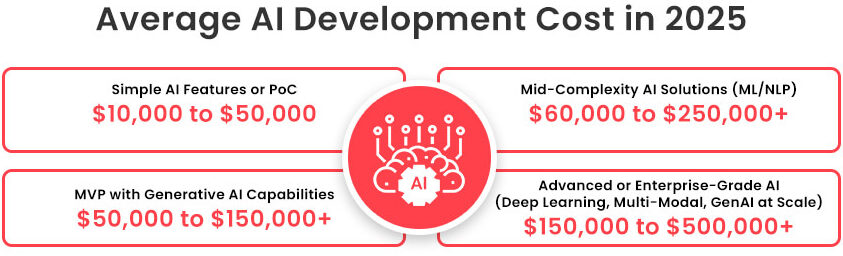
Estimated Average Cost Ranges by AI Project Type
check below mentioned AI project types and their costs to get the clear idea:
Simple AI Features or PoC: $10,000 to $50,000 This is ideal for early-stage testing, these projects usually involve basic rule-based logic or simple automation.
MVP with Generative AI Capabilities: $50,000 to $150,000+ A minimum viable product using GenAI often includes fine-tuning on pre-trained models like GPT or LLaMA. Ideal for startups validating market potential.
Mid-Complexity AI Solutions (ML/NLP): $60,000 to $250,000+ These projects include custom model development, predictive analytics, or NLP pipelines. They often require structured datasets, trained models, and robust deployment workflows.
Cost to Build an Advanced or Enterprise-Grade AI (Deep Learning, Multi-Modal, GenAI at Scale): $150,000 to $500,000+ — even exceeding $1M These solutions support high-accuracy performance, multi-system integrations, and serve enterprise workloads. They typically demand large datasets, heavy compute, and advanced infrastructure.
Why These Ranges Vary So Widely
You should understand that AI development is not just about coding. It is a fusion of data readiness, model accuracy, domain expertise, and infrastructure scalability. A few key drivers that push costs up or down include:
Project Complexity: More features mean more development time, testing, and customization.
Data Needs: If you need to collect, clean, or label large datasets, costs can spike quickly.
Infrastructure: Training models using high-performance GPUs or TPUs can cost thousands per hour.
Key Factors Affecting AI Development Costs in 2026
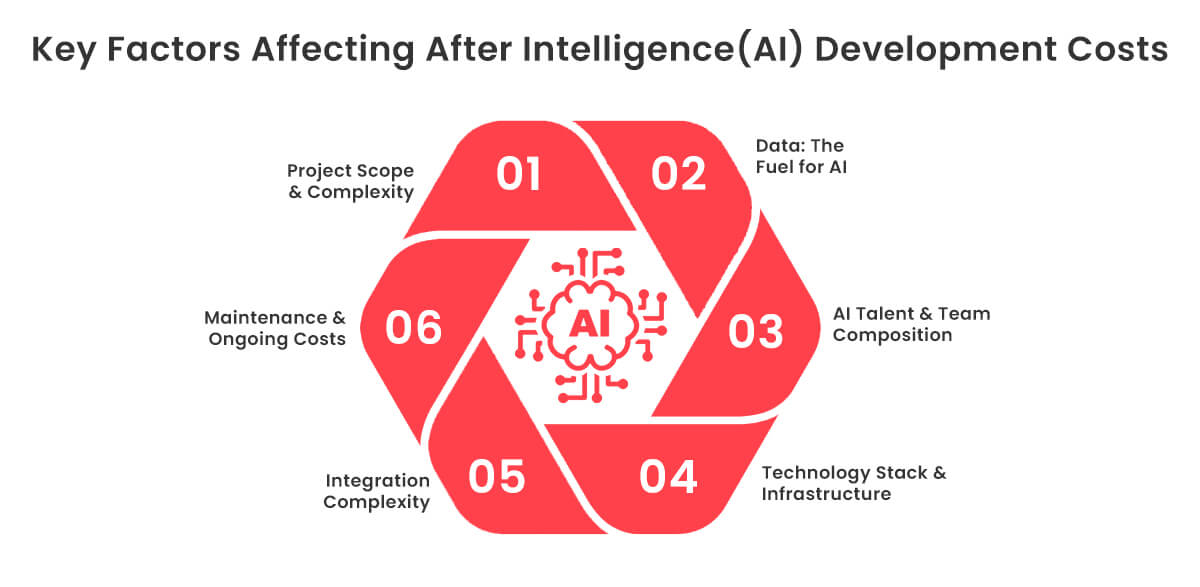
AI development is not just about coding models. It is an intricate process that depends on what you build, how you build it, and who builds it for you. Let’s break down the core factors that influence costs—and why they matter more than ever in 2026.
1. Project Scope and Complexity
Not all AI project is created equal. A rule-based chatbot and a generative AI writing assistant serve different purposes and come with very different price tags.
Rule-Based Systems: These are logic-driven. Costs stay low but capabilities are limited.
Machine Learning Models: More flexible, but require clean data and iterative training.
Deep Learning Solutions: Handle complex tasks like image or speech recognition. Need large datasets and powerful infrastructure.
Generative AI (LLMs): Tools like GPT, LLaMA, or Claude demand intensive compute and fine-tuning expertise.
The complexity also scales with:
The number of features
Desired accuracy and performance
Level of automation you expect
Businesses now expect multi-modal, conversational GenAI tools. These next-gen features mean bigger workloads, more fine-tuning, and higher development costs.
2. Data and Dataset Size
AI is only as good as the data it learns from. And data is not free—either in cost or effort.
Data Acquisition: Whether you’re buying third-party datasets, scraping public data, or generating synthetic data, expect costs between $1,000 and $100,000+, depending on quantity and quality.
Data Preparation: Cleaning, labeling, and annotating data can take up to 30% or more of the entire project cost—anywhere from $5,000 to $100,000+.
Data Volume & Quality: More data does not always mean better results. But poor data always means higher training costs.
Storage & Management: Cloud storage can cost between $200 and $2,000+ per month, depending on scale.
With stricter data privacy laws like GDPR and CCPA evolving, sourcing proprietary, regulation-compliant data is more costly—and more essential.
3. AI Talent and Team Composition
Artificial intelligence solution is not built by one person. It requires a cross-functional team with deep expertise.
Compute costs range from $500 to $10,000+ per month, based on usage.
Hardware Needs:
Training large models may require NVIDIA A100 or H100 GPUs, which can cost $3 to $20+ per hour per instance if rented.
On-premise setup is possible but often more expensive upfront.
MLOps Tools: Deployment, monitoring, and version control are critical—especially in 2026 where models need continuous updating.
2026 Insight: MLOps maturity is growing, but tooling is becoming more specialized and sometimes more expensive. Cloud optimization is now essential to keep costs predictable.
5. Integration Complexity
AI never works in isolation. It needs to connect with your existing tech ecosystem.
Common Integration Needs:
CRMs, ERPs, custom dashboards
APIs, legacy databases
Security protocols and compliance layers
Cost Range: Expect to spend an additional $5,000 to $100,000+, depending on how well your current system is structured.
AI does not end at deployment. Post-launch expenses are often overlooked but critical to long-term success.
Typical Ongoing Costs Include:
Model Monitoring: Tracking performance and accuracy over time.
Retraining: Adjusting for data drift or changing conditions.
Infrastructure Costs: Compute resources to serve predictions.
Support & Bug Fixes: Regular improvements and patching.
Annual Cost Estimate: Maintenance usually consumes 15–25% of the initial development cost annually.
With more businesses deploying models in live environments, continuous retraining and MLOps integration are not optional—they are now expected.
AI Development Cost Breakdown: Key Areas of Spending
Knowing the total cost of an AI project is useful. But understanding how that cost is distributed is essential for better planning and smarter decisions.
Whether you’re budgeting for a prototype or a full-scale system, here’s how AI development costs typically break down—by both development phase and project type.
1. Cost by Development Phase
Each phase of AI development carries its own weight—and cost. The more complex the project, the more time and resources each step requires.
Here’s how budgets usually get allocated across the full AI lifecycle:
Discovery & Planning (5–15%) This is where the foundation is laid. Research, goal setting, and PoC (proof of concept) development happen here. The goal is to validate ideas and define a clear path forward.
Data Preparation & Feature Engineering (15–30%) Before you can train a model, the data must be cleaned, labeled, and structured. A big part of the process is choosing the right inputs, known as feature engineering. This step takes a significant portion of time and budget.
Model Development & Training (20–40%) This is the heart of the project. It involves selecting algorithms, training models, tuning performance, and evaluating results. GenAI or deep learning models often push this phase toward the higher end.
Integration & Deployment (10–20%) Once your model works, it must be connected to your live system. That includes backend integration, APIs, frontend layers, and deployment to cloud or edge servers.
Testing & QA (10–15%) Testing ensures everything works as expected. This includes unit testing, performance testing, security validation, and user feedback cycles.
2. Cost by Project Type
AI projects come in all shapes and sizes. Here’s how costs break down by type of engagement—each with different scopes, timelines, and outcomes.
Proof of Concept (PoC)
Focus: Validating the idea
Duration: 2 to 10 weeks
Typical Cost:$10,000 – $100,000
A PoC answers the question: “Can this work?” It’s best for early-stage exploration, stakeholder buy-in, or technical feasibility checks. Minimal data, limited automation, and no production deployment.
Minimum Viable Product (MVP)
Focus: Market testing and user feedback
Duration: 3 to 6 months
Typical Cost: $50,000 – $150,000+
An MVP delivers a functional AI product with essential features. Common in startups or early-stage innovation teams. May include fine-tuned GenAI models, simple dashboards, or user-facing tools.
Full-Scale Implementation
Focus: Enterprise-grade deployment
Duration: 6 to 12+ months
Typical Cost: $100,000 – $500,000+
This is where AI becomes a long-term asset. Includes multiple model integrations, heavy compute needs, regulatory compliance, and full MLOps setup. Most often used by larger businesses scaling across teams or regions.
3. Cost by AI Solution Type (2026 Examples)
Different types of AI solutions come with different price tags. Some are quick to deploy and easy to scale. Others require deep expertise, complex models, and extensive compute resources.
Here’s what to expect when budgeting for specific AI solution in 2026:
Common AI trend in retail, media, and e-learning. Requires behavioral data and ML models.
Predictive Analytics Systems
$60,000 – $300,000+
Used in finance, logistics, and healthcare. Accuracy depends on historical data quality.
Computer Vision Systems
$80,000 – $400,000+
Applications include object detection, facial recognition, and visual QA in manufacturing.
Natural Language Processing (Custom Models)
$100,000 – $300,000+
Includes custom-built NER, sentiment analysis, and language models tailored for specific tasks.
Generative AI Solutions (Text, Image, Code)
$50,000 (MVP) – $500,000+
Includes tools for content creation, code suggestions, or art generation. Based on LLMs or diffusion models.
Here you can see that not all AI is equal. The type of AI you’re building directly impacts the cost. Align your solution with clear goals and right-size your investment.
4. Cost by Industry (Estimated Ranges for 2026)
The cost of AI implementation also varies by industry. Regulations, data sensitivity, and use case complexity play major roles in defining the budget.
Here are typical 2026 cost ranges by sector:
Industry
Estimated Cost Range (2026)
Key Cost Drivers
Healthcare
$80,000 – $600,000+
Patient data privacy, HIPAA compliance, diagnostic accuracy, and clinical integrations.
Finance
$100,000 – $800,000+
High-security demands, regulatory checks, fraud detection, and precision forecasting.
Retail / E-commerce
$50,000 – $400,000+
AI for personalization, inventory prediction, chatbot support, and dynamic pricing.
Manufacturing
$60,000 – $500,000+
IoT sensor data processing, quality control using vision, predictive maintenance.
Note: These numbers represent average estimates. Within each industry, costs vary based on the specific solution being developed, existing system readiness, and team experience.
Custom AI Development vs Off-the-Shelf AI Solutions: Which is Right for You?
Choosing between building a custom AI solution or using a pre-built AI tool depends on your goals, timeline, and how much control you need. Here’s a detailed comparison to help you decide which one is right for you:
Factor
Custom AI Development
Off-the-Shelf AI Solutions
Flexibility & Customization
Fully tailored to your workflows, goals, and data
Limited to pre-defined features and functions
Speed of Deployment
3 to 12+ months depending on scope and complexity
Days to weeks, often ready out-of-the-box
Initial Cost
Higher ($50,000 – $500,000+)
Lower ($5,000 – $50,000)
Long-Term ROI
High when scaled; supports growth and evolving needs
Moderate; may require upgrades or migration later
Data Ownership & Control
Full control of data and model IP
Data may be shared with the provider
Integration Capability
Seamlessly integrates with your internal systems and APIs
May lack connectors for legacy or custom software
Scalability
Built to scale with your business
May hit limitations as usage grows
Security & Compliance
Can be designed to meet strict industry-specific standards
May not meet all compliance needs (HIPAA, GDPR, etc.)
Innovation Potential
Enables unique solutions, competitive advantage
Offers generic capabilities shared across users
Vendor Lock-In Risk
Low—solution is owned and managed by you or your provider
High—tied to the platform’s roadmap and limitations
Maintenance & Support
Requires ongoing support, monitoring, and updates
Usually includes standard support, limited flexibility
Best Suited For
Businesses with unique needs, large datasets, or compliance-heavy industries
Startups, SMEs, or businesses needing quick wins
Pricing Models for AI Development
How you pay for AI development can be just as important as how much you pay. Choosing the right pricing model impacts flexibility, risk, and overall cost-efficiency.
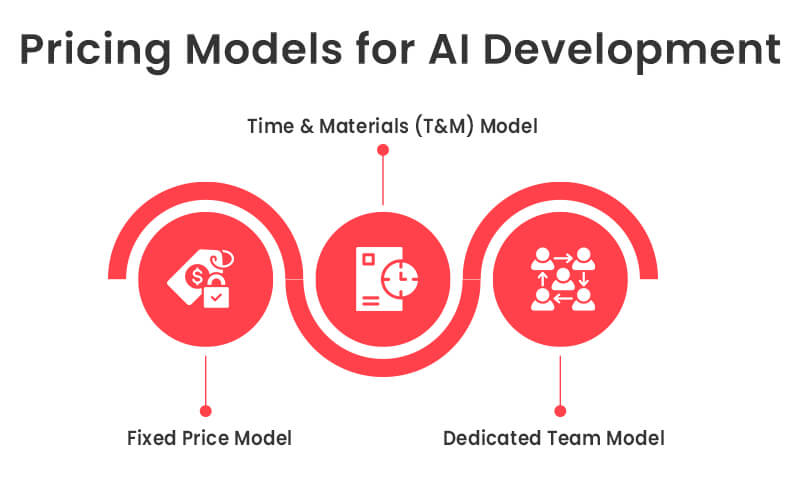
Here are the most common pricing models used in 2026 and when each one makes sense.
Fixed Price Model
In this model, the total cost is agreed upon upfront. It works best when the project scope, timeline, and deliverables are clearly defined.
Pros:
Predictable budget with no surprises
Clear milestones and timelines
Minimal client involvement once scope is finalized
Cons:
Limited flexibility to adapt or change features
Scope creep can lead to renegotiation or delays
Often comes with buffer pricing to cover unknown risks
Best For:
Proof of Concept (PoC)
Small tools with limited complexity
Well-scoped MVPs with clearly defined outcomes
Time and Materials (T&M) Model
With T&M, you pay for actual hours worked and materials used. It’s ideal when the project needs room to evolve.
Pros:
Flexible for changing requirements or ongoing feedback
Encourages iterative development and experimentation
Closer collaboration with developers
Cons:
Less budget predictability
Requires more client oversight and project management
Costs can grow if scope expands continuously
Best For:
MVPs or mid-scale AI systems
Projects where experimentation or testing is key
Teams working with agile methodology
Dedicated Team Model
You hire a full AI team that works exclusively on your project. This model offers the highest level of control and scalability.
Pros:
Full access to a team with specific expertise
Long-term commitment builds deep product understanding
Ideal for ongoing updates, retraining, and scaling
Cons:
Higher upfront cost commitment
Needs clear leadership and coordination on your end
Not suitable for short-term or small-scope projects
Best For:
Enterprise-grade AI projects
Generative AI solutions requiring continuous improvement
Businesses looking to build and maintain in-house AI capabilities over time
Which Model Should You Choose?
Project Type
Recommended Pricing Model
Proof of Concept (PoC)
Fixed Price
MVP with evolving scope
Time and Materials
Full-scale enterprise system
Dedicated Team
Research-heavy, exploratory
Time and Materials or Hybrid Model
Tips to Reduce AI Development Costs in 2026
AI can be expensive but it doesn’t have to break the bank. With the right strategy, businesses can build powerful AI solutions while staying within budget.
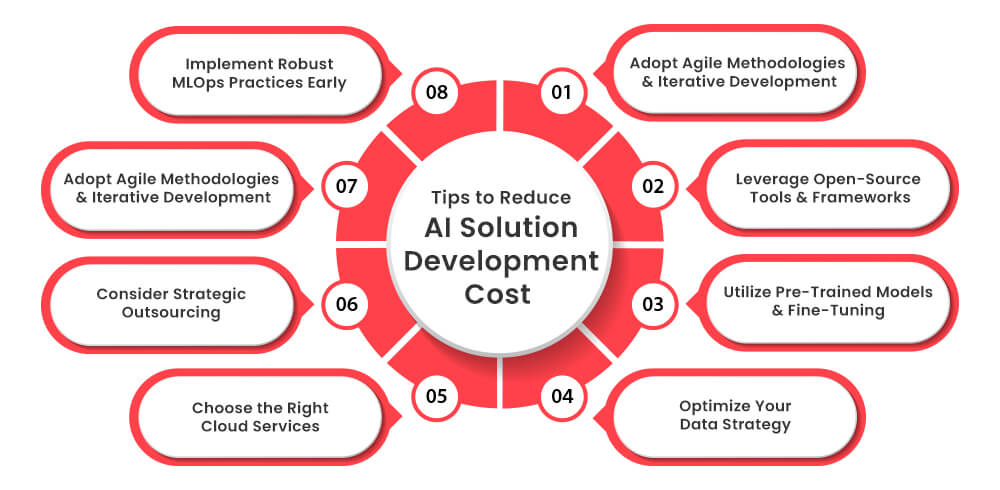
Here are some smart ways to reduce costs without compromising results.
Start with a Clear Strategy and Defined Scope
Many AI projects go over budget because they start without a solid plan. Jumping into development without defining the problem, users, and success metrics leads to wasted time and misaligned efforts.
Start small. Build a Proof of Concept (PoC) or Minimum Viable Product (MVP) first. These lightweight versions help validate ideas, test model performance, and gather real-world feedback.
Instead of aiming for perfection, focus on solving a core problem. You can always scale later.
Leverage Open-Source Tools and Frameworks
Why reinvent the wheel? Open-source AI libraries and frameworks offer powerful capabilities without licensing fees.
Some of the most widely used tools in 2026 include:
LangChain and Haystack for GenAI and LLM orchestration
Hugging Face for pre-trained model access
These tools not only reduce development costs but also speed up experimentation and prototyping.
Utilize Pre-Trained Models and Fine-Tuning
Training large AI models from scratch is expensive and time-consuming. Thankfully, you don’t have to start at zero.
Many platforms offer pre-trained models that can be fine-tuned for your specific use case. This approach is ideal for tasks like:
Sentiment analysis
Text summarization
Image classification
Code generation
Fine-tuning allows you to adapt powerful models like GPT, BERT, or LLaMA to your domain with a fraction of the time and cost.
Optimize Your Data Strategy
Data is a major cost driver in AI. But with the right approach, you can minimize data-related expenses without compromising model quality.
Here’s how:
Use existing internal data before sourcing new datasets.
Leverage public datasets from trusted repositories like Kaggle or government portals.
Explore synthetic data generation for edge cases or limited domains.
Label data efficiently using active learning or semi-supervised methods.
Also, invest in data quality—not just quantity. Clean, relevant data leads to better performance and lower training costs.
Choose the Right Cloud Services
Cloud costs can sneak up fast. Choosing the right setup can make a big difference.
For AI workloads, serverless options and spot instances offer flexible, cost-effective compute power:
Serverless platforms like AWS Lambda or Azure Functions are great for lightweight, event-driven tasks.
Spot instances provide significant savings—up to 90%—for non-critical training jobs or batch inference, though they can be interrupted.
Match your compute needs with your usage pattern. Pay for what you use, not for what sits idle.
Consider Strategic Outsourcing
Hiring an in-house AI team is expensive. Outsourcing can give you access to skilled professionals at a fraction of the cost—if done wisely.
Choose outsourcing partners who:
Understand your business domain
Communicate clearly and consistently
Offer a transparent development process
Balance cost savings with collaboration quality. Don’t just chase the lowest bid. Effective outsourcing is about value, not just price.
Adopt Agile Methodologies and Iterative Development
AI development is full of unknowns. Requirements evolve. Data shifts. Outcomes need refining. A rigid approach leads to waste.
Instead, go Agile.
Break the project into short sprints. Test often. Adjust based on real-world feedback. Agile reduces the risk of building the wrong solution—and helps spot inefficiencies early.
It also allows teams to prioritize high-impact features first, improving time-to-value.
Implement Robust MLOps Practices Early
MLOps are the DevOps of AI that help manage models efficiently across development, deployment, and monitoring.
Key tools include:
Version control for models and datasets
Automated pipelines for training and deployment
Monitoring systems to detect drift and performance drops
Starting with MLOps early ensures that updates are smooth, retraining is repeatable, and scaling is seamless.
Skipping MLOps often leads to expensive firefighting later.
Conclusion
Budgeting for AI development in 2026 is about more than just numbers. It’s about aligning your investment with real business outcomes. From MVPs to large-scale deployments, the right approach ensures every dollar spent contributes to meaningful impact.
Working with an experienced AI automation agency can make the difference between trial-and-error and targeted success. These agencies bring cross-domain expertise, pre-built tools, and proven workflows that reduce cost and speed up time-to-value.
Whether you’re automating customer support, streamlining logistics, or enhancing decision-making, an AI automation firm can help you plan smarter, build faster, and scale efficiently—all without overshooting your budget.
FAQs
What is the absolute minimum budget needed to start an AI project in 2026?
If you’re working with a lean budget, it’s still possible to start an AI project—especially with the help of open-source tools and pre-trained models. A basic Proof of Concept (PoC) or MVP using existing frameworks and cloud services can often begin in the $10,000 to $25,000 range.
However, these entry-level projects usually come with limitations. They may lack scalability, robustness, or advanced personalization. The goal at this stage is to test feasibility, not to launch a production-ready system.
Why is there such a wide range ($10k to $1M+) in AI development cost estimates?
The cost of AI development varies widely because no two projects are the same. A simple rule-based system can be built with minimal effort, while a full-scale deep learning platform may require months of work, specialized talent, and high-end infrastructure.
The main cost drivers include:
Project complexity (rule-based logic vs. generative models)
Data needs (volume, quality, manual labeling)
Team expertise (AI engineers, researchers, MLOps professionals)
Infrastructure and compute power (especially for model training and deployment)
The broader the scope and the higher the ambition, the more the budget needs to scale.
How much does data collection and preparation typically add to the overall AI project cost?
Data work is one of the most time-consuming and expensive parts of AI development. Collecting, cleaning, labeling, and structuring data can account for 20 to 40% of the total project budget.
Costs vary based on the size and condition of your data. If you have well-organized internal data, expenses may be minimal. But if your team needs to source, annotate, or generate custom datasets, expect to spend anywhere from $5,000 to over $100,000, depending on the volume and complexity.
Is it cheaper to build an AI model from scratch or use pre-trained models/APIs in 2026?
In most cases, using pre-trained models or APIs is significantly more affordable and faster than building from scratch. Fine-tuning foundation models like GPT, LLaMA, or BERT allows businesses to adapt powerful capabilities to their specific use case—without the massive time and cost of full-scale training.
Custom models offer more control and customization, but they require large datasets, advanced talent, and dedicated infrastructure. That makes them better suited for highly specialized or large-scale enterprise use.
For common tasks, such as text summarization, sentiment analysis, or chatbots, pre-trained models deliver strong results at a fraction of the cost.
What are the ongoing costs of maintaining an AI system after deployment?
AI systems don’t stop costing money once they go live. They require continuous monitoring, retraining, infrastructure management, and support to stay effective.
Key ongoing costs include:
Model monitoring for performance drops or data drift
Retraining based on new data or changing use cases
Cloud inference costs, especially for real-time AI
Bug fixes, security updates, and user feedback cycles
A good rule of thumb: expect to spend 15–25% of your initial development cost per year on ongoing maintenance.
How do AI development costs differ based on geographic location (e.g., US vs. Europe vs. Asia) in 2026?
AI development costs can vary significantly by region due to labor rates, talent availability, and development models.
Here are sample 2026 hourly rates for AI professionals:
North America: $100 – $200+
Western Europe: $75 – $150
Eastern Europe: $40 – $90
Asia : $25 – $75
Latin America: $35 – $90
Outsourcing to regions with lower labor costs can offer substantial savings—especially for PoCs or MVPs. However, time zones, communication quality, and experience levels should also factor into the decision.
How much does it cost to build specific AI applications like a customer service chatbot or a recommendation engine?
AI applications vary widely in cost depending on complexity, data needs, and technology used. Here are some costs to develop different AI solutions for popular use cases:
Customer Service Chatbot (GenAI-powered):$25,000 – $50,000+ Includes LLM fine-tuning, integration with support platforms, and basic NLP flows.
Recommendation Engine:$50,000 – $150,000+ Often requires behavioral data, real-time inference, and model training pipelines.
Predictive Analytics System:$60,000 – $300,000+ Used in finance, healthcare, or logistics, depending on data availability and required accuracy.
These numbers link directly to scope, data readiness, and whether you use pre-built tools or develop from the ground up.
What are the most effective ways to reduce AI development costs without sacrificing quality?
Cutting costs does not mean cutting corners. The smartest way to reduce AI development costs is by making strategic decisions early on.
Here’s what works:
Start small with a Proof of Concept or MVP to validate ideas before scaling.
Use open-source tools and frameworks instead of building everything from scratch.
Leverage pre-trained models and APIs, especially for common tasks like NLP, classification, or recommendation.
Optimize your data strategy—clean, focused datasets save time and deliver better results.
Choose cloud services carefully, using spot instances and serverless setups to avoid overpaying for idle compute.
Done right, these steps help you launch faster, stay agile, and get the most from your budget.
How long does it typically take to develop and deploy an AI solution?
AI development timelines depend heavily on project complexity and scope.
Here’s a general timeline guide:
Proof of Concept (PoC): 2 to 10 weeks
Minimum Viable Product (MVP): 3 to 6 months
Full-Scale AI Solution: 6 to 12+ months
If you’re building advanced GenAI applications, integrating with legacy systems, or handling large datasets, expect the upper end of the timeline. Simpler automation tools or NLP-based features can be launched more quickly.
How can I get an accurate cost estimate for my specific AI project idea?
To get a reliable estimate, start by clearly defining your:
Business goals
Technical objectives
Available data
Required features and level of accuracy
With that information, you can engage with an AI development partner USA who understands both the tech and the business side. They’ll help you assess feasibility, scope the project, and map costs based on your unique needs.
As the tech-savvy Project Manager at Prismetric, his admiration for app technology is boundless though!He writes widely researched articles about the AI development, app development methodologies, codes, technical project management skills, app trends, and technical events. Inventive mobile applications and Android app trends that inspire the maximum app users magnetize him deeply to offer his readers some remarkable articles.