“Working with Prismetric was a straightforward experience from day one. Their staff understood what we wanted to create and helped turn our idea into a practical AI product. They kept us informed, responded promptly, and handled every stage professionally. The solution matched our business needs well, and I would happily work with their team again.”
Marc De Chellis
Product Director- Launchpad Apps
“We had a positive experience with Prismetric while developing our AI product. Their team was professional, responsive, and willing to share ideas that improved the outcome. Communication was clear, deadlines were handled well, and the project stayed on track. They made things easy for our team, and we would gladly work with Prismetric on projects.”
Richard Tellier
President TellAText LLC
“Prismetric did a great job from planning through delivery. Their team understood the project, communicated well, and kept things moving without making the process complicated. They were reliable, easy to work with, and paid attention to the details. I would recommend them to anyone looking for a dependable team for AI development and product work.”
Curt Hayes
President Audio Design Inc
“Prismetric made the development process easy to understand from the beginning. Their team kept us updated, answered questions quickly, and handled changes without confusion. They were professional, helpful, and focused on making sure it worked properly. I was happy with how the AI project turned out and would gladly work with them again in future.”
Table of Contents
IT Compliance Regulations for US Industries in 2026: Complete Guide
In 2026, IT compliance for US industries is shaped by five major forces: expanding state privacy laws, AI and automated decision-making rules, stricter cybersecurity governance, faster incident reporting expectations, and stronger oversight of vendors and data transfers. Regulated sectors such as healthcare, finance, defense contracting, critical infrastructure, SaaS, education, retail, and manufacturing must prove that their controls are active, documented, tested, and continuously monitored not just written in policy manuals.
As US businesses continue to modernize their digital ecosystems with cloud platforms, AI systems, automation tools, connected devices, and third-party software, compliance has become a core part of business resilience. It is no longer limited to annual audits or legal documentation. Instead, organizations now need to embed compliance into their IT infrastructure, product development lifecycle, cybersecurity operations, vendor relationships, and data governance strategies.
For companies operating in compliance-heavy industries, staying aligned with evolving IT regulations is critical for protecting sensitive data, avoiding penalties, maintaining customer trust, winning enterprise contracts, and ensuring long-term operational continuity.
Key Takeaways
State privacy laws now require stronger consumer rights, risk assessments, opt-out signals, and sensitive-data protections.
AI compliance is becoming part of IT governance, especially for hiring, finance, healthcare, public benefits, and customer-facing automation.
CMMC affects defense contractors and subcontractors handling Federal Contract Information or Controlled Unclassified Information.
Critical infrastructure organizations must prepare for CIRCIA-style cyber incident and ransomware payment reporting.
Vendor, cloud, SaaS, and data-transfer risks are now central to IT compliance programs.
Table of Contents
What Is IT Compliance in 2026?
IT compliance in 202 6 is the process of aligning an organization’s technology systems, security controls, data practices, vendor relationships, documentation, and reporting processes with applicable laws, regulations, industry standards, and contractual obligations.
In simple terms, it ensures that a business is not only protecting its data and systems but also proving that the right controls are in place and functioning as expected. This includes everything from access control, encryption, data retention, and incident response to vendor due diligence, audit evidence, privacy notices, AI governance, and regulatory reporting.
For US industries, IT compliance varies depending on the type of data a company handles, the sector it operates in, the states where it conducts business, the vendors it works with, and the customers it serves. A healthcare organization may need to focus on HIPAA, while a defense contractor may need to meet CMMC requirements. Similarly, a SaaS company serving enterprise customers may need to align with SOC 2, state privacy laws, AI governance expectations, and customer-specific security obligations.
Build Compliance-Ready IT Systems
Prismetric develops secure software solutions with data protection, access control, audit trails, and regulation-ready architecture.
IT compliance refers to the structured process of ensuring that a company’s technology environment meets the legal, regulatory, security, privacy, and contractual requirements relevant to its operations.
This includes aligning business systems with rules related to:
Data privacy and protection
Cybersecurity controls
Cloud and SaaS security
Vendor and third-party risk management
Incident detection and reporting
User access and identity management
Data storage, retention, and deletion
AI and automated decision-making systems
Audit documentation and evidence management
Industry-specific compliance frameworks
For modern businesses, IT compliance is not just about avoiding regulatory penalties. It is about building secure, reliable, and trustworthy digital operations. When compliance is integrated into IT strategy from the beginning, organizations can reduce risk, improve customer confidence, accelerate audits, and support sustainable growth in regulated markets.
Why IT Compliance Is No Longer a Once-a-Year Audit Task
Traditionally, many organizations treated IT compliance as a periodic exercise. Teams would prepare documentation before an audit, review policies once a year, and update controls only when a regulator, customer, or certification body required it.
That approach no longer works in 2026.
Today’s regulatory environment is dynamic, technology-driven, and deeply connected to business risk. Cloud environments change constantly. AI tools are being adopted across departments. Vendors are added and replaced frequently. State privacy laws continue to expand. Cyber threats evolve rapidly. Incident reporting expectations are becoming stricter. As a result, businesses need continuous compliance rather than one-time compliance.
Modern IT compliance requires organizations to maintain ongoing visibility into their systems, risks, controls, and evidence. This includes continuous monitoring of security controls, regular testing of incident response procedures, updated vendor reviews, mapped regulatory obligations, and audit-ready documentation.
A strong compliance program in 2026 should include:
Continuous monitoring: Businesses need real-time or recurring visibility into access controls, vulnerabilities, system configurations, cloud environments, and security events.
Audit-ready evidence: Policies alone are not enough. Organizations must maintain proof that controls are implemented, reviewed, tested, and updated.
Security control mapping: IT teams need to map controls across multiple frameworks such as NIST, HIPAA, CMMC, SOC 2, PCI DSS, GLBA, and state privacy requirements.
Regulatory change tracking: Companies must monitor changing federal, state, and industry-specific regulations to ensure their compliance program stays current.
Board and executive accountability: Compliance is now a leadership-level concern because it affects business continuity, legal exposure, customer trust, and financial risk.
Cross-functional coordination: IT compliance requires collaboration between IT, cybersecurity, legal, privacy, HR, finance, procurement, operations, and executive teams.
This shift has made compliance a continuous business function. Organizations that treat it as an ongoing operational discipline are better positioned to respond to audits, customer security reviews, cyber incidents, and regulatory changes without last-minute disruption.
The Difference Between Compliance, Cybersecurity, and Governance
Compliance, cybersecurity, and governance are closely connected, but they are not the same. Businesses need all three to build a resilient and regulation-ready IT environment.
Cybersecurity focuses on protecting systems, applications, networks, and data from unauthorized access, misuse, disruption, or theft. It includes technical and operational safeguards such as firewalls, encryption, endpoint protection, vulnerability management, identity access controls, threat monitoring, and incident response.
Compliance focuses on proving that required controls exist, operate effectively, and meet applicable legal, regulatory, contractual, or industry requirements. It requires documentation, evidence, reporting, audits, policies, control testing, and accountability.
Governance focuses on assigning ownership, setting policies, defining risk appetite, making decisions, and ensuring that security and compliance activities align with business objectives. Governance answers questions such as who owns a control, who approves a risk, who reports incidents, and who is accountable for compliance outcomes.
For example, implementing multi-factor authentication is a cybersecurity control. Documenting MFA coverage, testing access logs, and showing evidence during an audit is compliance. Assigning responsibility for identity management, reviewing exceptions, and reporting access risk to leadership is governance.
In 2026, successful IT compliance programs are built at the intersection of these three areas. Cybersecurity protects the business, compliance proves the controls are working, and governance ensures the right people are accountable for managing risk.
What Changed in IT Compliance for US Industries in 2026?
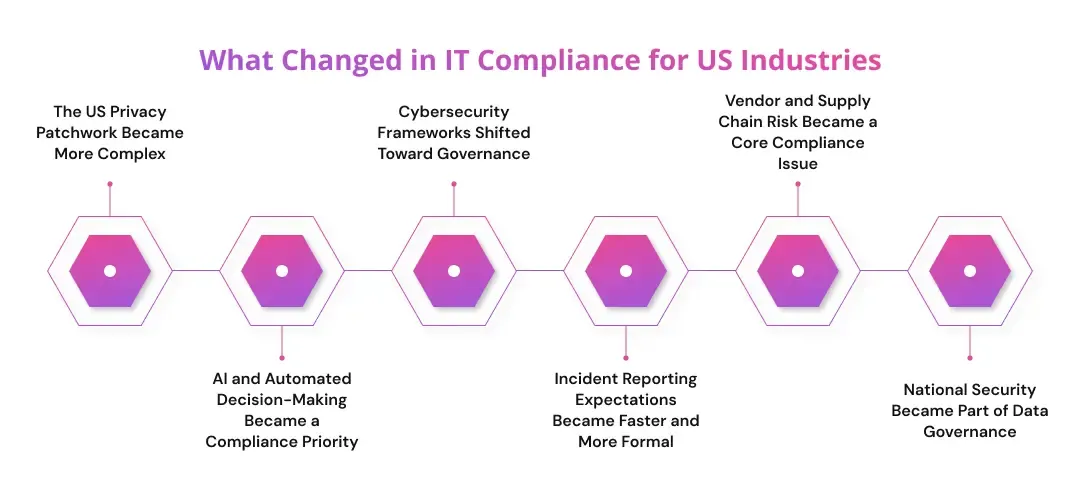
IT compliance in 2026 is being shaped by a more complex mix of privacy laws, cybersecurity expectations, AI governance requirements, vendor oversight, and national security controls. For US businesses, the biggest change is that compliance is no longer limited to a single industry regulation or annual certification. It now requires continuous visibility across data, systems, vendors, AI tools, reporting workflows, and executive risk ownership.
As organizations continue to adopt cloud infrastructure, SaaS platforms, AI-enabled workflows, remote teams, connected devices, and outsourced IT services, regulators are placing greater emphasis on how data is collected, processed, transferred, secured, and monitored. Businesses must now prove that compliance is built into their technology ecosystem rather than added as a last-minute documentation layer.
Below are the major changes defining IT compliance regulations for US industries in 2026.
1. The US Privacy Patchwork Became More Complex
One of the most significant compliance challenges for US businesses in 2026 is the continued expansion of state-level privacy laws. Since the United States does not have one comprehensive federal privacy law covering all industries, companies must navigate a growing patchwork of state-by-state privacy obligations.
This means a business operating across multiple states may need to comply with different rules for consumer rights, sensitive data, opt-out mechanisms, targeted advertising, data protection assessments, consent management, and privacy notices. For digital-first businesses, SaaS providers, ecommerce platforms, healthcare technology companies, fintech firms, and data-driven enterprises, this creates a major operational challenge.
In 2026, privacy compliance is no longer just about publishing a privacy policy. Organizations need systems and workflows that allow consumers to access, correct, delete, and opt out of certain uses of their personal data. They must also be able to identify where personal information is stored, who has access to it, which vendors process it, and how quickly the business can respond to consumer privacy requests.
A strong privacy compliance program in 2026 should address:
State-by-state privacy obligations: Businesses must identify which state privacy laws apply based on where consumers, employees, or customers are located.
Consumer access, correction, deletion, and opt-out rights: Companies need clear workflows to respond to consumer requests within required timelines.
Universal opt-out mechanisms: Businesses may need to recognize browser-based or device-level signals that allow consumers to opt out of targeted advertising, sale, or sharing of personal data.
Sensitive data rules: Information such as health data, financial data, biometric data, precise location data, children’s data, and government identifiers may require additional safeguards or consent.
Geolocation data restrictions: Companies collecting precise location information must evaluate whether they have proper notice, consent, retention limits, and security controls.
Privacy notices and consent mechanisms: Privacy disclosures must accurately explain what data is collected, why it is collected, how it is used, and who it is shared with.
Data protection assessments: Businesses involved in high-risk processing, targeted advertising, profiling, sensitive data use, or automated decision-making may need documented risk assessments.
For compliance-heavy industries, privacy readiness now requires close coordination between legal, IT, marketing, product, engineering, security, and vendor management teams. A privacy request cannot be fulfilled effectively if the business does not know where the data lives, how it flows across systems, or which third parties process it.
This is why privacy compliance in 2026 has become a technology architecture issue as much as a legal issue. Businesses need data mapping, consent management, access controls, deletion workflows, vendor tracking, and audit-ready documentation to remain compliant at scale.
2. AI and Automated Decision-Making Became a Compliance Priority
AI adoption has accelerated across almost every US industry, but in 2026, businesses can no longer treat AI as an experimental productivity tool with limited compliance impact. AI systems are now being used to support hiring decisions, lending decisions, insurance underwriting, healthcare operations, fraud detection, customer service, education platforms, public benefits, and risk scoring.
As a result, AI compliance has become a core part of IT governance.
The biggest concern for regulators is not only whether AI is being used, but how it is being used, what data it relies on, whether it produces biased or inaccurate outcomes, and whether humans have meaningful oversight over high-impact decisions. Businesses must also understand whether their vendors are embedding AI into SaaS platforms, analytics tools, HR systems, marketing software, customer support platforms, or security tools.
In 2026, companies should be prepared to manage AI-related compliance across the following areas:
AI inventories: Organizations need a clear record of all AI systems, models, tools, and third-party AI capabilities used across departments.
Automated decision-making technology: Businesses must identify systems that make or assist decisions affecting consumers, employees, patients, students, applicants, or beneficiaries.
Algorithmic profiling: Companies need to understand when AI or analytics tools are used to evaluate behavior, preferences, eligibility, risk, productivity, or performance.
Bias testing: AI systems used in high-impact areas should be tested for unfair, discriminatory, or inaccurate outcomes.
Human oversight: Businesses should define when a human must review, approve, override, or explain an AI-supported decision.
Explainability: Organizations need to be able to explain how AI systems are used, what inputs they rely on, and how decisions or recommendations are generated.
Model monitoring:AI models should be monitored over time to detect drift, errors, security risks, and unintended outcomes.
AI vendor governance: Companies must review whether vendors use customer data to train AI models, where AI processing occurs, and what contractual protections exist.
Industries using AI in employment, lending, insurance, healthcare, education, and public services face particularly high compliance exposure. In these areas, AI outputs can affect access to jobs, credit, housing, medical services, educational opportunities, insurance coverage, and government benefits.
For businesses building AI-enabled products, compliance should be embedded into the product development lifecycle from the beginning. This includes data source validation, risk classification, model testing, security review, human oversight design, consent review, documentation, and post-launch monitoring.
Businesses introducing AI into regulated environments can use AI implementation to integrate models, data, security controls, human oversight, testing, and monitoring into the production environment from the beginning.
The organizations that succeed with AI in 2026 will not be the ones that simply adopt the most tools. They will be the ones that can prove their AI systems are secure, explainable, monitored, and aligned with business, legal, and ethical requirements.
Cybersecurity compliance in 2026 is moving beyond technical safeguards and toward enterprise-level governance. Businesses are still expected to implement core security controls such as multi-factor authentication, encryption, vulnerability management, access controls, endpoint protection, backup testing, and incident response. However, regulators, customers, auditors, and boards now want to see how cybersecurity risk is governed across the organization.
A major example of this shift is NIST Cybersecurity Framework 2.0, which places greater emphasis on governance as a core cybersecurity function. This reflects a broader change in how businesses are expected to manage cyber risk. Security can no longer be handled only by the IT department. It must be connected to leadership accountability, enterprise risk management, business continuity, vendor oversight, and regulatory reporting.
In 2026, cybersecurity compliance programs need to show that the organization has a structured approach to:
Board visibility: Giving executives and board members meaningful visibility into cybersecurity risks, incidents, remediation progress, and compliance gaps.
Enterprise risk alignment: Connecting cybersecurity controls to business risk, operational resilience, financial exposure, and legal obligations.
Incident response planning: Maintaining tested response procedures for cyber incidents, ransomware events, data breaches, and system outages.
Third-party risk integration: Including vendors, SaaS providers, cloud platforms, MSPs, and subcontractors in the cybersecurity risk management process.
This governance-first approach is especially important for organizations operating in regulated sectors such as financial services, healthcare, defense contracting, critical infrastructure, education, retail, and SaaS. These businesses need more than security tools. They need documented accountability, control ownership, risk reviews, escalation paths, and compliance evidence.
For example, installing an endpoint detection solution may improve cybersecurity. But from a compliance perspective, the business also needs to show who owns the control, how alerts are reviewed, how incidents are escalated, how exceptions are handled, and how evidence is retained for audits.
This is why cybersecurity frameworks in 2026 are becoming more business-oriented. They help organizations move from reactive security practices to structured, measurable, and leadership-driven cyber risk management.
4. Incident Reporting Expectations Became Faster and More Formal
Cyber incident reporting has become one of the most important compliance priorities for US businesses in 2026. Regulators are increasingly focused on how quickly organizations identify incidents, assess impact, escalate internally, preserve evidence, notify stakeholders, and report to the appropriate authorities.
For public companies, material cybersecurity incident disclosure requirements have made cyber reporting a board-level and investor-facing issue. Critical infrastructure organizations are also expected to prepare for formal reporting obligations related to covered cyber incidents and ransomware payments. Even companies outside these categories may face state breach notification laws, contractual reporting requirements, cyber insurance conditions, and customer notification obligations.
The key challenge is that incident reporting timelines can be short. Businesses cannot wait until an incident occurs to decide who is responsible, what must be reported, who must approve the disclosure, and what evidence must be collected.
In 2026, organizations should strengthen incident reporting readiness across the following areas:
Material cybersecurity incident disclosure: Public companies must have a process to determine whether a cyber incident is material and whether it triggers disclosure obligations.
Critical infrastructure reporting preparation: Covered entities should prepare workflows for reporting significant cyber incidents and ransomware payments.
Ransomware payment reporting: Organizations need procedures for documenting ransomware demands, payment decisions, legal review, and reporting responsibilities.
Internal escalation workflows: IT, security, legal, communications, compliance, and executive teams must know when and how an incident should be escalated.
Evidence preservation: Logs, forensic data, communications, affected systems, vendor activity, and decision records should be preserved to support investigations and reporting.
Legal, communications, executive, and IT coordination: Incident response must involve the right stakeholders from the beginning to avoid delays, inconsistent messaging, or missed reporting deadlines.
A strong incident reporting program should include predefined severity levels, contact lists, legal review triggers, regulator notification workflows, customer communication templates, and tabletop exercises. Businesses should also review vendor contracts to ensure third-party providers notify them quickly when a security event may affect their data or systems.
In 2026, incident response is not only about recovering systems. It is also about making timely, accurate, and defensible reporting decisions under pressure.
5. Vendor and Supply Chain Risk Became a Core Compliance Issue
Vendor risk has become one of the most heavily scrutinized areas of IT compliance. Modern businesses rely on a large ecosystem of cloud platforms, SaaS applications, managed service providers, AI vendors, payment processors, data brokers, offshore development teams, analytics tools, and infrastructure providers. While this ecosystem helps organizations scale faster, it also expands the compliance and cybersecurity attack surface.
Regulators and enterprise customers increasingly expect businesses to manage the risks created by third parties. This means organizations must understand which vendors access sensitive data, which systems they connect to, where they process information, whether they use subcontractors, and how they respond to security incidents.
In 2026, vendor and supply chain compliance should cover:
Cloud vendors: Businesses must evaluate data residency, encryption, access control, logging, backup, availability, and shared responsibility obligations.
SaaS providers: Companies need to review security certifications, data processing terms, breach notification commitments, user access controls, and retention policies.
Managed service providers: MSPs often have privileged access to networks and systems, making identity controls, monitoring, and contractual safeguards essential.
AI vendors: Organizations should confirm whether vendors use customer data for model training, how AI outputs are generated, and what safeguards exist for sensitive data.
Data brokers: Businesses must evaluate whether data acquisition, sharing, resale, or enrichment practices create privacy or national security risk.
Offshore support teams: Companies should understand which locations and personnel can access regulated data, production systems, or customer environments.
Contractual security requirements: Vendor contracts should include security obligations, audit rights, breach notification timelines, data deletion terms, and subprocessor controls.
Subprocessor reviews: Businesses must track downstream vendors that process data on behalf of primary vendors.
Continuous vendor monitoring: Vendor risk reviews should not be limited to onboarding. High-risk vendors should be reassessed periodically.
Vendor compliance is especially important for businesses in healthcare, finance, SaaS, retail, education, government contracting, and critical infrastructure. In many cases, a third-party breach can still create regulatory exposure for the company that collected or controlled the data.
To reduce risk, organizations should maintain a centralized vendor inventory, classify vendors by risk level, request compliance evidence, review contracts, monitor access permissions, and define offboarding procedures. For high-risk vendors, businesses should also review SOC 2 reports, ISO certifications, penetration test summaries, security questionnaires, business continuity plans, and incident response commitments.
In 2026, a business cannot claim to be compliance-ready if it does not know how its vendors handle data, security, AI, and breach reporting.
6. National Security Became Part of Data Governance
Another major shift in IT compliance is the growing connection between data governance and national security. US regulators are increasingly focused on how sensitive personal data and government-related data may be accessed, transferred, processed, or exploited by foreign adversaries or countries of concern.
This creates new compliance considerations for businesses that collect large volumes of personal data, use offshore support teams, work with data brokers, manage government-related information, or transfer data across borders. It also affects companies involved in cloud services, HR platforms, health technology, financial services, advertising technology, AI development, telecommunications, and analytics.
In 2026, organizations should treat national security-related data governance as part of their broader compliance program. This means understanding not only what data the business collects, but also where that data goes, who can access it, and whether any vendor, employee, investor, subcontractor, or business partner creates restricted access risk.
Key areas businesses need to evaluate include:
Bulk sensitive personal data: Large datasets containing health information, financial data, biometric identifiers, precise geolocation, personal identifiers, or other sensitive information may require additional restrictions.
Government-related data: Data connected to government employees, contractors, facilities, systems, or sensitive operations may create heightened compliance risk.
Data transfers to countries of concern: Businesses must evaluate whether data is transferred to or accessed from jurisdictions that create national security concerns.
Vendor, employment, investment, and data brokerage arrangements: Risk can arise not only from customer data transfers but also from vendor relationships, personnel access, foreign ownership, investment structures, and data sharing agreements.
Data flow mapping and access restrictions: Organizations need a clear map of how sensitive data moves across systems, vendors, locations, and user roles.
For businesses, the practical impact is clear: data governance must now account for geopolitical and national security risk. It is not enough to know that data is encrypted or stored in the cloud. Companies must also know who can access it, from where, under what contractual terms, and for what purpose.
This shift requires closer coordination between IT, legal, privacy, security, procurement, HR, compliance, and executive leadership. Organizations should review data access policies, vendor contracts, offshore support models, data brokerage relationships, and cross-border data flows to ensure they are not creating hidden compliance exposure.
In 2026, data governance is no longer limited to privacy and cybersecurity. It is also a matter of national security, vendor accountability, and enterprise risk management.
Need Help With IT Compliance Readiness?
Prismetric designs secure software, cloud systems, and AI solutions built around modern US compliance requirements.
IT compliance requirements in the US vary by industry, data type, customer base, vendor ecosystem, and regulatory exposure. A healthcare company, for example, must prioritize ePHI protection and HIPAA safeguards, while a defense contractor must focus on CMMC, DFARS, and controlled unclassified information. Similarly, a SaaS or AI company may need to manage privacy laws, customer security reviews, SOC 2 expectations, and AI governance controls at the same time.
The table below gives a quick industry-wise view of the major IT compliance regulations and action items businesses should prioritize in 2026.
Industry
Key Regulations/Frameworks
Main IT Compliance Focus
2026 Action Items
Healthcare and Health Tech
HIPAA Security Rule, HITECH, business associate agreements
Update risk analysis, review business associates, strengthen MFA, encryption, logging, and backups, test incident response, validate AI use in clinical workflows
Financial Services, Banking, Lending, and Insurance
Document cyber governance, strengthen vendor reviews, maintain incident disclosure workflows, monitor AI models used for credit, underwriting, fraud, and eligibility
Government Contractors and Defense Industrial Base
Identify FCI/CUI systems, confirm CMMC level, maintain SPRS status and affirmations, prepare subcontractor evidence, close POA&M gaps
Critical Infrastructure, Energy, Utilities, and Transportation
CIRCIA readiness, NIST CSF 2.0, NERC CIP where applicable
Incident reporting, OT security, operational resilience, remote access, vendor risk
Create incident classification procedures, test 72-hour and 24-hour reporting workflows, segment OT and IT, validate monitoring, run tabletop exercises
Technology, SaaS, Cloud, and AI Companies
SOC 2, ISO 27001, NIST CSF 2.0, state privacy laws, CCPA/CPRA, AI governance, EU AI Act, EU Cyber Resilience Act
Maintain control mapping, build AI inventories, update privacy notices, maintain SBOM and vulnerability management where relevant, document access, retention, and deletion
Validate PCI DSS scope, audit checkout scripts and third-party tags, honor opt-out signals, review payment vendors, document data retention
Education and EdTech
FERPA, COPPA, state student privacy laws
Student records, children’s data, cloud learning platforms, classroom AI tools
Review EdTech vendor contracts, restrict access to student records, establish parental consent workflows where required, monitor AI tools used for grading, tutoring, admissions, or profiling
Manufacturing, Industrial, and Supply Chain Companies
NIST CSF 2.0, CMMC if serving defense contracts
OT cybersecurity, supplier access, production continuity, asset disposition
Map IT and OT assets, secure remote maintenance, review supplier cybersecurity terms, build production incident response, maintain chain-of-custody for retired assets
Professional Services, Legal, Accounting, and Consulting
Client data protection, document management, vendor access, AI use in client work
Classify client data, restrict access by matter or engagement, validate AI tools before use on confidential information, improve backups, logging, and retention
Healthcare and Health Tech
Healthcare remains one of the most compliance-heavy industries in the US because organizations handle electronic protected health information, patient records, billing data, telehealth interactions, and connected medical device data. In 2026, healthcare providers, health tech companies, telemedicine platforms, and business associates need to ensure that HIPAA Security Rule safeguards are not only documented but actively implemented.
Key compliance areas include HIPAA, HITECH, business associate agreements, ePHI protection, telehealth platform security, medical app integrations, ransomware readiness, risk analysis, and access control.
Healthcare organizations should prioritize:
Updating their HIPAA risk analysis
Reviewing business associate agreements
Strengthening MFA, encryption, logging, and backups
Testing incident response and ransomware recovery
Validating AI use in patient-facing or clinical workflows
Financial Services, Banking, Lending, and Insurance
Financial institutions face intense regulatory pressure because they process sensitive financial data, identity information, payment data, credit decisions, fraud signals, and investment-related information. In 2026, IT compliance in finance is closely tied to cybersecurity governance, third-party oversight, incident disclosure, and model risk management.
Relevant frameworks and regulations include the GLBA Safeguards Rule, FTC Safeguards reporting, SEC cybersecurity disclosure rules, PCI DSS, SOX, state privacy laws, and internal model risk controls.
Financial organizations should prioritize:
Documenting cybersecurity governance and executive oversight
Strengthening vendor and third-party risk management
Maintaining incident disclosure and escalation workflows
Monitoring AI models used in credit, underwriting, fraud detection, and eligibility decisions
Improving identity, access, and fraud prevention controls
Government Contractors and Defense Industrial Base
Government contractors and defense suppliers must pay close attention to CMMC, DFARS, and NIST SP 800-171 requirements. These obligations are especially important for organizations that process, store, or transmit Federal Contract Information or Controlled Unclassified Information.
In 2026, compliance readiness can directly affect contract eligibility. Contractors and subcontractors must also manage supplier flow-down obligations, meaning smaller vendors in the defense supply chain may also need to meet specific cybersecurity requirements.
Defense contractors should prioritize:
Identifying systems that handle FCI or CUI
Confirming the required CMMC level for applicable contracts
Maintaining SPRS status and required affirmations
Preparing subcontractor compliance evidence
Closing POA&M gaps before assessment or contract review
Critical Infrastructure, Energy, Utilities, and Transportation
Critical infrastructure organizations must focus on operational resilience, incident reporting, OT security, and vendor access controls. For sectors such as energy, utilities, transportation, water, telecom, and industrial operations, cyber incidents can disrupt essential services and create national security risks.
Key compliance areas include CIRCIA readiness, NIST CSF 2.0, NERC CIP where applicable, IT and OT segmentation, incident reporting, operational continuity, vendor access, and remote monitoring.
Critical infrastructure organizations should prioritize:
Creating incident classification procedures
Testing 72-hour cyber incident and 24-hour ransomware payment reporting workflows where applicable
Segmenting OT systems from enterprise IT
Validating remote access, logging, and monitoring
Running tabletop exercises for cyber and operational disruption scenarios
Technology, SaaS, Cloud, and AI Companies
Technology companies face a broad compliance landscape because they often process customer data, host enterprise workloads, integrate with third-party systems, and deploy AI-driven features. SaaS, cloud, and AI companies also face pressure from customers that require security certifications and detailed compliance evidence before signing contracts.
Common frameworks and requirements include SOC 2, ISO 27001, NIST CSF 2.0, state privacy laws, CCPA/CPRA, AI governance, EU AI Act exposure, EU Cyber Resilience Act exposure for products with digital elements, data processing agreements, and subprocessor management.
Technology companies should prioritize:
Maintaining control mapping across multiple frameworks
Building AI governance processes and model inventories
Updating privacy notices and data processing terms
Maintaining SBOM and vulnerability management where relevant
Documenting customer data access, retention, deletion, and subprocessor activity
Retail, Ecommerce, and Payment Processing
Retail and ecommerce businesses handle payment card data, consumer profiles, loyalty program data, browsing behavior, targeted advertising data, and third-party tracking technologies. In 2026, compliance is not limited to checkout security. It also includes consumer privacy, advertising transparency, vendor scripts, and data retention practices.
Relevant requirements include PCI DSS, state privacy laws, FTC Act expectations, consumer data protection rules, payment security controls, loyalty program disclosures, tracking pixel governance, and targeted advertising opt-outs.
Retail and ecommerce businesses should prioritize:
Validating PCI DSS scope
Auditing checkout scripts, pixels, and third-party tags
Honoring opt-out signals for targeted advertising and data sharing
Reviewing payment processors, ecommerce platforms, and marketing vendors
Documenting data retention, deletion, and consent practices
Education and EdTech
Education and EdTech organizations manage sensitive student records, children’s data, learning analytics, classroom technology, cloud platforms, and AI-enabled educational tools. As schools and digital learning platforms adopt more automation, compliance teams need to ensure that student privacy and parental consent obligations are built into the technology stack.
Relevant requirements include FERPA, COPPA, state student privacy laws, cloud learning platform controls, AI tools in classrooms, and student data security practices.
Education and EdTech organizations should prioritize:
Reviewing contracts with EdTech vendors
Restricting access to student records
Establishing parental consent workflows where required
Monitoring AI tools used for grading, tutoring, admissions, student profiling, or classroom analytics
Improving data retention and deletion procedures
Manufacturing, Industrial, and Supply Chain Companies
Manufacturers and industrial companies are increasingly exposed to IT compliance risks because of connected production systems, remote maintenance tools, supplier portals, OT environments, and digital supply chain platforms. Companies serving defense contracts may also need to align with CMMC requirements.
Key compliance areas include NIST CSF 2.0, CMMC where applicable, OT cybersecurity, supply chain traceability, vendor access, remote maintenance controls, data destruction, and asset disposition.
Manufacturing and industrial companies should prioritize:
Mapping IT and OT assets
Securing remote maintenance connections
Reviewing supplier cybersecurity requirements
Building incident response plans for production disruption
Maintaining chain-of-custody for retired IT assets and destroyed data
Professional Services, Legal, Accounting, and Consulting
Professional services firms often manage highly sensitive client information, financial documents, legal records, tax data, contracts, intellectual property, and strategic business information. In 2026, these firms also need to manage vendor access, document management platforms, cyber insurance requirements, and AI use in client work.
Relevant compliance considerations include state privacy laws, client confidentiality duties, FTC security expectations, cyber insurance requirements, vendor controls, document management security, and AI governance.
Professional services firms should prioritize:
Classifying client data by sensitivity
Restricting access by matter, client, project, or engagement
Validating AI tools before using them on confidential information
Improving backup, logging, and retention policies
Reviewing document management, e-signature, and collaboration vendors
Cross-Industry Regulations Every US Organization Should Understand in 2026
While every industry has its own compliance requirements, several regulations and frameworks affect organizations across sectors. Businesses operating nationally, serving enterprise customers, or handling sensitive data should understand these cross-industry requirements and use them to build a scalable compliance foundation.
NIST Cybersecurity Framework 2.0
NIST CSF 2.0 is one of the most useful cybersecurity frameworks for organizations that want to structure their risk management program. It is built around six core functions: Govern, Identify, Protect, Detect, Respond, and Recover.
The major change is the addition of Govern as a core function. This makes cybersecurity governance, leadership accountability, risk ownership, policies, and oversight central to the framework.
Even when NIST CSF 2.0 is not legally mandatory, organizations can use it as a baseline to align security controls, board reporting, vendor risk, incident response, and compliance documentation.
State Privacy Laws
State privacy laws are now a major compliance concern for businesses operating across the US. Requirements differ by state, which means one generic privacy policy is often not enough.
Businesses need scalable workflows for privacy notices, consumer access requests, deletion requests, correction rights, opt-outs, sensitive data, children’s data, targeted advertising, profiling, and data protection assessments.
For IT teams, this means privacy compliance must be supported by data mapping, consent tools, access controls, deletion workflows, vendor tracking, and audit-ready evidence.
CMMC
CMMC applies to many Department of Defense contractors and subcontractors that handle Federal Contract Information or Controlled Unclassified Information. It is tied to contract eligibility, which makes it a business-critical requirement for the defense supply chain.
CMMC readiness requires more than policies. Contractors must identify covered systems, implement required controls, maintain documentation, complete required assessments or certifications, and provide affirmations.
Flow-down requirements can also affect smaller suppliers that support larger defense contractors.
CIRCIA
CIRCIA is focused on improving cyber incident visibility across critical infrastructure sectors. Covered organizations should prepare for cyber incident reporting and ransomware payment reporting requirements.
The key compliance challenge is internal readiness. Businesses need to define who classifies an incident, who escalates it, who approves reporting, what information is preserved, and how legal, IT, security, communications, and executive teams coordinate under tight timelines.
DOJ Data Security Program
The DOJ Data Security Program focuses on national security risks involving bulk US sensitive personal data and government-related data. It is especially important for organizations that transfer, sell, license, or provide access to sensitive data in ways that may involve countries of concern or covered persons.
Businesses need to know where sensitive data goes, who can access it, which vendors or offshore teams are involved, and whether data brokerage, employment, investment, or cloud arrangements create restricted access risk.
This makes data flow mapping, access restrictions, vendor review, and cross-border data governance essential.
HIPAA Security Rule
The HIPAA Security Rule applies to covered entities and business associates that create, receive, maintain, or transmit electronic protected health information.
It requires administrative, physical, and technical safeguards to protect ePHI. In 2026, healthcare organizations should focus on risk analysis, access controls, encryption, logging, backups, business associate oversight, and ransomware readiness.
For health tech companies, HIPAA compliance should be built into product architecture, data storage, user permissions, audit trails, and third-party integrations from the beginning.
GLBA Safeguards Rule
The GLBA Safeguards Rule applies to covered financial institutions and requires a written information security program designed to protect customer information.
It also includes service provider oversight and security event reporting obligations. Financial institutions should maintain documented security controls, vendor due diligence, access management, encryption, incident response, and executive-level accountability.
For fintech platforms, lenders, insurers, and financial service providers, GLBA compliance must be part of both cybersecurity operations and product design.
SEC Cybersecurity Disclosure Rules
Public companies must maintain processes for cybersecurity risk management, governance, and material incident disclosure. This makes cybersecurity a board, investor, and executive reporting issue, not only an IT issue.
Organizations need clear workflows for identifying cyber incidents, assessing materiality, escalating findings, involving legal and leadership teams, and preparing disclosure when required.
Even private companies can benefit from aligning with these expectations, especially when working with public companies or preparing for enterprise customer reviews.
PCI DSS
PCI DSS applies to organizations that store, process, or transmit payment card data. It is especially important for ecommerce, retail, hospitality, SaaS billing, marketplaces, subscription platforms, and payment processors.
The standard focuses on protecting payment account data through technical and operational controls. Businesses should validate PCI DSS scope, secure payment environments, limit cardholder data exposure, review third-party payment vendors, and maintain evidence of compliance.
secure payment environments, limit cardholder data exposure, review third-party payment vendors, and maintain evidence of compliance.
AI Compliance Requirements US Industries Should Prepare for in 2026
AI is now part of daily business operations across healthcare, finance, HR, education, retail, government, insurance, and SaaS. But as AI tools become more deeply integrated into digital products and internal workflows, they also create new compliance risks around data privacy, bias, explainability, security, and accountability.
For US industries in 2026, AI compliance is not just a legal or innovation concern. It is becoming a core part of IT compliance, cybersecurity governance, vendor risk management, and product development.
Why AI Compliance Belongs in the IT Compliance Program
AI systems often interact with sensitive data, business systems, customer records, employee information, financial data, patient data, and proprietary documents. This means AI can create compliance exposure even when it is used only for productivity, automation, or analytics.
Businesses need to bring AI under the IT compliance program because:
AI tools may access, process, or generate sensitive data.
AI outputs may affect consumers, employees, patients, students, applicants, or beneficiaries.
AI vendors create third-party risk through data processing, model training, hosting, and system access.
Agentic AI tools may take actions across connected systems, such as sending messages, updating records, triggering workflows, or making recommendations.
Logs, approvals, review records, and monitoring are needed to prove that AI systems are being used responsibly.
In 2026, organizations should treat AI systems like any other high-risk technology asset. They should be inventoried, reviewed, approved, monitored, and documented throughout their lifecycle.
High-Risk AI Use Cases by Industry
Not every AI use case carries the same compliance risk. Tools used for internal content drafting may be lower risk, while AI systems that influence employment, healthcare, credit, education, insurance, or public services require much stronger oversight.
Industry
High-Risk AI Use Cases
Healthcare
Clinical decision support, patient messaging, billing automation, care recommendations
Businesses using AI in these areas should define clear approval workflows, human review checkpoints, documentation requirements, and monitoring procedures before deployment.
AI Governance Controls to Include
A practical AI compliance program should help organizations understand where AI is used, what risks it creates, who owns those risks, and how controls are tested over time.
Key AI governance controls should include:
AI system inventory: Maintain a list of all internal, customer-facing, and vendor-provided AI systems.
Approved and prohibited use cases: Define where AI can and cannot be used, especially with sensitive or regulated data.
Data source documentation: Track what data is used to train, prompt, test, or operate AI systems.
Human review checkpoints: Require human oversight for decisions affecting people’s rights, opportunities, benefits, or services.
Model monitoring: Monitor AI systems for drift, errors, misuse, security issues, and unexpected outputs.
Prompt and output logging: Retain logs where needed for auditability, investigation, and quality control.
Vendor due diligence: Review AI vendors for security, privacy, model training, data retention, and subprocessor practices.
Security review before deployment: Test AI integrations for data leakage, unauthorized access, prompt injection, and system abuse.
Incident response for AI failures: Define how the organization will respond to harmful outputs, data exposure, bias complaints, or automation errors.
Record retention: Maintain policies, approvals, testing results, vendor reviews, and monitoring evidence.
The goal is not to block AI adoption. The goal is to make AI adoption secure, explainable, compliant, and scalable.
Third-Party and Vendor Risk Management in 2026
Vendor risk management has become one of the most important parts of IT compliance. Most organizations now rely on cloud platforms, SaaS tools, managed service providers, AI vendors, payment processors, analytics platforms, offshore support teams, and data processors to run critical business operations.
This creates a simple compliance reality: a company may outsource the work, but it cannot outsource accountability.
Why Regulators Care About Vendors
Regulators and enterprise customers expect businesses to understand and manage outsourced technology risk. Vendors often have access to the same systems and data that internal teams use, which means a vendor failure can quickly become a compliance issue.
Vendor risk matters because:
Vendors store customer, employee, patient, student, financial, or business data.
Vendors may access production systems, cloud environments, databases, or internal applications.
Vendors may use offshore teams or subcontractors that create additional data access risk.
Vendors may use customer data to train or improve AI models.
Vendors can cause reportable breaches, service disruptions, or privacy violations.
Regulators expect companies to manage outsourced risk through contracts, reviews, monitoring, and evidence.
In 2026, vendor compliance is not limited to onboarding questionnaires. High-risk vendors need continuous review, contractual safeguards, access monitoring, and incident coordination.
Vendor Risk Checklist
A strong vendor risk management program should include:
Vendor inventory: Maintain a centralized list of all vendors, SaaS tools, cloud providers, MSPs, and data processors.
Data access classification: Identify what data each vendor can access, store, process, or transmit.
Contractual security clauses: Include security requirements, audit rights, confidentiality terms, and compliance obligations.
Subprocessor list: Track third parties used by your vendors to process or support your data.
Breach notification terms: Define how quickly vendors must notify your organization after a security incident.
Data deletion terms: Require vendors to delete or return data at contract termination.
AI training restrictions: Restrict vendors from using company or customer data to train AI models without approval.
Encryption requirements: Require encryption for data in transit and at rest where appropriate.
SOC 2 or ISO reports: Request independent security reports for high-risk vendors.
Incident response coordination: Define how vendors will support investigations, reporting, and recovery.
Annual reassessment: Review high-risk vendors at least annually or when major changes occur.
Questions to Ask Every IT Vendor in 2026
Before approving a vendor, businesses should ask clear questions that connect security, privacy, AI, and compliance risk.
Important vendor review questions include:
What data will you access, store, process, or transmit?
Where is the data hosted?
Do offshore teams or subcontractors access the data?
Do you use customer data to train AI systems?
What security framework do you follow?
How quickly will you notify us of a breach?
Can you provide audit reports or compliance evidence?
How do you delete or return data at contract end?
These questions help organizations identify hidden compliance risks before a vendor becomes deeply embedded in business operations.
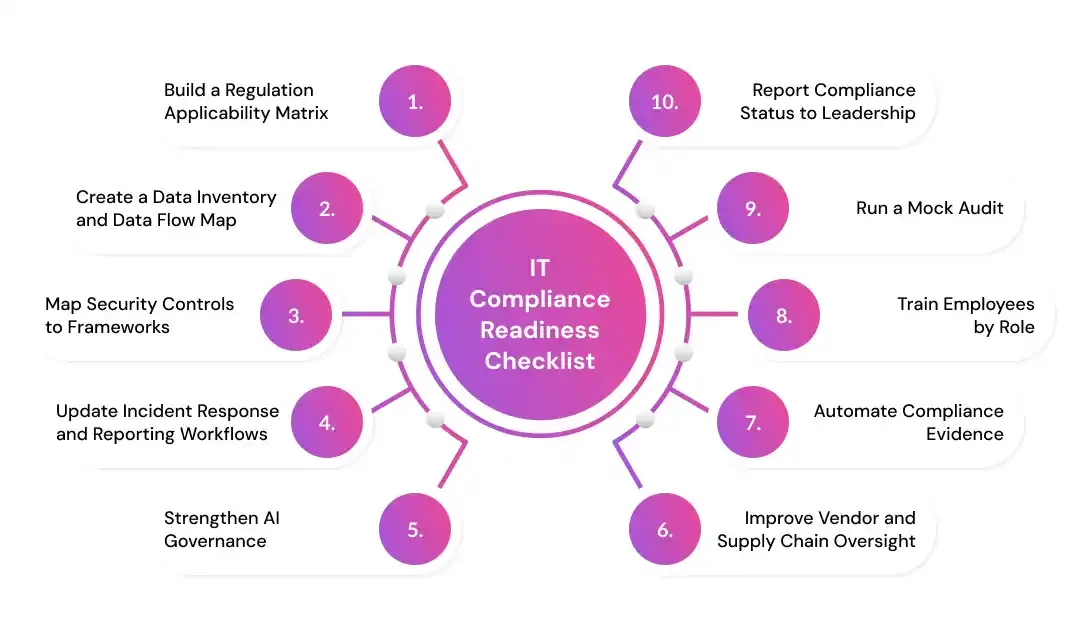
2026 IT Compliance Readiness Checklist
Building a compliance-ready organization in 2026 requires more than policy updates. Businesses need a structured roadmap that connects regulations, systems, data, vendors, controls, employees, and leadership reporting.
The following checklist can help organizations prepare for audits, customer security reviews, cyber incidents, privacy requests, and regulatory changes.
Step 1: Build a Regulation Applicability Matrix
Start by identifying which laws, frameworks, contracts, and reporting duties apply to the business. This prevents teams from over-focusing on one regulation while missing another.
Map the following:
Industry
States where customers or employees reside
Data types handled by the business
Systems and applications in scope
Vendors and subprocessors
Customer, government, or supplier contracts
Incident and breach reporting obligations
This matrix becomes the foundation for control mapping, risk prioritization, and compliance planning.
Step 2: Create a Data Inventory and Data Flow Map
A business cannot protect or govern data it cannot locate. Data mapping helps teams understand where sensitive information is collected, stored, processed, shared, and deleted.
Include:
Personal data
Sensitive data
ePHI
Financial data
Student data
CUI and FCI
Payment card data
AI training, prompt, or input data
Cross-border transfers
This step supports privacy rights, vendor reviews, data minimization, access control, and national security-related data governance.
Step 3: Map Security Controls to Frameworks
Most organizations need to comply with more than one framework. Instead of managing each requirement separately, businesses should map common controls across multiple standards.
Useful frameworks include:
NIST CSF 2.0
CIS Controls
ISO 27001
SOC 2
NIST SP 800-171
PCI DSS
HIPAA Security Rule safeguards
For example, MFA, encryption, logging, vulnerability management, and incident response can support several compliance obligations at once.
Step 4: Update Incident Response and Reporting Workflows
Incident response must be clear before an event occurs. Businesses should define how incidents are detected, escalated, investigated, reported, and documented.
Include workflows for:
Incident intake
Severity classification
Legal review
Executive notification
Law enforcement contact
Customer notification
Regulator reporting
Ransomware payment decisioning
Evidence preservation
This helps teams respond faster and avoid missed reporting deadlines.
Step 5: Strengthen AI Governance
AI governance should be added to the compliance program, especially when AI tools interact with sensitive data or influence high-impact decisions.
Prioritize:
AI acceptable use policy
AI vendor review
High-risk AI approval process
Human oversight
Logging and monitoring
Bias and accuracy testing
Restrictions on sensitive data in public AI tools
The objective is to make AI usage visible, controlled, and audit-ready.
Step 6: Improve Vendor and Supply Chain Oversight
Vendors should be reviewed based on the level of risk they create. A payroll vendor, cloud provider, AI platform, or MSP may require deeper review than a low-risk business tool.
Focus on:
Contract review
Risk scoring
Evidence requests
Subprocessor monitoring
Annual reassessments
Exit planning
Vendor oversight should continue after onboarding, especially for vendors with access to regulated data or critical systems.
Step 7: Automate Compliance Evidence
Manual evidence collection slows down audits and increases the risk of missing documentation. Organizations should automate evidence capture wherever possible.
Track evidence such as:
Access logs
MFA status
Vulnerability scan results
Backup test results
Policy approvals
Training completion
Vendor reviews
Security incidents
Change management records
Automated evidence helps businesses stay audit-ready throughout the year.
Step 8: Train Employees by Role
Compliance training should be role-specific. Executives, developers, HR teams, finance teams, and customer support teams all interact with risk differently.
Training should be customized for:
Executives
IT and security teams
Developers
HR
Finance
Customer support
Sales and marketing
Legal and compliance
Vendor managers
Role-based training makes compliance more practical and reduces risky behavior across departments.
Step 9: Run a Mock Audit
A mock audit helps businesses test whether their controls, documentation, and teams are ready for a real audit, regulator review, or customer security assessment.
Review:
Evidence sampling
Control owner interviews
Vendor evidence
Incident response tabletop results
AI governance documentation
Data deletion testing
Privacy request testing
This step helps identify gaps before they become audit findings.
Step 10: Report Compliance Status to Leadership
Compliance needs executive visibility because it affects business risk, customer trust, contracts, insurance, and operational continuity.
Leadership reports should include:
Top risks
Open gaps
High-risk vendors
Incident response readiness
AI usage
Regulatory deadlines
Budget needs
Remediation roadmap
Clear reporting helps leadership make better decisions and ensures compliance remains a business priority, not just an IT task.
Secure Your Data, Vendors, and Systems
Prismetric helps businesses create safer IT ecosystems with access control, vendor oversight, and compliance-ready workflows.
How to Ensure Compliance-Readiness in Product Development?
Compliance-readiness should begin at the product planning stage, not after launch. Businesses building digital products for healthcare, finance, education, retail, SaaS, or government-linked industries need to identify applicable regulations, data risks, user roles, and reporting obligations before development begins.
A reliable IT services partner can help businesses design secure architecture, implement access controls, define data flows, and embed audit-ready documentation into the development lifecycle. This ensures that compliance is not treated as a separate checklist but as a core part of product strategy.
For companies using AI, working with an experienced AI development company in USA can help ensure that AI models, automation workflows, and customer-facing features are built with proper data governance, human oversight, bias testing, logging, and vendor controls from day one.
The goal is to build products that are not only scalable and user-friendly but also secure, regulation-ready, and prepared for audits, customer security reviews, and future compliance updates.
FAQs About IT Compliance Regulations for US Industries in 2026
What are IT compliance regulations for US industries in 2026?
IT compliance regulations for US industries in 2026 refer to the laws, frameworks, and security standards businesses must follow to protect data, manage cyber risk, govern AI, report incidents, and maintain audit-ready systems.
These requirements vary by industry, business model, data type, customer location, and vendor ecosystem.
Why is IT compliance important for businesses in 2026?
IT compliance is important because it helps businesses protect sensitive data, reduce cyber risk, avoid penalties, and maintain customer trust.
It also supports enterprise sales, vendor approvals, cyber insurance, investor confidence, and long-term business continuity.
Which industries have the strictest IT compliance requirements in the US?
Industries handling regulated, sensitive, or high-impact data usually face the strictest compliance requirements.
Common examples include:
Healthcare and health tech
Financial services and banking
Insurance
Defense contractors
Critical infrastructure
SaaS and cloud companies
Education and EdTech
Retail and payment processing
What are the major IT compliance regulations companies should know in 2026
The most important regulations and frameworks include HIPAA, GLBA, CMMC, CIRCIA, PCI DSS, SEC cybersecurity disclosure rules, state privacy laws, NIST CSF 2.0, SOC 2, ISO 27001, and NIST SP 800-171.
Companies using AI should also prepare for AI governance, automated decision-making rules, bias testing, model monitoring, and vendor AI risk management.
How do state privacy laws affect US businesses in 2026?
State privacy laws affect how businesses collect, use, share, store, and delete personal data. Companies operating across multiple states may need to support consumer access, correction, deletion, opt-out, and sensitive data rights.
A single privacy policy is usually not enough. Businesses also need data mapping, consent workflows, opt-out tools, vendor tracking, and privacy request processes.
Is NIST CSF 2.0 mandatory for US companies?
NIST CSF 2.0 is generally not mandatory for every business, but it is widely used as a cybersecurity governance baseline.
Many organizations use it to structure risk management, board reporting, vendor oversight, incident response, and compliance control mapping.
What is CMMC and who needs it?
CMMC applies to many Department of Defense contractors and subcontractors that handle Federal Contract Information or Controlled Unclassified Information.
It is important because CMMC compliance can affect contract eligibility, supplier relationships, assessment requirements, and cybersecurity documentation.
What is CIRCIA and why does it matter?
CIRCIA focuses on cyber incident and ransomware payment reporting for covered critical infrastructure organizations.
Businesses that may fall under CIRCIA should prepare incident classification workflows, reporting procedures, evidence preservation steps, and executive escalation processes before an incident occurs.
How does AI affect IT compliance in 2026?
AI affects IT compliance because AI tools may process sensitive data, influence business decisions, generate customer-facing outputs, or automate actions across systems.
Companies need AI inventories, approved use cases, bias testing, human oversight, prompt and output logging, vendor reviews, and incident response plans for AI failures.
What are high-risk AI use cases for regulated industries?
High-risk AI use cases are those that can affect people’s rights, opportunities, finances, healthcare, education, employment, or access to services.
Examples include:
Credit scoring and underwriting
Hiring and promotion screening
Clinical decision support
Student monitoring and grading
Insurance claims and pricing
Public benefits eligibility
Fraud detection and risk scoring
What is the role of vendors in IT compliance?
Vendors play a major role because they often store data, access systems, process transactions, support cloud environments, or provide AI-enabled services.
Businesses must review vendor contracts, subprocessors, breach notification terms, data deletion rights, security reports, and AI training restrictions.
How can a company become compliance-ready in 2026?
A company can become compliance-ready by first identifying applicable regulations, mapping sensitive data, reviewing vendors, and documenting security controls.
The next step is to test incident response, train employees, automate evidence collection, and report compliance gaps to leadership.
What is the difference between cybersecurity and IT compliance?
Cybersecurity focuses on protecting systems, networks, applications, and data from threats.
IT compliance focuses on proving that required controls exist, operate effectively, and meet legal, regulatory, contractual, or industry requirements.
Do small businesses need IT compliance?
Yes, small businesses may still need IT compliance if they handle customer data, payment information, health records, student data, government contract data, or financial information.
Even when a regulation does not directly apply, customers, vendors, insurers, and enterprise partners may still require proof of security controls.
What happens if a business fails to comply with IT regulations?
Non-compliance can lead to regulatory penalties, lawsuits, breach costs, contract loss, insurance issues, customer churn, and reputational damage.
In highly regulated sectors, it may also affect licensing, government contracts, investor confidence, and the ability to sell into enterprise markets.
How often should businesses review their IT compliance program?
Businesses should review their IT compliance program continuously, not just once a year.
At minimum, reviews should happen when new regulations take effect, new vendors are added, AI tools are deployed, systems change, incidents occur, or the company enters new states or industries.
What should be included in a 2026 IT compliance checklist?
A strong checklist should include regulation mapping, data inventory, vendor review, security control mapping, incident response, AI governance, employee training, evidence automation, and leadership reporting.
It should also include privacy request workflows, access reviews, backup testing, vulnerability management, and audit preparation.
How can IT services help with compliance-readiness?
Professional IT services can help businesses assess compliance gaps, secure infrastructure, map controls, manage vendors, automate evidence, and prepare for audits.
They can also support cloud security, incident response, access management, data protection, and ongoing compliance monitoring.
Why should companies work with an AI development company in USA for AI compliance?
Working with an experienced AI development company in USA can help businesses build AI systems with stronger data governance, human oversight, bias testing, security controls, and audit-ready documentation.
This is especially important for companies building AI products for healthcare, finance, HR, education, insurance, retail, or public-sector use cases.
What is the best first step for IT compliance in 2026?
The best first step is to build a regulation applicability matrix. This helps the business understand which laws, frameworks, contracts, and reporting obligations apply.
After that, companies should map sensitive data, identify high-risk systems, review vendors, and prioritize the controls that reduce the most business risk.
As the tech-savvy Project Manager at Prismetric, his admiration for app technology is boundless though!He writes widely researched articles about the AI development, app development methodologies, codes, technical project management skills, app trends, and technical events. Inventive mobile applications and Android app trends that inspire the maximum app users magnetize him deeply to offer his readers some remarkable articles.