Generative AI in Financial Reporting: Use Cases and Benefits
Key Takeaways
- Generative AI reduces reporting time, automates disclosures, and improves accuracy across financial documents.
- It converts complex financial data into clear, plain-language summaries for non-financial stakeholders.
- AI tools identify anomalies, model future risks, and maintain consistency across multi-department reports.
- Successful adoption depends on strong data governance, human oversight, and alignment with AI compliance standards.
- Prismetric delivers tailored AI solutions with audit-ready outputs, custom LLMs, and finance-focused automation.
Financial reporting is under pressure like never before. Organizations face growing demands for faster insights, higher accuracy, and airtight compliance, all while data volumes explode. Traditional reporting systems, bogged down by manual workflows and siloed data, often struggle to keep pace. Enter generative AI, a breakthrough technology now reshaping how finance teams operate.
According to McKinsey, generative AI could add up to $4.4 trillion annually to the global economy, with finance and risk functions standing out among the biggest beneficiaries.
So, what exactly is generative AI? It is a type of artificial intelligence powered by large language models (LLMs), designed to create new content such as text, summaries, reports, and insights based on the data it is trained on. Unlike traditional AI, which typically analyzes structured data and provides outputs in pre-set formats, generative AI can generate natural language explanations, simulate financial scenarios, and flag anomalies across complex datasets.
It is not just about automation; it brings intelligence that reads, writes, and learns at scale.
In this article, we will explore how generative AI is transforming financial reporting. You will discover real-world use cases, including automated disclosure generation, audit readiness, and enhanced compliance accuracy. We will cover benefits like faster reporting cycles and reduced manual errors, and explain integration strategies that support seamless adoption.

How Generative AI Can Improve the Financial Reporting Process
Generative AI is redefining how financial reports are created, reviewed, and delivered. It removes manual bottlenecks, enhances accuracy, and turns complex data into clear, actionable insights. For finance teams under pressure to do more with less, this technology offers a smarter way to manage reporting tasks.
One of the biggest advantages is speed. Generative AI can draft financial disclosures, management commentary, and performance summaries in minutes. This reduces turnaround time and frees up analysts to focus on strategic insights. A recent Gartner survey found that 74% of CFOs plan to increase investments in AI to improve reporting speed and quality.
Generative AI also strengthens accuracy. It automatically pulls data from structured and unstructured sources, checks for inconsistencies, and flags anomalies. This reduces the risk of human error and improves data integrity across reports. In large organizations where reporting often spans multiple departments and systems, AI ensures consistency across every version of a financial document.
The technology also adds value beyond automation. It can identify trends, generate forecasts, and highlight emerging risks based on real-time data. For example, an AI-powered tool can analyze current cash flow patterns and suggest future liquidity concerns, giving CFOs a proactive edge.
By using natural language generation (NLG), generative AI can also translate complex financial metrics into easy-to-understand language. This improves communication with non-financial stakeholders such as board members, investors, and regulators.
Benefits of Using Generative AI in Financial Reporting
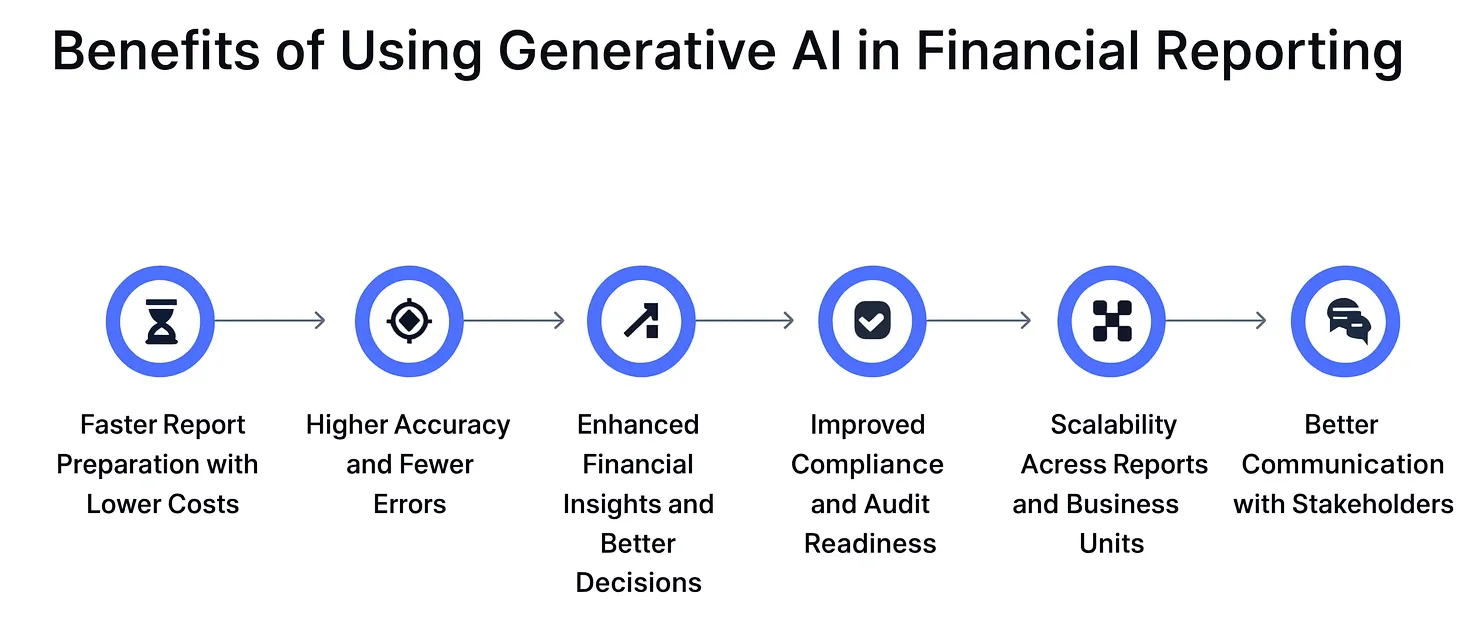
Generative AI is not just a tool for automation, it is a strategic asset that can reshape the way organizations manage financial data, reporting workflows, and decision-making. Here are the most impactful benefits finance teams can expect.
1. Faster Report Preparation with Lower Costs
Generative AI significantly speeds up the reporting process by automating repetitive tasks like drafting disclosures and formatting statements. Reports that once took days can now be generated in hours, reducing the burden on finance teams. This leads to lower operational costs and allows staff to focus on high-value analysis rather than data entry.
2. Higher Accuracy and Fewer Errors
Manual reporting often leads to inconsistencies, missed details, and calculation errors. Generative AI minimizes these risks by pulling data directly from verified sources, validating inputs, and applying standardized formats. This improves accuracy across reports and ensures greater consistency in financial disclosures.
3. Enhanced Financial Insights and Better Decisions
Beyond automation, generative AI unlocks deeper insights from financial data. It can detect patterns, model future scenarios, and highlight anomalies that might go unnoticed in manual reviews. With this added intelligence, finance leaders can make faster, data-driven decisions that support better strategic planning.
4. Improved Compliance and Audit Readiness
AI tools can be trained to follow complex financial regulations, ensuring that every report aligns with standards like GAAP, IFRS, or ESG requirements. Built-in audit trails and version tracking add another layer of security. This makes it easier for companies to stay compliant and respond quickly during audits.
5. Scalability Across Reports and Business Units
As businesses grow, so do their financial reporting demands. Generative AI can scale effortlessly across departments, regions, and subsidiaries without sacrificing quality. Whether generating hundreds or thousands of reports, it maintains consistent structure, tone, and data accuracy throughout.
6. Better Communication with Stakeholders
One of the standout benefits of generative AI is its ability to simplify complex financial language. It creates plain-language summaries that help non-financial stakeholders like board members or investors so that they can grasp key insights quickly. This improves transparency and strengthens stakeholder trust.
Also Read:
Top Generative AI Development Companies
How to Integrate Generative AI into Financial Reporting Processes
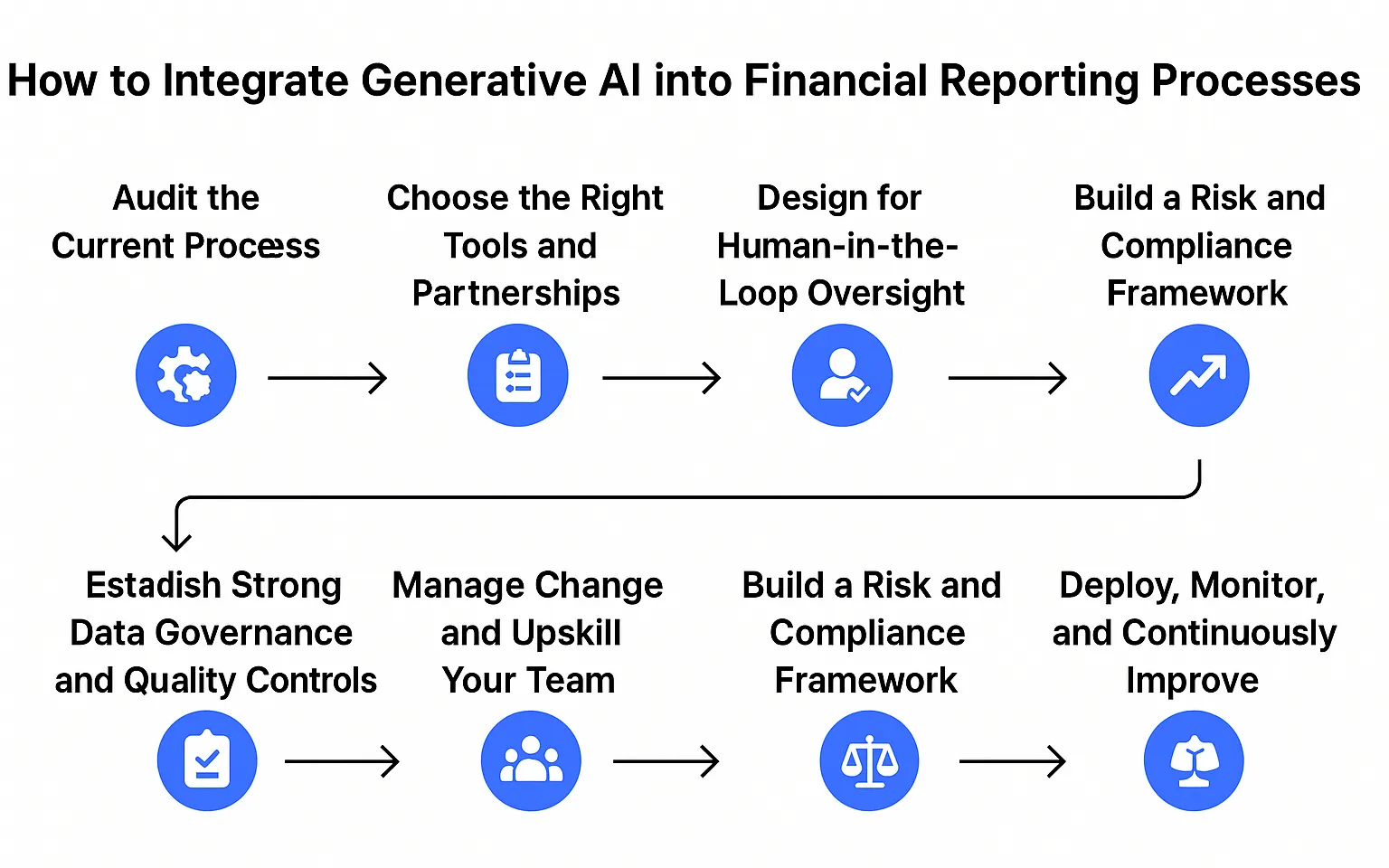
Integrating generative AI into financial reporting is not just about adopting new technology. It requires a clear roadmap, strong data practices, the right tools, and collaboration between finance, IT, and compliance teams. Here’s how to get started.
1. Audit the Current Process
Before introducing AI, map your existing reporting workflows from end to end. Identify bottlenecks, repetitive tasks, and high-risk areas for human error. These pain points will highlight where generative AI can add immediate value, such as automating report generation or cross-checking data entries.
2. Choose the Right Tools and Partnerships
Selecting the right solution is critical. You’ll need to evaluate whether off-the-shelf tools meet your needs or if custom models are required. Look at large language model providers, NLP solutions, and data platforms based on their accuracy, integration capabilities, scalability, and compliance support. Many organizations benefit from combining trusted platforms with custom configurations.
3. Establish Strong Data Governance and Quality Controls
Generative AI performs best when fed clean, reliable data. Build a framework that ensures your data is accurate, consistent, and well-documented. Define rules for data validation, set up version control, and monitor sources regularly. Solid data governance reduces the risk of incorrect or misleading outputs.
4. Design for Human-in-the-Loop Oversight
AI should support human decision-making, not replace it. Build workflows where financial professionals review, verify, and refine AI-generated content. This includes setting review checkpoints, training staff on prompt creation, and establishing final sign-off processes. Human oversight ensures both accuracy and accountability.
5. Manage Change and Upskill Your Team
Technology alone won’t deliver results without people who know how to use it. A successful AI integration requires clear communication, change management planning, and focused training. Start by educating finance teams on how AI fits into their daily workflows. Offer hands-on training sessions to build confidence in using tools and reviewing AI-generated content. Encourage cross-functional collaboration between finance, tech, and compliance to bridge knowledge gaps.
6. Build a Risk and Compliance Framework
Compliance remains a top priority in financial reporting. To meet regulatory expectations, build a framework that monitors AI behavior, maintains audit trails, and ensures transparency in how reports are generated. Address concerns like data privacy, bias, and explainability. Involve legal and compliance teams early in the process to ensure the AI outputs align with standards such as GAAP, IFRS, SOX, or ESG reporting requirements.
7. Deploy, Monitor, and Continuously Improve
Start with small pilot projects to test the system, gather feedback, and refine the process. Use these early wins to gain internal buy-in and scale adoption gradually. Set clear KPIs to measure success, such as reduced turnaround time, error rates, and user satisfaction.
Regularly review AI performance, retrain models with updated data, and gather feedback from end users. Continuous improvement ensures the solution evolves with your business needs.
What You Need to Know: AI, Regulation, and Ethical Risks
As generative AI becomes more common in finance, regulators and standard-setters are paying close attention. Organizations like the SEC, FASB, IFRS Foundation, and the European Union are actively exploring how AI fits into financial reporting standards. While formal guidelines are still evolving, there is a clear push for greater transparency, explainability, and accountability in how AI is used to produce financial disclosures.
One emerging expectation is that companies disclose their use of AI in financial reporting, especially if it influences decision-making or public disclosures. This includes being able to trace how the AI generated outputs, ensure that reports are auditable, and show that human oversight was maintained throughout the process.
Ethical concerns also play a key role. Generative AI can unintentionally introduce bias, rely on flawed data, or generate outputs that appear accurate but are misleading. There are also concerns about privacy, intellectual property rights, and who is ultimately responsible for errors made by AI systems. Companies must put safeguards in place to detect, prevent, and correct these risks before they become liabilities.
For auditors and finance professionals, this new environment demands new skills. There is a growing need to understand how AI tools work, how to assess the quality of AI-generated content, and how to uphold professional standards in an AI-assisted workflow. This includes maintaining judgment, skepticism, and control over every step of the reporting process.
Why Financial Organizations Choose Prismetric for AI Reporting Automation
As financial reporting becomes more complex and fast-paced, finance teams need reliable AI partners. Prismetric delivers tailored generative AI solutions that help automate reporting tasks, reduce manual errors, and ensure compliance.
Their services are built specifically for financial use cases. Prismetric customizes large language models (LLMs) to handle disclosures, summaries, and risk analysis. These models are aligned with accounting standards like GAAP and IFRS, ensuring outputs are accurate and audit-ready.
Prismetric’s strength lies in data integration and preparation. Their team connects structured and unstructured data from various sources, cleans it, and ensures it’s ready for AI processing. This helps produce reports that are both consistent and trustworthy.
Finance teams also benefit from human-in-the-loop workflows. Users can review and adjust AI-generated content before it’s finalized. Prismetric includes features like audit trails and explainability reports to support transparency and regulatory readiness.
In addition to the tech, Prismetric supports ongoing adoption and training. They help organizations align AI tools with business goals, train teams, and fine-tune systems based on real-world use. This enables scalable, long-term success with AI in financial reporting.
With end-to-end support and finance-focused expertise, Prismetric gives financial organizations a safe, effective path to AI-powered automation.

Final Thoughts
Generative AI is no longer a future concept in financial reporting. It is a practical tool that is already transforming how organizations improve speed, accuracy, and compliance. From automating disclosures to identifying risks and simplifying complex data, Generative AI is helping finance teams work smarter in a fast-changing environment.
However, successful adoption depends on thoughtful execution. With the right tools, solid data governance, and a reliable partner like Prismetric, financial organizations can unlock the full potential of AI while staying compliant and in control. Now is the time to explore, experiment, and lead the way in intelligent financial reporting.
Generative AI in financial reporting refers to the use of AI models, such as large language models (LLMs), to automatically create, analyze, and interpret financial content. It can draft disclosures, generate reports, identify anomalies, and improve overall reporting efficiency.
Generative AI reduces manual errors by pulling data from validated sources, applying consistent formats, and automatically checking for inconsistencies. This results in more reliable and audit-ready financial documents.
Yes, generative AI can be configured to follow regulations like GAAP, IFRS, and ESG standards. It also creates audit trails and ensures transparency, which helps organizations stay compliant and ready for audits.
Generative AI is transforming finance teams by handling tasks that were once time-consuming and error-prone. It streamlines reporting, enhances analysis, and supports better communication with both internal and external stakeholders.
Key use cases include:
- Automating financial statement creation such as income statements, balance sheets, and cash flow reports
- Analyzing trends and performance metrics from large datasets in real time
- Forecasting future financial outcomes using predictive models and scenario planning
- Detecting anomalies and inconsistencies in financial data for better risk management
- Generating plain-language summaries to explain financial data to non-financial audiences
While generative AI offers major benefits, it also comes with risks that need careful management. These risks can impact accuracy, compliance, and trust if not addressed with proper controls and oversight.
Potential risks include:
- Bias in outputs due to flawed or incomplete training data
- Privacy and data security concerns when handling sensitive financial information
- Over-reliance on AI-generated content without proper human review
- Lack of transparency in how AI arrives at certain conclusions
- Responsibility for errors when inaccurate reports are submitted or disclosed
Integration starts with mapping current processes, choosing the right tools, establishing data quality controls, and training staff. A human-in-the-loop approach ensures accuracy and accountability during implementation.
Yes, generative AI is highly scalable. It can handle high-volume reporting across multiple business units, geographies, and regulatory environments while maintaining consistency and speed.
Prismetric offers tailored generative AI services for finance, with custom LLMs, data integration, human-in-the-loop systems, and compliance-ready features. Their solutions help reduce manual workload and improve reporting outcomes.